From the data above, it's clear that although my accuracy on units and sales was pretty good, my EPS was too high. The reason for this was the lower margins for the iPad. It's very likely that these margins will improve after the launch quarter (as they did for the iPhone).
"Apple sold 3.47 million Macs during the quarter, representing a new quarterly record and a 33 percent unit increase over the year-ago quarter. The Company sold 8.4 million iPhones in the quarter, representing 61 percent unit growth over the year-ago quarter. Apple sold 9.41 million iPods during the quarter, representing an eight percent unit decline from the year-ago quarter. The Company began selling iPads during the quarter, with total sales of 3.27 million."
The Droid X comes loaded with several nonstandard applications for Google’s Android, most of which cannot be removed. Among the phone’s so-called junkware is a Blockbuster video app and a demo for an Electronic Arts game called Need for Speed: Shift.
The fact that the number of people planning to buy is more than 70 percent of those who have already bought is a good sign for a device that sells for at least $499, said Britt Beemer, America's Research Group founder. "That shows incredible demand for the product."
And this says nothing of demand outside the US, which, in my opinion, is even higher.
The contrast between this "incredible demand" and the "incredible derision" with which the product was met by the technology media speaks volumes of the disconnect between the market's most demanding and most vocal customers and the silent vast majority.
Sony Ericsson shipped 11 million phones at an average selling price of EUR160 in the second quarter, compared with 13.8 million units at an average price of EUR122 a year earlier. Sales rose to EUR1.76 billion from EUR1.68 billion, against expectations of EUR1.79 billion.
The company's estimated share of the global handset market remained flat from the previous quarter at around 4%.
The company reported net profit of EUR12 million for the three months to June 30, compared with a EUR213 million net loss the year before, missing analysts' expectations for a EUR50 million profit but sustaining the turnaround that started in the first quarter.
One of the biggest losers in the Kin debacle that hasn't been talked about is Sharp. OEM for the Kin, and the biggest cellphone brand[s] in Japan....but not in the states of course. Kin was supposed to be their entry point into the US market for mobile. Sharp ponied up half the ad $$ for the Kin launch...basically subsidised it with the thought it would be good for their brand and they would sell a lot of phones and be a trojan horse for other Sharp Mobile efforts in the US. Big fail. Not only did they have to tool up factories custom design hardware and sub the marketing they only sold a few thousand phones at best. Sharp's taking a huge bath on this one. And because Sharp's mobile group is in Nara Japan and had no people on the ground in WA or Palo Alto...they had little leverage or insight into the US market and got taken for a ride. I'm sure there are a lot of unhappy execs in Osaka right now cause of this...
That interpretation of the data is exaggerated and/or incorrect. An analysis of profitability was done with respect to Nokia here and industry-wide here.
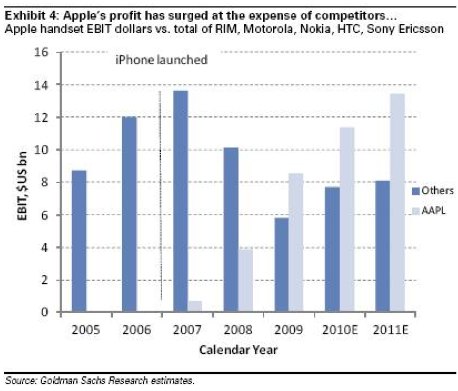
Goldman Sachs analysis (graph below) shows competitors' profits and losses combined. Sony Ericsson and Motorola generated negative profits during 2008 and 2009 and may do so through 2010. Apple's profits are likely to be larger than the industry *net* profits but not twice as much by 2011 (the graph does not even show that; 13.5 is not twice 8). Furthermore, the competitors do not include Samsung and LG!
Exaggeration or not, the fact remains that Apple entered the market in 2007 and in only three years became the most profitable phone vendor. It's indicative of the value of an integrated user experience innovation in the market, which itself is indicative of the value of software in a hardware-oriented incumbency.
Market share is an existential threat to Symbian, it imperils the very existence of the platform. And the main reason Symbian is losing share is the user experience which isn’t competitive with Apple or Android. Based on the early previews I’ve seen Symbian 3 looks to have polished a few of the rough edges, but doesn’t fix the problem. So if the weak UI is threatening Symbian’s very survival the Foundation ought to be seriously worried, right? Wrong. I just looked on the Foundation web site and blogs at the roadmap and features for future releases. What I see is too much effort on stuff that really doesn’t matter. For example: Audio policy packages for Symbian, WIFi direct, support for an “open cloud manifesto”, an accredited Symbian developer program for China, better multitasking, multiple personalised home screens, HDMI connection to external TVs, better web runtime support, better internal architecture and so on.
Forget elegant architecture, forget better multitasking, forget Chinese developers, forget release schedules that don’t deliver S4 devices with a new user experience until 2011. None of these matter. People will never use the features if they don’t buy the phone. The situation is now serious enough that any developer who isn’t working on something directly related to a new UI is wasting their time. The S4 UI is a “bet the platform” project. For any organisation to be in a situation where its survival depends on one project is very dangerous, especially when their track record in the area isn’t outstanding. I think the Foundation needs a contingency plan in case the planned S4 interface isn’t radical enough or good enough. Maybe redirect some developers and start a couple of skunkworks projects to create new competing UIs for S4, or perhaps announce a competition with a $1M prize for a new Symbian UI to encourage some radical ideas.
I think the Symbian foundation is just re-arranging the deck chairs on the Titanic and ignoring the Android iceberg ahead.