I was a guest on Moisés Chiullan's Electric Shadow along with Jason Snell and John Gruber. We talk about how "Cinematic" applies to Apple's approach to communications.
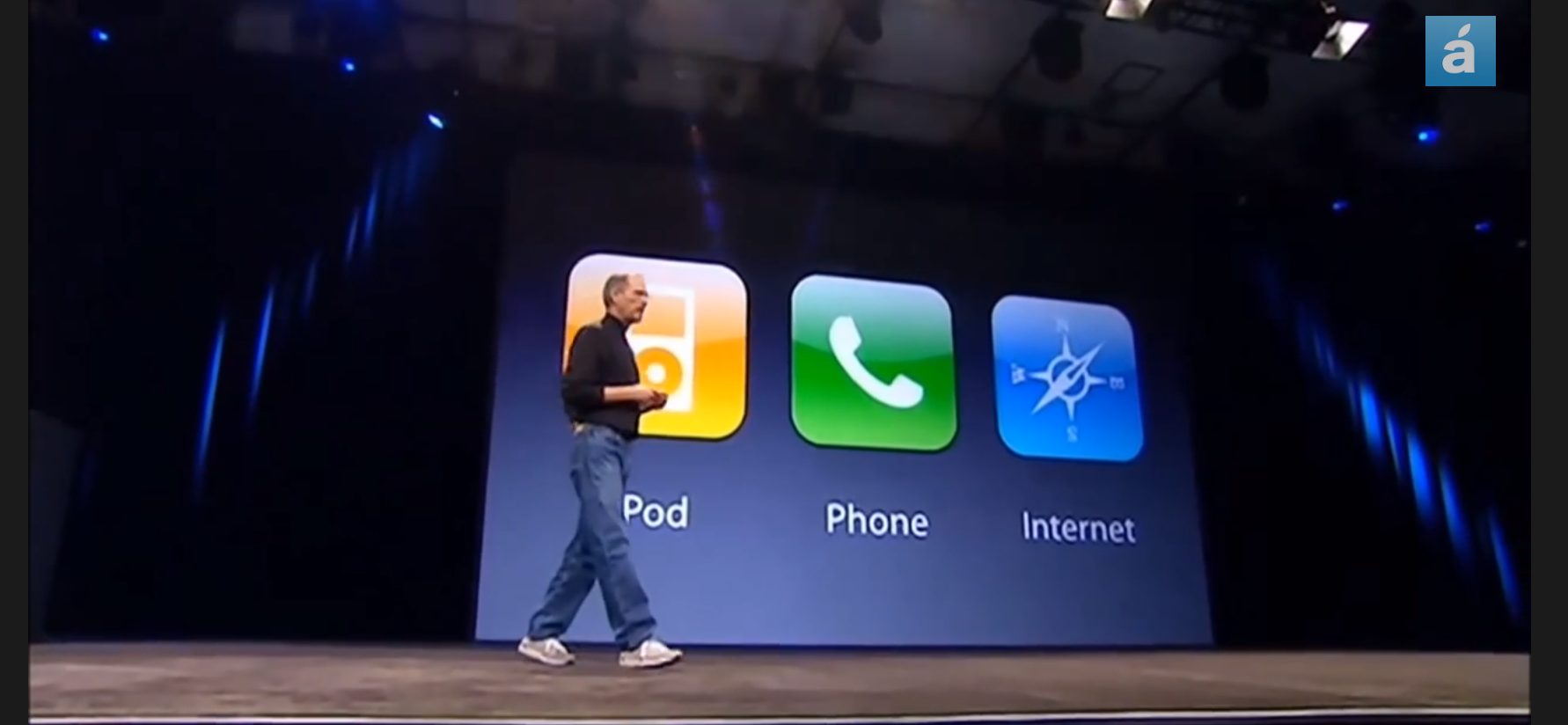
When the iPhone launched, Steve Jobs introduced it as being three products in one:
A wide-screen iPod
A phone
A breakthrough internet communicator
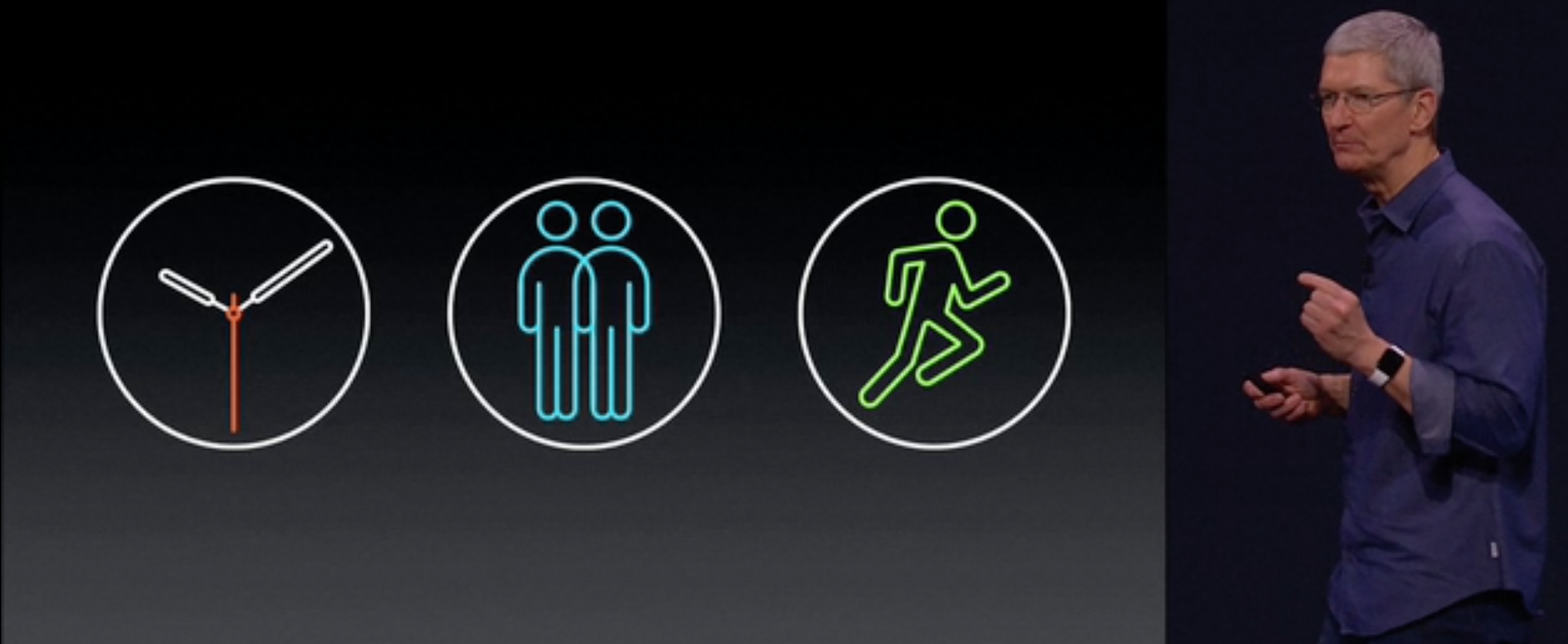
When the Apple Watch launched, Tim Cook introduced it as being three things:
A precise timepiece
A new, intimate way to communicate
A comprehensive health and fitness device.
As in the Revolutionary User Interface story, the symmetry in approach to the launch is telling, but what I want to note is that the three things which the iPhone was defined as being are no longer things that it is most used for.
Yes, the iPhone is still a wide-screen iPod which gets plenty of use but I don't think anyone thinks that is a defining feature. It's also a phone, but the Phone is just an app which, for me at least, is not frequently used. I communicate with my iPhone but the go-to app is iMessage or FaceTime or Skype or maybe Email or Twitter. Phone is something I use so rarely that the interface sometimes baffles me. And yes, it's an Internet appliance. Browsing is something I do quite a bit but many of the browsing jobs-to-be-done are done better by apps. News, shopping Facebook and maps are "things which were once done in a browser."
So I wonder whether the tentpole product-defining anchors used to introduce the Apple Watch will be faintly amusing a few years from now.
Of course, the reason iPhone outgrew its tentpoles is because of the app economy. 1.3 million apps does that to a product. When it becomes a platform a product invites collaboration on the problem of innovation. Collaborative innovation explodes the opportunity to discover new needs and uses. How, when and why people use the product changes beyond anyone's imagination.
But this does not mean that the tentpoles used at launch are in any way in error. They are necessary to explain the value of a new category. The audience can't be told "wait and see all the cool stuff you'll be able to do with it". They need to be told why it's useful today. They speak in the language the audience can understand today. Steve Jobs could not talk in the language of apps and services in 2007. The unforeseen became the inevitable.
Tentpoles therefore don't define the product but do provide the starting blocks from which the initial buyers make a cognition leap. And once they're off, the others will know where to go.
My hypothesis is that The Primary Cause for the shift of profits from Incumbents to Entrants has been the disruptive impact of a new input method.
It was a description of what I considered to be the "disruptive technology" which caused incumbents which had a "front-row seat" to the future of their industry to be completely displaced and marginalized by an entrant ((later more than one)) with no discernible right to do what they did.
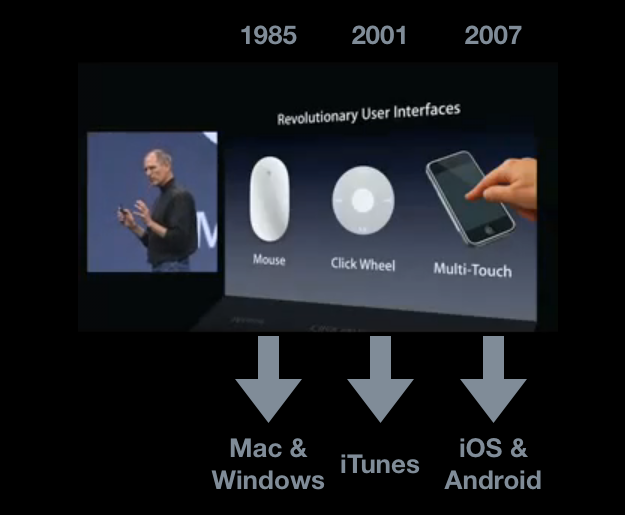
I illustrated what underpinned the sea change in the phone business via the slide that Steve Jobs used in the iPhone launch event:
I added the years when each input method was introduced and the platform/ecosystems created as a result. These new ecosystems were the primary cause for dramatic industry-sized shifts in profits.
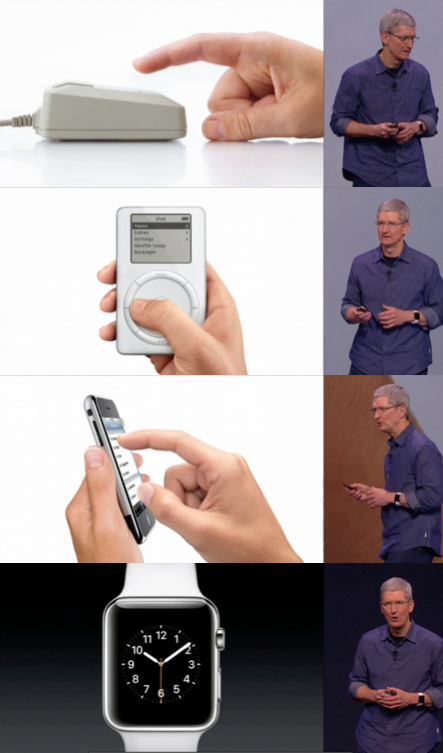
Not coincidentally, during the 2014 Apple Watch launch, the presentation began ((Begins one hour into the 2 hour downloadable video)) with a re-telling of the "mouse, click wheel and Multi-Touch" story.
Seven years later, the difference is that there is a new object added to the story. It answers the question that has been on my mind since that first post on revolutionary user interfaces was written: what will come next.
Now that we have an answer, the next step is to understand the new platform, its ecosystem; which industry will be affected and which incumbents will be displaced and to what degree will value be created beyond that which will be displaced.
Q: Do you expect to see a sapphire cover on the new iPhone(s)? Is that material significant?
I expect Sapphire will become a signature feature across many products. I don’t know if they will have capacity to deploy on iPhone this year but on a watch it’s essential. Here’s a clue: if the screen has any curvature, especially around edges, it needs to be sapphire as glass can’t take strain in that shape. The scope of the plant they are building with GT implies that they will have massive volume potential with at least one major iPhone model using the material. It’s a significant material because it allows design freedom in new directions, especially curved (concave) touch surfaces that retain a jewel-like feel. This has Jony Ive all over it.
Q: Is it fair to conclude now based on the 5C and 5S that Apple will never launch a “cheap iPhone”?
Oscar Wilde said a cynic is someone who knows the price of everything and the value of nothing. When I see the word “cheap” I never know if it refers to price or value. And even when we talk about price, an iPhone is cheaper than buying all the things it replaces so it’s always been a low end disruptor in my mind. (I saw a tweet with an image of a Radio Shack ad from the 1980s and every single item available on that page is now a part of the iPhone. It would have cost thousands to buy all those things back then–and dollars were worth a lot more.) Furthermore, I think Apple holds a black belt in pricing. They seem to define their position in the market by anchoring certain prices and “owning” them. Given all that I would say that Apple is not going to move their price points much. They will expand the portfolio and offer some iPhones at $300 but they will be older models. The average selling price (ASP) I expect to remain constant on a year-long average.
Q: In the past, Apple critics were quick to dismiss the new iPad and 5C iPhone as failures upon their introduction. You never judge. You just report the facts and data. That said, is there anything about past new Apple products launches that we should look at as a predictor of how a new iWatch might be received by customers?
When the iPad was imminent the great debate was over whether it would run iOS or OS X. Many imagined a touch-based Mac rather than the “big screen iPod touch”. It was a tough call and one which Microsoft could not and still does not make. Therefore, the interesting question for me with respect to iWatch is: What OS it will run? I will be shocked to the core if it does not run iOS. It is my opinion that making iOS work on it is the entire reason Apple is sweating this segment. They are in it because they are trying to make a platform product with a novel user experience and all the power of an ecosystem run on a wrist. It’s as big a problem as getting a phone-sized device to run a touch UI was in 2007. That is the crucial contribution that Apple is making to this next generation of computing. Now you might ask what users are asking for in this segment. The answer is nothing. Nobody is asking for this. As nobody asked for the iPhone (or the Mac or the iPad). It’s a new computer form factor and how it will be used will be determined by the apps written for it. But it will work and be magical out of the box in version 1. This is in contrast to the single purpose or accessory model of wearables we see to date.
Q: As a student of disruption, where is Apple most vulnerable to being disrupted?
Apple is a new market disruptor but much of what is put forward as a threat to it is low-end disruption. I think Apple knows enough about how that happens that it can manage its way around it. The strategy they employ is one of attrition. If you wait long enough a low-end threat tends to wear itself out as it starves of profit and is constantly gnawed-at by alternatives. (You see, if the disruptor cannot manage a profit then they cannot climb up the trajectory to get on top of the incumbent. Being profitable is a key requirement for successful disruption in the long term.) The attrition strategy works as long as you have the fortitude to hold out and the deep pockets to keep improving your product as alternatives flame out. It is my belief that Jobs made sure that thinking is inculcated in the company. So if not low-end is the company vulnerable to new-market disruptors? This is more subtle and the threat here is what Google/FaceBook/Amazon and the other ecosystems are all about. It’s creating new usage models and shifting where consumers place brand value. I think this is more what keeps Apple’s management awake at night. They are not standing still however. iTunes and Software and Services (now with Beats on board) is the way they are staying on top of that threat.
Part I is a review of the “automotive stack” and note how there is no singular event that seems to affect disruptive change. From changing jobs to be done, modular design and manufacturing processes, powertrain evolution, urbanization, environmental interests, regulation and taxation.
Part II is a review of a framework of analysis based on sources and uses of energy. Inputs, efficiency/losses, network effects and inertia, what can change and what can’t change.
For a shot of theory, Horace reflects on the dichotomy of efficiency vs. efficacy when it comes to predicting change in the sector.
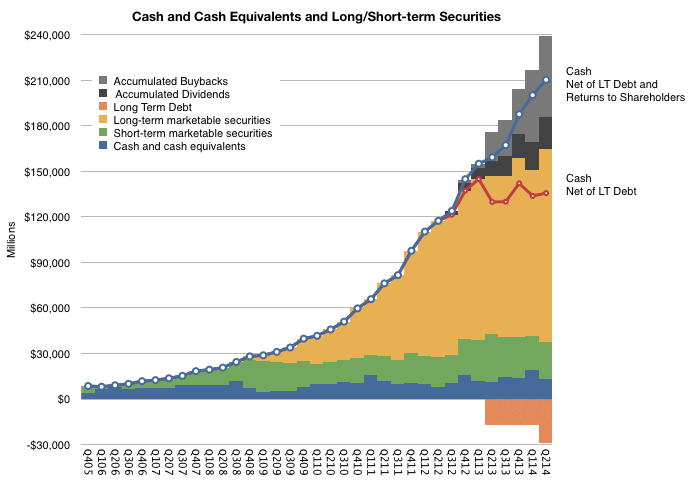
Prior to implementing a dividend and share buyback plan, Apple had accumulated about $120 billion in cash and marketable securities. In the eight quarters since implementing the cash return plan, Apple has paid about $21.5 billion in dividends and spent another $53 billion of its shareholder's money buying its own shares and retiring them. That's $74.5 billion in cash that's been removed from its balance sheet.
To avoid some repatriation taxes it also borrowed about $29 billion.
Of course, in the meantime, it also generated cash from operations.
Before the plan's implementation, eyeing the cash allowed for easy tracking of the accumulation of retained earnings. After the plan it's become a bit more complicated. The following graph shows all the quantities involved:
The graph lets us answer the question "What would have happened if Apple had not paid any dividends, bought back shares and taken on debt?" ((The grey and black area of the last column is the total "cash returned to shareholders" and sums up to the $74.5 billion mentioned earlier. The grey area is only theoretically valuable as it depends on the outstanding (i.e. not retired) shares retaining their value. In this case, the value of the shares grew, making this an actual gain for shareholders))
The answer is in the blue line. It would be about $210 billion today. There are about a dozen companies other than Apple worth more than that amount.
As the company is not growing as quickly as it used to, the slope of the blue line is constant (i.e. it's nearly linear.) Though that might be seen as evidence of failure, it's more useful to treat this vast quantity as a recognition of past successes. The company's beleaguered status needs to be carefully preserved.
Amazon's recent disputes with publishers (Hachette and Disney) shows a degree of market power that is closer to monopsony than to monopoly but this power is nevertheless real. It may not not be something that requires intervention, regulation or even scrutiny but market power is evident in both how companies operate and in how they are valued.
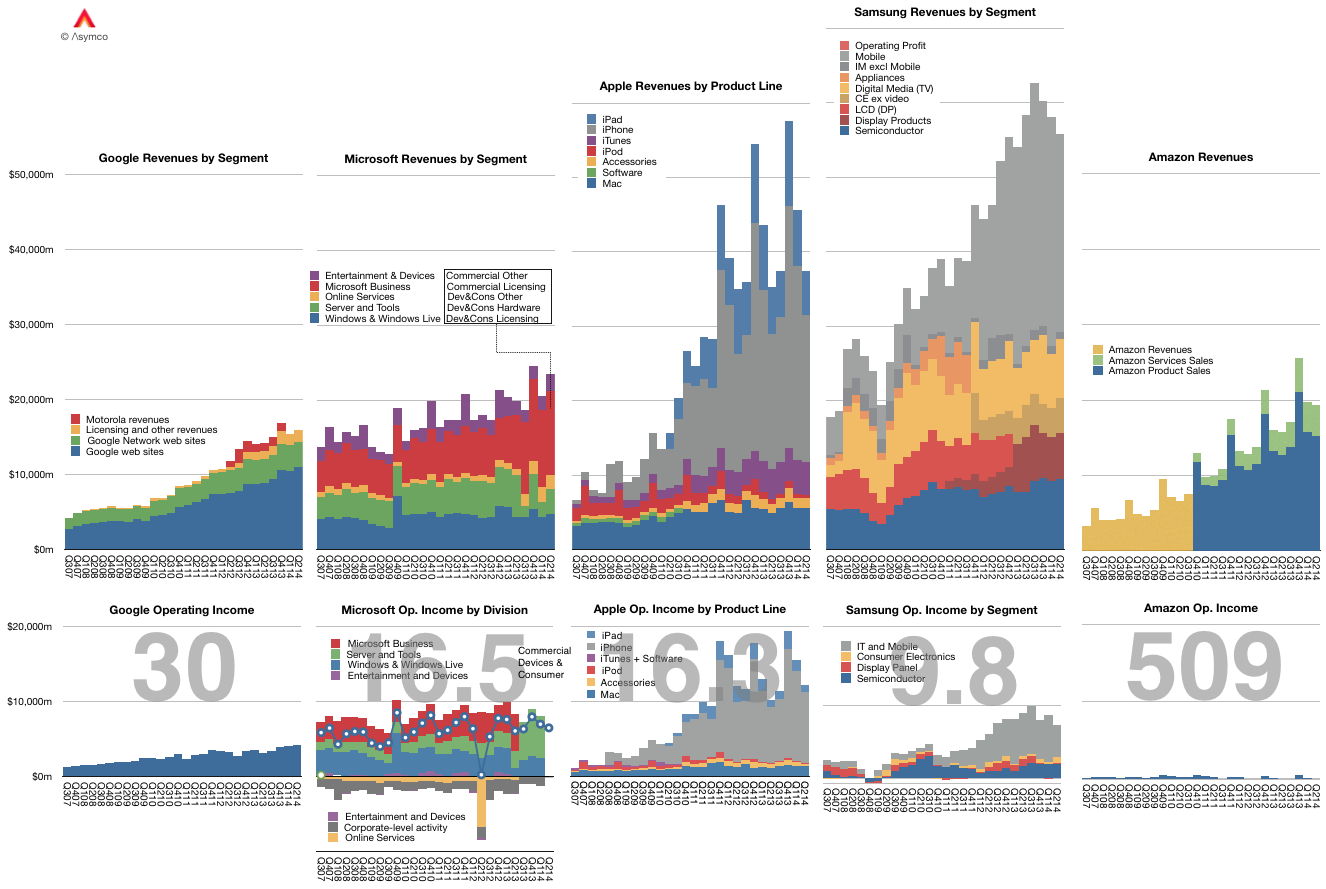
If you look at the following graph, it's easy to spot those with "monopoly" power. The graph shows a short history of revenues/operating income and P/E ratios. Modest or no growth in earnings coupled with extraordinary high P/E ratios indicate that the market understands the business is not threatened by competition.
In contrast, "beleaguered" companies include those with great sales growth but no perceived long term prospects. This perception is evidenced by a low P/E ratio. It indicates how long the company can maintain its present level of profitability. I've highlighted Apple's continuing, and indeed perpetual, beleaguered state. Excluding its existing capital base, Apple rarely gets votes for a life span longer than 10 years. One can see the same status in many Asian companies. Samsung is even more beleaguered than Apple by this measure.
The underlying implication is axiomatic as far as investments are concerned.: Being under threat all the time is undesirable.
But is this true?
One of the issues with monopoly/monopsony is that it leads to business practices and strategic priorities that are tainted by hubris. In contrast, the stress of competition leads to "paranoia" and to a sense of urgency which is blessed by innovative insight.
This is a corollary of Grove's "only the paranoid survive" or Jobs' rant on why Microsoft was unable to come up with breakthroughs. Grove and Jobs looked at dominance of a market (as either buyer or seller) and saw a curse. Their understanding of the human condition went beyond what the arithmetic of markets would suggest. Running a business and managing people who are asked to create things leads to this insight. Peering at spreadsheets doesn't.
The observation to be made is that those who invest in companies haven't caught on.
One of the paradoxes of the "post-industrial" era is the aversion to application of capital to growth opportunities. Generally speaking, capital has become trapped in bank accounts as opposed to equipment which could be used to produce value. This aversion is rooted in many dysfunctions, chief among them being the misunderstanding of the purpose of the firm.
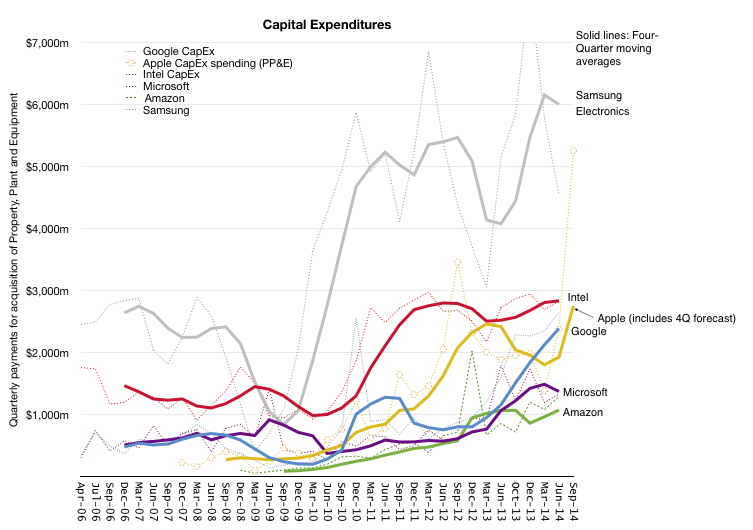
But there are exceptions. Illustrated below are the patterns of spending in property plant and equipment (capital expenditures) by companies that still recognize that there are opportunities to be obtained by investment in the means of production.
The highest spenders in this cohort are Samsung and Intel, both of whom spend mainly on semiconductor production equipment. Apple has been a big spender on production equipment and, to a lesser degree, on data center infrastructure. As the graph shows, Apple's spending has been nearly at the same level of Intel but with recent volatility, suggesting shifts in production processes ((I'm assuming that the 5S/5 required a surge in spending followed by a throttling back for the 5C with the iPad processes wild cards)).
Companies such as Microsoft and Amazon have been increasing their spending but since their assets are mostly data centers ((Amazon also accounts for its distribution warehouses and web site development costs as capex)) they have been considerably below the "manufacturing" investment level.
The interesting story emerging is Google. Its spending must include data centers primarily but the level is now reaching that of Intel and Apple. It actually spent more than Apple for the last four quarters. There might be a lot more need for infrastructure to support its users, but the revenues have not risen as rapidly as this line item
The question of what Google spends on is interesting. There are many projects which require capital including announced fiber networks but nearly $10 billion/yr. in capex is a staggering amount and I'm curious if its explainable as sustaining their current strategy or something emergent.
In October 2013, at the end of its last fiscal quarter, Apple stated:
The Company’s capital expenditures were $7.0 billion during 2013, consisting of $499 million for retail store facilities and $6.5 billion for other capital expenditures, including product tooling and manufacturing process equipment, and other corporate facilities and infrastructure. The Company’s actual cash payments for capital expenditures during 2013 were $8.2 billion.
The Company anticipates utilizing approximately $11.0 billion for capital expenditures during 2014, including approximately $550 million for retail store facilities and approximately $10.5 billion for other capital expenditures, including product tooling and manufacturing process equipment, and corporate facilities and infrastructure, including information systems hardware, software and enhancements.
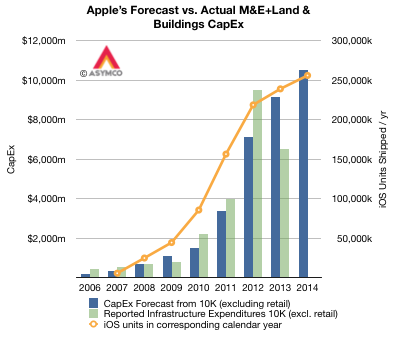
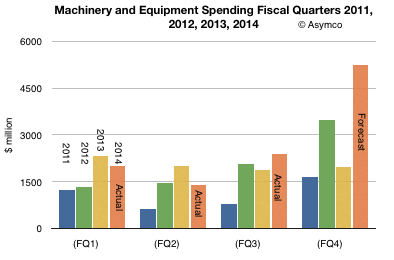
These 10K (fiscal year annual) forecast figures for capital expenditures are shown in the following graph. Note that they also include the fiscal years from 2006 to 2012. Note also that the graph includes the actual expenditures (in green).
From 2006 through 2013 the sum of the forecasts was $23.445 billion while the sum of the expenditures were $24.662 billion. With the exception of a carry-forward in 2012, the forecasts are broadly in-line with expenditures, with about 5% more spent than forecast.
This pattern of accuracy in spending makes a $10.5 billion expenditure during the current fiscal year believable. In other words, taking the forecast at face value, and given that three quarters of the fiscal year have already passed, what does it imply for the current and last quarter? The following graph shows what Q3 spending should be relative to previous quarters (and 2011, 2012 and 2013).
The FQ4 (CQ3) "budget" for PP&E should therefore be $5.255 billion. This would be the most Apple has ever spent on PP&E in a single quarter.
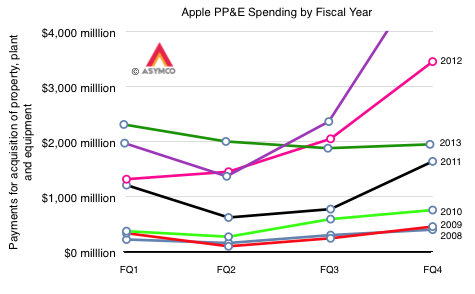
Shown another way, each fiscal year's spending from 2008 to present looks like this:
2014 is shaping up to be a bigger "ramp" in spending than any previous year. We have also noted how iOS device shipments correspond to these CapEx figure.
The relationship is shown in the first graph. I super-imposed iOS unit shipments for the calendar years because capital expenditures tend to result in production in the following quarter and Apple's fiscal year is shifted one quarter earlier than the calendar year. The iOS units shown for 2014 is based on shipments to date and a forecast of shipments for Q3 that is in-line with company guidance ((37.2 million iPhones, 14 million iPads, 1.9 million iPods touch which result in net sales of $40.18 billion and corresponds to the top of the guidance range of $37 to $40 billion)) and a modest forecast for Q4.
The metric of Capital Expenditures (excluding retail) is a good "rule-of-thumb" for predicting iOS growth, but it's not perfect. Obviously we've seen issues between forecasts and actual spending on a quarterly basis, but there is an overall relationship which makes sense: Apple spends on tooling and infrastructure in terms of data centers to support iOS growth. So far, a growth in CapEx has resulted in a growth in iOS.
It's therefore reasonable to assume that calendar 2014 will see at least 250 million iOS devices sold. How much that figure will vary will depend to some degree on the confluence and substance of product announcements this fall. ((My best guess is now 255.8 million.))
ABI Research estimates that AOSP (or forked Android) is the fastest growing mobile operating system with a total share of units shipped of about 20%. This is not surprising considering that most Chinese vendors don't include standard Android into their products. Indeed the current leader in China, Xiaomi has its own take on Android and includes a unique UI and set of services. This is also not a new pattern, Amazon's fork of Android has been in development for many years and powers the second most used tablet in the US.
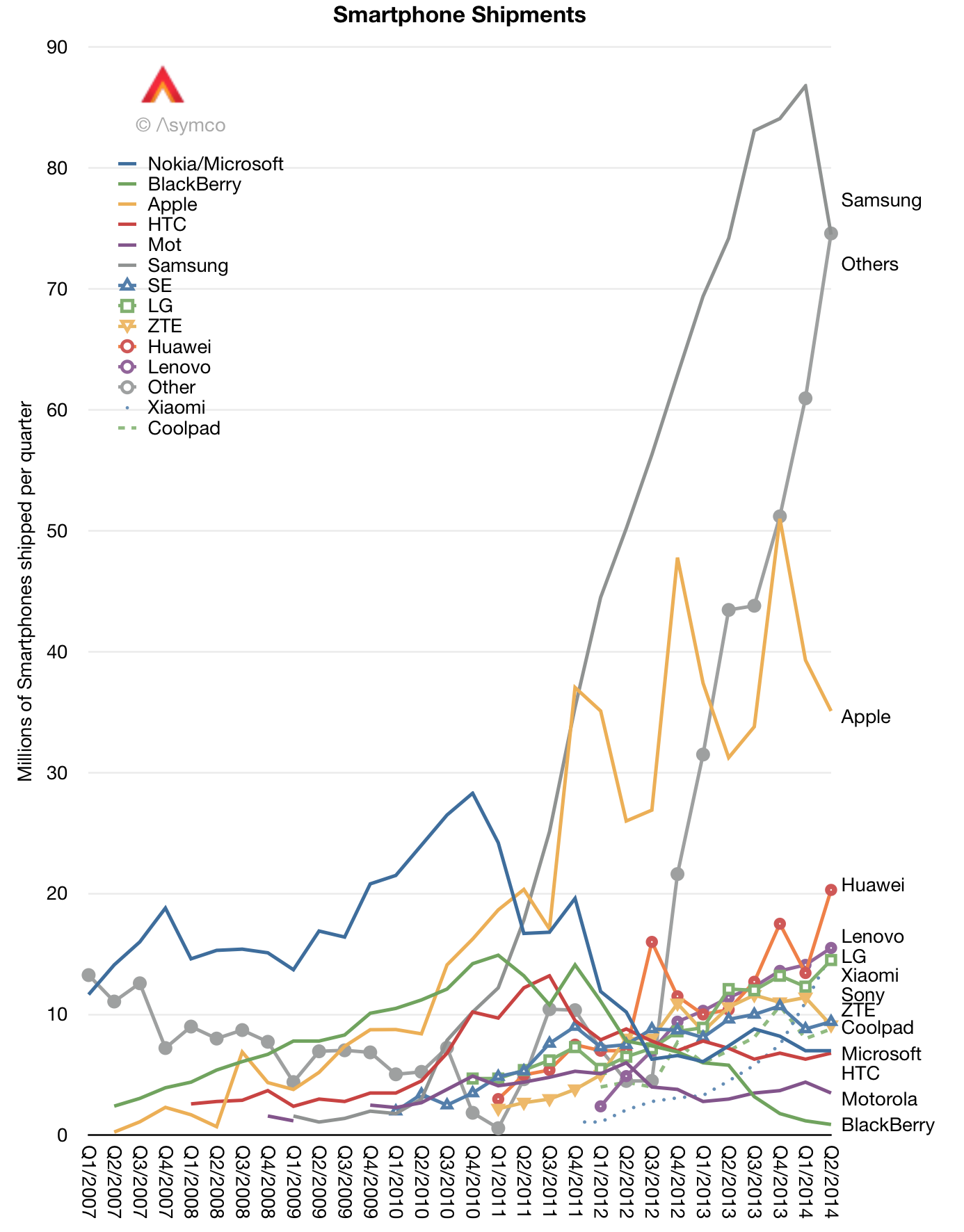
If one looks at the volumes of smartphones shipped by vendor, the most rapidly growing (Huawei, Lenovo, Xiaomi, ZTE, Coolpad and "others") are likely to be using forked versions of Android.
The reasons for this are many: a reluctance to deal with Google's obligations, Microsoft's IP licensing costs ((which even Samsung seems to be eschewing)) , potential litigation, politics (including bans on Google services in certain markets), etc. But the most likely reason is flexibility. Vendors competing on price and localization are looking to move quickly against each other and can't wait for blessings from above. Belonging to some "Alliance" and all that it entails is just too much to ask for companies that are, so to say, delicate.
The result is that the "more open" version of Android is beginning to threaten the "less open" version of Android. China is already lost to OHA but India where penetration is still very low is up for grabs. Into this fray Google launched "One" a more low-end friendly version of sanctioned Android, hoping to retain opportunity.
The value of a singular Android version is not just being Google-friendly but also being better managed and more BOM-friendly. Google is trying to solve the control issue with ease of use, but still retaining control There will be alternatives however which are both easy and "open" ((or Free as in speech)). It seems that there is an opportunity for a hardware-independent vendor to take AOSP and provide a complete solution to local phone brands so they don't need to expend efforts on integration. A non-Google One, so to speak.
Why it's likely is that openness in software makes sense when parts of the stack become commoditized. Google took advantage of the commoditization of operating systems (i.e. Linux) to deliver non-open services on top. However, it's inevitable that some of those very services will also be commoditized and therefore that the portions of the stack which sustain Google will be forked as well.