Asymco

Asymmetric Intelligence

Research

  1. Measuring the iBook market

    Research · 49 comments

    In June of 2011 Apple announced that 130 million ebooks were sold through iTunes. In October of 2012 it announced that 400 million sold.

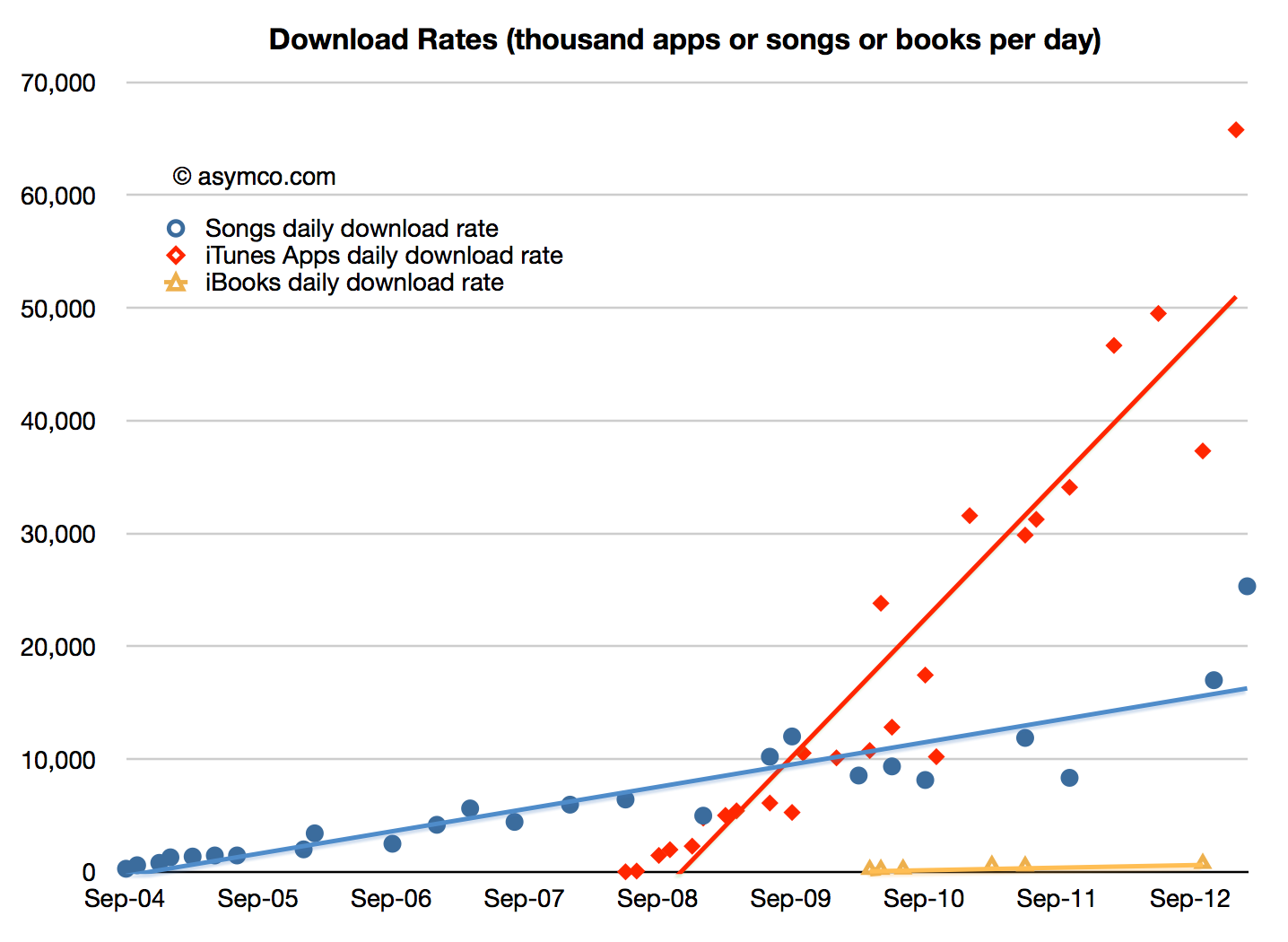
    That means 270 million ebooks were sold in 16 months. Or about 17 million units per month, on average. It also suggests 2012 ebook sales of about 200 million units.[1] The following graph shows the download rate of books relative to apps and songs:

    Screen Shot 2013-02-28 at 2-28-3.09.25 PM

    The download rate looks paltry but we need to remember that Apps have a very low average selling price (about 23 cents including in-app purchases) and that Songs are probably priced around $1.1 on average. In contrast each ebook could be generating about $10 per download.

    However that may be a bit high. We don't know the mix of lower priced and higher priced books. Many best sellers are $13 or $14 but there might be some free books in the mix as well.

    If I choose a more conservative $9 average selling price and assuming a 70% share for the publisher then Apple's iBooks generated about $1.3 billion in payments and grossed about $1.8 billion.

    In the past few posts I measured the iTunes App ecosystem and the Music economy. With the iBook market now measured we can derive the size of the only remaining media type: video.

    Screen Shot 2013-02-28 at 2-28-3.17.57 PM

    ---

    Notes:

    1. I've seen one estimate that world-wide ebook unit sales reached 860 million implying Apple's share was about 24%.
  2. LG's new Tele-vision

    Research · 17 comments

    LG Electronics has acquired HP's WebOS for an undisclosed amount. When last it changed hands WebOS was part of Palm which was purchased for $1.2 billion in 2010.

    Palm has thus been effectively divided into several smaller pieces distributed as follows:

    HP will own:

    • Support of existing Palm users
    • Palm back-end assets including source code, infrastructure and talent
    • webOS patents

    LG will own:

    • Stewardship of the Open WebOS and Enyo open-source projects where the source code resides
    • Associated talent
    • WebOS websites
    • License for IP related to webOS

    LG announced that it plans to offer an "intuitive user experience an Internet services across a range of consumer electronics devices." In an interview, the CTO of LG said that given the current situation with Android, LG does not plan on making smartphones running webOS but will use it in televisions and other devices such as cars, signage and appliances where there are no embedded OS's. "We'd like to secure a software platform across all devices."

    Most commentary regarding the deal focused on the use of the platform for TVs but management seems to consider all devices, perhaps even phones, at some future date, to be webOS targets.

    The TV however seems to be low hanging fruit today. The TV as an app platform will be the new ecosystem war and no platform today has a lock on the developers or users. The way this rivalry will shape up will not mirror other device classes for the same reason that current device classes are platform silos.

    PCs, music players, tablets and phones all have different super-majority platform leaders. The association of a platform with a device class depends first on the distribution model, which favors a specific business model which favors a specific vendor which favors a specific platform. As each device is distributed differently, a different platform takes precedence.

    Consider that the PC has historically been purchased by IT departments which led to a monoculture of Windows which led to a persistent leadership for Microsoft.

    The music player created dominance around iTunes mostly because the distribution model for music labels was baked-in. With network effects, the iPod quickly gained and perpetually retained market share leadership.

    The smartphone business initially favored Symbian and BlackBerry because they had the market access through operators. After the touch UI became dominant (and incumbents failed to respond in a timely manner), Apple and Google took leadership as soon as they accepted the operator distribution model. Android in particular is especially resonant with operators and has been developed with their requirements in mind.

    The tablet business is more like the PC business but without enterprise requirements or patterns of purchase. This has meant that app/content ecosystems and retail distribution were the key gating factors. The story is still unfolding but so far Microsoft has not found a foothold while iOS and Android and Amazon have.

    That leads to the question of how will smart TVs be sold and which business model (or go-to-market strategy) will succeed. Steve Jobs pointed out the difficulty in trying to deliver innovation into a value chain dominated by cable companies which can effectively block it. A TV which is an application execution device rather than a content terminal will require a re-definition of the category. That will require a re-positioining of this product. Few companies are able to do that. [See also my post Tele Vision from mid-2011].

    Which brings us back to the question of webOS. As long as LG sells TVs as content terminals they might not obtain much value from webOS. If, on the other hand, LG were to use webOS to re-define their televisions to be something else entirely, namely software execution devices, sold differently and hired to do a different job than a TV, then webOS becomes not only necessary but potentially a source of great prosperity.

  3. The iTunes Value Structure

    Research · 19 comments

    The International Federation of the Phonographic Industry (IFPI) reported that global digital revenues were $5.6 billion in 2012. This represented about 9% growth from 2011 and accounted for 34% of total industry revenues[1].

    Apple regularly reports iTunes as a separate revenue item and occasionally it also reports payments data for developers and app download rates. By interpolating the data published and combining it with some assumptions it's possible to estimate the mix of revenues (and costs) associated with iTunes.

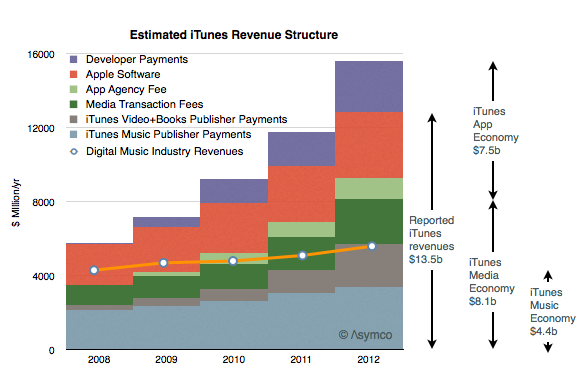
    My yearly estimates are summarized below.

    Screen Shot 2013-02-26 at 2-26-6.04.23 PM

    Note that I also included historic digital music industry revenues (as a line). I also included the following summary items:

    1. iTunes reported revenues were $13.5 billion (including Apple's own software sales)
    2. iTunes gross revenues were about $15.6 billion (including payments to developers)
    3. The iOS and OSX "App Economy" was about $7.5 billion while the iTunes "Media Economy" was about $8.1 billion (both figures include transaction costs.)
    4. The iTunes Music economy was $4.3 billion of which $3.4b was paid to music labels.[2]

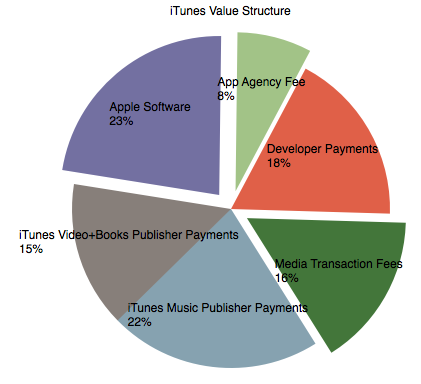
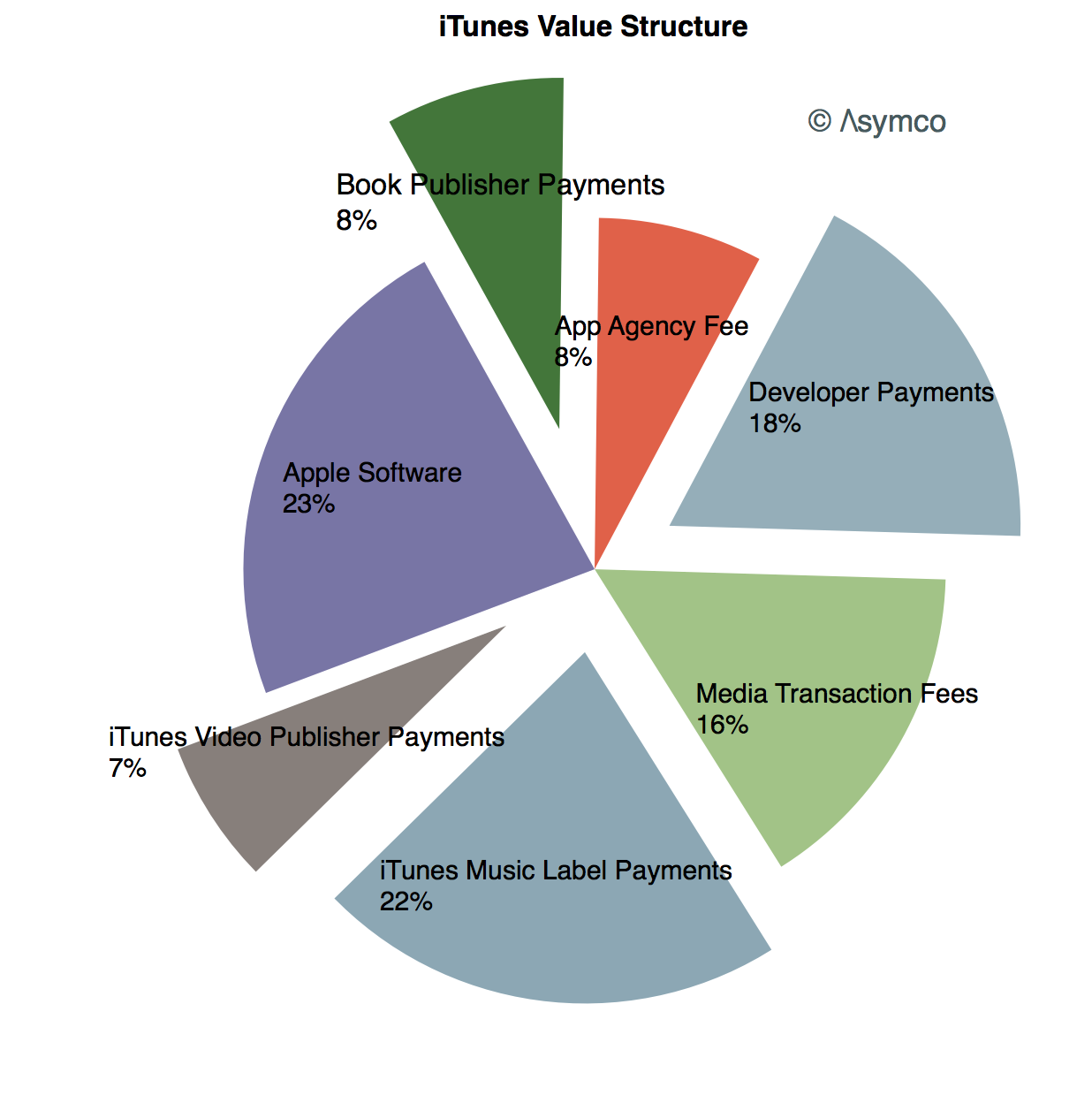
    In terms of percent of total value the components are:

    Screen Shot 2013-02-26 at 2-26-6.09.12 PM

    Looking at growth, these estimates imply that App revenues are growing at about 50% while iTunes Music is at 10% and Video+other at 90%.

    Looking at profitability, there is potential for operating margin in Apple Software and App Agency Fees and perhaps some of the Media Transaction Fees (exploded wedges above). Historically, Apple suggested that their App and Media stores ran at break-even but that may no longer be the case. Operating margins from Software may be significant.

    ---

    Notes:

    1. These revenues were from recorded music and don't include live performance
    2. My estimate for the iTunes Music payments to publishers is equivalent to about 60% of total industry revenues.
  4. Apple's International Retail Strategy

    Research · 56 comments

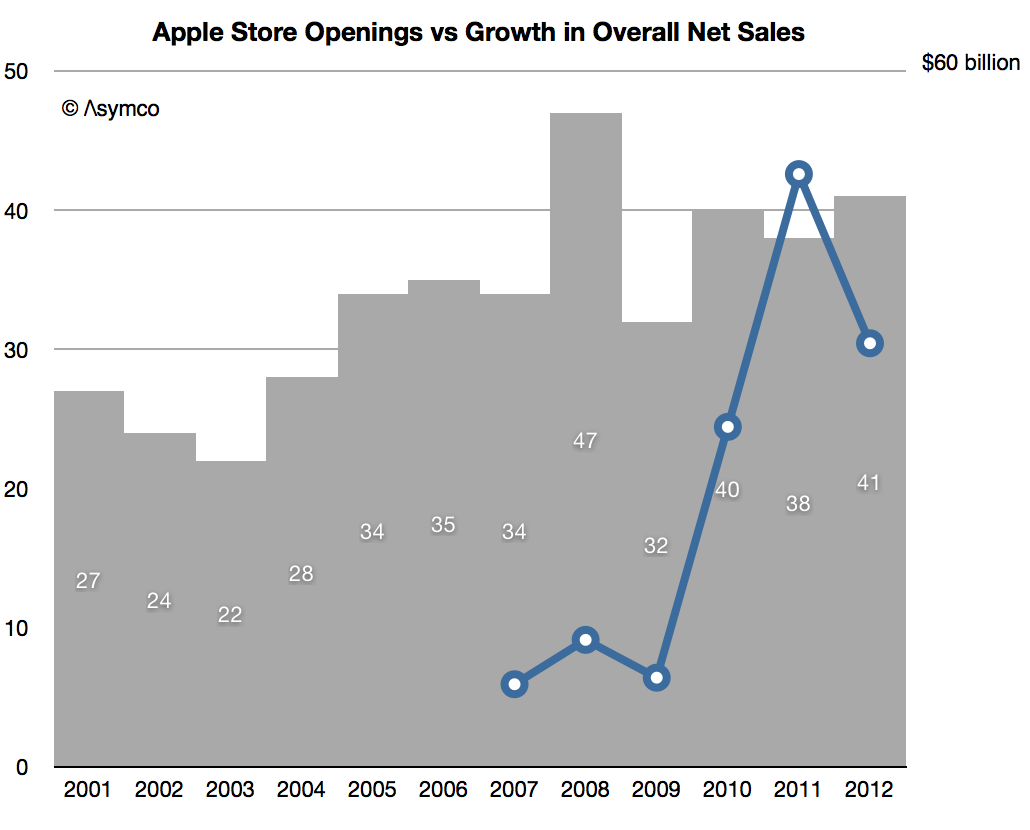
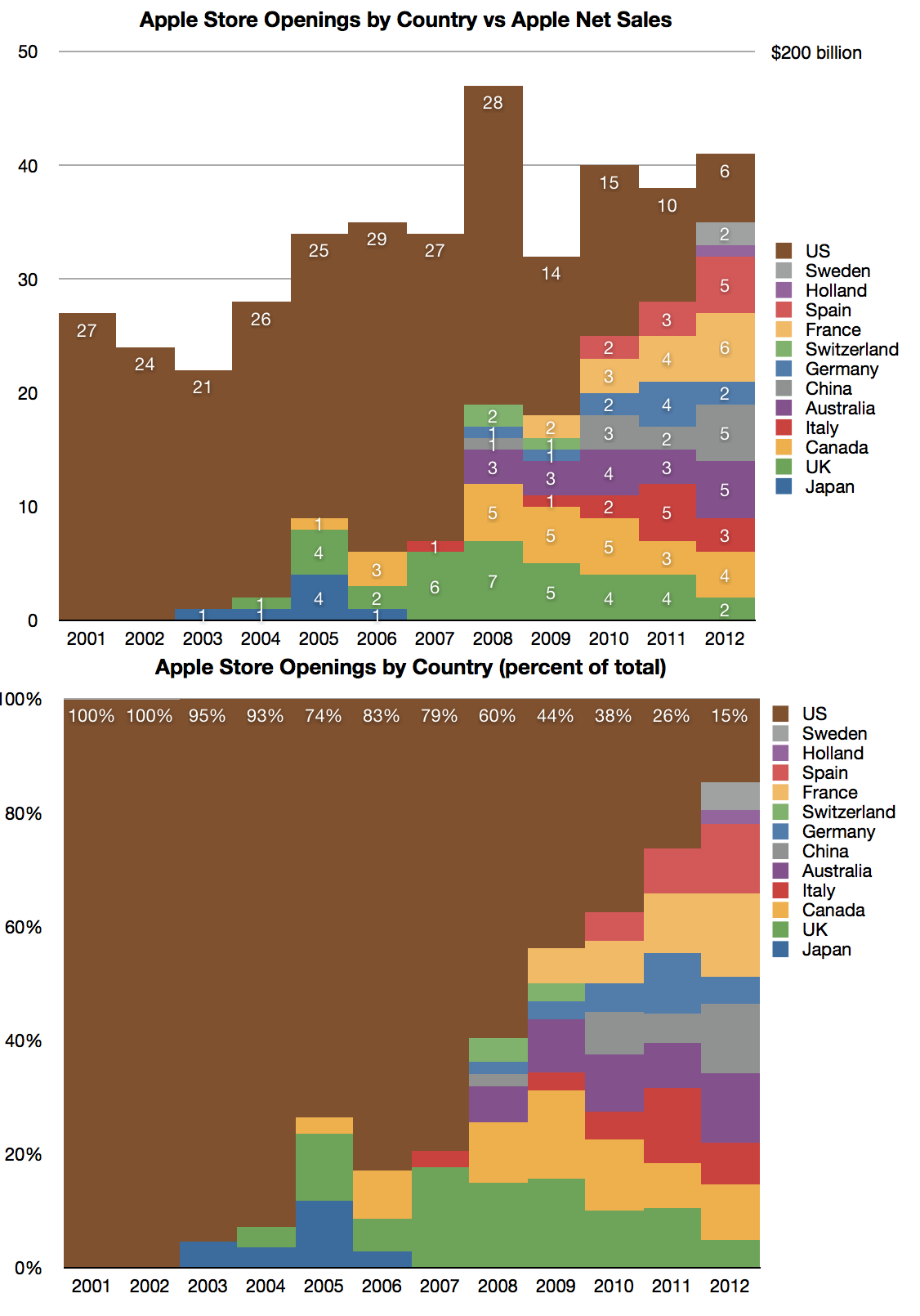
    In 2012 Apple opened 41 stores. The total is the second highest yearly opening rate since the stores first began operating. The highest total was in 2008 when 47 stores opened.

    Although it is a healthy total, the surprising story about retail is that stores are not being opened as quickly as Apple's sales and reach are growing. The following graph shows the yearly opening rate.

    Screen Shot 2013-02-25 at 2-25-6.28.22 PM

    The line in the graph above shows the change net sales since 2006 (right scale).

    The store opening rate has been around 40/yr. during the last five years, up from 30/yr. during first seven but a 33% growth rate it's still a frustratingly slow rate of growth. Consider that during 2007 when Apple opened 34 stores, Apple's net sales were growing at the rate of $7 billion/yr and that in 2012 when it opened 41 stores sales grew about $37 billion or more than 5 times faster.

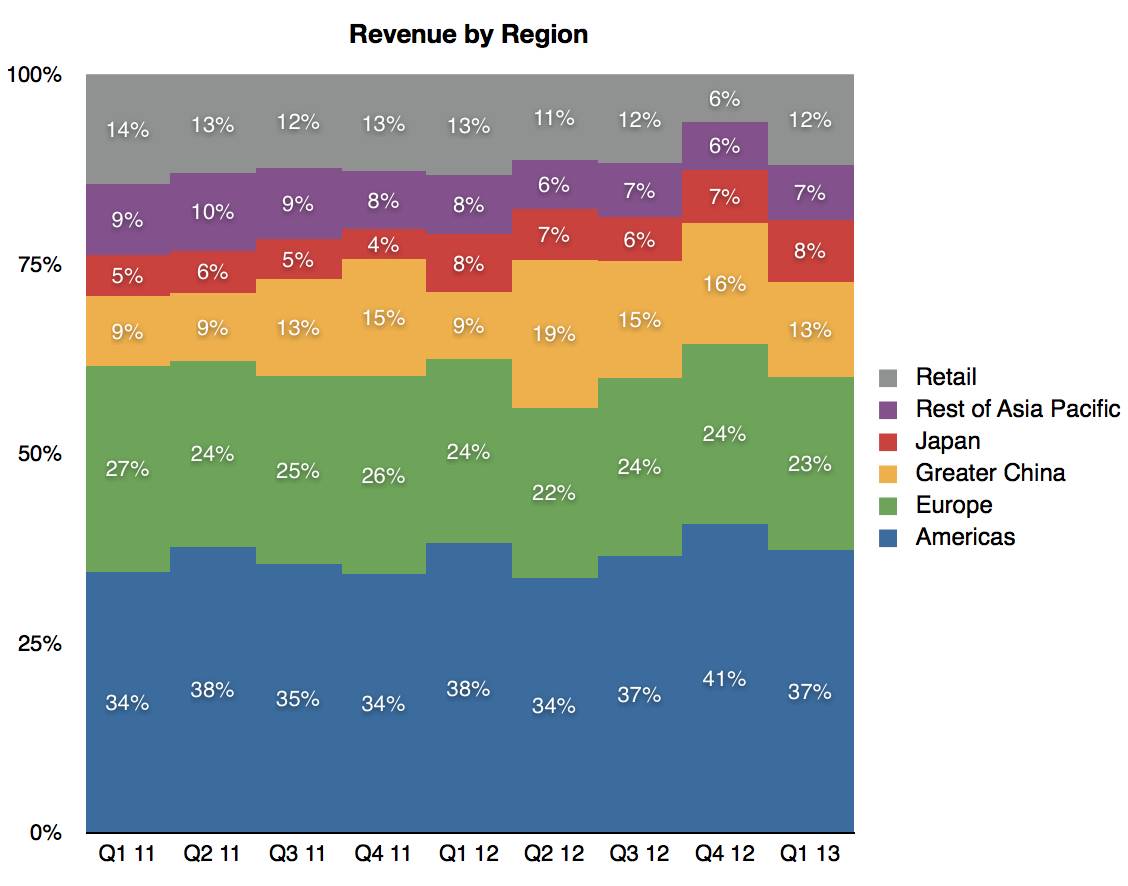
    Although performance for the stores has improved (i.e. the sales per store went up), sales outside of their own retail channel are now a far higher portion of total. 2007 retail revenues were $4.7 billion or 17% while 2012 were $19.1 billion or 12%. You can see the mix by region in the following graph:

    Screen Shot 2013-02-25 at 2-25-4.32.22 PM

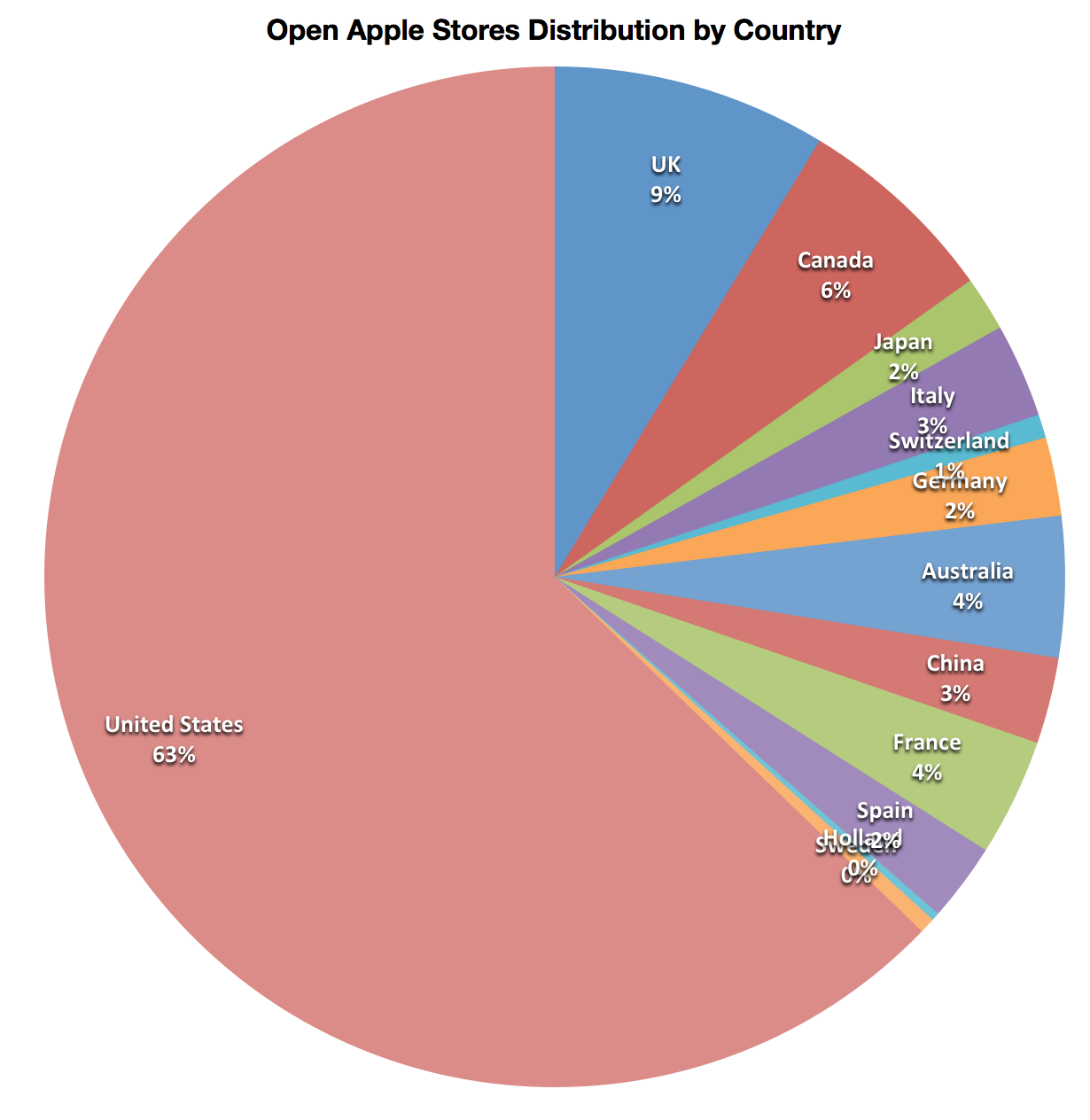
    Note that these are quarterly figures.  Now consider the split of stores currently open in each region:

    Screen Shot 2013-02-13 at 2-13-4.11.22 PM

    We can then conclude that for sales outside of the retail channel, the split of sales and stores is as follows:

    • Americas: 37% of sales 69% of stores (63% in US, 6% in Canada)
    • Europe: 23% of sales 22% of stores
    • Japan: 8% of sales,  2% of stores
    • China: 13% of sales, 3% of stores
    • Rest of Asia: 7% of sales, 4.5% of stores (all in Australia)

    This explains the current mix of store openings, shown below:

    Screen Shot 2013-02-25 at 2-25-4.38.09 PM

    In 2012 only about 15% of store openings were in the US. It would seem reasonable therefore to expect that the priority for most, if not all, future openings should be outside the US to address the current sales/retail presence imbalance and to accommodate the bulk of future growth.

  5. Bits v. Bytes: Follow the money

    Research · 68 comments

    Google announced its first computing product: the Pixel. It's not the first Chromebook but it is the first device which is uniquely branded as a Google product (Motorola notwithstanding.)

    It's a curious choice given that companies which have "crossed-over" from being service or software oriented to hardware have started with more "mobile" devices. Amazon launched the Kindle as a low-end product and gradually moved it up-market. Microsoft launched with the Surface tablet and then followed with the Pro version as a hybrid laptop/tablet.

    It's also curious since Google has spent years contributing to the development of mobile phones and tablets under the Nexus sub-brand. This was an approach consistent with earlier Chromebooks as well.

    But the Pixel is a high-end product. It's priced at the top of the range of what a laptop computer might cost (given the dimensions).  Perhaps it's part of a pattern where Google will hone its hardware skills toward releasing a phone or tablet it can call its own. Starting with a more traditional computer is "easier" than trying to deliver on the more demanding smaller form factors.

    And yet, the more obvious question is why would Google want to be in the hardware business? Isn't being a web-focused company implicitly suggesting that hardware is a commodity to be farmed off to perpetually impoverished and violently abused OEMs?

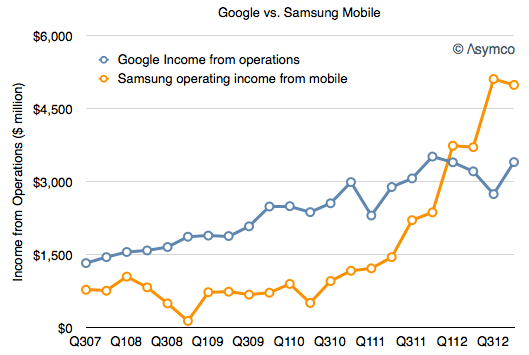
    The truth is quite different from this. Samsung currently makes far more operating profit from Android phones than Google does from all its operations. 

    Screen Shot 2013-02-22 at 2-22-3.47.58 PM

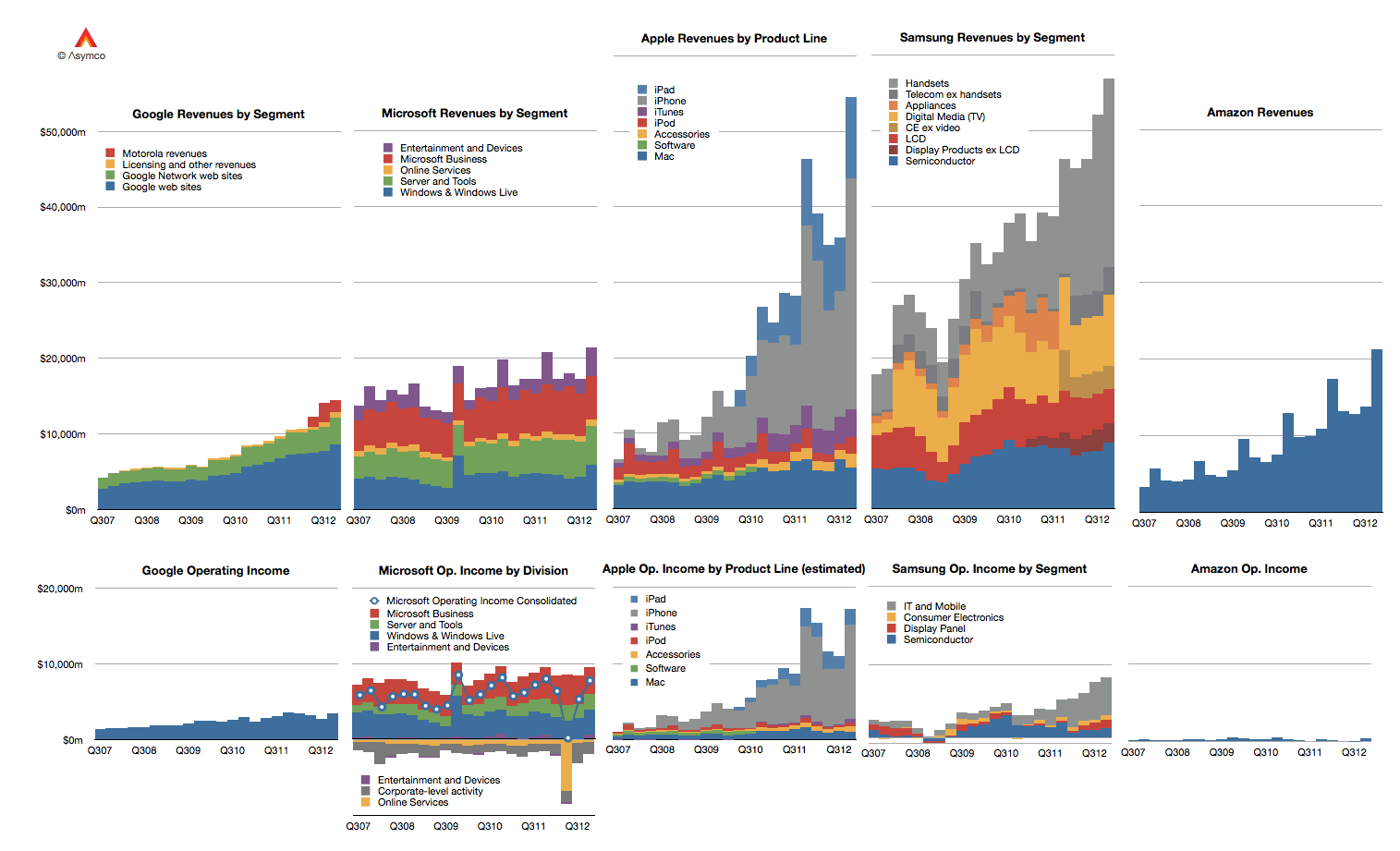
    When looking at the patterns of sales and profit capture for hardware vendors since 2007 the contrast is stark:

    Screen Shot 2013-02-22 at 2-22-3.32.46 PM

    Apple and Samsung tower over the fortunes for software only Microsoft or service-oriented Google and Amazon. Although all companies are growing, the value, as defined by the buyer, resides in the whole product. Putting aside all the theory, the numbers are staggering. Google, Microsoft and Amazon are skimming profits but they are not particularly efficient at profit generation vis-a-vis the integrated Apple (and increasingly integrated Samsung.)

    The question is which of the companies illustrated above will prosper from the value chain evolution under way?

  6. Are the ecosystem wars won on the factory floor?

    Research · 13 comments

    I'll be speaking at the Harvard Business School Technology and Operations Management Digital Seminar Series on "The evolution of value chains in a computing markets measured in the billions of units per year."

    ​Abstract

    2013 will see two billion phones shipped into a market of over 6 billion points of network connectivity for over 4 billion consumers. In addition to phones, there will be a few hundred million more tablets and mobile computers shipped. It's very likely that the majority of these devices will be "smart", meaning designed to be a part of an ecosystem of software, content and services. Contrary to the common assumption that larger markets sustain more competitors, this immense and rapidly growing market has become profitable for only two device vendors. The reason is that the windows for competitive advantage are fairly narrow and although production can be ramped more quickly than ever, the resources needed are available to few.  The frequency and amplitude of market flux benefits only those who can operate at scale and punishes those who can't. Close observation of the investments of these "superpower" competitors shows an extraordinary level of capital purchases of manufacturing equipment, regardless of their nominal position in the value chain. These capital expenses have been growing in proportion to in the frequency of product launches. I present data showing a correlation between manufacturing equipment CapEx and ecosystem success and put forward a hypothesis that this relationship is causal. I also discuss the implications for ecosystems owners with regard to the processes, resources and priorities necessary to succeed in this evolved value chain.​


    The event is open to the public and taking place March 7th, 3:00PM to 4:30PM in the Cotting Conference Room.

  7. Why doesn't anybody copy Apple?

    Research · 237 comments

    Apple's products are the envy of the world. They have been spectacularly successful and are widely imitated, if not copied. The expectation that precedes a new Apple product launch is only matched by the expectation of the replication of those products by competitors.

    This cycle of product mimicry was succinctly summarized by Marc Andreessen regarding a rumored Apple TV product:

    And once the television launches, everyone will scramble to copy it. "There's a pattern in our industry, Apple crystallizes the product, and the minute Apple crystallizes it, then everyone knows how to compete."

    This idea that the basis of competition is set by Apple and then the race is on to climb the trajectory of improvement is so well understood that it's axiomatic: "It's just the way things are." Apple releases a product that defines a category or disrupts an industry and it becomes obvious what needs to be built.

    But what I wonder is why there isn't a desire to copy Apple's product creation process. Why isn't the catalyst for a new category or disruption put forward by another company? More precisely, why isn't there another company which consistently re-defines categories and repeatedly, predictably even, re-defines how technology is used.

    Put another way: Why is it that everyone wants to copy Apple's products but nobody wants to copy being Apple?

    Note that I don't suggest that there isn't a capability to copy. It may or may not be possible, but capability comes after desire and without desire there can be no capability. What I'm suggesting is that there isn't a desire to "be like Apple". If there were a desire, we would be seeing a massive search and debate into what makes Apple successful. Management consultants would be pounding the pavement pitching the "Apple way". Wall Street would be sizing up companies to a standard of "Apple-ness" and rewarding those who conform and punishing those who don't.

    None of this is happening. I can think of two reasons why:

    1. Apple is not to be imitated because it's not worth copying. I.e. Apple is not a successful company.
    2. Apple is successful but Apple cannot be copied because its success is a magical process involving sorcery.

    There is a great deal of evidence for the first hypothesis. The idea of Apple being successful is not something reflected in its stock price. Being valued at a lower P/E ratio than its competitors, and indeed lower than the average company in the S&P 500, indicates that to whatever degree Apple was successful in the past, it's not seen by the vast majority of observers as successful in the future (no matter when you choose to make this observation).

    Why should one bother copying Apple if it results in being punished with a low valuation? You work really hard at innovation and then that innovation becomes commoditized very quickly. Why should one bother?

    And yet if we look outside the investor community, especially if we ask operational managers and entrepreneurs, there are some who would say that Apple is actually a success story. However, when asking innovation practitioners what makes Apple successful the answers regarding the causality of this success border on the mythical. Answers which reference "skills", "culture" and "teams" abound. The culmination of this hypothesis is the "chief-sorcerer" theory of success which places one magician in charge of casting all the right spells. These resource-defined explanations are unsatisfactory because they are vague. Without specificity they don't help us understand why they can't be copied.

    But what about Apple's own opinion of what makes it tick?

    Bill C. Shope: How do we think about Apple's culture of innovation today?

    Timothy D. Cook: Innovation is deeply embedded in Apple's culture. The boldness, the ambition, the belief that there are no limits, the desire among our people to not just make good products [but to] make the very best products in the world. It's in the values. It's in the DNA of the company.

    Now if you look at some essentials for innovation, there is no formula.
    If there was a formula, there would be a lot of companies that have a lot of money that would gone out and bought their ability to innovate.

    Some of the essentials for us are skills and leadership. Apple is in a very unique, and, in my view, unrivaled position because Apple has skills in software, in hardware, and in services.

    […] arguably, where you can innovate in hardware, [where] you can innovate in software, [where] you can innovate in services; the real magic happens at the intersection of these.

    And you know, the iPad is very magical. And it's exactly because our company was doing all of those things. And so for many years this idea ... [which] some people call vertical integration, ... it was out of favor. People thought it was kind of crazy. And we never did.

    And so through all of those years, we continued to build. And these skills, this isn't something you can just go write a check for. This is something that you work decades for. Building this experience. And so I think we bring that. I think we're unique in that. I think we're unrivaled in that. I think there are people trying desperately to catch up in that. And I think they're finding that it's not so easy to do.

    Tim Cook refers to integration and a great team as unique Apple advantages (but also note the references to magic and belief.) It's a better explanation but it is still hard to understand why nobody copies this approach. Integration is something that can take a long time, but it is possible with a Herculean effort. A few companies are starting to make moves in that direction (e.g. Microsoft.) But efforts are half-hearted. There is no "move the Earth" panic to become an integrated company from Samsung, Google or Microsoft.

    Maybe others haven't quite balanced both the cost and the benefit of being Apple. It's clearly still mysterious and unclear why one would want to do this. It's much easier to use what you already have and how you operate to copy what Apple produces rather than how they produce it.

    My own suspicion is that Apple is more aware of what makes it special than they are letting on. In other words, I believe that Apple is self aware but being careful not to share what it knows. However, as Tim points out, it's not a formula. There is no silver bullet, no single trick.

    It's complex, it's subtle, it defies explanation but it's not magic. It's a process that requires a degree of faith and fortitude. It's collecting but ignoring data and trusting judgement when data tells you to move in a different direction. It's a lot of willful rejection of conventional wisdom. It's asymmetric approaches to competition. It's art as much as science. And most of all, it's a lot of mind-numbing polishing while trusting that only by doing great work is survival even possible.
  8. A short interview with Jasna Sykorova

    Research · 22 comments

    A short interview for iCon where I'll be presenting tomorrow. The interview originally took place on January 9th, 2013.

    Jasna Sykorova: You have focused on mobile devices for some time now. What made you to start to give a special attention to Apple related data?

    I began to look at Apple in 2005; long before they were in the phone market. I had an iPod and liked the Mac but I did not have particular reason to think about the company. You might find it strange that it was the launch of two very peculiar products that caused me to change my perception of the company. They were the iPod Shuffle and the Mac mini.

    These are not seen as important today nor were they back then.  But they signaled to me that something dramatic was happening: the company was shedding its "premium" image. This and the earlier move of iTunes to Windows signaled [to me] that Apple was serious about the mass market and the minimum price that a person would need to pay to become an Apple owner.

    This was pivotal to me also from the point of view of disruption theory. If a company takes the fight to the low end it means it protects itself from a low end disruptor and may even enter new markets. So if the thinking is that Apple would disrupt then it would have to get into new categories. I then asked myself what it would target. I told myself (again, in 2005) that Apple will do three things:

    1. build a phone
    2. disrupt the PC market
    3. enter the living room.

    1 and 2 are well understood to have happened and 3 is nearly here with Apple TV.

    Each of these were tremendous opportunities and it's been fun watching it happen over the last 7 years.

    By the way, my expectations were right not because of any insight into the company. I had not studied Apple much at the time. All my expectations came from understanding the psychology of a disruptor. Nor does it mean that what Apple did was deliberately planned. It's possible to predict what people will do even if they don't know what they will do themselves.

    Can data tell stories? Can you judge just by data?

    Data tells amazing stories but not without an interpreter. Having data without a storyteller is like the tree falling in the forest and nobody being there to hear it. If the data's story is not interpreted then does the story actually exist? Did the data "make a noise"? It's a question for philosophers.

    Practically, it's important not to base decision making on data alone. Data only exists about the past. Clay Christensen blames God for making us suffer in this cruel way. The past sometimes reveals patterns that help us predict the future, but it's hard to see some patterns. You may need to look at long time frames and there's never enough data. What is more helpful is to have a theory.

    Science works this way. Data helps build a model and the model helps build a theory and that theory is tested over time and adjusted. Unfortunately, we don't have very good theories about how businesses should be run. I used to say that if Business Management was a science it would be like medicine in the Middle Ages: mostly superstition and faith in the powers of individuals. [We need to move forward from this.] That's what I'm doing with my work: trying to build and test management theories. The data is just the first step on that road.

    What is the difference between Apple in the time of Steve Jobs and Apple now?

    Steve Jobs was a very important influence in the DNA of Apple. I think his influence was so deep that it existed even when he was not there in the 90s and I think it exists to this day. The influence is in the priorities, values and culture of the company. These influences exist in all companies and are very hard to change. They are almost never put in writing or even discussed. They are dogma, constitutions or doctrine by other names.

    Processes and assets may change however. I think decision processes will change at Apple. I suspect there will be more discipline in that regard and more rational ways of doing things. That could be good or that could be bad. But the passion to be great will not change. That's what the brand speaks to each employee. They are there because they want to be part of that greatness.

    You will speak about Apple's strategy for enterprises at the iCon. Do you consider it a “new wave” of activities of Apple? What chance does it have against the strong corporate players like Dell? And what benefit can iPad have for a company, if any?

    If you look at my list from 2005 you don't see Enterprise on there. I think it might have joined the list since then. But it's not obvious yet. The thing is that Apple's approach to Enterprise will not be typical. It will be disruptive. It will be subtle and "easily ignored". This is what I want to discuss. The incumbents are not noticing Apple even as they are losing significant value to Apple in their core markets.

    Analysts (and consultants) find all kinds of reasons to downplay Apple's efforts and comfort the organizations who hire them [which is why the approach is generally unfelt]. Also IT is changing in the jobs it's hired to do. These are all good signs that something is happening. Something that will become very quickly a fait accompli.

  9. Tim Cook's comments on Apple Stores, illustrated

    Research · 44 comments

    Yesterday Tim Cook spoke at the the 2013 Goldman Sachs conference:

    There's no better place to discover, explore and learn about our products than in retail. It's the retail experience where you walk in and you instantly realize this store is not here for the purpose of selling. It's here for the purpose of serving. I’m not even sure “store” is the right word anymore. They’ve taken on a role much broader than that. They are the face of Apple for almost all of our customers

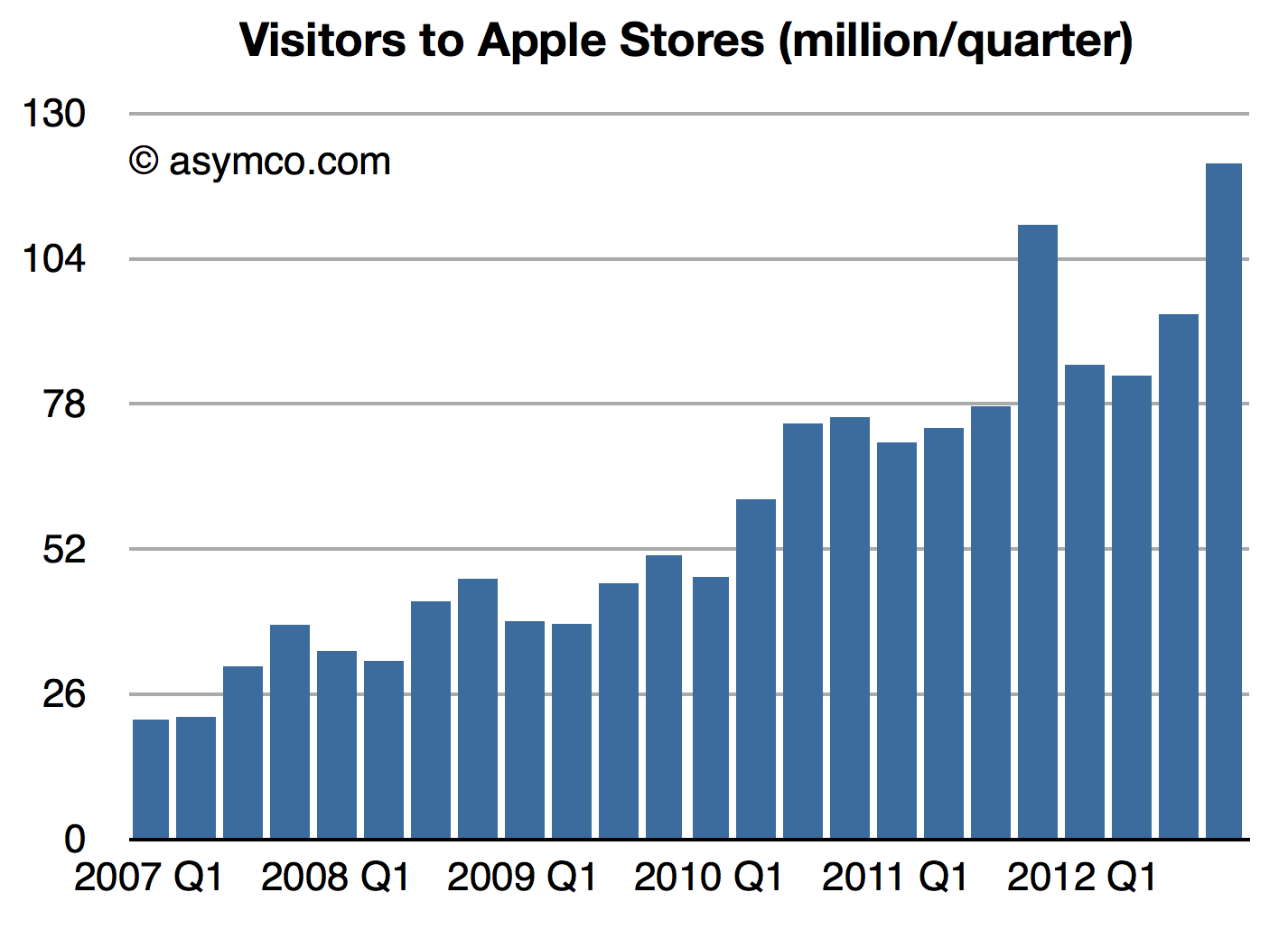
    Last quarter, we welcomed 120 million people in our stores.

    Screen Shot 2013-02-13 at 2-13-1.46.24 PM

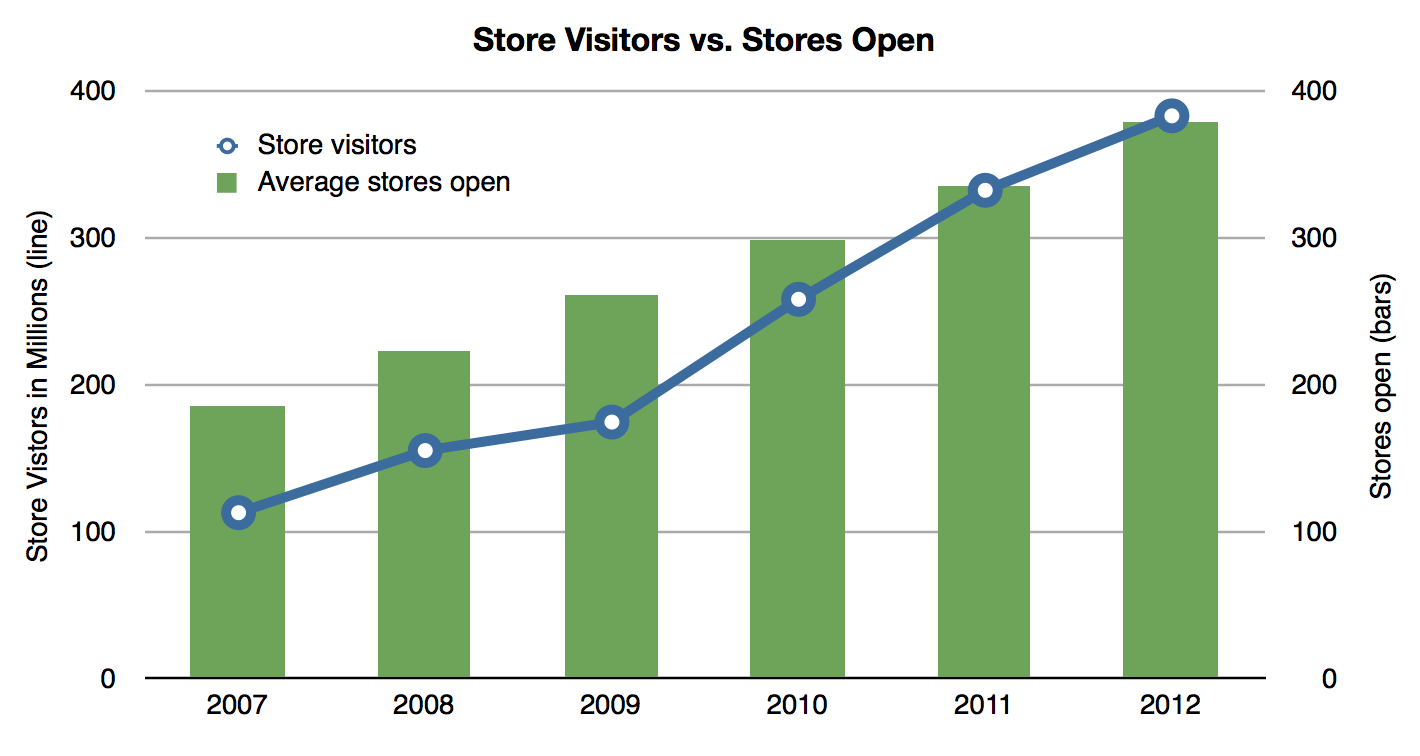
    We only have a little over 400 [stores]. Last year, we welcomed 370 million into the stores.

    Screen Shot 2013-02-13 at 2-13-12.51.57 PM

    We're closing 20 of our stores and moving them and making them larger this year. And in addition to that 20, we're adding 30 more. Those 30 will be disproportionally outside the U.S. That gets us in 13 countries.

    Screen Shot 2013-02-13 at 2-13-4.11.22 PM

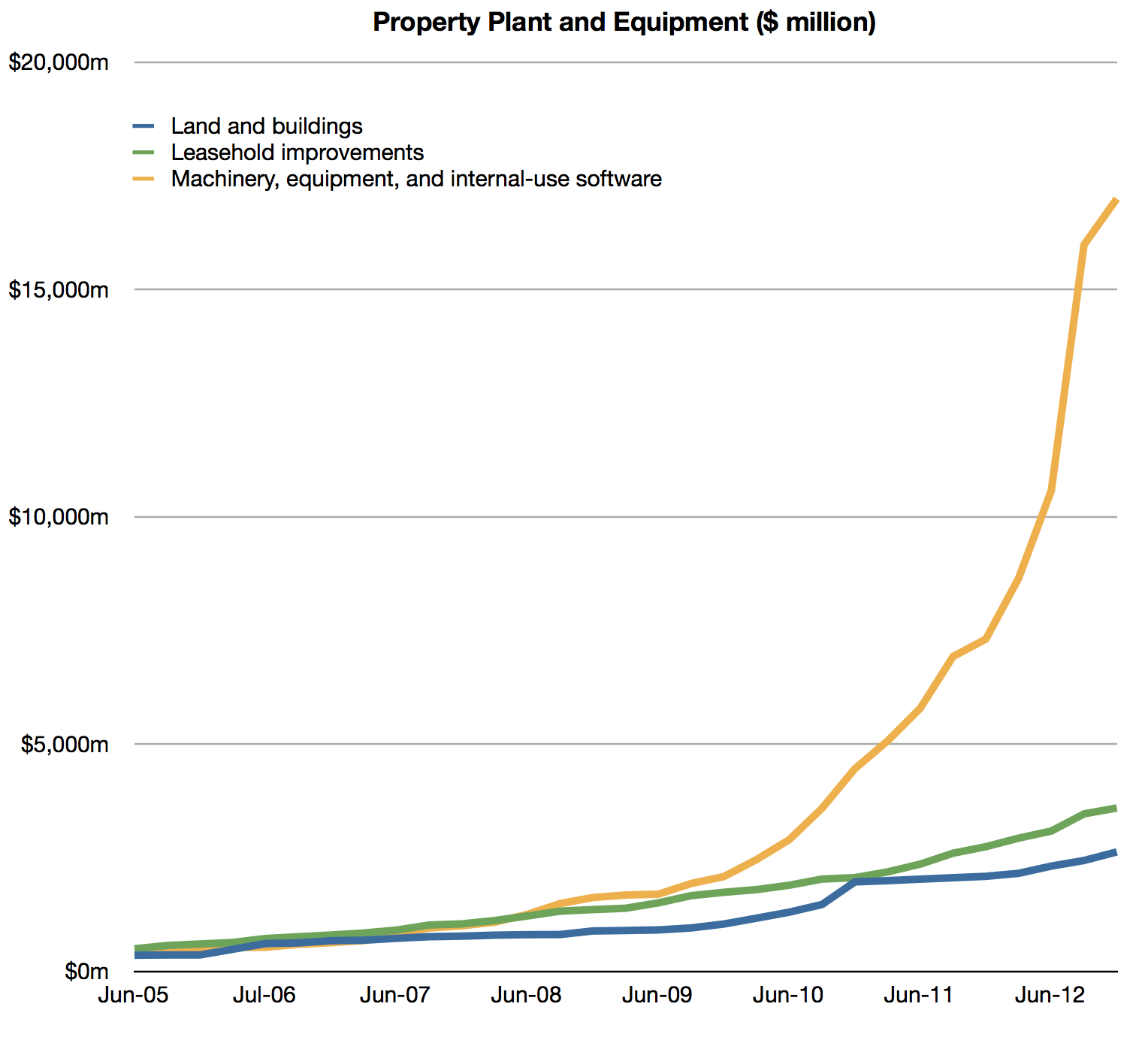
    And so I'm incredibly bullish on the stores. We're going to continue to invest like crazy in them.

    Screen Shot 2013-02-13 at 2-13-1.48.27 PM

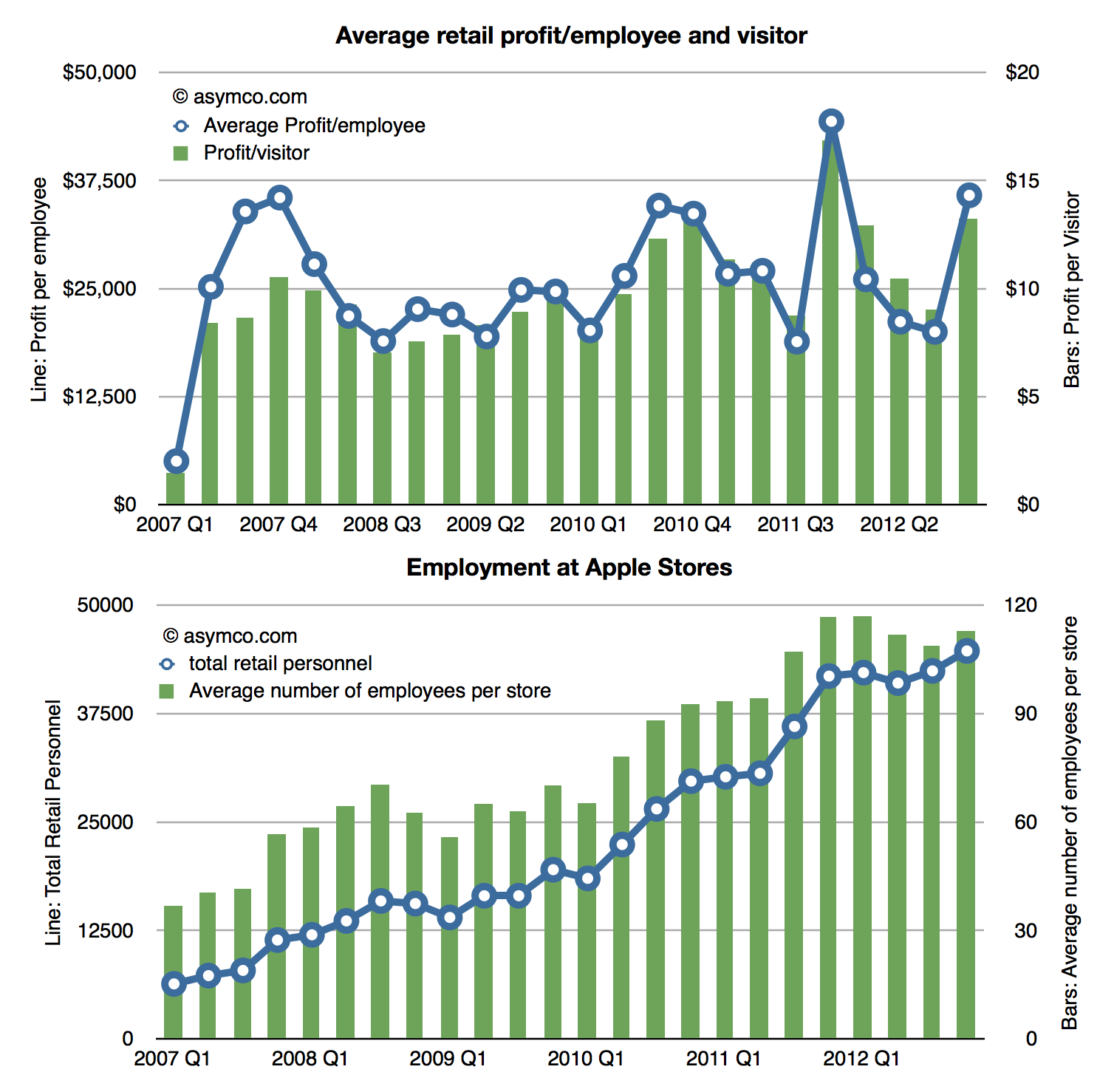
    Our team members are the best in the world. And the financial results are great.

    Screen Shot 2013-02-13 at 2-13-1.32.23 PM

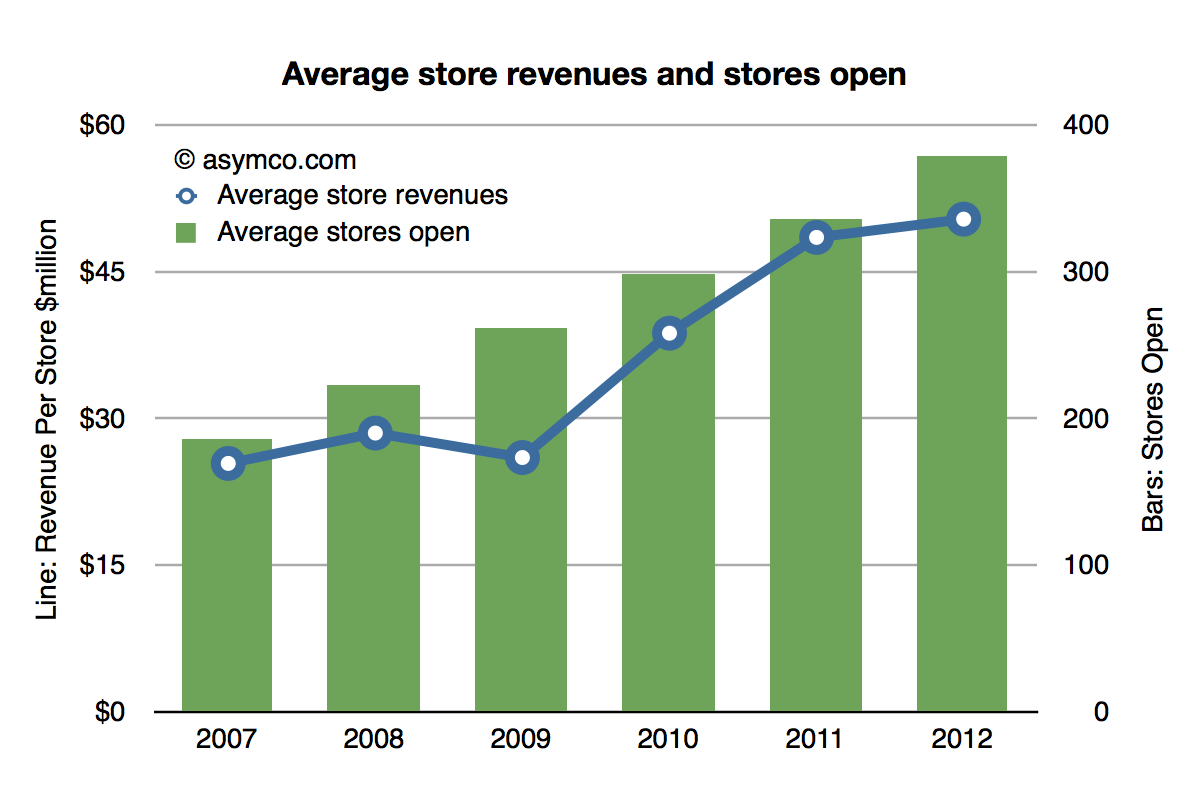
    Average store last year was over $50 million in revenue.

    Screen Shot 2013-02-13 at 2-13-1.39.15 PM

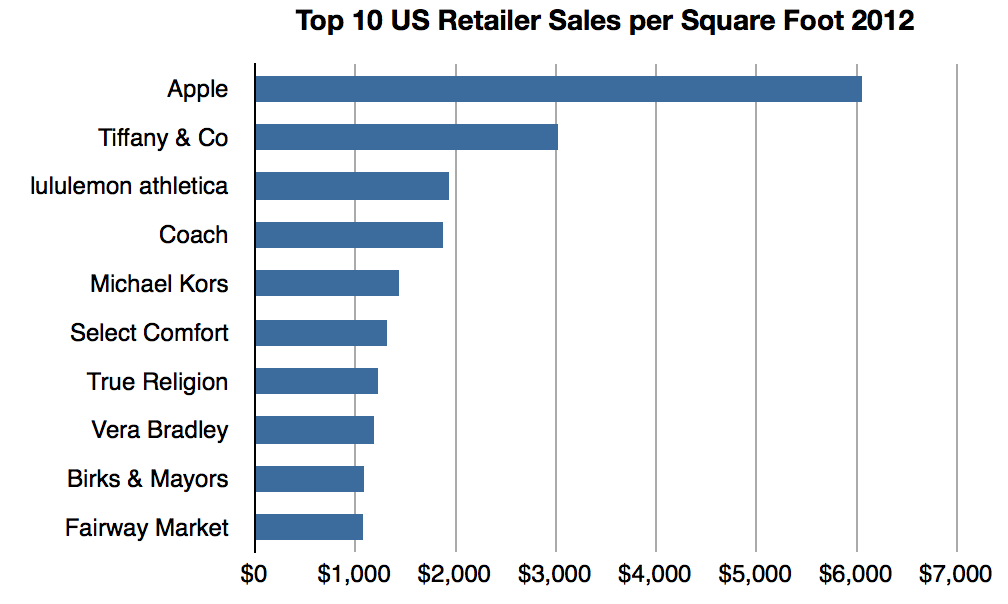
    Who would've thought a store could do that?

    Screen Shot 2013-02-13 at 2-13-4.07.44 PM