Asymco

Asymmetric Intelligence

Research

  1. Apple, RIM and HTC captured 75% of mobile phone operating profits in Q1

    Research · 32 comments

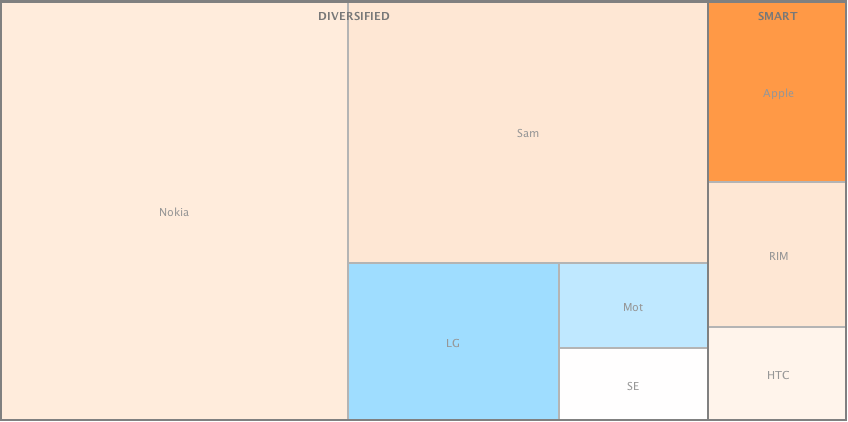
    I produced two alternate views of the primary mobile phone brands in terms of volumes sold and operating profit in Q1.

    These views[1] allow a comparison by categorized competitors. I grouped dedicated smartphone vendors (SMART) vs. diversified and used color coding for profitability (blue colors indicate loss-making vendors).

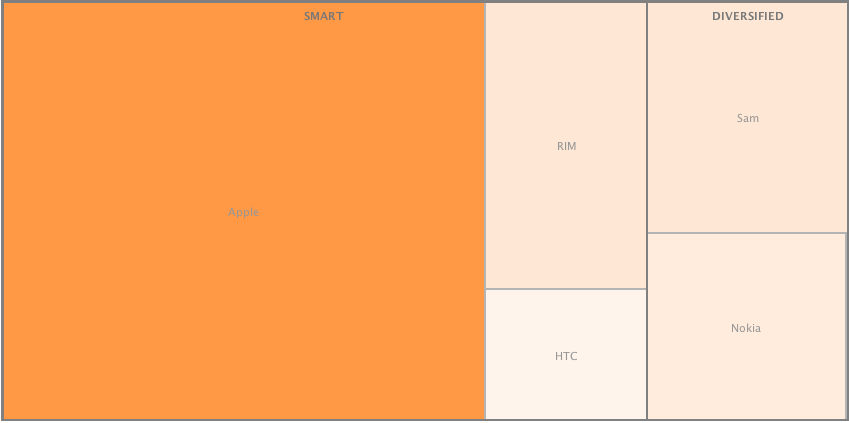
    The same view is drawn for profitability. Loss-making competitors are excluded.

    This view shows how 16% of the volumes for the smartphone vendors generated 75% of total profits. As smartphone penetration grows, those vendors who maintain a diversified portfolio will continue to see their average price and profitability slide.

    I've suggested before that I don't see non-smart devices being interesting to vendors in the near term. Each additional dumb phone added to a portfolio will decrease a company's operating margin. The market dynamics are such that I think non-smart phones will disappear entirely from branded portfolios in 3 to 5 years.

    ---

    Notes:

    1. These are called "tree views". I used Many Eyes experiment from IBM Research to create these charts.
  2. iPhone share of phone market in Q1: 5% volumes, 20% revenues, 55% profit

    Research · 40 comments

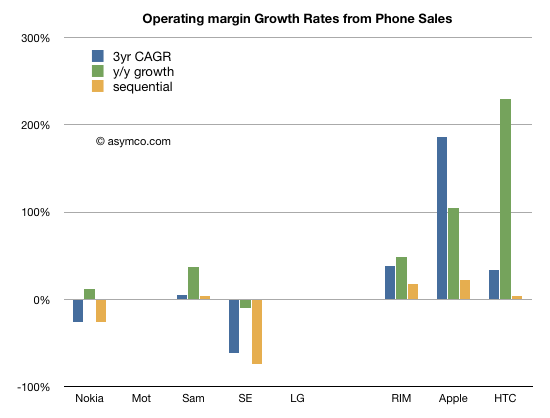
    Operating profits for the eight vendors I track increased at a compounded 25% over three years. As with revenues, the growth is concentrated. The following chart shows operating profit growth across three time frames: three year compounded, year/year and sequential. Loss-making vendors are excluded from this chart.

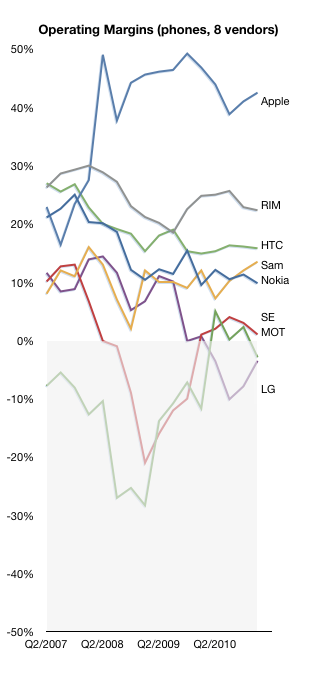
    Looking at individual performance, the following chart shows how each vendor performed over time:

    The mobile industry has historically been unforgiving. Companies that fall into unprofitability tend to stay there or exit/merge. This has claimed many: Ericsson, Siemens, Alcatel, BenQ, Palm, Sony, Toshiba, Handspring, NEC, Hitachi, Casio.

    LG, MMI and Sony Ericsson are all in the same precarious situation. We'll have to watch carefully whether a recovery is possible for any of them and whether Nokia will reach the same rocky position.

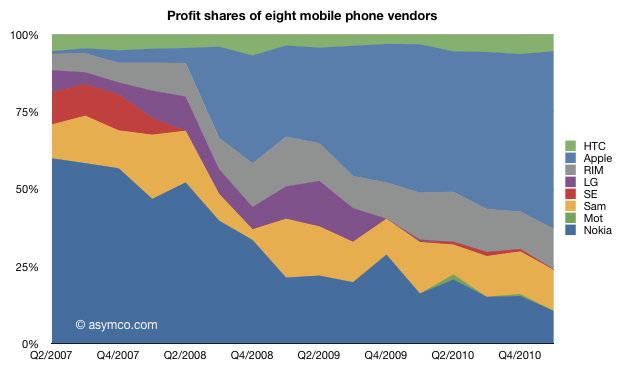
    Looking at operating profit shares, the picture is plain to see. While RIM, Samsung and HTC have maintained profit share, between 2007 and now, profit share has mostly shifted from Nokia to Apple.

    But this does not tell the whole story. Here are the absolute amounts of operating profit from mobile phones. Exactly three years ago Nokia was earning 47% profit share or $2.35 billion. This past quarter Apple's 57% was equivalent to $5.23 billion, more than twice as much.

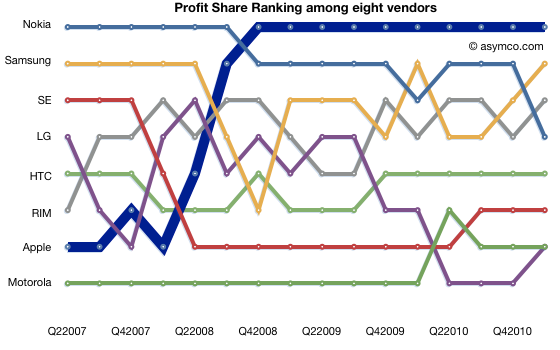
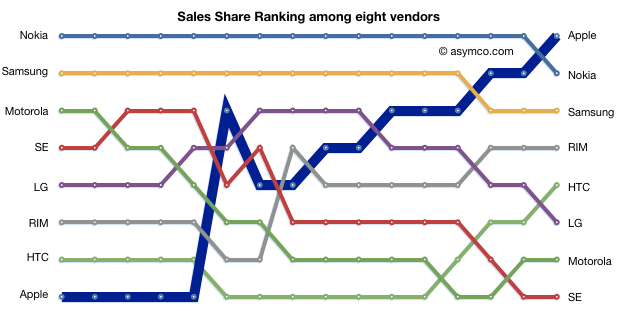
    Finally, the league table shows how Nokia has now dropped from second to fourth in the last quarter. Not only Samsung, but RIM has overtaken Nokia as well.

    It's become routine to see Apple at the top of the list of profit earners from mobile phones.

  3. Did Microsoft pay for the wrong Skype?

    Research · 51 comments

    When a company is acquired, the price paid is usually higher than what the company is worth. This is because there is a "control premium" that needs to be paid so that the acquiring company can control the destiny of the acquired company (while the seller loses that right). So the question has to be what does the premium (or excess cost) buy? What is the value of that control? What will be the new destiny? Whose destiny is changed?

    Clayton Christensen succinctly defined the value in any company as the sum of three constituent parts: resources, processes and business models. Market value can be nothing more and nothing less than these three things.

    An acquisition has to be positioned on one of these targets just like a product is positioned on a specific market. The problem with being deliberate about where the value lies is that once positioned a certain way, the integration team will begin to execute on that plan. This means that the thing you decided was worth most (e.g. resources) gets all the attention and the other potential sources of value (processes or profit models) are discarded.

    This argument reduces to there being three separate companies being available. The buyer pays for all but gets to keep only one.

    When you look at it this way you realize that the reason most acquisitions fail is that the buyer throws away most of the real value in the company.

    For example, when looking at Skype through Microsoft's eyes, they could be valuing it for its resources (employees, management team, customers, or intellectual property.) Or they could be valuing its processes (how it makes software and how it recruits customers) or it could be its business model (viral distribution, very low prices with wide distribution, plan to disrupt telecommunications). Each of these is a separate, mutually exclusive deal with separate integration plan and separate strategic justification. Each is targeting a separate Skype.

    If Microsoft were to pay a premium for Skype's resources then they will probably not make use of the processes or business models. There is some value in this Skype. Microsoft could use the customer base to sustain their existing businesses and to up-sell services.

    But what if the real value is not in resources but in the business model? A model which would allow for Microsoft to disrupt its core business. Perhaps Microsoft could use the Skype approach to creating new customers, eliminating its partner network and expensive direct sales force. This would be a different Skype. It would have the potential to transform Microsoft. Microsoft could become what Skype is now: a communications network or carrier that disrupts the way people use network operators.

    This type of value exists in Skype but its asymmetry with Microsoft's core would make it a very tough sell internally. A recent article pointed out that when Skype was up for sale last time, Google's acquisition was sabotaged internally by people who realized that peer-to-peer would be "incompatible" with the centralized architecture of Google's services. If not for the effort of certain individuals, Google might have ended up with Skype and destroyed it with internal antibodies.

    Chances are that Microsoft paid for Skype's customers and engineers but will not apply the innovations of viral peer-to-peer distribution or disruptive voice pricing. If that happens then perhaps Microsoft will pay $8.5 billion for the wrong Skype and telecom disruption will find another home.

    Notes:

    Adapted from an answer published in Capital.bg. My thanks to Adrian Georgiev for asking the right questions.

  4. Ascent of the entrants: Taking food from the mouths of giants

    Research · 34 comments

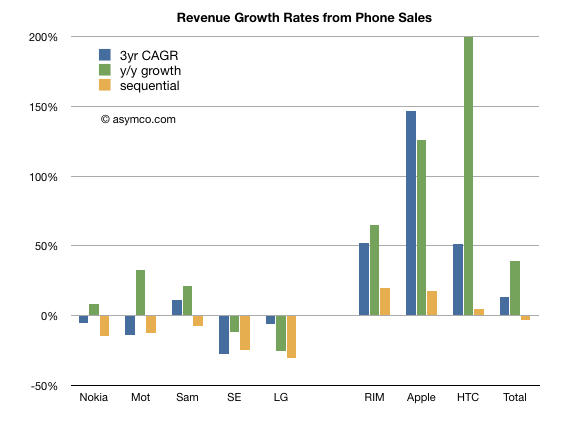
    Revenues for the eight phone vendors I track increased overall during the last three years. The compounded annual growth was about 13%.  However the growth was not evenly distributed. The following chart shows revenue growth across three time frames: Three year compounded, year/year quarterly and sequential quarterly.

    I separated the incumbent companies from the "entrant" smartphone vendors for contrast.

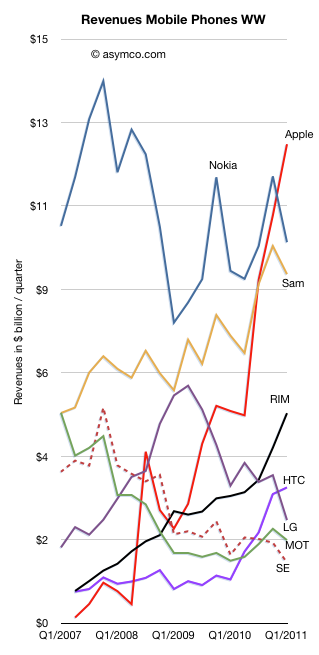
    Looking at individual performance, the following chart shows how each vendor performed over time:

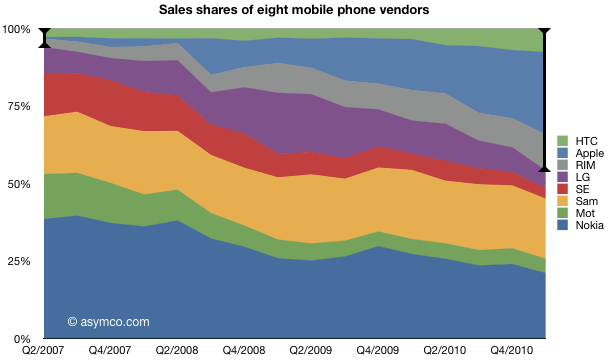
    The share of revenues is shown in the following chart (I highlighted the smartphone cohort):

    The ascent of the entrants is shown in the league table below:

    The headline that Apple became the biggest phone vendor in the world by revenue has already flashed across the feeds of the world. It's another straw on the camel's back. But I'd like to take a moment to note that this is not just an Apple story.

    If you look at the league table, RIM, HTC and Apple were at the bottom three years ago and now they are either in the top or the middle. RIM in particular deserves credit for reaching the fourth spot and staying there. HTC also has shown a late surge to fifth passing LG, Motorola and Sony Ericsson in the process.

    Combined, these vendors went from taking in about one dollar in 20 (6%) in Q2 2007 to nearly half the money (46%) in Q1 2011. As the market also grew, the total amount went up an order of magnitude. From $1.8 billion to $21 billion in three years. Not bad for niche players.

  5. The end of phone vendor tiers

    Research · 25 comments

    It's time to review the mobile phone market at the end of the first quarter of 2011. Before I begin, I'd like to remind that this analysis will span multiple posts and that many details will be published separately due to time and space constraints. Data about platforms, sales, profitability and pricing will be posted separately.

    All data sets and chart data will be available for interaction and download through Asymco Interactive when complete. You can purchase a license to Asymco Interactive anytime and you will have access to any new data sets for next 90 days so don't hesitate to pre-order the report.

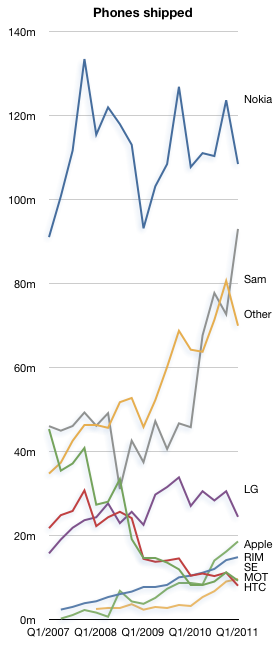
    The overall phone market grew at a compound rate of 9% over three years. The pattern of entrants focused on smartphones and mobile computing growing faster than the incumbents continues. The compound three year unit growth for the tracked vendors in descending order is:

    1. Apple 122%
    2. HTC 55%
    3. RIM 50%
    4. Samsung 15%
    5. Other 14%
    6. LG 0%
    7. Nokia -2%
    8. Sony Ericsson -29%
    9. Motorola -30%

    To give an idea of the split between smart and non smart, Nokia's smart business grew at 18% compounded while its non-smart units contracted at -6% rate.

    In terms of y/y growth the market grew at 26% and the vendor ranking is:

    1. HTC 194%
    2. Apple 113%
    3. Other 103%
    4. ZTE 75%
    5. RIM 42%
    6. Motorola 13%
    7. Samsung 9%
    8. Nokia 1% (smart: 13%, non-smart -2.3%)
    9. LG -10%
    10. Sony Ericsson -23%

    Sequentially, the growth rankings are:

    1. Other 28%
    2. Apple 15%
    3. HTC 7%
    4. RIM 5%
    5. ZTE -10%
    6. Nokia -12%
    7. Samsung -13%
    8. Motorola -18%
    9. LG -20%
    10. Sony Ericsson -28%

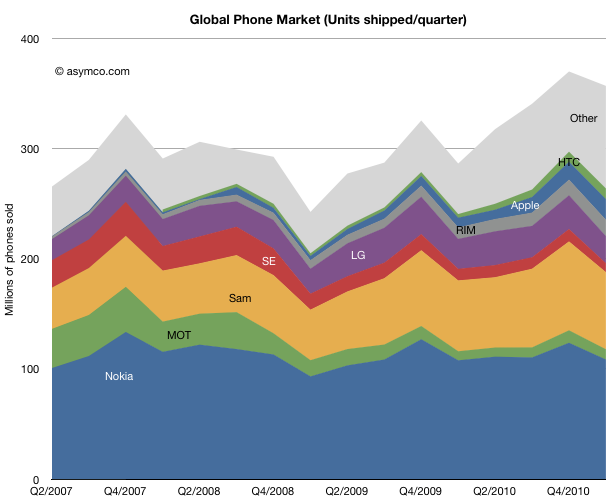
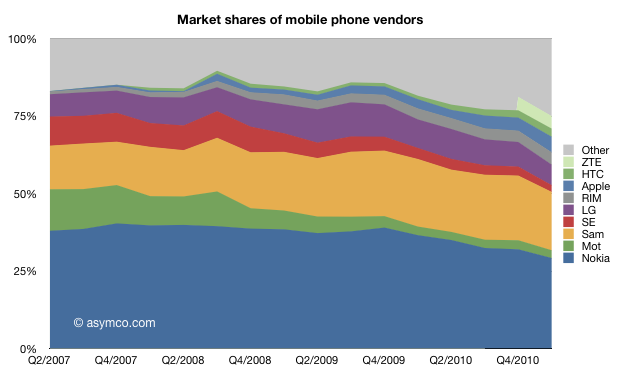
    In terms of market share, the field is becoming more crowded.

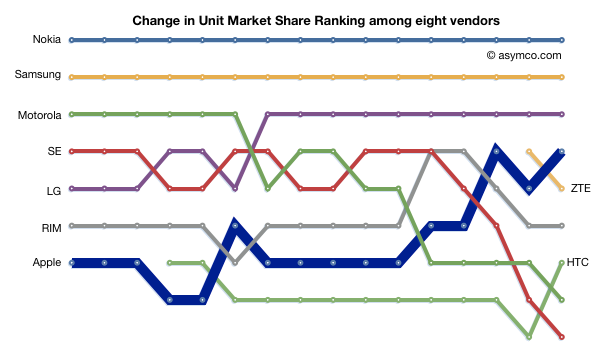
    The ranking of units shows a continuing relegation of Sony Ericsson and the increase of HTC to 7th spot. Apple reclaimed its fourth spot from ZTE.

    As the number of vendors increases and the share of incumbents decreases it becomes harder to identify who is a "top tier" vendor or, in fact, what the tiers are.

    It's pretty clear that on a unit basis there are nine vendors selling significant volumes. The other important observation is that vendors like ZTE are graduating from "other" while "other" is still growing, now at 25% of the market.

  6. Measuring iPhone progress

    Research · 65 comments

    Speaking of boats, there were recent claims that the iPhone is "dead in the water". As someone who has done some sailing I can say that being dead in the water is dangerous. Not only are you not going anywhere but you also don't have steering control. It's movement through the water that allows a rudder to work so being stationary means that you can't orient the boat when waves or wind might threaten stability.

    This implied inability to gain directional control is what makes the accusation so powerful. How valid is it? That claim certainly was not made because the iPhone did not grow. iPhone grew at 113% year on year. It even grew sequentially in a post-holiday quarter and the growth is not slowing materially.

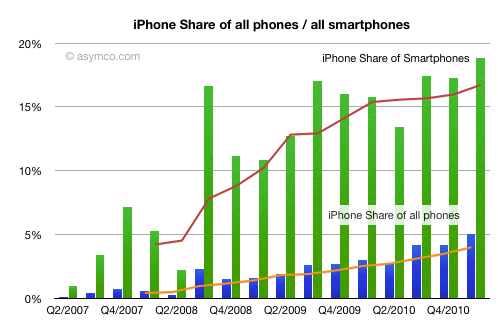
    The claim was made that iPhone was not gaining share. But share of what? If we look at the iPhone share of all phones and share of smartphones, it's still growing. It reached 5% share of all phones sold in the quarter and fourth most popular vendor in the world. Beating RIM, HTC, Motorola, Sony Ericsson and ZTE.

    So what makes the iPhone dead in the water?

    The claim was made relative to the (a) share of (b) mobile platforms (c) installed base (d) in the US. In other words, if one adds all Android phones in use vs. the iPhones in use in the US (while ignoring iOS devices other than iPhone) while the market is growing at nearly triple digit rates, then the iPhone is not gaining (much) share.

    That's the most obtuse way of suggesting a slowing product. If something is dead in the water, it isn't going anywhere or making any progress.

    On a unit basis and one the basis of vendor comparison, iPhone is doing very well. On the basis of value capture and profitability it's doing even better. More about that later.

  7. A rising tide does not lift leaking ships

    Research · 28 comments

    I've often said that the smartphone rising tide has lifted many boats. If you were selling smartphones during the last three years, your business was growing, no matter what phones you made.

    In fact, measuring success and failure was a matter of deciding what growth rate was "not good enough". Growing at 30% was nearly enough to shame some vendors into re-evaluating their strategies.

    But that sort of tidal growth can't last. At some point  ships with holes begin to sink no matter what the tide brings.

    When we look at the data from the last quarter, we should be asking again whether some ships have developed some leaks.

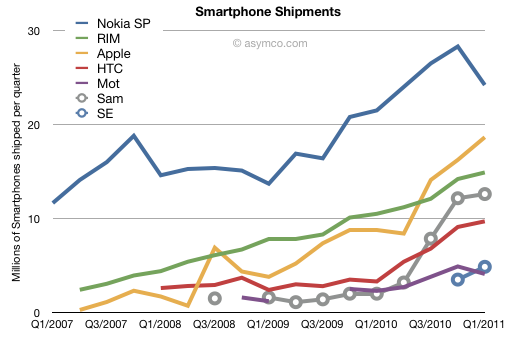
    The challenge is in eliminating seasonal effects. Q1 is usually a sequential drop for many markets. There is an unsettling drop in Nokia and Motorola and a weakening in Samsung and HTC. On a year/year basis the growth rates appear more robust for HTC and Samsung (194% and 530% respectively), but one should note the low bases they started from. Apple maintained triple digit growth (113%) while RIM sustained a respectable 42%. Motorola grew at 78% but looks weak sequentially. Sony Ericsson began to offer smartphone units and they are showing a run rate similar to Motorola but can't gauge their growth rate yet.

    Apple and RIM seem largely unaffected by seasonality but Apple is growing twice as fast.

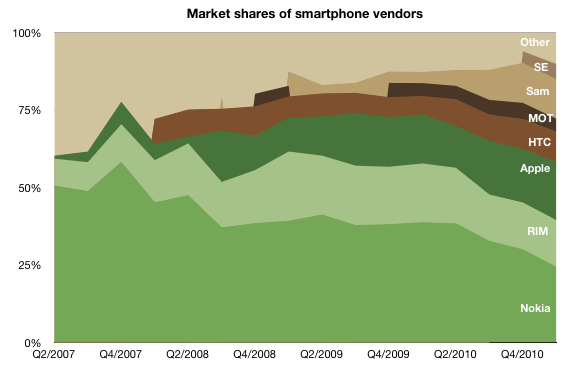
    But the biggest surprise is the drop in Nokia's volumes. There was a similar drop in Q1 2008 but the phone market was plunging into recession then and the company's smartphones moved in sync to the overall market (one with limited competition). This quarter's drop happened when the overall market is growing. The alarming thing is that Nokia's smartphone performance in Europe seems to be a big part of the problem.

    Data from IDC shows that Nokia's volumes plunged by 15% y/y in Europe while the smartphone market there grew by 76%. Apple ended up with the largest share in a region that had been Nokia's with 70%+ share. That share is now under 20%. Nokia's overall growth was a mere 13% y/y while the market grew 73%. The result is the following picture of Smartphone shares:

    But perhaps the drop should not be a big surprise. Was it due to the public execution of Symbian? Did Europeans stay away from Nokia in droves due to an aging portfolio or because they felt betrayed. Perhaps we'll never know but there is another indicator to mull over. Nokia's brand fell to 81st spot in a recent survey. It used to rank in the top 10.

  8. Codifying asymmetry: How Apple became Jobsian

    Research · 79 comments

    Any student of organizational theory must struggle with the question of how to assign weight to the influence of the leadership of a company. In the case of Apple, the question is:

    Is Jobs is the embodiment of Apple or is Apple already Jobsian, imbued with his ethos?

    John Gruber summed up (start at 8:00 min) the "Apple is Jobsian" argument by saying that Apple is Steve Jobs' greatest creation and that he has been working on crafting the company as much as he has been crafting products. The result being that it's well designed for sustainable longevity.

    The arguments for "Jobs is Apple" are mostly rooted in anecdotes of a supreme leader that is indispensable to every decision and detail. There are also ample examples from history of companies who foundered after the departure of founders (Apple itself is notably cited.)

    But beside armchair quarterbacking, what evidence is there that Apple is being engineered to operate independent of its founder? Unfortunately there is almost no organizational analysis for Apple. Unlike many of its contemporaries, there aren't org charts or tell-all accounts on life in Cupertino. There are no anonymous "mini-aapl" blogs or tales from the disgruntled.

    For this reason, a recent quote about the mysterious "Apple University" in Fortune caught my eye.

    First a brief review of what was known.

    Apple University was first mentioned in 2008 when Joel Podolny was hired from running Yale Management School to join Apple in creating this new "University". I remember at the time thinking what such a thing might be. To leave the top job in one of the top business schools to join Apple must require some powerful incentives. I envisioned Apple entering into a far more ambitious iTunes project where they could be offering degree programs or teaching resources through the familiar store front.

    But nothing was heard about Apple University again. Until yesterday.

    According to the article in Fortune and some additional details from another source, Joel Podolny has been building an understanding of how Apple is run. He's then been asked to codify this understanding into a curriculum that can be taught to Apple employees.

    The idea that Apple is trying to capture its institutional processes and knowledge is very compelling. Few companies have self-knowledge. Fewer still try to codify it and teach it to new generations of leaders (Disney, McDonalds and Toyota have in-house training programs but they are mostly aimed at new hires).

    For those who don't bother, the consequences are a more rapid descent into disruption. I've experienced the consequences of the failure to remember decision processes. Knowledge about decisions disappears once the decision maker moves on, leaving a new generation to figure out the causes of success (and failure) all over again.

    The evidence of the forgetting of history abounds at companies like Sony and Microsoft which seem to be behaving exactly opposite to how they once did. Sony, once a serial disruptor, turned into a sustainer. Microsoft who pioneered software as a business, cannot find new business models for software.

    Apple's decisions and outcomes are the stuff of legend. They famously act asymmetrically to what is "conventional wisdom". Wisdom imparted supposedly through business schools but systematically contradicted by Apple's principles:

    • Accountability without control
    • Lack of "P&L responsibility" for top management
    • Saying no to "better things"
    • Building products before markets are identified
    • Functional vs. hierarchical or divisional organzation
    • A disregard for polite consensus

    So if this type of decision process is not codified, how is it going to persevere when convention dictates otherwise?

    If the article is correct and there is an effort under way to codify and teach new generations "the Apple way" then the case for Apple being Jobsian grows a lot stronger.
  9. Staying Hungry

    Research · 47 comments

    During the June 2005 Stanford University commencement speech Steve Jobs famously cited the farewell message placed on the back cover of the 1974 edition of The Whole Earth Catalog: "Stay hungry, stay foolish."

    That's a nice, pithy statement. I interpreted "Being Foolish" in a Quora answer as "being naive about how things should be and thus allowing oneself to see how things could be."

    But what about staying hungry?

    A clue comes from the recent Fortune article "Inside Apple" (currently only available in print or as an app). Even with nearly $70 billion in liquidity Steve Jobs claims "Apple is a company that doesn't have the most resources." A former executive claims "We've always fought for resources...Steve and Tim in general want to be sure you need what you're asking for."

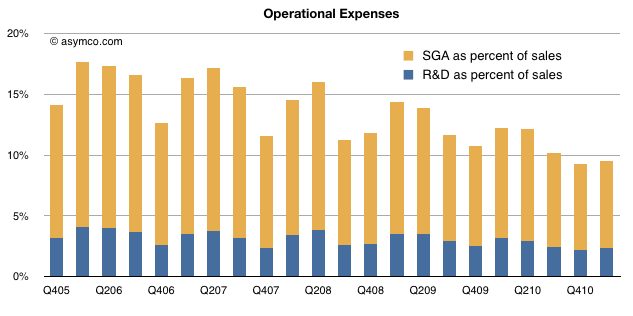
    Note that "resources" here does not mean capital. It means people. Apple is very constrained in the number of people it has available to put on projects. The evidence is in the company's operational expenses. They make up only 9.5% of sales (nearly an all time low). R&D in particular is only 2.4% of sales ($581 million).

    Although R&D doubled in three years sales nearly double every year.

    Looking at the totals over the last full year, the company spent about $2 billion on R&D. A remarkably efficient way to generate $47 billion in sales or $13.3b in operating income. Another way of thinking about it is that every dollar spent in engineering resulted in $23 in sales.

    So the way to interpret the "stay hungry" metaphor is as a low cost structure. It has great advantages beside efficiency. There is a constant demand for focus and justification of spending. There is a certain level of cross-fertilization as people are assigned to varying projects to maximize their utilization. Finally, there are the subtle but powerful influences of hunger: motivation, invention and intense attention to details.

    For Apple this aphorism seems to be more than a motivational poster quote.

  10. Phone Tipping Point Countdown Reset

    Research · 23 comments

    comScore's latest survey data is in and the news is good.

    In March an additional 3 million Americans became smartphone users. That translates to 700,000 every week or 100,000 every day switching from a non-smart or feature phone to a smartphone.

    The smartphone is now in use by 31% of the phone users in the US. A year ago 80% of Americans did not use a smartphone. Today non-consumption is down to 69%.

    It also means that only 19% more penetration remains before half of the population is using smartphones and that penetration is increasing at an average of 1.3% per month.

    I reset my Phone Tipping Point countdown clock to reflect the new data.

    I call it the Phone Tipping Point because it's the moment when I expect we'll stop using the word "smartphone".

    It's nearly one year away.