Asymco

Asymmetric Intelligence

Research

  1. Feature Tablets

    Research · 48 comments

    Andrian Georgiev, a reporter from the Bulgarian business newspaper "Capital weekly" wrote an article for which he asked me some questions. My answers are below. The article is available here (Bulgarian).
    Q: How many tablets will be sold worldwide this year and in 2012?
    A: We can only guess the answer. The total will be constrained by parts shortages for 2011, but my estimate [through the end of 2012] is over 100 million. Perhaps even 120 million is possible.

    Q: Do you think Amazon is working on a tablet? Could it be a game-changer?
    A: If Amazon (or Facebook or Baidu) were to build a tablet the greatest innovation will be in their business models. In other words how they make money. I suspect Amazon's hardware will be free or nearly free but users will be incentivized to buy content or other goods from Amazon. Similarly for other businesses that will take a hardware product and make it an accessory to their core business. In that regard the "game will change" because hardware will conform to "the application" above it. In other words, that the device will be an accessory to the service, not the other way around.

    Q: Why is it so hard for manufacturers to create a tablet that rivals iPad?
    A: The iPad is a collection of components. Some are easy to duplicate or to source. This includes memory, microprocessors, communications components. Other components are harder to find and may be expensive once found. This includes the right kind of batteries and the screen. Yet other components are impossible to find or duplicate. That includes software.

    --

    Some additional thoughts:

    The changing of the game may not happen for some time. "Feature tablets" (analogous to feature phones) will however be viable as niche businesses quite soon. I believe "conforming" operating systems will be more popular with tablet makers than with phone makers.

  2. The trouble with halos

    Research · 45 comments

    The Mac grew at 28% while the overall PC market contracted at 3%. The Mac has outperformed the PC market overall for 20 consecutive quarters.

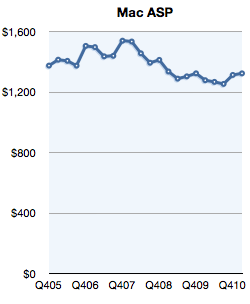
    Prices increased sequentially and year-to-year.

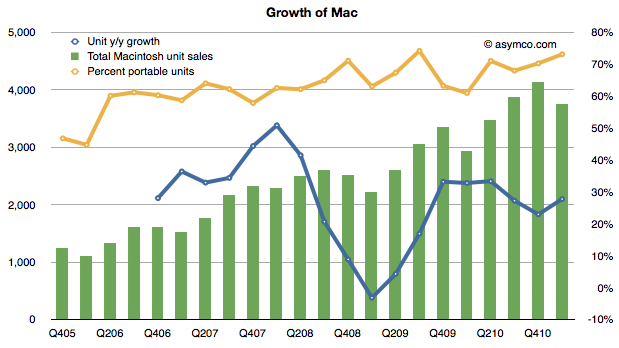
    I've mentioned the increasing shift of Mac mix to portables as a possible reason for the growth of the business. The Mac was one of the first to move to a portable form factor and has been pushing portability over performance for many years.

    The following chart shows the relationship between growth and portable mix:

    The trouble is that mix is not enough to explain the increasing gap with the rest of the PC industry. Windows PCs have also embraced portability and have even run down the path of over-serving portability with the netbook.

    Clearly something else must also be at work. This was even noted by Apple's COO Tim Cook in the last conference call in response to question on the effect of iPhone growth on the Mac:

    [iPhone] clearly seems to be creating a halo effect for the Mac. And I think that's one reason we see the growth that we are seeing on the Mac. It's amazing when you see the 28% year-over-year versus the worldwide market in PCs contracting by 3 points. It's an astonishing delta.

    The delta has been there for a while but it's widening and it's persistent.

    I've never been comfortable with the halo effect. Not because it's not happening but because we don't have a way to measure it. I've never seen reliable data that establishes a causal link. Lots of anecdote but little proof.

    The other problem with halo is that it implies illusion and hence impermanence. The halo effect is a cognitive bias which can mislead. An example would be judging a good-looking person as more intelligent.

    This effect is often exploited in marketing. It's quite common in the automotive industry where halo vehicles (e.g. Ford GT 40 or Dodge Viper) are created which promote sales for the entire brand even though they may lose money. These efforts often fail or have temporary benefits at best.

    When it's deliberate and an attempt to prop up something unworthy it seems deceptive, dangerous and temporary (buyers may be disappointed when they buy a Ford or Dodge and realize that they are not supercars and a reverse halo effect can emerge.)

    A halo effect should be used to boost a product that is under-rated not badly rated. This is when the effect creates benefit over a long period of time like the five years over which the Mac has over-performed.

  3. Combating superlatives fatigue

    Research · 18 comments

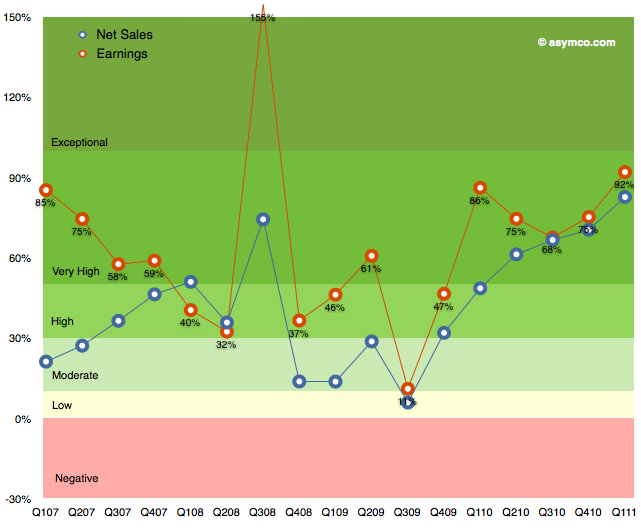
    The following chart shows Apple's growth for net sales and earnings over the last few years. I've used a grading system with color coding to show bands of growth.

    It's easy to become de-sensitized to the scope of these numbers, but it bears repeating: the growth has been steadily increasing since 2009.

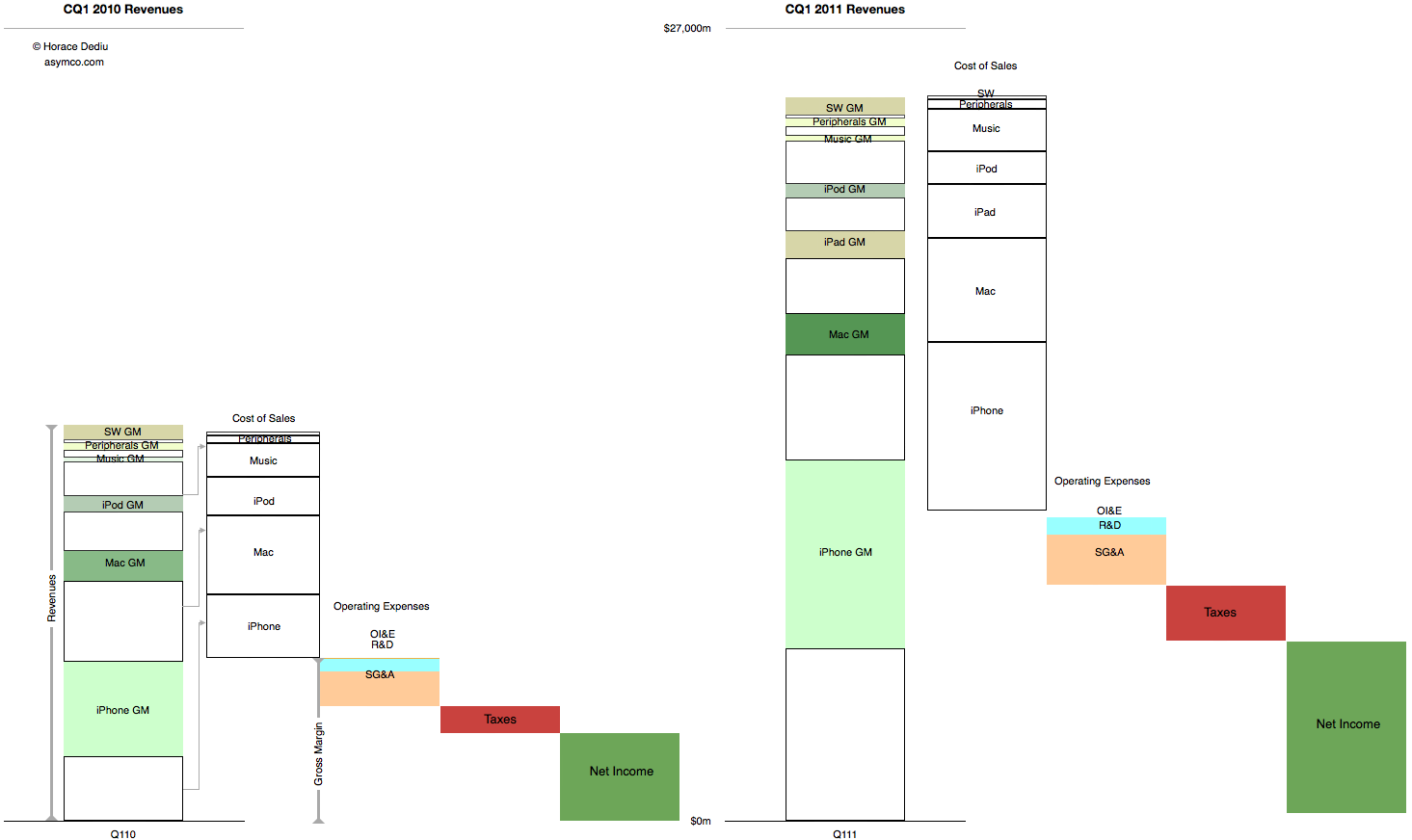
    These abstractions in growth can also be shown in a direct "before-and-after" view of the income statement.

    This latter view gives an idea of how much bigger the company's business is now vs. a year ago. Not just on the revenues but also the cost of these revenues and what is retained.

    This story never gets old.

  4. Windows generates less than a third the profit of iOS + OS X

    Research · 35 comments

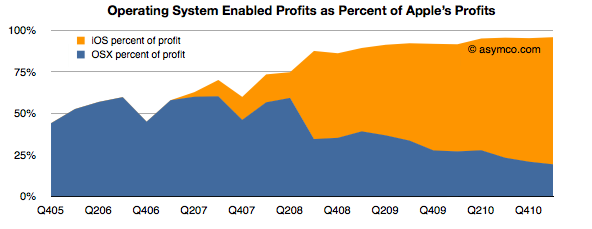
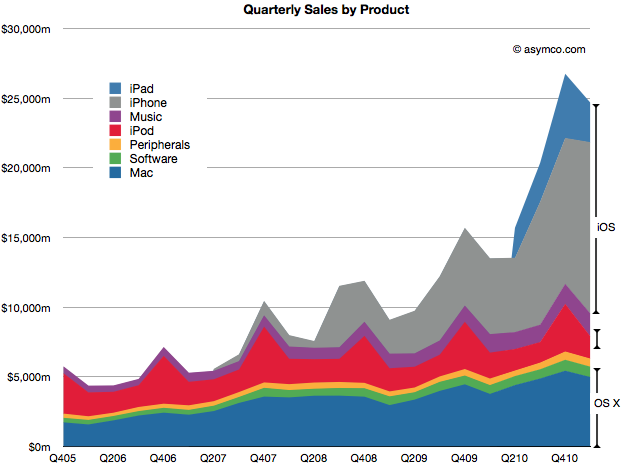
    While a lot of the credit for Apple's success is rightfully assigned to the iOS franchises, the OS X business has more than quadrupled in five years. This has happened without drastic price fluctuations. Neither holds for the overall PC industry which has seen both volume and sales decline while prices have eroded along with profitability. On top of that, growth has nearly evaporated.

    Even with this success, as a percent of total value created, the Mac accounts for a mere 13% of Apple's profit. Including software as part of the OS X franchise implies that OS X is enabling about 20% of Apple's profits.

    iOS, on the other hand, is accounting for more than 75%. These two platforms combined amount to 96% of Apple's profits (up from 50% four years ago).

    That's $9.8 billion from integrated platform-based devices. One can be very confident that this profit would be negligible without the software differentiation only Apple can offer.

    So $10 billion is a lot of profit to obtain from a business enabled by operating system platform software. How can we get a handle on this size? How big is this? We could compare this with another operating system business: Microsoft Windows.

    Microsoft's Windows and Windows Live Division obtained sales of $4.445 billion in the last quarter with an operating income of $2.764 billion.

    So although Windows earned about twice what the Mac earned[1], iOS and OS X together enable 3.5 times the profits of Windows.

    The end of an era is the end of growth in one dominant business model. The PC era was epitomized by the concentration of profits in a dominant operating system vendor. That growth has slowed if not ended. The post-PC era is being kicked off by a new business model where profits are being concentrated in a hardware+software+service integrator.

    --

    1. Or you could read this as: The Mac generates half the profits of Windows while iOS devices generate 2.3x Windows profits.
  5. The market values Apple's balance sheet, not its income statement

    Research · 79 comments

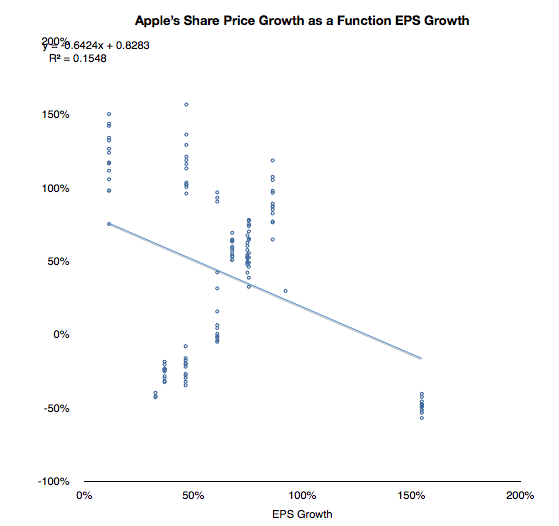
    As I have tediously repeated in this blog, Apple's share price has been de-coupled from its earnings for many years. Consistent earnings growth above 70% is not seen as valuable. As the chart below shows, there is no correlation between EPS growth and value growth.

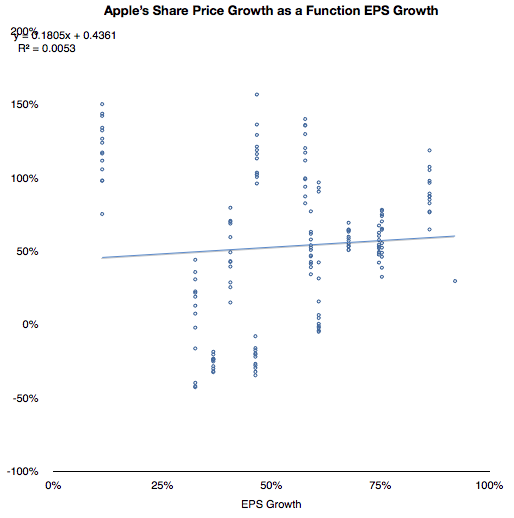
    With the outlying quarter when 154% growth was matched by a negative 50% price change, the correlation does not look much better:

    If we cannot correlate share price with growth then what is being valued? This has been a vexing problem because growth is the traditional, and logical, metric of valuation. Share prices, by definition (net present value of future cash flows) reflect future potential. That potential is more sensitive to growth than to anything else.

    But I've been leaving one factor out of the share price definition. Share price is NPV of future cash flows plus current assets.

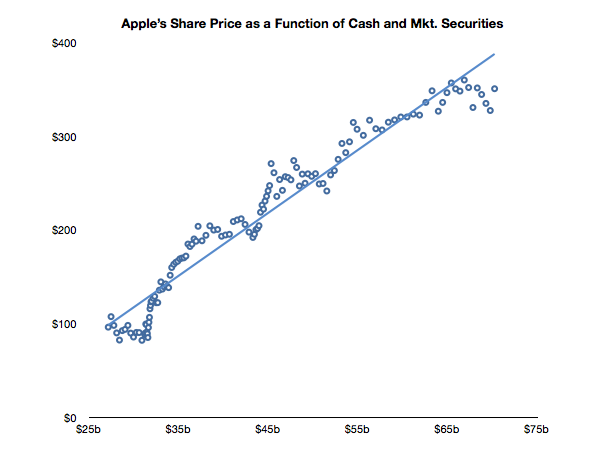
    Since future cash flows are being thrown out of the equation, the company must be valued as a multiple of its cash. Does this relationship hold true?

    In the chart below I show the weekly closing price of the shares and the corresponding value of the interpolated cash (and marketable securities) per share over the last two and a half years.

    A strong correlation can be observed. The R squared value is a healthy 0.94. Of course this is not to imply causation. Correlation is not causation, but it is a hint.

    Can predicting the cash per share be a strong indicator of future stock price? Perhaps. As long as this relationship holds, then having a reliable earnings model would still give us a solid predictor for the share price. Not because we can use EPS forward estimates multiplied by P/E but because we can estimate cash flows and the increase in retained earnings.

    Of course, the market "is being irrational" because it values on the basis of the present only (not its future.) But who are we to argue? This valuation has held since October 2008.

    As far as the market is concerned Apple's future is irrelevant. Its value is defined as a constant multiple of cash.

  6. When exceptional growth is not an exception

    Research · 69 comments

    Apple's last quarter's sales growth was an impressive 83%. It was not as high as the 92% earnings rise because there was a higher mix of iPhones this quarter than in the past. The iPhone is the most profitable product in Apple's portfolio so it impacts the gross margin significantly.

    The iPhone is, in fact, a huge part of Apple's business. In units it reached 5% global share and 14% US share. I'll go over the overall industry data as soon as all the major reports are in, but already it has been estimated that Apple is the largest phone vendor by profit and sales.

    In the following chart, you can see just how important the iPhone has become. Together with the iPad and iPod touch, iOS-powered devices make up about 65% of sales. That's almost three times the value of OS X based products which make up 23% of sales. That also leaves just 12% of sales not directly affected by these two juggernaut platforms (though music and peripherals are clearly indirectly affected by Apple's own platform products.)

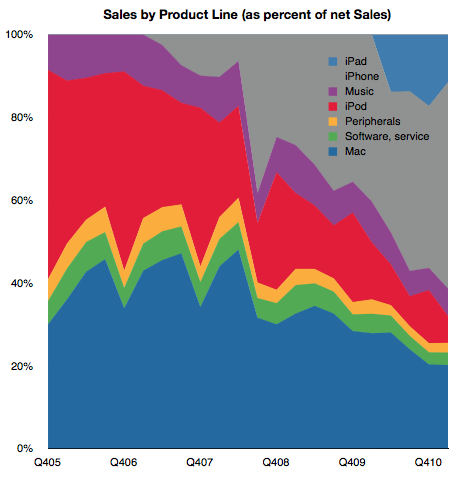
    The following chart shows the same information as shares of total net sales.

    I've read that some of the uncertainty around Apple's future prospects is driven by the perceived vulnerability of these new blockbuster iOS products. At first glance this growth looks quite unprecedented and hence risky. 65% of sales from iOS did not exist four years ago. If you look at the sector it's hard to find any company that has doubled its sales in a few years from completely new product lines. Especially a mature company over 40 years in the business.

    Well, there is one.

    If you look again at the second chart above, you'll note that the proportion of sales held by iOS devices has mostly replaced the sales share that used to be held by iPod, itself a product that did not exist four years prior to the time of these charts.

    Apple consistently doubled its sales on the basis of the iPod. It's now consistently doubling on the basis of iOS.

    Exceptional claims require exceptional evidence. But that's exactly what the investment thesis for Apple should be: Exceptional growth is no exception.

    Steve Jobs himself said it well once: "I wasn't alive then, but from everything I've heard, Babe Ruth only had one home run. He just kept hitting it over and over again."

    Even this exceptionalism is not unique. It happens not just at Apple, but at another of Jobs' creations: Pixar.

    Perhaps this magic formula for exceptionalism is itself a fluke but what if it's not. What if blockbusters are really something that can be built with repeatable consistency. What would that be worth?

  7. The Apple Growth Scorecard

    Research · 127 comments

    Apple's revenue for the first quarter was $24.7 billion, which at 83% was the largest quarterly revenue growth they ever experienced. Operating margin was an all-time high of almost $7.9 billion, representing 31.9% of revenue and yielding 95% EPS growth.

    After earnings were announced the share price reached $350.7. This includes $70 in cash. Trailing twelve months' earnings were $20.97. That makes the Price/Earnings ratio 16.7. Excluding cash, P/E is 13.4. The average growth over the past four quarters was 77%.

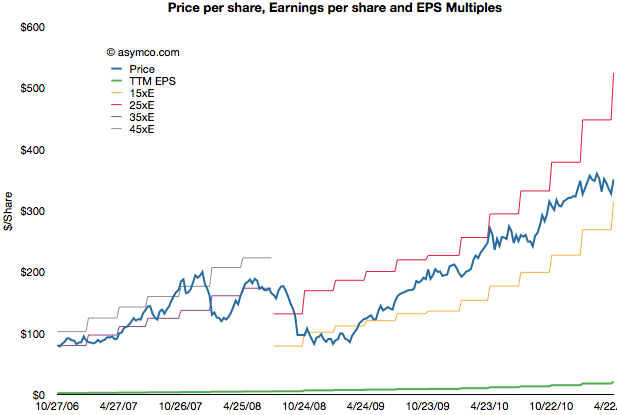
    The following chart shows the share price vs. earnings. The green line is price and the blue line is share price. I also added multiples of the earnings to show how the stock traded in certain multiple bands.

    During the period of 2006 to 2008 the company shares traded roughly in a range of 35 to 45 P/E. Since late 2008 the company shares have traded in a range of 15 to 25 P/E.

    Share prices normally reflect potential earnings growth and past growth is often a good indicator of near term continuing growth. This is why the P/E is usually a proxy for growth. The faster the growth, the higher the P/E. Or so one would think.

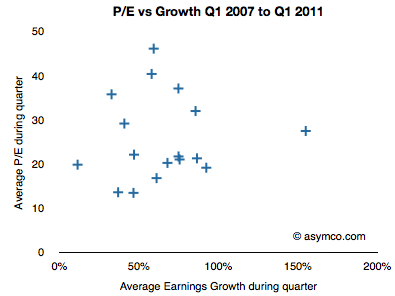
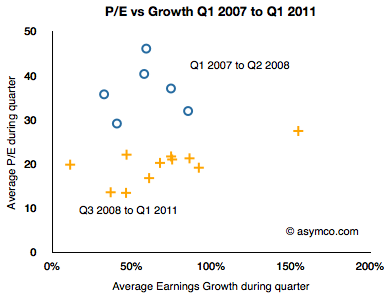
    If we look at the P/E vs. earnings growth for Apple, the picture is not encouraging.

    P/E and Growth don't seem at all correlated. In fact, if we drop two outliers it almost seems that P/E is insensitive to growth.

    I took the data a step further and separated it into two clusters: pre-recession and post-recession.

    The blue circles are Q1 '07 to Q2 '08 and the orange plus signs are Q3 '08 to Q1 '11. As the share price chart implies, there is a clustering of averages where during the 2007 and early 2008 period P/Es were in the 35 range while growth was in the 50s and P/Es below 20s with similar or higher growth ranges.

    As the following scorecard shows, the company's growth is exceptional. That does not seem to be something that is being valued by investors.


  8. If Cash is King, Apple's is an Emperor [Updated]

    Research · 84 comments

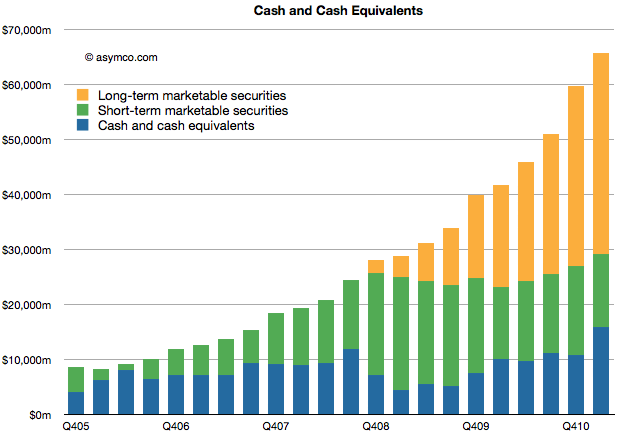
    Apple's cash for short-term and long-term marketable securities totaled $65.8 billion at the end of the March quarter. Cash increased by $6.1 billion.

    The increase in cash is net of approximately $900 million for prepayments and capital expenditures related to the strategic supply agreements that Apple announced last quarter.

    The following chart shows the historic cash, short-term and long-term liquid assets Apple holds.

    As in previous quarters, the securities Apple holds are:

    • Cash
    • Money market funds
    • U.S. Treasury securities
    • U.S. agency securities
    • Non-U.S. government securities
    • Certificates of deposit and time deposits
    • Commercial paper
    • Corporate securitiesMunicipal securities

    Although the asset classes are all liquid, those with longer maturity dates are classified as "long-term" securities (orange area in chart above) and are often not counted as "cash" in many financial databases.

    The enormity of the overall size of this cash can be put into several perspectives:

    • The funds are big enough to place Apple's CFO office in the top 100 largest fund managers in the world and larger than any hedge fund manager.
    • Cash growth in one quarter was higher than the market cap of many companies. For example, if pre-payments were added back, the cash increased by about the market cap of Motorola Mobility.
    • Current cash is worth more than Nokia, RIM and Motorola Mobility's market caps, put together.
    • Apple's cash is worth half of Google's enterprise value.
    • About two years ago, in January 2009 the stock traded at a price of $78 with at least one analyst placing a target of $70 on the stock. Today Apple's cash is worth $67 70/share.
    • If you owned $100,000 of Apple stock, $19,000 of that would be cash and only about $80,000 would be "at risk" capital.
    • If Apple had no revenues, the current cash would sustain operations (SG&A and R&D) for over 7 years or until the middle of 2018.

    When analysts cite limits to the rate of Apple's growth on the basis of the "law of large numbers" I wonder if there is an implied limit to how big this cash pile can grow. By looking at the chart its size seems to be growing faster all the time.


    [Updated] The cash per share figure was wrong. It is $70/share.

  9. The iPad slowdown and impact from the Japanese disaster

    Research · 41 comments

    Tim Cook explains that there was no material impact from the Japanese disaster:

    "Regarding our global supply chain, as a result of outstanding teamwork and unprecedented resilience of our partners, we did not have any supply or cost impact in our fiscal Q2 as a result of the tragedy, and we currently do not anticipate any material supply or cost impact in our fiscal Q3. To provide a bit more color on this, we sourced hundreds, literally hundreds of items from Japan, and they range from components such as LCDs, optical drives, NAND Flash and DRAM to base materials such as resins, coatings and foil that are part of the production process at several layers back in the supply chain. The earthquake and subsequent tsunami and the associated nuclear crisis caused disruption for many of these suppliers, and many unaffected suppliers have been impacted by power interruptions.

    But since the disaster, Apple employees have literally been working around the clock with our supplier partners in Japan, and have been able to implement a number of contingency plans. Our preference from the beginning of this tragedy has been to remain with our long-term partners in Japan. And I have to say, they have displayed an incredible resilience that I personally never seen before in the aftermath of this disaster. So while we do not anticipate -- currently anticipate any material impact to our component supply or cost in our fiscal Q3, we do need to caution everyone that the situation remains unpredictable"

    via Apple Management Discusses Q2 2011 Results - Earnings Call Transcript - Seeking Alpha.

    Still, the message did not get through to everyone:

    However, the supply chain impact on Apple from Japan’s earthquake, tsunami and nuclear power crisis is the culprit behind the only product line that came in below expectations – iPad. Apple sold 4.7 million units of iPad, vs. analysts’ expectation of 6 million.

    The Rise and Rise of Apple: Time For A Split? - Seeking Alpha

    The shortfall in iPad units was explained by Tim Cook as ramp-up challenges:

    "Let me mention a few things for you to consider, Toni. First off, product transitions are never simple. And as you can probably appreciate, we are in a position that we have to call them for many, many weeks in advance in terms of how many of the current product we want to produce and the dates at which we will announce the new product. We drew the channel down on the current product or the original iPad, I should say, by 570,000 units during the quarter. And we added at the end of the quarter 170,000 of the new iPad 2s although most of that was in transit at the end of the quarter. And so the net reduction was 400,000. And so our sell-through was above 5 million for the quarter. And again, this has to be planned quite a ways in the future. I think the key point here is --

    [also the dates, just to remind you, we set out an invitation to the event toward the end of February. We had the event in early March. We placed the unit on sale in the United States on March 11 and our quarter ended about 2 weeks thereafter. And so there was some expectation of a new product, and we would have obviously factored that into our thinking about the product transition as we plan the number of the original unit to build.]

    And so I think the key point here is that I'm extremely pleased with the progress that we were making on the manufacturing ramp. We have gotten off to a materially better start and produced a lot more units than we did on the original ramp of the first iPad. And when we're so confident with our ability to supply that we've already put on 25 additional countries at the end of March, and we'll be placing on 13 more next week and we'll do even more as we stepped through the quarter."

  10. Estimates for Apple's third fiscal quarter (ending June)

    Research · 42 comments

    Apple's CFO guidance statement:

    We expect revenue to be about $23 billion compared to $15.7 billion in the June quarter last year. We expect gross margin to be about 38%, reflecting approximately $55 million related to stock-based compensation expense. We expect OpEx to be about $2.5 billion, including about $255 million related to stock-based compensation expense. We expect OI&E to be about $70 million and we expect the tax rate to be about 25%. We are targeting EPS of about $5.03.

    Apple Management Discusses Q2 2011 Results - Earnings Call Transcript - Seeking Alpha

    Last quarter Apple guided revenue growth at an aggressive 63% with an EPS growth of 47%. They delivered 83% and 93% respectively.

    They are now guiding about 47% revenue growth and 43% EPS growth and my current estimates are 65% and 72% respectively based on the following:

    • iPhone units: 14.7 million (75%)
    • Macs: 4.3 million (25%)
    • iPads: 9.8 million (200%)
    • iPods: 8.0 million (-15%)
    • Music (incl. app) rev. growth: 25%
    • Peripherals rev. growth: 25%
    • Software rev. growth: 25%
    • Total sales: $25.8 billion (65%)
    • GM: 38.5%
    • EPS: $6.02 (72%)

    The biggest uncertainty remains iPad growth. This will be the first quarter where we can dial in a y/y growth rate. I'm being bullish with 200% because I believe the ramp for the iPad 2 may get sorted out. There are also more countries being opened up this quarter (13 this week).

    Apple's stock price to earnings ratio has dropped to 16.72. Ex-cash it's 13.5. On a forward basis (my estimates) it's 8.3. Apple's valuation is now a case for business historians to discuss because I don't think there are modern precedents.


  11. A new era is only a new state of mind

    Research · 51 comments

    The following interview was conducted by Bruno Ferrari a writer about technology for EPOCA, the weekly magazine of Organizações GLOBO, the largest Brazilian media company on March 30 2011. The article (published in Portuguese here) is an edited subset of the following exchange.

    Q: In your analyses, you mention tablets as part of a new era, the “Post PC era”. Why do you think the PCs will be replaced by tablets?

    This is not quite correct. Post PC does not mean the end of the microcomputer. The way to think about it is this: The stone age did not end because we stopped using stones. Same with the iron age and the industrial era. The era of jet travel did not end automobile or even ship travel (though that changed to recreation rather than transportation for passengers.) Each phase of technology does not fully replace its predecessor. It offers a new set of solutions and perhaps a slightly different way of solving old problems. We'll still have PCs but we will use a new type of computer, an even more personal computer. The world still uses the microcomputer's technological ancestors.

    In terms of what new jobs will we hire the tablets to solve, they will vary greatly from what we used PCs for. Just like we used microcomputers for different things than we used time-shared minicomputers and mainframe computers. I expect social interaction, media consumption and entertainment will move from a PC to a tablet. New uses will emerge from the vast experiment that is the app phenomenon.

    Q: What are the new ways to interact with machines? With gestures? How will this change the market?

    Each major disruption of computing came from a new generation of input and/or output methods. Terminals (vs. punch cards) enabled minicomputers. The GUI enabled the rise of the microcomputer and touch is enabling the rise of the tablet. Perhaps this era will last decades perhaps only years, but there will be new input and output methods available. The world's research laboratories are filled with ideas from projection screens (from high brightness LEDs) to motion sensing (as implemented partly by Kinect) and even novel voice control methods. I believe that each major innovation will create a new wave of growth and, if coupled with a new business model, a new set of companies and platforms.

    Q: What are the main differences between PC and Post PC era?

    The main difference will be in the context in which the product will be used. Tablets and smartphones allow "computing" to be done in previously non-consuming contexts: while standing, while in the active company of others, while commuting or while lying back and relaxing. It will also allow more individual use. Like the transistor radio allowed teenagers to listen to rock-and-roll out of hearing range of their parents who had control over the family stereo, a truly personal computer will allow people to "escape" into a world of more intimate consumption and communication.

    Q: Do you think physical keyboards and mouse will be extinct?

    Even physical keyboards have been evolving dramatically. If you look back to the earliest IBM PC keyboards, they were mechanically complex and had a rich feel. Modern laptop keyboards are flimsy things with barely any feedback. Early PC keyboards were patterned after the needs of professional typists (aka secretaries). Current keyboards are designed around space constraints. Same with mice. They went from two to three to one to no buttons. With laptops we ended up with track balls,  little knobs in the middle of the keyboard or with trackpads. Users adjusted over time.

    What changed with tablets is the removal of an on-screen pointer. The pointer was there because the mouse/touchpad was one layer of abstraction for controlling what was on screen. Without a pointer you have direct manipulation. I'm sure many people who never used a mouse would find the direct method more intuitive and in a generation people will wonder how we put up with mice. Conversely, those who are used to a mouse will find it uncomfortable at first. Remember that in the 80s many keyboard experts found mice something that slowed them down.

    So I believe that people will adjust to a world without mouse pointers. I suspect children born today will grow up without ever using a mouse (or a phone with a wire permanently attached to the bottom).

    Q:  Apple has more than 90% of tablet market worldwide. Do you think Apple will be the leader of technology market in the next few years?

    The challenge for Apple is that they cannot serve the whole world. They can only grow so fast. On one hand we have their inability to meet demand and on the other we have alternative products which can. Market leadership may not be sustainable just because the market is so big and no single company can supply it. I do believe that Apple is not sitting on its hands however. Their culture promotes pushing forward.

    Q: At smartphone market, do you believe on a risk of a new duopoly, Apple-Google? Some analysis says that they’ll control the channel sales of software, content and hardware. The conclusion is companies like RIM, Nokia and HP (Palm) will not be able to keep up.

    Analysts differ in their opinions. IDC just released a forecast that shows Microsoft growing beyond iOS in four years. I don't try to make this type of prediction. At least not to a high degree of precision. I do believe that there will be more than two platforms. This is because the market is so large and so diverse and there are so many ways to reach customers (through operators, through retail stores, through online).

    Q: Can we compare the beginning of the tablets with PCs? Apple developed the interface and made ​​the first computers nice and easy to use. But Windows has allowed hardware manufacturers to invade the market, popularizing it. This will be repeated with Android? Or with other systems?

    Innovations are always copied. Even when protected by all sorts of laws or patents. What makes a company successful with innovation long term is to always keep innovating. Often coming up with the next big thing means damaging the old thing. That's hard to do for many companies so they don't do it and somebody else does. This is why great companies end up as formerly-great companies. As I pointed out above in the discussion about input methods, innovations are always bubbling up. As long as Apple takes these ideas and polishes them and brings them to market, they'll do all right.

    Q; How about Microsoft? Do you think the company will lose the podium in Post PC era?

    Microsoft already has lost its position as leader in personal technology. The end actually came in about 2000. Once Windows became "good enough" and did not crash so much, they have had a hard time finding something to improve. If you go back and watch every CES keynote that Microsoft presented since then it's been a litany of dead end ideas.

    Every major innovation since 2000 has been in consumer technology and that's never been an attractive business for Microsoft (with the exception of XBox which was really aimed at Sony and Nintendo without the intention of creating a new market.) Microsoft struggles not because they lack talent (engineering or management) but rather because their business model is relatively rigid. They make money through software licensing. You can see how that's a hard thing to sell to consumers ("I'm buying what?") Consumers tend to pay Microsoft through the purchase of another product. If the market demands hardware/software integration (like in a phone or tablet) or making money by giving software away (like Google), they struggle. This business model rigidity is present in almost all companies, so Microsoft is not uniquely troubled.

    Q: Most of the tablets will use mobile networks to connect to the internet. Do you think the world is ready with an infrastructure that supports this growth in access via mobile networks?

    This is a good question because the growth of mobile broadband is a major enabler (or constraint) on growth. Fortunately, the roll-out of mobile broadband is fairly predictable and it looks good. There are some challenges for operators long term in paying for the infrastructure, but they don't lack for financing today and the business case for more infrastructure seems to be very attractive. It will take time and it won't be even globally, but the incentives are clearly there. A lot of value is being created with mobile computing and much of that value will end up paying for the bandwidth.

    Q: How about the App Market. You posted recently a chart showing how fast developers are buying thickets for both Google and Apple developer events. You said that it is one signal of the Post PC Era. What will be the importance of apps on the next years. Do you think Apps market will be more important than hardware, content and OS market?

    Developers are one more sign that something big is happening. It's not the only sign and may not be the cause of the change, but it's yet another signal. But apps are a phenomenon that will result in something bigger than we can imagine. The way to think about apps is as a new medium, similar to the emergence of radio, television, cinema and even books. The app is a new art form as well as something that provides functional value. We don't know whether the app phenomenon will be tied to one platform or will evolve to something like HTML5, a common standard. But the value of having an app for everything is plainly evident. The economics, creative energy and dynamism of apps cannot be overestimated. I will write more about this subject as I think it's one of the most important consequences of the post-PC era.

    Q: What’s the destiny of the PC? Are they on their last years?

    Again, it's not so much that PCs will disappear any more than mainframes or servers have disappeared. What is more likely is that they will be used for isolated, focused jobs. The "end of an era" is the end of growth, not the end of existence. The PC has arguably reached end of growth in most developed markets. There is still strong growth in emerging economies but even there, much of that growth will probably be replaced with smart devices growth.

    Q: We had the Mainframe Era, the Terminal Era, the MiniPC Era, The PC Era and now we starting the PostPC Era. Do you imagine what Era we'll se after the tablets? When do you think is it going to happen?

    I don't try to be a futurist who can see with clarity technological change. I try to see the patterns of markets through the motivation of companies. With that in mind, my answer will be that large companies will acquire promising new technologies from start-up companies and implement products with global distribution. To see the future you therefore need to look at what small companies are doing today. I note that there is a lot of innovation in new communication methods (social media) and new input methods around gestures and display technology. I am skeptical about the power of voice controls.

    I'm most confident that there will be a re-definition of television, a "socialization" of almost all media. So I'll abstain from answering directly what happens after the Tablet Era. Perhaps something more personal and more of a companion than a tool.