Asymco

Asymmetric Intelligence

Latest from Asymco

  1. Apple trading at a discount to the S&P 500

    Research · 1 comment

    Flush with $45 billion in cash and investments ($50 per share) and no debt, Apple sports an enterprise value of about $190 per share. Compare that to $15 of earnings this year and enough catalysts to make next year’s estimate of $18 seem easily attainable, and you have a stock that actually trades at a discount to the S&P 500.

    via Why Apple's Stock Actually Looks Cheap -- Seeking Alpha.

    This is not news around here...

  2. Subscribe to Asymco One for full access to our research.

  3. Subscribe to Asymco One for full access to our research.

  4. Breaking Android: How Google's lack of control affects their value chain

    Research · 27 comments

    A few years ago I read a book called "Breaking Windows" which was the story of the DOJ investigation into Microsoft's abuse of monopoly. The book was written by a journalist who tried to summarize some of the findings from the published internal emails.

    One of the takeaways was the logic of Microsoft's entry into the Office market. The main internal justification was not that it would be a hugely lucrative new business, but that it was a necessity to the maintenance of the Windows business.

    The story was that Lotus, having a huge installed base, could (and did) arbitrarily refuse to upgrade their software to the latest Windows version and in so doing, could kill the franchise. Lotus owned the "killer app" and could hold Windows hostage. Users would rather keep their applications than upgrade a largely invisible OS.

    Another way to read this was that Microsoft needed to "vertically integrate" Windows so that it encompassed not only the OS but also the key applications that ran on the platform. A purely horizontal OS platform was obviously not viable as a business even back in the early 90s.

    What reminded me of this story was the news that Dell is launching a new smartphone in the US.  Called Aero, it will run Android 1.5, an ancient version released in April of 2009, 18 months ago.

    Now think about the idea of Adobe coming to market next week with a new version of Photoshop that ran only on Windows XP. Or even more poignantly, if Office were not part of Microsoft, seeing a *new* version of Word that only worked with Vista.

    Through an aggressive acquisition plan twenty years ago, Microsoft avoided this scenario. Google today is faced with the prospect that not only the devices (which sit on its OS) but also services and apps on top would choose to remain on old versions of Android. There is nothing to stop them from doing just that. Unlike Microsoft, Google does not enforce licensing terms for Android. It is at the mercy of the value chain.

    Couldn't Google crack down and deprecate Cupcake? It's not as easy as that. Not only do they not have license terms that permit that but in the phone business, development lead times are so long and global distribution can be so elastic that a low volume vendor like Dell has no choice but to sell multiple OS versions of their own products. Microsoft has almost the same problem with Windows Mobile, with a variety of given-up-for-dead Windows Mobile 6.5 powered devices still in the pipeline while Windows Phone 7 is imminent.

  5. Subscribe to Asymco One for full access to our research.

  6. HTC: How Taiwan Compares

    Research · 1 comment

    Taiwanese operators Chunghwa Telecom and Taiwan Mobile have reported much interest in iPhone 4 pre-orders. Both operators announced at 9pm on 26 August they would open pre-ordering at 10am on 27 August and both operators saw their websites crash, the China Post reports. By noon, some 10,000 users had signed up with Chunghwa Telecom and by 11am Taiwan Mobile had sold out all of its 3,000 iPhone 4 handsets available for pre-ordering. Rival Far EasTone said between 30,000 and 40,000 people signed up for a phone on its website and the operator will notify people that will be able to get the handset.

    Taiwan Mobile sells out of iPhone 4 pre-orders - Telecompaper.

  7. Subscribe to Asymco One for full access to our research.

  8. The next 100 million iOS devices part II

    Research · 16 comments

    Brian Marshall, an analyst with investment firm Gleacher & Co., predicts that Apple will have sold 200 million iOS devices by this time next year. He expects the iPhone and iPad to represent 68 percent of gross margins for 2010.

    via Apple's mobile OS could move to more devices.

    My expectations for the next 100 million were made in June:

    My expectation is that well over 100 million iOS devices will sell during 2011, but even during the next 12 months (2H ’10 and 1H ’11) the total may well reach 100 million, making 200 million installed by June 2011 very likely.

    The next 100 million iOS devices

    My current expectation is that iPhone and iPad will account for 70 million additional iOS units for the twelve months following this June quarter. This excludes any Apple TV units moving to iOS.

    As iOS moves to more of the iPod line-up it's quite possible that another 30 million iPads with iOS will ship in the same time frame making Marshall's forecast sound reasonable.

  9. Subscribe to Asymco One for full access to our research.

  10. Dogfooding Asymco stats

    Research · 15 comments

    Frequent readers of this blog know they're in good company. There have been over 1000 comments in but a few months and, without any qualification, they have all been valuable.

    I've been delighted that contributing readers are not only civil and polite, but that they almost always move the intellectual level of the blog higher. That's very gratifying because although one major consideration when publishing is creating a large audience, a high quality audience is much more important. Especially to a site dedicated to elevating analytical discourse.

    So, being analytical, I wanted to find out how to characterize the audience and understand the attributes of the readers. Naturally, where appropriate I would like to share that information. I hope to share some stats, perhaps with some interesting highlight, every month.

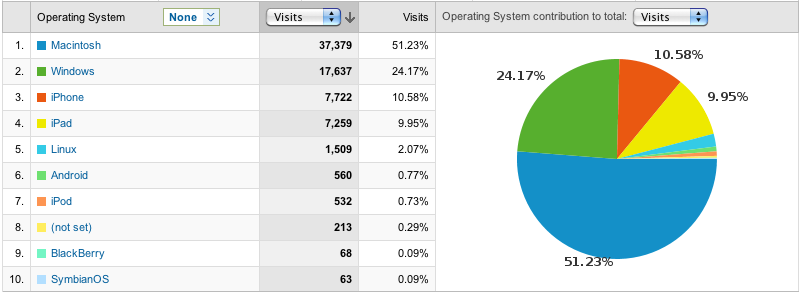
    To kick off, here is a snapshot of one month's worth of visits to www.asymco.com ranked by operating system.

    What is perhaps unexpected is that mobile platforms (iPhone, iPad, Android etc.) generated more views than Windows. When comparing browsers, I also observed that Internet Explorer makes up only about 5% of views. (If that's not a leading indicator of the intellect of the readers, I don't know what is.)

    Time will tell whether these ratios persist, but so far, it seems that Asymco readers are at least eating their own dogfood.

  11. Subscribe to Asymco One for full access to our research.

  12. ADD this: Apple's Balance Sheet

    Research · 6 comments

    Only on Asymco...

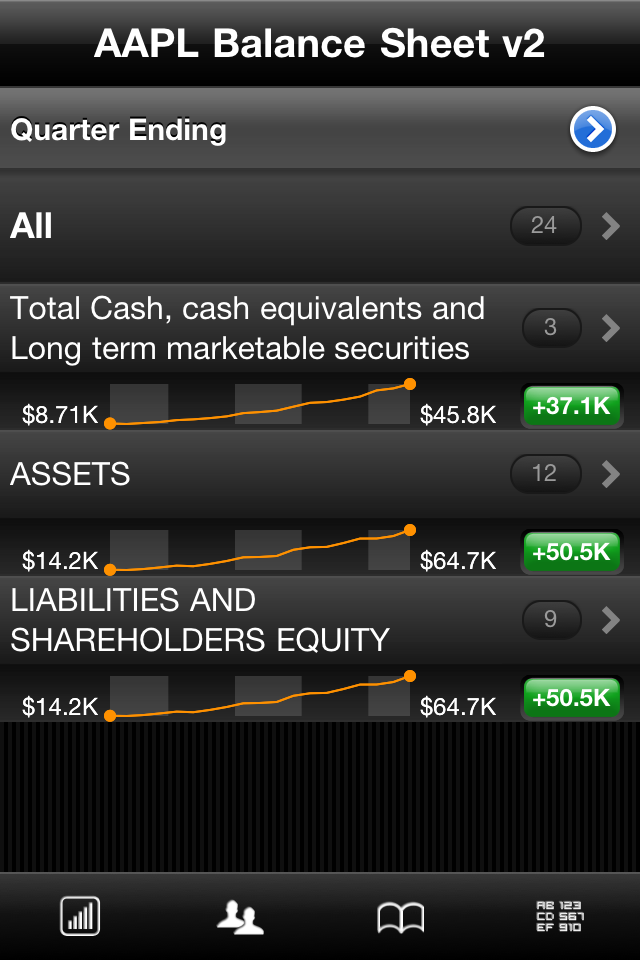
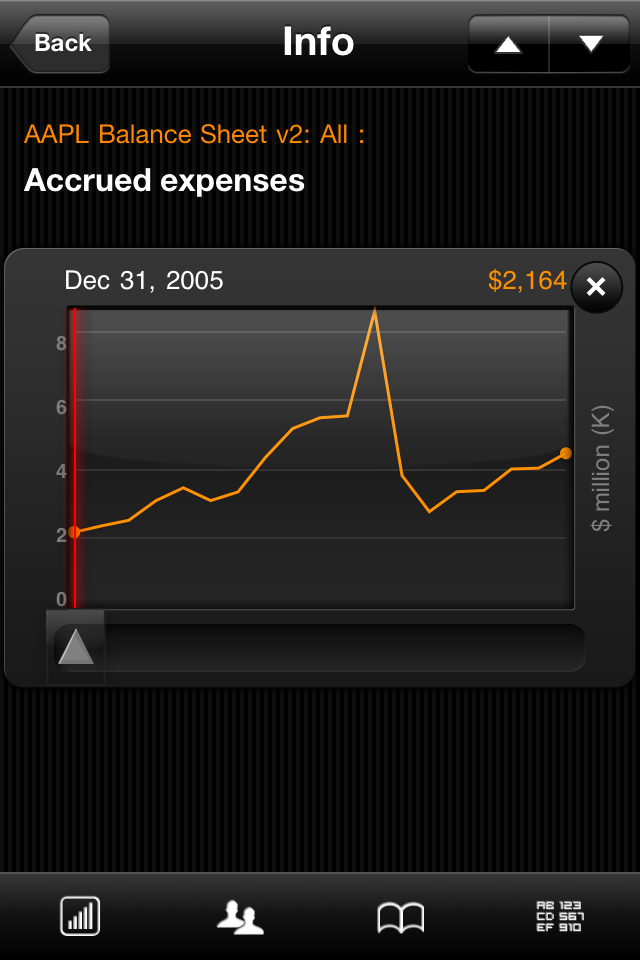
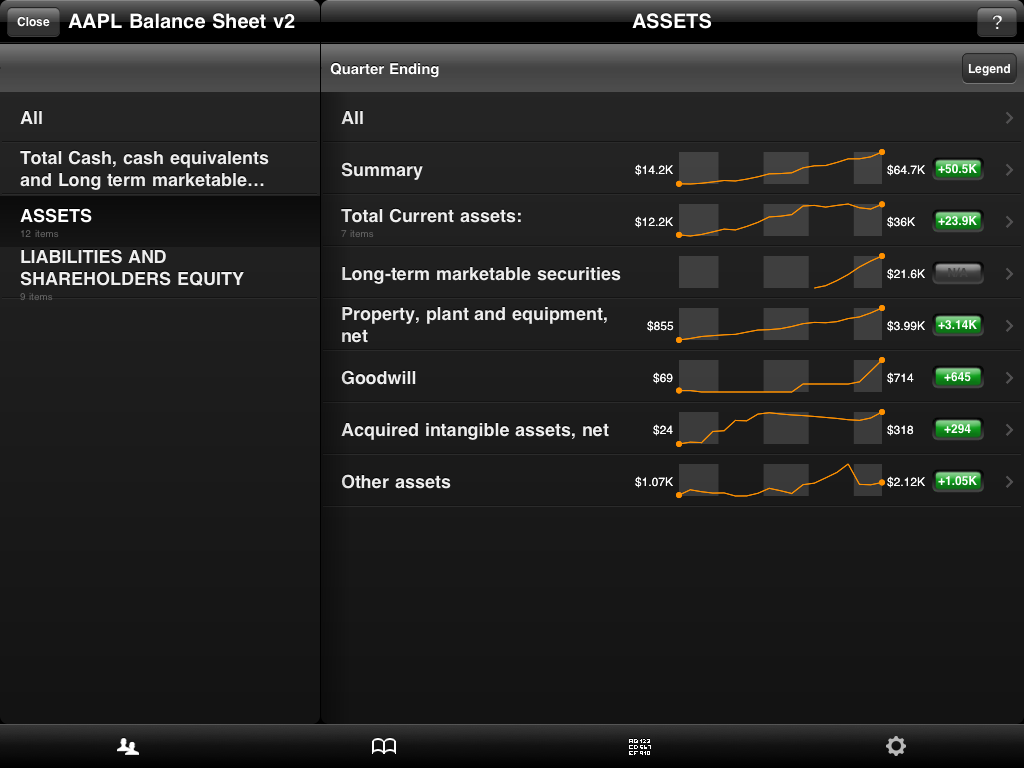
    Let your fingers do the walking through Apple's income statements since FQ1 2005. Glide effortlessly through juicy bits of assets and liabilities. Slide your finger through nineteen quarters of financial goodness.

    A special bonus: included is a separate visualization of Apple's liquid assets: cash, cash equivalents, Short-term marketable securities and Long-term marketable securities. $$$$$!

    Brilliant to use and look at on both iPhone, iPad and iPod touch:

    Get it here.

    AAPL Balance Sheet v2 using your iOS device.

    You will need to have Roambi™ installed on your iPhone, iPad, or iPod Touch to open this file. (It's free!) Tap Here To Install.

    Read more about ADDs in Asymco's ADD Page.

  13. Subscribe to Asymco One for full access to our research.

  14. All the new screens

    Research · 15 comments

    There is a rush to market a whole new batch of tablets. Here's another one.

    Image (www.pocket-lint.com)

    Yet another tablet

    They all bear an outward resemblance to another tablet that was widely panned.

    So what strikes me about all of these designs is that they're basically just shiny rectangular things. There is very little you can do as a vendor to stand out with any particular rendition of a rectangle.

    This is also becoming obvious with the mechanical design of smartphones. They are all smaller rectangles with shiny black screens.

    Which begs the question: as they are all just screens, shouldn't what's on the screen matter more than the screen itself?

    It seems only one vendor shows what's on their screen.

  15. Subscribe to Asymco One for full access to our research.

  16. Bond market discounting Nokia's credit rating

    Research · 6 comments

    The world’s largest mobile-phone maker’s bonds are trading as if Nokia’s rating has been cut, with spreads over government debt widening as the company strives to develop devices with the same mass appeal as the iPhone, Research In Motion Ltd.’s BlackBerry and devices based on Google Inc.’s Android software.

    There’s a “significant amount of risk overall with Nokia’s business model,” said Scott Shiffman, who directs bond research at Chapdelaine Credit Partners in New York. “Credit spreads should move wider over time and ratings will continue to move lower. We think the ratings agencies will play catch-up to the business deterioration.”

    via Nokia's Credit Rating in Jeopardy on Falling Profit, Bonds Show - Bloomberg.

    Management response continues to be that Nokia is "by a very wide margin the largest supplier of smartphones and small computers in the world.”

  17. Subscribe to Asymco One for full access to our research.

  18. Microsoft's billion dollar bonfire

    Research · 31 comments

    Microsoft executives told Goldberg during a recent visit to company headquarters that the company, carriers, and manufacturing partners, would spend "billions" of dollars in the first year on marketing and development of Windows Phone 7. Another source estimated a $1 billion price tag for the launch, with half of it going to marketing.

    via AppleInsider | Microsoft to spend over $500m to catch up to iPhone, Android.

    Note the scale of spending here.  The number quoted is twice Apple's yearly ad budget, for all its products.

    $500 million is roughly the equivalent of Apple's entire advertising budget for its 2009 fiscal year. In its 2009 Form 10-K filing to the SEC, the Cupertino, Calif., company listed $501 million in advertising expenses. Microsoft's fiscal 2009 advertising budget was $1.4 billion.

    But beside the unrepentant destruction of Microsoft's shareholder wealth, one other thing jumps out at me: why are the operators and vendors going along with this?

    Fragmentation increases the cost of development, marketing, operations and hinders the creation of cohesive ecosystems.

    Most companies are very aggressive in consolidating around internal platforms and standards. Supporting R&D teams and marketing teams around each platform is costly and dilutive to one's brand.

    With hundreds of Android devices and RIM and Apple increasing distribution, why would operators be willing to spend hundreds on a venture to promote a new platform? This decision is even more puzzling when realizing that the vendor of the new platform left nothing but business model carcasses behind the last time they got involved in the industry.

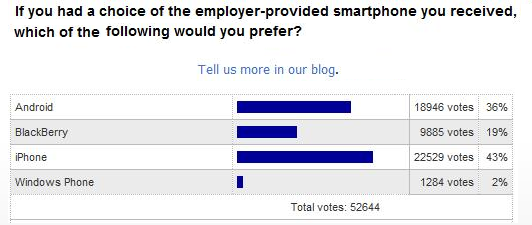
    In addition the positioning of this product is suspiciously awkward. One could argue that as a vendor or operator, having an unaddressed or underserved market (say, business users) might mean this platform could expand the distribution of your product or service. But Windows Phone is being positioned as a consumer brand and that's a crowded space where every other platform is also targeted. See the survey data below (unconfirmed source: US Army)

    So again, why would operators and licensees spend hundreds of millions to introduce yet another platform in the market?

    Maybe they are just taking Microsoft for a ride.

  19. Subscribe to Asymco One for full access to our research.