Asymco

Asymmetric Intelligence

Latest from Asymco

  1. Is Mobile Computing Good Enough?

    Research · 1 comment

    This new "mobile computing" use case that smartphones try to serve is not going to be satisfied with solutions that are built from modular components.

    The reason is simple: as the solutions are not good enough (because it's early days), they need to be improved. If they are to be improved, competitive pressure will compel those who try to do so as rapidly as possible. The fastest climb up the trajectory of performance will get the bulk of the benefits. Modular implementations are simply not fast enough in cycle time of iteration in comparison to the integrated approaches.

    This is why Apple will grow faster than Google, Nokia and Windows Mobile.

    How does this relate to the ecosystem?

    Many have been commenting that Google's (or Nokia's or Microsoft's) ecosystems are more "open" or "flexible" with respect to Apple's. And that in the long run that is the right architecture. That may be, however implementing loose ecosystems coupled loosely to modular devices and operating systems and services as a whole will not be competitive. They will be too late, too slow and too hard to use. They will be awkward to position and the benefits will be impossible to explain to end users. They will be sold through a distribution channel that is too long and with poor information feedback. Too many "vested" interests will dilute the product's reason for being. The pricing of the integrated player will cause poor economies for the modular cohort. I could go on but it suffices to say that the modular approach will fail to be competitive.

    Footnote: the arguments for the imminent explosion of Android are all based on a forecast from Ken Dulaney at Gartner. It was also Ken who in 2004 forecast that Windows Mobile will dominate business devices and that RIM would never gain share leadership. Here is why he is wrong now as he was wrong then:

    Ken and his peer group are implicitly and explicitly owned by the customers he tries to serve. What I mean is that Ken is hired by those who have the money but not the competence to think by themselves. His clients are the incumbent device vendors who are signaling to him that they will increasingly license Android (as they signaled that they will license WinMo before). He adds up all the signals he gets and multiples by random numbers to get a forecast. It's a supply-side forecast assuming "Porter's five forces" is still at work. In that sense, he is selling back to his clients what they've already told him. He is hired to validate their assumptions and that's what he delivers. Rinse, repeat.

  2. Subscribe to Asymco One for full access to our research.

  3. Motomojo

    Research

    Motorola shipped 13.6 million handsets in the quarter, compared with 25.4 million in the same quarter the year before.

    Android will not save them. Not least of all because HTC makes better Android devices.

  4. Subscribe to Asymco One for full access to our research.

  5. Subscribe to Asymco One for full access to our research.

  6. Subscribe to Asymco One for full access to our research.

  7. Apples vs. Nokia in North America

    Research · 1 comment

    Comparing US sales of iPhones vs. Nokia's NA device business.

    AT&T iPhones activated in Q3: 3.2 million

    Nokia phones sold in North America Q3: 3.1 million

    (obviously, Nokia's figures include Canada and Apple might have sold a few more phones in the US than AT&T activated so Apple outsold Nokia by a significant margin in units in the US.)

  8. Subscribe to Asymco One for full access to our research.

  9. Market Caps

    Research

    For reference, some selected current market caps:

    • Microsoft (MSFT) - $236.76B
    • Apple (AAPL) - $183.40B
    • Google (GOOG) - $173.97B
    • IBM (IBM) - $159.93B
    • Cisco (CSCO) - $138.60B
    • Hewlett-Packard (HPQ) - $114.26B
    • Intel (INTC) - $109.85B
    • Disney (DIS) - $54.31B
    • Nokia (NOK) - $48.24B
    • Research In Motion (RIMM) - $37.43B
    • Amazon (AMZN) - $40.34B
    • Dell (DELL) - $29.63B
    • Sony (SNE) - $29.10B
    • Yahoo! (YHOO) - $24.78B
    • Motorola (MOT) - $18.82B
    • Adobe (ADBE) - $18.23B
    • Palm (PALM) - $2.51B
    • RealNetworks (RNWK) - $564.74M

    The top 10 world-wide:

    1. Exxon Mobil Corporation 352.31B
    2. PetroChina Company Limited (ADR) 240.47B
    3. Microsoft Corporation 237.58B
    4. Petroleo Brasileiro SA (ADR) 220.19B
    5. BHP Billiton Limited (ADR) 204.30B
    6. HSBC Holdings plc (ADR) 199.98B
    7. China Mobile Ltd. (ADR) 199.09B
    8. Royal Dutch Shell plc (ADR) 195.76B
    9. Wal-Mart Stores, Inc. 195.27B
    10. Apple Inc. 183.57B

    Steve Ballmer is not worried, Apple is just a rounding error.

  10. Subscribe to Asymco One for full access to our research.

  11. Subscribe to Asymco One for full access to our research.

  12. Peugeot Renault and Citroen

    Research

    I'm trying explain the complete lack of interest in Nokia among the US blogging/early adopter audience. If you are an enthusiast, why do you not care about the market leader. The automotive analogy is not quite perfect, but there are brands that are just invisible to the community even though they are quite popular and significant.

    The French have a pretty crap reputation and it's not entirely undeserved, however what's worse than being talked about badly is not being talked about.

  13. Subscribe to Asymco One for full access to our research.

  14. Subscribe to Asymco One for full access to our research.

  15. Tim "Corleone" Cook

    Research

    When asked more pointedly, "So when you go from exclusive to multiple, you don't change the charge to the carrier?" Cook answered, "Correct."

    Apple has more pricing power than the Don.

  16. Subscribe to Asymco One for full access to our research.

  17. iPhone Money Trail

    Research

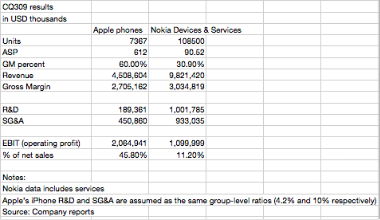
    Peter Oppenheimer, Apple's Chief Financial Officer, said that the Average Selling Price of iPhones in the quarter "was just over $600. This reflects both high mix of 3GS sellthrough and benefits of rebalancing the ending channel inventory toward the 3GS."

    An astonishing admission from Apple who has never revealed their iPhone ASP. Previous analyst estimates had the iPhone ASP at $550. If this is true, then Apple has violated one of the cardinal mobile industry rules: "Thy ASP shall always erode". Given what is known about the components, iPhone gross margin is likely to be above 50%. The gross margin, or what you are able to capture in value above the bill of materials, isthe primary indicator of value creation in the device business. Apple's number is astronomical vis-a-vis the competition. Stay tuned as this gets scrutiny.