The following is a list of the best-selling products across several categories:
Car model: VW Beetle 21.5 million Car brand: Toyota Corolla 43 million Music Album: Thriller 70 million Vehicle: Honda Super Cub 87 million Book Title: Lord of the Rings 150 million Toy: Rubik’s Cube 350 million Game console: Playstation 382 million Book series: Harry Potter Series 450 million Mobile Phone: iPhone 1 billion
The iPhone is not only the best selling mobile phone but also the best selling music player, the best selling camera, the best selling video screen and the best selling computer of all time.
It is, quite simply, the best selling product of all time.
It is that because it is so much more than a product. It is an enabler for change. It unleashed forces which we are barely able to perceive, let alone control. It changed the world because it changed us.
And it did all that in less than nine years. One has to wonder what it will enable in the next nine.
What is an innovation? What is the difference between ideas, inventions, novelties, discoveries and creations?
What is a disruption, formally-speaking? Also, what is it informally speaking? Why the distinction?
What is Performance (or P-space)? How does Performance relate to utility, quantity, price and other microeconomic concepts?
What is a new market? How do we distinguish a new industry from a new market.
Do firms matter? Are firms causal to economic growth?
What is the role of technology in innovation? Can we innovate without technology? Can we fail to innovate with technology?
Do firms have life in the biological sense? If not how do we measure their existence?
What are entrepreneurs? What do they do that’s different than what managers or business leaders do?
How do you navigate P-space? How do you think about your business and economy in performance terms.
What is a diffusion? Is adoption a good measure of technological progress? What is the connection between diffusions and disruptions?
How does Capital map to P-space?
How can we maximize economic growth? Is there a growth algorithm? What is the role of government policy in growth? What about the role of the creation of customers?
What is the difference between consumption and non-consumption? What is non-production?
What are the known forms of disruption? Can there be forms we don’t yet know about?
Why do customers buy solutions? Understanding the causes of purchase decisions.
Are profit motives necessary for growth? What motivates individuals, if not profit?
A merger is the result of two entities in the same business joining forces. It is usually justified through "synergy", a euphemism for removing redundancies from their unity. Arithmetically, the desired outcome is that the resulting organization should be smaller than the individual parts (which is desired if the available market is shrinking.)
An Integration is the answer to the question of "Why two companies in different businesses are better off together." Arithmetically, it suggests that the proposed sum is greater than the individual parts.
The spin-off is the response to a situation where one company houses two unrelated businesses.
For completeness, we can define an acquisition as the purchase of an unequal entity in order to improve the value of the acquirer.
The logic of any of these is that there is a disequilibrium which offers an opportunity to those who can exploit it. What the analysis fundamentally assumes is that the status quo of firm boundaries is not optimal.
Much of the measurement of the balance in the equations assumes that the overall industry is stable and that the problems (technical or market) are largely understood and that there is no learning that needs to happen. Boundaries need to be re-drawn because they are imperfect. Boundaries may have grown imperfect for many reasons: founders/owners were separate, markets and technologies evolve at different rates, resources are inflexible, processes are entrenched and values are outdated.
However, all this arithmetic can be safely thrown out of the window if there is a new industry in the making. If there is no balance to begin with because there is an entirely new problem being posited. That is, not only do we not know the answers to technical or market questions, we don't even know what the right questions are.
When looking at the history of industry creation, the breakthroughs were always about the discovery of the right questions to ask. The early automobile industry was a scramble for solutions to a huge number of technical and market questions: technology, business model, infrastructure, usability, customer segmentation. From 1886 until 1915 there were many grand experiments with thousands of automobile firms springing up. ((Estimated 3000 world-wide))
Early computing, internet, mobile and consumer durables industries went through similar periods of grand experimentation. But the breakthroughs occurred when someone was able to ask (and subsequently answer) a question that nobody had asked before.
Henry Ford asked, "What would enable everyone to have a car". The result was not a better car but a better production system.
Steve Jobs asked, "What would enable everyone to have a computer". The result was not a faster computer, but a more approachable computer.
Akio Morita asked, "What would enable young people to have their own music". The result was not a better audio quality but a smaller audio player.
Kiichiro Toyoda asked, "How can a car be built without faults". The result was not a bigger factory but many smaller ones.
Jeff Bezos asked, "What would cause people to do their shopping online". The result was not a lot of unique sites but one infinite one coupled to a logistics and computing service.
Having great taste in questions turns out to be the principal quality of the successful industrialist: The creation of economic value and power well beyond the boundary of the firm itself.
When the correct question is asked, resources can be efficiently marshaled to answer it. The wrong or incomplete question leads to inefficient resource allocation. And so the architecture of the solution can be built. If the new problem statement is a technical one then an integrated implementation is required. If the new question identifies non-consumption then a modular implementation is required. Each of these approaches suggests different customer sequencing strategies and different application of resources and processes.
There is no right architecture for industry creation. What matters is asking the right question.
So is Elon Musk, today, asking the right question?
The presumptive question seems to be "What would enable everyone to have an electric car?" This is not a great question if it is seen as a continuation of other such questions: "What would enable everyone to have a safe car" or "an efficient car" or "a reliable car" or "a fast car" or "a second car" or "a fashionable car" or "a bigger car", etc.
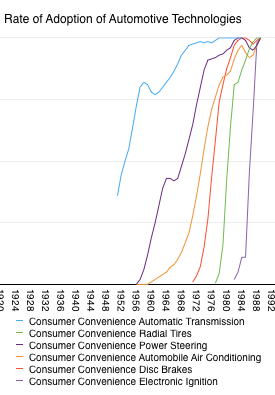
These previous questions were answered by introducing sustaining improvements or modules to the existing production systems. The following graph shows the speed of adoption of various automobile technologies. Hundreds more were introduced and all could be shown to have roughly parallel adoption curves. None of these introductions changed the structure of the industry. ((The industry changed through revolutions in production systems)).
To make electric cars therefore all one has to do is to reduce the cost of electric components for carmakers. They certainly make lots of cars and can make lots more. So why not give them the economic incentives in the form of components to build electric ones? ((Incidentally, hybrid cars are slow to be adopted because the modules are not available as such. Each manufacturer is struggling to match Toyota's solution through internal development—a decade-long process.))
Tesla seems to be an attempt to incentivize carmakers to build electric cars by setting an example. Maybe it will succeed but this is not a reliable or even viable way to build a defensible business. Envy generates the wrong competitive response, usually. If that business cannot be defended then it will perish and so perhaps will the acceleration.
And so we come to the question of whether the defensibility of Tesla relies more on integration. By adding ancillary businesses, can it sustain itself and perhaps eventually pivot away from a commoditizing business (car making)?
Through the addition of a business building batteries and then a business selling home power storage and now adding a business selling home solar power provisioning, the car business becomes a module in a larger system.
So is Musk effectively asking "How to accelerate a global transition away from hydrocarbon energy?"
This gets more interesting as a question. The production, storage and use of energy have been modularized over a century and a half from the wood era through the hydrocarbon era. Perhaps the renewable era will be characterized by integration and de-networking or edge-enabled production. If so the energy problem needs to be solved through a re-integration and a new set of business models. Production and consumption can be coupled and thus production can be decentralized.
But is the answer Tesla+SolarCity? An integrated approach is appropriate if the technical problems are very difficult and cannot be solved through collaboration across firm boundaries and if buyers are eager for great leaps in performance. Join forces if introducing a new measure of performance, solving an unmet job to be done.
A modular approach is appropriate if the problem is one of scale and reach. That is, remain separate if the problems are with finding and building new markets (competing against non-consumption) and if customers are eager for convenience or conformance while being largely satisfied with performance.
This is the crucial dichotomy: The business architecture needs to match the point of time in the evolution of the prevailing measure of performance. Consider this proposed integration an experiment to determine what performance we should measure and thus where we really are.
When Spotify and Pandora were starting their streaming services many were quick to point out that Apple was about to be disrupted. The future, they said, was streaming because (young) people could not be bothered with ownership of music and the limitations of a personal collection. Who would want to pay for a few hundred songs when they could listen to millions for free?
This perception continued and became more vocal over the years. Seven years in fact. Spotify collected 20 million paying subscribers while Apple did nothing. Pandora grabbed 80 million active listeners and possibly 4 million paying subscribers while Apple did nothing. The boat had sailed and Apple was not only not on it but oblivious that there was a boat in the first place.
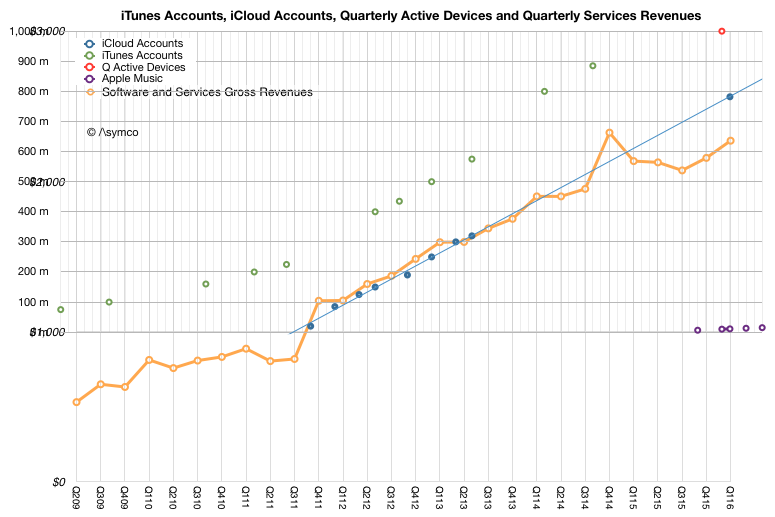
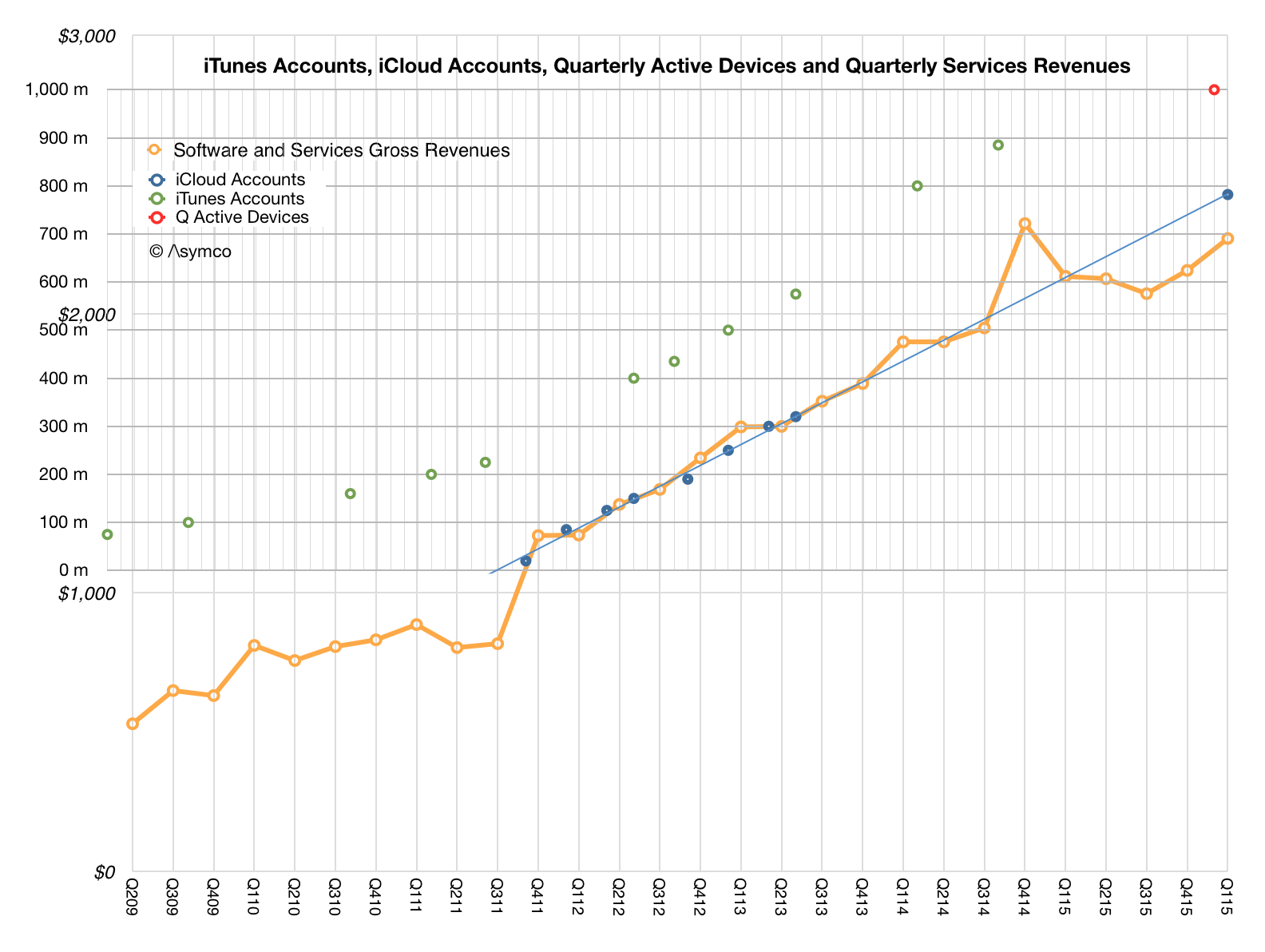
At first Apple launched a half-hearted streaming service and then a paid service finally showed up with Apple Music in mid 2015. Since then the company managed to add 15 million subscribers. A tiny number compared to the 900 million iTunes accounts it had reported a year earlier. Pathetic. The number of music subscriptions relative to iCloud accounts, iTunes accounts and active devices is shown the the graph below.
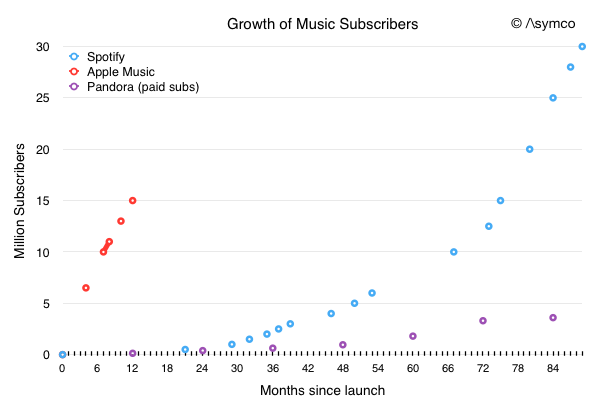
It may be paltry compared to the count of users Apple may have in total, but how does a 15 million user base in 1 year compare with the growth rate for the incumbents Spotify and Pandora?
The following graph shows the ramps for Spotify, Pandora and Apple Music since their moments of market entry. The accumulation of users by Apple looks to be the fastest yet.
This is, of course, due to a maturing use case. Apple did not have to educate people to the notion of music as a subscription. It could just announce it and users would discover it and just sign up, especially if they were already iCloud subscribers and had a credit card attached to their iTunes account.
But that's the whole point. Apple did not have to move first in music subscriptions. It did not even have to move second or third. When it did move it could just skim the market and add to its already healthy Services revenue (orange line in the first graph above.) Missing the boat in music in this case meant capturing all the value quickly and with minimal expense.
Fundamentally, Apple's entry into music subscriptions was a sustaining effort. Streaming sustained Apple rather than disrupting it. The difference may seem merely one of semantics, but it is also the difference between life and death for a challenger. Meaning matters.
This is a cautionary tale for those who would pronounce every new idea as "disruptive" to Apple or anyone else on the basis of novelty alone. The tests for disruptiveness are easy enough and it behooves the analyst to apply them before dropping the d-bomb.
Apple is among the biggest companies in the world. But what has it done for us lately? We break down where the company is headed with help from two of the best Apple analysts in the game -- Horace Dediu and Neil Cybart. How does Apple compete going forward? Will they introduce a car? Or are they doomed to a slow decline?
At WWDC 2016 Apple offered a set of new data points to illustrate its ecosystem's robustness.
First, the number of registered developers increased by 2 million in the last year to a total of 13 million. That is a growth rate of 18%. To compare this total consider that Oracle claimed in 2014 9 million Java developers and IDC claimed in 2014 there were 18.5 million software developers in the world, of which 11 million were professional software developers and 7.5 million were hobbyist developers. It's therefore possible that Apple's "market share" among developers is close to 70%.
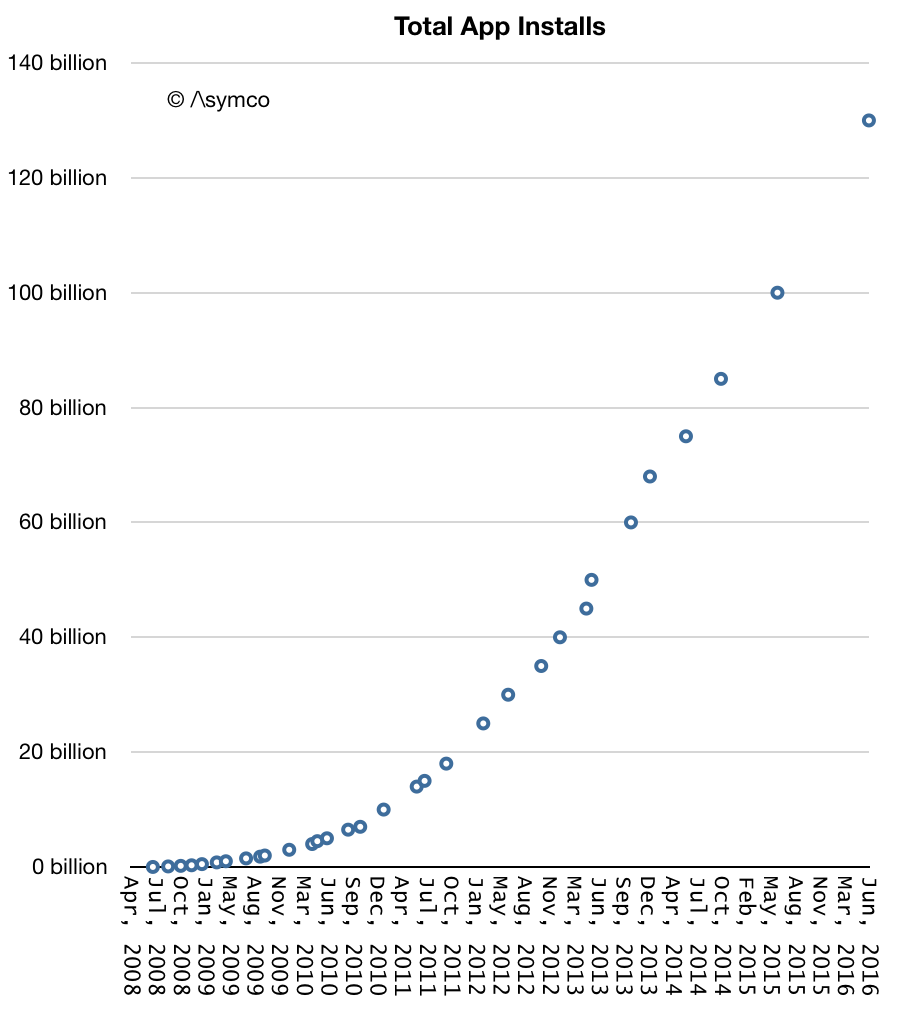
Second, App installs have now reached 130 billion. The cumulative growth is shown in the graph below:
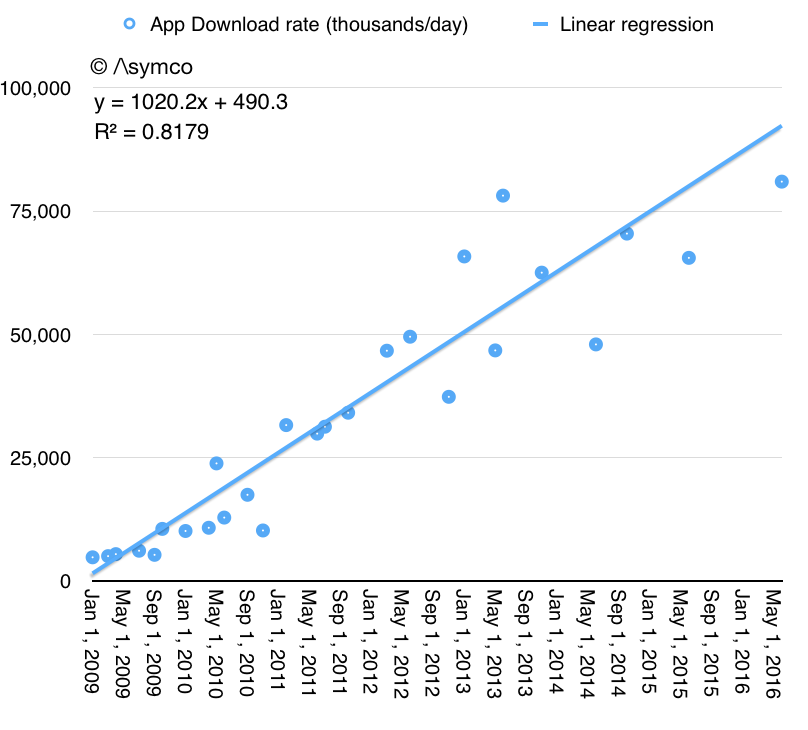
The rate of growth is also shown in the following graph:
Note that the rate of growth continues to increase and is now above 30 billion/yr. It turns out that apps continue to be a popular download item. The size of the audience continues to grow (see graph below) and it's therefore understandable that activity in the store continues to grow.
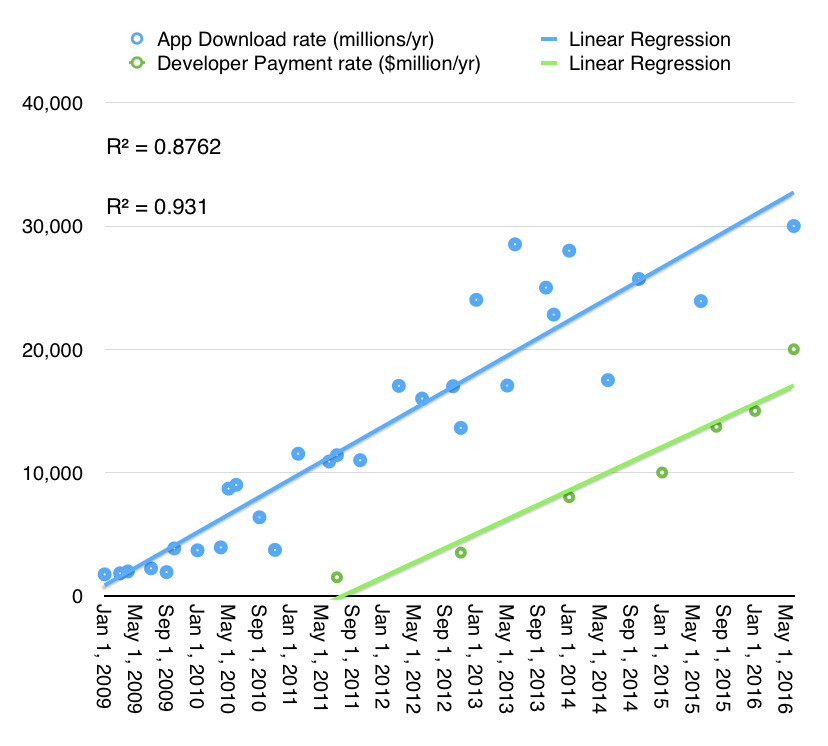
Third, the rate of payment to developers has also increased to over $20 billion/yr., with the total payments having reached $50 billion.
The graph above shows the derived payment rate (in green) relative to the download rate (blue). Although not completely parallel, the overall correlation is plain to see.
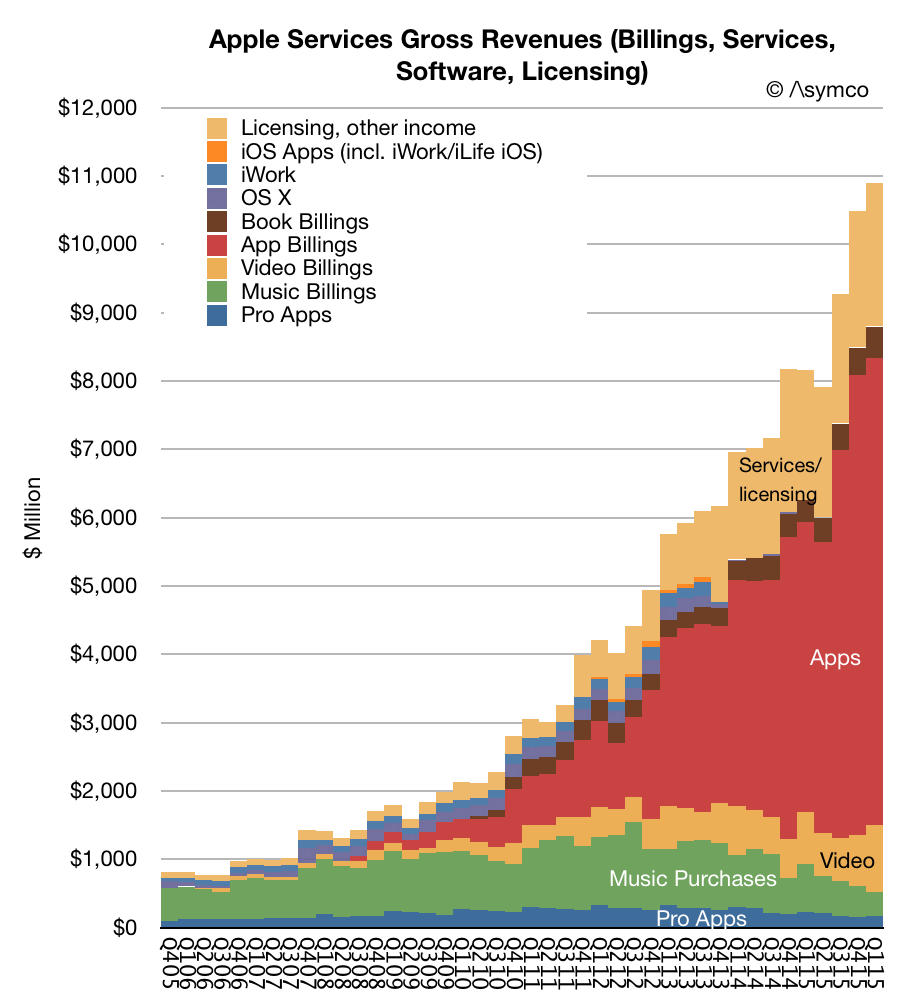
Fourth, there are more platforms than ever (four device and three services). As a result, Apps and services continue to outgrow traditional content revenues. Gross revenues for iTunes/Apps/Software/Services/Licensing is shown below:
Overall, economic activity transacted directly through Apple's platforms is approaching the run rate of $40 billion/yr. It continues to grow at about 20%, so it's foreseeable that it will reach at least $50 billion/yr.
It's hard to compare to other ecosystems as metrics vary but this rate alone places Services as one of the larges businesses in the world (service or otherwise).
There are other ecosystems "on top" of iOS which transact outside the Apple systems (and hence are not reported in the total above). These include Facebook, Google, Uber, Amazon and other economies which use iOS devices to enable engagement. These add up to hundreds of billions of dollars in transactional value. My estimate is that all mobile services are at least $250 billion/yr today and will reach $800 billion/yr in 2020. Apple is and will continue to be the home or enabler to the majority of this revenue.
But the more profound point to be made is that this ecosystem relies mainly on direct payments by the beneficiaries of the service or content. Apple contents itself with the $35 billion it can transact through its own storefronts because it feels that the business models are compatible with its brand.
When it comes to all the ways of "monetizing" platforms, this may be a very conservative strategy but it's one that also avoids the potential pitfalls of social scandal.