With its recent release of the new Kindle Fire HD tablets, some have argued that Amazon has declared war on Apple and its iPad. But how serious is the threat? Are the two companies even playing the same game? I reached out to analyst Horace Dediu, founder and author of Asymco, to get his take. Dediu will speak on all this and more at TOC Frankfurt on October 9, 2012. Our short interview follows.
Matteo Fumagalli is a student of economics at University of Insubria, Italy. He is writing a thesis for a bachelor's degree analyzing the smartphone industry.
He asked me to answer the following questions:
-First question is about you. Why did you found Asymco?
I founded the company to develop software, mainly apps. I began writing the blog as a way to drive traffic to the site. I would have preferred to build a blog only but did not think it was possible to earn any money doing that so I treated it as a hobby. Even after the site became more visible I changed from development to consulting and did not expect that writing in itself could be self-sustaining. It took about two years before I felt comfortable with the idea that I could do writing and speaking exclusively. I am still exploring additional business models however.
-You worked 8 years as analyst and business development manager at Nokia and you anticipated their current crisis with your first post on Asymco. Do you think Nokia will have the chance to recuperate, and eventually what will be the role of Windows Phone?
Nokia may recover or remain independent, at least. But it will be far smaller. The idea of a return to dominance or 40% share seems very unlikely. As I pointed out in the first post, the organization cannot cope with the new marketplace. Large organizations require extreme stress and damage to change. It's a phenomenon at all levels of society that success results in rigidity. From the individual to the nation to the civilization, success makes change very, very difficult.
Windows Phone is an attempt to create a third ecosystem. I am concerned that the logic of having a third alternative is not solving a consumer need but an operator need. In other words, consumers are not asking for a third option and when they are presented with a third option they are not excited by it. The consumer does not think in terms of increasing their options. They decide once every two years which phone to buy and that is the end of their thinking on the subject. By focusing on the operator's needs the platform is fundamentally mis-positioned.
What Windows Phone needs to be positioned as is either as fundamentally different, solving a different job for the consumer. Or fundamentally better along a new dimension like price or convenience. These are some of the claims it makes but they are very weak claims right now.
-What about RIM, other company which is going through difficult times? What do you think about their decision not to move to Android and stake everything on their closed OS?
The decision to remain with their own platform may sound risky but it's a simple decision about retaining their business model. RIM is not a general-purpose manufacturer. They have always made an incremental margin on services, messaging and email. For them to use a third party OS would force them to build within the constraints of that OS or platform. That would result in a difficult competitive environment and not one where the company could sustain margins vs. larger competitors. In other words, the company faced two risky alternatives. They chose the risk they were more familiar with or the one that they already had an operating company organized for.
-Recently Apple lost market share in Europe and China favoring Android. What will be the impact of iPhone5 on this situation? As expert of Apple strategy, do you think Apple has done something wrong in these last months?
Apple lost market share when considering the smartphone market. I agree with management (and I've argued this before they did) that the market for the iPhone is all phones, not just smartphones. In that context, Apple is increasing its share consistently. Since Apple has only one product in the market (with some residual older versions as well), it's very seasonal. It would be natural to see variance in share through the year. What should be watched is a four period average performance. Overall, Apple is growing its iPhone business faster than the overall phone market so it follows that its share is increasing. I see a long-term potential for the iPhone having 20% share of all phones. That would give it an installed base of over 1 billion users.
-Smartphone penetration is reaching 60% and we probably talk about saturation in next 2 years. What will be for you the future role of tablets and phablets, they will be threaths of substitution for smartphone or maybe an opportunity to offer complementary products?
The evidence so far is that buyers don't mind having more than one device. It makes sense if each device is hired for a different job and it cannot be general purpose enough. We've seen this phenomenon with mobile phones where penetration in many markets is above 100%. That implies that even a basic feature like a phone number cannot serve all the needs on one person. To me it seems likely that one person will have more than one device and more than one form factor.
-What do you think about legal battle between Apple and Samsung? There will be consequences also for Google and Android?
I defer to my blog post Deus Ex Machina. Legal battles are not strategy.
-What will be the role of the possible entry of Amazon in the smartphone industry? It's too late for them?
Amazon is a retailer. I find it hard seeing a retailer becoming a platform provider. Not only is retail a difficult to expand business model internationally, but it's hard to imagine partners being comfortable building an ecosystem on top of retail. Retail is not sufficiently flexible as a business model.
We don't want to just make a new phone. We want to make a much better phone.
- Jony Ive, video at iPhone 5 launch event
Disruption theory has taught us that the greatest danger facing a company is making a product better than it needs to be. There are numerous incentives for making products better but few incentives to re-directing improvements away from the prevailing basis of competition.
This danger is more acute for technology companies. Coupling incentives with the speed of improvement in various technologies (aka Moore's law) means that over-service can come suddenly and more quickly than warnings from the marketplace. A product can tip from under- to over-shooting the market within one product cycle. One year the product is under-performing and trying to catch up to the competition and the next it's superfluous and commoditized. The dilemma is compounded by the cycle time of development which can span multiple product cycles.
Therefore, how to tell whether a product is over-serving a market is one of the most important and frequently asked questions I get asked. It's easy to see over-service in the rear view mirror when looking at a multi-year pattern. The trouble is that by the time you see the data, it's too late. How do you tell you're on the cusp of good enough, subject to imminent disruption before you get there?
I consider measuring a product's absorbability to be a marketing problem. The marketer's job is to read the signals from the market[1]. Determining absorbability comes down to reading two market signals, both of which must be met before green-lighting an improvement: (a) a product's improvements must be used and (b) a product's improvements must be valued.
If a product's improvements are not used and the buyer will not pay more for them then they are not being absorbed and the effort to develop the improvements should be redirected.
Now the problem becomes one of measurement. Of the two, utilization is easier. Data can be gathered on whether a feature is being used. Research methods exist to tell if a feature would be used even if it's not available[2]
The more difficult assessment is that of the value of a feature. You can usually only tell value by trying to price it and watching what happens. For example, you add more speed/memory/capacity and try charging more (or the same) for the product. The acceptance will be measured by sales growth and will give you an indication of whether these improvements are valuable.
If you have to add features and drop prices at the same time then it's likely that the market does not value the improvement.
But this is extremely risky. You need to wait through a sales cycle and iterate through a development cycle before you have an answer. In a space where competitors are placing opposite bets, the experiment fails even if you get the data.
How can you structure a value measurement experiment without wasting an opportunity?
Rather than dealing with hypotheticals, let's use the iPhone as a test case. As Jony Ive states, the focus for the latest iPhone was to make it better. Is this improvement absorbable? What happens if Apple's bet on being better is wrong?
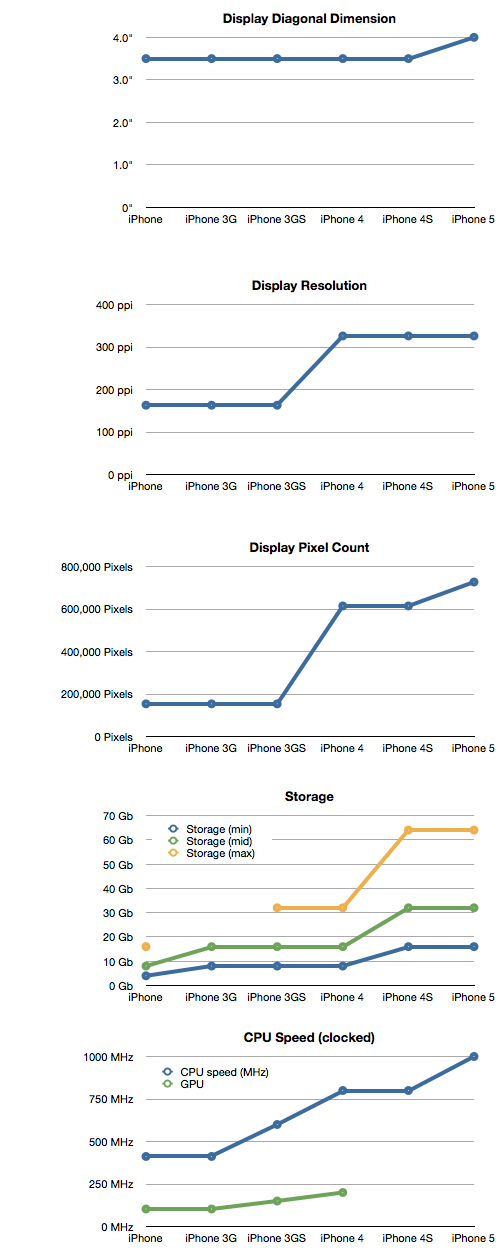
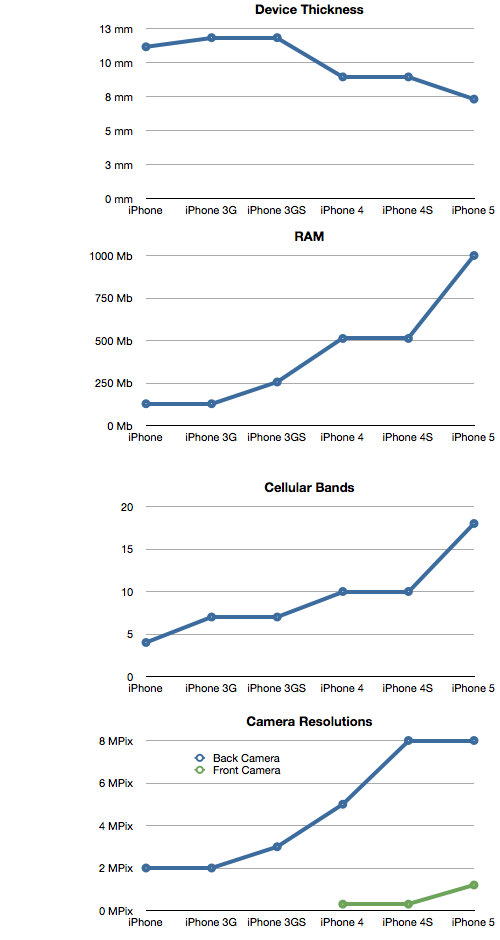
First, we can confirm that the iPhone has been on a trajectory of getting better and that those improvements have been absorbed so far. We can measure the history of performance of the product (roughly doubling every year) and we can also measure proxies for performance as I have in the following charts:
As the product has been improved along these dimensions, sales have increased and prices have held steady (even rising occasionally.)
The question is about the future: what about the latest "5" variant?
The clue to this experiment is the presence of a control group. We could test the question of absorbability by keeping a version of the product which did not improve (or got cheaper) and measuring whether it performs better vs. the "improved" version.
Of course, this is exactly what Apple does with the n-1 generation products. By ranging products which are older and at lower price points it can measure whether the improvements are valued.
If sales of the n-1 variant were to increase relative to the new version then they can understand when they are at the point of good enough. The experiment is brilliant because the margin on the older products is maintained even at the lower price point.
We don't have public data on the performance of the old vs. the new but some studies show that, at least in some markets, the older variants have, so far, been a minor part of the sales mix. The CIRP study from early this year showed that about 90% of holiday iPhone sales in the US we for the latest (4S) variant. If this pattern persists globally and for the 5 then the improvements can be said to be valued.
If the new features (as represented by the metrics charted above) also get broad engagement--data which Apple can easily obtain--then the iPhone 5 can be declared not good enough. The company can then comfortably work on improving it further.
---
Note that the marketer's job is to listen not to talk.
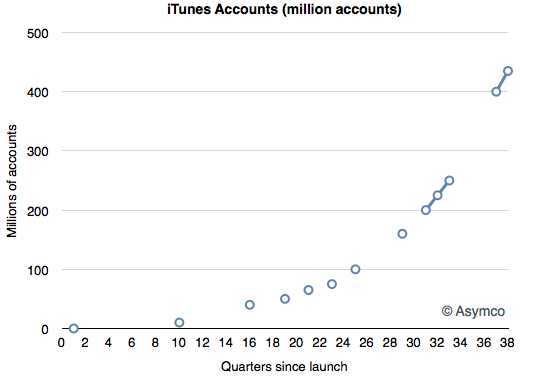
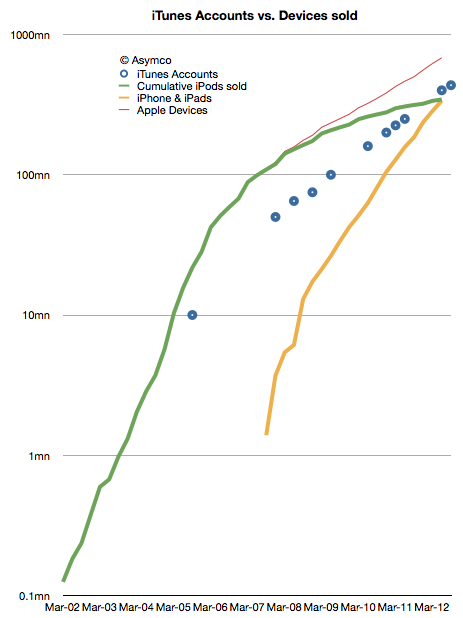
During the iPhone 5 launch event, Apple announced 435 million iTunes accounts (with credit card numbers) with one click shopping.
The account total is updated occasionally by Apple and the history of these updates is shown below:
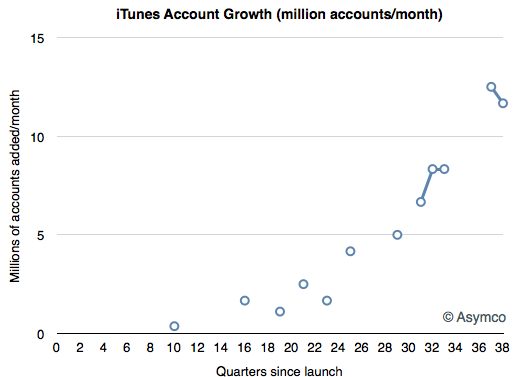
Measuring the growth in accounts shows steady acceleration.
The current rate is approximately 12 million new accounts per month.
The growth in iTunes accounts mirrors the growth in iOS usage as shown the following chart:
The alignment between the circles and the red line should offer an alternative method of projecting the platform's growth.
Projecting the growth forward would imply one billion accounts in another two years. As iPhone and iPads growth increasingly converges with iTunes (of which there are 400 million units sold), the same time frame could apply to iOS cumulative sales.
This is not a very precise forecast, but late 2014 to early 2015 could see one iOS billion units sold.
Horace and Moisés discuss Apple's iPhone 5 announcement. Was there a strategic shift? Whatever happened to targeting the low end of the market? Also, what's in store for the iPod touch?
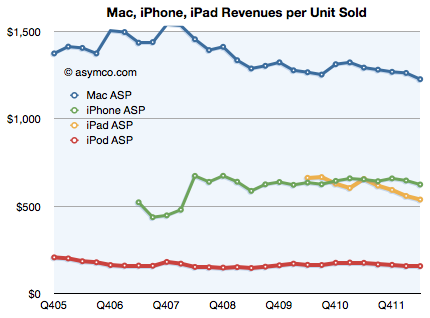
The most remarkable thing about the iPhone as a technology product is that it has been able to maintain pricing stability for over five years. As the following chart shows, the revenues per unit sold for the iPhone (as reported by the company) have held even as volumes grew exponentially.
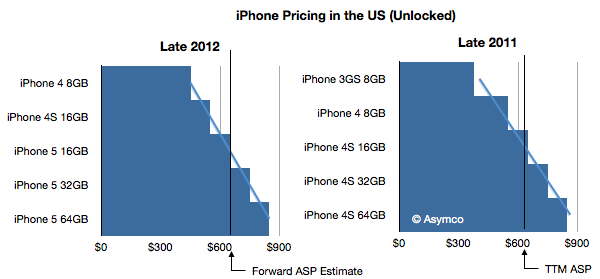
The latest version of the product should see no significant change in this pattern. I show below the price spectrum of the iPhone as available unlocked in the US (therefore assuming no sales taxes or VAT and no subsidy). I also highlighted the average revenue per unit from the latest four quarters.
The only difference between 2011 and 2012 is that the lowest priced variant is now $450 vs. $375 a year ago.
Without knowing the split between products, it's hard to tell how much impact this price increase will have. Note that the average price was very nearly the same as the 16GB variant ($643 ASP vs. $649 16G pricing). Assuming equal volumes for each variant, the average pricing for 2011 would have been $634. Therefore the actual ASP was only $9 higher than average pricing.
If we assume the same for this year (equal split between variants + $10) then the average price could rise to about $660. That would be a slight increase but it would be multiplied by many more phones sold.
In fact, going from $634 to $649 and selling 200 million units would imply an additional $3.4 billion in revenue.
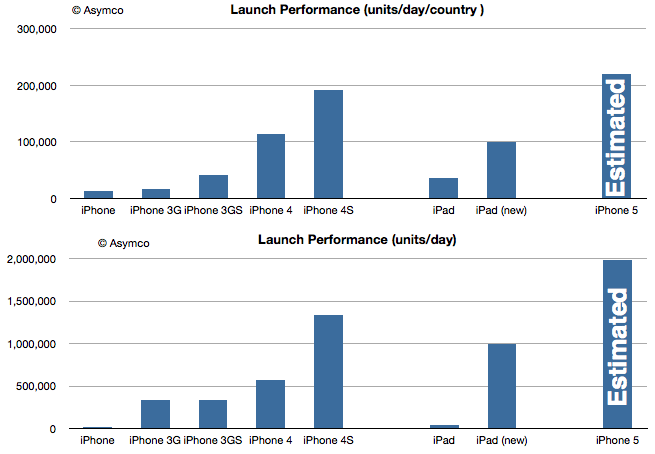
The iPhone 4S sold about 4 million units in the first three days of availability last year. The iPhone 4 sold about 1.7 million and iPhone 3GS about 1 million.
The main driver to growth for the initial weekend is usually upgrades for existing customers. There might be first time buyers, but the dedication required to ensure being first to have it usually means buyers are keen on the brand and are repeat customers.
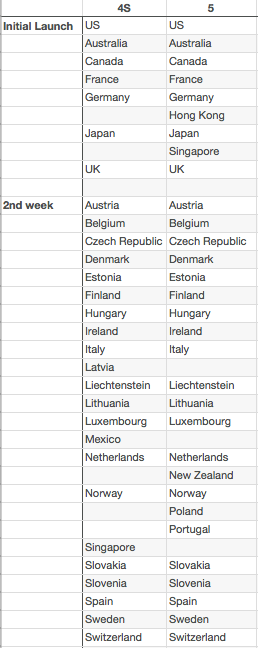
The other factor is the number of countries where the phone is available. The 4 was initially available in 5 countries. The 4S in seven and now the 5 will be in nine countries. I made a list of the differences in launch countries for the 4S and the 5 below:
I've also listed the second week launch countries for completeness and shown which countries have changed.[1]
The performance of the 5 in the first weekend should be better on a volume basis simply because there are more existing customers who wish to upgrade and because there are more initial and significant launch countries.
The 4S launched with an average of 1.3 million units per day but 191k units/day/country. The 4 launched with 113k units/day/country. If we assume that the 5 can capture 220k units/day/country we reach 2 million units/day for this launch footprint and a total of about 6 million units for the launch weekend.
These estimates are shown below relative the the other iPhone and the iPad launches.
The additional shipments to fulfill orders for the second week may see the iPhone 5 sell over 10 million units before the quarter is over.
---
Notes:
Hong Kong and Singapore are noteworthy initial launch additions, Poland a noteworthy second week addition and Mexico a noteworthy second week omission.
Horace is still out crossing the globe on secret missions, so Moisés Chiullan, host of Screen Time, fills in for Dan. This week, Horace covers his Swipe Conference presentation on the history of personal computing and the shift to new platforms that foreshadows the dawn of a new era, the state of the US mobile market and where Lumia fits into the fold, and how Samsung moves forward in the wake of the litigation.
Amazon will sell as many Kindles as they make, but the number they will make will not be the most they could make.
The logic of selling a product which has a profit model unrelated to the cost of goods sold is tricky. The incentives are different. The risk is not selling too few but selling too many.
For this reason I think the total number of new Fire units to be sold has already been determined by a production order. You cannot think about the business from a demand point of view. If the product would be free then the demand would be infinite. The decision about how many will be "sold" will depend on the goodwill of the producer.
What Amazon tries to do with the brand is ensure that the Fire is in the hands of its most ravenous consumers. That is why it's not sold in all markets or through all channels. They are sold through Amazon.com in the US (limited sales in UK as well). This is because a large number of the product in the hands of users who only use it for browsing or in areas where Amazon does not have content deals or where its ads are poorly targeted (e.g. India, Indonesia or Madagascar) would be a disaster. It may not be all that helpful to Google to have Android in those markets but as you would expect it's still a profitable business for Apple.
So one way to think of the Fire is as a promotional item (aka swag) for another business (Amazon.com). Using this frame of mind, assessing its "threat" to another business which charges for the product itself is like assessing whether free t-shirts from trade shows affect the sales of clothing or apparel in general. They do, but mostly the sale of cheap t-shirts. I doubt that people stop buying more functional clothing because they have hundreds of free t-shirts. And then there's the problem of looking like an advertisement.
A recorded interview Peter Wells at Swipe Conference. We discuss the rise and fall of the PC, and some of the parallels that can be drawn from the rise of mobile platforms today. Which mobile platforms are destined to succeed, and who will fade away? And why can't some analysts count the iPad as a PC replacement? Horace also discusses the amazing iPad app he used today in his presentation.