Asymco

Asymmetric Intelligence

Industry

  1. YLE: Nokia's smartphone share crumbles in Finland

    Research

    Roughly translated:

    Nokia is rapidly losing share in the smartphone market in Finland. The iPhone is becoming a large part of the market.  Sales grew in the first quarter but a growing slice of revenues is going to Nokia's competition.  iPhone share of the Finnish smartphone market has not been previously disclosed but Sonera Sales Director Juha Koivuniuemi reveals it to be more than 20 percent.

    Nokian asema murenee huippupuhelimissa myös Suomessa | Talous ja politiikka | YLE Uutiset | yle.fi.

    I should mention that I had previously estimated iPhone share at 17% in January.

    Reminds me of another phenomenon: the iPhone in Japan.

  2. Why I think Apple wants everybody to have an iPhone

    Research · 15 comments

    In recent entries I asked: Can the iPhone reach 10% of the world’s 3G subscribers? and  Can iPhone reach 20% of global smartphone market?

    These were rhetorical questions designed to demonstrate that a growth rate of 50% (compounded) over three years was clearly possible through reduction to absurdity of alternative scenarios.

    The question of iPhone as iPod vs. iPhone as Mac businesses is at the crux of any investment in Apple today and the key strategic question facing Apple and all its competitors.  Anyone holding or considering buying AAPL shares should answer this question for themselves.

    To the top-down market share scenarios above I add the following, more direct, signals Apple has made regarding their iPhone-for-all strategy:

    1. The fact that they entered the market at all.  When they were building iPods, Apple came to understand that to be a device company means to be a phone company.  The device business is much more sensitive to volume (i.e. economies of scale) than the PC business. Nokia proves this point every day.  You can’t be in the device business with low volumes and stay profitable for long. This is because you can't get component pricing low enough to sustain margins that can afford you R&D sufficient to differentiate your product.  Therefore you cannot stay in the phone business with low volumes (see Palm).
    2. Apple repeatedly signaled that they will not permit a pricing umbrella for their products.  Although the product seems priced highly now it’s only because that’s what the market can bear and because of the possibility of taking a cut from service revenues.  The iPhone is not as expensive as it might seem relative to other smartphones, it just has a huge gross margin (50% at least).  Apple can keep their costs low through volume but they can also tweak pricing down if they need to.
    3. The platform approach.  Apple is putting in an enormous effort to orchestrating a mobile platform.  This is the most obvious signal.  Platforms are expensive to build. If the cost to build a mobile phone is x, the cost to build a mobile platform is 10x.  Platforms are expensive to maintain but generate enormous rents if volumes are built and users are retained.  The platform’s value grows as the n*log(n) of the number of users (Metcalfe’s law).
  3. Mobile phone companies consolidate while the smartphone market expands

    Research · 2 comments

    In Japan’s second cell-phone merger this month, Fujitsu and Toshiba said Thursday they will merge their handset operations ... NEC, Casio Computer and Hitachi merged their phone units earlier this month.

    via Fujitsu and Toshiba to Merge Cellphone Units - DealBook Blog - NYTimes.com.

    Mergers usually happen in a mature industry when there is excess capacity and decreasing growth.  In the mobile phone market we've seen several companies disappear or merge over the past decade:

    • Ericsson
    • Sony
    • Alcatel
    • Siemens
    • Casio
    • NEC
    • Hitachi
    • Fujitsu
    • Toshiba
    • Palm
    • Handspring
    • Motorola tried but failed to get itself acquired.

    But we've just seen forecasts where the smartphone market is growing and is expected to continue growing at 40%. Why is there consolidation in a growing market?

    The obvious answer is that none of the companies listed above had any significant smartphone businesses.  But that begs another question: why? Is the smartphone market so different than the mobile phone market?

    If the answer is yes, then there is an implied asymmetry.  Asymmetry is symptomatic of disruption. Disruption then leads one to ask how the other incumbents will cope?

  4. Nokia: Throwing in the towel

    Research

    “We have long maintained that the company’s ponderous corporate culture would eventually find its footing, but with competitors attacking fiercely at both the low and high end, deterioration in its core European market, and a lengthening timeline for Symbian^3, which may not live up to expectations anyhow, shares will plunge well below recession lows,” he warns.

    via Nokia: Charter’s Snyder, Long-Time Bull, Throws In The Towel - Tech Trader Daily - Barrons.com.

    But at least Nokia management can take comfort in having a higher P/E ratio than Apple.

  5. Android vs. Google Part III

    Research · 2 comments

    Revised language for section 3.3.9 of Apple’s developer agreement, concerning the use of data collection:

    The collection, use or disclosure is for the purpose of serving advertising to Your Application; is provided to an independent advertising service provider whose primary business is serving mobile ads (for example, an advertising service provider owned by or affiliated with a developer or distributor of mobile devices, mobile operating systems or development environments other than Apple would not qualify as independent

    via Apple Makes Good on Steve Jobs’s Promise, Invites Other Advertisers. But What About Google’s AdMob? | Peter Kafka | MediaMemo | AllThingsD.

    Apple is stating that user data must be handled by organizations that are strictly independent.  If the ad service provider is part of an organization that either competes with Apple's devices or platform, it's not independent.

    AdMob would have been allowed to operate unhindered on iOS but AdMob as part of Google is not.

    Conversely, if Google were to abandon Android, the path to riches would be open again.  As shown several times already, by pursuing a mobile device platform Google strategically abandoned some significant revenue opportunities in exchange for some extraordinarily high costs.

    Readers of this blog should not be surprised.

  6. Safari claims 200 million installed base, WebKit at 500 million

    Research · 1 comment

    Safari continues to lead the pack in performance, innovation and standards support," said Philip Schiller, Apple's senior vice president of Worldwide Product Marketing. "Safari now runs on over 200 million devices worldwide and its open source WebKit engine runs on over 500 million devices

    via AppleInsider | Apple releases Safari 5 with extensions, expanded HTML5 support.

    Safari's installed base includes Mac, iPhone, iPod touch, iPad as well as the number of Windows versions.  Assuming 45 million Macs, there are probably around 50 million PCs using Safari.

    WebKit includes all iOS devices as well all Android and Symbian/S60 and Palm Pre.

  7. Was Quattro a bargain? Was AdMob a rip-off?

    Research · 4 comments

    Apple's announcement of $60 million booked revenues for iAd, of which 60% is meant for developers implies $24 million operating profit for the second half of 2010.  Assuming this rate doubles $100 million for 2011, it becomes clear that the acquisition of Quattro for $250 million is reasonable (2.5x gross earnings) and that the AdMob price of $750 million seems expensive.

    Now Google may have justification for the $750 million along the lines of income from non-Apple platforms, but the CPMs for Admob are a fraction (perhaps 10%) of what iAd is able to obtain.  Therefore, it's a pretty fair conclusion that Google did not get a bargain.

  8. Can Google buy consumer competitiveness? Can Apple be an ad giant?

    Research

    Daniel Eran Dilger in fine form after Apple became the world's largest technology company by market capitalization.

    These days, Apple’s primary competitors have all fallen down on their knees while clutching their gutted bellies...

    Who is left? Google, the paid search giant that backers hope will beat Apple in hardware and software platforms… despite Google being neither a hardware vendor (nor marketer nor retailer nor support provider) nor having any real experience in managing a software platform for consumers. Fans of Google suggest that the company will take on Apple by acquiring a competing version of everything Apple has built over the last decade: iTunes, a mobile platform, hardware expertise, user interface design savvy, development tools, and a user base.

    The problem is, they don’t also foresee that Apple could compete against Google in its own home territory of ads.

    via How Apple could slay Google at WWDC 2010 — RoughlyDrafted Magazine.

    The key assumption in the "Google can buy anything Apple already has" is that of the three things that make up a company (resources, processes and priorities) the only thing cash can buy is resources, and, in the tech world, even those are fragile things with legs that can walk out the front door.

    Google's "copy-paste" competitive approach vis-a-vis Apple falls down when you realize that Apple has been successful mostly because of its processes and priorities. It's well known that all of its vanquished competitors could (and did) recruit legions of Apple employees, elevating them to positions of responsibility, with naught to show for it. Grafting engineers and IP onto Google (or Nokia or Microsoft) cannot make it into an Apple.

    Conversely, through a risky, long and arduous path, Apple could become a Google. Success with ad-based search requires resources (mostly CapEx), algorithms and distribution. With the $42 billion (soon to be $100 billion) in the bank and eye-watering free cash flow, there are few no resources that Apple cannot buy.

    With iAd the world will witness an Apple that can make loads of money in Google's home turf, while Google burns cash and bridges with Android trying to defend its soft platform underbelly.  The irony is that Apple can knee-cap Google without even trying to do search. After all, Jobs said plainly enough: On a mobile device Search hasn't happened.

    Judging by the stock prices of the two companies, I suspect investors know this already.
  9. The Next Billion Users

    Research

    Five weeks ago Apple forecast 100 million iPhone OS devices will be sold by summer. This was fairly easy to predict but the question comes up: when will the next 100 million be sold? And what about after that?

    The iPhone OS three-legged platform is now the fastest growing platform ever and enjoying network effects which naturally accrue to platforms under solid custodianship. However, I am observing signals from Apple that they intend this platform to become the global standard for mobile computing, which, in today's world, means targeting 1 billion users. Here are the signals that I'm noting:

    1. Geographic and cultural universality. What plays in Peoria should play in Beijing.  As it has shown by being big in Japan, the iPhone crosses over cultural idiosyncrasies. Not long ago it was taken for granted that "mobile tastes" differ and "one size does not fit all" in mobile phones hence the need for hundreds of phone models in every portfolio. Apple has completely destroyed this myth. (One could ask why should mobile computers be polymorphous when their slightly larger cousins the laptops are rigidly monotonic?) By broadening the platform with multiple screens and connectivity options, Apple is cleverly spanning the jobs that he platform can be hired for.
    2. Avoidance of a pricing umbrella.  Note that this does not mean being low prices, but rather, the protection of their franchise through pricing. Apple has developed a way to stretch a single product across multiple price bands, and carefully builds product to price and margin targets that have strategic placement.
    3. Product cycles and product ramps. Apple has imposed upon itself a yearly product cycle for the iPhone and the iPod.  This is a brilliant move because it keeps the product fresh without having it seem disposable.  It also keeps competitors within its turning radius. However, the challenge is that the distribution network has to be filled rapidly and drained rapidly to maximize availability. This gets harder and harder as the volume grows. Imagine having to manufacture and ship into the channel a billion devices in less than a quarter.

    I would point out that all these are marketing, not technical challenges. They are thinly disguised questions about product placement, portfolio, pricing, production and distribution--classic Marketing 101. (Promotion, which is what most people equate with marketing is not particularly challenging, especially for Apple who mostly does it through PR).

    It is comforting perhaps to know that Apple is the best marketing organization in the industry today. So to answer the question, 100 million is in the rear-view mirror, 200 million will come up in no more than 2 years and 1 billion will take 5 to 8 years.

  10. Global smart phone OS shares (part II)

    Research

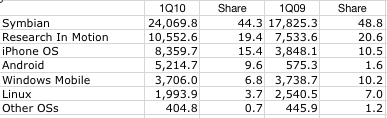
    On May 5th, I tried to fill in the blanks on Global smart phone OS shares | Asymco. I estimated that the shares for the mobile OS's were as follows (based on Canalys partial data):

    • Symbian (Nokia): 42%
    • Blackberry OS (RIM): 19%
    • iPhone OS (Apple): 16%
    • WinMo (Microsoft): 10%
    • Android (Google): 10%
    • WebOS (Palm): 2%

    Now Gartner has published their sell-through estimates:

    • Symbian (Nokia):: 44%
    • Blackberry OS (RIM): 19%
    • iPhone OS (Apple): 15%
    • Android (Google): 10%
    • WinMo (Microsoft): 7%
    • Linux: 4%
    • Other OSs: 1%

    My estimates were within 1 or 2 percent of actuals except for Windows Mobile where I over-estimated by 300 basis points.

    The analysis of Android vs. iPhone market shares (globally and within the US) which depended on this estimation does not change materially.

    The complete data from Gartner follows: