Asymco

Asymmetric Intelligence

Market

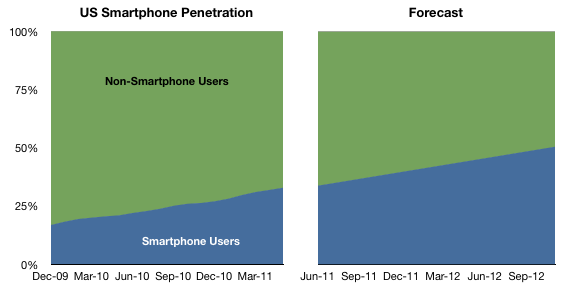
  1. Switching rates for US smartphone users suggest 50% penetration by August 2012

    Research · 21 comments

    The latest comScore MobiLens is out and it allows an update to the picture of the US phone using population. Through the three month period ending May 2011, smartphones were in use by 76.8 million or about one in three US phone users. Here are some other highlights:

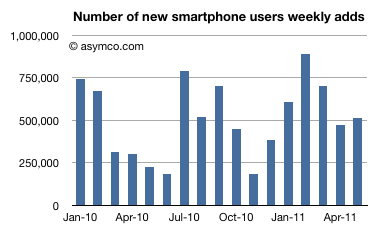
    • A total of 513k users switched into using a smartphone every week during the period, a rate of switching consistent with the last 17 periods (average of 510k/wk).
    • Penetration of smartphones increased by 940 basis points, slightly higher than the 900 bp increase in the last period but consistent with average.
    • Using a four-period trailing average and linear extrapolation, 50% penetration will be reached by August 2012. "Summer 2012" seems a safe bet as that target has not changed much.

    I've updated the countdown counter (Phone Tipping point at top of right column on this page) to reflect the new date.

    The following charts show the penetration and switching rates.


  2. The Android (in)adequacy: How to tell if a platform is good enough

    Research · 97 comments

    About 10 years ago I met an advertising executive in New York who explained the difficulty of advertising a new brand of deodorant to consumers. “Most people never change their deodorant,” I remember him saying. “They pick one brand when they are young, and stick with it for a long, long time. If it works, why switch?”

    The same theory can be applied to customers who are making the switch to smartphones today. Once they have picked a type of phone, whether it’s Apple iOS, Google Android or something else, it’s difficult, and often expensive, to switch. Consumers become comfortable with the interface and design of the phone and the apps they have purchased on that platform. If it works, why switch?

    Many Smartphone Customers Are Still Up for Grabs - NYTimes.com

    This quote says a lot. The notion that customers remain captive to a platform is well understood. After all, it seems impossible to get people to switch out of Windows (or Mac or iPod). Platform vendors are aware of this as the land grab for users seems to be running at full pitch.

    However, there is a critical condition described in the quote above: "If it works, why switch?"  The condition which keeps users loyal is that the product they chose is good enough--i.e. "it works." That's a symptom of over-service and commoditization. If a product, like deodorant, is good enough you won't be tempted to move to another brand even if it's marginally better since the new brand has switching costs in the form of uncertainties ("Will it be as good? What if I don't like the smell? etc.) People are inherently conservative and you can't compete with comfort and familiarity by launching a marginally better product.

    So with that in mind, why is it that millions are switching mobile platforms?In this blog I've cataloged the massive shifts occurring away from mobile platforms that have been around for years with deeply entrenched user bases. Microsoft's Windows Mobile, Nokia's Symbian, Palm's PalmOS and RIM's Blackberry have collectively lost tens of millions of users. A net of half a million Blackberries are being abandoned in the US every month.

    So we would need to say that the condition of "it works" or being good enough was not met with those platforms. The attraction of something better is clearly greater than the switching cost.

    So this highlights a good test for how to tell if smartphones are good enough: If users are fiercely loyal with a given platform then it's probably good enough but if they are willing to switch (i.e. disloyal) then it's probably not good enough. It seems like a trivial observation but it's a very important clue to the bigger question of whether we can "call the end" of the market. Just like it would have been premature to call the end in 2006 when Symbian and RIM seemed unbeatable, it will seem premature to call the end now in the event that a significant innovation is yet to appear.

    The correct calling of the end has profound investment implications. Do you (like Microsoft) invest billions in a new platform if you know that there is no more room for entrants? Should Samsung bother with Bada or HP with WebOS if the game is already over? Even more, should Apple even bother to improve iOS if they have no shot at switching a billion likely Android adopters. Why not just nurture the current installed base and work on building walls and moats around them?

    So with this hypothesis in mind, it makes sense to analyze whether Android or iOS, the current presumed champions, are "good enough" on the basis of how often users switch out of them. My bet is that neither is good enough and that there will be increasing churn between platforms. I imagine that Android is less sticky (and hence less than good enough) based on app consumption but there is little evidence of churn because most phones in use have been bought less than one device generation ago. More importantly, there have been few opportunities yet for switching as many Android buyers don't even have the choice of other platforms either due to where they live or how much income they have available.

    To really tell where we stand, we would need to collect stats on switchers to know just how satisfactory the platforms may be. Remember that a choice of a new deodorant on the same shelf at nearly the same price is the test for loyalty. For an adequacy test we need to see better distribution and more choices for consumers. It's still very early even in the US for any conclusions to be drawn about the adequacy of Android.
  3. Capital.bg | Nobody wants to buy RIM

    Research · 24 comments

    Технологии и наука | Хорацио Дедиу: Никой не иска да купи Research In Motion RIM - Капитал.

    My thanks again to Andrian Georgiev for interview questions [Bulgarian] related to RIM. My answers to his questions (in English) are below:

    Q: What should RIM do to reinvent itself? Should it stray from its business-oriented image?

    RIM had begun to move away from a business image already in 2005 or so when it started its "Pearl" brand and a consumer-oriented strategy. The company probably foresaw that business customers would not be enough to maintain the growth they had become accustomed to. The strategy has led to a growing popularity in Latin America and other regions like the Middle East where the product is used as a low-cost alternative to SMS for avid texters. Even in the US, many teenagers use Blackberries instead of iPhones because they can use it for the BBM service (at a lower cost). I believe that it is not coincidence that iMessage was launched.

    The company's salvation is not in branching into new markets but in establishing a credible platform. When Nokia announced that they would be the "third option" after the iPhone and Android ecosystems, they did not even mention the Blackberry. The fact that Blackberry is not seen as an ecosystem is the root of the problem.

    Q: How should RIM accelerate the introduction of QNX?

    QNX is a solid operating system and I believe RIM should have begun developing with it much earlier. By waiting long after the iPhone launched (and even after Android) to upgrade its OS, RIM missed a great opportunity. The foothold market the company had was wasted by not leveraging it into building a mobile computing ecosystem.

    There is little that can be done to move any more rapidly now. Product development cannot be done any faster. What the company could do is to very carefully define why QNX based products are better than the competition and not rely on specifications. In other words, what jobs does their platform solve for users that current solutions don't address? I note that this is the problem with the Playbook. It's not differentiated on what it does to improve the life of the user.

    Q: Should RIM move on with just one CEO?

    The problem is not the number of managers but their view of the world. What would benefit the company is a better marketing manager where marketing is defined as understanding of user needs. Engineering expertise is not enough.

    Q: What would you advice RIM to do in terms of R&D?

    RIM is an engineering led company. Many successful companies rightly develop their engineering skills first because that is what allows them to create new products more quickly. This is true of Nokia and also of Apple and Microsoft in their early years. What is difficult is to allow marketing people to define products after that early phase. This is partly due to the fact that there is less respect for "Marketing" among engineers. Many see it as a "soft" discipline where there is little rigor. But this is not an accurate or fair picture. Great marketing determines what products should be built not just how they should be sold. Engineering can discover new products based on new technology becoming available, but Marketing can discover new products based on unmet user needs. Both need each other.

    My advice would be to allow a way for R&D to absorb input from marketing.

    Q: Do you think that RIM could be bought by a bigger company in the short-term?

    Mature companies are usually bought for their assets and not so much for their vision or priorities. The opposite is true for young companies who are selling themselves to the public via IPOs. For young companies the vision or priorities of business models is seen as more important. When companies are only valued for their assets, they are usually very under-valued. When companies are only valued for their vision, they are usually over-valued.

    RIM's challenge is that nobody believes they have any vision and their assets are weak (no good ecosystem as I pointed out above.) So the price anybody would pay for RIM today would probably be far lower than what management thinks it's worth. And since they are still profitable they won't sell the company at a deep discount.

    So my guess is that we won't see any acquisition soon.

  4. The app industry vs. the music industry

    Research · 25 comments

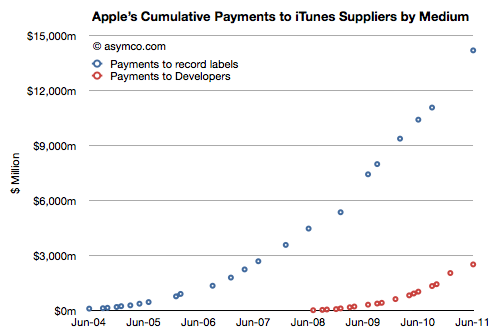
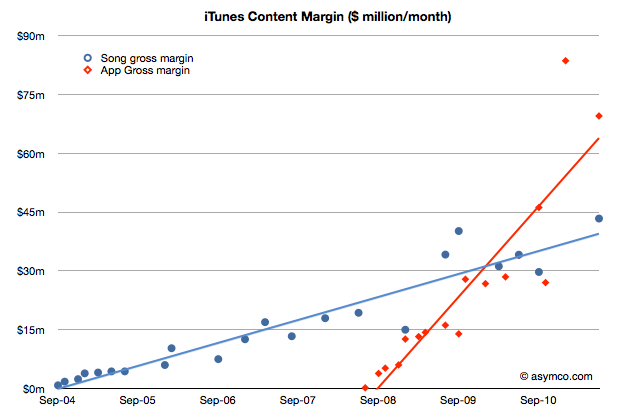
    By my estimate, Apple has paid out $16.6 billion to content owners. $2.5 billion to app developers and about $14 billion to music companies. The developer payments are published by Apple, the music payments are estimated based on total downloads and guesses about the split and pricing of that content (90% for the content and $1 to $1.2 average pricing over time.) There might be reason to move the music figure up or down but the difference will still be nearly a factor of 5.

    The cumulative payments are shown in the following chart:

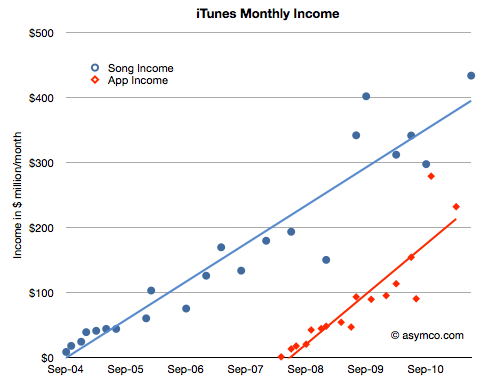
    From this perspective, the music business is still a far bigger ecosystem than apps. However that's cumulative data and digital music has been around far longer. The story can be told a different way: What's the rate of sale in the present period? From what we know about the business, we can see what Apple takes in for apps and music (I've already estimated what Apple "keeps" after paying content owners)

    The combined "sales rate" is a remarkable $665 million per month, but the split now is that music generates only twice the income of apps (i.e. cumulative is a factor of 5 but on a monthly basis the factor is 2). But what should be more impressive is how quickly the app business is ramping. By the slope of the trend lines, it would appear that app income will exceed music income within three years. Therefore, it's only a matter of time before apps generate as much income (exclusive of advertising) as music.

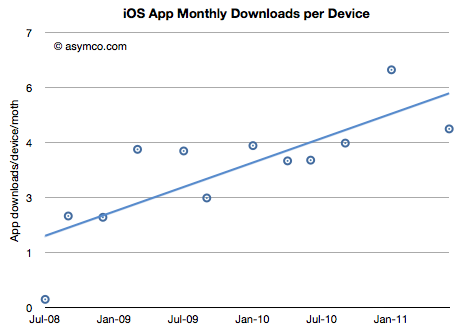
    Another perspective is the number of downloads per device per month. This shows that the rate of consumption of apps is increasing and is now about 6 apps per device per month.

    (You have to think of apps not as traditional computer applications or console games where each device has a certain number of expected apps attached, but rather that apps are more like a subscription where there is recurring monthly income).

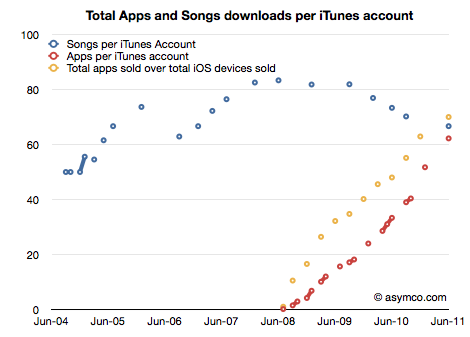
    I don't have a comparable figure for music because the number of iPods and Macs as target devices is hard to estimate, but I doubt consumption for music on a per device basis is increasing. As a consolation, I can estimate the number of apps or songs per iTunes account. Here the story is consistent.

    Each iTunes account has "consumed" about 67 songs but also 62 apps. Remarkable parity in such a short time. And the trend speaks for itself.

    All this data points again to the ascendancy of apps as a new medium. In a mere three years these digital objects have redefined themselves. They went from being tools to enhance the use of your phone to a new medium of expression and art. They have the ability to create a powerful economy of their own and will likely lead a profound shift in where value resides in mobile computing.

  5. iTunes now costs $1.3 billion/yr to run

    Research · 82 comments

    The iTunes store continues to grow. The data that Apple published in the last event included the following:

    • 15 Billion iTunes song downloads
    • 130 million book downloads
    • 14 billion app downloads
    • $2.5 billion paid to developers
    • 225 million accounts
    • 425k apps
    • 90k iPad apps
    • 100k game and entertainment titles
    • 50 million game center accounts

    As this data is added to the existing data and cross-referenced additional insight into the economics of iTunes is emerging.

    Since we know something about the average price of songs and apps, and we know the split between developers and Apple (and roughly between music labels and Apple) we can get a rough estimate of the amount Apple retains to run its store.

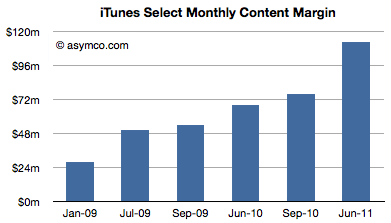
    The following chart shows iTunes "content margin" by month. This margin is what Apple "keeps" after paying content owners but before paying for other costs like payment processing and delivery/fulfillment which should be accounted as variable costs. Strictly speaking this margin is not "gross margin".

    If we add the content margins from music and apps and assume the store runs at break even we can get an idea of what it costs to operate the store.  The latest number is $113 million per month (from a total income of $313 million/mo.). It implies over $1.3 billion per year.

    Much of that cost does go into serving the content (traffic and payment processing). Some of it goes to curation and support. But it's very likely that there is much left over to be invested in capacity increases.

    I would like to hear alternative opinions, but my guess is that much of the capex that went into the new data centers Apple built came from the iTunes operating margin.

  6. Getting to one billion iTunes accounts

    Research · 37 comments

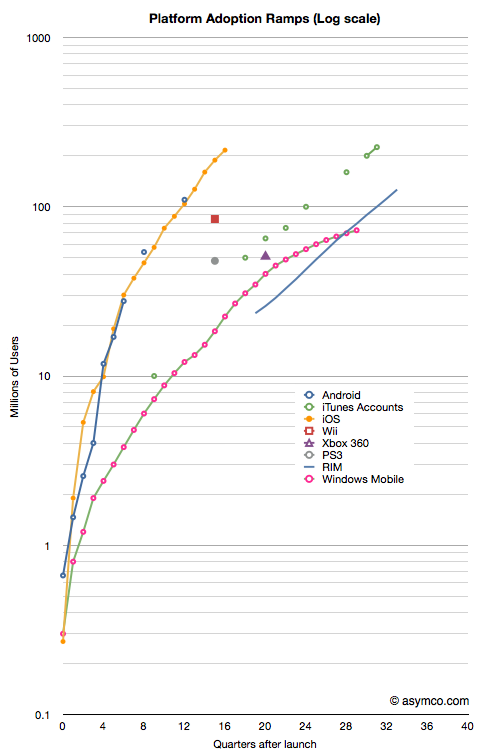
    There are 225 million iTunes account holders. 25 million joined in the three months. As the iTunes store has been operating since April 2003 it's possible to step back and look at its history and measure the rate of growth relative to other ecosystems.

    The following chart shows various platforms/ecosystems in terms of adoption. In the case of phone operating systems and consoles, the cumulative units sold is shown. The scale is 10 years by 1 billion users with users measured on a logarithmic scale.

    What can be easily observed is that iTunes continues to grow on a logarithmic scale even at its advanced age of 7 years. This cannot be said for console-based gaming systems or for some alternative mobile phone platforms (e.g. Windows Mobile or Symbian).

    The reason for this prosperity at an advanced age may be due to the fact that iTunes has survived the transition from one device (the iPod) to a device platform (iOS). It also was able to embrace multiple media from music, to movies to TV and apps. iTunes turned out to be far more flexible and resilient given what was technologically foreseeable at its birth.

    Looking to the future, is it possible that iTunes could grow in parallel with iOS toward the 1 billion user limit that the slope in the chart implies? Much will depend on gaining users who are unlikely to have credit cards and live in emerging markets. If there is one obstacle to the iEmpire it's the addressability of markets which lack consumer credit infrastructure. I suspect, however, that these problems are not unsurmountable given that telecom infrastructure leapfrogged credit infrastructure growth with nary a ripple. Apple could certainly offer that service directly to the consumer.

  7. Songs, Books and Apps: What do the three media types tell us about the future of consumption?

    Research · 30 comments

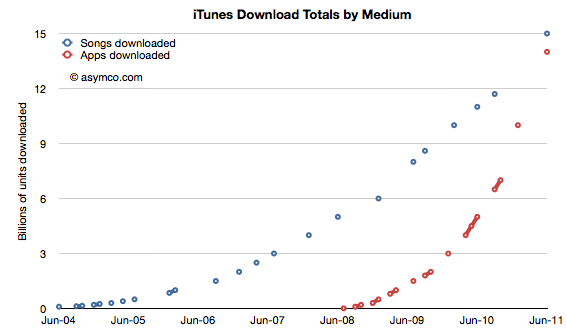
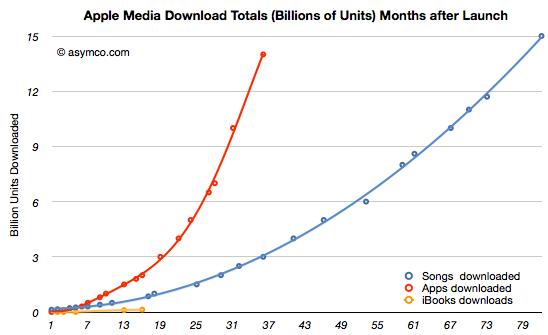
    The 200+ million iOS devices have caused 14 billion apps to be downloaded in less than three years. The iTunes music store caused 15 billion songs to be downloaded over a 7 year period.

    The two media download totals are shown in the following chart:

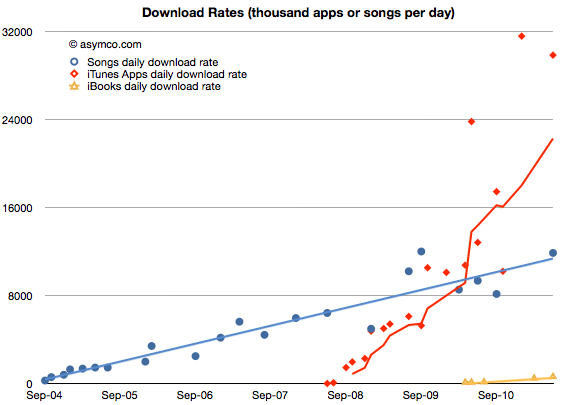
    About 9 months ago I predicted that Apps would overtake song downloads. I was off on the timing by a few months. The app download rate slowed down in the last few months. However, the crossover point is imminent. The song download rate is running at about 12 million per day while the app download rate is at about 30 million per day (the iBook download rate is still growing but is only at half a million per day). The following chart shows the three media types and their download rates over time.

    Although it took about 35 months for Apps to reach 14 billion downloads, the equivalent time for the Songs was about 80 months. You can see the different "ramp rates" (cumulative totals indexed to the same starting date) for the three media on the following chart.

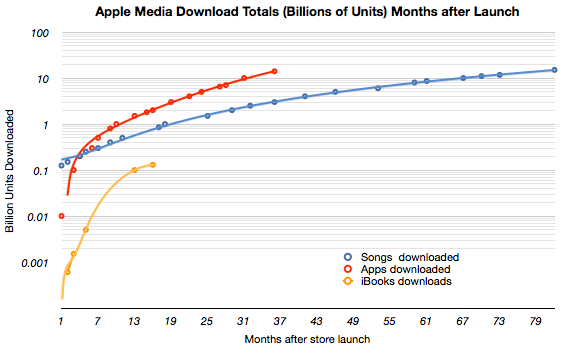
    Given the large numbers involved, a better view might be had looking at a log scale chart of the same data:

    What I would point out is the emerging pattern that the three media ramps are separated by about an order of magnitude. In other words songs are 10x more downloaded than books (at a given point in the life of the media store) while apps are 10x more downloaded than songs. You would see this pattern emerge within the log chart as the three lines run parallel and equidistant.

    Obviously, apps are going to be more popular than songs since many are free. And obviously songs are going to be more popular than books because many are much cheaper.

    But painting this picture with price is only a rough sketch. The ways that these media are consumed (and consumable) fills in the details. The amount of energy needed to enjoy each varies greatly. The "digestibility" of the material is different. In a way, these are the same factors which are drawing consumption toward tweeting, blogging and browsing and away from paper based media.

    The new technologies are allowing consumption to conform more closely to people's lives. They are like clothes that fit a bit better and are more comfortable. They may not look as good as formal attire, but in the end casual always wins.

  8. Does the phone market forgive failure?

    Research · 59 comments

    One of the details of Nokia's warning which did not get a lot of attention was the mention that profitability for the current quarter could not be guaranteed. That is to say that Nokia may make a loss, perhaps for the first time in more than a decade.

    This may not be that newsworthy except for the strange fact that as far as I've been able to observe, any company in the mobile phone market that ended up losing money has never recovered its standing in terms of share or profit (i.e. AMP index value has never recovered).

    Here is a list companies that have "hit the rocks" in terms of mobile phone profitability and their fates (in no particular order).

    1. Alcatel of France. Sold its brand and operations to TCL Communications of China in 2004.
    2. Siemens of Germany. Exited in 2005 through acquisition by BenQ of Taiwan.
    3. BenQ of Taiwan. Mobile devices division declared bankruptcy in 2006.
    4. Ericsson of Sweden. Exited by merging with Sony in 2001 even though third in volume share the prior year.
    5. Sony of Japan.  Joined with Ericsson to form Sony Ericsson in 2001. Held less than 1% share prior to merger.
    6. Motorola of the United States. Even though once the largest vendors, after a period of severe distress, Motorola spun off Motorola Mobility. Market value shows long-term viability still a concern.
    7. Casio of Japan. Merged with NEC and Hitachi in 2010.
    8. NEC of Japan. Merged phone units with Casio and Hitachi in 2010.
    9. Hitachi of Japan. Merged phone units with NEC and Casio in 2010.
    10. Fujitsu of Japan. Merged with Toshiba in 2010. Held 15 percent of Japanese market prior to merger.
    11. Toshiba of Japan. Merged with Fujitsu in 2010. Held 4% share in Japan.
    12. Palm of the United States. Sold to HP in 2010.
    13. Handspring of the United States. Sold to Palm in 2003.

    That makes 13 large phone brands that, in less than a decade, have either exited or lost independence after suffering crises of profitability.

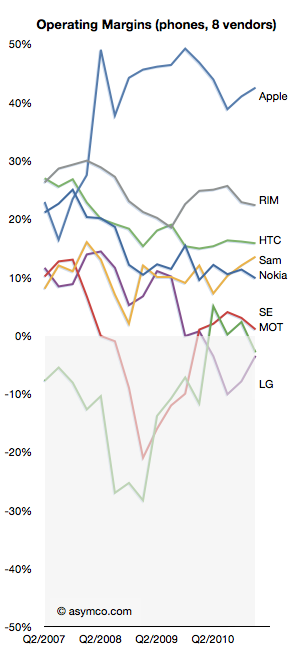
    As the following chart shows, at this time Motorola, Sony Ericsson and LG are still operating but have been dipping into the red.

    The three suffered severe volume contractions in feature phones and have no differentiation in software or platform products which makes their position precarious.

    This cursory survey shows that it's difficult to be optimistic once a company reaches a point of crisis. It's a curious outcome given that the market is so vast and growth is so robust.

    But the fact is that because of the technology cycle time, rapid business model evolution and fairly low barriers to entry, there is great rivalry between competitors. Profitability is the canary in the coal mine. It causes a brand to be tarnished in the eyes of distributors who, because of sales cycle times, are extremely sensitive to obsolete inventory. A loss maker is seen as a maker of damaged goods.

    It then turns off the tap of incentives, promotions and hence visibility in the eyes of consumers. It's a vicious cycle from which few (if any) can recover. Past greatness offers no succor.

    And so, with Nokia about to join the list of loss-makers it's only natural to question its fate as an independent company.

  9. Is Nokia worth less than Skype?

    Research · 57 comments

    Yesterday Nokia warned that its guidance for the quarter and the year were "no longer valid." The surprise to me is that management was surprised. In February I warned that even if Nokia could fool consumers into buying products whose platform was publicly executed, distributors and operators would not likely go along with the deception. Pricing collapse is the proof of a channel breakdown.

    That seemed predictable. What I struggled with was how Nokia itself could present such an optimistic forecast. Absent any explanation, Nokia's forecast of robust sales for Symbian products into the near future belies a failure of understanding of the dynamics of platforms and especially the impact of destruction of trust and brand value that commenced in February. Distress is a slippery slope and it does not model well in a spreadsheet. It takes a leap of non-linear faith to predict the piling-on effect on the up- and the down-side.

    Faith in the company's guidance meant that the market reacted to the bad news by discounting Nokia down to a market cap of $26.7 billion. One analyst even cut his target price down to $4/share, 57% of yesterday's close. How can this fair? What is Nokia's phone business worth?

    Here's a quick sum-of-the-parts analysis. After yesterday's hair cut Nokia's overall enterprise value is about $20 billion. The Navteq part of the business (purchased for $8.1 billion in 2008) could get a value of $3 billion (based on about 3x sales) and the value of Nokia Siemens networks could be at $6b (less than 0.5x sales). That makes Nokia's phone business worth about $11 billion.

    An alternative view based on "the Motorola case study" $4 target price would imply an overall enterprise value of $11 billion. This either makes Navteq and NSN worthless and Phones worth $11 or it makes the phone business worth a lot less than $10 billion. Perhaps less than $8.5 billion which is what Microsoft paid for Skype. Should we be shocked? Nobody would argue that Nokia is worth more than Facebook so who's to say that Skype or Twitter aren't more valuable than a device company in crisis?

    I don't try to predict the market's behavior, nevertheless, the markets are now very skeptical that there is much in Nokia to salvage. It's perhaps unfair and illogical but this is the end game of disruption. It ends much more suddenly than it begins. It's the consequence of nobody noticing the beginning that makes the end so shocking.

  10. Microsoft has received five times more income from Android than from Windows Phone

    Research · 174 comments

    Microsoft gets $5 for every HTC phone running Android, according to Citi analyst Walter Pritchard, who released a big report on Microsoft this morning.

    Microsoft is getting that money thanks to a patent settlement with HTC over intellectual property infringement.

    Microsoft is suing other Android phone makers, and it's looking for $7.50 to $12.50 per device, says Pritchard.

    HTC Pays Microsoft $5 Per Android Phone, Says Citi.

    A rough estimate of the number of HTC Android devices shipped is 30 million. If HTC paid $5 per unit to Microsoft, that adds up to $150 million Android revenues for Microsoft.

    Microsoft has admitted selling 2 million Windows Phone licenses (though not devices.) Estimating that the license fee is $15/WP phone, that makes Windows Phone revenues to date $30 million.

    So Microsoft has received five times more income from Android than from Windows Phone.

    Looking forward and assuming that Microsoft can receive this type of settlement from about half of the Android license takers, then the prospects of a windfall from Android dwarf the expected income from Windows Phone.

    Google's Android seems the best thing that could have happened to Microsoft's mobile efforts, ever.

    I could also calculate how the Android license income could be further funneled to Nokia (via their current agreement with Microsoft) for promotion of its phones. Thus, an Android licensee could reduce his margins in order to promote a competitor's products.

  11. Why the phone market is resilient to low-end disruption

    Research · 10 comments

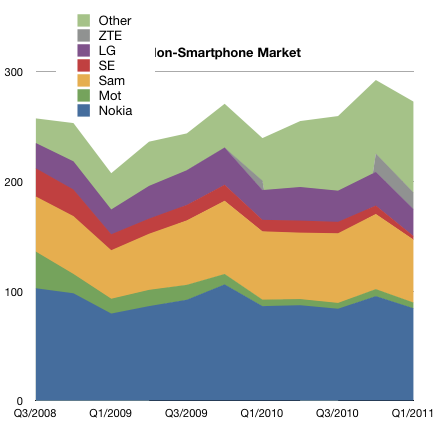
    The phone market excluding smartphones is not growing. Over a three year period it grew at 2% compounded.

    The following chart show the make-up of the market by vendor.

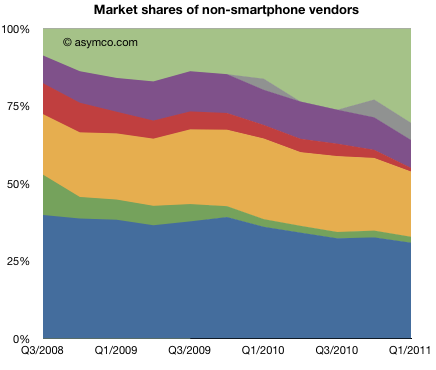
    Since it is not expanding rapidly, share over time has a lot more meaning.

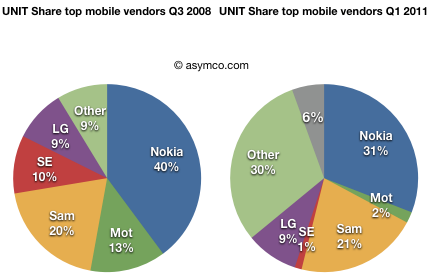
    The change in share over the last few years (since Q3 2008) is shown in the following two pie charts:

    Although many will argue that the non-smart market is one of great opportunity, the historic data shows that the market is not vibrant:

    • It's growing slowly if at all
    • Prices are falling as buyers find nothing of value in new products
    • There are fewer branded competitors (from 5 to 3)
    • There is increasing "white label" or unbranded volume growth (from less than 10% to over 30% share in three years)

    Although low end entries (in this case the unbranded new vendors) can signal disruptive potential, that potential is unlikely to manifest itself in voice-oriented products. Low-end disruptions take hold when markets are overshooting the expectations of the majority of buyers and incumbents are motivated to exit.

    However, if we consider all phones as a single market, then there is vast under-performance in the high end--something another set of entrants have taken advantage of and something neither the incumbents nor the low-end entrants are motivated or capable of pursuing.

    The phone market is not being disrupted because of the low end entrants. Nokia and Samsung are motivated to compete for those customers. It's being disrupted because the new market of mobile computing is completely asymmetric.