Asymco

Asymmetric Intelligence

Nostalgia

  1. Peak Cable

    Research · 172 comments

    Paying for TV has been a curious consumer phenomenon. There was a time when TV was free to consumers. It was delivered as a broadcast over-the-air and paid for either by commercials (US mostly) or by taxes on viewers (Europe mostly). The consumers were delighted with the idea as it was far better than radio and radio was delightful because it was far better than no radio.

    The process of convincing consumers to pay for something that used to be free was quite interesting. The first benefit to be articulated was that the quality of the picture would be much better. It would, in essence, be noise-free. ((This was in fact the birth of cable TV: a shared antenna for a community in an  electromagnetic shadow))

    The second benefit was an increase in the number of channels. VHF and UHF television would cover about three and 5 channels respectively while cable could offer dozens, many specializing on specific types of content like the Home Box Office (HBO) offering movies and ESPN offering sports only and MTV music videos and CNN news only.

    The third benefit was fewer (or no) commercials for some of the channels. This was especially valued by fans of movies whose interruption by commercials was often detracting from the immersive value and continuity of the cinematic experience.

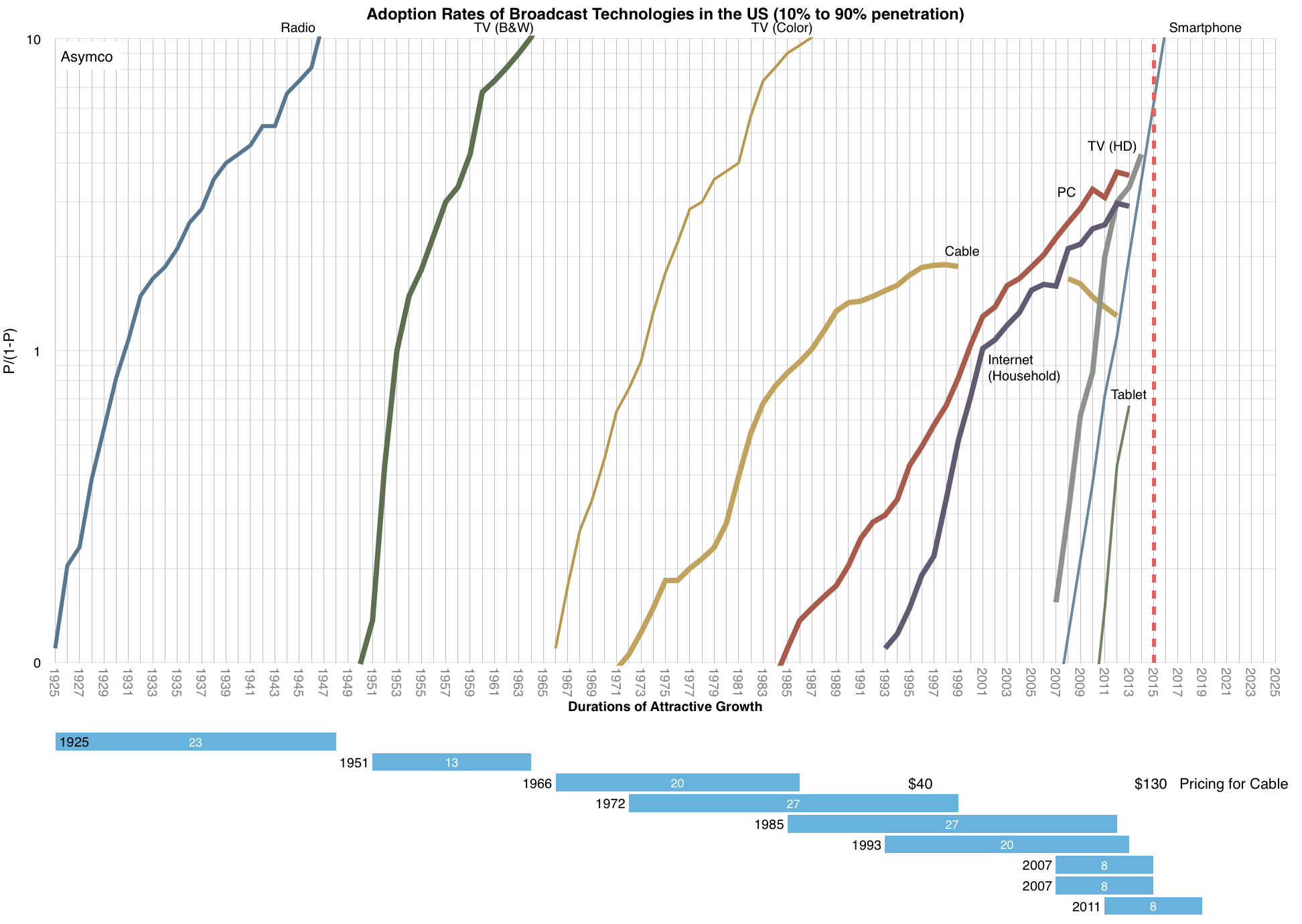
    These benefits were very attractive during the 1980s, to the extent that about 60% of US households adopted cable. An additional group later adopted satellite-based pay-TV as the technology became reasonably cheap.
    Screen Shot 2015-03-19 at 2.29.06 PM

    These benefits were priced modestly but as the quality and breadth of programming increased, prices rose. An average cable bill of $40/month in 1995 is $130 today ((a 6.1% compounded rate of price growth vs. a 2.4% rate of inflation)). Some of that revenue went into upgrading the capital equipment in use (the plant) and some into paying for the higher production values. Yet more went to the sports leagues and their players whose business models increasingly depended on broadcast rights.

    And so over a period of about 40 years, watching TV went from free to quite expensive. More expensive even than a family's communications costs (i.e. telephone service.) That's quite an achievement at a time when technology diffusions caused huge price reductions in other goods and services. Consider that the TV set used to watch the programming improved dramatically while decreasing in price over the same period.

    Meanwhile, some of the benefits began to be less relevant. Commercials are more abundant than ever. Ad buyers spend about $60/month per household to deliver ads ((Implying that the TV "business" has a $200/household/month revenue model)) The quality of the TV picture is actually worse due to compression than one might get with over-the-air digital broadcast. Finally, the abundance of channels is beyond anyone's absorption rate. Those channels which used to be "pure" became polluted and undifferentiated as each tried to be the other. ((A pursuit no doubt driven by seductive but toxic market research))

    On top of these paradoxes is the fact that actual penetration of the service has been declining. As the graph above shows, Cable TV has declined (though Pay TV much less so). The industry has reached saturation decades ago and has not offered anything meaningful in terms of innovation.

    Disruption theory suggests that once a product over-serves on meaningful bases of value creation (and underserves on value) it opens the door to disruption. Which leads me to ask not whether cable is past its prime but rather why it's still around?

    The answers are usually immediate and plentiful: conspiracies of monopolists, lobbying, back-room deals, lock-in of content and all kinds of other misdemeanors. To which I would say: You can fool some of the people all of the time and all of the people some of the time but you can't fool all of the people all of the time.

    So again, why have all the people been fooled all this time? Twenty years have passed since the industry reached saturation and prices keep rising. Today the average cable bill is projected to rise to $200/month by 2020.

    My answer is that disruption is predictable. Users are cutting cords, the "uncabled" or "never-cabled" are a significant portion of the population. 13.5% of broadband households with an adult under 35 have no pay-TV subscriptions. 8.6 million US households have broadband Internet but no pay-TV subscription. That's 7.3% of households, up from 4.2% in 2010.  Another 5.6 million households "are prime to be among the next wave of cord-cutters," according to Experian.

    The same phenomenon occurred with mobile vs. fixed telephony. For several years it seemed that mobile was sustaining to fixed or that fixed was immune due to lock-ins. The fixed telephone incumbents insisted that the data was inconclusive. Then the trickle of abandonment turned into a deluge. The quality of service for mobile kept increasing and, with data, it became clear that the mobile devices could unleash unfathomable functionality and value.

    And so it goes. A business dies first slowly then quickly. (('How did you go bankrupt?' Bill asked.
    'Two ways,' Mike said. 'Gradually and then suddenly.' -The Sun Also Rises (1926) Ernest Hemingway)) The exact timing is tricky because of the non-linearity of the phenomenon. It's also hard to declare end-of-life since business zombies are very common. What is clear however is that the economics will change dramatically and the alliances between talent and distribution will shift to entrants and away from incumbents. The point when we will look back and say that cable was finished will probably come by the end of this decade.
  2. Conversations with Apple's brand

    Research · 22 comments

    According to Folkore, in 1981 Apple took out a two page ad in Scientific American which explained that whereas humans cannot run as fast as other animals, a human on a bicycle is the fastest species on earth.

    Jobs had made the observation that a computer was "a bicycle for the mind" earlier, in 1980, at a time when the decision to purchase a computer was driven by an intellectual curiosity and justified as an improvement or assistant to the intellect. It was to make the lighten the labors of our intellect.

    Apple brand at the time as an appeal to the intellect via a humanistic argument. A more emotive positioning of a tool, but a tool nonetheless. This positioning evolved throughout the 80s and 90s into an "intersection of technology and the liberal arts."

    We can see how the conversation with the potential buyer was along the lines of appealing to the intellect while offering a humanist sweetener. Humanizing the product allowed it to be accepted into a world that feared the complexity and awkwardness of such a machine.

    During the 2000s, with the ascent of iPod, the conversation shifted to prioritizing  the emotions more than the intellect. The products had to appeal to those who wished to express and enjoy products of emotional value. Products like music and videos and the output of the arts rather than the sciences. The brand became emotional rather than intellectual. It created an aesthetic, and become culturally iconic.

    During the 2010s, with the ascent of iPhone and the emergence of the Watch, the brand speaks a language of instinct, leaving intellect and emotion as secondary or tertiary voices. Instinct is visceral, lust-inducing. It seems to short-circuit any of the rational. Non-rationalism does not mean irrational. It just skips right over the head and heart and hits the gut.

    One could argue that during these three decades, the organs the brand was engaging in conversation shifted from the mind to the heart and then to the glands. Those glands which release hormones and are directed by non-rational neurons. The evidence of the conversation would be in resulting products causing pupils to dilate, breaths to be quickly drawn and skin temperatures to rise.

    The brand therefore has managed to move from a rational, to a neurological, to an endocrine response.

    The curious thing is that during these shifts, Apple's entry into new biological spheres of influence has been largely unchallenged. I suspect this is because emotional or instinctive products are appealing due to their lack of rationalized value. In other words, what makes a product hormonally appealing is a lack of intellectual appeal ((and vice-versa in many cases)). Apple can enter into the world of lustful appeal while lustful brands can't enter into functional appeal.

    This is a classic asymmetry which perhaps no other brand can pull off. ((The reason is complicated but stems from the firm having been built to execute nothing but home runs. By shunning portfolio theory, Apple can wander into new categories far from its biological home grounds.))

  3. Haunted Empire

    Research · 67 comments

    The "Stupid manager theory of company failure" (and its corollary, the "Smart manager theory of company success" ((As well as the "Smart/Stupid leader theory of national success/failure"))) remains the most popular, perhaps even the most universally accepted theory of management. Book after book, thoughtful article after article alludes to this theory and whenever a company is perceived to be under-performing, all fingers point to the leadership with demands for blood letting.

    This is not a new phenomenon. When catastrophe strikes, as a thoughtful species, we have always asked for leaders to be sacrificed. In Europe during the Iron age leaders were sacrificed when crops failed. In South and Central America leaders were ceremonially tortured for similar reasons.

    Of course most crop failures were due to weather phenomena and the anointed leadership had nothing to do with these causes. Nevertheless ancient correlation analysis would have revealed the pattern that good leadership meant good weather and bad leadership meant bad weather.

    There was a balance to the downside however. When times were good the leadership enjoyed luxuries and praise. This was the essential deal societies made: we'll keep you in riches and allow you to be idle as long as times are good but ritualistically slaughter you when times are bad. We'll declare you "chief magical officer" and place all our faith in you. But, of course, if you fail, we will will be vengeful.

    And so it goes in today's corporate world. I've often said that corporate governance is medieval, or pre-scientific in its approach to understanding causality. That may be too generous. As far as the reward/punishment system (also known as Human Resources) it's probably pre-neolithic. The luxuries and extravagance which we heap upon the leader provide abundant evidence. Leaders insist on these ironic "pay packages" and boards approve them because they know they can and will be ritualistically sacrificed if and when the mobs turn against them.

    A manager would be a fool to accept even generous pay given the risk, actually near certainty, of ritualistic slaughter. They demand and are unquestionably given absurd pay that has no relationship to performance. Such pay has no relationship to performance because it isn't designed to reward performance but to account for the risk of arbitrary and very public sacrifice. Boards (and hence shareholders) are deliberately hiring a scapegoat for sins as yet unknown. Luxury and violence are thus finely balanced in what is called "Executive Search".

    What allowed civilized society (i.e. that outside of corporations and politics) to move beyond this has been an understanding that our destinies are not necessarily tied to individuals' actions. We don't need to adulate/prostrate/dismember/defenestrate someone if our car does or does not work. People have begun to understand that there are rules about nature beyond the control of known or unknown agents. Complex systems like factories, farm  irrigation and even air traffic can be made predictably reliable without magic.

    Yet we are not willing to suggest that such rules apply to social systems. It's not just laymen who abstain. Historians and social scientists are mortified at the notion that causal statements could ever be made about society.

    Causal statements (beyond good/bad people => good/bad outcomes) are  considered non-credible in the very institutions which harness laws of nature in order to create value. Consider the recent instance of corporate defenestration  directed at Tim Cook. He was accused of failure of magic. I say this because he replaced a previous magician with many powers and the anger at his inability to match this power was at a fever pitch in 2012 and 2013. A book was even written about this failure and titled with the appropriate metaphor (See blog title).

    I know what you're saying: the sad fantasists which subscribe to these theories are wrong. Their theory is disproven almost every day. Even though we reward them as if they did, managers do not possess magical powers.

    But the author of Haunted Empire was surely well rewarded for her accusations. We rewarded her because our search for answers is otherwise unmet. What alternatives do we have?

    Think of it this way: What did ancient people have other than the Anointment/Sacrifice theory of good management? It persisted for millennia. The lack of alternatives means today we still believe as they did.

  4. Biggest news of 2014

    Research · 70 comments

    As corporate romances go, IBM and Apple's must rank among the most unexpected. As I wrote on the date they changed their Facebook status, the two companies were antagonists for the better part of twenty years and their rapprochement was met with a shrug mostly because yet more decades passed since.

    Screen Shot 2014-12-26 at 11.28.03 AM

    Nostalgia aside, this new union is profoundly important. It indicates and evidences change on a vast scale. The companies' antagonism was due to being once aimed at the same business: computing. Since the early 1980s, "computing" came to be modularized into hundreds, perhaps thousands of business models. It is no longer as simple as selling beige boxes. IBM was forced out of building computers and into services and consulting while Apple moved to make devices and the software and services which make its hardware valuable.

    The convergence of interests which was consummated into a deal this year stems from the migration of computing around what has come to be called "mobile". Apple intends to accelerate the adoption of its mobile platforms among the remaining non-adopters: enterprises–a group which, by now, qualifies as laggards. ((There was a time–when Apple was young–when enterprises were the innovators, early adopters. That role ended approximately in the year 2000)) Simultaneously IBM intends to connect data warehouses at those same enterprises to their employed users.

    Both can achieve their goals better if they join forces: Apple offers assistance and expertise while obtaining access and lubrication for orifice entry. IBM offers modularized access to databases through its own APIs and obtains credible client experiences. The combination increases adoption of mobile (i.e. intuitive) solutions and an increase in productivity, benefiting the buyer.

    The recent apps release showed just how transformative this relationship could be. We were witnesses to apps which appeared to be designed for users[!] They were not designed for committees that prepare checklists of requirements.

    We must applaud IBM for having the courage to resist the featuritis which plagues enterprise software design. This resistance requires saying No to those who specify and are thus authorized to purchase software and hardware. IBM has had to essentially say no to those who buy and yes to those who are paid to use. The quality of the experience is evident at first sight. The number of user actions, the number of screens to wade through have been ruthlessly culled. These are concepts and ideas which now permeate app design best practices. Yet they are practices which still elude the spec-driven enterprise software wastelands.

    Simultaneously we must applaud Apple for accepting that there are throngs of unwashed masses laboring in cubicles which deserve to be served. They may be employed by laggards but they are people too. Apple management has made clear that they are being more inclusive and open minded. Extending that open hand to the downtrodden salaried masses must surely bring a tear to one's eye.

    Being unexpected and yet explanatory of the state of technology today, the partnership between IBM and Apple is, in my opinion, the most significant technology news of 2014.

    As a romance, it is at least as newsworthy as the divorce of Wintel was in 2012.

  5. What next, Samsung?

    Research · 200 comments

    I received a few questions from Shirley Siluk of NewsFactor as a follow-up to my post on the trajectory of successful companies.

    1. Do you foresee any hope for a turnaround for Samsung? If so, where do its best opportunities lie?

    Screen Shot 2014-10-13 at 1.44.54 PM

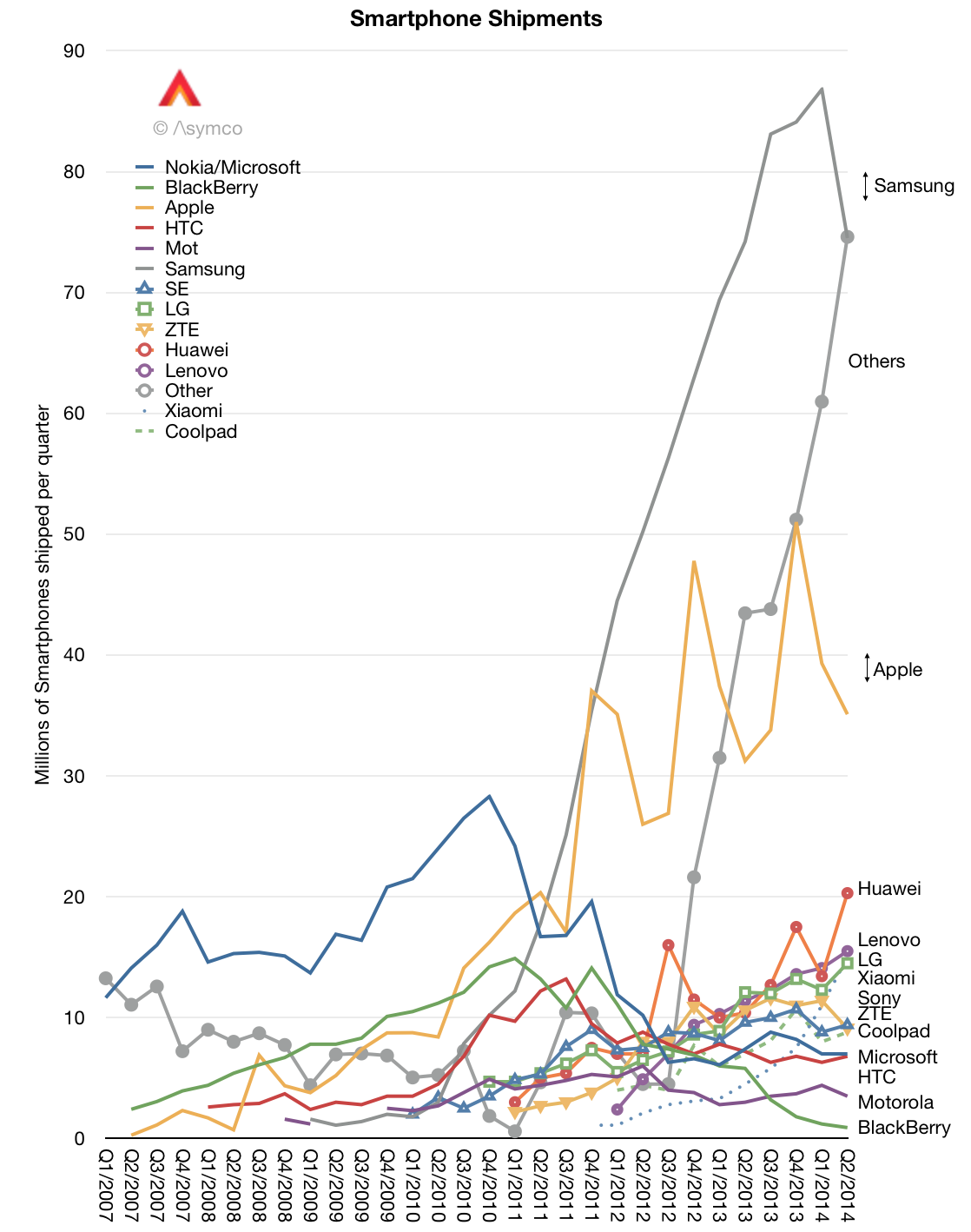
    The smartphone business was a huge opportunity for Samsung and they took full advantage of it. Unfortunately, it’s a difficult business to stay on top of. The list of victims in that industry is quite long and there have been no long-term winners. Samsung’s operating model seems to be to invest as a ‘fast follower’ filling in the market after it’s established while leveraging capital intensive components synergies. That has also worked for them in consumer electronics (at the expense of Sony and other Japanese vendors). If the modus operandi does not change then their turnaround will depend on the creation of new opportunities/categories. Wearables may be such an opportunity but it may not be as big as the phone business. ((The graph shows estimates of smartphone shipments for a select number of vendors.))

    2. What has contributed most to Samsung's decline? Which competitors are posing the greatest threat?

    The fast follower strategy belies its own limitations: it implies a transience or impermanence in strategy. In a fast follower strategy it’s only a matter of time before late followers eat into the business, similar to the way that the fast follower ate into the innovator. Chinese vendors are poised to take more share. The way I said it in 2011 was that I saw in Huawei ((I did not anticipate the Xiaomi and Lenovo entrants which are also doing very well.)) what Samsung was five years earlier. It’s easier for the low-end providers to move up-market and not at all easy (in terms of loss of margin) for the higher end to move down.

    3. You mentioned the pattern of commoditization in all of Samsung's markets -- what would be the best way around this?

    Commoditization is largely unavoidable. The way to survive as a business is to ensure you create new businesses or solve new problems. One hope that springs eternal is that through a “brand” a maker can ensure long-term margin survival. That did not help Nokia, Sony, or Microsoft. Brand is only valuable if it carries meaning and often that meaning becomes a fading product. So the short answer is that Samsung needs to create new categories or businesses. The challenge for them is that they need to control the platform and service infrastructure. These are currently out of their control and I’m not quite sure how they can regain that control.

    I was wondering if you had any followup comments you could offer about Samsung in light of the announcement today that it's developed a faster 60 GHz wifi technology -- do you think this kind of technology, if it's everything Samsung says it is, could provide the kind of corporate turnaround momentum Samsung needs?

    Certainly not. This is a sustaining improvement in a technology. What Samsung needs is a disruptive improvement. A disruptive improvement implies a new business model. Put another way, it means that Samsung needs to invent a new way of making money.

    --

    Postscript: One problem with this prescription is that it's considered impossible to execute and those who try to operate as repeatable innovation companies are punished with deep discounts and condemned as being "hits driven" rather than annuities. Woe befalls the manager who seeks this route.

  6. Tentpoles

    Research · 126 comments

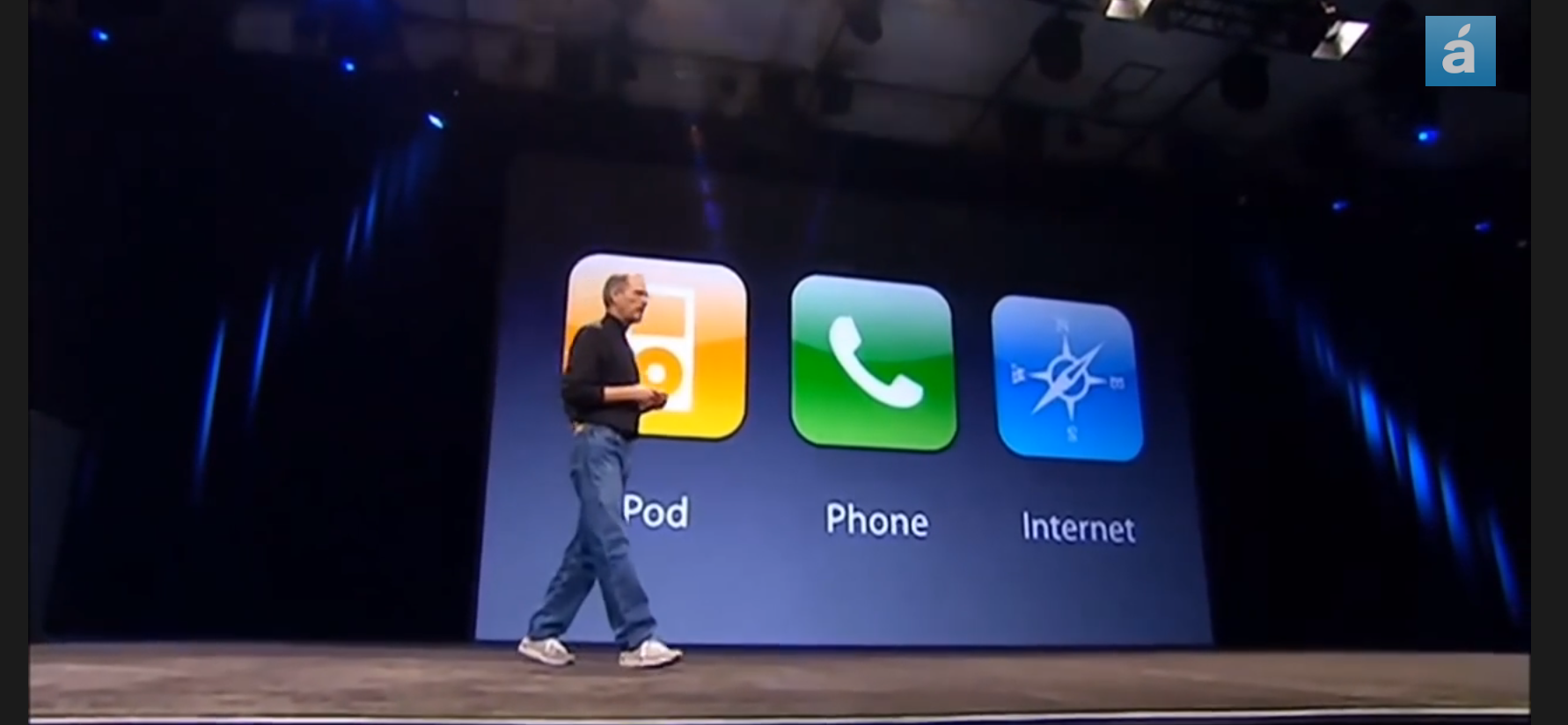
    When the iPhone launched, Steve Jobs introduced it as being three products in one:

    • A wide-screen iPod
    • A phone
    • A breakthrough internet communicator
    Screen Shot 2014-09-11 at 2.40.54 PM


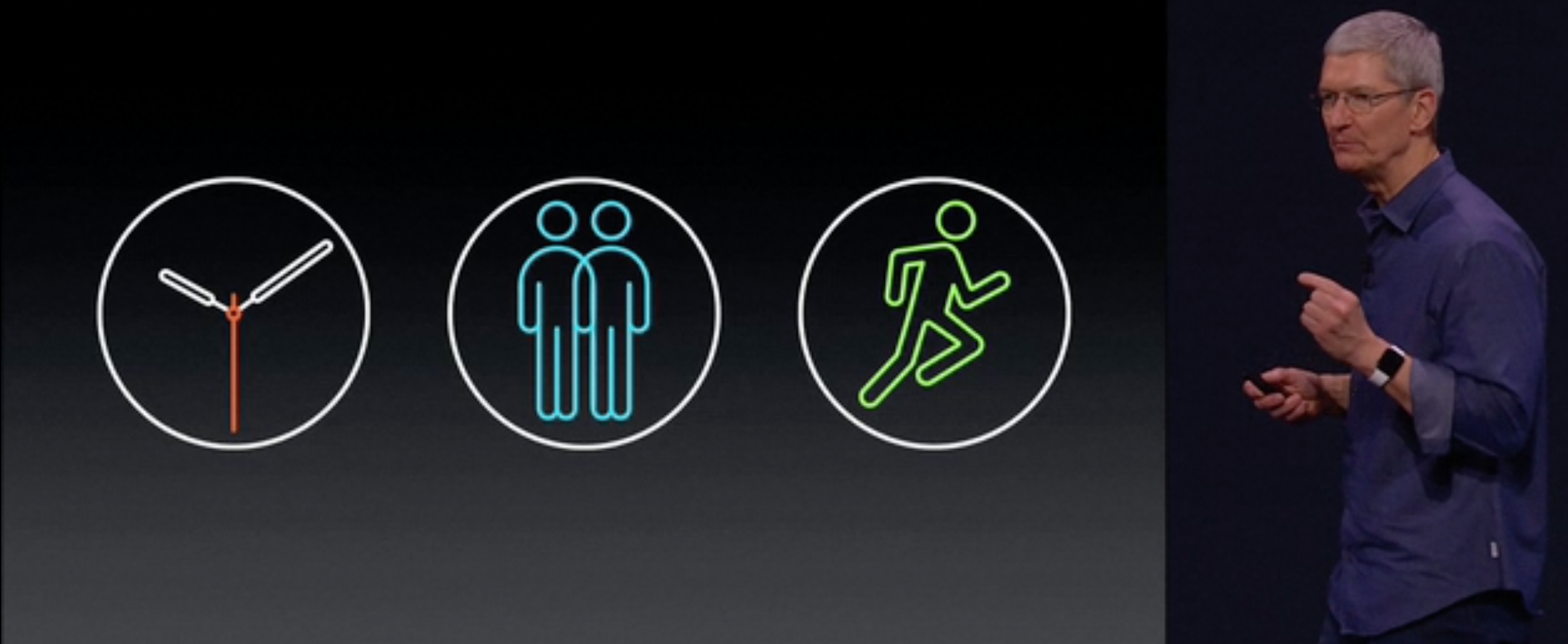
    When the Apple Watch launched, Tim Cook introduced it as being three things:

    • A precise timepiece
    • A new, intimate way to communicate
    • A comprehensive health and fitness device.
    Screen Shot 2014-09-11 at 2.37.52 PM

    As in the Revolutionary User Interface story,  the symmetry in approach to the launch is telling, but what I want to note is that the three things which the iPhone was defined as being are no longer things that it is most used for.

    Yes, the iPhone is still a wide-screen iPod which gets plenty of use but I don't think anyone thinks that is a defining feature. It's also a phone, but the Phone is just an app which, for me at least, is not frequently used. I communicate with my iPhone but the go-to app is iMessage or FaceTime or Skype or maybe Email or Twitter. Phone is something I use so rarely that the interface sometimes baffles me. And yes, it's an Internet appliance. Browsing is something I do quite a bit but many of the browsing jobs-to-be-done are done better by apps. News, shopping Facebook and maps are "things which were once done in a browser."

    So I wonder whether the tentpole product-defining anchors used to introduce the Apple Watch will be faintly amusing a few years from now.

    Of course, the reason iPhone outgrew its tentpoles is because of the app economy. 1.3 million apps does that to a product. When it becomes a platform a product invites collaboration on the problem of innovation. Collaborative innovation explodes the opportunity to discover new needs and uses. How, when and why people use the product changes beyond anyone's imagination.

    But this does not mean that the tentpoles used at launch are in any way in error. They are necessary to explain the value of a new category. The audience can't be told "wait and see all the cool stuff you'll be able to do with it". They need to be told why it's useful today. They speak in the language the audience can understand today. Steve Jobs could not talk in the language of apps and services in 2007. The unforeseen became the inevitable.

    Tentpoles therefore don't define the product but do provide the starting blocks from which the initial buyers make a cognition leap. And once they're off, the others will know where to go.


  7. Revolutionary User Interfaces, Part 2

    Research · 67 comments

    In 2011 I wrote:

    My hypothesis is that The Primary Cause for the shift of profits from Incumbents to Entrants has been the disruptive impact of a new input method.

    It was a description of what I considered to be the "disruptive technology" which caused incumbents which had a "front-row seat" to the future of their industry to be completely displaced and marginalized by an entrant ((later more than one)) with no discernible right to do what they did.

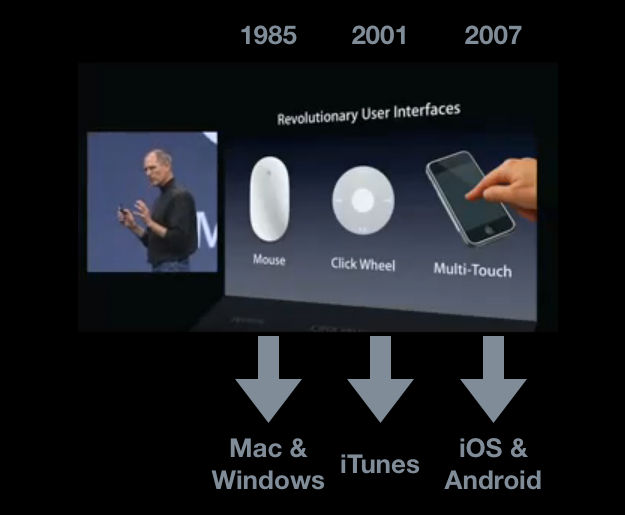
    I illustrated what underpinned the sea change in the phone business via the slide that Steve Jobs used in the iPhone launch event:

    Screen-Shot-2011-11-03-at-11-3-10.45.20-AM


    I added the years when each input method was introduced and the  platform/ecosystems created as a result. These new ecosystems were the primary cause for dramatic industry-sized shifts in profits.

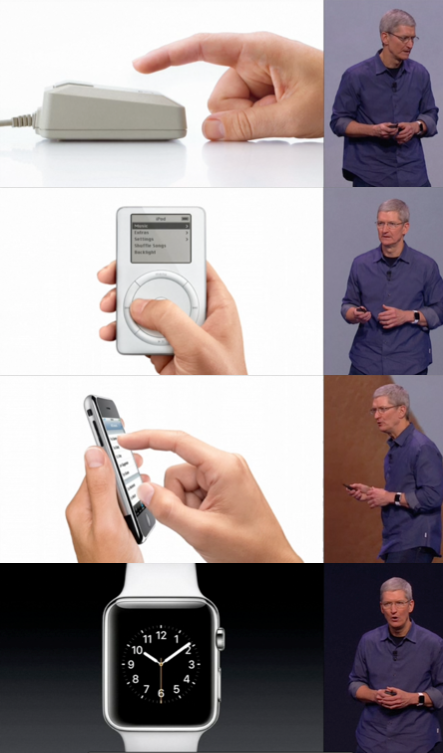
    Not coincidentally, during the 2014 Apple Watch launch, the presentation began ((Begins one hour into the 2 hour downloadable video)) with a re-telling of the "mouse, click wheel and Multi-Touch" story.

    Screen Shot 2014-09-10 at 10.07.55 AM

    Seven years later, the difference is that there is a new object added to the story. It answers the question that has been on my mind since that first post on revolutionary user interfaces was written: what will come next.

    Now that we have an answer, the next step is to understand the new platform, its ecosystem; which industry will be affected and which incumbents will be displaced and to what degree will value be created beyond that which will be displaced.

    Piece of cake.

  8. Is the PC back?

    Research · 119 comments

    Gartner's own press release has an interesting spin:

    "After Two Years of Decline, Worldwide PC Shipments Experienced Flat Growth in Second Quarter of 2014, According to Gartner"

    Gartner's actual figure is 0.1% growth. Gartner and IDC measure slightly different quantities as "PC" but they don't disagree much. IDC still shows declining PC sales at about -1.7%. However both also include the Mac in their accounting of PC. If we were to remove the Mac and measure "Windows PC" ((In quotes because this total includes Linux and Chromebook)) Gartner's figures would show -0.8% drop in PC ex-Mac shipments.

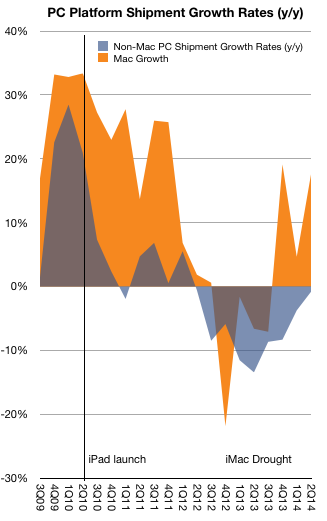
    The difference in growth between the Mac and non-Mac PCs is shown in the following graph.

    Screen Shot 2014-07-23 at 7-23-5.23.08 PM

    As Apple puts it, the Mac grew faster (and hence gained share) for 31 out of the last 32 quarters.  It missed on this perfect record during the fourth quarter of 2012 when the then fresh new iMac was impossible to buy due to production issues.

    So as far as the Mac is concerned the slowing of the decline in PC unit shipments isn't at its expense. What has been discussed as a cause for the moderation of market contraction is the expiration of Windows XP support. Certainly that seems plausible and is supported anecdotally. If it's true then the PC respite may be transient.

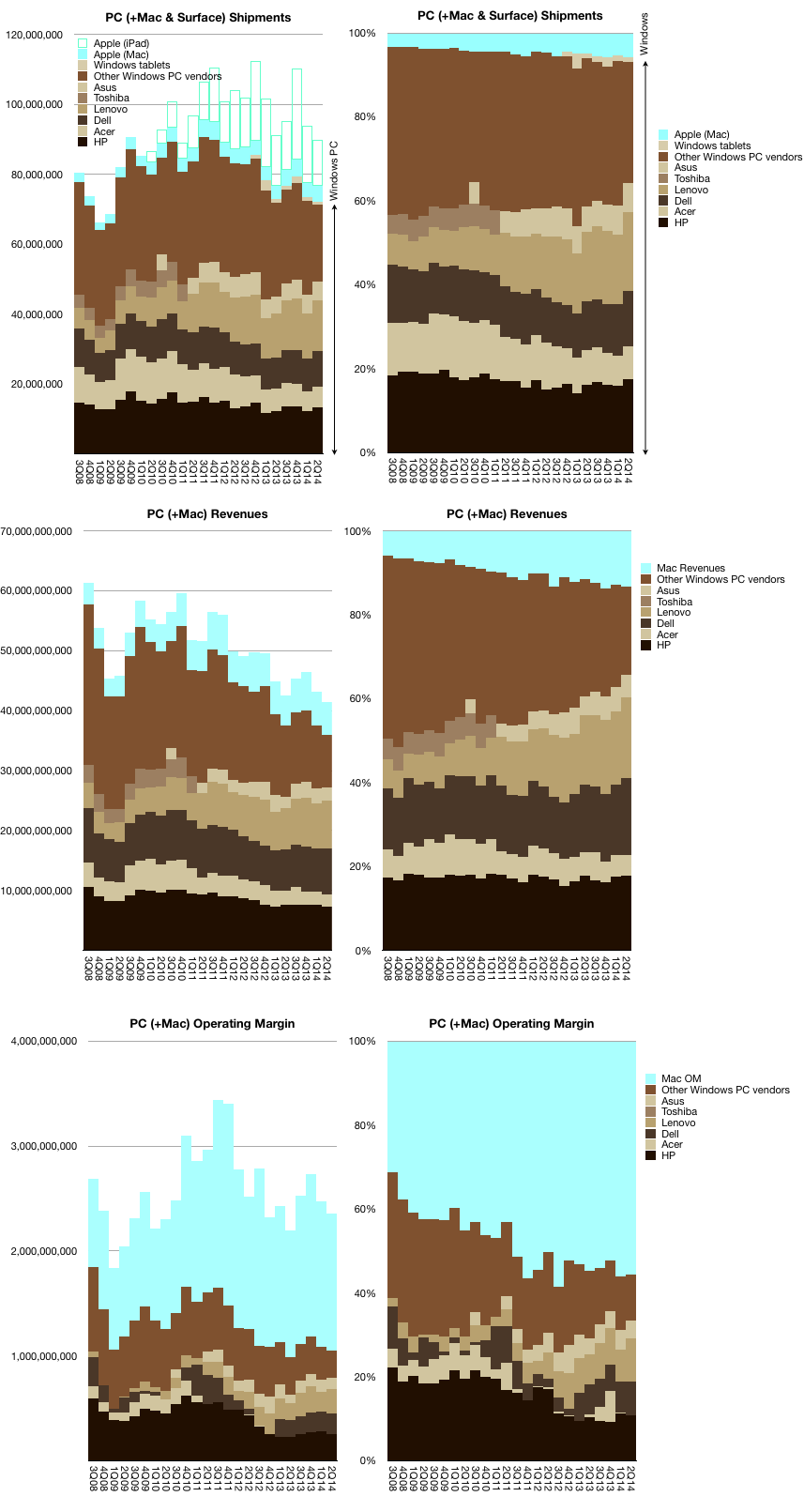
    To put a finer point on it, it would be useful to know  revenues and profits  in addition to volumes. Thanks to Charles Arthur for providing most of the data that allows this picture to be drawn:

    The revenue pictures shows that (non-Mac) PCs have been declining for almost four years and into the present quarter and operating margin ("profit") has shrunk to nearly $1 billion (while being generous with "other" PC vendors).

    Incidentally, the Mac is nearly the highest revenue PC brand and by far the most profitable. Indeed, it's more profitable than all the other vendors put together.

    If one includes the Mac, the PC industry may be limping along, but if we were to exclude it then this post conforms to Betteridge's law of headlines.

  9. IBM and Apple: Catharsis

    Research · 62 comments

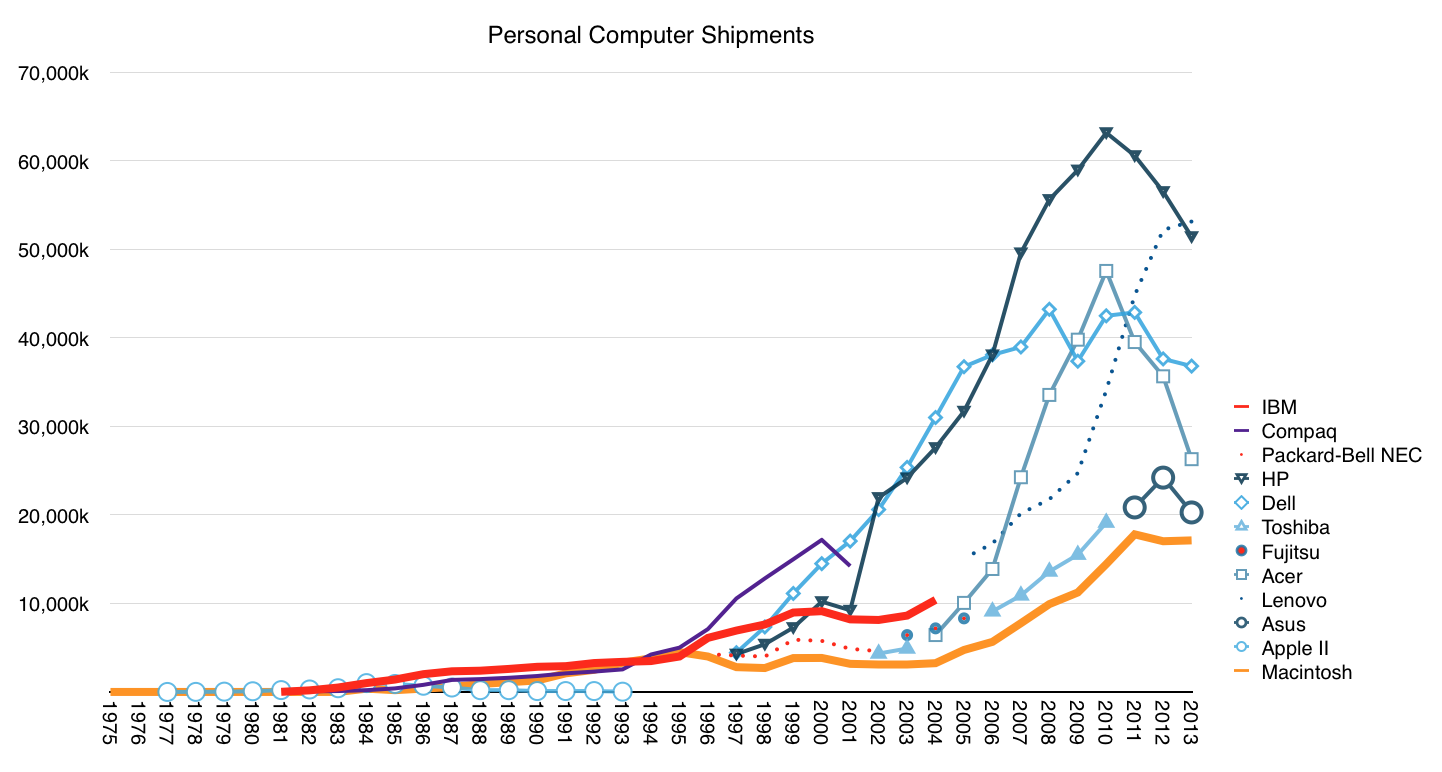
    IBM did not invent personal computing but their "PC" became synonymous with the category. Having entered the market in 1981, the IBM PC quickly became the top selling brand. From 1984 to 1993 IBM sold more PCs than any other vendor, conceding the spot to Compaq which remained on top only until 2000. No PC vendor remained at the top of the sales leagues longer than IBM. HP had the second longest run but that run was broken last year as Lenovo (who acquired IBM's PC business) surged.

    Screen Shot 2014-07-16 at 4.19.11 AM

    As the graph above shows, the period of time when IBM was dominant was characterized by far lower volumes. In 2004, the year IBM exited, they sold about 10 million units. ((as the graph shows, if we consider Lenovo as taking over from there, they did a very good job extending the legacy.)) It was a decent performance but one that did not keep up with the Dell and HP/Compaq race to the bottom in pricing and subsequent rise in volumes.

    However, throughout its position of strength, IBM was a reluctant PC maker. IBM never controlled the PC platform the way they had controlled their mainframe and mini-computer businesses. Their falling out with Microsoft over OS/2 and their attempts at differentiating with the PS/2 architecture show how uncomfortable the situation was. Their exit in 2004 must have come as a relief and, in retrospect, they should be congratulated for having exited the market well before it began deteriorating. First came pricing and margin collapse and later total volumes began to decline. Most of the remaining vendors are today in various states of distress. Lenovo is growing but incumbents like Dell, HP and entrants have come and gone (Fujitsu, Sony, NEC, Toshiba). Potential disruptors  like Asus and Acer have found no long-term success with PCs.

    This is because without control over the platform, PC hardware is nothing more than a commodity, with negligible margins, intense competition and an inability to control one's destiny.

    One company making computers did manage to control its destiny. By continuous refinement, the Macintosh survived and even thrived as the market pivoted toward mobility (and hence requiring integration that values design).  Indeed, Apple now ships over 17 million Macs a year. More than either IBM or Compaq did at their peaks. It's not in the top five globally but has a very profitable niche. ((It's very likely that it captures more operating profit than the top five vendors combined.))

    As a matter of fact, through 2013 Apple shipped a total of 156.5 million Macs,  50% more than all IBM PCs ever shipped. Apple also shipped more than twice as many iPads and five times more iPhones. And it's not just popular with consumers. With iOS Apple manages to reach 98% of Fortune 500 companies and 92% of Global 500.

    At the same time, even though IBM exited the hardware business, it remained a powerful force in computing. IBM pivoted to primarily being a service company with a vast client base and increasing global reach. It essentially moved up the value chain to become an integrated services provider to business customers. IBM's reach in breadth and depth of services is extraordinary.

    This dramatic turnaround–Apple moving to a device leadership position and IBM moving to a service leadership position–created the conditions for today's announcement of a strategic partnership--an event which is astounding to those who witnessed the 1980s and 1990s. Were it not for the tenacious independence of Apple and the business model agility of IBM, neither company would be around today to leverage one another.

    There is drama in this industry and this latest chapter has a plot twist which any poet would envy.

  10. Measuring Not Getting the Cloud

    Research · 137 comments

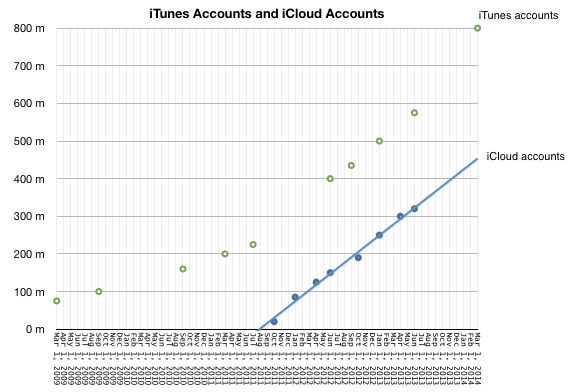
    This is what "Not getting the Cloud" looks like:

    Screen Shot 2014-05-09 at 5-9-3.30.03 PM
    Screen Shot 2014-05-09 at 5-9-4.04.33 PM


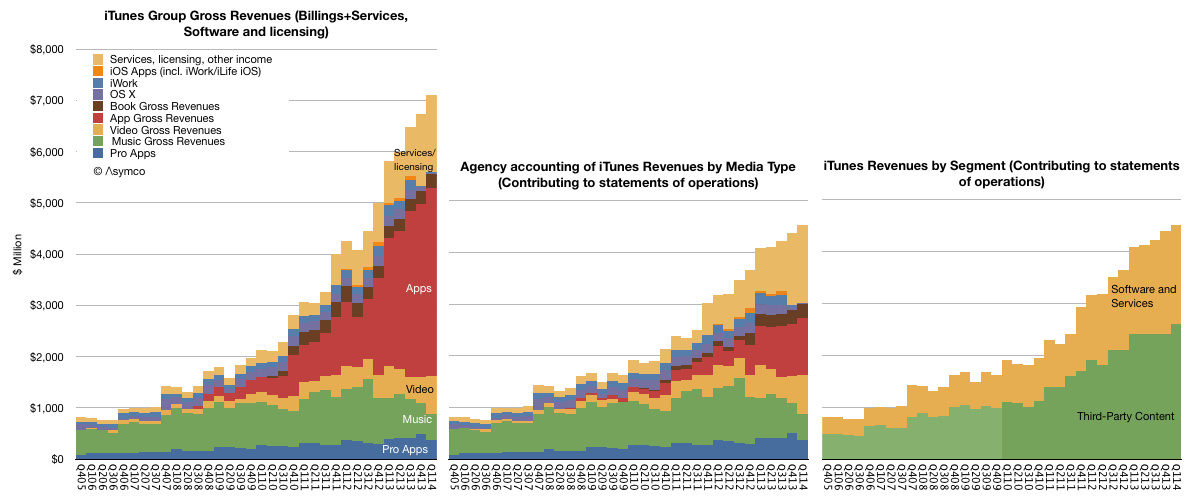
    "Not getting the cloud" means that in the last 12 months Apple obtained:

    • 800 million iTunes users and
    • an estimated 450 million iCloud users spending
    • $3 billion/yr for end-user services plus
    • $4.7 billion/yr for licensing and other income which includes
    • more than $1 billion/yr paid by Google for traffic through Apple devices and
    • $13 billion/yr in app transactions of which
    • $9 billion/yr was paid to developers and
    • $3.9 billion/yr was retained as operating budget and profit for the App Store. In addition,
    • $2.7 billion/yr in music download sales and
    • more than $1 billion/yr in Apple TV (aka Apple's Kindle) and video sales and
    • $1 billion/yr in eBooks sold

    In summary, iTunes, Software and Services has been growing between 30% and 40% for four years and is on its way to $30 billion/yr in transactions and sales for 2014.

    This is what can be deduced from a reading of Apple's financial statements of operations. If there are comparable details for companies which do get the cloud, I'll be happy to tally the comparison so we can calibrate this failure.

  11. Inventive Teens

    Research · 23 comments

    Philip Elmer-DeWitt cited Piper Jaffray's latest Teen Survey on Device Ownership where ~7,500 teens in the US are asked about their device ownership. This type of data is similar to the method comScore uses to measure penetration smartphones in the US making the two data sets comparable.

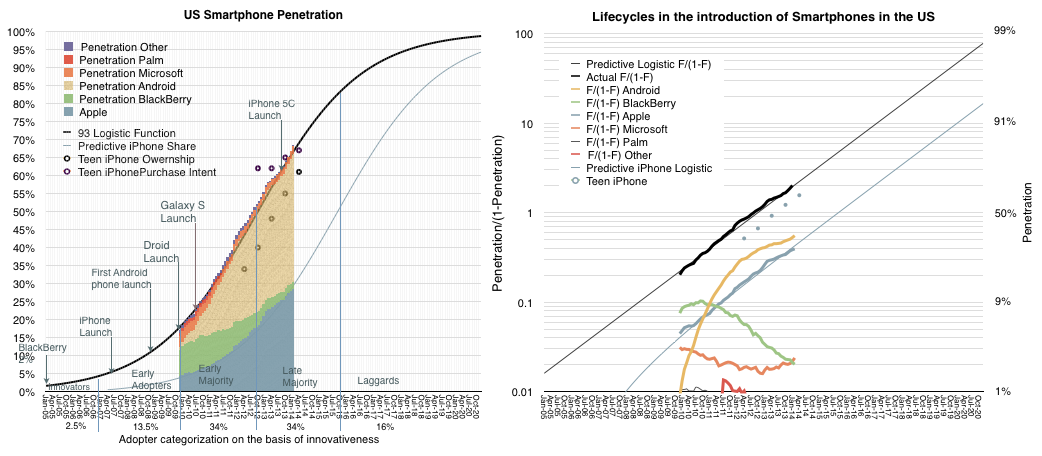
    The combined data is shown the following graphs.

    Screen Shot 2014-04-10 at 4-10-3.07.04 PM

    One graph is the penetration data and the other is the ratio of penetration to unpenetrated on a log scale. The PJC Teen Survey data is shown as dots on both graphs. In the spring of 2012 the difference between teen iPhone ownership and overall population iPhone ownership was 20 percentage points. In the fall 2012 it was 22 points. In spring 2013 it was 25 points. The spread increased to 30 points in the fall of 2013.

    This implies that the latest sample (April 2014) should have at least a 31 point lead on what comScore will report in another two months. ((comScore reports data during the first week of a month for a period ending one month earlier. So the April release covers a sampling period ending February)) In other words current iPhone penetration in the US is probably 30%. This assumes of course that the relationship between teens and overall population has not changed. But there is consistency in the pattern of iPhone growth for over 50 months.

    In addition, the purchase intent data is showing that there is growing interest and that interest reflects demand which has been largely met by a purchase decision.

    Teens are leading adoption in this particular sector because the device is very well suited to the jobs that they need to do, mainly social interaction. It's no coincidence that the audiences for the fastest-rising services (SnapChat, WhatsApp, Vine, YouTube, Instagram) consist mainly of teens. They also lead adoption in FaceBook, iTunes, MySpace, etc. In that regard teens are an early indicator of mainstream behavior.

    Teens taught the world new habits throughout the 20th century ((An entertaining review of the contribution (and invention) of teenagers in the 20th century can be enjoyed in James May's 20th Century Episode 5)) and they certainly seem to be teaching us in the present.