Goldman Sachs is pushing back on negative sentiment surrounding Apple ahead of its second-quarter earnings, arguing that the stock's recent underperformance reflects fears that do not match the company's underlying position.
But analyst Michael Ng said, "concerns for Apple are overly pessimistic given its much stronger relative position."
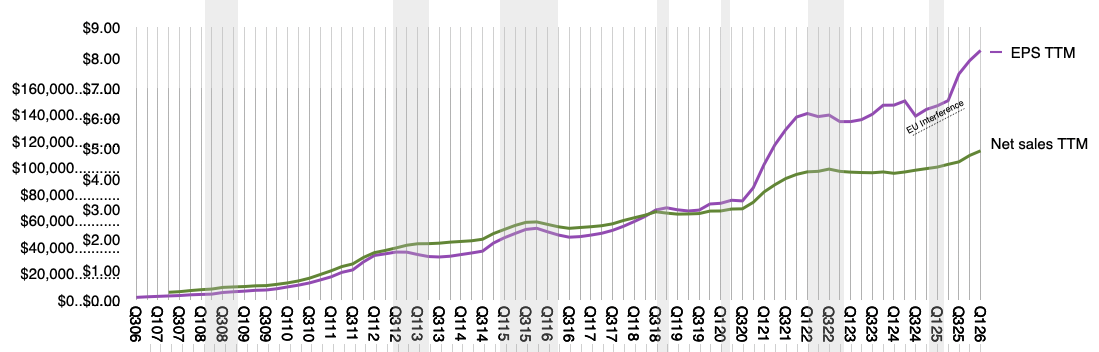
Goldman Sachs forecasts fiscal second-quarter EPS of $2.00, above the Street consensus of $1.93, with outperformance expected across iPhone revenue, Mac revenue and gross margins.
Favorable foreign exchange and strong Services revenue growth are also expected to flatter results.
On Services, Goldman Sachs projects 14% year-on-year growth despite another slow App Store quarter, with iCloud+, AppleCare+, prior price increases on Apple TV+ and solid advertising performance cited as supporting drivers.
Looking ahead, the bank sees advertising inventory expansion in the App Store and Maps as further tailwinds.
Recent data points cited by Goldman Sachs include high-end smartphone outperformance flagged by TSMC on its latest earnings call, iPhone share gains in China, and reports that Apple is actively securing mobile DRAM supply while keeping pricing competitive.
The bank sees further catalysts ahead, including WWDC, where new AI Siri features are expected, and the fall iPhone lineup, which Goldman Sachs described as likely "the most innovative ever with the introduction of the iPhone Fold."
Asymco Bulletin is a digest of all the work we have published for the week ending Apr 5, 2026.
Podcast
Apple at 50: Ben Thompson of Stratechery interviews Horace Dediu → Horace describes his journey from Romania to becoming a leading tech analyst, highlighting his experiences at GTE Labs, business school under Clayton Christensen, and Nokia during the iPhone's birth. He emphasizes Apple's customer-centric approach and its potential to navigate AI challenges. Dediu also shares insights on his new paid service, Asymco One, and reflects on the importance of understanding market dynamics and customer satisfaction. He expresses optimism about Apple's future and underscores the value of deep, long-term analysis in tech forecasting. →
Apple’s Business Strategy → Apple's enterprise growth is driven by its strong consumer base. Do new services like Apple Business suggest a new emphasis? →
Melius highlights FCF while reiterating buy on Apple → In the AI era, valuation shifts from traditional P/E to EV/FCF, highlighting Apple's robust financial health and fair valuation amidst its significant product launches. →
The iPhone 50 years from now – and why Apple won’t have AI execs → Rumors suggest the iPhone 70th anniversary edition might feature an innovative new camera system, while Apple CEO Tim Cook dismisses the idea of AI-led executives due to legal and functional constraints. →
Ben Thompson of the Stratechery interviews Horace on the Stratechery Plus Podcast to discuss Horace's journey to become an influential tech analyst: early career in research, business school under Clayton Christensen, and his time at Nokia during the rise of the iPhone.
The conversation further explores Disruption Theory in the context of both smartphones and AI, why Christensen misjudged Apple, and whether AI could challenge today’s tech giants. It also marks the launch of Dediu’s new paid service Asymco One and reflects his continued conviction in Apple Inc. at its 50-year milestone.
Apple Business isn’t so much a new thing as a consolidation of what used to be two separate products–Apple Business Manager and Apple Business Essentials–into one. The new platform includes device management, company email and calendar at your own domain, an employee directory, and brand management tools across Maps, Mail, Wallet, and Siri.
The device management piece used to cost money and was only available in the U.S. While you still pay if you want to add iCloud storage or AppleCare+ for business, the core business tools are now free. “We’ve unified Apple’s strongest business offerings into one simple, secure platform,” said Susan Prescott, Apple’s vice president of Enterprise and Education Marketing.
There are a number of ways this is a smart play for Apple. The company has been growing its share of small businesses, and having a suite of tools to help those businesses manage devices and software is a big part of that. And it’s even smarter than it might look, because the goal is to make Apple devices the default option at work. Once your company email, device management, and employee directory all run through Apple, leaving gets a lot harder.
All of that is actually helpful context for the new thing Apple announced: ads are coming to Apple Maps this summer in the US and Canada. That means that local businesses with a physical location can claim their listing through Apple Business, upload photos, set a budget, and run a campaign. Apple’s automated system runs an auction and delivers ads, much in the same way ads work on Google or Instagram. Advertisers only pay when someone views or taps their ad.
What’s most notable, however, is how Apple is approaching ads in its Maps app differently from Google Maps. The company says it will only show one ad per search, and won’t allow competitor search targeting, meaning you can’t buy an ad that shows up when someone searches for the coffee shop down the street.
“A user’s location and the ads they see and interact with in Maps are not associated with a user’s Apple Account,” Apple said in its announcement. “Personal data stays on a user’s device, is not collected or stored by Apple, and is not shared with third parties.”
That’s a distinction that means a lot because, generally, consumers aren’t huge fans of ads. Partly that’s because they’re usually just in the way of finding whatever you were actually looking for, and partly because where there are ads, there’s usually data tracking.
Apple’s model is meaningfully different from how Google Maps advertising works. If you’ve opened Google Maps lately and searched for a local business, it’s not uncommon to see several sponsored results for other businesses before you see the one you actually searched for. I get that there’s money there, but it’s an absolutely garbage experience. If I type in the name of a business, there should never be paid results before the thing I asked you to show me.
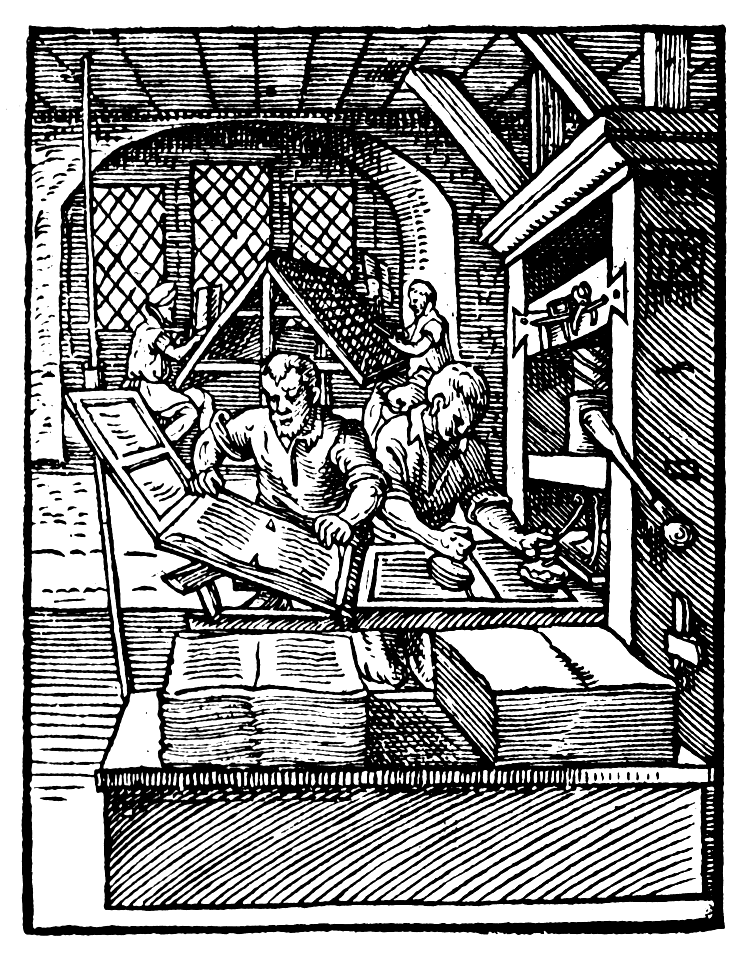
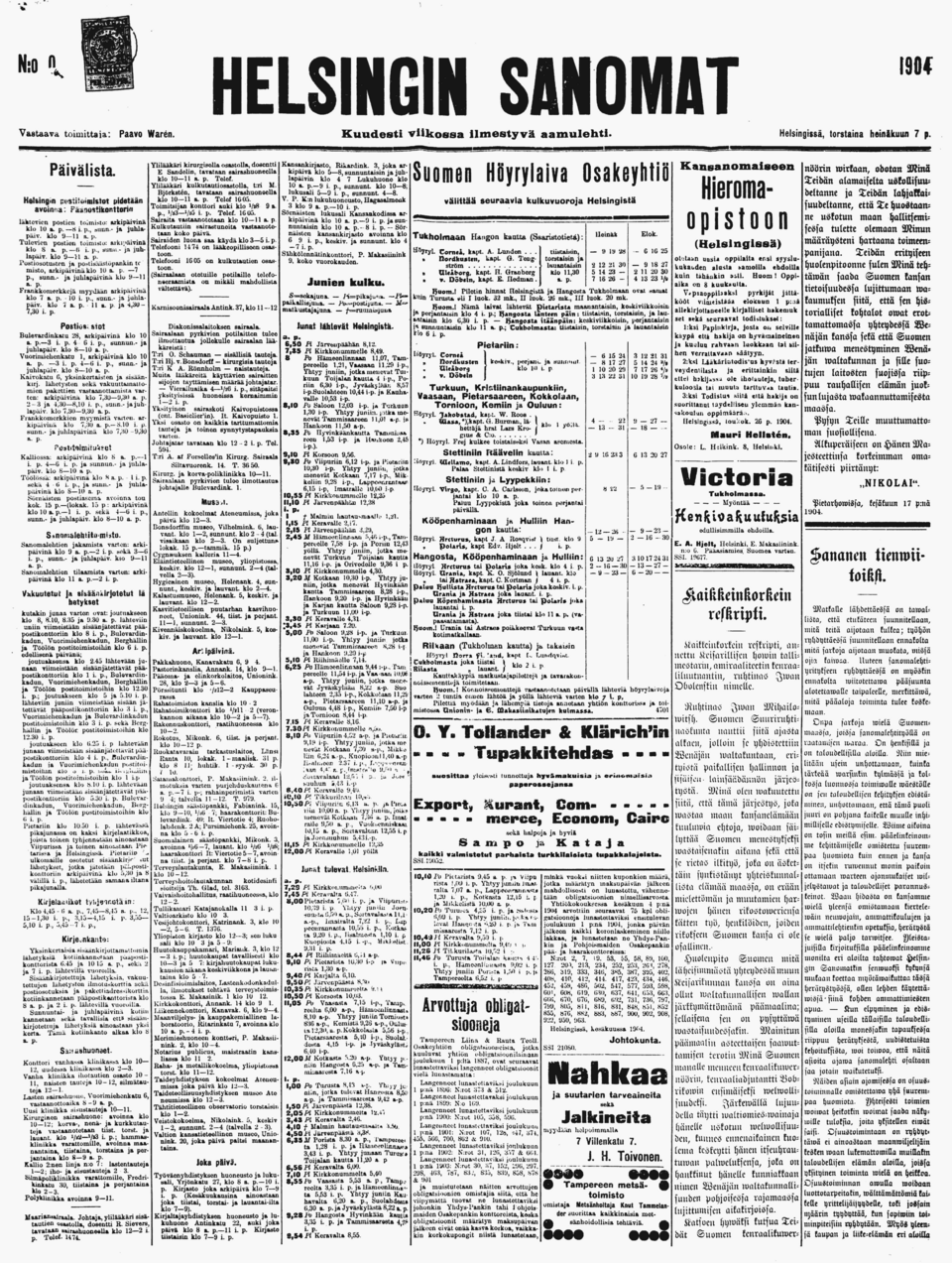
It was not a product that anyone asked for. Like many innovations, it wasn't an invention. It was not patented or discovered in a laboratory. It emerged as a result of the convergence of three disparate technologies: continuous roll printing presses, the telegraph, and the railroad. This convergence occurred by the 1830s, facilitated by a business model aptly named “the penny press”.
Stepping back, the printing press was initially developed in the 1450s, 40 years before Columbus' voyage. It went through numerous evolutions. The big change was moving from batch (page-at-a-time) to continuous (rotary) processes. In the 1600s, Gutenberg type presses could operate at the rate of 240 impressions per hour. By 1818, The Koenig press could reach 2400 impressions per hour.
The steam-powered rotary printing press, invented in 1843 in the United States by Richard M. Hoe, ultimately allowed millions of copies of a page in a single day. Mass production of printed works flourished after the transition to rolled paper, as continuous feed allowed the presses to run at a much faster pace. Hoe's original design operated at up to 2,000 revolutions per hour where each revolution deposited 4 page images, giving the press a throughput of 8,000 pages per hour. By 1891, The New York World and the Philadelphia Item were operating presses producing 90,000 4-page sheets per hour. -Wikipedia
By harnessing steam engine power, the marginal cost of printing approached zero and typesetting productivity was such that tens of these pages could be laid out in hours. The production problem was solved.
The telegraph gave rise to news services which could relay national or international news to local papers nearly instantly. Small towns did not need to employ correspondents to reside on assignment to report what was happening in any and all national capitals. New syndication business models represented by Reuters and the Associated Press would distribute to thousands of smaller papers and communicate the stories via the Victorian Internet. Local reporters could flesh-in the paper with the latest from the community. The content sourcing problem was solved.
Finally the railroad offered daily distribution from urban to rural populations. This meant the entirety of a country's population would have access to news and commentary and, “all that was fit to be printed” on a daily basis. The distribution problem was solved.
A Bundle and Institution
From the capital point of view, the greatest investment for a newspaper publisher was the printing plant. The bigger the plant, the bigger the circulation. And the bigger the circulation, the bigger the profit. Printing presses kept getting bigger and faster. An old newspaper man told me that a newspaper is nothing more than a mechanism for depreciating a printing plant.
In order to pay off this investment, publishers not only sold papers but also advertising. To appeal to more readers they added a variety of content types beside news. Sections emerged to cover sports, lifestyle, photographs, opinion, comics, serialized novels, financial information, entertainment/gossip (thus forming the Hollywood star system). This included style pages, advertising and serialized novels. Some of the greatest literature of the time by authors like Mark Twain and Charles Dickens was first published in newspapers. Weekend editions were an obvious product extension.
Thus an institution was born. The newspaper became the primary source of information for the world. It became highly influential and a political (and propaganda) instrument. It came to be the historical record. We still seek out old papers in archives to find out what happened day-to-day in history.
The bigger the bundle the better the business
What made it resilient was its continuous bundling of additional information types, catering to diverse audiences. There was something in a newspaper for everyone. For men and women, from youth to elderly and for rich and poor. Since the cost of adding pages to the paper was marginal, bundling ensured a growing audience. This audience attention could be monetized through newsstand sales, subscriptions and advertising.
Obviously nobody would read a newspaper cover-to-cover. There was far more information than could be consumed and also far more than was interesting to any one person. The style reader probably did not care much for sports. The Hollywood gossip reader did not probably check the finance pages. But most readers of newspapers bought the bundle because it offered optionality.
They did not need to read it all but they could if they wanted. Maybe a scandal in Wall Street would attract the gossip reader occasionally. Maybe a pennant race would attract the style reader. If something exciting happened, you could read all about it.
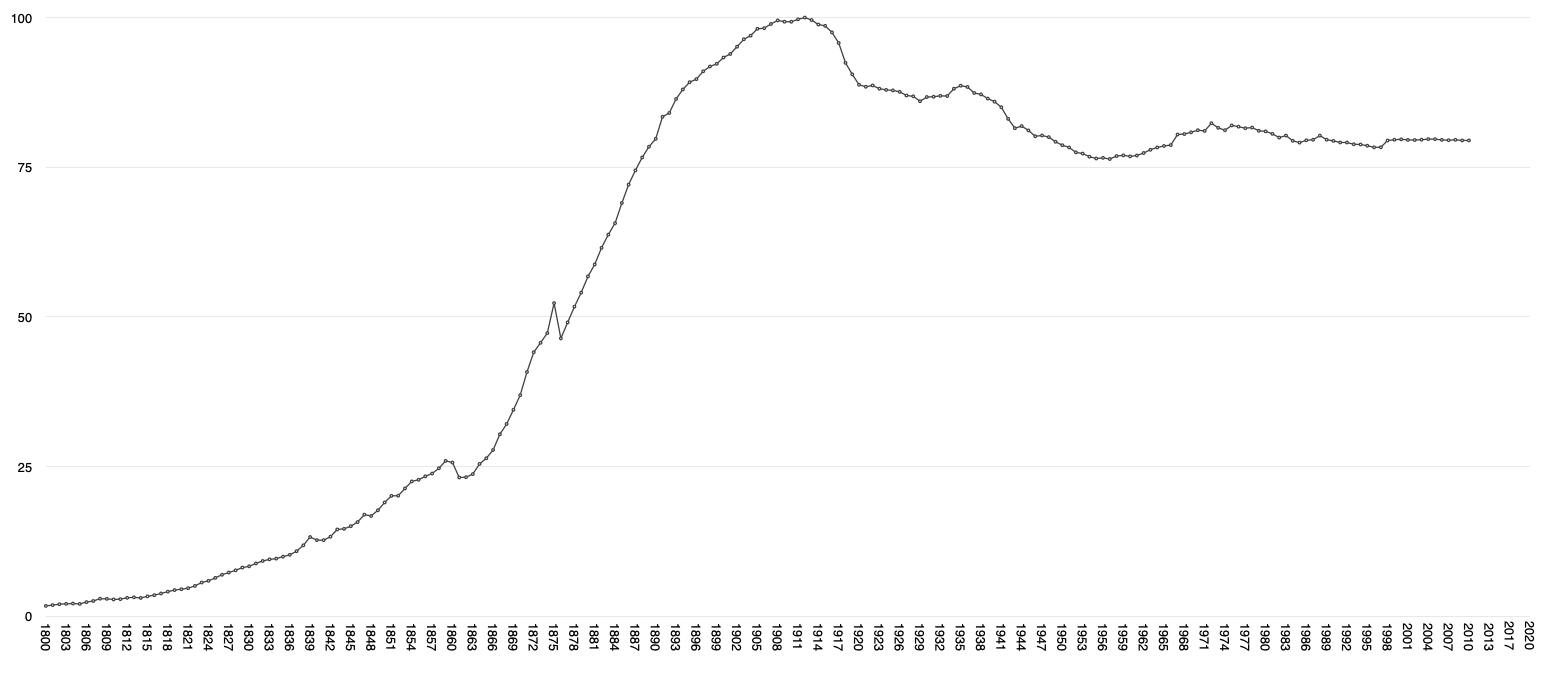
Consumers were happy with the bundle and the newspaper became a tentpole holding up the information a society needed to function. It swayed elections, influenced public opinion and investigated the bad and the ugly in society. By the turn of the century, more than 9000 newspapers were publishing daily or weekly in the US. A proliferation such that almost every one of the 3140 US counties had more than one.
Percent of communities in the US with published newspaper titles. Banks, Arthur (2004), “Cross‐National Time‐Series Data Archive,” via Diego A. Comin Bart Hobijn THE CHAT DATASET NBER Working Paper 15319
Unbundling the Newspaper
Then the internet arrived. Gradually, it became possible for every single piece of the bundle in a newspaper to be made available as a web page, free with some display ads. If you were interested in style, there were 1,000 style sites. If you were a sports fan, there would be 1,000 sports sites. News junkies could get the latest news faster online. Financial news was now real-time. No longer did you have to wait for the morning to find out what happened in the markets the day before.
As national and global news could be obtained on web sites, newspapers hoped to continue as sources of local information. That also gradually got peeled away by social media. The result was nothing short of catastrophic. Since 2004, the United States has lost one-fourth (2,100) of its newspapers. Weekday circulation declined 45%, from more than 122 million to 68 million. Consequently, half of the counties only have one newspaper, and two-thirds lack a daily newspaper. The loss of newspapers has resulted in the displacement of 36,000 journalists, including photographers, editors, comic strip artists, and copywriters.
The internet unbundled the newspaper but also the music album, the magazine, the TV channel and almost all forms of entertainment. Unbundling built new empires: iTunes/Apple Music, Netflix, Spotify, YouTube, Facebook.
This unbundling led to a new way of finding opportunities. You could actively look for bundles and once you found one you could ask when and how it would get unbundled. And vice versa. Jim Barksdale summarized it as: “i know of only two ways to make money: bundling and unbundling.”
So much so that if you found a huge bundle that somehow resisted unbundling you would have to investigate it for what's wrong with it. The classic example is the automobile. As a bundle of many types of trips and configurations into a simple but over serving business model clearly it was ripe for an unbundling. That is what ride sharing (with or without a human driver), and new modes represented by micromobility seek to do.
The AI Bundle
The iPhone is an enabler in this game, capable of either bundling or unbundling depending on the apps which are built for it. Wearables do some of the side quests but the phone is still the core of the personal network.
I would contend that AI is exhibiting a lot of bundling characteristics. We assume one model is good enough for all types of tasks even though there are pitfalls in privacy, security or complexity. Being a prompt mechanic feels like more of a DIY experience. But indications are out there that AI will be unbundled. According to The Information,
“Apple has complete access to the Gemini model in its own data center facilities. Apple can use that access to produce smaller models that power specific tasks or are small enough to run directly on Apple devices so they can run the tasks faster.”
This approach relies on a process called model distillation, where a larger AI model trains smaller versions that can run efficiently on-device. These smaller models reduce the need for cloud processing and improve speed, which fits Apple’s focus on privacy and performance.
“Since Apple has full access to Gemini, its student model can also learn to imitate the internal computations that Gemini uses to arrive at its answers.”
But it does not stop there. The implication of AI as a job destroyer is also challenged by bundling theory.
Jobs as Bundles
We have long been warned that AI would eliminate millions of jobs. One of many forecasts predicts that by 2030, approximately 10.4 million US jobs, 6% of the workforce, will be lost to AI. The underlying assumption behind these figures is simple: if AI can perform tasks that are currently performed by humans, the human workforce will be rendered obsolete.
A new paper by Luis Garicano, London School of Economics, Jin Li and Yanhui Wu, University of Hong Kong suggests it's not that simple.
The paper argues that jobs aren't tasks. They're bundles. For instance, radiologists don’t merely read scans; they interpret edge cases, collaborate with clinicians, and approve decisions that individuals make. Replacing the image-reading aspect doesn’t necessarily equate to replacing the Radiologist job.
Authors draw a line between “weak bundles” and “strong bundles” based on their ability to be split apart. Weak bundles can be easily separated, while strong bundles cannot be without losing their value. You can think of bundling strength as also the degree of modularity/integration. A weak bundle is more modular, a strong bundle is more integrated.
"In weak-bundle occupations, AI automates some tasks and narrows the boundary of the job… In strong-bundle occupations… AI improves performance inside the job, but does not remove the human from the bundle."
In jobs with weak bundles, AI doesn’t merely replace a task; it fundamentally reshapes the job. The human is left performing tasks that the AI cannot, often in a more specialized and limited capacity compared to the original role.
Once AI takes over a portion of the work, humans cease to divide their time. They dedicate themselves entirely to the remaining tasks, resulting in increased output per worker, i.e. higher productivity. Thus even weak bundles don't necessarily imply job reduction but increased output.
Artificial intelligence is transforming job roles, rather than eliminating them. While certain tasks may be reallocated and productivity could potentially increase, employment and working hours have remained relatively stable. In many instances, the bundle holds.
In a strongly bundled occupation, AI still improves task-performance, but the human retains both tasks and a larger revenue share. Whether the aggregate labor share rises or falls depends partly on the distribution of coordination costs between tasks within an occupations.
If most employment sits in strongly bundled jobs, the aggregate labor share is more resilient than the task-exposure models predict. The distribution of bundle strength across the occupational structure is therefore a first-order empirical question for understanding AI’s macroeconomic impact.
In other words, the doom/utopia AI outcome dichotomy is false. It depends on the potential for unbundling. If you're in an integrated (strong-bundle) job, blending judgment, context, and responsibility, AI is sustaining: it will make you faster and better paid. If you're in a modular (weak-bundle) job, it will shunt you into an integrated role, whereby productivity rises.
The degree of job displacement will depend on the degree of bundling in most jobs across the economy. It may turn out that integrated jobs will be added as the opportunities created by productivity will be market creating.
History is filled with examples of restructuring of ideas and the re-configuration of businesses due to technological change. AI is an example of both enabling and disabling of existing businesses and occupations. Very much the way the Internet turned out to be.
Displacement happens but innovation creates more opportunity and reallocation of effort to better (or at least more) outcomes. The newspaper and internet created markets and jobs. Will AI do the same? Modularity may hold the answer.
Apple first brought podcasting to a mainstream audience when it added the category to iTunes in 2005. And the dedicated Apple Podcasts app has been a central part of the landscape ever since. Today, users can get the app in more than 170 countries and regions. It offers millions of shows across hundreds of categories, plus features like Enhance Dialogue mode, playback speeds from 0.5x to 3x, automatic chapter creation, timed links and transcripts for over 125 million episodes in 13 languages.
A major update to Apple Podcasts will introduce full video podcast support this spring using the company’s HTTP Live Streaming (HLS) technology, the iPhone giant said Monday.
The update promises a seamless experience for both viewers and podcast creators, with new tools for monetization and content distribution that Apple said will set a new standard for the medium.
“By bringing a category-leading video experience to Apple Podcasts, we’re putting creators in full control of their content and how they build their businesses, while making it easier than ever for audiences to listen to or watch podcasts,” said Eddy Cue, Apple SVP of Services.
NB: YouTube has become a juggernaut swallowing music, podcasts, shorts/reels and not least of all movies and TV. It's hard to overstate just what a hegemony this has become. I must say that it has always been evident to me as a low-end disruption to video. It became the tail that wags the dog of entertainment. Apple's efforts can only be distinguished as "premium". Premium TV, premium music and premium podcasting (and premium News). The challenge for Apple is to attract creators not just listeners. We do distribute our Asymetric Podcast on Apple Podcasts and we will move to video but it's clear that there are other platforms that have higher volumes. The big news is support for ads.
Creators can dynamically insert video ads — including host-read spots — unlocking access to the broader video advertising market while maintaining full creative control.
"Apple does not charge hosting providers or creators to distribute podcasts on Apple Podcasts, whether via traditional RSS/MP3 or HLS video. Apple will charge participating ad networks an impression-based fee for the delivery of dynamic ads in HLS video on Apple Podcasts starting later this year."
According to JP Morgan analyst Samik Chatterjee, citing Sensor Tower, Apple's App Store revenue for May 2025, increased by 4.9% month-over-month (which compares to an average sequential increase of 2.3%) and an acceleration of year-over-year revenue to 13.0% in May versus up 11.8% in April. On a year-over-year basis, the App Store downloads increased by 3.1% in May (versus +5.8% in April) according to Chatterjee.
This analysis is based on app download sampling and may be indicative of the activities of consumers on the App Store. Services revenue in the first calendar quarter was $26.6 billion, up 12% year-over-year and at an all-time revenue record. Services gross margin was 75.7%, up 70 basis points sequentially, also an all-time record.
The world however seems to be having a problem with Apple Services. After years of skepticism of its relevance, now that it has achieved a run level above $100 billion/yr., it's being criticized for being harmful to competition.
The comments that it's unfair to developers or that it deters innovation are uninformed to say the least. What is missing from that analysis is that the App Store is only a small fraction of the entire ecosystem around Apple's platforms and that the economic activity the platforms enable is immense.
Let's learn.
Over the last year Apple reported a bit more than $102 billion in revenues for Services at a very high margin. The reason it was such a high margin was partly due to the fact the Services does book all payments from customers through the App store as revenues. In other words it does not include payments to developers as either revenue or costs. Those payments pass through but they are certainly part of the economic activity on the store. It would be indeed unusual for a physical store not to report what it pays for what it sells as part of revenues. But this is the basis Apple chose (or was obligated to choose) as the way to report App Store revenues.
Thus considering the payments to developers, the economic activity directly related to the App Store amounts to $120 billion/yr which includes commissions of about $30 billion/yr (last 12 months) and payments to developers of about $90 billion/yr (implying about 25% blended average commission rate.)
So including payments to developers the Services business grosses $186 billion/yr. of which 102 billion is reported as revenue, with the 75% gross margin and $90 billion is paid to developers "off the books".
But that $102 billion in revenues is only about 30% App Store commissions. The rest includes many types of income: It includes:
Advertising which consists of Apple's own advertising services and third-party licensing arrangements notably the distribution fees for Google search (accounting for most of Googles "TAC" or traffic acquisition costs.
AppleCare, Apple's own extended warranty service.
Cloud Services which provide content synchronization.
Digital Content which not only includes the App Store but also stores for books, music, video, games and podcasts. Apple also offers digital content through subscription-based services, frequently bundled, including Apple Arcade, essentially a game subscription service; Apple Fitness, a personalized fitness service; Apple Music, which offers music streaming and on-demand radio stations; Apple News, a subscription news and magazine service; and Apple TV, which offers exclusive original content produced by Apple and live sports access licensed sometimes exclusively by Apple.
Payment Services which offers Apple Card, a co-branded credit card, and Apple Pay, a cashless payment service.
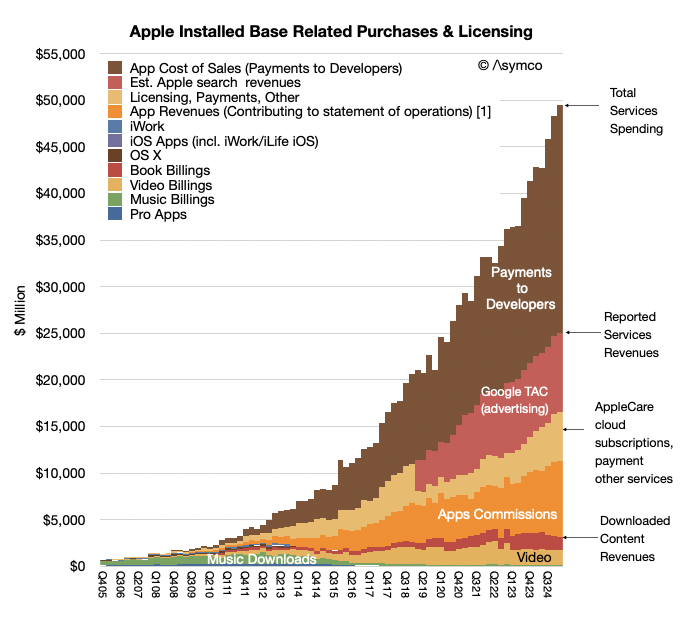
The quarterly view is summarized in the graph above. So a fixation on the commission is only a view into 16% of Services as an economic foundation (the orange area in the graph above).
But that's still only a sliver of the whole picture.
A report written by Jessica Burley, Analysis Group and Professor Andrey Fradkin, Boston University Questrom School of Business has estimated that the global App Store ecosystem facilitated $1.3 trillion in developer billings and sales in 2024. As the report writers say: "For more than 90% of the billings and sales facilitated by the App Store ecosystem, developers did not pay any commission to Apple."
How is this not visible? The reason is that this economic activity is distributed over the millions of purchases Apple users make through its iOS Apps every day. This includes traditional App Store "Billings" including paid downloads and in-app purchases, including subscriptions, that use Apple’s in-app purchase system and “Sales” which includes money spent by customers purchasing goods and services in general using any iOS and iPad OS apps. Apps developed by Apple such as Apple Music, Safari or browser apps such as Chrome are excluded from this analysis.
The economic activity unleashed by the App Store now reaches well over $1.3 trillion/yr. As the authors further explain,
While the present analysis captures the major app monetization strategies available to developers, the full economic impact of the App Store ecosystem extends beyond the estimates provided in this report, as the current methodology does not capture all of the ways in which the App Store ecosystem facilitates sales, or all of the benefits created by apps. For example, the App Store supports “companion apps” that raise the value of a company’s goods and services, including smart home apps and health apps. In addition, many apps now use different monetization strategies. As such, this analysis does not account for all the ways in which the App Store ecosystem creates value.
Furthermore the report breaks down the categories as Digital Goods and Services, Physical Goods and Services, M-Commerce (General Retail, Travel, Food Delivery and Pickup, Grocery, Ride Hailing), Digital Payment and In-App Advertising.
In addition the report estimates these categories from 2019 as well as 2024 providing a growth perspective: Over the past five years, the App Store ecosystem has more than doubled in size, increasing from $514 billion in 2019 to nearly $1.3 trillion in 2024.
It also identifies regional dynamics between the US, China, Europe (with select countries) and Rest of World (with select Asian countries).
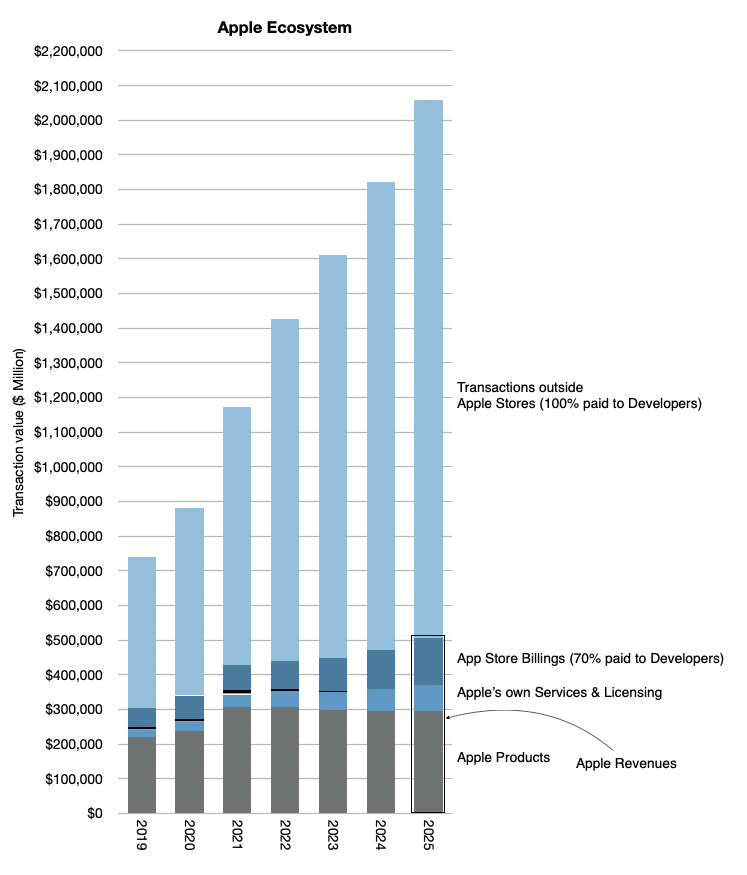
I've been keeping my own analysis of what I called the Apple Economy and it includes these transactions outside the App Store and Apple's own products and services. If I were to subtract Apple's own revenues from the total, for 2024 I was getting about 1.4 trillion (out of a total of over 1.8 trillion).
My point was always to estimate the economic impact of Apple beyond its own sales. This gave us perspective to assume that in 2025 the total would reach over $2 trillion. The graph below gives the perspective which also implies a doubling since 2020 to 2024.
The new report from Burley and Fradkin is a detailed, bottom-up analysis which quantifies what was perceived as the economic value of Apple being far more than what the financial data records.
Bill Gates once stated in reference to Zuckerberg's assertion that Meta was developing a "platform" that it's not a platform unless the economic value of everybody that uses it exceeds the value of the company that creates it.
Apple captures about $30 billion as sales but delivers over $1.3 trillion in sales, a multiple of 43! I would call that generous. In addition it doubles the market in 4 to 5 years. I'd call that market expanding not constraining. Finally, it's a market that Apple created out of nothing. I'd call that market creation not destruction.
If judged on the question of creation and satisfaction of the customer, i.e. the ultimate purpose of the firm, the App Store and Services in general has satisfied 1.4 billion people. That they are spending over $1.3 trillion and doubling in 4 years is nothing short of astonishing.
We'll discuss this topic and other topics related to Apple at ACTIVE: The Apple Investor Conference, which takes place on next Tuesday, June 10th, the day after the WWDC25 keynote.
In yesterday's post, I proposed a way to inspect the Google-Apple distribution deal. It could be understood as a flat-rate deal where default placement of Google search in Safari is paid for with a constant run rate. This was the assumption for a few years with estimates for this run rate ranging widely.
Alternatively, it could be understood as a commission rate where payments are in proportion to ad sales. This is the 36% commission rate that has leaked during the antitrust trial.
Finally, it could also be seen as an access fee for each individual. This is the 17c/user/day that seems apparent from my calculations.
If one were to critique these options, I would disqualify the flat rate as unfavorable to Apple since the user base grows and behaviors can shift. The distribution commission sounds ideal but it would be problematic to enforce. How exactly can one track the precise income obtained by Google for each use of search, maps or YouTube on iOS or MacOS devices reliably enough with an audit trail for Apple to inspect?
For these reasons, I believe the fee of $x/user (or possibly active device as a proxy) makes more sense. The burden would be on Apple to prove that they have such active users/devices while Google could sample their metrics to confirm. Data on active users and devices are figures that Apple already supplies publicly and a method for determining them likely could stand scrutiny by outsiders. The server logs showing active devices can't be too onerous to share.
And so that's the model I'm going with. Having said that, the formulation of compensation for what is a complex distribution deal is likely complex. The abstraction to users/devices is one we have to live with given the challenges of inspecting the invisible.
That's the model of the present. The future however is clouded by the potential interference of authorities. In this case, an antitrust prosecution of Google is asking whether the way Google buys distribution is anti-competitive. The legal arguments are beyond scope here but the gist of it is that buying exclusive distribution when you are dominant may close options to not-so-dominant competitors.
The consequences, if we are to believe the commentary, are that the deal with Apple could be declared illegal and thus, stay with me here, Apple would lose a lucrative source of income.
Let me repeat this for emphasis: If Google were found guilty of anti-competitive behavior, Apple would be punished.
Let me expand for emphasis: If Google were found guilty of anti-competitive behavior, Google will be forced spend far less and be marched off a gangplank to swim in far greater profits.
Given this commentary one wonders why Google's management and legal team aren't begging the judge to rule against them and why Google shareholders aren't hoisting the prosecuting team on their shoulders.
The deal between Google and Apple exists only because both Google and Apple find it to be a better alternative to not having a deal or having any another deal. It does not exist because Apple benefits and Google doesn't or that Google benefits and Apple doesn't.
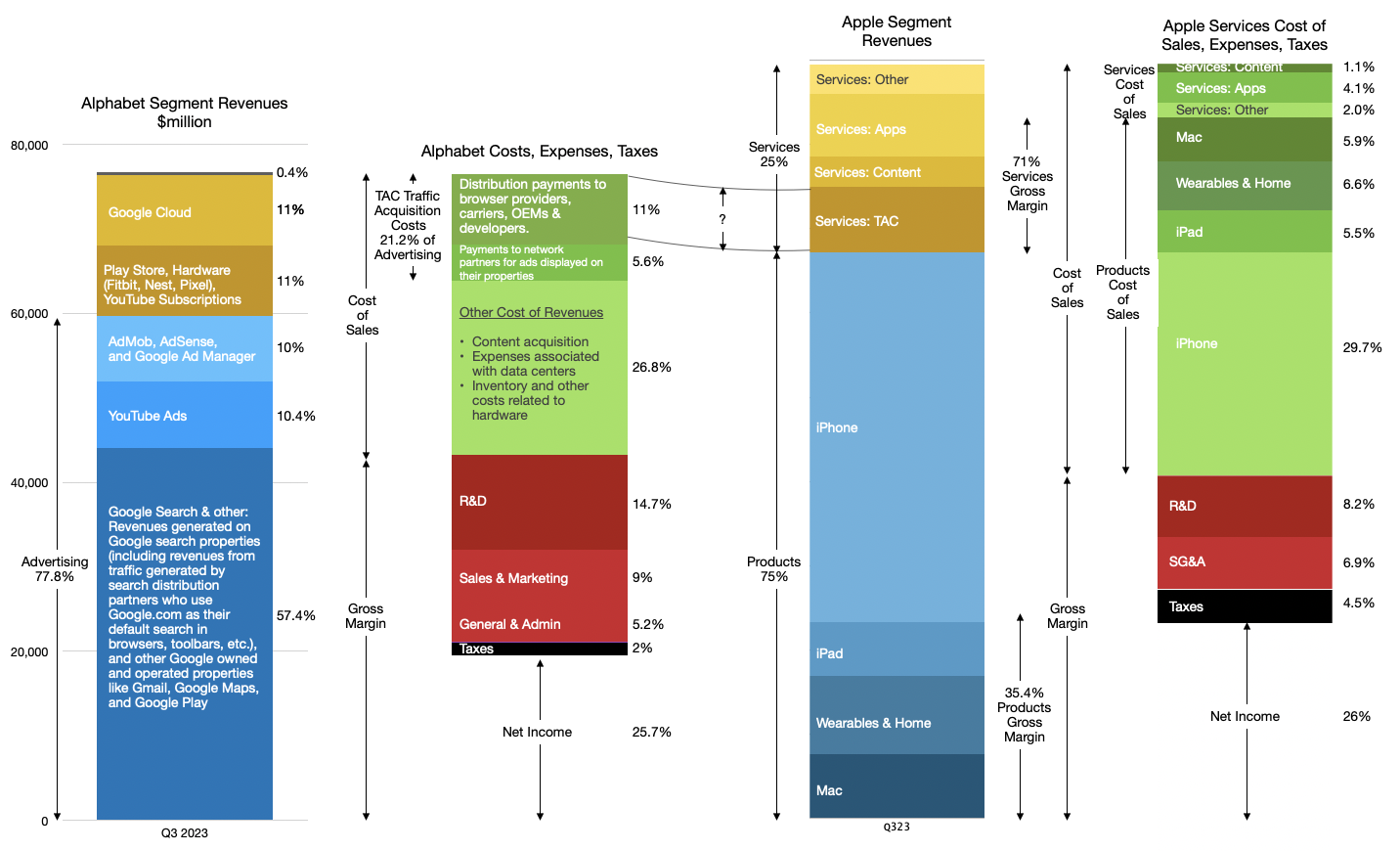
As I've explained the first post in this series, Google's benefit is distribution or access to 1.3 billion very valuable customers. For this they pay quite a lot and Apple receives quite a lot in turn. The relationship is shown in this illustration:
But—and here you should pay close attention—Apple also pays something for that benefit. Apple's $26b+ income from Google's TAC payments are in exchange for offering access. To Google. Not to someone else. And not to itself. Apple's costs are opportunity costs.
If Google had not offered the area marked with a question mark in the image above then Apple would have found alternatives. Alternatives that it's saying no to today.
Apple's alternative to the deal is what needs to be studied.
Could, for example, Apple have signed Microsoft for Bing access in Safari? Sure! They probably didn't because, as they declared, the quality of Bing would not be as good and as a result most people would switch out of it and thus result in lower revenues. Then again, perhaps Apple could make a fortune from Microsoft. Apple could have enabled Microsoft to rise to 40% market share in search, and also improving its quality. How much would that be worth to Microsoft? How much additional opportunity could Microsoft create from establishing such a strong consumer-facing franchise—something they have struggled to obtain even with vast expenditures. Surely Microsoft could be convinced to split revenues 50/50 for what would be all marginally zero-cost new upside!
Could Apple have developed its own search? Sure! They probably already did. Internet Search is a lot easier in 2023 than it was in 2007. Costs for computation, communication and storage drop exponentially while the number of internet hosts has stopped growing. Apple uses indexing in Siri and each iPhone, Mac and iPad runs a local search engine (Spotlight). Again, there are reasons why this is not as good or easy as signing Google up. But on the other hand, perhaps Apple could be making a killing on search. Why accept a 36% commission from Google when they could take 100% of 40% of all Search?
But most importantly, a declaration that this deal is invalid simply means that Apple and Google would craft another deal that would work around the restrictions. And that new deal would probably turn out to be more beneficial to Apple.
Why, I hear you ask?
Because Google would ask for the changes! Google would be forced to re-negotiate because they lost at trial. If that were the case, Apple would naturally ask for concessions. The most certain outcome would be that Apple will be paid even more for access to its users.
How much more? Remember that Google must ensure access to Apple's customers. According to my calculations Apple customers deliver almost 40% of its advertising revenues. The 36% commission suggests that there is plenty of head-room. Apple could ask for 50% and meter the results on a different basis. This would be a 39% increase in pricing for distribution.
This would result in a deal worth $41 billion/yr.
To implement workarounds, the companies would need to bridge their servers in order to ensure metering along new metrics. There would a great deal of complexity. But it would be worth it because both would find such a deal better than alternatives.
Fundamentally, the relationship between Google and Apple exists and will continue to exist because it is mutually beneficial and a better alternative to any other agreement or no agreement. If the current deal is found unsound, for whatever reason, a new deal will be created because it will need to be created.
Apple sits in a better position today than it ever did. Its customer base is growing while its pricing power with consumers is growing. In contrast, Google is the process of explaining that it did not break any laws. This while losing Android users to Apple. How does this lead to a vulnerability for Apple?
What we are witness to here is Apple increasing its distribution pricing power while simultaneously decreasing its opportunity costs.
The idea that Google being found guilty of anti-competitive behavior would result in a "hit to Apple earnings" is preposterous and fails on first inspection. The exact opposite is the likely outcome.
In Google and Apple: The Beginning, we looked at the history of the relationship and the situation which emerged when Mobile Computing rose to such a level of ubiquity that it determined the fate of both companies. Apple today holds firmly in its grasp about 27% of all smartphone users (1.3 billion out of about 4.8 billion). That audience consists of the top quartile of users in terms of income, access to credit, consumption and loyalty. I performed a deep dive on newly available data which confirms that App Store users individually spend more than 7 times Play Store users.
Apple has over 1 billion customers but also they're the best billion.
For this reason, Google has needed to ensure that it maintains access to Apple users for its main business: search. Just like any developer looking at iOS and Android ecosystems, Google knows that Apple's customers are highly desirable, profitable and loyal. Apple had to remain a distribution partner for Google.
How to do that? Google distributors are incentivized with what Google calls TAC or traffic acquisition costs. This is how Google describes TAC in its 10Q filings:
TAC includes: ◦ Amounts paid to our distribution partners who make available our search access points and services. Our distribution partners include browser providers, mobile carriers, original equipment manufacturers, and software developers. ◦ Amounts paid to Google Network partners primarily for ads displayed on their properties.
Apple belongs to the first category, a distribution partner that is both a browser provider and OEM. These costs are part of Google's "Cost of revenues" or Cost of Sales. These are costs that are proportional to sales and are usually measured as a percent of sales. The higher the sales, the higher the costs.
So the question that has been hovering over both companies for a long time is just how much is the portion of TAC allocated to Apple? Consequently, how much does Apple receive in such payments? This is a relevant figure as it affects the degree of co-dependency but also of relative profitability of each business. Apple gaining highly profitable commissions for access to its customers and Google getting highly profitable search terms from those same customers.
Here's what we know: Google reports its overall TAC total as part of its cost of revenues and Apple reports its overall Services revenues and margins as a separate segment. Google also reports TAC as a cost against its Advertising segment revenues.
In the last quarter TAC was $12.6 billion, a 21.2% cost against an Advertising total of about $59.4 billion. Apple reports Services top line only without sub-segments so we don't know how much of that TAC it receives. Services for Apple includes many elements including licensing, AppleCare, cloud subscriptions, digital content, third party subscriptions, apps, payment, advertising and other services. Some of these elements can be estimated as we have some historic data. Apps in particular can be teased out as we have developer payment data.
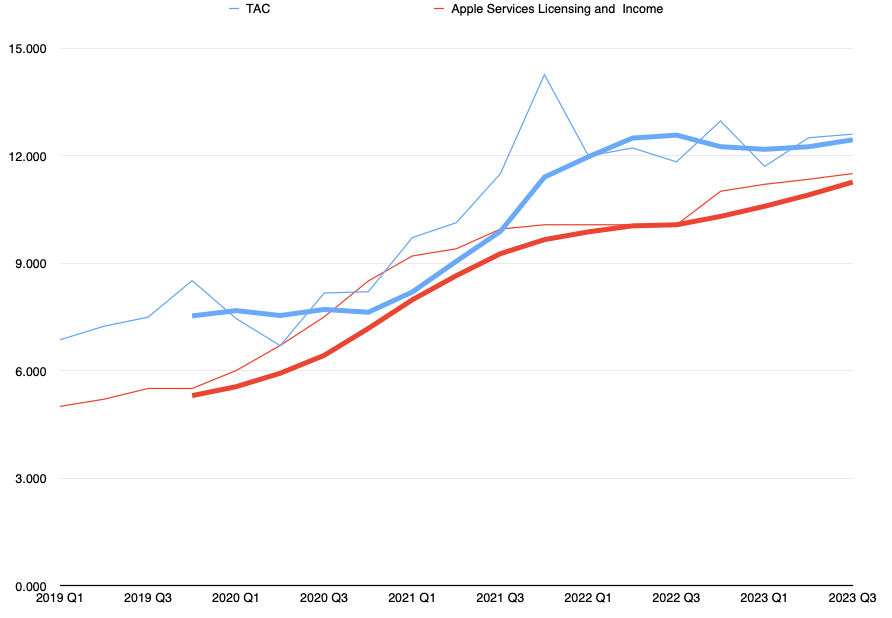
I've been estimating what would be Apple's TAC+cloud+payments as a bundle over the years. Looking at this figure vs. what Google reports as TAC yields this graph:
The thin lines are the actual data and the thick lines are 4 period averages. Apple is red, Google is Blue.
What this shows is that Google TAC is fairly well correlated to what Apple receives and that there is a gap of some degree. What is needed is an estimate of the percent of TAC that goes to Apple and a percent of Apple Services that matches it. Two variables but one equation.
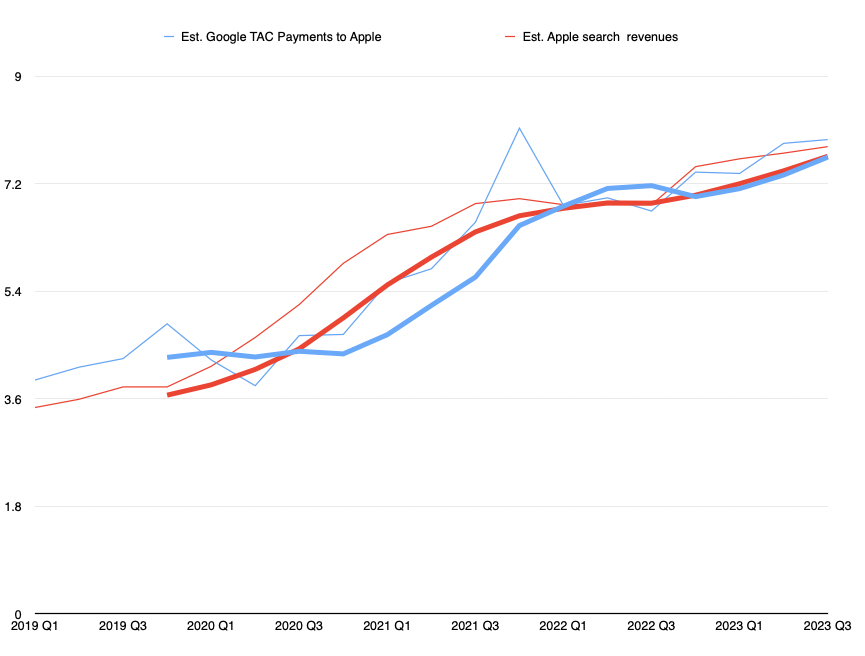
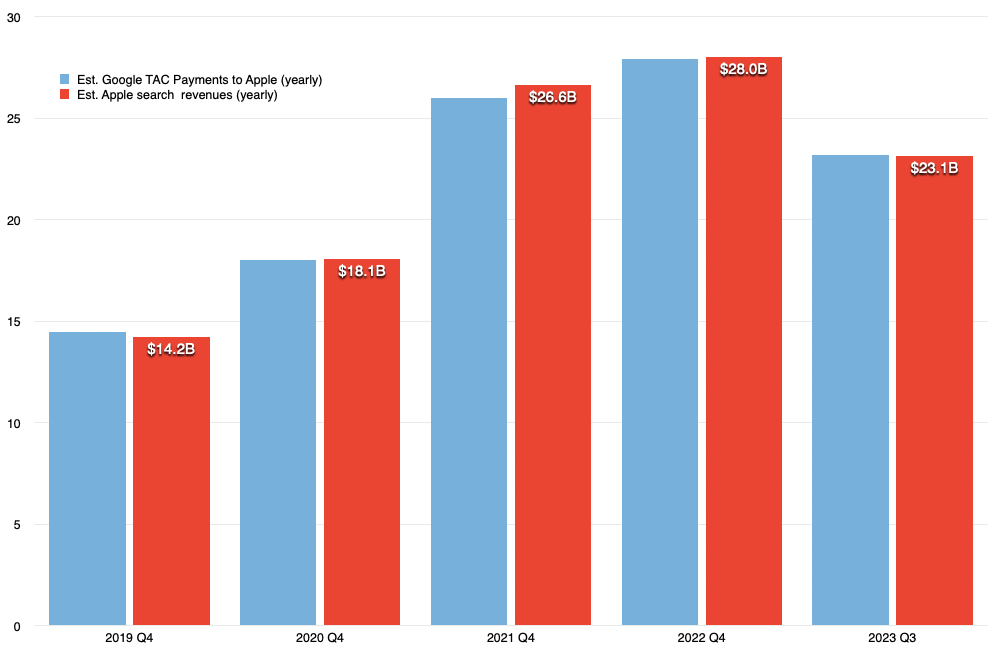
After some iteration through some constraints (which would be laborious to explicate but I can reveal at the next live event) I built the following estimate:
Though not matching identically, the yearly totals are pretty close to each other. The resulting yearly payments are
2019: $14.2 billion
2020: $18 billion
2021: $26 billion
2022: $28 billion
2023 (first 3 quarters): $23 billion
I would say this might be an upper bound for the estimate but not too far from reality. Most estimates to date have been far lower and I don't think they are accurate.
To stress test this I ran several sanity tests including comparing the revenue per user for Apple users and for non-Apple users and checking the sensitivity of services gross margins to TAC total.
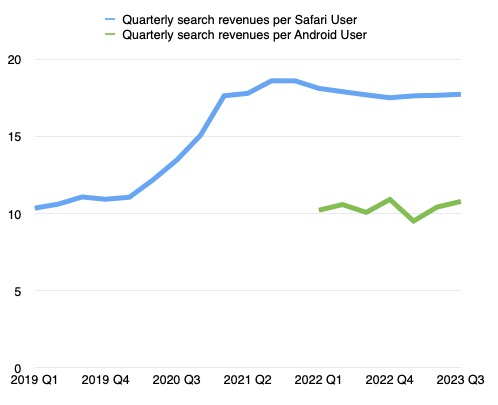
I'll just expand a bit on the revenue per user implications. We can calculate the revenues per user since we know that, according to Google's CEO, Apple receives 36% commission on search. Having the figures above, we can estimate the search income attributed to Apple and, by subtraction, the same for non-Apple. Then we can divide by the install base of each.
This shows that the deal could very well be indexed on the number of users with a specific value attached to each per quarter/month/day as these figures are fairly stable. The figure at this time shows that Apple users are valued at about $17.7/quarter or 19c/day while non-Apple users are around $10/quarter or 11c/day.
It also shows that Apple got "a raise" during 2021, increasing the amount it gets paid per user by about 60%.
It also suggests that Apple users generate about 37% of all of Google's advertising revenue, disproportionately as it's from a 27% user base market share.
None of these conclusions should seem surprising or extraordinary. If anything, they suggest that Apple is providing Google with bargain access to its customers. I suspect that Apple users are more valuable than a ratio of 2:1 in search. The app (and content and device ASP) economics are far more lopsided.
Apple is most certainly also very well aware of this and yet has maintained relatively modest pressure on Google in terms of pricing for access. There might be good reasons of which we are not aware of but as the antitrust pressure grows, so might Apple's interest in getting a better deal.
In the next installment of this series we will look into just how much better this deal can get.
Speaking of Google and Apple, one aspect where the two companies differ is on the question of privacy. Online privacy isn’t just something you should be hoping for – it’s something you should expect. You should ensure your browsing history stays private and is not harvested by ad networks.
By blocking ad trackers, Magic Lasso Adblock stops you being followed by ads around the web.
It’s a native Safari content blocker for your iPhone, iPad and Mac that’s been designed from the ground up to protect your privacy.
Over 280,000+ users rely on Magic Lasso Adblock to:
Remove ad trackers, annoyances and background crypto-mining scripts