Asymco

Asymmetric Intelligence

Bulletin

An at-a-glance summary of Asymco in your inbox. The weekly synthesis with built-in noise reduction.

  1. Asymco Bulletin 031 - Sep 20, 2026
    Bulletin

    The Asymmetric Weekly, for the week ending Sunday, Sept 20th.

    Research

    The Dawn of Gestural Computing

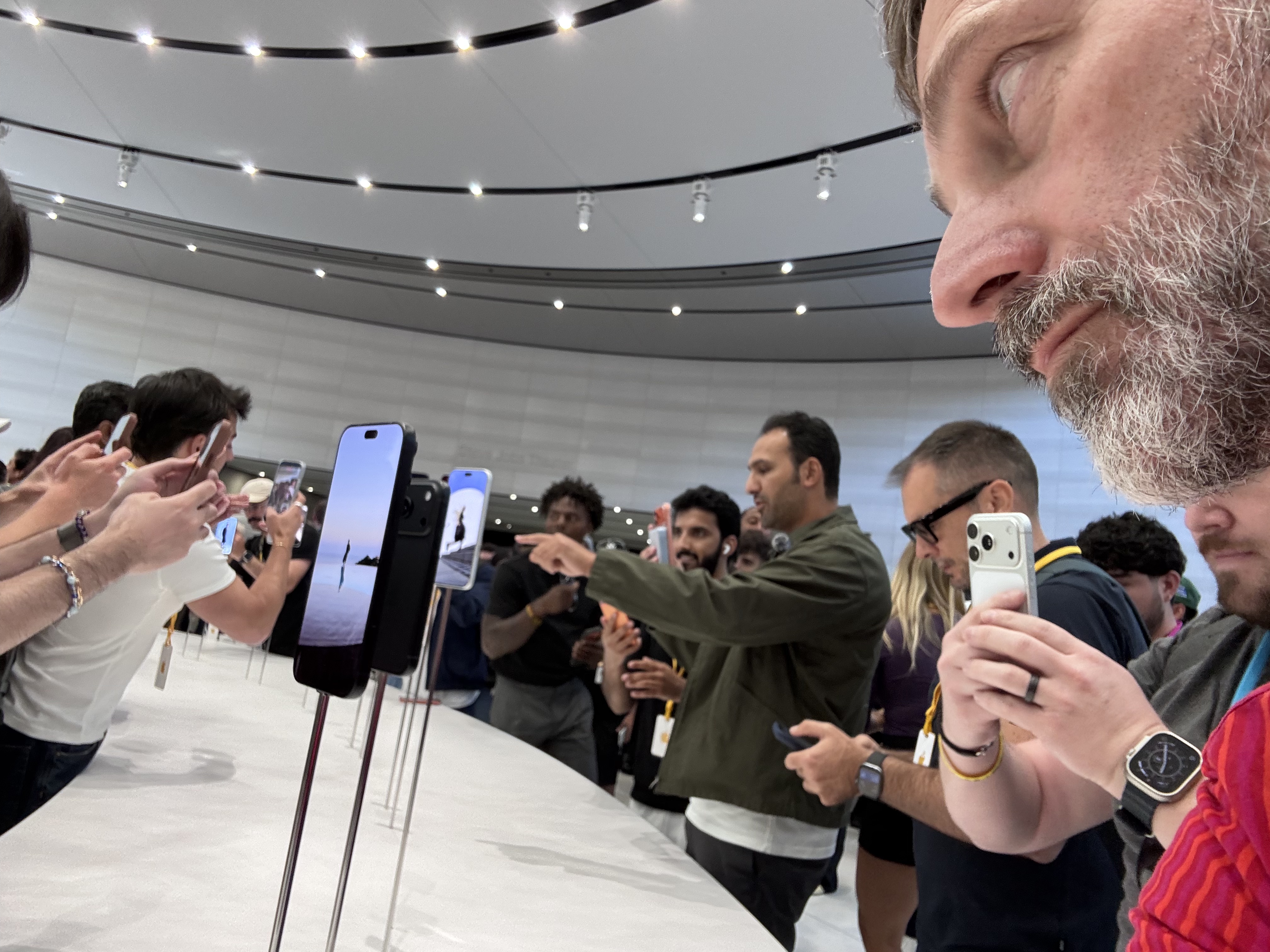
    The more one one thinks about the iPhone Duo the more the Duo branding appears to be signifying something beyond two screens. Perhaps Duo is marking iPhone 2.0, a new epoch in the history of Apple devices. Consider that the premise of folding the screen isn't just to afford a larger surface, but physically transforming to form factors of a book, a mini laptop, a notebook (with Pencil!), a tablet, an alarm clock, a movie screen... →

    Duo dollars a day, Duo cents an unlock
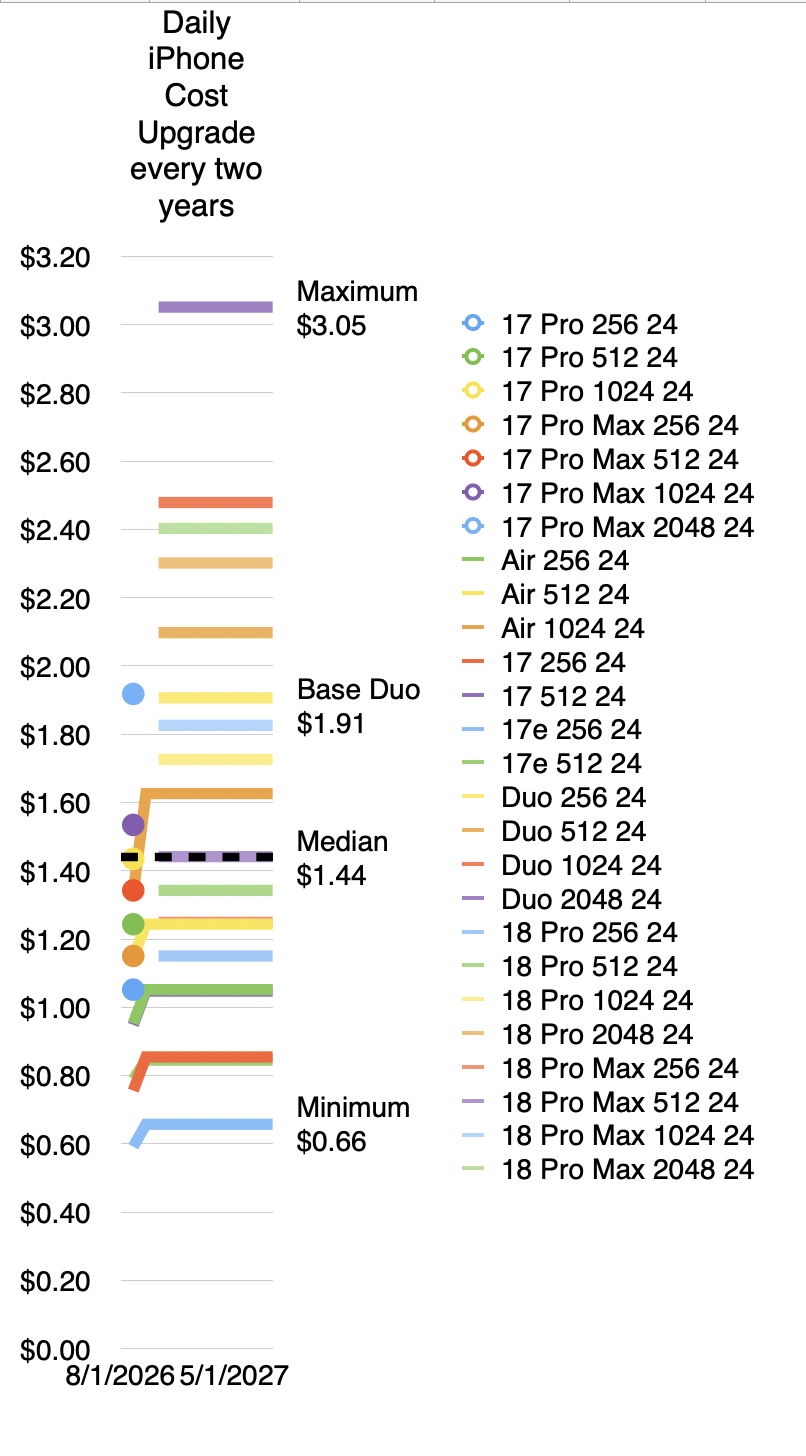
    The Duo's price range is $2000-$3200. How should we think about this? →


    Nota Bene

    The iPhone Duo: pathos, not specs
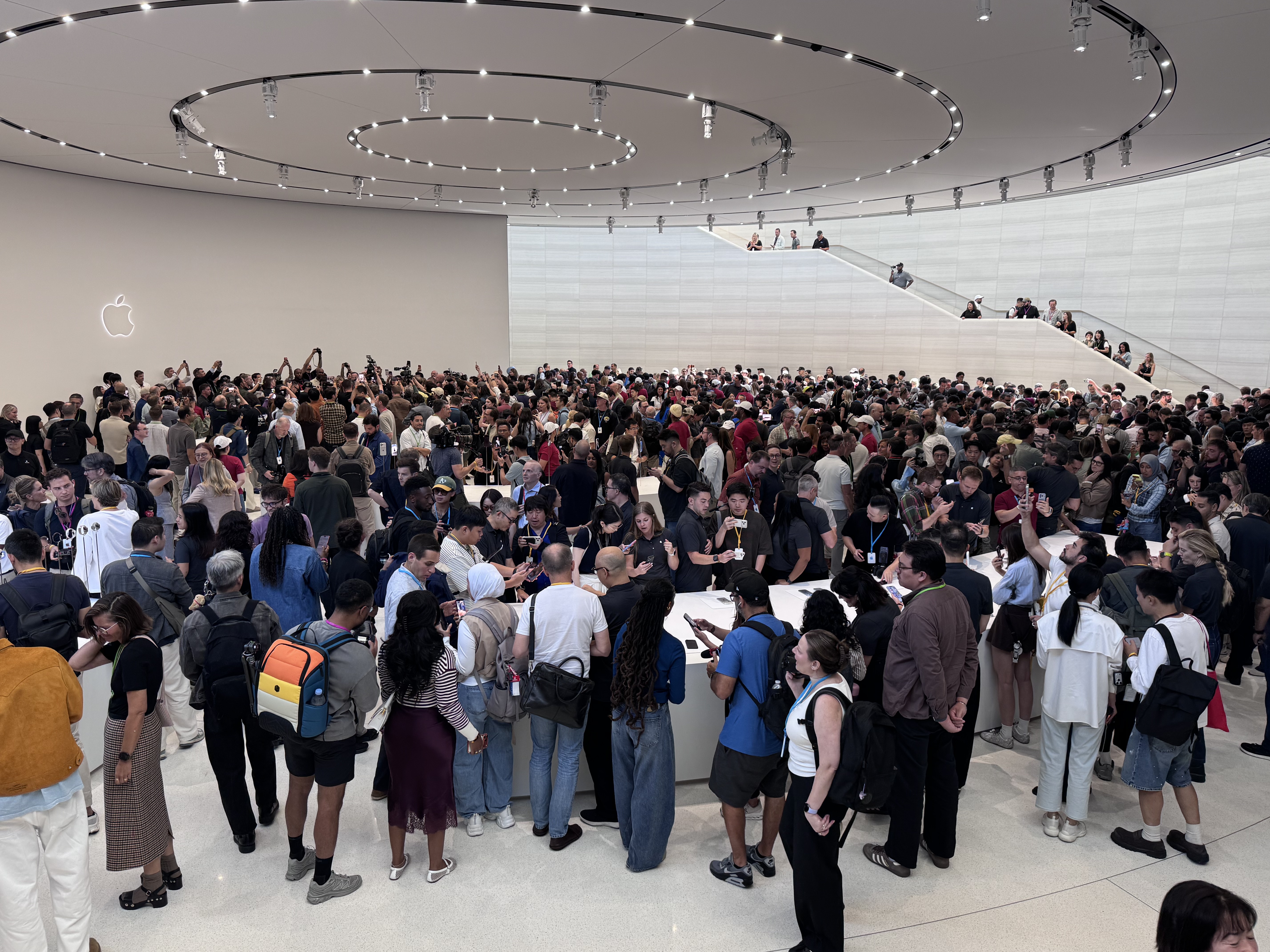
    One theme about the iPhone Duo seems underreported: pleasure, prestige, the pride of ownership. It's always been there with Apple products, but being the first to get a foldable, after everyone's been talking about it for so long, might be a bigger driver than the practical aspects. →

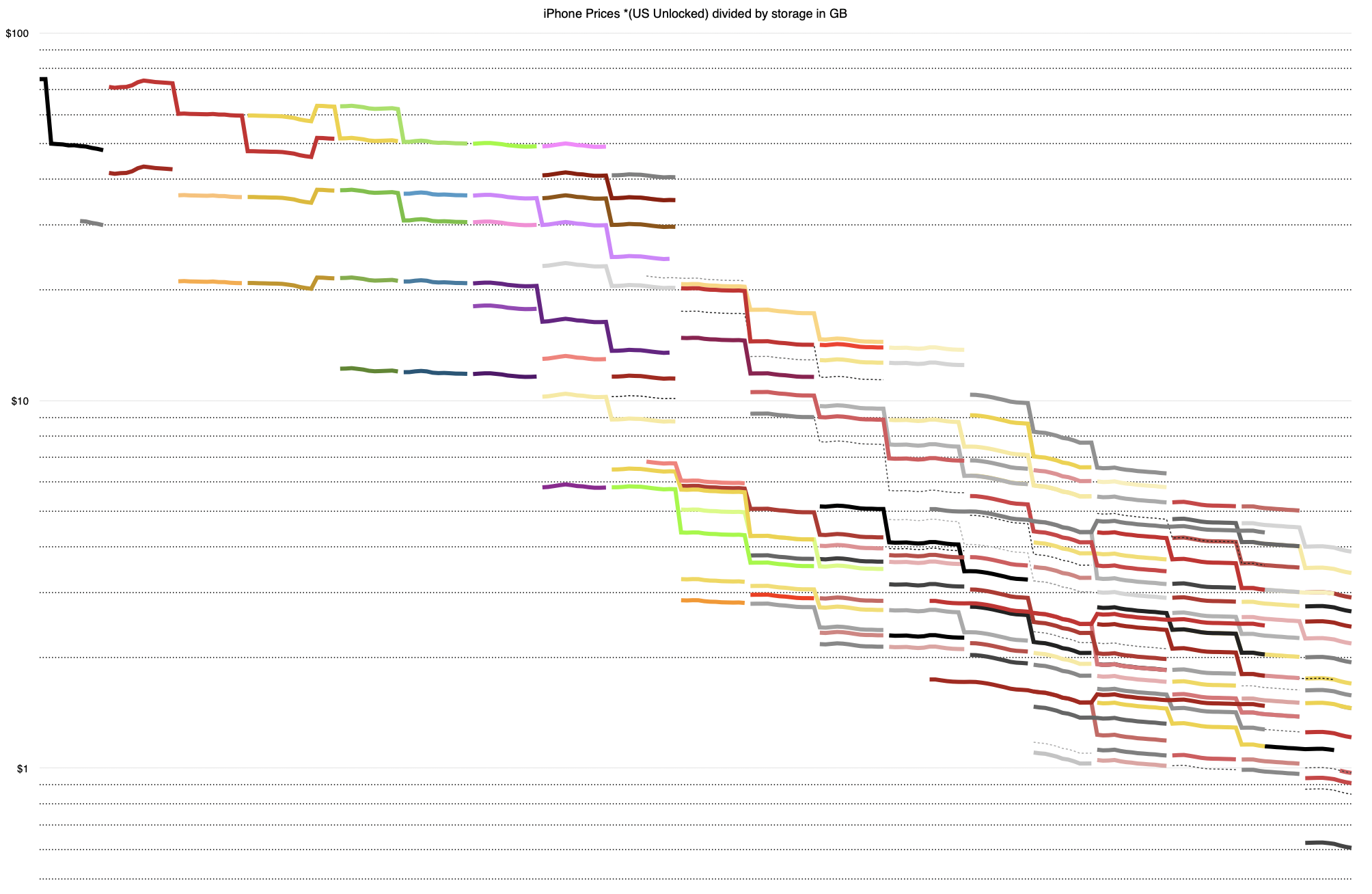
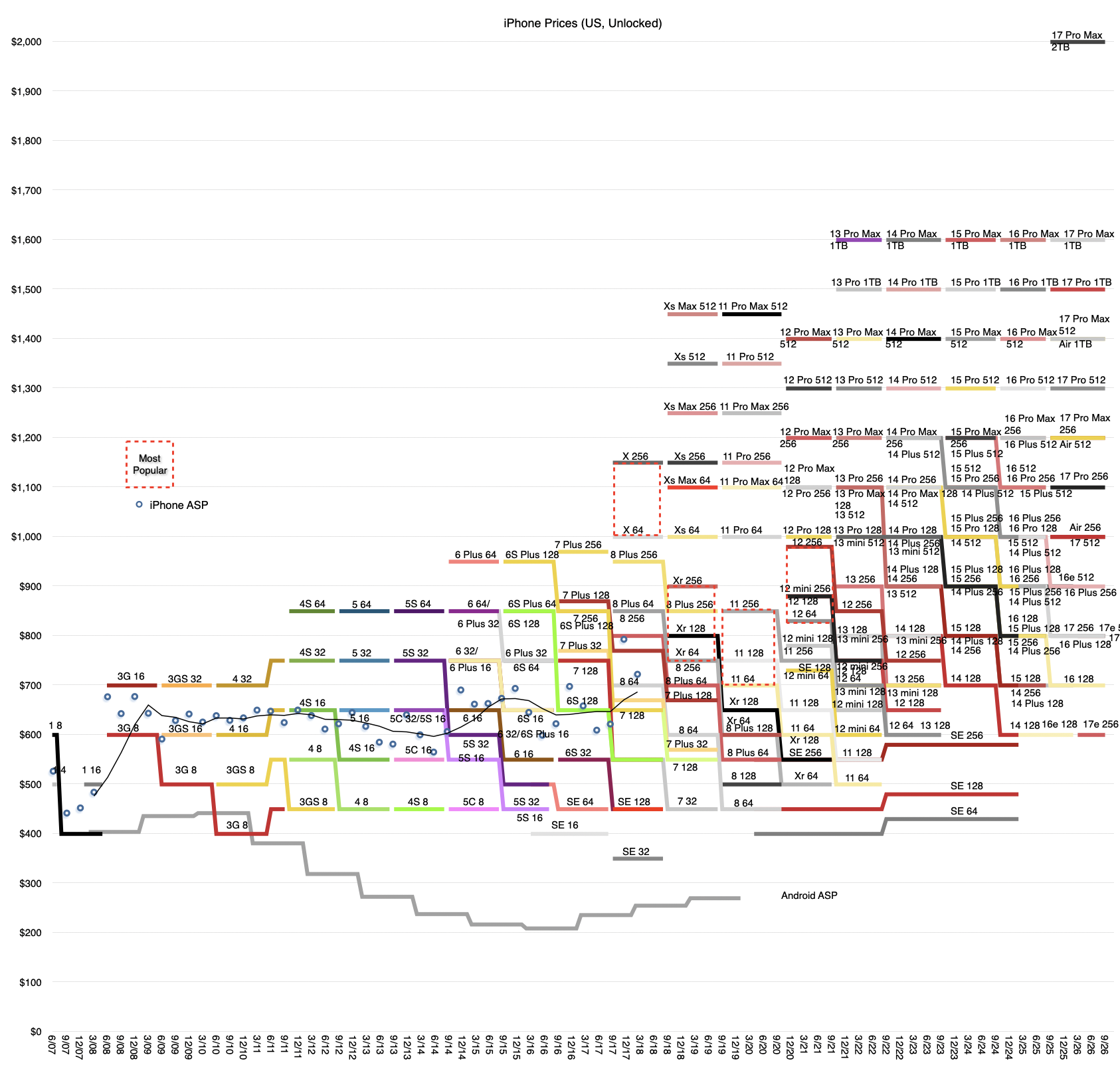
    Stairway to the $3200 Heaven
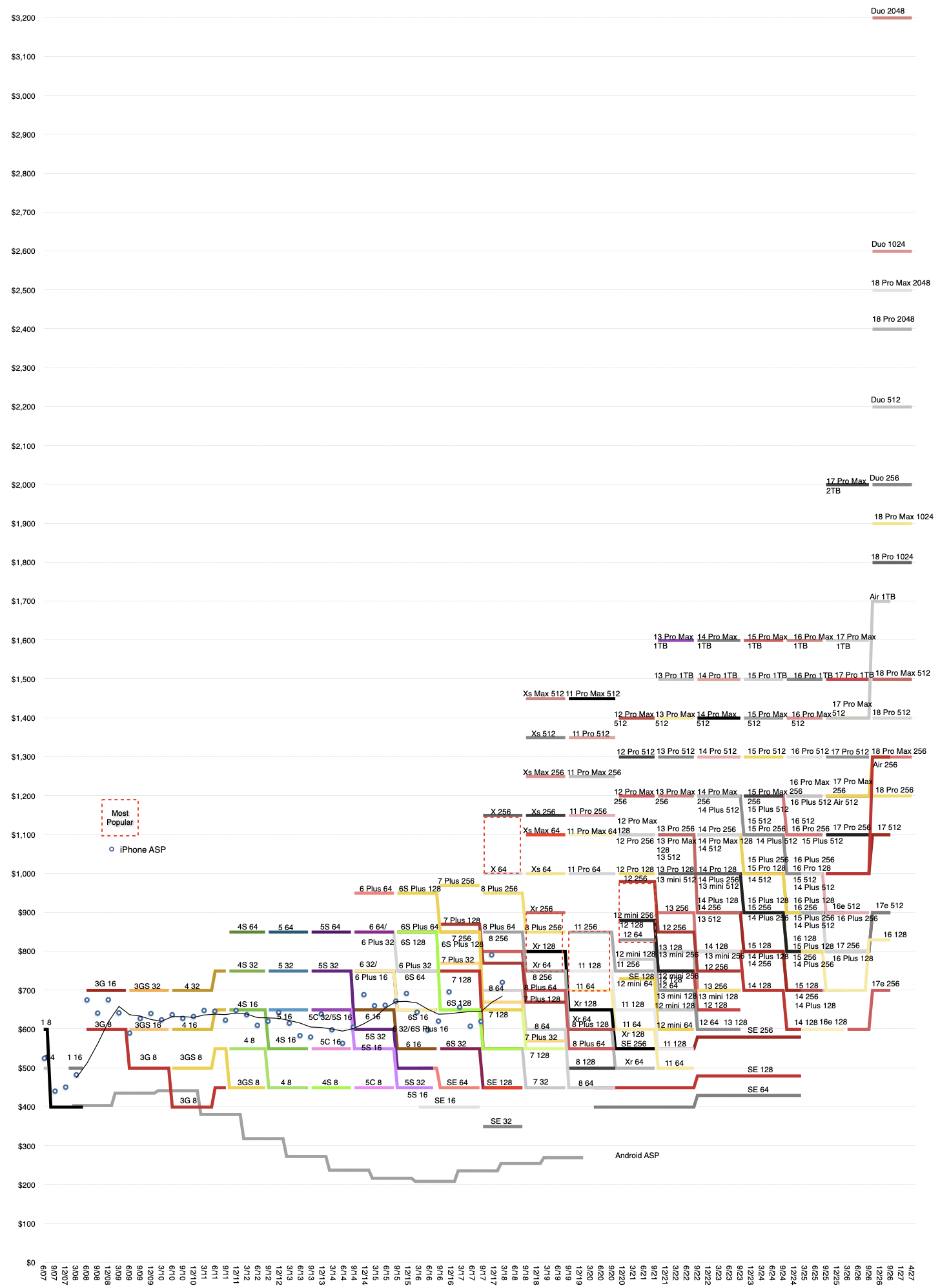
    The top price in the iPhone Stairway to Heaven chart is now $3,200. How does this affect iPhone ASP? →

    What happens when smartphones become too good? → Katharine Sorensen of The Beiruter interviewed me on the shuttle bus to Apple’s September event, two days before the Duo existed. Her question was the more profound one: what happens when phones are good enough, when replacement cycles stretch to four years and the installed base grows regardless. The industry has spent its history persuading people the device in their pocket could be substantially better. Apple’s answer arrived that Wednesday with a hinge. →

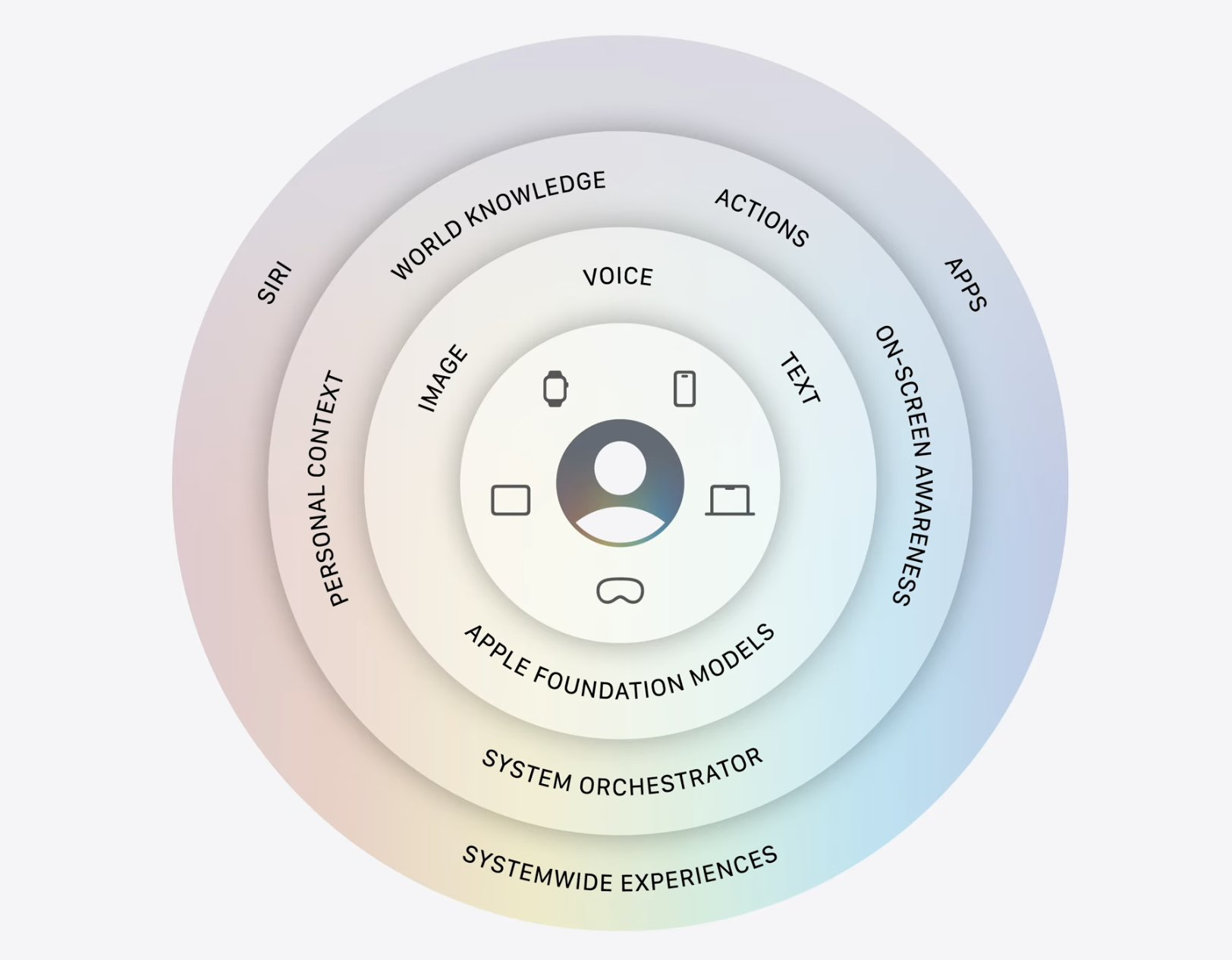
    Siri, not a companion, by design. → People have gotten used to AIs being wrong, so folding intelligence into the OS adds little brand risk as long as the experience is as expected. The product manager for Apple Intelligence told me Siri is built not to be a companion: an advisor and a concierge with a professional persona that keeps its emotional distance. The exposure Apple actually guards against is not hallucination but a violation of privacy or security, where a single leak brings lawsuits and regulators at once. Managing that risk is the cost of doing business. →
    Refurbishing the Innovator’s Dilemma → Apple already sells refurbs, but at small scale, and refurbishment is a scale game. Lease returns change that: one and two year old phones taken back in volume, refurbished and resold at minimal profit, because the point is not profit but visibility into a secondary market Apple otherwise has to sample. The lowest priced new iPhone is now in the $800s, and the $400 slot belongs to the used market, just as only 12% of Americans can now afford a new car and the auto industry has dehydrated itself of visibility into everyone else. My advice to Apple is to not fall into the innovator’s dilemma: more profitability is not always the right answer. →


    Live Events
    Asymco Office Hours Duo: The First Ternus Keynote – Sunnyvale Session Recording & Transcript, September 11, 2026 → Recording and transcript of the Sunnyvale session, held two days after Apple’s September event and the first keynote under John Ternus. Inside: the Duo as a pricing decision made seven years ago, the attraction of moving objects, two cents an unlock, the 1.2 billion puzzle of the iPhone ASP, why launch the iPhone 18 in spring, Siri designed not to be a companion, Apple’s unpretentious moonshot, and what follows the memory famine. Full recording and transcript for Asymco One subscribers. →


    Asymco One gives you full access to our research, analysis, and commentary. Subscribe with code BULLETIN for a discount.

    Feedback: Have questions or comments? Reach out to us at contact@asymco.com. We’d love to hear from you.
  2. Asymco Bulletin 030 - Sep 13, 2026

    Bulletin

    The Asymmetric Weekly

    Invitations

    Asymco Office Hours Duo: Sunnyvale and Boston → Two cities, two sessions, two happy hours, marking Apple’s first keynote under John Ternus.

    West Coast: Sunnyvale, Friday, September 11. This session has now taken place. Asymco One subscribers: stay tuned for the recording and transcript.

    East Coast: Boston, Friday, September 18, 4–5:30pm ET. In person at Boston Seaport, followed by an Asymco Happy Hour from 5:30–7pm ET, or join remotely. Register for tickets, in person or remote. Asymco One subscribers are guaranteed seats, can sign up for free, and have access to recordings and transcripts. →


    Research

    Apple iPhone Event First Impressions

    From the Steve Jobs Theater I’m writing while still in the SJ Theater in Cupertino after the end of the event and the media frenzy around the demo devices. The atmosphere was noticeably more enthusiastic and the venue was packed. First impression was that John Ternus was already received as a “star” with a standing ovation to on-stage appearance and cheering at his video introduction from Tim Cook. Clearly the audience is already excited by his presence if not charismatic performance. The products were on par with outstanding polish and refinement. The details especially health and assistive features are truly →

    Is the Stairway to Heaven still working?

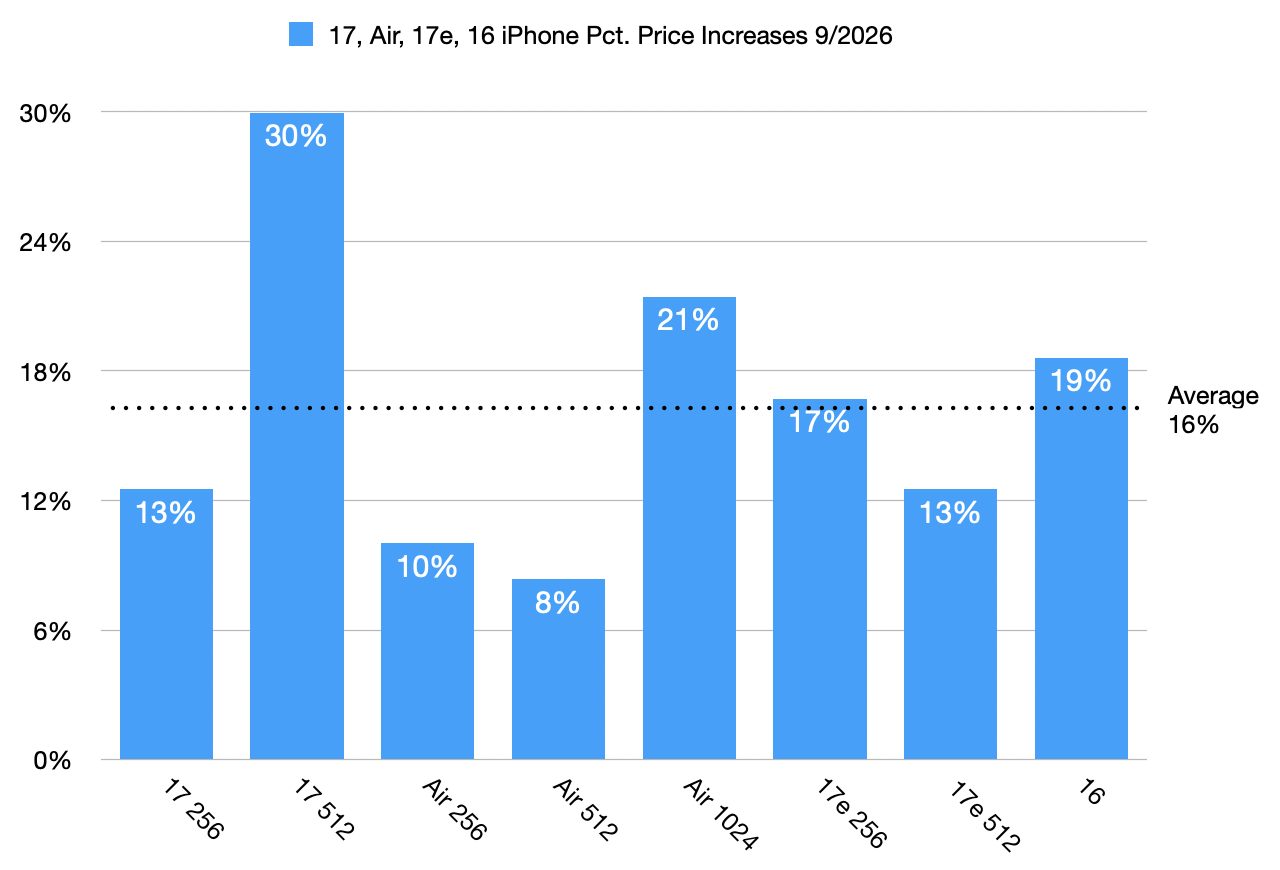
    Time to re-frame pricing on a daily basis The launch of the iPhone Duo and the surge in memory pricing has caused a disturbance in the force. The new Stairway graph is shown. A few notes: The process of lowering prices for n-1 devices has reversed. Previous generation iPhone prices have gone up for the first time ever. This is mitigated by the fact that “n-1” is not quite apparent for the 17 as it’s still the current model in the mid-range. The 17e and the 16 are still in the roster →

    Are iPhones too cheap?

    Prices for the iPhone 18 Pro and Duo are lower than expected When the iPhone Duo price was announced in the Steve Jobs theater I was the only one applauding. Prior to the Duo bombshell, the iPhone 18 Pro prices were announced to be a mere $100 higher than the iPhone 17 Pro and the Apple watch prices were kept steady while the AirPods prices actually came down (for one of the cases). A stunned silence was clearly warranted but applause? Of course, these are the starting prices and the higher memory/storage configurations are sharply higher. The top of the →


    Nota Bene

    Apple acquires Sonera. The next pivot point for interfaces? → Apple has always placed itself at the interface layer between human and machine, from the original personal computer through the mouse, the scroll wheel, multi-touch, spatial computing and audio. Every acquisition that detects or deduces human intention, gestures, motion, biometrics, health, belongs to that same pattern. Sonera built a room-temperature magnetometer that reads the weak magnetic fields produced by neural activity without touching skin, a sensing modality I was not even aware of. That is the first practical path to a non-invasive brain-computer interface, which is to say the next stage of human-computer interaction. →

    Apple now in third place in US PC market share → Apple passed Lenovo into third place in the US with shipments up 32.1%, lifting its share of the US consumer PC segment to 29.4%, while business shipments grew 50.6%. Dell fell 8.8% as component allocation moved away from entry-level systems and its Chromebook shipments collapsed 47%. Consumer PC shipments are expected to decline further this year. Apple is taking share in a contracting market, which is the only kind of share worth taking. →

    iPhone 17 is the best selling iPhone ever with first year revenue of $170 billion → The iPhone 17 series took more than $170 billion in first-year revenue, an 11% increase over the 16 series, with the base model alone growing revenue 1.3x over its predecessor and ranking as the best-selling smartphone in the world in the first half. China drove the gain, up 35% on wholesale revenue and close to a quarter of series revenue, on base-variant upgrades. The lineup worked because Pro features moved down to the base tier. That is a tough act for the 18 to follow. →

    Apple Watch Is Growing in a Shrinking Market → Global smartwatch shipments fell 4% year over year in the second quarter while Apple’s climbed 14%, the fastest growth of the five largest brands, taking share from 17% to 20.1%. It is not only phones and Macs and tablets. The pattern now shows up in every category at once. That is more than a memory shortage can explain. →


    Asymco One gives you full access to our research, analysis, and commentary. Subscribe with code BULLETIN for a discount.

    Feedback: Have questions or comments? Reach out to us at contact@asymco.com. We’d love to hear from you.
  3. Asymco Bulletin 029 - Sep 6, 2026

    Bulletin

    The Asymmetric Weekly

    Look Ahead

    Friday 11 September, Time TBD. We are holding an in-real-life Office Hours, either in Boston or the Bay Area, open to Asymco One subscribers. We will be broadcasting the event live. If you would be interested in attending, write to events@asymco.com.


    Research

    Deploying Enterprise AI on Apple Hardware is Suddenly a no-Brainer

    Apple’s AI angle in the enterprise There was a time when Apple’s point to the Enterprise buyer was that Apple products were ultimately more cost effective and productive. The total cost of ownership was lower as the products were cheaper to maintain and lasted longer and users were more productive as the user experience frictions were lower than Windows. The problem was that Apple devices were at odds with IT policies and standards. Everything from device management, software licensing, identity and authentication management, migration, training, security were built excluding the Apple platforms. The Microsoft world was interlocking and impenetrable even →


    Nota Bene

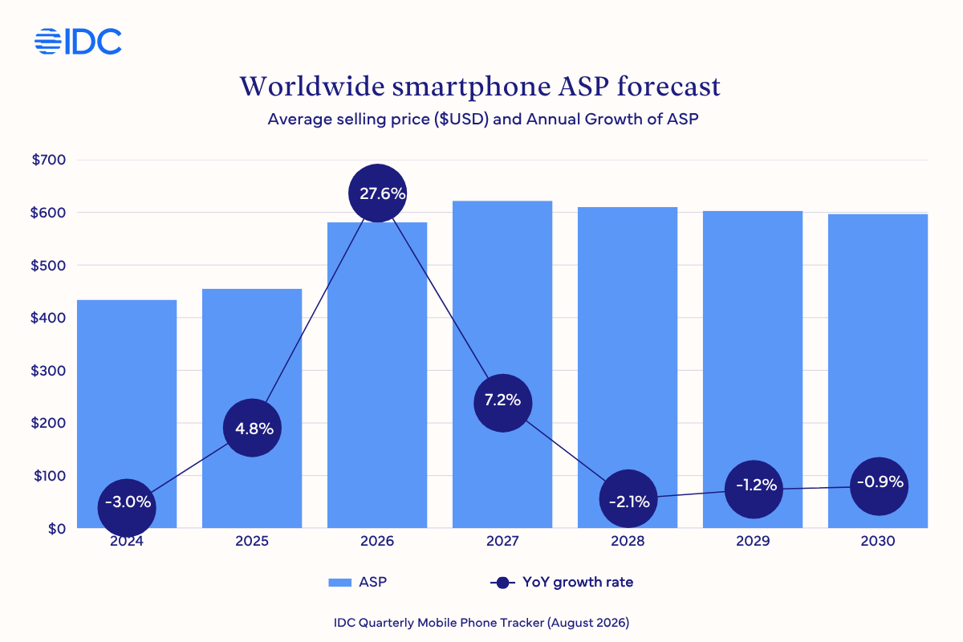
    IDC lowers smartphone market volume estimates again → IDC now expects global smartphone shipments to fall 16.7% in 2026, revised down from 13.9%, which would be the steepest annual contraction on record. Second half shipments are set to drop more than 27% while ASP rises 27% to $581, because the memory tsunami has arrived and consumers are paying the AI bill. The era of the cheap smartphone has ended. IDC also credits Apple’s foldable with altering the market’s trajectory, which mistakes how markets are actually created. →

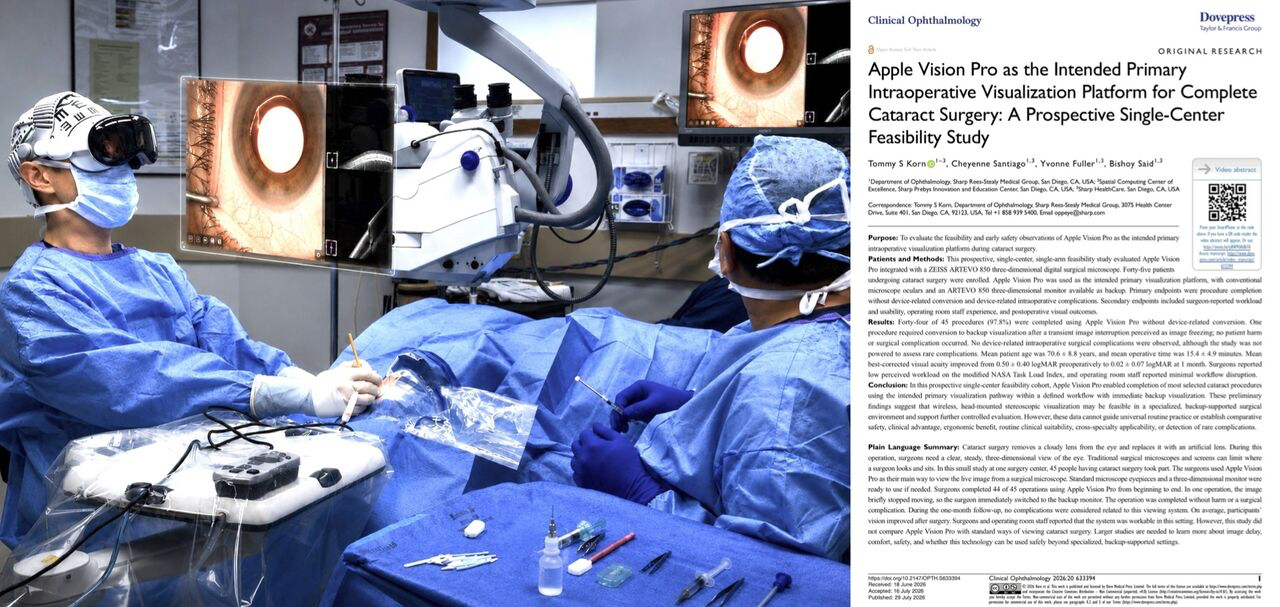
    The first surgical Apple Vision Pro application approved by the FDA → Stryker’s SportSuite Vision received De Novo authorization on July 17, making it the first application cleared for intraoperative use with Apple Vision Pro, and the first live procedure was a hip arthroscopy at Duke Health. Separately, Nabla is running AI clinical dictation on device on Apple computers. Regulatory clearance is the hard part, and it has now been cleared. Spatial computing has moved from demonstration to the operating room. →


    Asymco One gives you full access to our research, analysis, and commentary. Subscribe with code BULLETIN for a discount.

    Feedback: Have questions or comments? Reach out to us at contact@asymco.com. We’d love to hear from you.
  4. Asymco Bulletin 028 - Aug 30, 2026

    Bulletin

    The Asymmetric Weekly

    Look Ahead

    We are considering an in-real-life Office Hours this fall, either in Boston or the Bay Area, open to Asymco One subscribers. If you would be interested in attending, write to events@asymco.com.


    Nota Bene

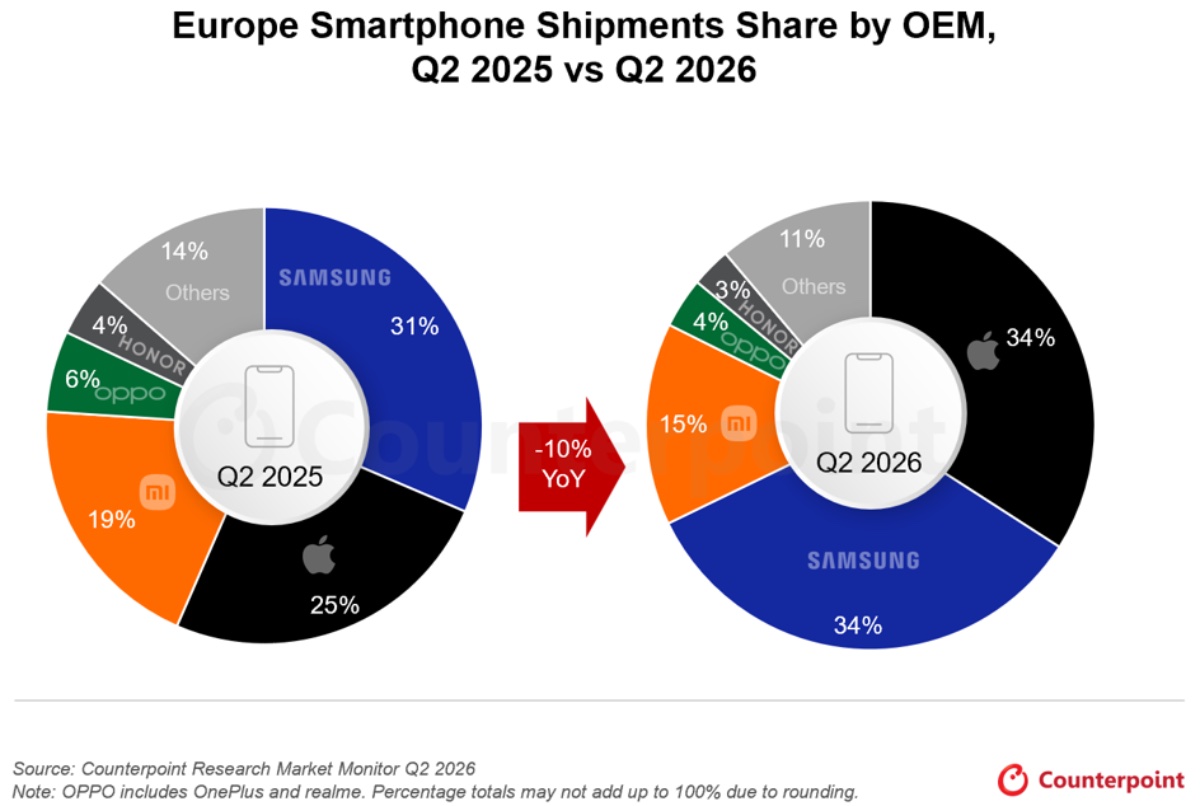
    One in three phones sold in Europe is now an iPhone → Europe's smartphone market fell 10% year over year in Q2 to 35 million units, the weakest second quarter in three years, and Apple took 34% share, up from 31%, now tied with Samsung. Counterpoint expects further declines ahead, worst at the low end, and expects Apple to outperform the market for the foreseeable future. This runs longer than a single quarter. Apple is energized by the transition because it was never a phone company to begin with. →

    The Freshman Register → Social media accounts for the largest share of screen time on every device, Apple's included, and if short video and messaging count it runs past four hours a day. But the thesis has collapsed after 22 years: what users see is almost never from friends, family, or the accounts they chose to follow, a shift that began with TikTok seven years ago. Followers no longer matter because the algorithm decides distribution, and an algorithm learns that negative emotions are worth more than positive ones. Usage is up, satisfaction is down, and Meta now trades at a P/E of 20 with a five year return of 50% against Google's 144% and Apple's 110%. It is no longer social media. It is algorithmic media, and the corrosion will eventually undermine the business. →

    Apple Pay’s Pay Day: Tap to Pay Is Coming to Walmart and Sam’s Club → In 2014 I expected Apple Pay to be a billion dollar business by 2020 at a 15 basis point take rate, and in 2021 I concluded I had been four years too optimistic. Apple Pay handled $7.6 trillion in 2025 and generated roughly $5.6 billion in revenue at half that take rate, so the estimate was conservative after all. The user base passed 818 million, 94% of US retail accepts it, and it now carries 10% of global card transactions and 54% of US in-store wallet transactions. Walmart is joining on August 24, which means the last major holdout took twelve years to decide that checkout convenience matters. →


    Asymco One gives you full access to our research, analysis, and commentary. Subscribe with code BULLETIN for a discount.

    Feedback: Have questions or comments? Reach out to us at contact@asymco.com. We’d love to hear from you.
  5. Asymco Bulletin 027 - Aug 23, 2026

    Bulletin

    Summary of Week 34, 2026.

    Forward Looking

    We are considering an in-real-life Office Hours this fall, either in Boston or the Bay Area, open to Asymco One subscribers. If you would be interested in attending, write to events@asymco.com.


    Research

    What’s so special about Apple Upgrade?

    What has servitization ever done for us? Necessity is the mother of invention but return on invested capital is the mother of innovation. Invention is big ideas with unclear benefits. Innovation is big benefits with unclear ideas. This is why inventions are easy to point out but hard to find useful while innovations are very useful but hard to explain. Innovation is a matter of many small changes with big returns. The bigger this ratio between return and change, the more profound the innovation. Moving from selling music on physical media to digital files and then to subscribing to an →

    A Second Study on the Apple Vision Pro in Surgery is now Published

    Apple Vision Pro as the Primary Visualization Platform for Cataract Surgery. Dr. Tommy Korn co-authored a new study of the Apple Vision Pro and spatial computing in cataract surgery. It has been peer reviewed and published in Clinical Ophthalmology. I had spent a day shadowing Dr. Korn as he performed a dozen surgeries. It is remarkable that those delicate operations–saving people’s vision–can be assisted so competently by the Apple Vision Pro. Dr. Korn and his team evaluated the 2nd generation Apple Vision Pro (M5) using the ClearSphere app as the primary 3D view for cataract surgery. This surgery replaces the →

    What’s Going on with Smartphones?

    A state of the union look at the market for mobiles. Looking at the IDC data on smartphone shipments (2014 to present), the pattern shows a peak in 2017. Covid caused a contraction and recovery but since then the unit market has not reached pre-Covid levels. Moreover, the current memory supply crisis is expected to cause a dip unlike any of the previous ones. IDC expects the market in 2026 to decline double digits and another 1.1% decline in 2027. This may be optimistic. Yearly volumes could drop below 1 billion. The sub-$100 entry-level device tier could become permanently constrained →


    Nota Bene

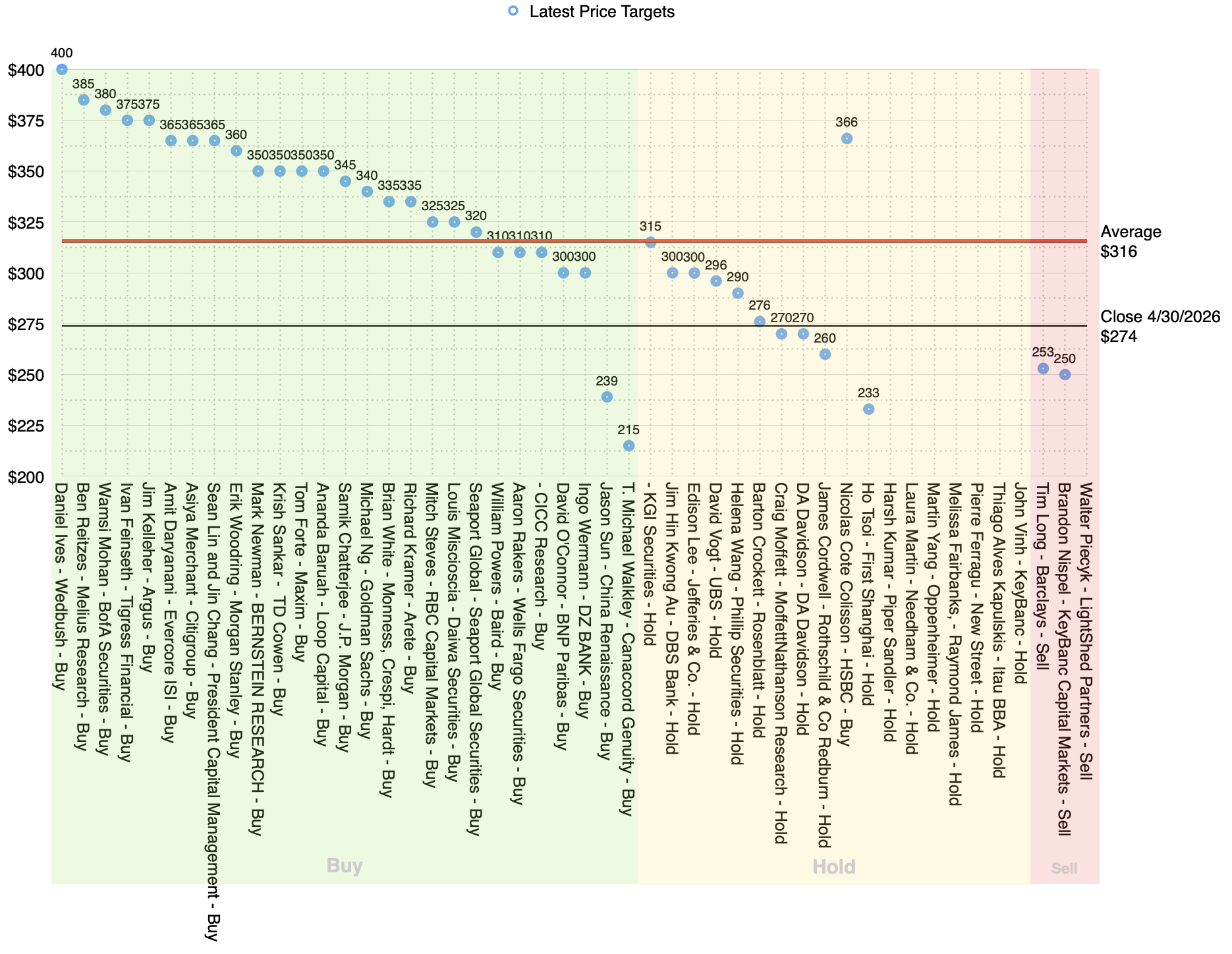
    Rothschild & Co. Redburn upgrades Apple to ‘Buy’ from ‘Neutral’ → Redburn moved its target from $260 to $400 on the expectation of an iPhone Ultra at $2,199 lifting lineup ASP by 11% into June 2027. The jump looks dramatic until you notice the prior target was set almost a year ago, in September 2025. Eight other ratings and targets have moved in the two weeks since earnings, in both directions. A large revision mostly measures how long an analyst waited to revise. →


    Office Hours

    Apple TV: content is still king → Frederick H. asked why Apple is obsessed with making movies and shows. Libraries were being vacuumed up and locked into silos, so Apple chose to build its own from zero rather than buy anyone else's. Quality became the goal because awards are the only measurable proxy left once streaming destroyed ratings and box office. Sony learned this with Betamax and bought a studio for the same reason. If someone else owns the content, they dictate what you are allowed to build to display it. →

    Apple and memory chips: a flat no, then a quiet maneuver? → Joseph B. asked whether Apple would buy a memory maker. Memory is a different business with different dynamics and it only works at a scale Apple could not absorb alone, so it does not resonate with them. I expected them to build or buy anyway, and instead they issued a flat public rejection, which surprised me. They will back into it another way, financing someone else, maneuvering, something involving Intel. It would be fitting if Intel became a memory company again, having left memory for CPUs at its origin. →

    AI: a technology in search of a job → Bob V. asked how well Apple is pushing back on being late to AI. Reviews of the betas have been positive and the story has played out, but none of that is the point. For consumers, AI is still a technology searching for a job to be done, with real niches that are not consumer niches. ChatGPT is not the answer any more than TCP/IP or the 8088 was, and a chat prompt is a low bandwidth interface, a command line by another name. Emoji generators and image editing are features, not apps, and Siri is a feature too. →


    Asymco One gives you full access to our research, analysis, and commentary. Subscribe with code BULLETIN for a discount.

    Feedback: Have questions or comments? Reach out to us at contact@asymco.com. We’d love to hear from you.

  6. Asymco Bulletin 026 - Aug 16, 2026

    Bulletin

    Asymco Bulletin is a digest of all that was published during the week ending Aug 16, 2026.

    Next Office Hours will be in-person

    We are planning a face-to-face live Office Hours this fall, either in Boston or the Bay Area, open to Asymco One subscribers. If you would be interested in attending, write to events@asymco.com.


    Research

    The Economy Chosun Interview, Parts 1 & 2

    Part 1 is about culture and innovation: how a company with modest founders and no wealthy backers survived on timing, persistence, and the willingness to be reborn, because Apple 2.0 has little to do with Apple 1.0 and we still call it one fifty year continuity. Part 2 is about the interface, which is where Apple has always ended up, deliberately or by accident, and which determines whether the next computing paradigm gives Apple a design surface or takes one away. Supply chains and geopolitics are management problems with management solutions. AI is the only genuinely strategic question, and the answer depends entirely on whether it turns out to be infrastructure or a platform. →


    Nota Bene

    Apple passes $10B/yr sales in India → India crossed $10 billion in annual Apple sales for the first fiscal year, up 11% and led by the iPhone with iPad and Mac also climbing. The market is still tiny next to Greater China's $18.8 billion in a single quarter or Japan's $6.6 billion. A weakening rupee and higher local pricing make it look better in dollars than it feels to a buyer paying $870 for the entry iPhone 17 versus $800 in the US. →


    Asymetric

    Asymetric Podcast: Waterloo

    Asymetric Podcast: Episode 139 — No Free Lunch → Horace on the unbundling and rebundling of LLMs, and on the turmoil in the Korean stock market. →


    Office Hours

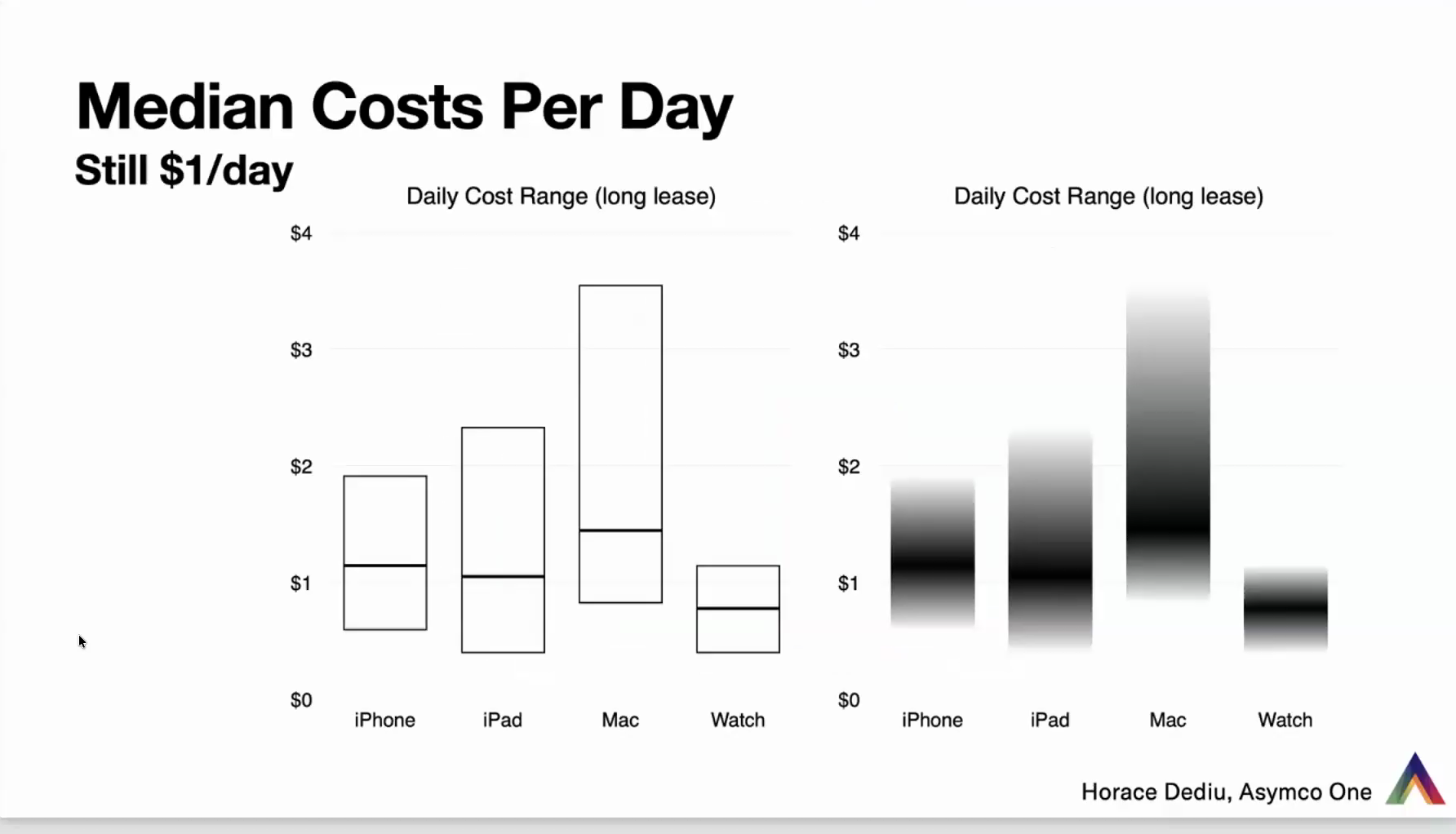
    Apple Upgrade: down to the penny, up to an algorithm → The gap between short and long term lease multiples on the iPad, versus the iPhone's steeper 1:1.5, likely comes down to depreciation and residual value rather than any messaging. Every price looks algorithmic now, down to $50.01 for the two terabyte 11 inch iPad Pro, a sharp break from the deliberate, human-directed pricing that shaped the iPhone lineup. Someone needs to build a scraper and track this the way a market signal gets tracked, because these prices move and nobody is watching. The real puzzle is accounting: a leased device sitting in a customer's hands is not a sale, so where does Apple book it. →

    Vision Pro and glasses: the job is seeing, not capturing → Vision Pro keeps getting funded because Apple believes in it, not because of some product roadmap logic, and the surgical results already coming out of hospitals are proof it does something real. The bigger opportunity is plain eyewear: the magnetic lens swap Zeiss built for Vision Pro is the same trick Apple pulled with Watch bands, and glasses are a market larger than watches ever were. Everyone else building smart glasses treats them as cameras for capturing what you see, the same mistake made with smart speakers built as microphones instead of speakers. Apple's glasses will be sold as an optical device first, the way the Watch was sold as a chronograph, because the job of eyewear has always been to help you see, not to record you. →

    Subscriptions and Active

    Cook Doctrine's remedy: floods don't change architectures → Cook calls the current semiconductor crunch a hundred year flood, and floods do not change how cities are built, they just get the dams built afterward. Apple is not going to turn itself into a chipmaker just because chip companies are printing money right now, because a windfall like that is closer to winning the lottery, and lottery winners often end up worse off. The pattern is always the same: Apple gets burned by a dependency, retail, Intel, Microsoft, Google Maps, and builds its own version so it never happens again. Leverage over suppliers is not a personality trait, it is what falls out of owning the customer relationship first and negotiating from scale second. →

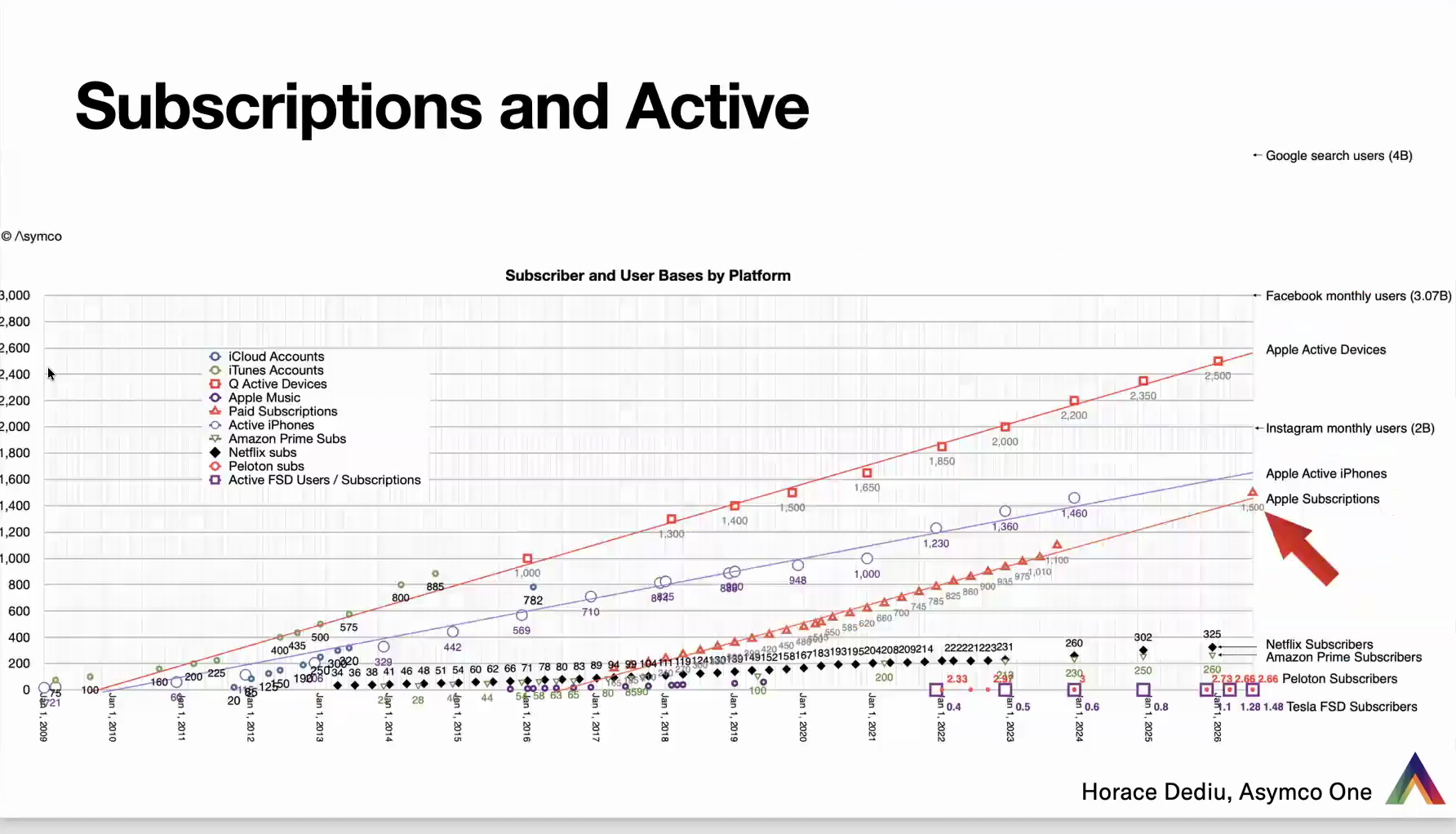
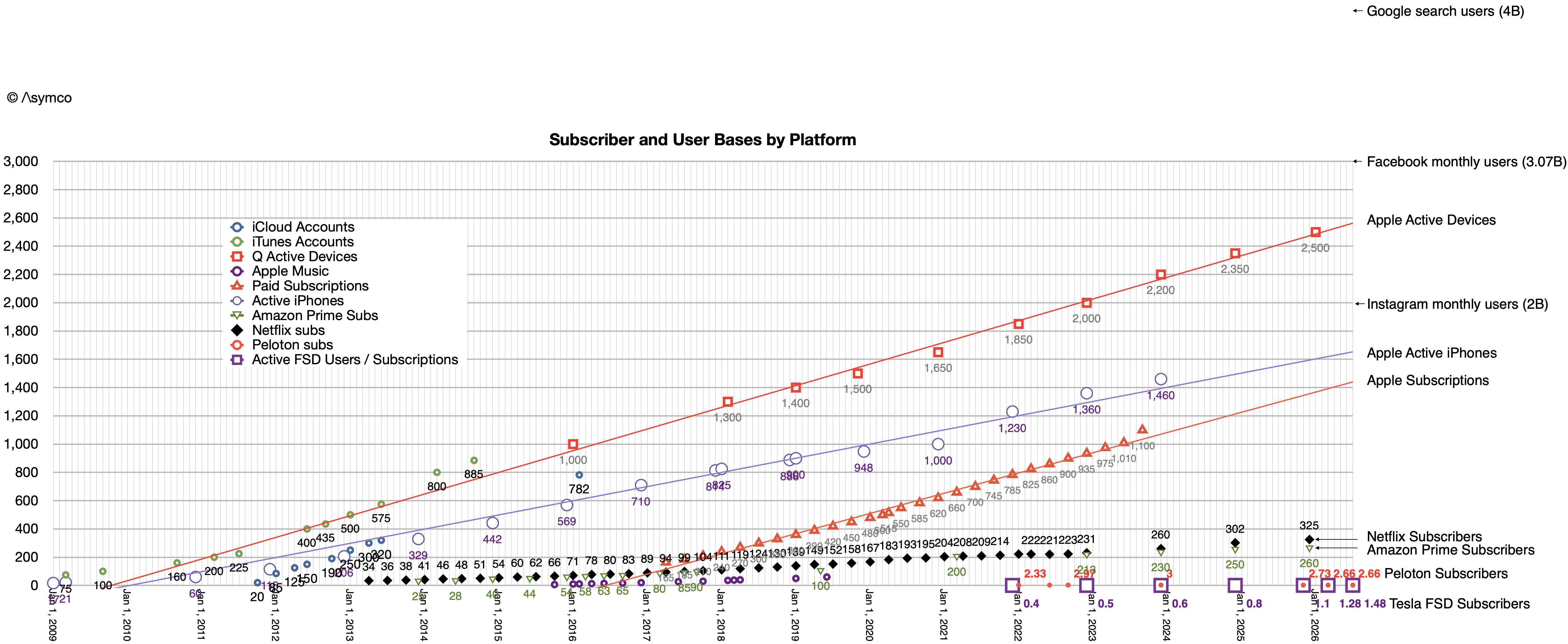
    iPhone unit sales: count users, not phones → A weak unit number this quarter or the next few does not matter, because the installed base depends on the number of customers and how long they keep devices, both of which keep growing. Apple has had quarters with falling unit sales before and people wrote it off every time, so watch subscriptions and active devices instead of phones shipped. The guidance looks soft mostly because of engineering: a folding phone in limited production, a low end model pushed to next year, and the long planned split launch tied to Apple Upgrade. The comps will look ugly for a while because Apple is deliberately rearranging the calendar it has wanted to rearrange for fifteen years. →

    Why iPhone prices do not change

    The SoC crunch: Apple has had fires and earthquakes too → Apple's lever on the chip shortage is squeezing everyone else in the bill of materials first, the screen, the battery, the casing, even though those suppliers are already thin on margin. Contract length and exclusivity give Apple more room to negotiate than price alone. This is a hundred year flood, but Apple has weathered fires and earthquakes before and treats a components crunch as a solvable operational problem, not an existential one. The real existential risk is simpler: a workforce that walks out the door one day and does not come back. →

    EU tech policy: playing chess by looking ahead one move → EU regulators play chess one move ahead while applying a twenty year old theory of gatekeepers and app store fragmentation to a digital world that has already moved past it. A thousand app stores sounds like consumer choice until nobody can find anything, so the market collapses back to a single gatekeeper anyway, the same lesson from Nokia's era as from iTunes. Compromise legislation tends to produce something consumers hate, GDPR and cookie banners being the proof, and people simply route around it. If Siri AI gets delayed in Europe over this, Europeans become second class users of their own devices, and Apple will still just stick to its guns. →


    Asymco One gives you full access to our research, analysis, and commentary. Subscribe with code BULLETIN for a discount.

    Feedback: Have questions or comments? Reach out to us at contact@asymco.com. We'd love to hear from you.
  7. Asymco Bulletin 025 - August 9, 2026

    Bulletin

    Asymco Bulletin is a digest of all the work we have published for the week ending Aug 9, 2026.

    Research

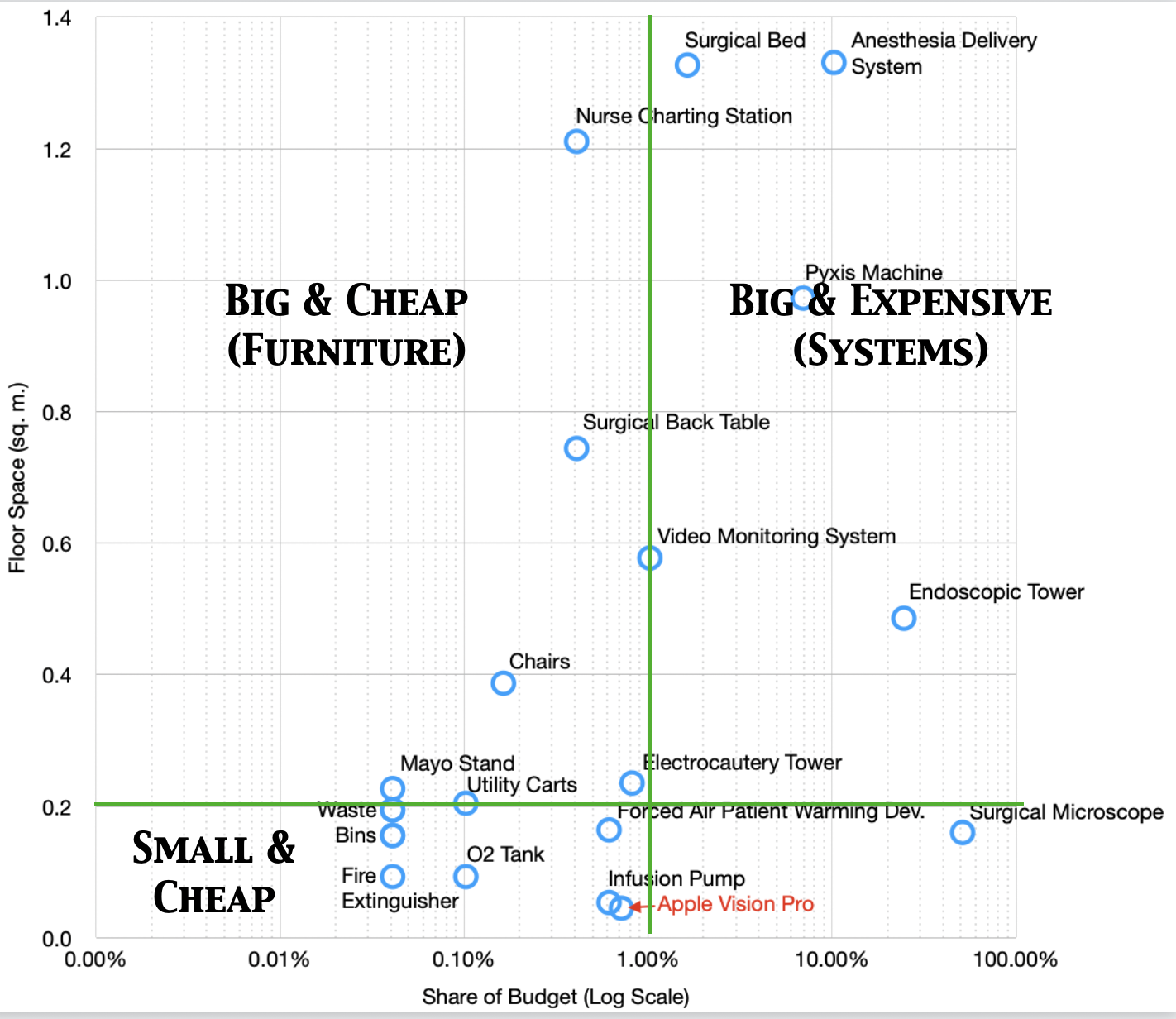
    Apple Vision Pro in Surgery: A New Paper

    It was an honor to collaborate with the UC San Diego Shiley Eye Institute team on a new paper in AJO International evaluating Apple Vision Pro as the primary display for endoscopic lacrimal surgery. The results: 19% shorter operative times, 100% functional success, lower surgeon workload, and every participating surgeon preferring it. My contribution measured cost and space, where the headset is less than 1% of the cost of conventional OR visualization and smaller than almost any piece of equipment. Criticized in consumer contexts as too big and too expensive, in the operating room the Vision Pro is very small and very cheap. →


    Office Hours

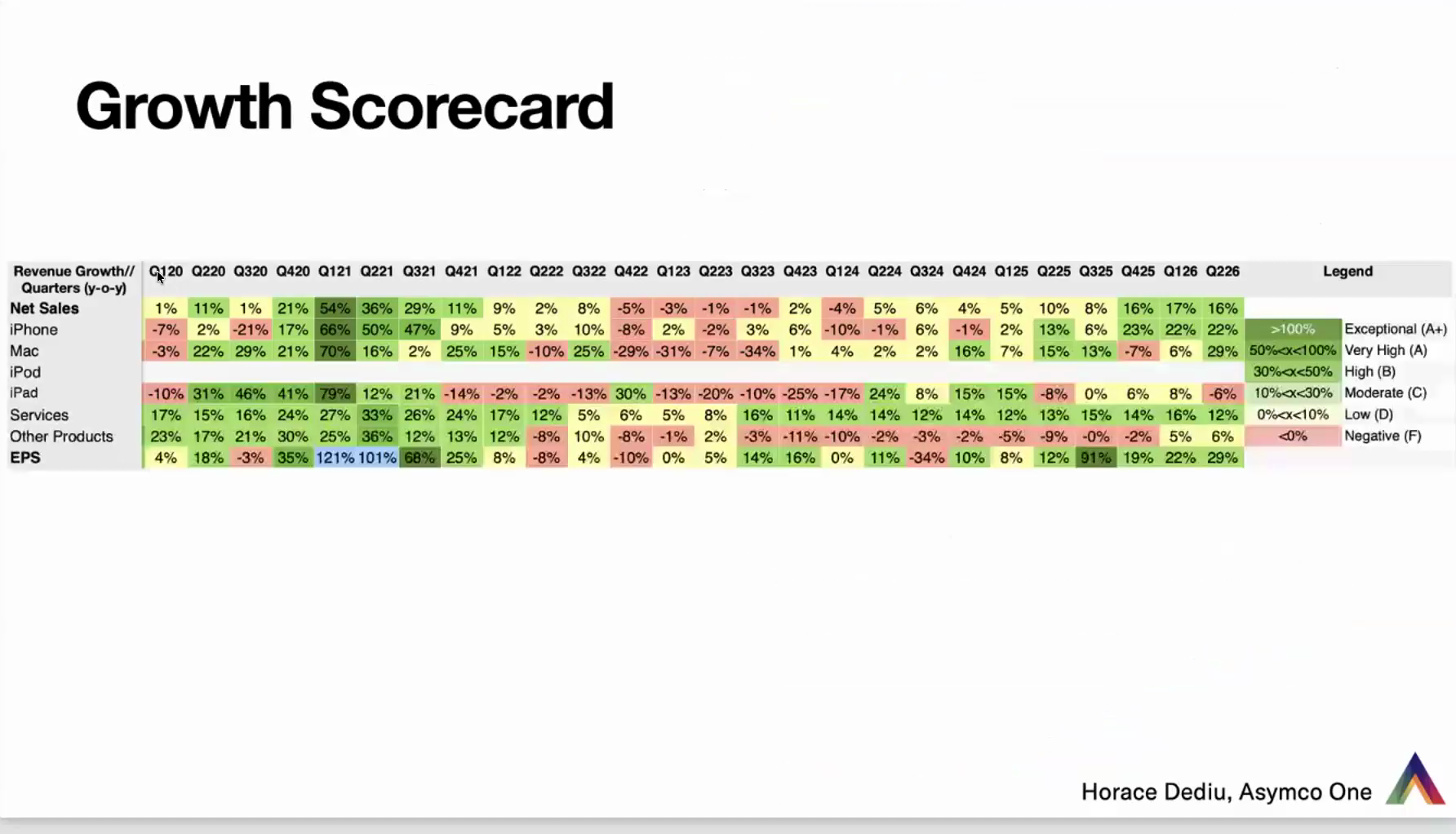
    CQ2 FQ3 (June) 2026 Quarterly Review

    Apple 2026 FQ3 Review: The Presentation — Asymco Office Hours, 31 July 2026 → Apple’s best quarter in years, albeit with a warning label. Revenue up 16%, EPS up 29% with an 11 cent tariff refund nobody modeled, and the Mac up 29%, double expectations. Guidance drops growth to about 10% because demand ran double Apple’s own plan and supply, especially silicon, could not keep up; Tim Cook conceded the planning mistake. Inside: 1.5 billion paid subscriptions on the ACTIVE trajectory, R&D nearing 10% of sales, three visits to 40 times earnings, and every Apple Upgrade lease priced to the penny, still a dollar a day. →

    Apple’s guidance: in six months there will be a new set of worries → Joseph B. asked what is up with the guidance and why it was news to Mr. Market. Apple got caught in the AI rotation as a safe harbor, a role management never sought, and the 10% one-day drop was unwarranted by what was reported: a very strong quarter with unusual circumstances in foreign exchange and supply. Nobody talks about memory anymore even though the price increases were a month ago. In six months this will be forgotten and there will be a new set of worries. →

    The foldable iPhone: what will it be good for? → Frederick H. asked what job a foldable iPhone accomplishes. I don’t have that job myself; I carry an iPad mini and never reach for it when the iPhone is in hand. But I was wrong once before, insisting phones should stay one-handed while the market chose the Max, so maybe we need to try it before we learn what it is for. Samsung’s folds have gone nowhere in six years, yet showing you could buy one may drive the first quarters, and if it opens into an iPad mini it becomes an experiment in having your iPad in your pocket. →


    Asymco One gives you full access to our research, analysis, and commentary. Subscribe with code BULLETIN for a discount.

    Feedback: Have questions or comments? Reach out to us at contact@asymco.com. We'd love to hear from you.
  8. Asymco Bulletin 024 - August 2, 2026

    Bulletin

    Asymco Bulletin is a digest of all the work we have published for the week ending Aug 2, 2026.

    July Office Hours

    Apple Earnings Special: Office Hours Live Q&A → The Apple Earnings Special took place on Friday, July 31, the day after Apple’s fiscal Q3 2026 earnings call, Tim Cook’s last as CEO. Horace reviewed the results and their implications and took questions from the live audience. Asymco One subscribers will have access to the live recording. →

    Latest updates at asymco.com/live. →


    Research

    Why is there no Apple Car?

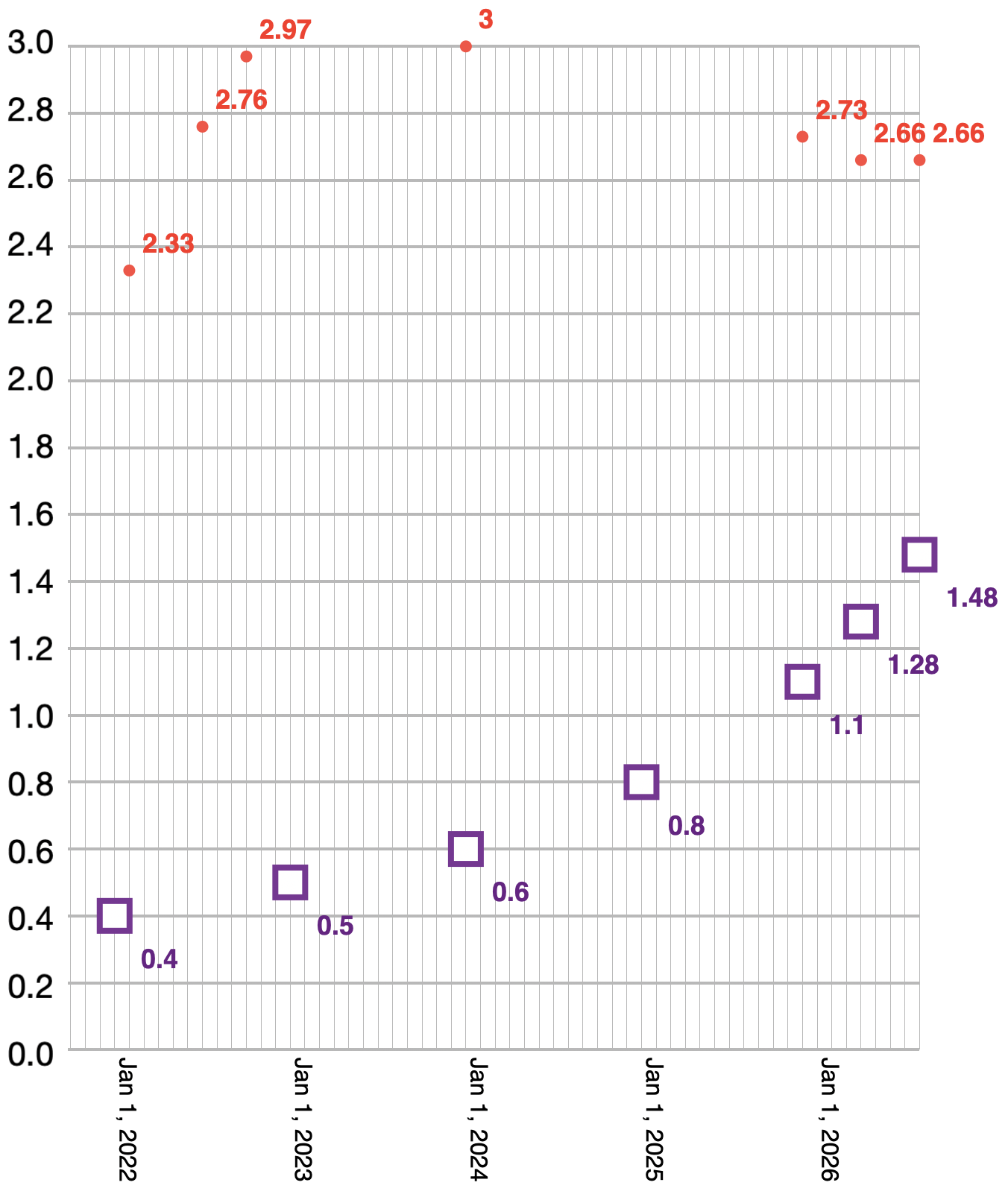
    Tesla grew deliveries 25% and still managed only a 1.4% operating margin, 0.7% excluding regulatory credits. The bull case rests on FSD subscriptions, now 1.48 million, but Peloton peaked at 3 million on the same accelerating curve. Cars cannot be consolidated, made uniform, or iterated fast enough; even BMW’s base is only 50 million users and Tesla’s is barely 10 million after 23 years. There is no critical mass for an ecosystem in automobility, and that is why there is no Apple Car. →

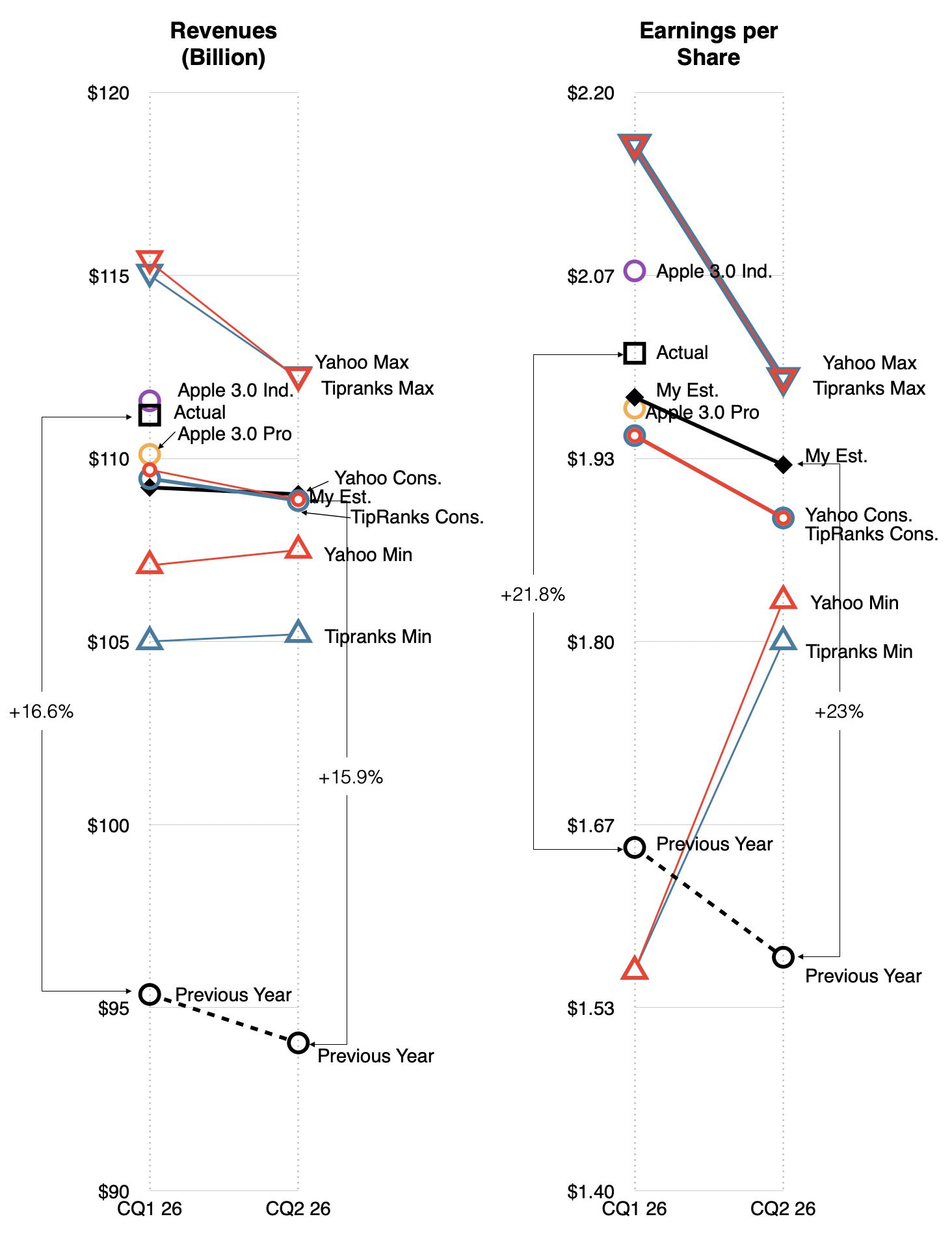
    Apple Earnings Consensus for June Quarter

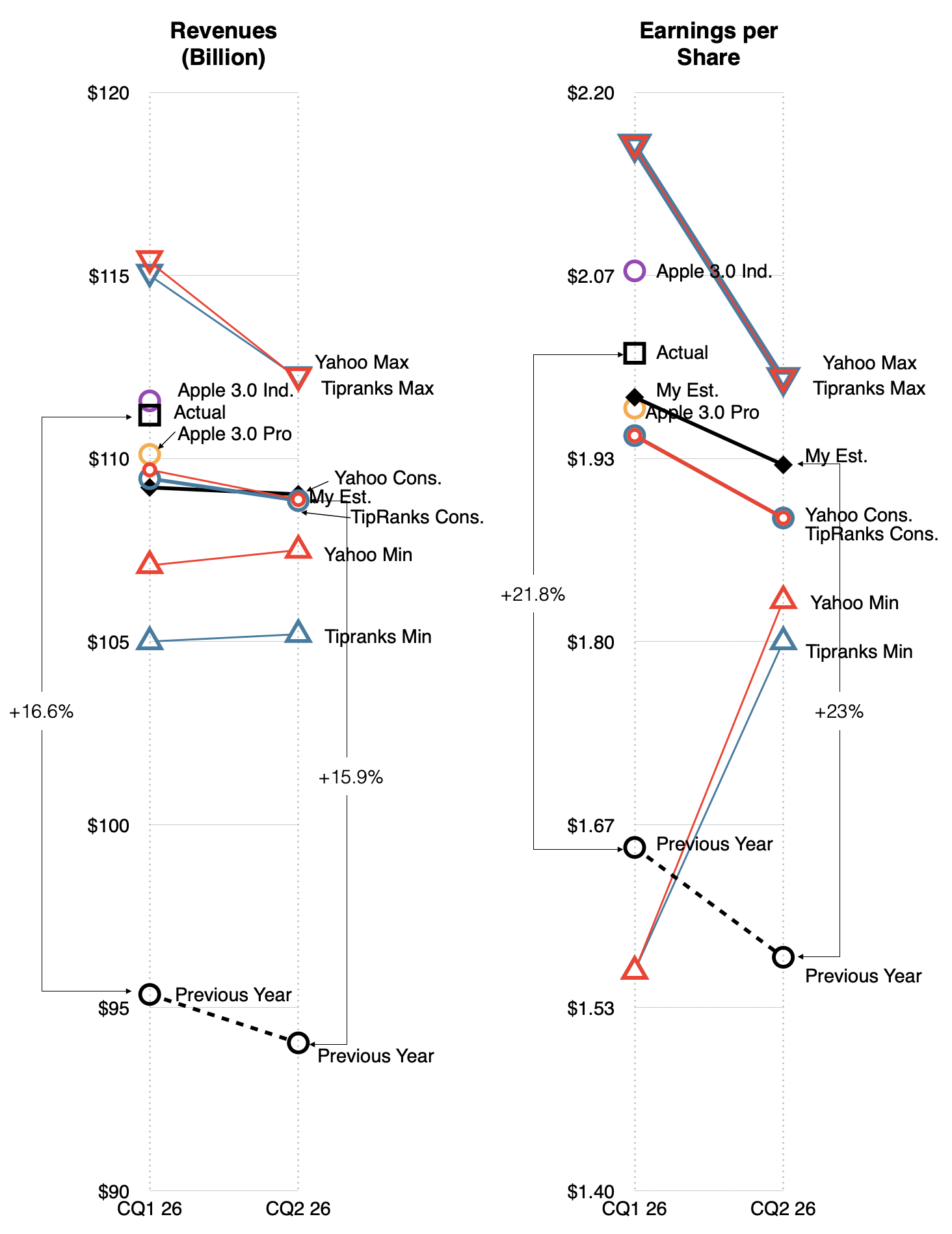
    A summary of revenue and EPS estimates from Yahoo, TipRanks and my own, alongside the March quarter’s estimates and actuals. Results land half an hour after close on July 30th, with Office Hours the following day. Both aggregators narrowed their EPS ranges significantly during the quarter, with a smaller squeeze on the revenue maximum. I don’t yet have a hypothesis for why. →

    Is the Market Overvalued? Four Perspectives

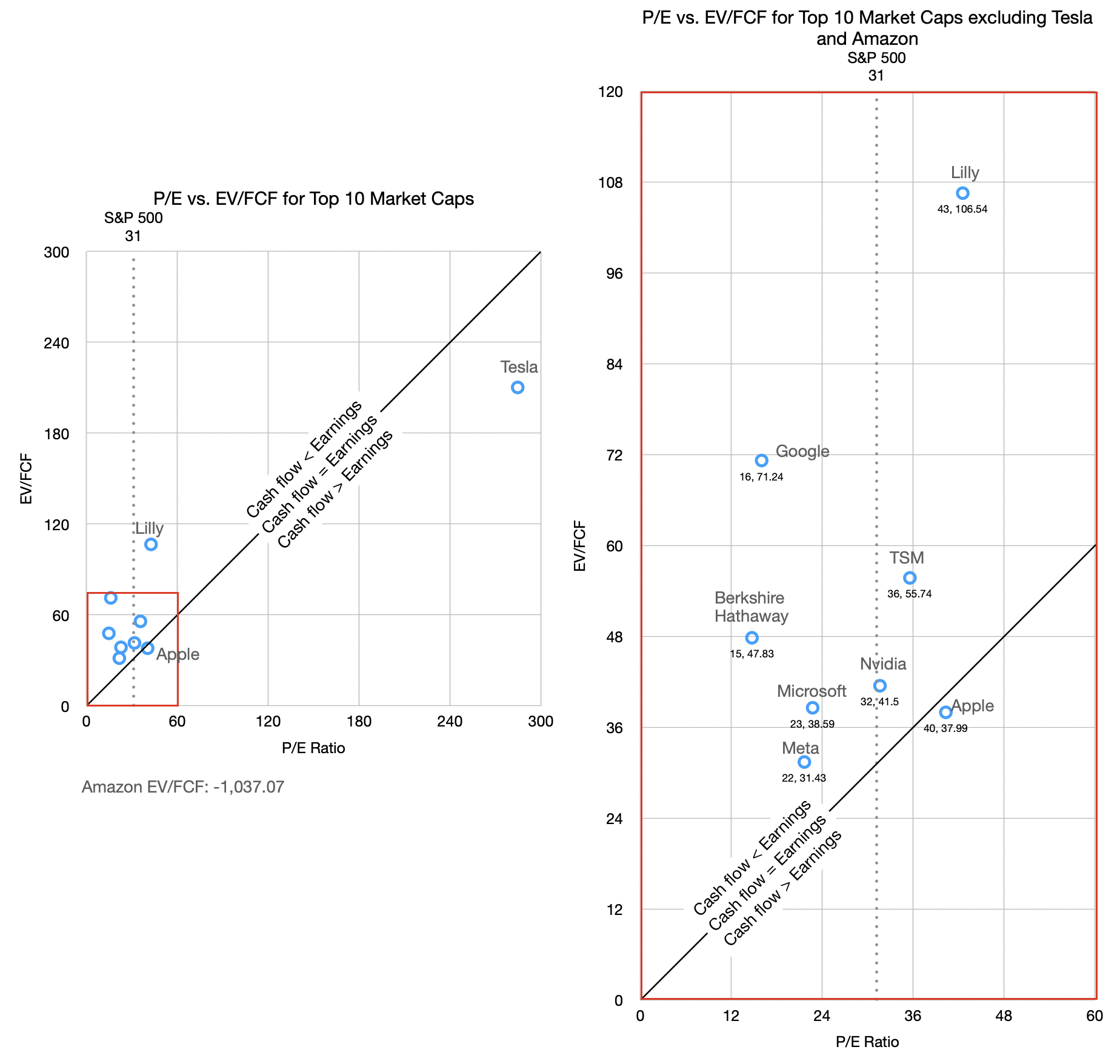
    Four ways to look at valuation: P/E, EV/FCF, each against growth, and the two against each other. On P/E the market looks reasonable, but free cash flows are turning negative; Alphabet just recorded its first since 2004. When P/E and EV/FCF match, a company is in balance, and Apple is nearly alone there. Recessions are built on bad debt, and if data centers become debt financed against absent cash flow, contagion follows. Earnings are an opinion, cash flow is a fact. →


    Nota Bene

    Goldman Raises Price Target Ahead of Q3 Earnings → Goldman raised its target to $370 from $330, expecting 17% revenue growth and $54.8 billion in iPhone revenue from a price-inelastic base. Ng sits near the high end on both target and estimates. My iPhone estimate has higher unit growth but lower ASP growth; we end up $1 billion apart on revenues, almost all of it iPhone ASP. →

    Apple reaches $5 trillion market cap for first time → Apple briefly touched $5 trillion, a day after passing Nvidia as the most valuable public company. Eight years ago, on the eve of $1 trillion, analysts called it a clean beat on the path to a trillion while warning that 80% of sales were secularly challenged. Strip out the price points and the 2018 quotes read like the present. The company quintupled by doing nothing different. It has always been doing the right thing. →

    Wall Street Predicts Third Quarter Numbers For Apple → Consensus sits at $108.9 billion in revenue and $1.89 in EPS against guidance of 14 to 17 percent growth, on Tim Cook’s final earnings call as CEO. The quarter had no major hardware launches yet iPhone share increased. The thing to watch is guidance: September hangs on exact launch dates, given a split launch period and potential new ASPs. →

    Apple Will ‘Watch Everything Burn’ When AI Bubble Bursts → Ed Zitron told MacRumors that Apple is insulated from an AI collapse and will sit on the sidelines and watch everything burn. I would say they will simply collect all the available profits. He is right to put the Vision Pro at the heart of the discussion; it is the most important innovation of the age. But his comments on how it works show he has not studied it deeply enough to understand why Apple’s culture made it what it is. →


    Asymco One gives you full access to our research, analysis, and commentary. Subscribe with code BULLETIN for a discount.

    Feedback: Have questions or comments? Reach out to us at contact@asymco.com. We'd love to hear from you.
  9. Asymco Bulletin 023 - July 26, 2026

    Bulletin

    Asymco Bulletin is a digest of all the work we have published for the week ending Jul 26, 2026.

    Office Hours

    Asymco Office Hours Live Q&A — Friday, July 31 → The next Asymco Office Hours Live Q&A will be on Friday, July 31st at 12pm ET / 9am PT, the day after Apple’s fiscal Q3 2026 earnings call on Thursday. Horace will review the results and their implications, and we will take Q&A from our live audience.

    Asymco One subscribers are guaranteed seats, can bring a guest, and will have access to the live recording.

    Sign up and latest updates at asymco.com/live. →


    Research

    How to maintain a Sell rating on Apple

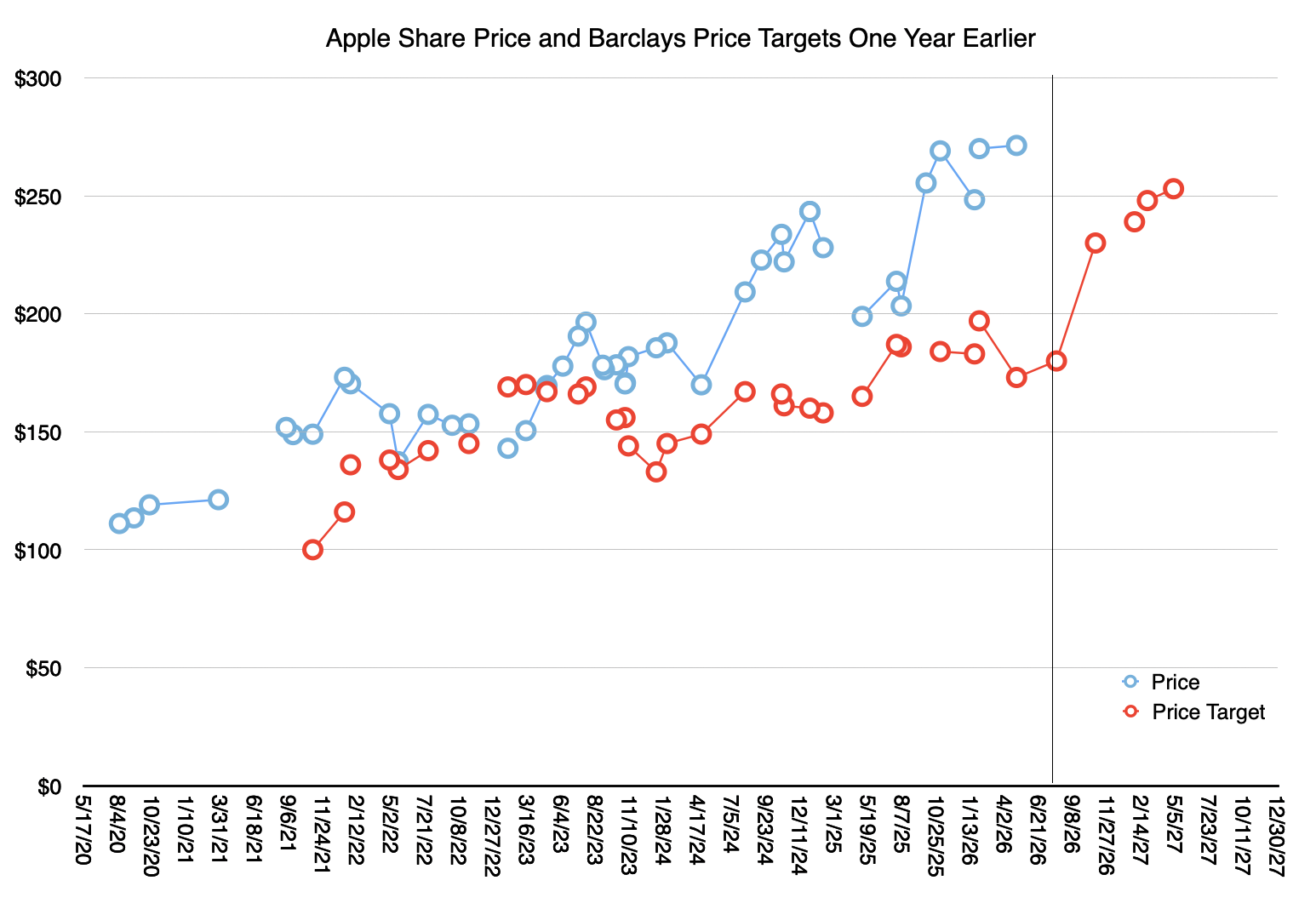
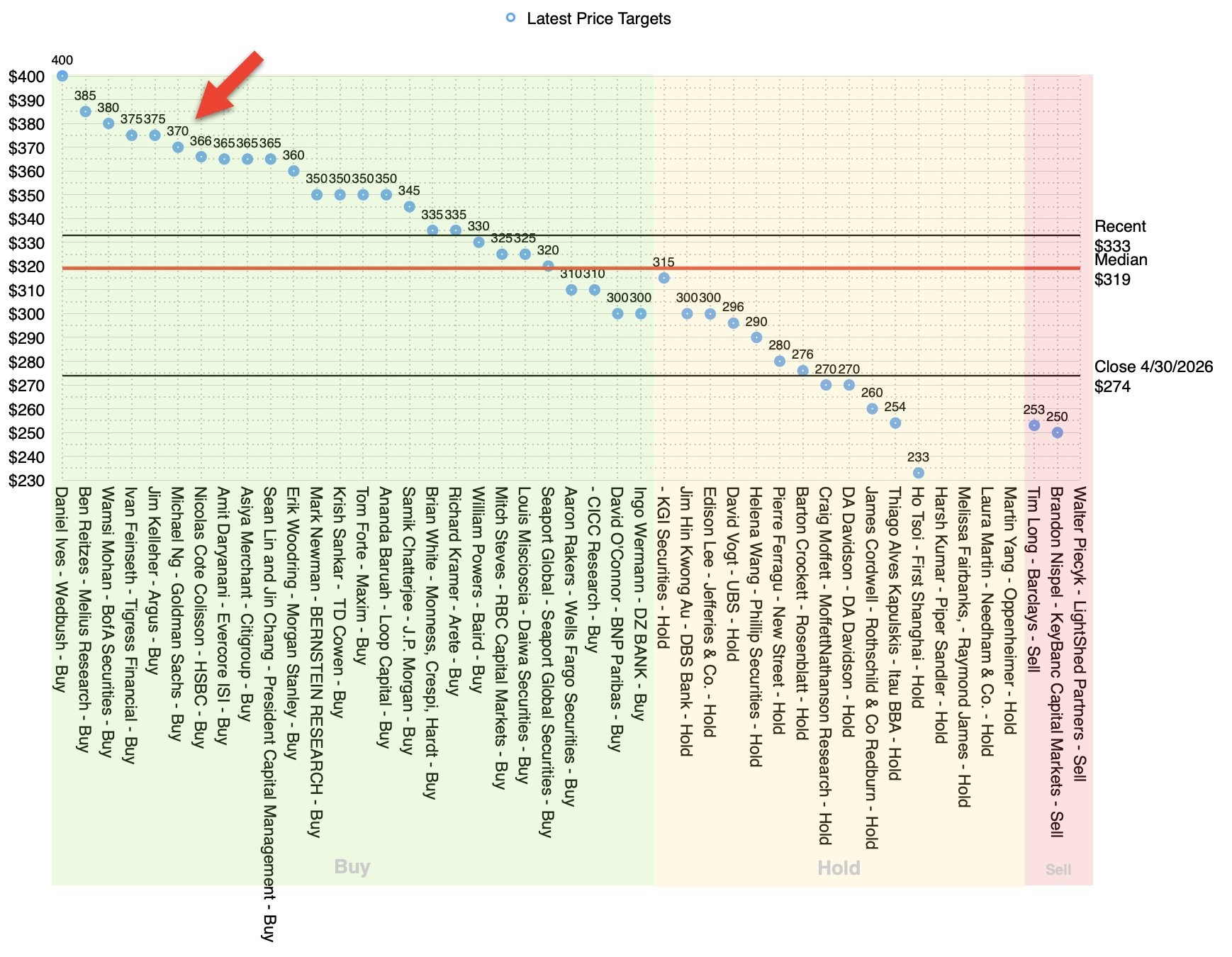
    Tim Long of Barclays has a Sell rating on Apple while the shares sit at an all-time high. Barclays has been at hold or sell since 2014, when the split-adjusted price target was $20. Since then the targets have risen 1,165% while the rating has fallen, with a 30% average error on one-year targets. The only way to square rising targets with a falling rating is to argue that all your previous ratings should be ignored. How long does an analyst insist on being ignored? →

    Preview of Apple’s June Quarter

    Apple reports on July 30th and we will hold Office Hours the next day. My estimate is 15.9% revenue growth with iPhone up 21%, gross margin at 48.5% and EPS of $1.93, up 23%. Memory pricing is the big worry, but June and July inventory was provisioned before the increases, so I am not worried about a margin miss this quarter. The squeeze arrives in next quarter’s guidance, where 45% would not surprise. →

    Beware December Quarter Guidance

    Rumors point to a split iPhone launch across two quarters, a folding model priced above the Pro Max, and the first break in the pricing cadence charted in the stairway to heaven. Any of these leaves management a dilemma: accurate guidance tips their hand, withheld guidance signals a miss. The next few quarters will be different and transitory while the fundamentals get stronger. The reporting will be all over the place and the negatives will overwhelm reason. Don’t be fooled. →


    Nota Bene

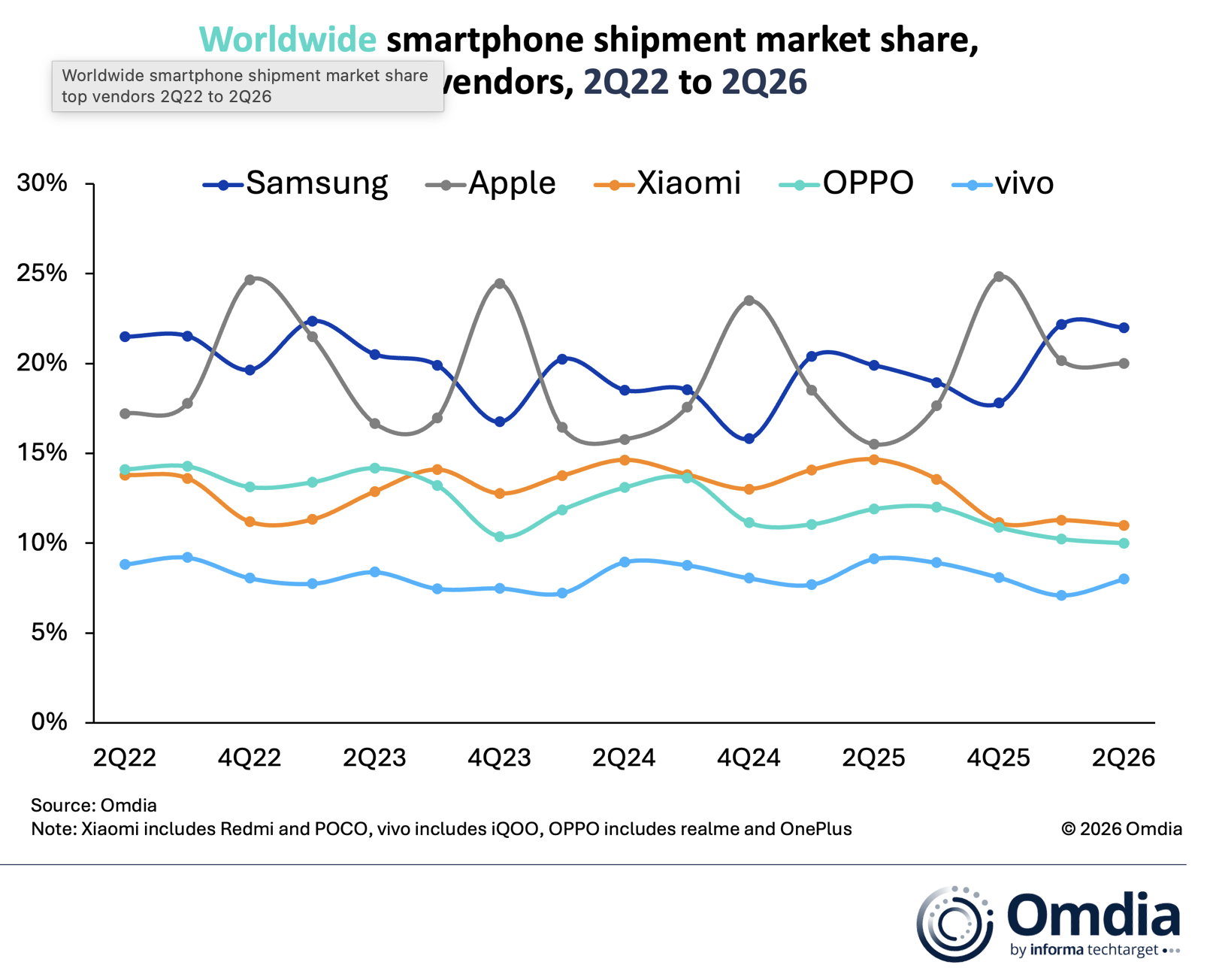
    Omdia: Global smartphone market down 4% in 2Q26 while Apple and Samsung soared → Omdia has the market down 4% in the second quarter while Counterpoint has sales down 11%, and either way Apple hit a record 20% share in its slowest quarter. The steepest drops are in the sub-$400 segment, where memory is now over 60% of the bill of materials. Xiaomi, OPPO and vivo all fell steeply on rising memory prices. In a contracting market with contracting margins, Apple is moving in the opposite direction, and every crisis of the last six years ended with the business emerging stronger. →

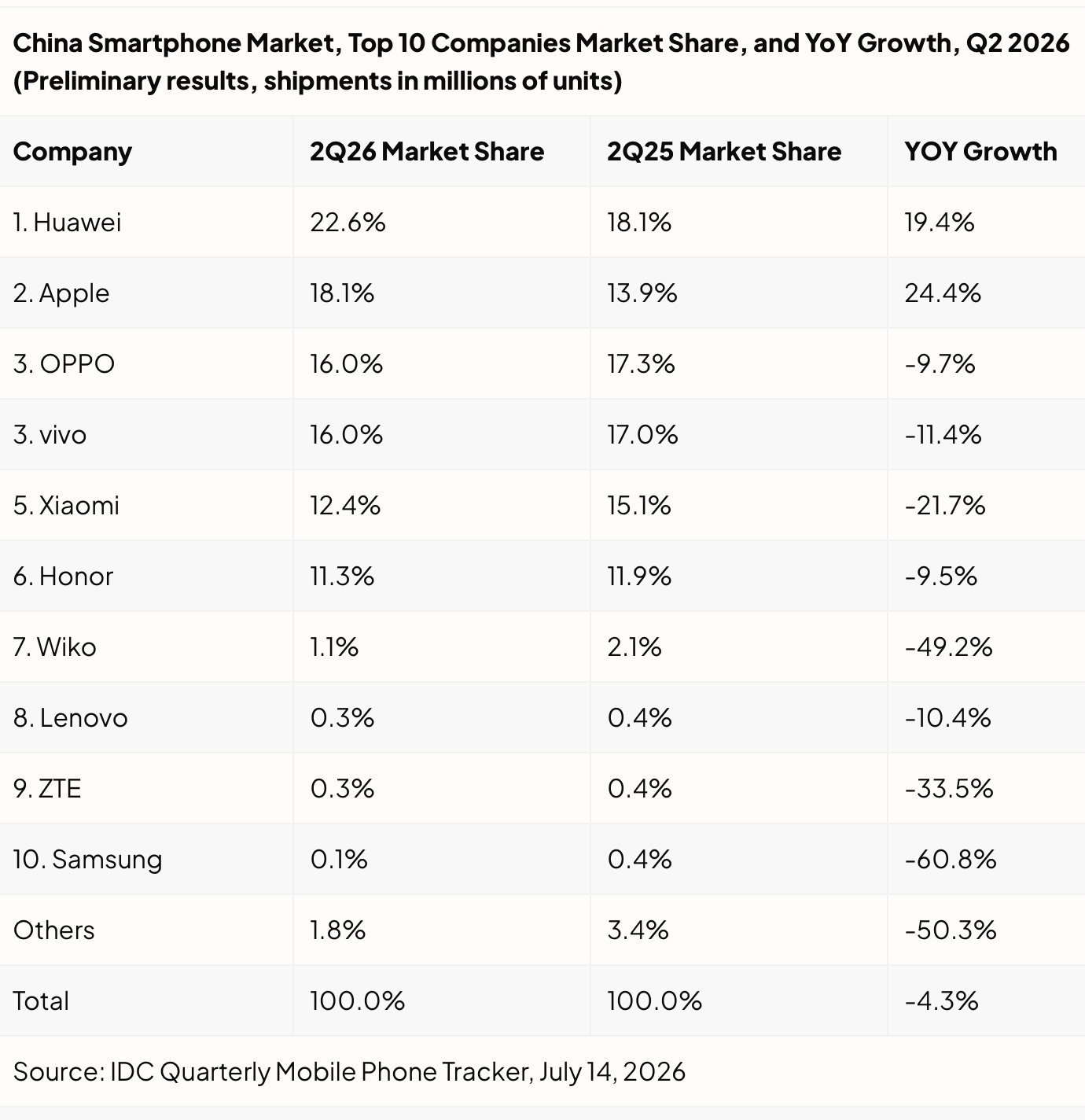
    Why Huawei and Apple Grew While China’s Smartphone Market Fell Again in Q2 2026 → China shipments fell 4.3%, the fifth straight quarterly decline, while Huawei and Apple each grew about 20%. Both held prices steady as the Android field raised them, and Apple’s early signaling of second-half increases pulled buyers forward into the iPhone 17. The repetition matters less than the discontinuity: pull-forward demand and iPhone price increases collide in the holiday quarter, with the line-up probably split across two launch quarters and China likely targeted with the later one. →

    Time to Buy, Time to Sell. → HSBC flipped to Buy with a 41% target hike to $366 while KeyBanc flipped to Underweight with a $250 target on a stock at $333. By my count 28 say Buy and 20 say Hold or Sell. KeyBanc’s own record shows targets tracking results closely while rated Buy, then diverging dramatically once the rating fell. Its latest target implies a 25% drop, set the day before the shares rallied. →


    Asymco One gives you full access to our research, analysis, and commentary. Subscribe with code BULLETIN for a discount.

    Feedback: Have questions or comments? Reach out to us at contact@asymco.com. We'd love to hear from you.
  10. Asymco Bulletin 022 - July 19, 2026

    Bulletin

    Asymco Bulletin is a digest of all the work we have published for the week ending Jul 19, 2026. Posted on July 20th.

    July Office Hours

    Asymco Office Hours Live Q&A — Friday, July 31 → The next Asymco Office Hours Live Q&A will be on Friday, July 31st at 12pm ET / 9am PT, the day after Apple’s fiscal Q3 2026 earnings call on Thursday. Horace will review the results and their implications, and we will take Q&A from our live audience. Asymco One subscribers are guaranteed seats, can bring a guest, and will have access to the live recording.

    Sign up and latest updates at asymco.com/live. →


    Research

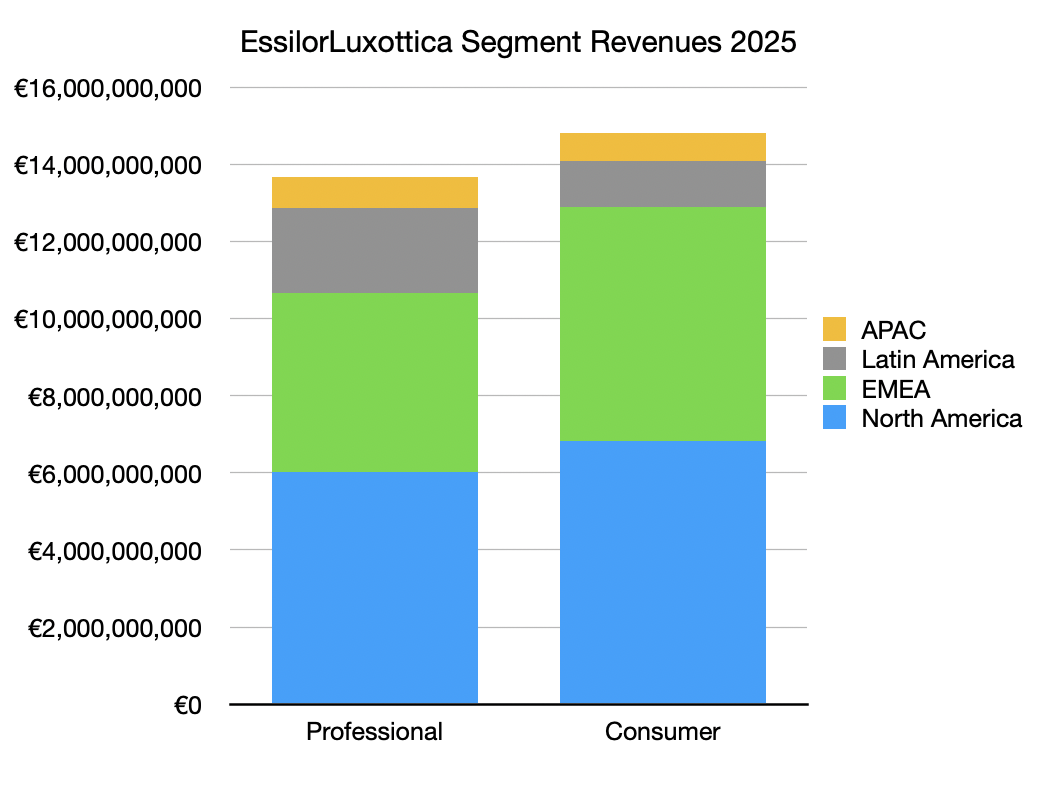
    Capturing Eyespace: Plotting Apple’s disruption of eyewear

    When Essilor merged with Luxottica in 2018 the eyewear market was $100 billion. In 2021 it was $150 billion. Last year it was $220 billion, this year it’s estimated at $245 billion and in six years, $463 billion. Much of this growth is due to increases in the Asia Pacific region with 11.5% CAGR. The growth is due to improving competitiveness with non-consumption through expanding distribution, mainly through retail and e-commerce. Technologies such as virtual try-on are enhancing accessibility, personalization, and purchasing experiences. Aging populations are also boosting demand for prescription eyewear. Focusing on the buying experience and addressing new users are evolutionary steps but changes in the product itself are an emerging revolution. Injection of software into what has been a purely passive optical object will change how we see the world. →

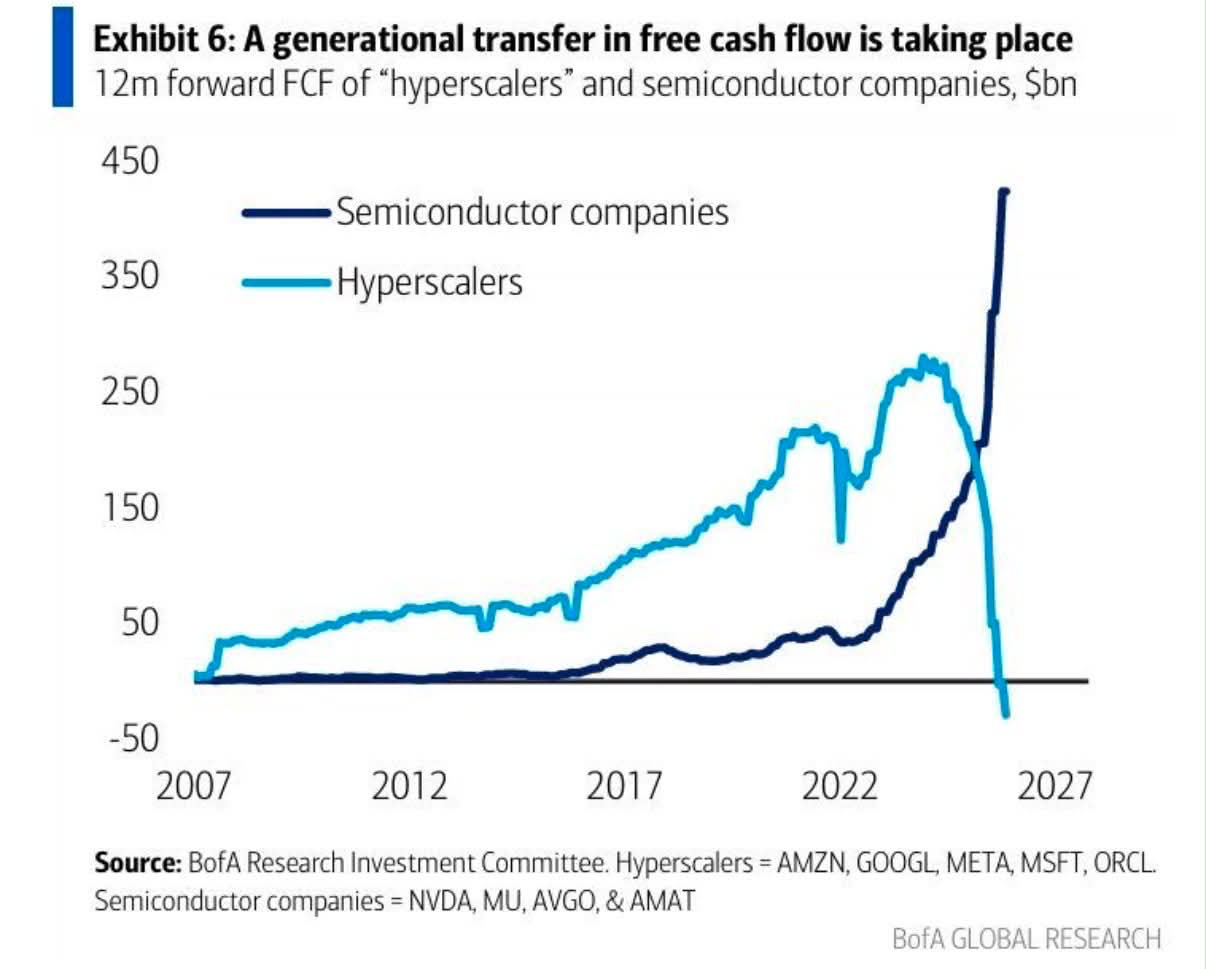
    Why all-in and why all are in

    The graph above shows that Amazon, Alphabet, Meta, Microsoft and Oracle decided to transfer their shareholders’ wealth to the shareholders of Nvidia, Micron, Broadcom and Applied materials. The transfer is real since the capital expenditures undertaken with this cash flow by these “hyperscalers” have gone directly to create unprecedented windfall profits for semiconductor companies. The scale is astonishing! These companies alone are taking hundreds of billions out of their owners' pockets. I ask why this is happening and, even more curiously, why is there a rush by all companies to do this. All but one that is. →


    Nota Bene

    No one admits they like or want to buy more AAPL → Apple hit an all-time high as investors went looking for a hedge against everyone else’s AI spending. The setup is almost funny: Meta, Oracle and Amazon are burning cash to build data centers, while Apple is expected to throw off $143 billion in free cash flow with capex falling. Its edge-AI approach, running models on the device, turns the absence of a frontier model into the whole thesis. The analysts calling it a boring defensive name are the ones who missed it. →

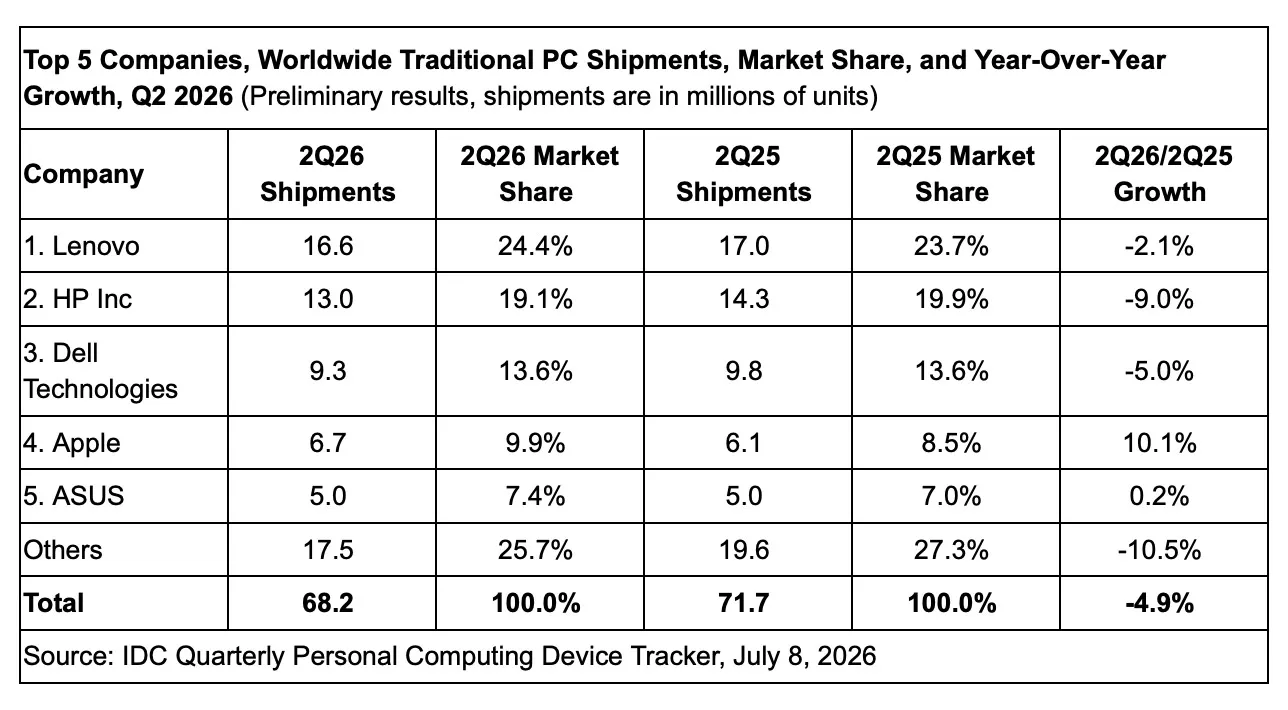
    Worldwide PC market update Q2 2026: Omdia and IDC → The PC market shrank about 4 percent while Apple grew, up 16 percent by Omdia’s count and 10 percent by IDC’s. Apple was lifted by the MacBook Neo, placing Dell now within reach. Units are falling while revenue climbs, because everyone is pushing through 20 to 40 percent price increases on the memory crunch. →

    Why doesn’t anybody copy Apple? → Everyone copies Apple’s products; almost no one tries to copy its operating model, which is the thing that actually matters. OpenAI poaching Apple people is the first real attempt I have seen to reconstruct that model, and I don’t think they have their priorities straight. Jobs said anyone you removed from Apple would be useless on their own, and they are about to prove him right. →

    JP Morgan raises Apple stock price target by $20 to $345 → JP Morgan lifted its Apple target to $345, arguing the memory-driven cost increases are a short-term worry and that iPhone, Mac and iPad volumes have shown little relationship to price over the years. Mac looks the most insulated, helped by AI-led demand.. →

    Citi hikes Apple price target by $50 to $365 → Citi cited Apple’s share gains in falling smartphone and PC markets and its power to raise prices mid-quarter. It expects further increases at the September launch, weighted to the high end, plus a foldable iPhone late in the year. Even with the raise the average target is below the market where the shares set a fresh all-time high above $323, running out ahead of the very analysts chasing them. →

    Game Over. Remember Consoles? → A PlayStation reader poll had nearly half of respondents considering a jump to PC, put off by the end of physical games and the prospect of a $1,000 PS6. Reader polls are unreliable, with selection bias and complaints crowding out the satisfied. The real signal is elsewhere: consoles have been under disruption pressure for years, and Microsoft is now cutting thousands from Xbox. I called this more than a decade ago, and the game is still ending. →


    Asymco One gives you full access to our research, analysis, and commentary. Subscribe with code BULLETIN for a discount.

    Feedback: Have questions or comments? Reach out to us at contact@asymco.com. We'd love to hear from you.
  11. Asymco Bulletin 021 - July 12, 2025

    Bulletin

    Asymco Bulletin is a digest of all the work we have published for the week ending Jul 12, 2026.

    Research

    More than meets the eye

    To see the future of wearables, I said look to where jewelry has been worn. The places where people trust metal against skin is where compute inevitably will reside. The categories are easily found. Head/Hair -> AirPods/Beats Arms -> Watch Hands -> Rings Ear -> AirPods Neck -> Beats My prediction has been more or less fulfilled. Today we wear Beats, AirPods, Apple Watch and (though not Apple) rings containing microprocessors. However, what is missing from this categorization is eyewear. In How We Got to Now, Steven Johnson describes the reading lenses of medieval Europe as the first piece of technology “since the invention of clothing in Neolithic times, that ordinary people would regularly wear on their bodies.” →

    Stay tuned for more on this topic in the coming weeks.


    Nota Bene

    Apple and Broadcom extend deal through 2031 → Broadcom and Apple extended their custom-chip agreement through 2031, and Broadcom jumped nearly 4 percent on the news. Apple is around a fifth of Broadcom’s revenue, so this is a lock-in that cuts both ways. Even as Apple designs more of its own silicon, including the C1 modem, it still leans on Broadcom for wireless and RF. The pattern is familiar: secure the supply years ahead, then decide later what to bring in-house. →

    Apple destroyed the mid-tier watch market. Now it’s coming for the $200 billion eyewear industry → When Apple entered watches, the mid-tier collapsed. Swatch is down 28 percent and Fossil roughly 70 percent, and Apple now outsells Rolex by revenue. The smart glasses category already surged 167 percent, and Apple is reportedly aiming at late 2027. Eyewear is a $200 billion industry that has never faced a competitor who ships hundreds of millions of wrist computers a year. →


    Office Hours

    Did a lottery winner become “the company of the future”? → The Wall Street Journal put Nvidia first among companies of the future and Apple twelfth. But Nvidia’s history is a flat line and then a near-vertical one, because the matrix-multiplication chip they already made turned out to be perfect for AI. That is winning the lottery, not building a moat. They have maybe five customers, every one desperate to replace them, while Apple ships hundreds of millions of chips a year; ask where Nvidia is in a decade. →

    The portability superpower → Someone asked why MLX lets you write for Apple Silicon and then move to Nvidia, a reverse Trojan horse. It fits a very old pattern. Apple has sweated portability since the Mach kernel and the PowerPC-to-Intel jump, when moving the entire OS looked impossible to everyone but them. Doing it at the level of AI chipsets is nothing new; the same instinct is why a touch-ready Mac, when it finally ships, will feel anticlimactic. →