Asymco

Asymmetric Intelligence

App Store

  1. It takes nearly $1 billion/yr to run iTunes

    Research · 44 comments

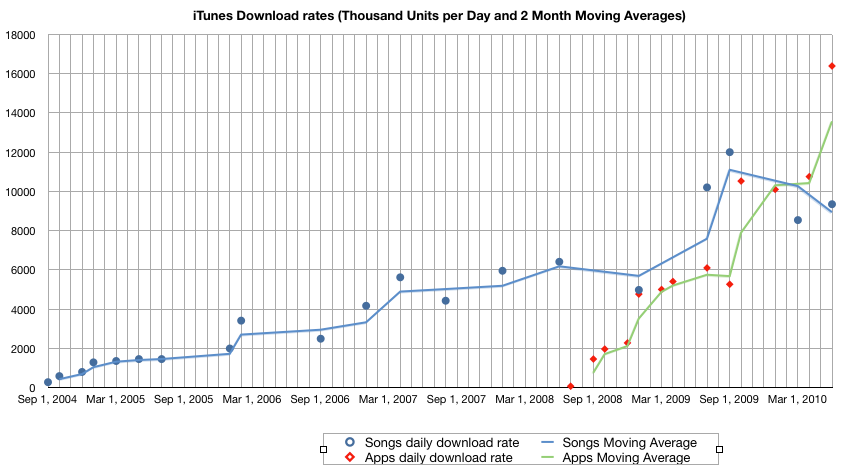
    In recent articles I highlighted the acceleration in iTunes App downloads where the rate is approaching 18 million apps per day and the cumulative total apps which is about to overtake the cumulative songs downloaded.

    We now turn our attention now to constructing the iTunes income statement: namely total sales, gross margins and deduce its operating budget.

    Gross Sales

    To obtain the top line (income) for iTunes we need to know the average selling price (ASP) for songs and for apps. Apps are easy, we received that info in June: $0.29 per app. For songs, it was easy before early last year: $0.99/song. After the selective price increase, the blended price needs to be estimated. I chose $1.10 for 2009 and $1.2 for 2010. These are just assumptions and can be adjusted but should give us a rough estimate:
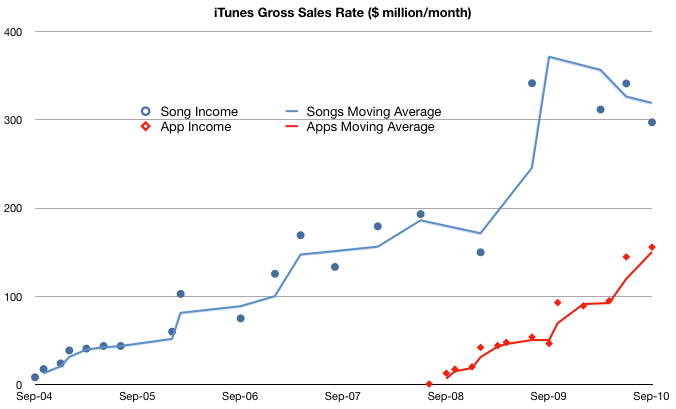
    I followed the convention of using income rate or $/month to show the history of sales. It shows that even with a price less than a third of the music product, apps are generating over half of the sales of music. In other words, apps are adding 50% to iTunes sales today. If the decline in music units continues and the app sales increase with the current trajectory then app sales value will overtake music sales next year, consistent with the cross-over of cumulative units sold.

    Gross Margin

    If we know how much Apple pays music licensors and developers (i.e. cost of goods sold) we can calculate how much it keeps for operations (gross margin). Apple's app margin is 30 percent. The music margin was never official but the consensus has been 10 percent for a while.

    Using these figures, we get the following chart:
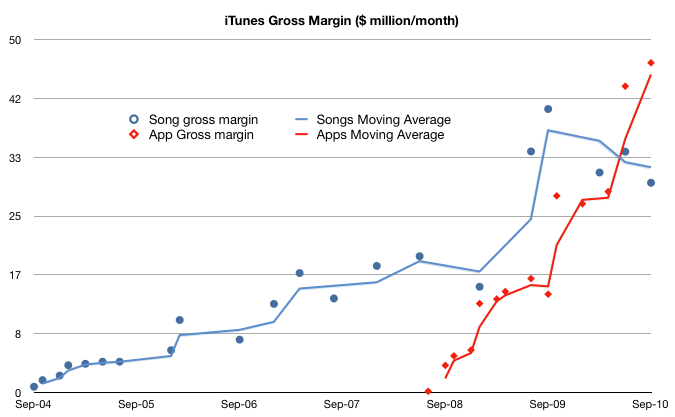
    This shows that what is left after paying the content license, Apple "keeps" about $50 million every month to run the App store (iTAS) and another $30 million to run the Music store (iTMS).

    The Operating Budget

    Apple has made a point of saying that both iTAS and iTMS are run at "break even" implying that the gross margin is used up in operating costs (CAPEX, R&D, SG&A). To be sure, the cost of bandwidth and the data center(s) needed must be considerable.

    But the operating budget for the store is beginning to reach a level that may be beyond what can be spent reasonably. The amount left over for operations has increased from ~$30 million a month in 2009 to $75 million/month today.

    In fact, if this burn rate is maintained (even though it's increasing) the operating budget for iTunes is nearing $1 billion/yr.

    I'm not an expert on the cost of operating data centers but $ 1billion a year seems like a lot. I would love to see an analysis of how this could be allocated.

    Implications

    I would also add that because of the increasing mix of apps, the overall gross margin percent is increasing. I estimate that to be a blended 17%--a healthy margin for a content store--and an increase from 10% before the app store came online.

    Finally, one implication of the economics involved is that a budget like this may provide a significant barrier to entry for any competitors looking to take on the iTunes juggernaut. iTunes has reached content critical mass (12 million songs), user base (160 million users) and wide distribution (23 countries for songs and 80+ countries for apps).

    These are non-trivial operational issues that even the best in the "cloud" business models will find challenging.

    Footnote:

    This discussion excludes video sales, rentals, book sales as we don't have solid histories for these product lines. However, we can do a spot check on the cumulative totals:

    • 450 million TV episodes downloaded implies $1 billion in sales.
    • 100 million movies downloaded probably adds at least another $1 billion
    • 35 million books adds another 500 million.
    • Compare with 11.7 billion songs at ASP of $1 for about $12 billion in song sales and 6.5 billion apps at ASP of $0.29 or about $1.9 billion.

    iTMS content downloads have generated $16.4 billion in sales to date.
  2. September Music Event: Just the numbers

    Research · 20 comments

    • 300 Apple Stores
    • 10 countries with Apple Stores
    • >1 million store visitors some days
    • 80k 1:1 sessions/week
    • 120 million iOS devices sold to date
    • 230k new iOS activations per day
    • 6.5 Billion apps downloaded
    • 200 apps downloaded every second
    • 250k apps available on App Store
    • 25k iPad apps available on App Store
    • 275 million iPods sold
    • #1 portable game player: iPod touch
    • 50%+ of portable game device share US and world-wide
    • 1.5 billion game and entertainment titles downloaded to iPod touch
    • 11.7 billion songs downloaded from iTunes
    • 450 million TV episodes downloaded from iTunes
    • 100 million movies downloaded from iTunes
    • 35 million books downloaded from iTunes
    • 160 million iTunes accounts
    • 23 countries for iTunes music downloads
    • 12 million song library
  3. New data on iTunes: 11 billion downloaded

    Research

    When Steve Jobs announced 150 million accounts with credit cards on the iTunes Store, iBookstore and App Store, he stated that as far as he knows it has "the most accounts of any store on the web".

    More interesting is the claim that iTunes has enjoyed 16 billion downloads.

    Subtracting the 5 billion app downloads, that leads to Music+Video adding up to 11 billion (books at 5 million is still too small to make an impact.)

    The last download data on iTunes was in February when Apple reported 10 billion songs downloaded. The new data implies the daily download rate is about 9.3 million per day.  The forecast I had suggested 11.1 billion by June 1 so it's come in a bit less than expected.

    12 billion songs is expected in September.

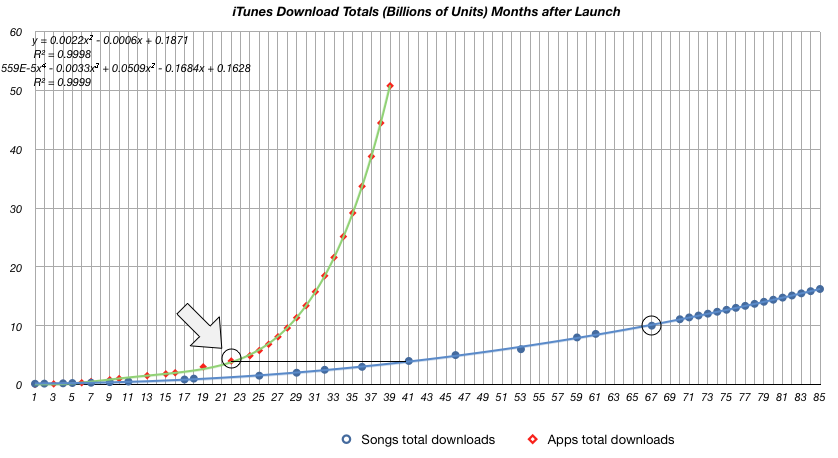
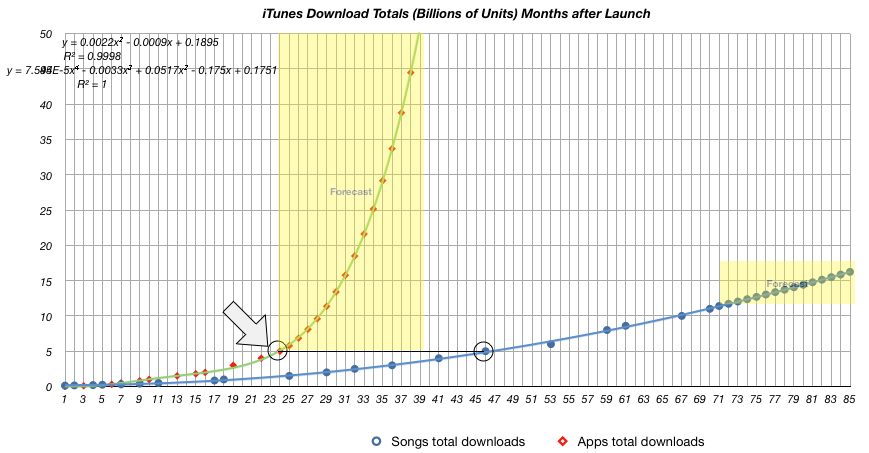
    The graph that follows shows actual and forecast cumulative downloads for the App Store and iTunes store based on months after launch.  As it shows, 5 billion apps took 24 months whereas 5 billion songs took 46 months.

    This graph shows the download rates.  The green line (apps) clearly overtakes the slowing blue line (songs/media).

  4. Time to Download 4 Billion Apps: 21 months

    Research

    Last week's announcement of "well over" 4 billion apps downloaded came 21 months after the App Store opened on iTunes.  To give a perspective on how fast that is, 4 billion songs took 41 months to sell on the iTunes Music Store.

    The graph below shows the last actual data provided on both the App Store and the Music store downloads (circled) plotted from time of launch.

    It also shows a curve-fit forecast of each store's downloads.  If the growth persists, 10 billion apps could be shifted in 28 months post launch, which is around November of this year.

  5. 300k Apps Approved by August

    Research

    Apple leads the App Store race with 170,000 apps

    Palm announced 2k apps on their store and Google recently crossed over 30k. Blackberry has 5k. Ovi maintains about 7k apps.

    According to Appshopper there are 199,885 apps approved and 172,662 available on the App Store. (200k will certainly be crossed today March 21st). Due to churn and policy enforcement Apple has removed 27,223 apps from its store over the years.

    In the case of Android, policing may not amount to much catalog erosion so the 30k figure is more comparable to the "approved" Apple figure.

    With 27th the deadline for inclusion by the April 3rd launch date, the rush to submit new apps for the iPad is on. No doubt, there will be a significant surge in new apps in March. This might lead to a new record of over 25k apps added in one month.

    My initial estimate in February for the 200k milestone was by May 1st. I was clearly off by nearly 40 days. If the add rate is maintained at 20k/mo 300k will come around in August although I'm not as confident in this forecast. The rate of app addition seems to be accelerating.

  6. Microsoft Taketh Away

    Research

    Summarizing the new Windows Phone 7 Series:

    1. No Multi-tasking -- However, there are going to be notifications.
    2. No App Sideloading
    3. No App store other than the Microsoft App Store
    4. No Cut/Copy/Paste
    5. No Expandable Storage
    6. No Exposed File System
    7. No Shell Customization / Skinning
    8. No native applications (managed code only)

    Funny how when iPhone came out and Ballmer laughed his head off, these were the "power" features that most pointed to in WinMo that made the iPhone a "toy".

    Maybe if people want an iPhone copy, they will get an iPhone.

    UPDATE:  (via Gruber)

    Catching up is hard. And based on what I’m hearing about iPhone OS 4.0, it seems likely that Windows Phone 7 is going to fall further behind before it even gets a chance to ship.

  7. App Store vs. Facebook as Platforms

    Research · 1 comment

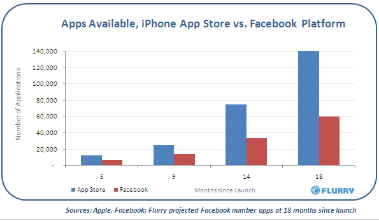
    Since the App Store launched in July 2008, 35,000 unique companies have released applications, which translates to 58 new companies launching apps each day. This appears to be the largest amassing of 3rd party developer support by any development platform in such a compressed timeframe. For example, comparing the number of applications created for the Facebook platform to the App Store over their respective first 9 months, Apple boasted 25,000 apps to Facebook's 14,000. Comparing respective growth in apps after 14 months, Apple had widened its gap to 85,000 apps over Facebook's 33,000. At the App Store's 18 month mark, reached this January, the number of iPhone apps was reported to have exceeded 140,000 compared to 60,000 we estimate Facebook had reached over the same number of months. Apple now leads Facebook with over twice as many available applications. We believe the difference in growth rates can be attributed to the App Store providing better monetization possibilities for application developers than Facebook. Developers, like all rational companies, pursue markets where the path to revenue generation is clear.

    link: Flurry Smartphone Industry Pulse, February 2010

  8. Korean Regulations Stifle Mobile Games Market

    Research

    South Korea is considering banning access to the Android Marketplace to its residents if Google continues to offer game apps that are not approved by the country's regulator

    link: Korea may block Android Market due to game laws | Electronista

    Currently, South Koreans have a choice of two Android-powered smartphones that have access to the Android Marketplace, and more are due for release this year. There are about 4,400 games on the Android Market available to South Koreans, with all of them needing to be rated.

    Apple has gone around the South Korean laws by not offering any gaming apps at its App Store for iPhones and iPod touch devices. South Korean developers put up locally approved games under the entertainment category in the App Store, however. Many South Korean iPhone owners create a second account outside of South Korea that does grant them access to games on the App Store as well.

  9. iTunes: Apps Downloading Faster than Songs

    Research · 4 comments

    Apple just started its countdown clock to 10 billion song downloads.

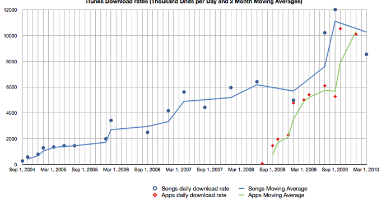
    I combined the data available for iTunes downloads of Songs and Apps (from Wikipedia) in the graphs above.

    Obviously, the App download rate is increasing (i.e apps are accelerating more rapidly) than songs. Both are averaging about 10 million units per day over the past 3 months.

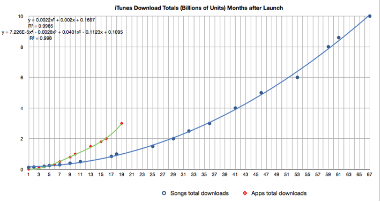
    A Download Totals graph also shows the acceleration plainly with the App Store getting to 3 Billion downloads in 19 months vs. 36 months for Songs. A curve-fitting analysis shows that the App store will reach 10 billion downloads 27 months after launch or around October 2010.

    The same analysis shows that the App Store will overtake the Music Store in total units downloaded in December 2010 when they both reach around 13.5 billion downloads.