
Asymco

Asymmetric Intelligence

Apple TV

  1. The big Mac (and iPad and iPhone) index (Updated)

    Research · 94 comments

    Apple's products are globally consistent. They sell the same exact[1] product in all countries. An unlocked iPhone is the same everywhere. It makes the products "liquid" in that they can be easily bought and sold across borders.

    However, laws do not permit the import and friction-free trading of electronic products. In addition to regulations there are duties levied and there are sales or consumption taxes levied on the purchase.

    However, knowing the retail price of an Apple product in a particular location, and knowing the tax and duties levied, can we work out if the price is consistent?

    Here is an example:
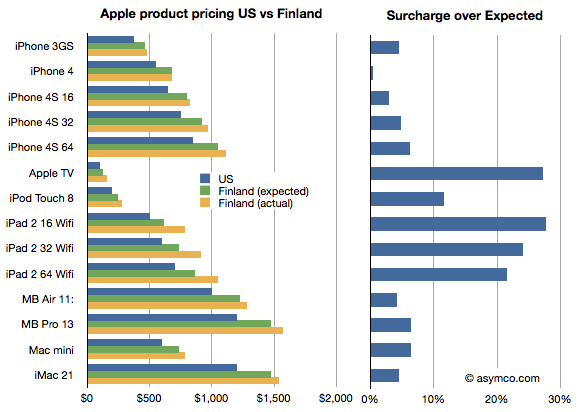
    I illustrated the price of a basket of Apple products in the US online Apple store in blue and the same products in the Finnish online Apple store where the prices were converted to US dollars in yellow. I also calculated what the price in Finland "should" be if the products were sold with the known VAT of 23% added. I called this "Finland (expected)" price and it's shown in green.

    I then took the difference between the "expected" and actual prices as a fraction of the expected and called that the "surcharge". The surcharge can be interpreted as "how much more does a buyer in a different country pay over the price in the US (excluding US sales tax) plus VAT and duties."

    What the chart shows is that not all Apple products are treated equally by Apple. In this particular case Apple TV and the iPad are "overpriced" significantly. Interestingly, the iPhones are nearly what would be "expected" price.

    It gets curiouser when comparing with other countries. In this case I compare the same basket in Brazil.
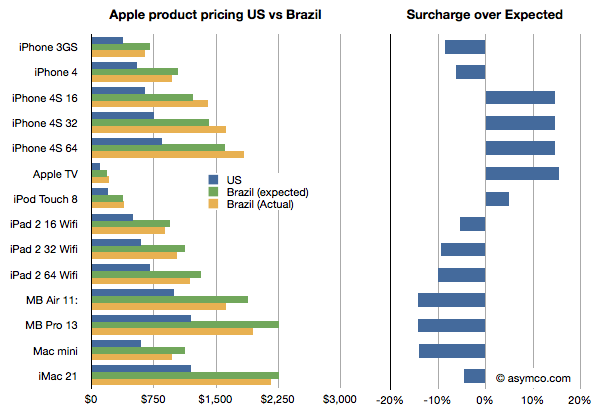
    Here the story is reversed. The iPads are cheaper than one would expect while the iPhones, especially the 4S, are more expensive, though not by as much as the iPads are in Finland.

    Why is this?

    I don't know. These prices are set by Apple though they may be influenced by operator deals they have locally or other terms. It would require local knowledge of the market to solve this.

    What would also be instructive, I believe, is to collect data from many more countries. If you are living in another country, you can help by providing the following data: For each of the products in this list,

    iPhone 3GS
    iPhone 4
    iPhone 4S 16
    iPhone 4S 32
    iPhone 4S 64
    Apple TV
    iPod Touch 8
    iPad 2 16 Wifi
    iPad 2 32 Wifi
    iPad 2 64 Wifi
    MB Air 11:
    MB Pro 13
    Mac mini
    iMac 21

    provide the retail prices (preferably from an online store) and the local VAT or duty that is expected for electronic products (enter data here.) You can provide the prices in local currency. We can then try to put a global picture together and understand what affects price differences across borders[2][3].

    Update: You can view and enter data in the spreadsheet here.

    Notes:

    1. There are minor differences like power adapters but they are not materially more expensive to produce.
    2. See also The Big Mac index.
    3. Thanks to Paulo Silva for supplying the prices from Brazil and asking the pertinent questions.
  2. Hiding in plain sight

    Research · 67 comments

    Guessing the next Apple product has become the parlor game of choice for a whole generation of technology journalists and analysts. The premise of the game is that given a track record of breakthrough products, there is always another one just around the corner. Being the one to predict this next breakthrough product creates credibility and demonstrates the domain knowledge of the predictor. If the prediction fails to materialize there is consolation in dismissing the actual announced product as disappointing, unsophisticated or, worst of all, uninteresting.

    Most often, these guesses are as much a reflection of the analyst as they are an analysis of the company. Too many predictions are designed to impress or demonstrate the imagination or knowledge of the predictor. They typically anticipate a giant leap of functionality, power or market re-structuring. They envision revolution not evolution; a cutting of the Gordian knot not a polishing of ugly rocks.

    Yet nearly all of Apple's launches have been sustaining improvements in existing products, technologies or platforms. To name just a few:

    • The iPad is an evolution of the iPod touch
    • The iPod touch is an evolution of the iPhone
    • The iPhone uses OS X and Objective C from the Mac
    • OS X came from NeXT
    • The app store market model came out of the iTunes store
    • The iTunes store came from iTunes which came first to the Mac as a media sync tool for the iPod
    • etc.

    John Gruber explained the process last spring as it relates to many of Apple's launches. Although the iPhone did introduce a new user input method and experience that takes consumption in a new direction, its building blocks were there for all to see for many years. The iPhone is a natural evolution of the computer with a handy little "Phone" app.

    Likewise, the iPod came seemingly out of nowhere but by watching the original launch you see it as part of a "media hub" strategy that envisions the Mac as a personal server. The very products which ended up disrupting the Mac/PC began as extensions of their victims.

    You can trace the DNA of almost all of Apple's products to previous products. If Apple did not have these foundations, the slow-motion revolutions would not have happened. Rather than a deliberate big bang, Apple's disruptions are the result of a discovery process. A test, iterate and improve loop. This is why they seem obvious after the launch but also why they seem to be such an anti-climax.

    Therefore, the challenge of predicting Apple's next product should be tackled not only through an act of imagination but by carefully projecting the current products and understanding where they can evolve.

    So it is that I approach the question of Apple's TV disruption. My working assumption about the next Apple TV is that it already exists. It's none other than the existing Apple TV, improved.

    Here are the clues or hints I noted:

    • It uses iOS and the hardware from the devices that run it. It originally ran a PC architecture and shared a kernel with Macs.
    • It has been integrated with iTunes media stores (with the notable exception of the iTunes app store)
    • It has begun to introduce channels other than downloads (ESPN, Wall Street Journal) thus establishing its own distribution for traditional content
    • It is a global product, depending only on the Internet protocols and independent of the balkanized cable standards
    • Through AirPlay it is integrated with Macs and Apple devices.
    • Through display mirroring, iOS devices can use the TV as an external monitor and can even change their own behavior when doing so

    This last point is intriguing. I have not seen discussion of this feature, but if using an iPad 2 or iPhone 4S with iOS 5 and an Apple TV with the latest software updates it's possible to have an iOS device become a controller for TV-based game experiences. Developers are already using the API. When using a pinball game with screen mirroring, the device becomes a controller while the action takes place on the big screen. Switching display mirroring off bring the action and control back onto the small screen. There are still problems with lag and the processors are over-taxed on high frame rates, but the APIs are already there for developers. (I could also mention the potential of new a Bluetooth standard for better wireless response).

    What these signals point to is Apple defining the TV as an iOS portfolio product. This means integration with iTunes, including an app store. This, in turn, means unleashing developer/creative talent through new monetization opportunities. This means new user experiences in discovery. This means FaceTime-like communication through the TV. This means many other things but mostly it means that the TV will be a platform product.

    The only challenge is a (currently lacking) smooth interface. Perhaps that's where voice comes into the picture. But whether that is built-in at the next rev of the product or not is not the story. The story is going to be the sustaining improvement in the original Apple TV. A wonderfully asymmetric product begging to be ignored. A product that because of its apparent lack of success, effectively hides all its secrets in plain sight.

  3. Property rights for your living room

    Research · 14 comments

    The new Apple TV has created a cottage industry of pundits debating the future ownership of your living room. This topic of to whom your living room belongs has been around since the 90's when Microsoft sought to plant a flag on your TV set and claim it in the name of Gates with a cable box software platform. A few billion dollars later they came away with not a single deed, not even to your couch.

    Talk of ownership flared up again in the last decade as various game consoles and boxes paraded in front of consumers. There were wars waged over DVD formats, encoding formats and DRM. Then came hulu and Apple TV and roku and who knows what else I missed.

    It's all bound to go badly. Here's why this property will remain off limits:

    • The ownership is not for the space but for the time and attention of the audience. The time spent consuming televised content is what's at stake.
    • That time is increasingly being fragmented. It was first broken into tiny pieces by cable channels that divided audiences into niches.
    • Erosion of cohesive audiences continued with DVD rentals and Netflix. Home theaters ate into both broadcast and outside-the-home entertainment
    • Attention was attacked with PVRs like Tivo.
    • Demographics were exploded with game consoles with age groups separating into different modes of consumption.
    • Migration of other portable devices like laptops, smartphones and iPads into the couch room are now further degrading the value of the "living room" as a significant target for advertisers.
    • Internationally there never was a unified living room. Consumption patterns and even broadcast business models vary widely.

    Ultimately there's really nothing in "the living room" worth fighting for. The disruptive play here is the crumbling of monolithic audiences that used to define "prime time". It's not a new box to take over from another box.

    The technologies that are coming to invade the living room have already broken it into parcels that lack cohesion.

    Just like the division of land among numerous generations of heirs creates land only useful for residential development, it's time to abandon dreams of owning the farm. That farm has long ago stopped being fertile.