Asymco

Asymmetric Intelligence

Apple Watch

  1. Glance: A Deep Look at Apple Watch

    Conference · 2 comments

    Bernard Desarnauts had a great idea a few weeks ago: the world needs an event to discuss Apple Watch. After recovering from the shock of not thinking of it first and then from the shock that nobody else had either, I immediately agreed and along with Ben Bajarin and Farshad Nayeri, we quickly rallied to organize and anchor this event: Glance: A Deep Look at Apple Watch.

    We had some big questions to answer:

    • What is the strategy for Apple Watch? Is it an object of beauty and desire, placing Apple in the "luxury sector" or is it a computer infiltrating what is otherwise a technology-free zone with utility in an asymmetric attack?
    • How can developers discover the killer jobs to be done? Beyond tentpoles what will the primary reasons people will use the watch? What does the data tell us so far? What can be observed from interviews?
    • Given the sales performance to date, what can we expect from the product? What is the addressable market? What will be the installed base? How quickly will it grow?
    • What is the platform strategy, especially with the cadence of OS releases? Is Apple treating this as a separate platform? Will it eventually become independent of the iPhone as the iPhone cast off its dependence on the Mac/PC?
    • What is the hardware strategy? What are the constraints from manufacturing, materials, battery life and screen space? What will be the replacement schedule? What is the role of modular internal designs?

    We realized that we did not have the answers. So we recruited a great cast of participants to help us:

    • Bob Moesta, the founder and developer of the theory of jobs-to-be-done marketing agreed to do a live interview to understand what jobs watches, and in particular Apple Watches, are hired to do.
    • Josh Clark, the premier UX designer who wrote Designing for Touch will explore the question of user experience in glanceable space.
    • Liza Kindred is considered the top expert on fashion tech–she’s writing the book on the future of commerce–brings keen understanding of wearables.
    • Abdel Ibrahim the most prominent blogger and writer on the topic of Apple Watch. Has forgotten more about the Apple Watch than you will ever learn.
    • Carolina Milanesi one of the most respected technology market analysts, now at Kantar and often quoted on all things Apple.
    • Greg Koenig, product designer at Atomic Delights will educate us on the atoms that make up the Watch.

    Investors who will participate in panel conversations:

    Special guest: Jean-Louis Gassée, former head of Apple Engineering, current VC and everything in-between will have a fireside chat with Tim Bajarin Legendary technology analyst who has been around long enough to see furthest ahead.

    We will explore Apple Watch as a very curious interaction between form and function, luxury and utility, exclusivity and ubiquity, tiny screens and big audiences, short attention spans, big data.

    We have developers, designers, investors, marketers and analysts contributing to what could be the biggest leap in computing since the smartphone.

    If you are interesting in becoming one of the innovators on this newest of platforms or planning a strategy to invest, or even (actually especially) if you are a skeptic, you can't miss this conference.

    Join us for Glance, a deep look at Apple Watch, downtown San Francisco, December 10, 2015.

    Early bird pricing is $495.

    If you miss early bird, and you're an Asymco reader, there is still a 30% discount.
  2. Apple management answers questions on the market performance of Apple Watch

    Research · 10 comments

    Katy Huberty (Analyst - Morgan Stanley): You've said in the past that the watch may take longer to ramp given the new category and new interface to customers. Is that, in fact, playing out? Is the watch ramping slower than past product categories?

    Tim Cook (CEO): Katy, when you use the word ramp, do you mean from a -- I assume you're talking about supply?

    Katy Huberty (Analyst - Morgan Stanley): Yes. Pre-orders and first week in sales and any other data points that you track in terms of interest versus, say, when the iPad launched in 2010?

    Tim Cook (CEO): Let me talk about supply and demand and sort of separate those two. Right now demand is greater than supply. And so we are working hard to remedy that. ((This is still true today, three months later))

    We've made progress over the last week or so and we're able to deliver more customers an Apple Watch over the weekend than we had initially anticipated. We're going to keep doing that. […] So I'm generally happy that the -- that we're moving on with the ramp.

    It is a new product for us, and with any kind of new product, you wind up taking some time to fully ramp.

    Having said that, I think we're in a good position. And by some time in late June, we currently anticipate being in a position that we could begin to sell the Apple Watch in additional countries. And so that's our current plan. ((This has been achieved according to plan.))

    From a demand point of view, it's hard to gauge when you don't have product in stores and so forth. And so we're filling orders completely online at the moment.

    The customer response from people that have gotten theirs over the weekend have been overwhelmingly positive. And we're far ahead of where we expected to be from an application point of view.

    To give you a comparison, when we launched the iPhone we had about 500 apps that were ready. When we launched iPad, we had about 1,000. And so our internal goal was to be able to beat the 1,000 level and we felt -- we thought it would be great if we were able to do that by a little bit.

    And as I've mentioned before, we now have over 3,500 apps in the App Store for the Watch. And so we couldn't be happier about how things are going from that point of view.

    We are learning quickly about customer preferences between the different configurations. There's a much larger breadth of possibilities here for customers than in our other products. And in some cases, we called that well and some cases we're making adjustments to get in line with demand.

    But I'm really confident that this is something we really understand how to do and will do. And so I'm really happy where we are currently and happy enough that we're looking forward to expanding into more countries in late June.

    […]

    Gene Munster (Analyst - Piper Jaffray and Co.):  …question for Luca, in terms of any thoughts on what the margin impact from the Watch as that ramps over the next couple of years?

    Luca Maestri (CFO): Apple Watch is, not only a new product, but it's a brand new category with a lot of new features, a lot of new innovative technologies. And Apple Watch margins will be lower than the Company average.

    […]

    Toni Sacconaghi (Analyst - Bernstein): I just wanted to revisit the watch.

    Tim, I think you said when you were talking about your new products, you said we're, quote, very happy with the reception. And in response to a previous answer you said, relative to demand, it's hard to gauge with no product in the stores.

    I would say relative to other product launches where your commentary around demand was characterized by superlative after superlative, that assessment feels very modest. And part of the reason that I ask is, A, are we reading you right in terms of that? But if we look at consensus, consensus is expecting that Apple will ship more watches in its first two quarters than it did iPads, despite, as you said, very limited distribution in terms of only selling through your stores.

    So I'm wondering if you can talk a little bit about putting those demand comments in context, given that they do seem different from how you've characterized product demand for other products. And how, if at all, we should think about the modeling demand in the context perhaps of the iPad, which was your most recent significant new category? And then I have a follow-up, please.

    Tim Cook (CEO): I'm thrilled with it, Toni. So I don't want you to read anything I'm saying any way other than that. So I'm not sure how to say that any clearer than that.

    And in any situation, whether it's the watch or in the past on iPad or on iPhone, when demand is much greater than supply, it's difficult to gauge exactly what it is. And so, as you know, we don't make long term forecasts on here. We maybe forecasts for the current quarter. And so I don't want to make any comment about the consensus numbers.

    Honestly, I haven't even studied those. We've got enough to think about here.

    I feel really great about it. The customer response, literally from what I've seen, is close to 100% positive. And so it's hard to imagine it being better.

    -------

    Excerpts from Apple Earnings Report: Q2 2015 Conference Call Transcript, April 27, 2015.

  3. The Watch

    Research · 196 comments

    Watch Screens

    Before its launch, I said that the Apple Watch would be as much a watch as the iPhone is a phone. Recall that when the iPhone was launched it was anchored on three tentpoles, one of which was being a phone and that when the Apple Watch was launched it was also anchored on three tentpoles, one of which was being a watch.

    Realizing that on the iPhone the "phone" is but an app — one which I find populated with FaceTime calls rather than cellular calls and whose messaging history is filled with iMessage threads rather than SMS — I consider it safe to say what the iPhone is today not as much a phone as a very personal computer. And so the question is whether the Watch will quickly leave behind its timekeeping anchor and move into being something completely different.

    I had the chance to use the Watch for a few days and can say that timekeeping is probably as insignificant to its essence as it's possible to be. It feels like a watch in the physical sense, looking good in the process (as the iPhone physically felt like a phone, also without being hard on the eyes)

    However it does not feel like a watch conceptually. I find myself drawn into a conversation by its vocabulary of vibrations. I find myself talking to it. I find myself listening to it. I find myself glancing at information about faraway places. I find myself paying for things with it. I find myself checking into flights with it. I order transportation, listen to news, check live data streams and get myself nagged to exercise. It tells me where I am. It tells me where to go. It tells me when to leave.

    Nothing ever worn on a wrist, or anywhere else for that matter, has done any of these things before. Not only are these things mesmerizing but they are done in a productive way on a wristwatch. In other words they are done in a mindful way.

    Cynics may say it does too little. Philistines may say it does too much. But for me it does just what I want it to do when I want it done. The things which are not done stay out of the way. This discretion is just as important as the effectiveness of action.

    Even more remarkably, this tasteful minder is offered not to a fortunate few but to millions of people of average means. In the true sense of technological democratization, Apple Watch is a phenomenon for mass consumption.

    Its launch needs to be understood as a watershed event. It could be compared to the launch of the Mac or the iPhone but it is different as much as it is the same.

    The product has a completely different character. It tries not to do more but to do less. But that which it does is more meaningful, more thoughtful. We talk of computing speeds and network feeds but we spend much more time and money to visit people who have little to say and say it slowly. We value charm and wit more than bandwidth and throughput. We are drawn to beauty more than to speed. This is what this computer captures.

    A maxim of the computing of the 21st century is that the closer the machine is to us the more we value it. It does not get rewarded for being fast but for being a companion. It does not get valued for features but for beauty. It does not get hired for power but for control. It does not get worn because it's smart but because it's clever.

    People understand these tradeoffs instinctively. They are not concepts that need selling. The product speaks plainly of itself and its success is therefore guaranteed.

  4. How will we measure Apple's Watch success?

    Research · 55 comments

    It won't be easy. The company will not be reporting the Watch segment revenues or (presumably) unit sales and therefore we won't have an accurate unadulterated view of the business. In addition, the large number of products in the mix and wide price variance means that it will be difficult for analysts to determine demand and price.

    There is a hidden benefit to not having this data. All data is a creation and it tends to lead thinking in directions led by whatever is being measured (and whoever chose those measures and their motives). And yet without data there is no evidence and no credibility. In other words: You can't manage without measurement but you can't be sure what to measure.

    The analyst is then faced with a requirement to have good taste or at least judgement about what to measure. This judgement is based on experience and good theory. Given that, what could we measure to determine whether the Apple Watch will be a success?

    Here are some suggestions:

    1. Language. Measure whether "Watch" will come to mean "Apple Watch". "Phone" has come to mean not only "smartphone" but also all mobile/cellular phones and not just things used for calling but things used for all manner of information. This is a great test because the theft of semantics can only be accomplished through a degree of ubiquity of influential mindshare. Incidentally, the brand may well have been designed to do just that. ((It leaves open the question as to what watches as currently defined will come to be known as.))
    2. A measurable and significant reduction in the use of the iPhone. The Watch peels off uses from the iPhone and therefore the more it peels off, the less remains. However, that which remains will be more uniquely valuable to the incumbent. This is the process of carving and erosion that the PC experienced vs. mobile devices in general.
    3. An increase in the mix of large-screen iPhones. As iPhones are removed from pockets more rarely, the larger version might be more comfortable to carry and more useful to use for the immersive tasks that are outside the scope of Watch.
    4. An overall increase in iPhone sales beyond the foreseeable trajectory. This would suggest switchers from Android would be drawn to the platform purely for the value of the "accessory". Note that this is not inconsistent with the lower usage and higher spec mix measurements.
    5. Apps uniquely targeting the Watch. It's hard to imagine how this will develop as it involves millions of creative minds, but as smartphones created new economic value through the solving of new jobs to be done, the Watch should do the same. As a side-effect it should lead to new empires (or at least Unicorns) being formed around Watch use.
    6. Iteration. How quickly and deeply will the product be improved? Basic accessories like headphones and Apple TV have a leisurely update cycle. Smarter devices are faster. The cycle time of iteration should indicate how seriously Apple takes the platform and that itself should be fueled by positive consumer sentiment for the product.

    These indicators are vague and the data will be weakly signaled but in many ways it will be more meaningful than any financial performance figures.

  5. Measuring the Apple Watch opportunity

    Research · 112 comments

    When the Apple Watch was launched, all eyes turned to the Swiss watch industry. Analysts measured it and asked if it's big enough to be interesting. Industry observers questioned the competitiveness of an entrant vis-à-vis the ancien régime. Marketers weighed in with segmentation hypotheses and how Apple's queer new device might best fit.

    These are all mistakes in analysis.

    The market for Apple Watch is not the Swiss (or Chinese) watch market. The market for Apple Watch is the number of wrists in the world. To the extent that those wrists will be covered with Apple hardware will determine whether it is successful or not.

    Measuring the existing market is a mistake because the existing products are hired for different jobs. Those measurements will yield only an answer to how big that job is.

    Assessing competitiveness vs. incumbents is a mistake because incumbents have perfected solving the problems of wrist-worn timekeeping devices over a century. Apple's watch is not a wrist-worn timekeeping device any more than the iPhone is a phone or the iPad is a pad.

    Segmenting the market by whatever means are convenient today is irrelevant because the segments are currently positioned on the current jobs to be done. It's no more relevant than classifying the iPhone along the segments defined for phones in 2007. ((e.g. keyboard phones, flip phones, and feature phones))

    Some have tried to wedge the Apple Watch among the "fitness tracker" market. This is no more plausible given that fitness tracking is no more interesting than timekeeping is to Watch.

    The best way to measure the opportunity is to quantify the "wrist-space-time" continuum and deciding what is and what isn't addressable. The wrist is an interesting place to put a computer and Apple makes computers. The rest is left as an exercise to the reader.

  6. How many iOS devices will be produced in 2015?

    Research · 1 comment

    12 months ago I asked How many iOS devices will be produced in the next 12 months?

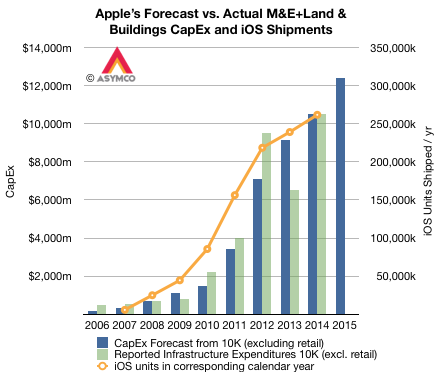
    Based on the analysis of Capital Expenditures (as forecast by Apple in their annual 10K report) I concluded "iOS unit shipments should be between 250 million and 285 million."

    The answer turned out to be 247 million. ((Including an iPod touch estimate of 9.5 million)) Including Apple TV the total would probably be around 251 million.

    Since last year, I adjusted my model by observing corresponding iOS unit shipments for the calendar year corresponding to each fiscal year. Since the calendar year is offset by one quarter (FQ1 = CQ4) looking at calendar year means looking forward one quarter post-spending. I believe this is more accurate as spending generally happens in advance of production.

    The resulting pattern is shown below:

    Screen Shot 2014-10-28 at 2.39.35 PM

    The company is currently anticipating spending $12.4 billion on non-retail CapEx. The spending for last fiscal year was almost exactly what was anticipated in the previous 10K. If we calibrate production (with a 3 month shift) to the 2014 benchmark, then 2015 calendar year would see about 310 million iOS units.

    The big question is whether this will include Apple Watches. To answer this we have to make many guesses:

    Does the company have a deliberate production plan for Apple Watches? What is the lead time? How quickly can production be ramped given channel and demand?

    Do Apple Watches require significant capital expenditures? Do Apple Watches require capital intensity similar to iPhones and iPads? How unique are the watch cases, straps and computing cores? What are the demands of the digital crown, the sapphire crystal, the display?

    The capital budget of $10.5 billion in F2014 had to cover the ramping of the iPhone 6/6Plus as well as some of the new Macs, iPads and the Arizona sapphire plant ((Note that some of that would have been in 2013 and at about $0.5 billion, the plant was about 5% of CapEx)). It also had to cover some of the new campus ((The construction cost of $1billion/yr would amount to about 8% of the capital spending (non-retail) )). In previous years the capital budget also covered data center construction ((Including vast renewable energy infrastructure)) which may not be present in the future budget.

    The non-retail capital budget is anticipated to increase by 18%. There are more moving pieces next year than usual, but directionally at least, CapEx remains a strong indicator of future iOS growth. Especially as it's given to us a full year in advance.


  7. Tentpoles

    Research · 126 comments

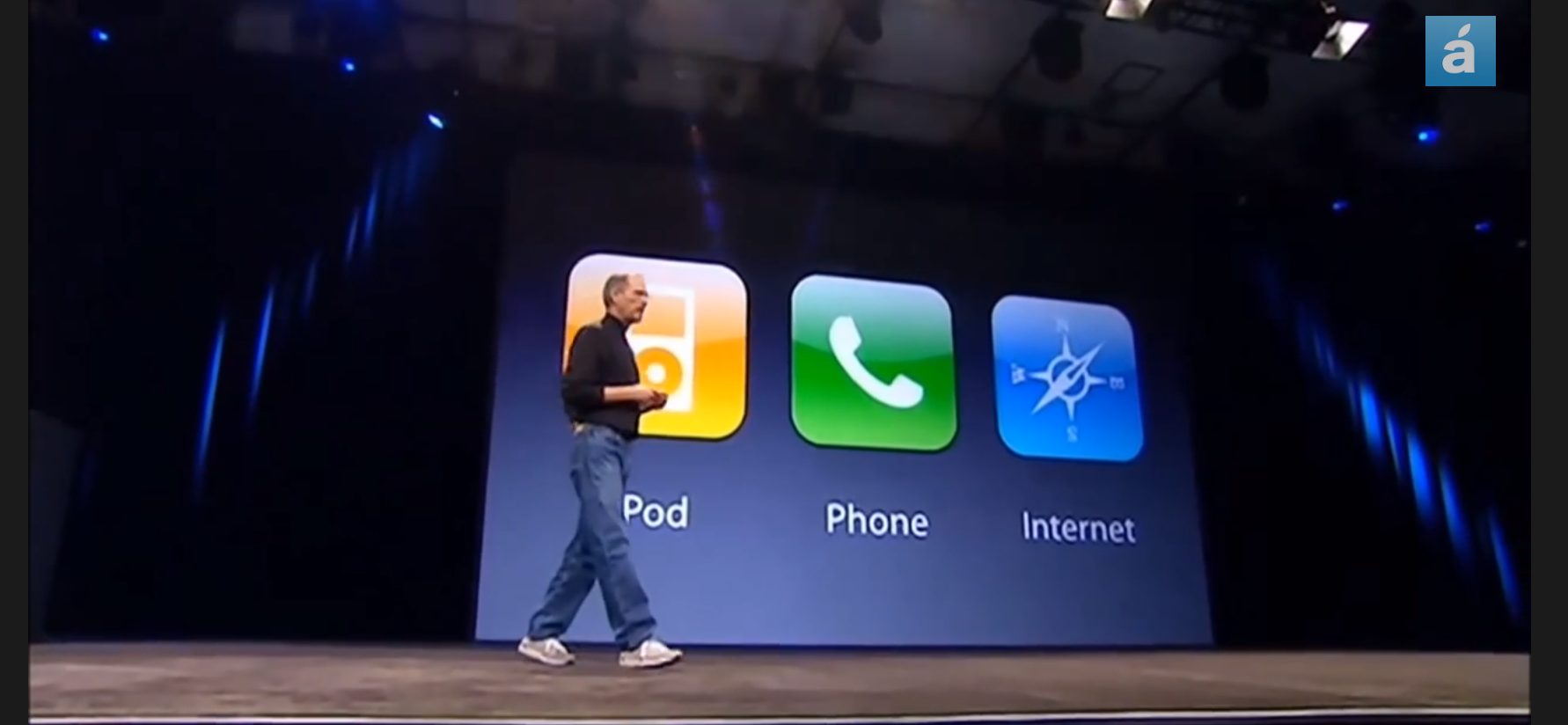
    When the iPhone launched, Steve Jobs introduced it as being three products in one:

    • A wide-screen iPod
    • A phone
    • A breakthrough internet communicator
    Screen Shot 2014-09-11 at 2.40.54 PM


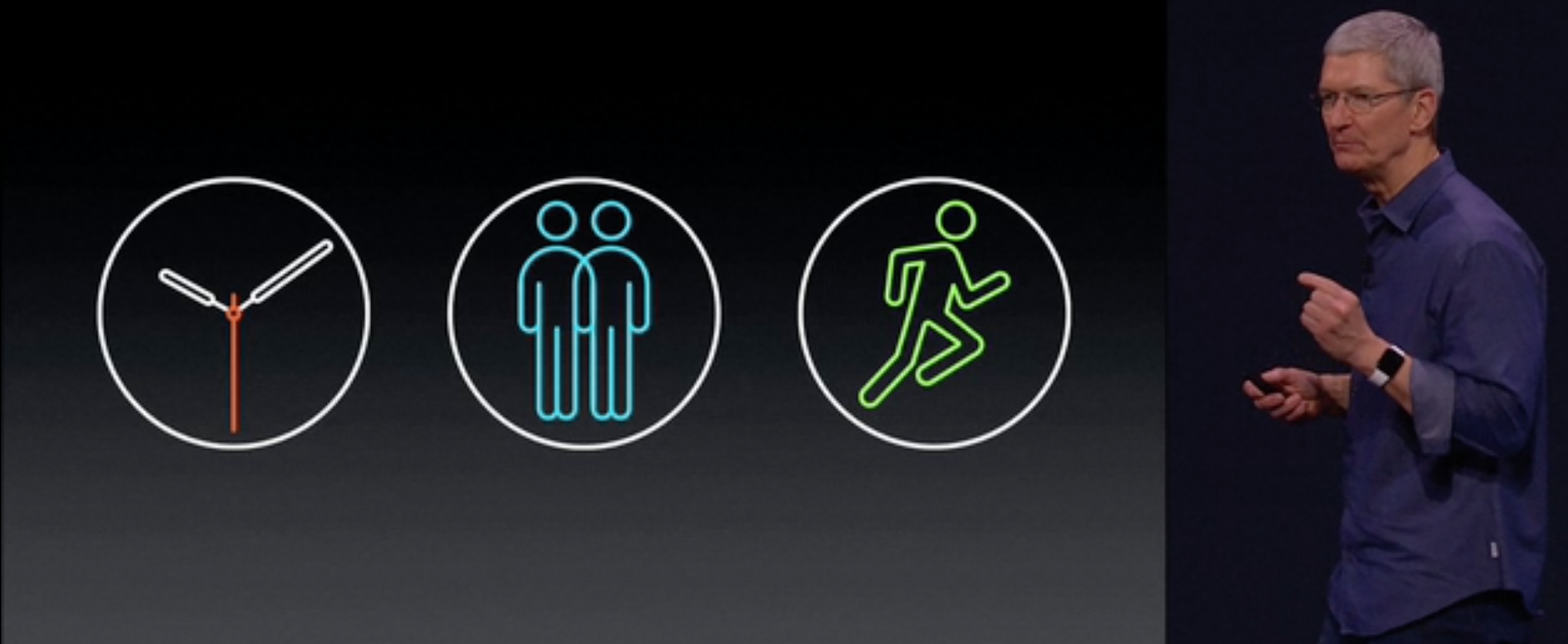
    When the Apple Watch launched, Tim Cook introduced it as being three things:

    • A precise timepiece
    • A new, intimate way to communicate
    • A comprehensive health and fitness device.
    Screen Shot 2014-09-11 at 2.37.52 PM

    As in the Revolutionary User Interface story,  the symmetry in approach to the launch is telling, but what I want to note is that the three things which the iPhone was defined as being are no longer things that it is most used for.

    Yes, the iPhone is still a wide-screen iPod which gets plenty of use but I don't think anyone thinks that is a defining feature. It's also a phone, but the Phone is just an app which, for me at least, is not frequently used. I communicate with my iPhone but the go-to app is iMessage or FaceTime or Skype or maybe Email or Twitter. Phone is something I use so rarely that the interface sometimes baffles me. And yes, it's an Internet appliance. Browsing is something I do quite a bit but many of the browsing jobs-to-be-done are done better by apps. News, shopping Facebook and maps are "things which were once done in a browser."

    So I wonder whether the tentpole product-defining anchors used to introduce the Apple Watch will be faintly amusing a few years from now.

    Of course, the reason iPhone outgrew its tentpoles is because of the app economy. 1.3 million apps does that to a product. When it becomes a platform a product invites collaboration on the problem of innovation. Collaborative innovation explodes the opportunity to discover new needs and uses. How, when and why people use the product changes beyond anyone's imagination.

    But this does not mean that the tentpoles used at launch are in any way in error. They are necessary to explain the value of a new category. The audience can't be told "wait and see all the cool stuff you'll be able to do with it". They need to be told why it's useful today. They speak in the language the audience can understand today. Steve Jobs could not talk in the language of apps and services in 2007. The unforeseen became the inevitable.

    Tentpoles therefore don't define the product but do provide the starting blocks from which the initial buyers make a cognition leap. And once they're off, the others will know where to go.