Asymco

Asymmetric Intelligence

Asymco

  1. Introducing Asymco One

    Invitation

    The all-in-one on Apple

    In July this of this year Asymco turns 17. In April of this year Apple turns 50. 

    This means that Asymco has been following Apple for one third of its life. I regret that it has not been for longer but oh, what a third it has been.

    • During 2009, Apple Net Sales were $46.7 billion.  17 years later revenues should comfortably top $500 billion. 
    • Earnings per share (split-adjusted) in 2009 were 37c. This year EPS will be around $9.5. 
    • Most importantly, at the end of 2009 Apple had about 107 million active devices (43 million Macs, 33 million iPhones and 30 million iPods!) Today it has 2.5 billion. 

    The increases in multiples:

    • 23x Active devices, or a compounded annual growth (CAGR) of 20%
    • 11x Revenues, CAGR of 15%
    • 26x Earnings, CAGR of 21%
    • Apart from the customer love affair these numbers reveal, investors were awakened.
      36x increase in Apple share price, from $7.5 to about $270. That’s 17 years of 23.5% growth. 
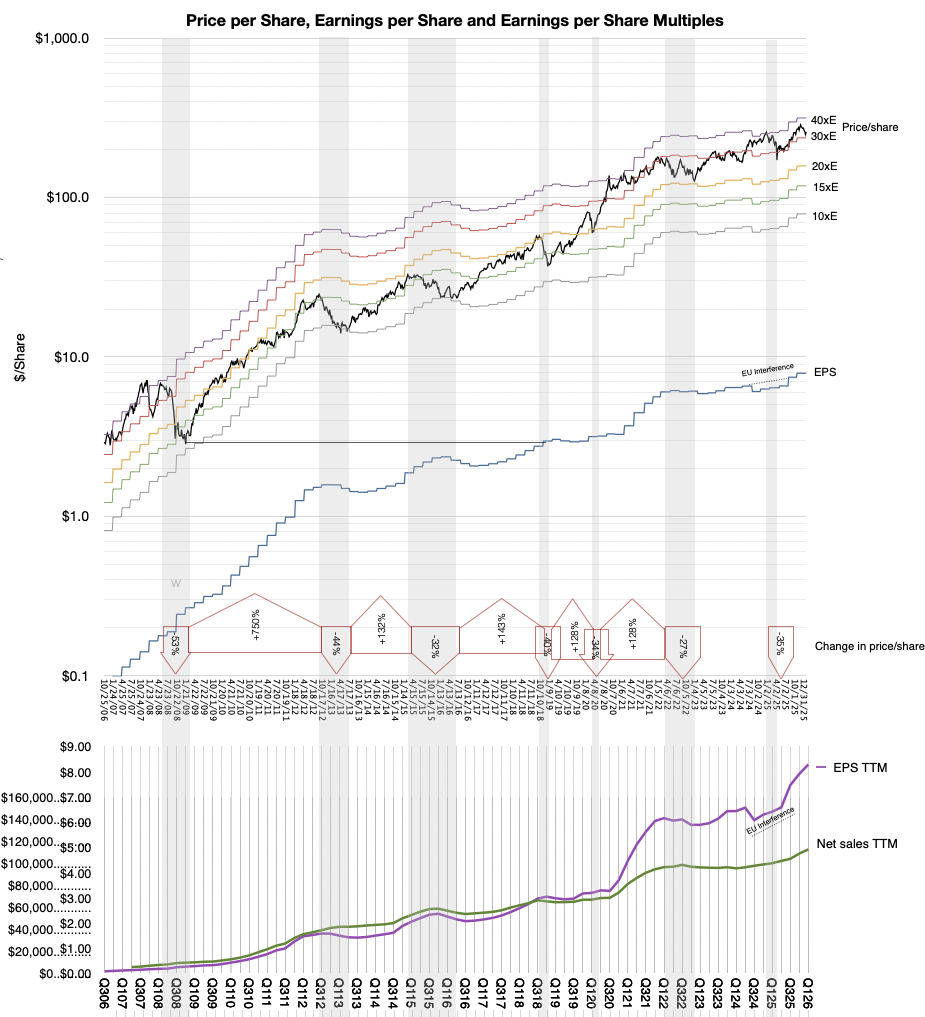
    The appreciation of the share price faster than the other underlying metrics reflects the undervaluation that existed for most of the last 17 years. Its value grew a lot more because it was too cheap to begin with. 

    That was perhaps my most important observation. A recurring undervaluation reflecting a perceived fragility. The more I studied and came to learn how the company operates the more I realized that the perception was wrong. It was in fact the opposite of reality.

    When I started my “Apple model” in 2009 I did it out of indignation. I had access to a few analyst reports covering the company and, when looking at their forecasts and assumptions, I was shocked to read that they treated Apple as a computer company. Two years had passed since the iPhone launched and I had made the radical assumption that the future of the company would be determined by the dynamics of phones--later to be broadened into “devices.” This did not appear radical to me because five years earlier Apple had created the market for music players. A market it came to dominate. It seemed very rational to me that with the iPod (and iTunes), Apple had demonstrated that it was more than a computer company. Or perhaps more accurately, it was so profoundly different as a computer company that it redefined what computers were. Nonetheless, observers seemed stuck with the perception that once a PC maker, always a PC maker.  

    So here is my prediction today: Apple at 50 is no less capable than Apple at 20. Indeed, it is more so.  This is because, even if it has not yet completed its quest, the company has sought self knowledge.  A knowledge which I have sought to gain as a distant observer.

    And so here I am, inviting you to come along with me on this journey. 

    Asymco is being re-launched. Apple at 50 is entering a new era. It has transitioned from Apple ][ to Mac to iPod, iPhone, iPad, Watch and Spatial Computing. But it has always been the company that brought computers to people and people to computers. The new era of computers that appear more like people is dawning and the connection between the two needs to be built. Only Apple is capable of creating this connection. And only Asymco is able to tell the asymmetric story of how it will happen.

    Let’s learn together. 

    To make this research possible we’re launching Asymco One. 

    Asymco One is the analysis you need for understanding everything in the world of Apple. It’s a bundle of seven categories of content:

    1. Curated news and commentary with Nota Bene. 
    2. Reconsider your assumptions with Research. 
    3. Save time with the weekly summary in the Bulletin. 
    4. Supercharge your narrative with Asymetric podcasts. 
    5. Get your questions answered during Office Hours. 
    6. Attend in-person or online the full-day Conference.
    7. Search over 1800 posts, 60,000 comments, 400 podcasts and thousands of graphs since July 2009 in the Archives.

    All while connecting with the most knowledgeable community of thinkers and investors in Apple.

    Asymco One is a bundle which will offer over one thousand updates per year providing the ultimate intuition on Apple for stakeholders and connoisseurs of the most important phenomenon of our time.

    It’s available as a subscription for $1000/yr, about the price of an adequately configured iPhone. 

    But for you, dear reader, who have been with us for so long, I am offering a discount of $250 with the code PIONEER.

    I hope to see you in the Comments, the Office Hours, the only Conference and in person. 

    Yours,

    Horace Dediu

    –
    Asymco One: About | Subscribe
    Use code PIONEER to save 25%.
  2. All Asymco Podcasts. All in One: Asymco One.

    Podcast · 2 comments

    For the first time, we will be bringing all Asymco Podcasts under the same roof, included in Asymco One subscription.

    Asymco One subscriptions will include access not only to the new episodes of the Asymetric Podcast, but also to all classic Asymco Podcast content.

    We have already started the process of remastering, transcription, and indexing archives of: The Critical Path, Asymcar, and Asymetric.

    Watch Asymco Podcasts for the latest updates.

    Learn more about Asymco One.

    Asymetric Podcast: Waterloo
  3. The Asymco Trilogy with Horace Dediu Part 2 - Apple in Asia & Luxury - Analyse Asia with Bernard Leong

    Research · 1 comment

    Horace Dediu, current fellow of the Clayton Christensen Institute and founder of Asymco.com joined us for an epic and insightful discussion focusing on few key interesting topics: (a) new market disruption theories, (b) Apple in China and the luxury market and (c) the Japanese automotive industry and how it shapes up against disruption from Tesla, Uber and Apple. In the second part of the trilogy, Horace discussed how Apple has managed to navigate the Asian markets with a combination of building the best product and building strategic partnerships with patience and grow the market with the right timing of the correct localised product, for example, the iPhone 6 Plus. Horace also pushed against the notion that Apple is really entering the luxury market, by applying “Jobs to be Done” perspective (used by Bob Moesta in his interviews) to the issue.

    Source: Episode 32: The Asymco Trilogy with Horace Dediu Part 2 - Apple in Asia & Luxury - Analyse Asia with Bernard Leong

  4. The Asymco Trilogy With Horace Dediu 1 - New Market Disruption by analyseasia

    Research · 12 comments


    Horace Dediu, current research fellow of the Clayton Christensen Institute and founder of Asymco.com joined us for an epic and insightful discussion focusing on few key interesting topics: (a) new market disruption theories, (B) Apple in China and the luxury market and (c) the Japanese automotive industry and how it shapes up against disruption from Tesla, Uber and Apple. In the first of the trilogy, Horace discussed the origins of Asymco.com and also why he has used Apple as the lens to understand innovation and technology disruption. We also traced back to other Apple-like companies in the past such as Sony in Asia, and look at how Apple and Pixar has displayed a different kind of "DNA" against innovative companies in the past. Last but not least, we discussed the evolution and future of Google and where it might lead them to.

    Listen to it here.

  5. Debug 64: Horace Dediu of Asymco (live from Ull) | iMore

    Research · 2 comments

    Debug is a casual, conversational interview show featuring the best developers in the business about the amazing apps they make and why and how they make them. On this episode — Live from the Ull conference in Ireland Guy and Rene talk to Horace Dediu of Asymco fame about his background as a developer, his time at Nokia, and his current job-to-be-done: analyzing Apple.

    via Debug 64: Horace Dediu of Asymco (live from Ull) | iMore.

  6. Announcing Next Airshows: Boston, New York and Helsinki

    Conference · 3 comments

    Airshow New York was our best Airshow ever. We sold out to an audience who engaged and challenged us to our best performance. We are learning more each time and after three shows we have honed the show to a fine performance.

    Due to the demand met in New York we decided to return there in December 5th but to also present in my home town of Boston on December 3rd. We are also presenting in my second home town of Helsinki in November.

    You can sign up for any of these events at Airshow.asymco.com.

    The purpose of Airshow is:

    • To explain how to present rich data in a compelling and emotionally engaging way.
    • To explain the principles of visual persuasion.
    • To offer hands-on training with the tools of persuasion: iPad and  Perspective.

    The method we devised borrows heavily from the techniques of Cinematography and screenwriting to impart meaning to the audience beyond the literal words spoken or images shown on screen.

    This includes:

    • Framing
    • Light and Color
    • Depth
    • Motion
    • The Reveal
    • Texture
    • Establishment
    • Characterization
    • Point of View

    These techniques are demonstrated with "feature presentations" and then deconstructed in interactive lectures. Throughout we also weave Aristotelian rhetorical tips and present from the Asymco repertoire of stories.

    The day ends with a hands-on exercise. iPads are required.

    At the end of the seminar you should be able to:

    • Understand how data can be used to persuade through an appeal to logic as well as through empathy.
    • Understand the basics of "data cinematicism" including the techniques analogous to cinematography and direction.
    • Understand story development techniques including how to facilitate the audience's entry into the story.
    • Build a cinematic presentation.

    We are looking forward to seeing you at the next Airshow.


  7. Introducing Asymcar

    Podcast · 14 comments

    If Apple can have a hobby then so can Asymco.

    Jim Zellmer and I were having fun talking about cars and thought why not record our conversations and put them up for others to listen. That's how Asymcar got started.

    Besides having fun, what we plan to do is use the auto industry as a lens to understand how disruption works. Whereas Asymco is a narrative on an industry that is dynamic because of disruption, we hope to make Asymcar a narrative on an industry that isn't dynamic because of a lack of disruption. A sort of foil to Asymco (or maybe an Asymco Bizarro.)

    The approach is to use stories that everyone can understand whether you care about cars or not. The inspiration was the TV program Top Gear which satirizes the adolescence of the male mind, and thus appeals to all. With Asymcar we hope to bring a rich set of new metaphors to describe similarly curious phenomena.

    Check out the first Podcast: Tubular exoskeleton-type thing

  8. 5by5 | The Critical Path #72: Bingewatch

    Podcast · 10 comments

    We take on the future of TV again, given the developments and experiments hitting the news. Hanging in the air like a big matzah ball is the question of a catalyst to bring long form video to the age of software. Not just digital production and distribution but an integration of software into the product itself. We get there via a quick recap of Asymconf California.

    via 5by5 | The Critical Path #72: Bingewatch.

    Show Notes & Links

  9. An interview with Matteo Fumagalli

    Research · 12 comments

    Matteo Fumagalli is a student of economics at University of Insubria, Italy. He is writing a thesis for a bachelor's degree analyzing the smartphone industry.

    He asked me to answer the following questions:

    -First question is about you. Why did you found Asymco?

    I founded the company to develop software, mainly apps. I began writing the blog as a way to drive traffic to the site. I would have preferred to build a blog only but did not think it was possible to earn any money doing that so I treated it as a hobby. Even after the site became more visible I changed from development to consulting and did not expect that writing in itself could be self-sustaining. It took about two years before I felt comfortable with the idea that I could do writing and speaking exclusively. I am still exploring additional business models however.

    -You worked 8 years as analyst and business development manager at Nokia and you anticipated their current crisis with your first post on Asymco. Do you think Nokia will have the chance to recuperate, and eventually what will be the role of Windows Phone?

    Nokia may recover or remain independent, at least. But it will be far smaller. The idea of a return to dominance or 40% share seems very unlikely. As I pointed out in the first post, the organization cannot cope with the new marketplace. Large organizations require extreme stress and damage to change. It's a phenomenon at all levels of society that success results in rigidity. From the individual to the nation to the civilization, success makes change very, very difficult.

    Windows Phone is an attempt to create a third ecosystem. I am concerned that the logic of having a third alternative is not solving a consumer need but an operator need. In other words, consumers are not asking for a third option and when they are presented with a third option they are not excited by it. The consumer does not think in terms of increasing their options. They decide once every two years which phone to buy and that is the end of their thinking on the subject. By focusing on the operator's needs the platform is fundamentally mis-positioned.

    What Windows Phone needs to be positioned as is either as fundamentally different, solving a different job for the consumer. Or fundamentally better along a new dimension like price or convenience. These are some of the claims it makes but they are very weak claims right now.

    -What about RIM, other company which is going through difficult times? What do you think about their decision not to move to Android and stake everything on their closed OS?

    The decision to remain with their own platform may sound risky but it's a simple decision about retaining their business model. RIM is not a general-purpose manufacturer. They have always made an incremental margin on services, messaging and email. For them to use a third party OS would force them to build within the constraints of that OS or platform. That would result in a difficult competitive environment and not one where the company could sustain margins vs. larger competitors. In other words, the company faced two risky alternatives. They chose the risk they were more familiar with or the one that they already had an operating company organized for.

    -Recently Apple lost market share in Europe and China favoring Android. What will be the impact of iPhone5 on this situation? As expert of Apple strategy, do you think Apple has done something wrong in these last months?

    Apple lost market share when considering the smartphone market. I agree with management (and I've argued this before they did) that the market for the iPhone is all phones, not just smartphones. In that context, Apple is increasing its share consistently. Since Apple has only one product in the market (with some residual older versions as well), it's very seasonal. It would be natural to see variance in share through the year. What should be watched is a four period average performance. Overall, Apple is growing its iPhone business faster than the overall phone market so it follows that its share is increasing. I see a long-term potential for the iPhone having 20% share of all phones. That would give it an installed base of over 1 billion users.

    -Smartphone penetration is reaching 60% and we probably talk about saturation in next 2 years. What will be for you the future role of tablets and phablets, they will be threaths of substitution for smartphone or maybe an opportunity to offer complementary products?

    The evidence so far is that buyers don't mind having more than one device. It makes sense if each device is hired for a different job and it cannot be general purpose enough. We've seen this phenomenon with mobile phones where penetration in many markets is above 100%. That implies that even a basic feature like a phone number cannot serve all the needs on one person. To me it seems likely that one person will have more than one device and more than one form factor.

    -What do you think about legal battle between Apple and Samsung? There will be consequences also for Google and Android?

    I defer to my blog post Deus Ex Machina. Legal battles are not strategy.

    -What will be the role of the possible entry of Amazon in the smartphone industry? It's too late for them?

    Amazon is a retailer. I find it hard seeing a retailer becoming a platform provider. Not only is retail a difficult to expand business model internationally, but it's hard to imagine partners being comfortable building an ecosystem on top of retail. Retail is not sufficiently flexible as a business model.