Asymco

Asymmetric Intelligence

Ben Bajarin

  1. Subscribe Again

    Research

    In March 2016 Ben Bajarin and I put on an event called SUBSCRIBE where we asked, among other things,

    • How will the online services business models evolve?
    • How will hardware affect software and services and vice versa?
    • How will  users, usage, and capital connect?

    Now is a good time to look back on that event.

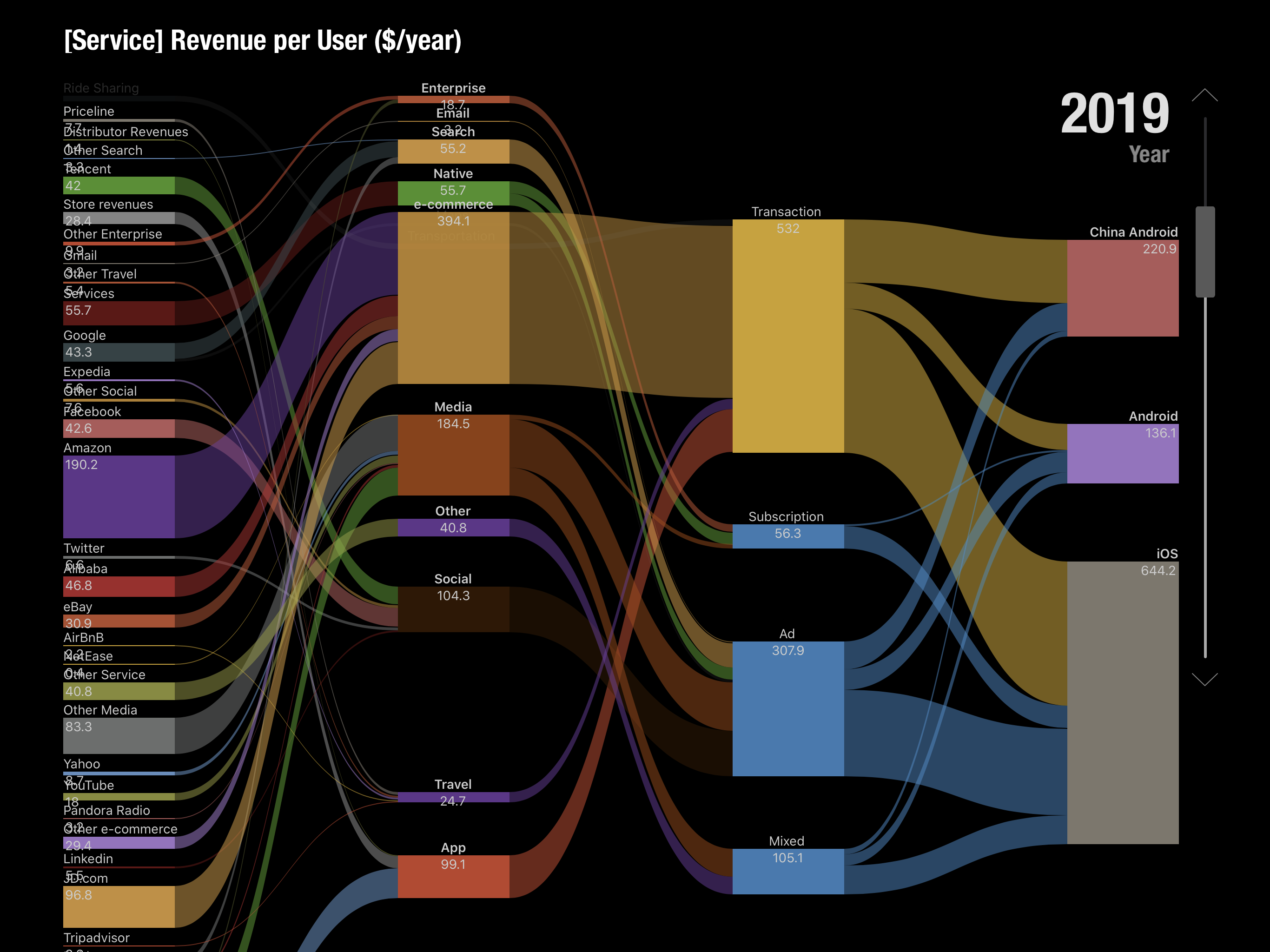
    For the keynote I prepared a model which predicted the mobile ecosystems for iOS, Android and Chinese Android over the next 5 years (to 2020). The methodology involved taking a measurement of the revenues of the top internet service companies, building up the categories these companies occupied, estimating how much of those revenues are through mobile distribution and then splitting the result among the three platforms of iOS and the two Androids.

    Adding to that the "native" app and content revenues for each platform would yield the Ecosystem total value. Applying a growth rate would offer some visibility into the future.

    The following images are screen captures of the Perspective presentation.
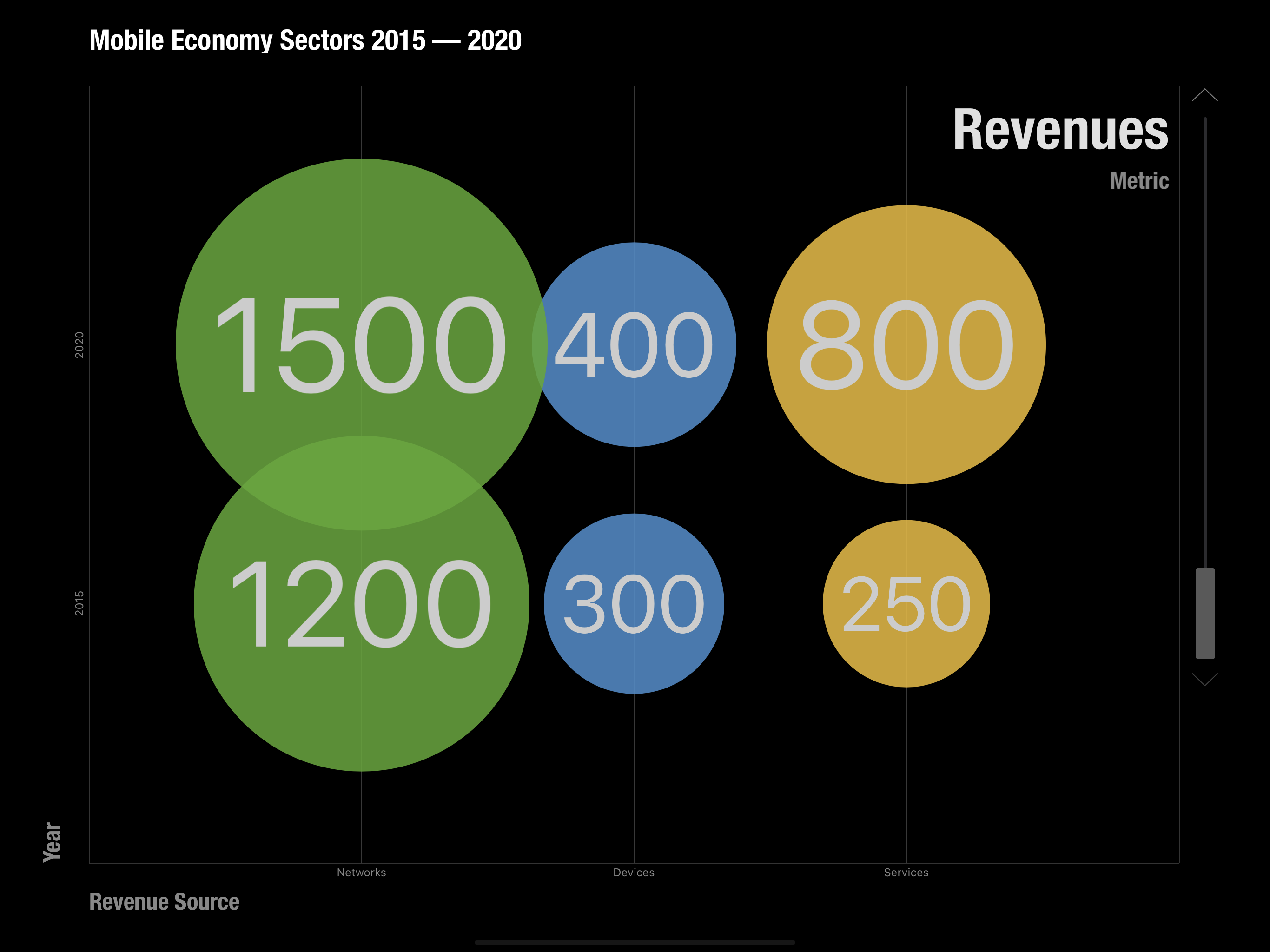
    Revenues across Networks, Devices and Services 2015 to 2020 (estimated March 2016)
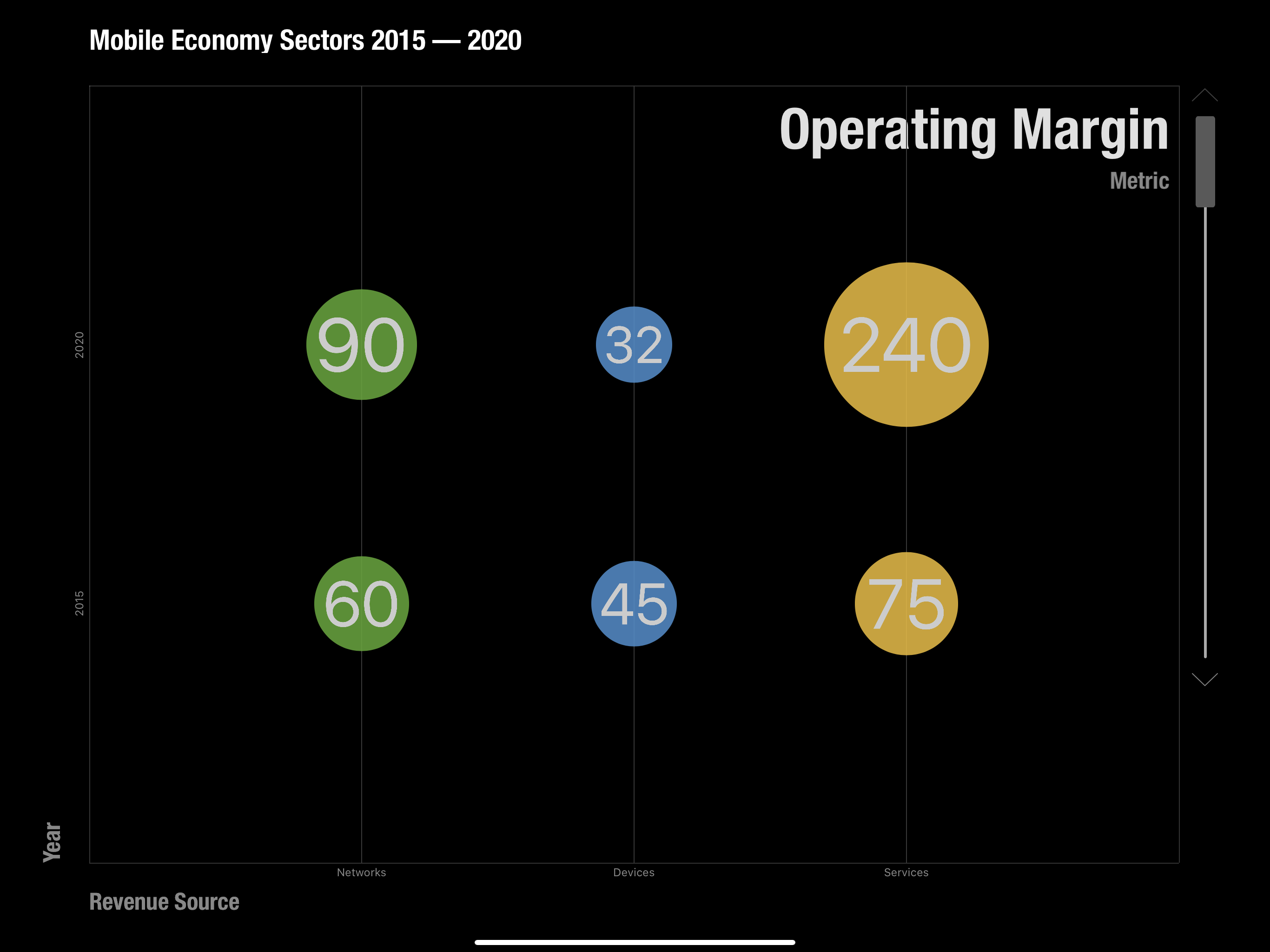
    Operating Income across Networks, Devices and Services 2015 to 2020 (estimated March 2016)
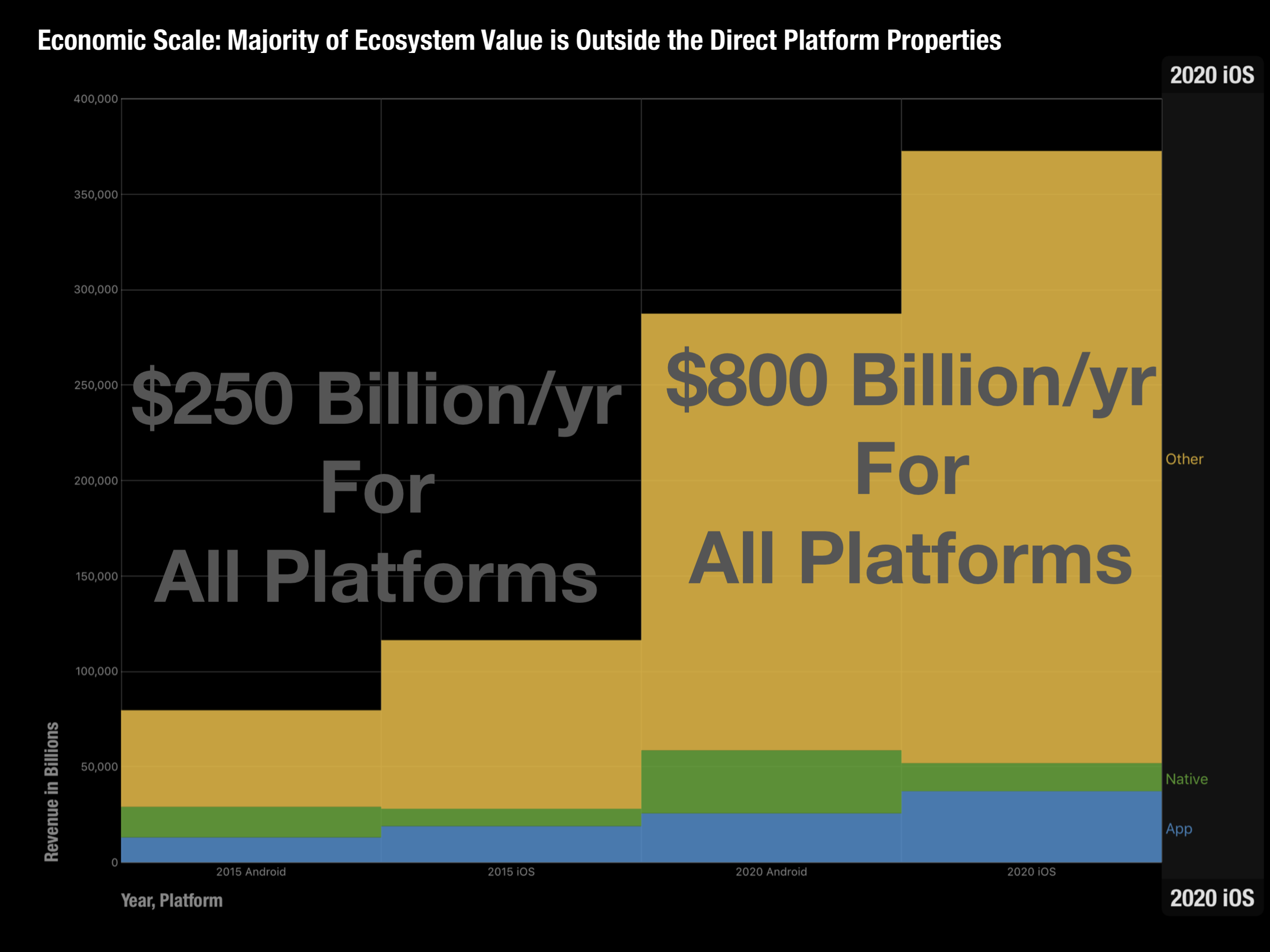
    Ecosystem composition (Third Party App, Native Apps, Other) 2015 to 2020, Android vs. iOS.
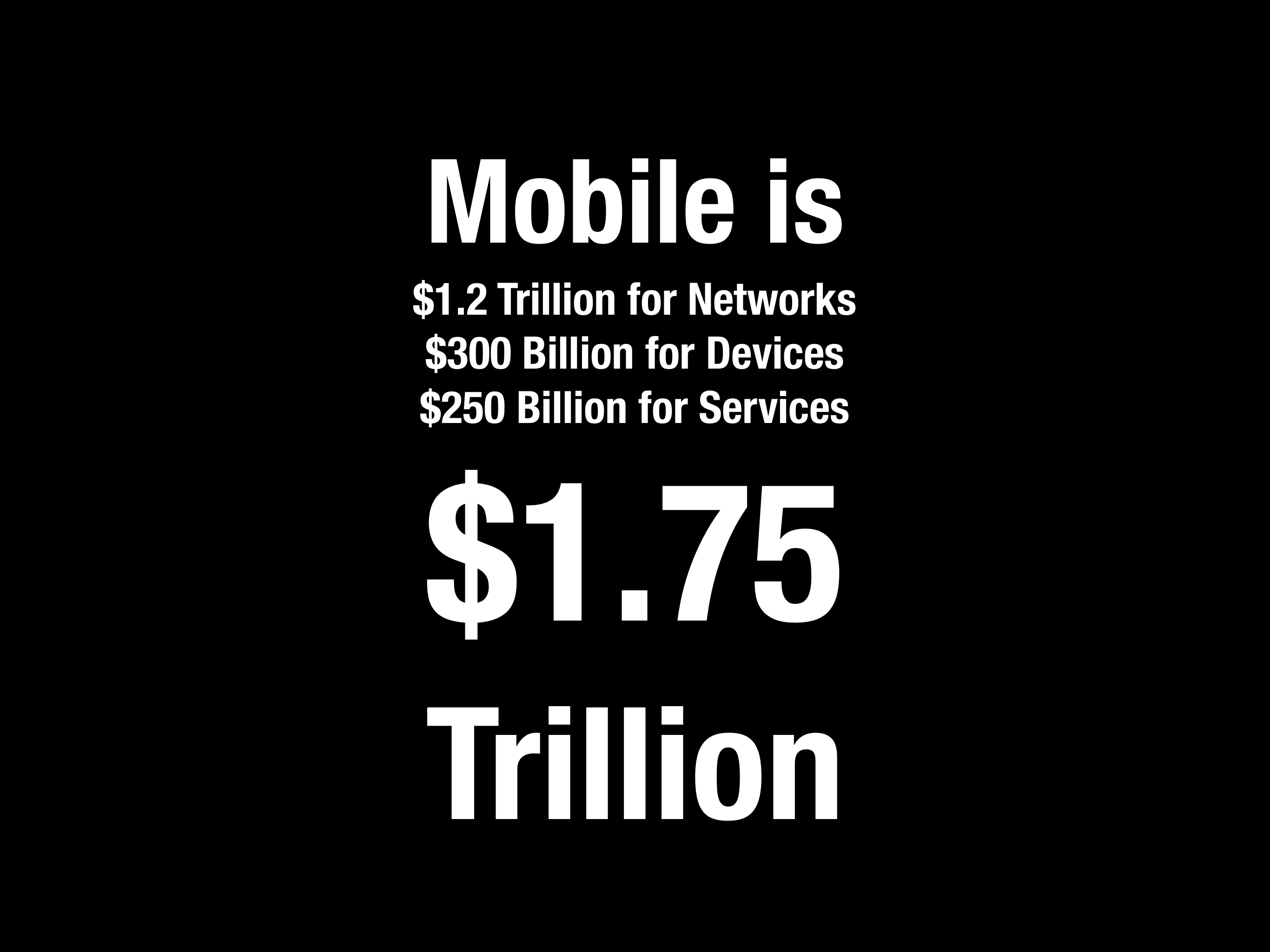
    Estimated mobile ecosystems total value by 2020 estimated in 2016.
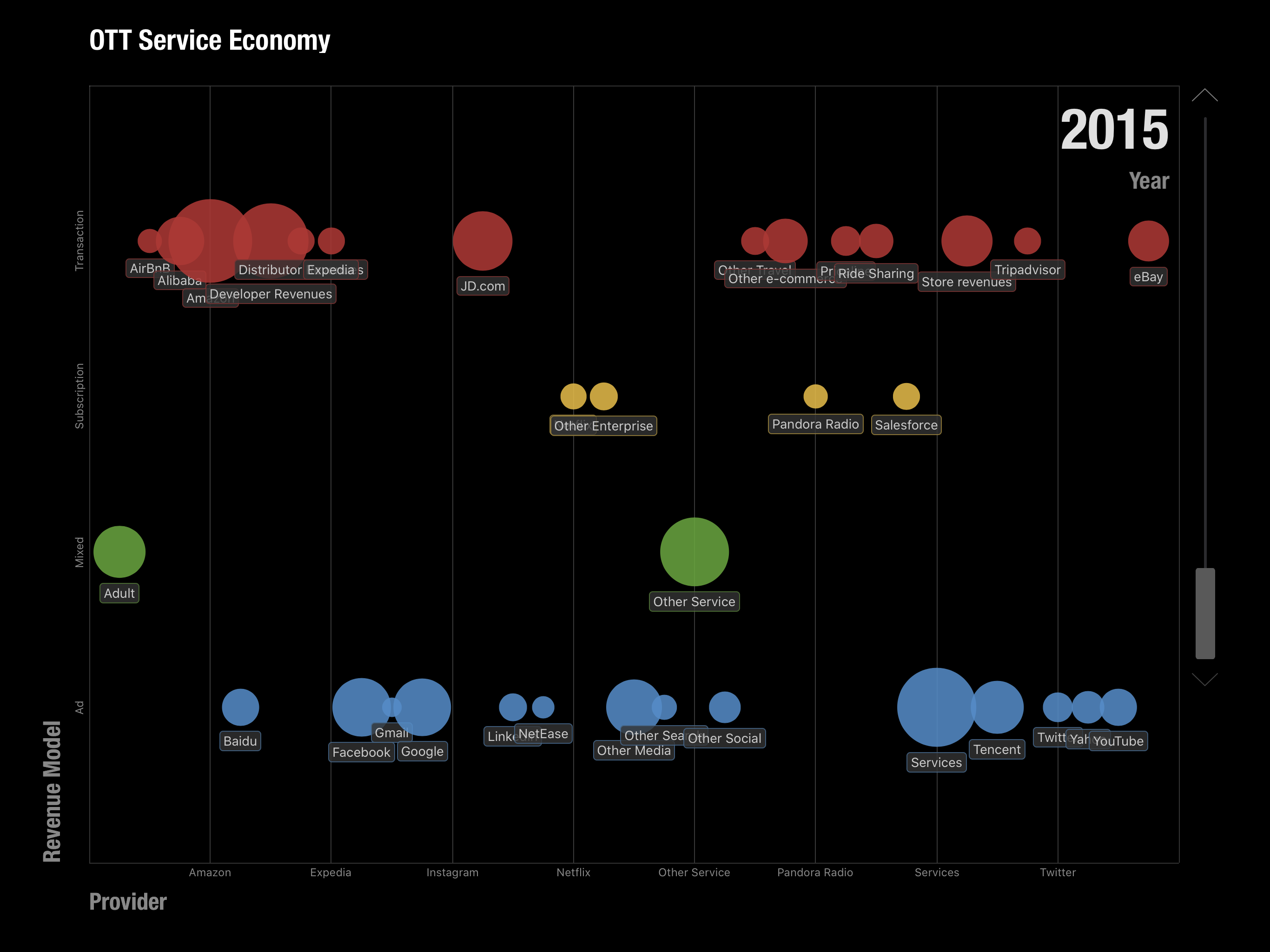
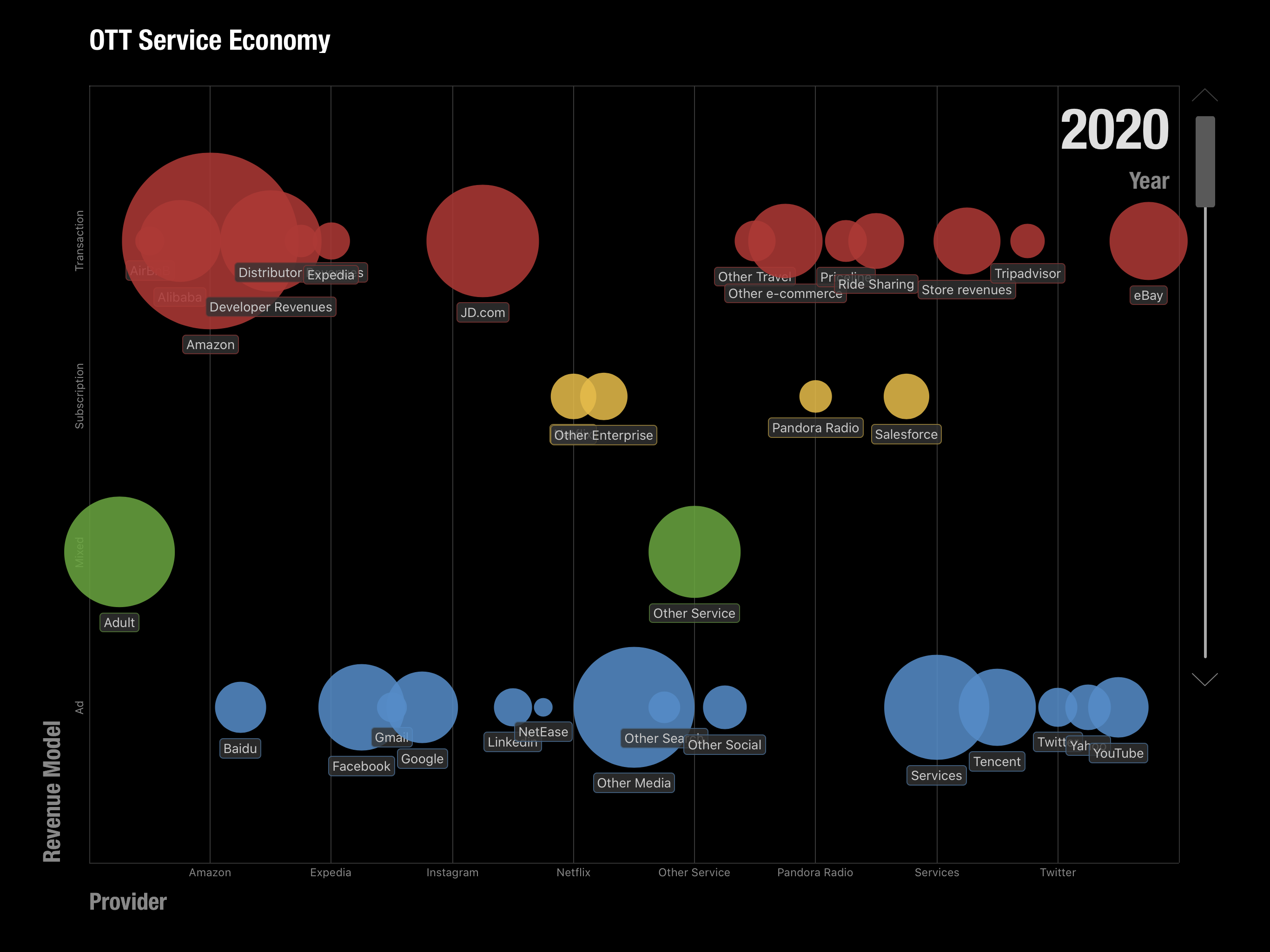
    Over the top (OTT) service components by revenue model in 2015 estimated in 2016.
    Over the top (OTT) service components by revenue model in 2020 estimated in 2016.
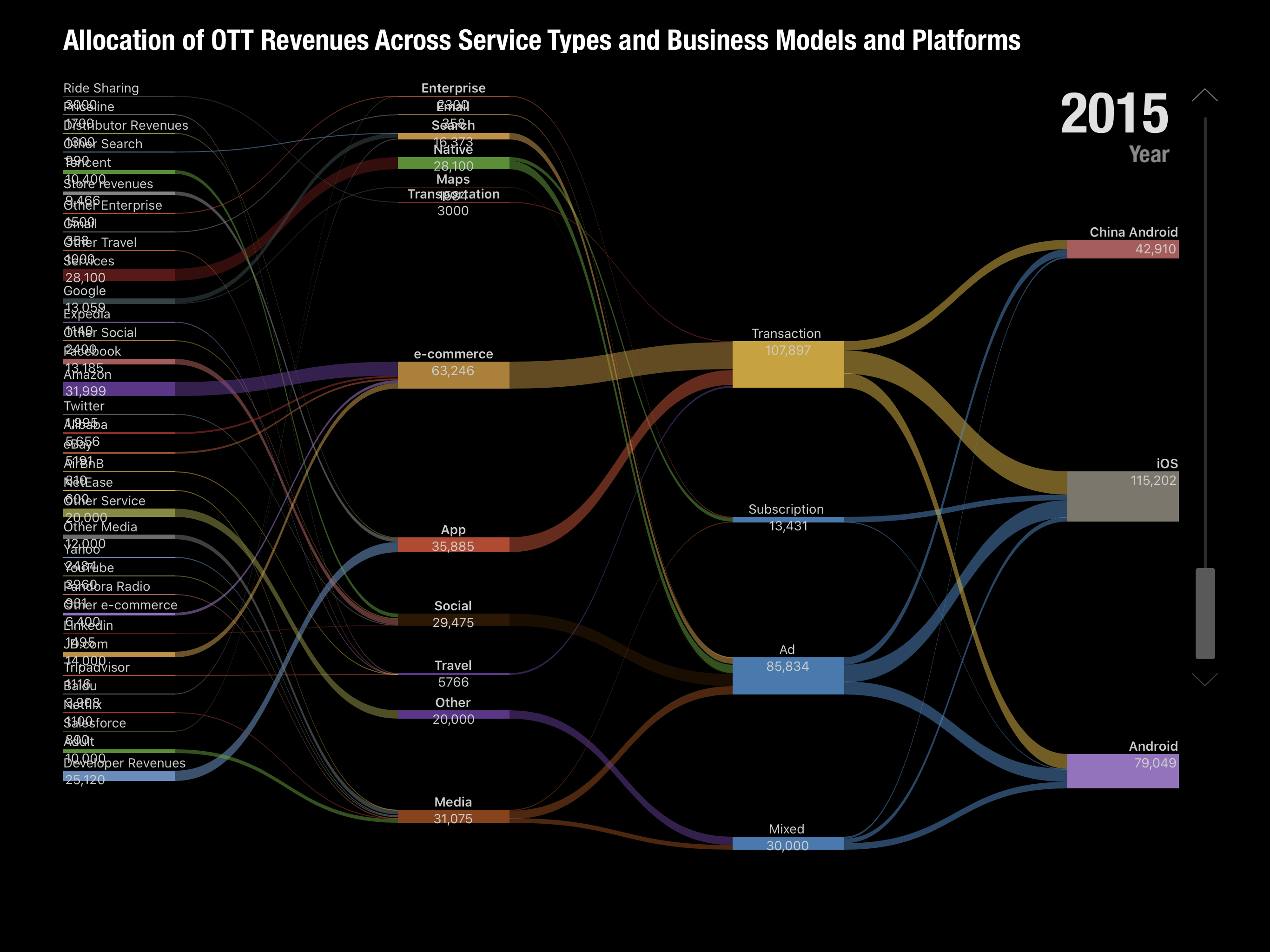
    Allocation of OTT Revenues Across Service Types and Business Models and Platforms 2015 (estimated in 2016)
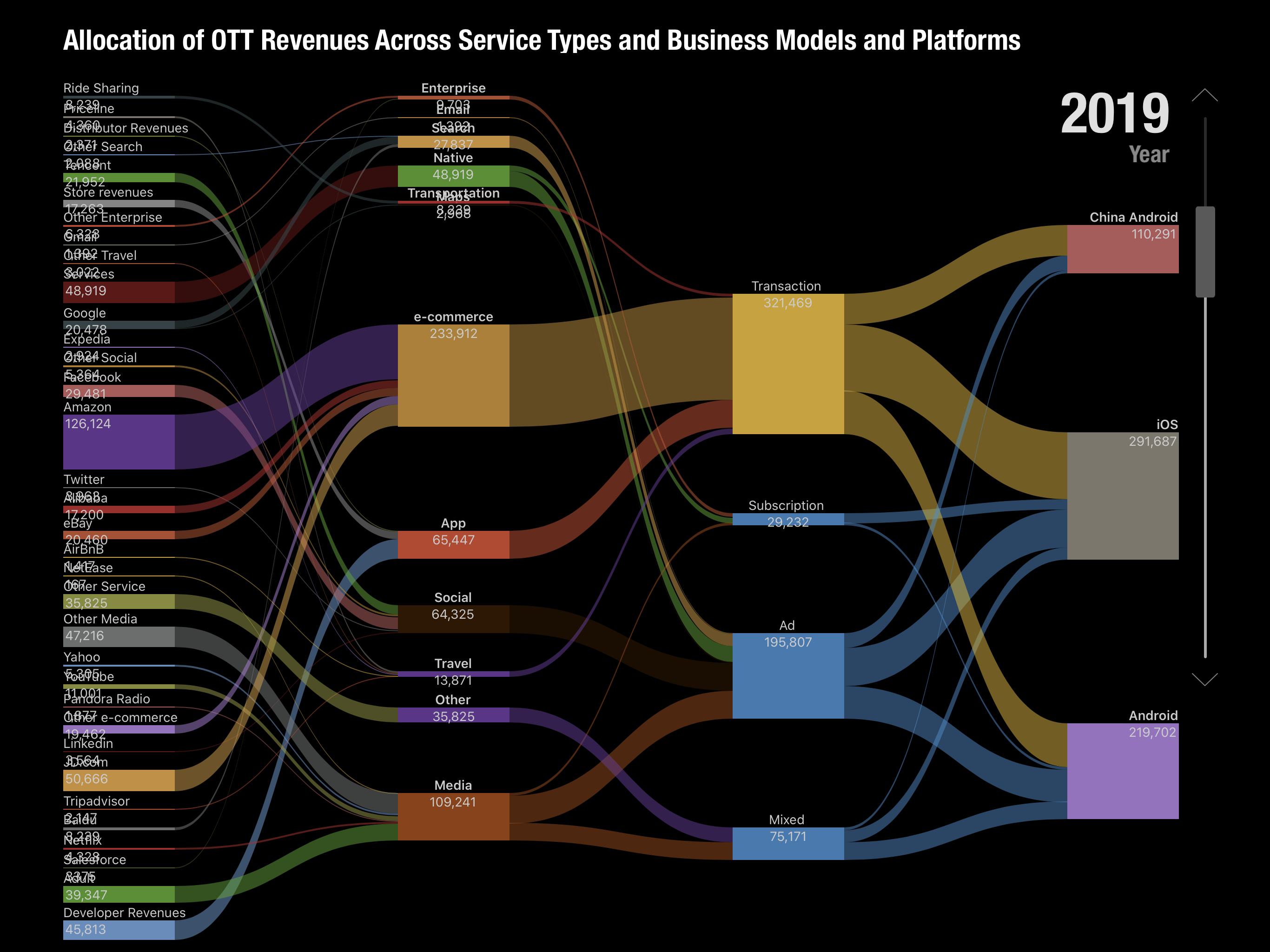
    Allocation of OTT Revenues Across Service Types and Business Models and Platforms 2019 (estimated in 2016)
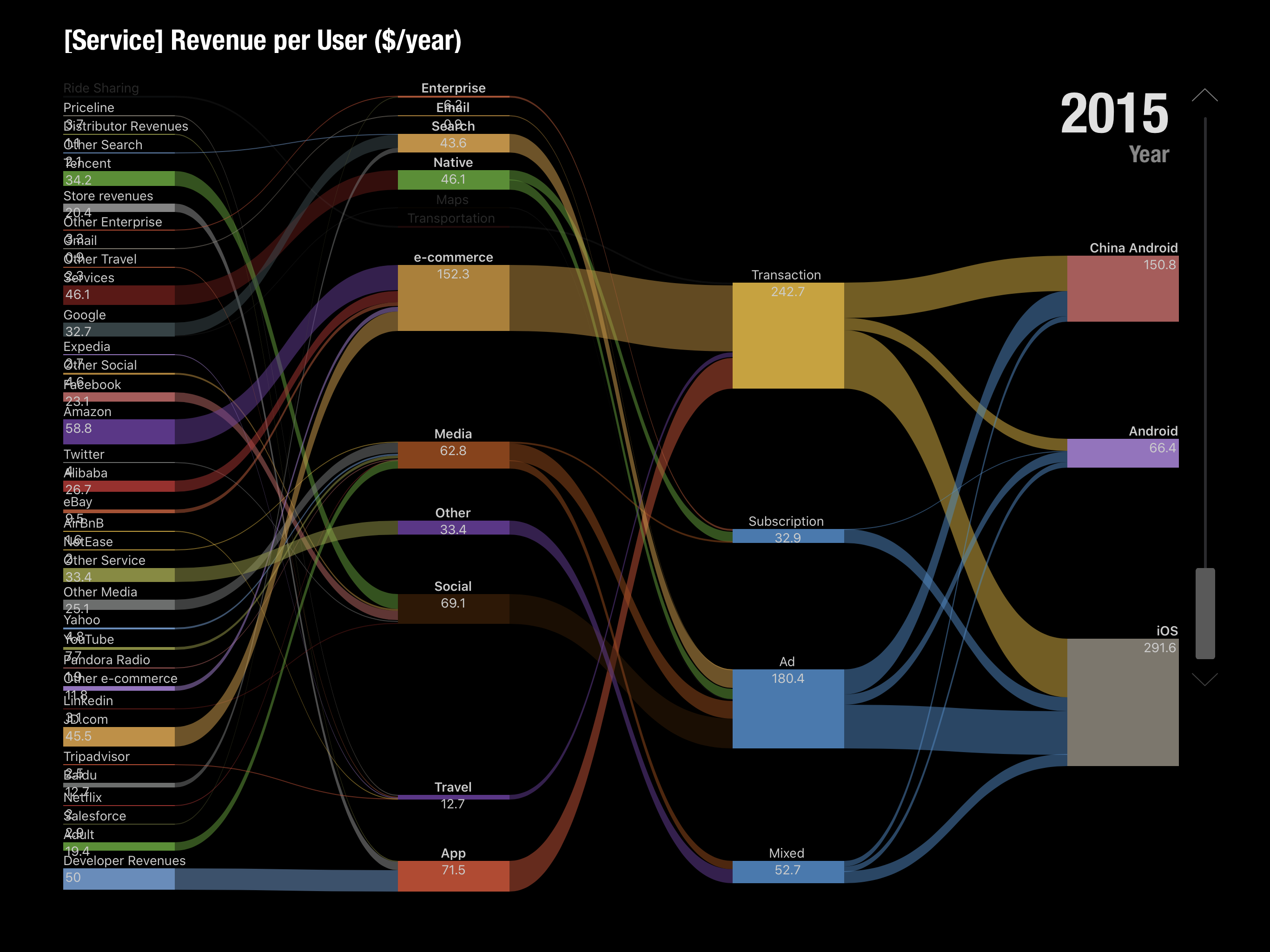
    Composition of service revenues per user ($/year) for mobile platforms in 2015 (estimated in 2016)
    Composition of service revenues per user ($/year) for mobile platforms in 2020 (estimated in 2016)

    Of course there are several potential errors in this methodology. The categories were not all inclusive. I used Social, Media, Search, Maps, email, Messaging, e-commerce, Travel, Enterprise, Storage, Transportation, Travel and Other as the top level categories. There are many products and services who would end up in Other. Moreover, these categories were anchored by the top companies in each category and the share of the top names was not always clear. Finally, the growth rates for these categories were based on historic trends which could change either way.

    The online services ecosystem (all platforms) was thus estimated to be $450 billion in 2015, growing to $820 billion by 2019 and $914 billion by 2020.

    The mobile split would vary by segment but would be roughly 75% by 2020 (25% would not be mobile). The final assumption was based on the split among the existing mobile platforms. I put a multiple of roughly 50% for iOS and 35% for Google Android and the rest for China Android.

    Multiplying all these assumptions gave me a figure of $275 billion for the iOS portion of the global online services market in 2019. (Incidentally, Android was estimated at $207 billion and China Android $110 billion.) Note that this does not mean this was an expectation of Apple's revenues or that this was the opportunity of Apple obtaining any percentage of this revenue. It was simply the value of what would transact through iOS, a platform which would act as a commerce enabler. This was to be the size of the iOS "ecosystem" or co-dependency between Apple and the companies delivering through its platform.

    Ecosystems are a powerful idea. As I recall, this term applied to mobile was coined by a Palm executive in the late 1990s when he referred to the value of all the apps built for the Palm Pilot. The biological term refers to the system of multiple species living in close proximity. It implies an equilibrium as each species benefits from the others and the environment. There might be predators and prey but biodiversity is the successful construct.

    The idea of an ecosystem for a platform was also the core strength of Microsoft's Windows which created the network effects around it and it has been the goal of every platform since. The nature of computing and networking implies that these systems grow faster and are more resilient than the more traditional value networks of other businesses or industries.

    Now this ecosystem was something we wished to highlight in 2016 as a core strength for Apple. It was not considered as such at the time and I thought putting a figure of $275 billion in 4 years' time was a way to highlight the potential. Time since has proven us right.

    This week Apple highlighted the result of another research team who attempted to measure the iOS ecosystem. Their conclusion was that billings and sales facilitated by the Apple App Store Ecosystem in 2019 was $519 billion. More than twice the amount I had so optimistically forecast four years earlier.

    The authors also emphasize that this is a conservative estimate and should serve as a baseline.

    I feel partly vindicated about that figure as my attempt at a figure was intended to highlight the scope of the ecosystem and it is better to have underestimated it than overestimated it. The authors' methodology was also similar in being bottom-up summation of components by categories of services but the information available today is enhanced by the new data Apple made available on subs and Services revenues and install base.

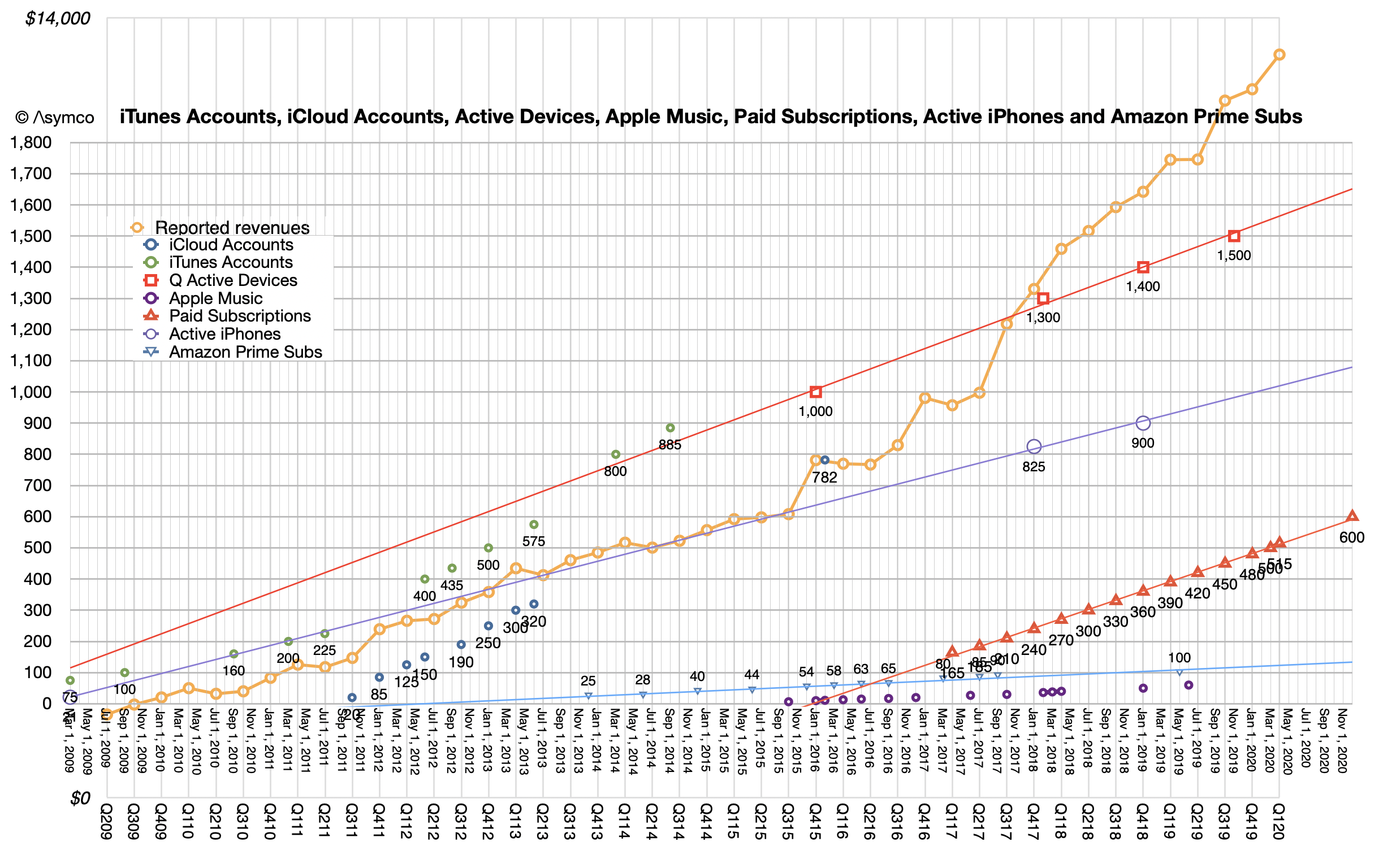
    Note that in the graph below the salient data points of subscribers (red triangles) had not begun until 2017 causing the acceleration in Services revenue (yellow line). Note also the additional square points representing install base.
    This figure of more than half a trillion dollars of value transacted through iOS should give some pause. It it a very powerful figure that can be combined with the other data from Apple:

    • More than 1.5 billion active devices
    • More than 1 billion iPhone users
    • More than 500 million paid subscriptions
    • More than $1/day iPhone hardware revenues for Apple

    The half-trillion per year on services implies between $335 and $520 in spending per user (likely closer to $500) per year. This would be in addition to the approximately $365/yr in hardware spending per user (which Apple books as hardware revenue). In the case of the iPhone there is yet more: the cellular network service which may average $350 per year.

    To simplify, the "average Apple user" spends $1/day for each device, $1/day for the network and $1.4/day on items bought through the device. Adding a margin of error, that's between $3.4 and $4 per day each user spends. Oh, and there are about a billion such users.

    The total spending enabled by iOS thus is close to $1.4 trillion/yr.

    That's a significant amount. It's bigger than many industries. There are only about 12 countries with higher GDP (Spain is about the same.)

    How does Apple benefit from this?

    Apple captures 30% of billings through its App Store. My estimate for these billings were $67.9 billion in 2019 which means App Store billings were 13% of the 2019 ecosystem. Apple's 30% cut of Billings amounts to 3.8% for the whole ecosystem. It's hardly an oppressive number.

    If Apple only captures 3.8% what use is this to Apple?

    The last decade has seen Apple emerge as the world's largest company in terms of market capitalization, and not doing so with a wild multiple of revenue or earnings, quite the opposite. It did this by creating the world's greatest customer base. Not in absolute scale. Android and Facebook have larger customer bases with multiple billions of users.

    No, Apple's one billion users are simply the best billion users. They are the most likely to stick with Apple and they are the most likely to buy more from Apple and—this is crucial—they are the most likely to buy everything else. Those other companies whose sales come from Apple customers have been taking note. They know that Apple customers are desirable customers and choose to target Apple customers, as much as they can. Associating your company with Apple makes a lot of economic sense.

    I will admit however that my argument that Apple created a customer base is contrived. The fact is that Apple creates products and services and those products are the root of its power to attract the right customers. By choosing to create the best products it coincidentally chooses to create the best customers. The power flows from product not from pricing or positioning. This is a lesson lost for many.

    Developers and regulators might feel Apple's massive power is perhaps too much. In the last decade, the narration around Apple has shifted from Apple being perpetually "doomed" to it being too dominant. Although I'm sure there are some who will try to conflate the two declaring that dominance will inevitably result in doom, most critics of Apple went from laughing (at it) to crying (about its practices).

    The argument that Apple should change its practices developed to price as it does, distribute as it does or design as it does because it was too successful or is "unfair" is getting the causality wrong. Dominance won't be altered by a few points of percentage change (on a tiny fraction of ecosystem transactions). Fairness won't be altered when there are thousands of business models and many remain to be invented. Case in point is pornography which is not permitted on the App Store but which exists in abundance thorough other access methods.

    The argument is that Apple should be more generous. That it should decrease the "cut" it takes for distribution. Or that it should not enforce revenue split for the customers it exposes to others.

    But this is problematic on many levels. The playing field for all developers needs to be level. The customer must be respected and access to that customer should be constrained or certainly metered. Abuses must be policed and that requires leverage.

    These practices are inter-dependent and the effect multiplicative, not additive. Apple has a monopoly on iOS and on MacOS and WatchOS and iPadOS. It does this to control the experience, security and safety of the user. It's that control which created the customer in the first place. It should naturally control access to its hard-earned customers.

    It does not monetize the distribution of content or apps unless the developer/creator directly charges for the product or service. Distribution is not cost free and to offer it for free is a subsidy which would create additional market and innovation disincentives. The loyalty of Apple users is evidenced by the 600 million paid subscriptions (end of year estimate) that are booked through the App Store. Developers benefit directly as a result.

    One could argue that the abundance of services which don't distribute through the App Store is evidence that the system works as intended. Apple's App store front is its property and it reflects its core values.

    Being on the shelf in the App Store means you operate on the terms of the shelf owner. If the rules are not agreeable then the half trillion dollars of ecosystem activity is testament to the availability of alternatives.

  2. Post-keynote Apple event San Francisco - September 8

    Conference · 5 comments


    I will be presenting my latest analysis of Apple at the Sustain event in San Francisco on Thursday Sept 8th, the day after Apple's keynote, along with Ben Bajarin, Carolina Milanesi who will alsob equipped with their latest market insights.

    sustain-title-white

    There is a time to disrupt and there is a time to sustain.

    Sustain event is about understanding Apple's levers of control to sustain the iPhone as it moves into direct competition with Android. We will also examine positions of top five technology brands: Apple, Amazon, Facebook, Google, and Microsoft.

    Learn more about the event at Airshow.io. Given he short notice, we are keeping this event on the small side so reserve your seat soon.

  3. SUBSCRIBE: The future of online services

    Conference Research · 4 comments

    Some say that advertising keeps the internet lights on. Advertising is a great business model for services but it has limits. There are only so many ad budgets to go around.  What will fuel an internet that outgrows all the ad money in the world?

    This is the topic that Ben Bajarin and I will explore in our next event: SUBSCRIBE: The Future of Online Services. 

    We will explore:

    • How will the online services business models evolve?
    • How will VR affect entertainment and communications?
    • How will AI affect shopping?
    • How will blockchain affect economics?
    • How will hardware affect software and services and vice versa?
    • How will  users, usage, and capital connect?

    Join us to learn more about the internet economy by studying the economics of the internet.

    SUBSCRIBE is a 1/2-day event taking place on both coasts. Register at:

    The first 20 registrants receive an early-bird discount.

    Learn more about SUBSCRIBE at SubscribeConf.com.

  4. Glance: A Deep Look at Apple Watch

    Conference · 2 comments

    Bernard Desarnauts had a great idea a few weeks ago: the world needs an event to discuss Apple Watch. After recovering from the shock of not thinking of it first and then from the shock that nobody else had either, I immediately agreed and along with Ben Bajarin and Farshad Nayeri, we quickly rallied to organize and anchor this event: Glance: A Deep Look at Apple Watch.

    We had some big questions to answer:

    • What is the strategy for Apple Watch? Is it an object of beauty and desire, placing Apple in the "luxury sector" or is it a computer infiltrating what is otherwise a technology-free zone with utility in an asymmetric attack?
    • How can developers discover the killer jobs to be done? Beyond tentpoles what will the primary reasons people will use the watch? What does the data tell us so far? What can be observed from interviews?
    • Given the sales performance to date, what can we expect from the product? What is the addressable market? What will be the installed base? How quickly will it grow?
    • What is the platform strategy, especially with the cadence of OS releases? Is Apple treating this as a separate platform? Will it eventually become independent of the iPhone as the iPhone cast off its dependence on the Mac/PC?
    • What is the hardware strategy? What are the constraints from manufacturing, materials, battery life and screen space? What will be the replacement schedule? What is the role of modular internal designs?

    We realized that we did not have the answers. So we recruited a great cast of participants to help us:

    • Bob Moesta, the founder and developer of the theory of jobs-to-be-done marketing agreed to do a live interview to understand what jobs watches, and in particular Apple Watches, are hired to do.
    • Josh Clark, the premier UX designer who wrote Designing for Touch will explore the question of user experience in glanceable space.
    • Liza Kindred is considered the top expert on fashion tech–she’s writing the book on the future of commerce–brings keen understanding of wearables.
    • Abdel Ibrahim the most prominent blogger and writer on the topic of Apple Watch. Has forgotten more about the Apple Watch than you will ever learn.
    • Carolina Milanesi one of the most respected technology market analysts, now at Kantar and often quoted on all things Apple.
    • Greg Koenig, product designer at Atomic Delights will educate us on the atoms that make up the Watch.

    Investors who will participate in panel conversations:

    Special guest: Jean-Louis Gassée, former head of Apple Engineering, current VC and everything in-between will have a fireside chat with Tim Bajarin Legendary technology analyst who has been around long enough to see furthest ahead.

    We will explore Apple Watch as a very curious interaction between form and function, luxury and utility, exclusivity and ubiquity, tiny screens and big audiences, short attention spans, big data.

    We have developers, designers, investors, marketers and analysts contributing to what could be the biggest leap in computing since the smartphone.

    If you are interesting in becoming one of the innovators on this newest of platforms or planning a strategy to invest, or even (actually especially) if you are a skeptic, you can't miss this conference.

    Join us for Glance, a deep look at Apple Watch, downtown San Francisco, December 10, 2015.

    Early bird pricing is $495.

    If you miss early bird, and you're an Asymco reader, there is still a 30% discount.

  5. Tech.pinions Podcast: Discussing Disruption Theory

    Podcast · 4 comments

    Ben Bajarin:

    A few weeks back Horace Dediu of Asymco and I were having dinner and we got to discussing some of this updated thoughts on disruption theory. One bit in particular was how the luxury tech market was causing him to evolve some thinking on the theory as it relates to consumer markets. I thought it would be great to have him on and we could chat more about disruption and the role it plays in the technology industry in the 21st century.

    via Podcast: Discussing Disruption Theory | Tech.pinions - Perspective, Insight, Analysis.

  6. Airshow 2014 World Tour: Coming to a City Near You

    Conference · 3 comments

    Screen Shot 2013-12-19 at 12-19-3.48.45 PM

    In a world where everyone needs to present, few know the power that lies under their fingertips.

    Whether one-on-one or in front of millions on TV, presentations are the primary means of persuasion in business.

    Have you ever cringed at text-only slides or puzzled over graphs that made no sense? Steve Jobs saw "PowerPoints" as "rambling and nonsensical" and had them banned internally. But he used visuals for all his keynotes. What made them tolerable, even persuasive?

    The problem is that most people receive no training in how to compose the most crucial images they project to an audience and the tools available do not take advantage of motion, touch, processing power, mobility and high resolutions.

    • Airshow teaches principles of visual persuasion using techniques of cinematography and visual storytelling.
    • Airshow shows how tablets create a new stage for your performance.
    • Airshow applies Aristotelian rhetoric, Cinematographic theory and Cinematic storytelling as well as Tufte design principles into a new medium.

    You’ll learn how to:

    • Persuade with logic, empathy and credibility.
    • Present rich data as compelling and emotionally engaging
    • Get hands-on experience with modern tools of persuasion including tablets and interactive, touch-based interfaces.

    You have the data. You have the audience. All you need is a story and a screenplay. How do you build them?

    There are techniques which are proven to work. They’ve been used by writers, performers and playwrights for centuries. Professional presentation coaches will teach you far less and at greater expense.

    • Airshow is better and less expensive, especially in terms of time.
    • Airshow is an intimate experience. Audience size is limited.
    • All the tools and techniques needed in one day of intense, inspirational and engaging training.

    Airshow could be coming to a town near you but to make it happen you need to act now.

    Here's how it works: For every month in 2014 an Airshow event will be hosted. The location for that month will be locked-in when the first 20 registrations for that city will be recorded. Any registrations that take place before the location is locked-in will be half-price.

    In other words, early registration means you get half off! ((If your registration is not part of a quorum (fewer than 20 total) then it's automatically re-issued for the following month. You may also request a refund.))

    Now is the time to learn presentation skills for the post-PC era. Just like there is no writing which does a movie justice, I can't write here how it's done, you have to see it live.

    Register now.

    HERE'S WHAT PEOPLE SAY ABOUT AIRSHOW

    “Airshow was amazing. Business stories with cinematic impact made easy with perspective”
    — Paul Brody, Global Business Leader, IBM

    “Airshow has fundamentally changed how I give client and industry presentations. It is an important tool in my toolbox which allows me to showcase my data and my story in ways that help audiences gain deeper insight and perspective.”
    — Ben Bajarin, TIME, TabTimes, Techpinions

    “Nobody brings numbers to life like Horace Dediu does.”
    —Philip Elmer-DeWitt, Fortune/CNN

    “The unhurried nature of Airshow is just terrific and in contrast to many other events. Anyone who goes will gain their own purposes.”
    —Steve Crandall

    “Airshow is a treat [...] showing how to make the audience wonder.”
    —Bertram Gugel

    “Airshow is surpassing my expectations. Very interesting deep content.”
    —Ryan Singer, 37signals.

  7. Cubed Episode 010: The Process of Innovation

    Podcast · 1 comment

    I joined Benedict Evans and Ben Bajarin on their Cubed podcast to discuss innovation and cultures that breed innovation. We also discuss some updates on our thinking of the curious case of the android tablet ghosts toward the end.

    Show Notes

    The Meaning of Really Cheap Android

    The Innovators Curse

    Dark Matter

    Android as the Platform For Commodity Electronics

    Harvard Business Review – How Pixar Fosters Collective Creativity  (subscription required)

    via Cubed Episode 010: The Process of Innovation | Cubed Podcast.

  8. Asymconf Program

    Research · 4 comments

    9:00 to 10:15 Being Back. How California came to disrupt

    The disruptive history of California is remarkable. Whereas few nations can claim credit to one, California is home to at least four major disruptions: Semiconductors, recorded entertainment, venture capital and personal computing. And it did all this in less than one century. If any one place can vie for the title of "serial disruptor" it's California. One success can be seen as luck, but many successes imply a system is at work. In this case session we discuss California's disruptive history and put forward hypotheses on the what causal mechanisms are at work. We ask further whether California can still be the home of future disruptions or whether the system has broken down.

    • The effect of "frontier mentality" on unforeseen growth
    • The effect of migration and diaspora on innovation and counter-effect of the absence of either.
    • Applying these causal themes to the management of innovation in institutions

    10:15 to 10:30 Break

    10:30 to 12:00 Designed in California, Assembled in China

    Geographically and culturally, California is closer to Asia than any other western market. It has always faced west more than it has faced east. Is there a symbiosis between California and Asia? Are its institutions adapting to a new center of economic mass? Is California leading in thinking or culture or is it being disrupted by a new frontier as growth moves east?

    • The growth in Asia and China in particular is in many ways a reflection of rapid industrialization. But it can also be seen as a low-end disruption.
    • What can be learned about business model innovation in the contrast between Californian and Asian approaches to business?
    • Does culture play a part in an innovation mentality?

    12:00 to 1:00 Lunch

    1:00 to 2:15 Guest presentations and Panel session

    Guests are invited to debate or discuss points raised during the morning sessions. A chance for panelists to challenge or refute points made as well as for the provision of anecdotal evidence.

    Potential panelists:

    • Ben Bajarin
    • Michael Lopp (aka @Rands)
    • Jean-Louis Gassée
    • Om Malik
    • Charlie Kindel
    • Dan Benjamin
    • Philip Elmer-DeWitt
    • Tim Bradshaw

    2:15 to 2:30 Break

    2:30 to 4:00 North vs. South

    Does the tension between industries of Northern California and Southern California reflect an opportunity or a crisis? We will re-visit the narrative of what Entertainment is hired to do. We will review the differences and similarities of the technological creative process vs. the artistic creative process. We will see whether industrialized, commercialized art is subject to disruptive forces or whether there is persistent exceptionalism at work.

    • Is the intersection of "liberal arts" and "engineering" more than a metaphor?
    • What can be learned by cross-pollination of the creative processes of engineers and artists.
    • What's the future of technology-based entertainment? Are North and South closer and have more in common than the war talk lets on?

    4:00 to 6:00 Reception

    Please register here.