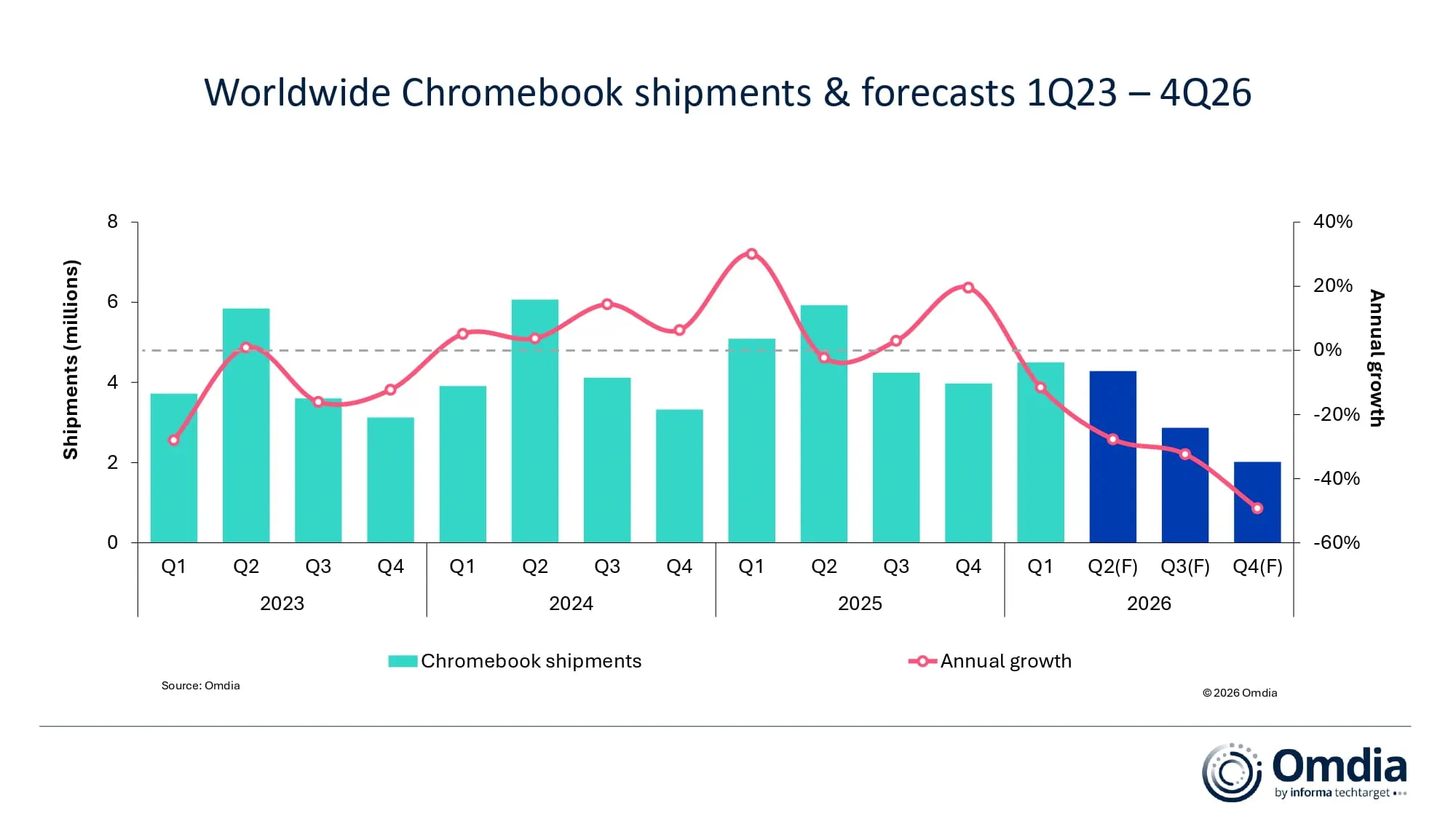
“Within the PC segment, Chromebooks are currently the most impacted category, with volumes declining significantly,” said Kieren Jessop, Principal Analyst at Omdia. “Production indicators point to a weak near-term outlook, and education-related deployments are increasingly being deferred until market conditions stabilize. Ongoing supply constraints are also expected to delay the second phase of Japan’s GIGA School Program 2.0. While the first phase - extended from end-2024 through end-2025 - was completed without major disruption, the current supply environment is likely to introduce delays in the next phase.”
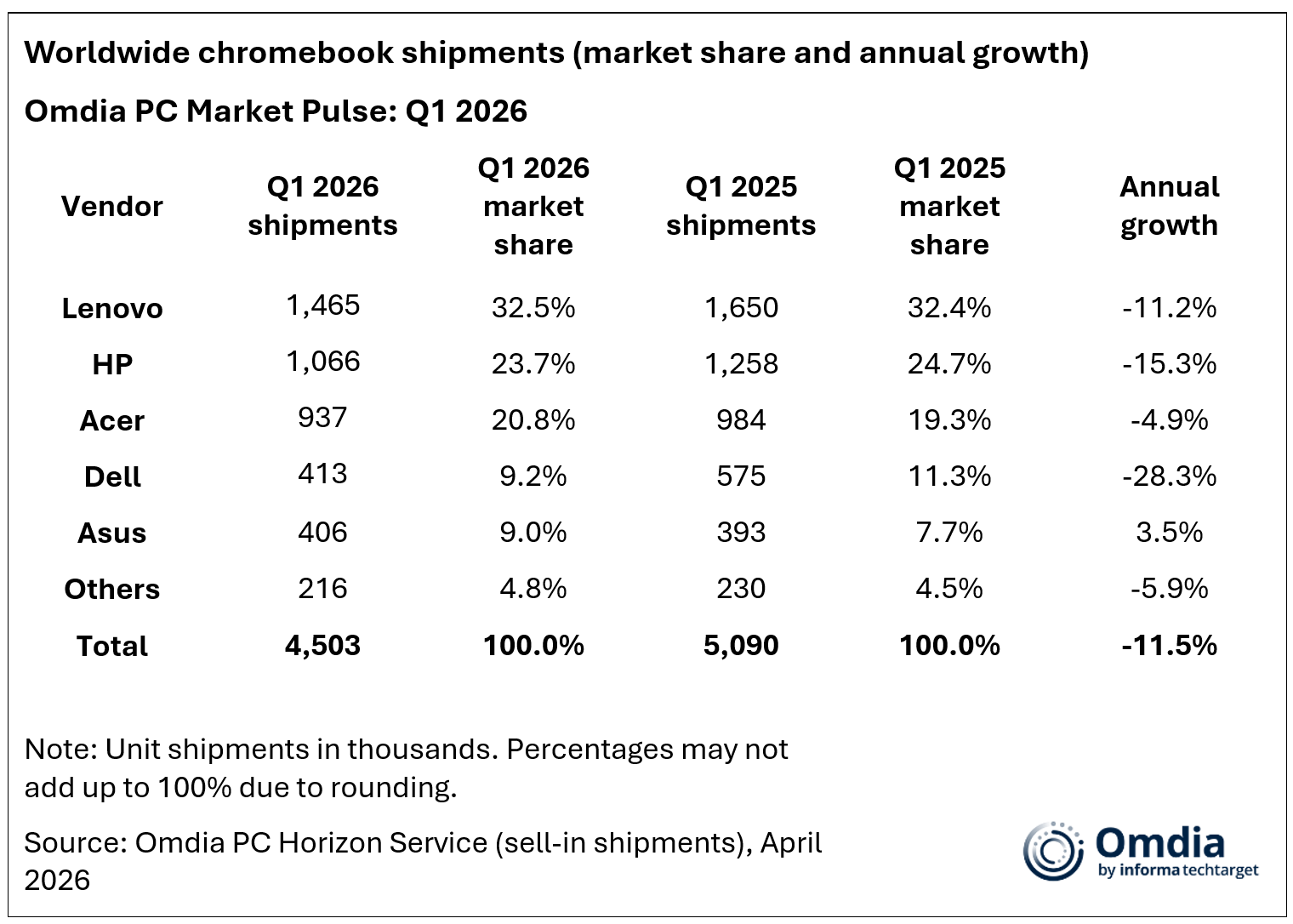
All major Chromebook vendors faced challenges in Q1. Lenovo, which ranked first and was a key participant in Japan’s GIGA School Program alongside its subsidiary NEC, saw shipments decline 11.2% year on year to 1.5 million units as the first phase of deployments concluded. HP ranked second, shipping 1.0 million units, down 15.3% year on year. Acer placed third with 937K units, managing a relatively smaller decline supported by stable shipments in North America and increased shipments into APAC. Dell experienced the steepest decline among the top five vendors, with shipments falling 28.3% year-on-year to 413K units. ASUS, another key participant in Japan’s GIGA School Program 2.0, was the only vendor to record growth in Q1, with shipments rising 3.5% year on year to 406K units, accounting for a 9% market share.
In Apple’s first 50 years it shipped 5.13 billion computers. This shipment total is higher than any other computer company in its first 50 years. There actually are no other PC makers that are 50 years old. But all these things were true also 40 years ago. So what are we celebrating now that we did not celebrate at Apple 40? The answer is Services, the consistency in growth in user base and the potential trajectory of growth to never-before imagine audiences. The biggest change is a change of horizons. →
Says Neal Stephenson who first coined the term “metaverse” This revelation came soon after Meta canceled the Metaverse. Let’s look into Neal Stephenson’s mea culpa:
When I was working at Magic Leap, and people asked me why I thought that [Metaverse] was a good idea, I would ask the rhetorical question: “do you really think that twenty years from now everyone is still going to be going around all day staring at little rectangles in their hands?” →
How everyone is wrong about AI. The newspaper was an unexpected development It was not a product that anyone asked for. Like many innovations, it wasn’t an invention. It was not patented or discovered in a laboratory. It emerged as a result of the convergence of three disparate technologies: continuous roll printing presses, the telegraph, and the railroad. This convergence occurred by the 1830s, facilitated by a business model aptly named “the penny press”. Stepping back, the printing press was initially developed in the 1450s, 40 years before Columbus’ voyage. It went through numerous evolutions. The big change was moving →
Running a data-center AI model on a MacBook → Apple's MacBook Pro, with its unique Apple silicon architecture, could revolutionize personal AI by enabling powerful AI models to run locally without relying on cloud data centers, potentially shifting the competitive landscape in Apple's favor despite current perceptions of lagging behind in AI advancements. →
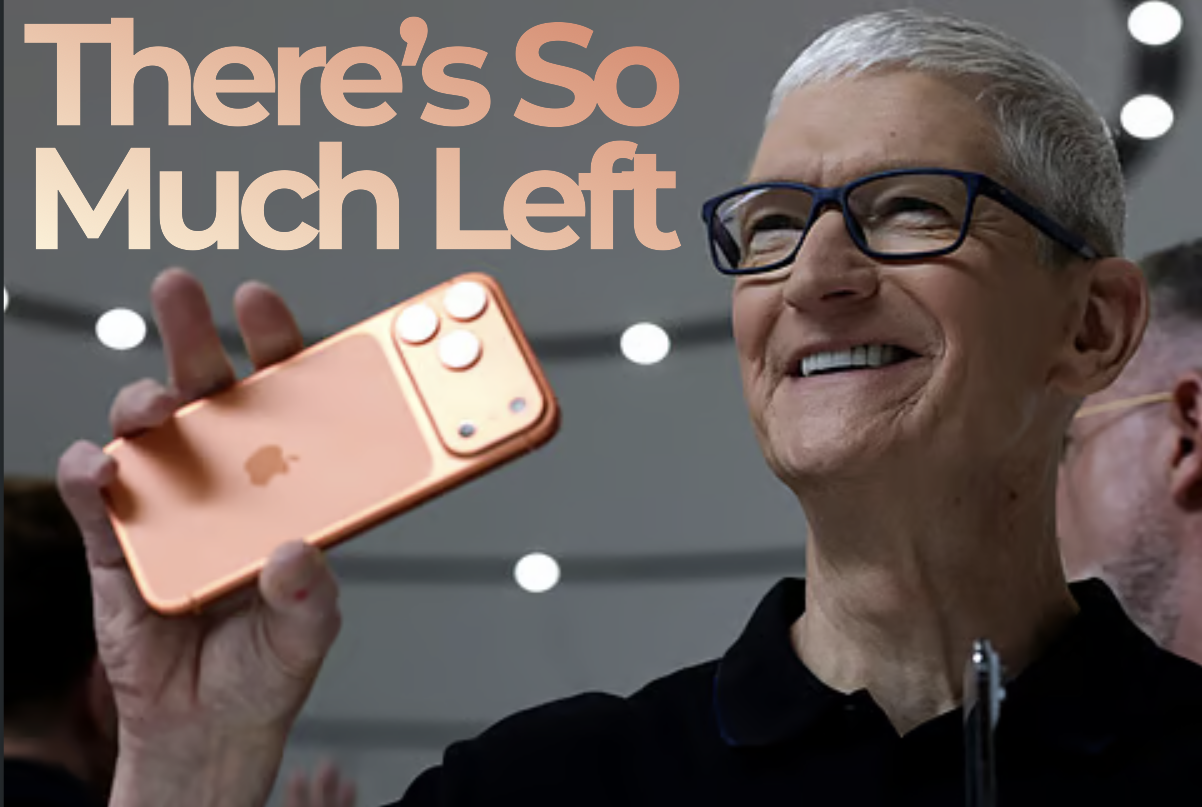
“There’s So Much Left” in iPhone: Tim Cook → Apple's relentless focus on user-centric innovation, epitomized by the ever-ascendant iPhone, underscores its enduring dominance and untapped market potential. →
Amazon developing a new phone more than a decade after its first → Amazon's renewed attempt at a smartphone, "Transformer," aims to integrate AI and deepen Prime ecosystem ties, learning from past Fire failures by addressing trust, scale, and developer engagement challenges. →
Mac fastest growing PC brand in India in Q4 2025 → In 2025, India's PC market soared to a record 15.9 million units, with Mac sales impressively up 24% year over year, hinting at a bright future despite looming 2026 challenges. →
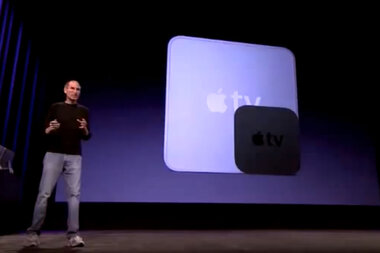
Apple TV is a categorization failure → Apple TV, launched in 2007, struggled for 19 years as a misunderstood, underappreciated gateway to content, overshadowed by Apple's product-centric reputation. →
Apple’s Custom Silicon Opens up Potential for a Cellular MacBook → "Apple's C1X modem not only matches Qualcomm's performance but also reshapes the economic landscape for always-connected MacBooks, hinting at a future where seamless cellular integration redefines portable computing." →
Survey shows record upgrade interest for iPhones → Morgan Stanley forecasts Apple as the sole major smartphone vendor to gain market share in 2026, driven by strong upgrade intent and advanced features, while Android struggles with rising costs and declining loyalty. →
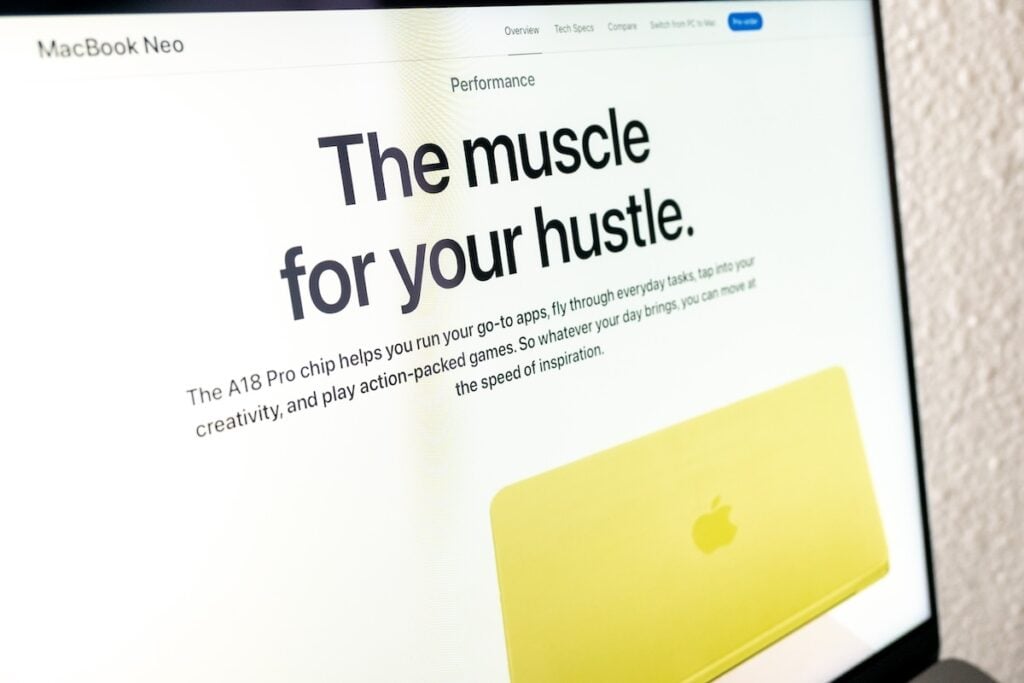
MacBook Neo Market Impact: Analysts weigh in → Market analysts predict the MacBook Neo will disrupt the low-end PC market, especially in education, by leveraging Apple's higher margins and user-centric design, despite challenges from price-sensitive K-12 sectors dominated by Chromebooks. →
World’s most respected Apple Analyst. —Macfilos
Like what you read? Get more from Asymco One: full access to Asymco's research, analysis, and commentary.
Francisco Jeronimo, Vice President of Client Devices at IDC, told Benzinga, "The MacBook Neo will have a significant impact on the low-end PC segment, particularly in education, which accounts for 6.7% of global PC shipments, or 13.4 million units in 2025."
He said that the market is currently dominated by Windows notebooks, with an average selling price of $682 and Chromebooks, which average at $362.
"Apple's ASP in Education was $1,425 in 2025 and accounted for only 5% of the segment," he said.
He echoed the statements by the above analysts while adding that MacBook Neo will allow Apple to acquire users early in their digital lives.
"Omdia’s February 2026 forecast shows Windows OEMs facing component cost increases of $90 to $165 per unit, pushing average notebook selling prices from approximately $850 toward $915," the research firm stated.
It went on to say that to maintain margins after these cost increases, many Windows laptops would need to be priced above $1,000 to "stay profitable."
On the other hand, Apple benefits from higher margins, making it easier for the iPhone-maker to sell the product at low-cost while still maintaining profitability.
In the education segment, the $499 price for students removes the cost barrier. However, the firm noted that the price isn't the only hurdle.
"Displacing Chrome in K-12 would require Apple to match Google’s admin tooling and institutional relationships, not just its price point," Canalys stated.
David Naranjo, associate director at Counterpoint, told Benzinga that Apple's real opportunity lies in higher education.
It is because the launch comes when Google continues to dominate the K-12 sector through Chromebooks, Google Workspace and school-managed devices.
"The MacBook Neo is unlikely to displace Chromebooks at scale in the K-12 market in the near term. Schools remain highly price-sensitive and deeply integrated into the Google ecosystem," Naranjo stated.
“Apple is moving into attack mode. They see the memory crisis as an opportunity to gain share,” said Francisco Jeronimo, Vice President at IDC. “All other smartphones in this price range will have to increase prices,” he added, noting that the shift could accelerate migration from Android to iOS, and from Chromebooks or traditional PCs to Mac devices.
The impact is expected to be most severe in the low-end Android segment, where profit margins are already thin. PC and Chromebook markets face similar challenges, with shipments forecast to decline by 11%.
In a video segment titled Pressure Points, Munster said the device could modestly increase Apple's overall revenue while expanding its reach in the education market.
"The new $AAPL MacBook Neo should add 0.5% to overall revenue for the next year. I believe it won't impact margins."
Munster estimated the device could add roughly $2 billion in annual revenue to Apple's Mac segment.
Apple's Mac business generated about $34 billion in fiscal 2025, meaning the Neo could provide roughly a 6% boost to that segment if adoption plays out as expected.
The analyst said Apple is targeting a large pool of potential buyers in the U.S. education market, where many students currently rely on Chromebooks.
"This market, if we just take the U.S. alone, is about 25 million students," Munster said in the video, adding that investors may think of this as "new customers for Apple."
"My take is that they're probably doing this at a similar margin profile as their existing products," he said.
Munster added that Apple's gross margins could remain near 48% across the coming quarters, suggesting the lower-cost Mac should not pressure profitability even as it expands Apple's customer base.
Google announced its first computing product: the Pixel. It's not the first Chromebook but it is the first device which is uniquely branded as a Google product (Motorola notwithstanding.)
It's a curious choice given that companies which have "crossed-over" from being service or software oriented to hardware have started with more "mobile" devices. Amazon launched the Kindle as a low-end product and gradually moved it up-market. Microsoft launched with the Surface tablet and then followed with the Pro version as a hybrid laptop/tablet.
It's also curious since Google has spent years contributing to the development of mobile phones and tablets under the Nexus sub-brand. This was an approach consistent with earlier Chromebooks as well.
But the Pixel is a high-end product. It's priced at the top of the range of what a laptop computer might cost (given the dimensions). Perhaps it's part of a pattern where Google will hone its hardware skills toward releasing a phone or tablet it can call its own. Starting with a more traditional computer is "easier" than trying to deliver on the more demanding smaller form factors.
And yet, the more obvious question is why would Google want to be in the hardware business? Isn't being a web-focused company implicitly suggesting that hardware is a commodity to be farmed off to perpetually impoverished and violently abused OEMs?
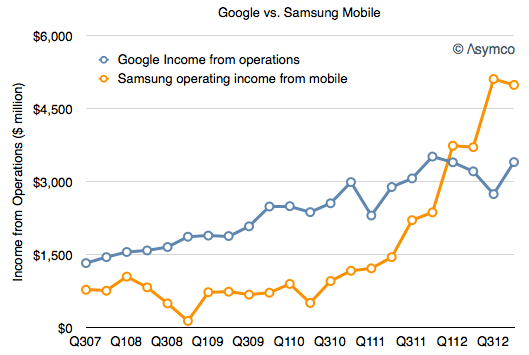
The truth is quite different from this. Samsung currently makes far more operating profit from Android phones than Google does from all its operations.
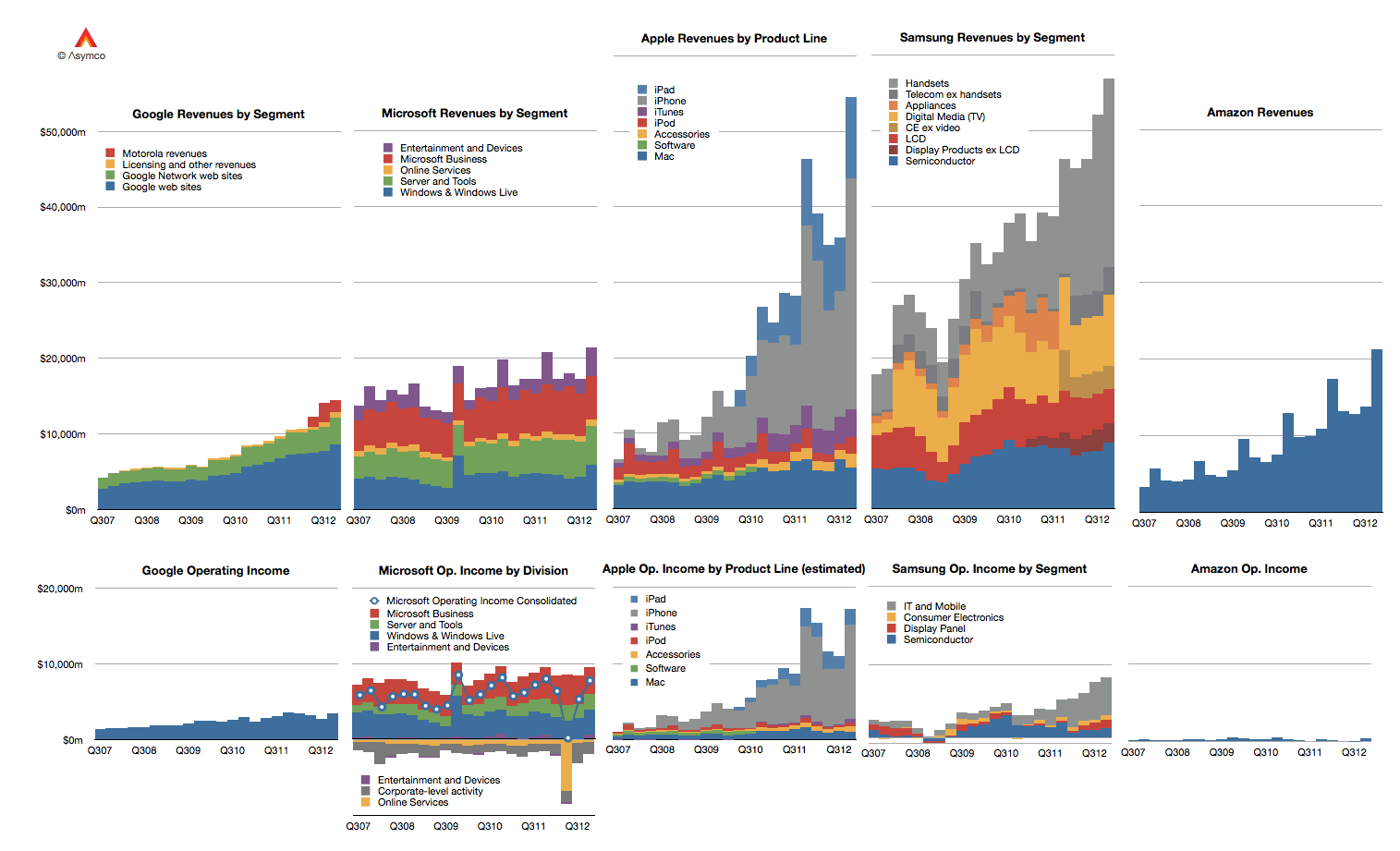
When looking at the patterns of sales and profit capture for hardware vendors since 2007 the contrast is stark:
Apple and Samsung tower over the fortunes for software only Microsoft or service-oriented Google and Amazon. Although all companies are growing, the value, as defined by the buyer, resides in the whole product. Putting aside all the theory, the numbers are staggering. Google, Microsoft and Amazon are skimming profits but they are not particularly efficient at profit generation vis-a-vis the integrated Apple (and increasingly integrated Samsung.)
The question is which of the companies illustrated above will prosper from the value chain evolution under way?