Asymco

Asymmetric Intelligence

Counterpoint Research

  1. Trendforce: Global Smartphone Production Fell 1.7% YoY in 1Q26; Sharper Decline expected in 2Q26

    Nota Bene · 2 comments

    Apple increases production by 21%

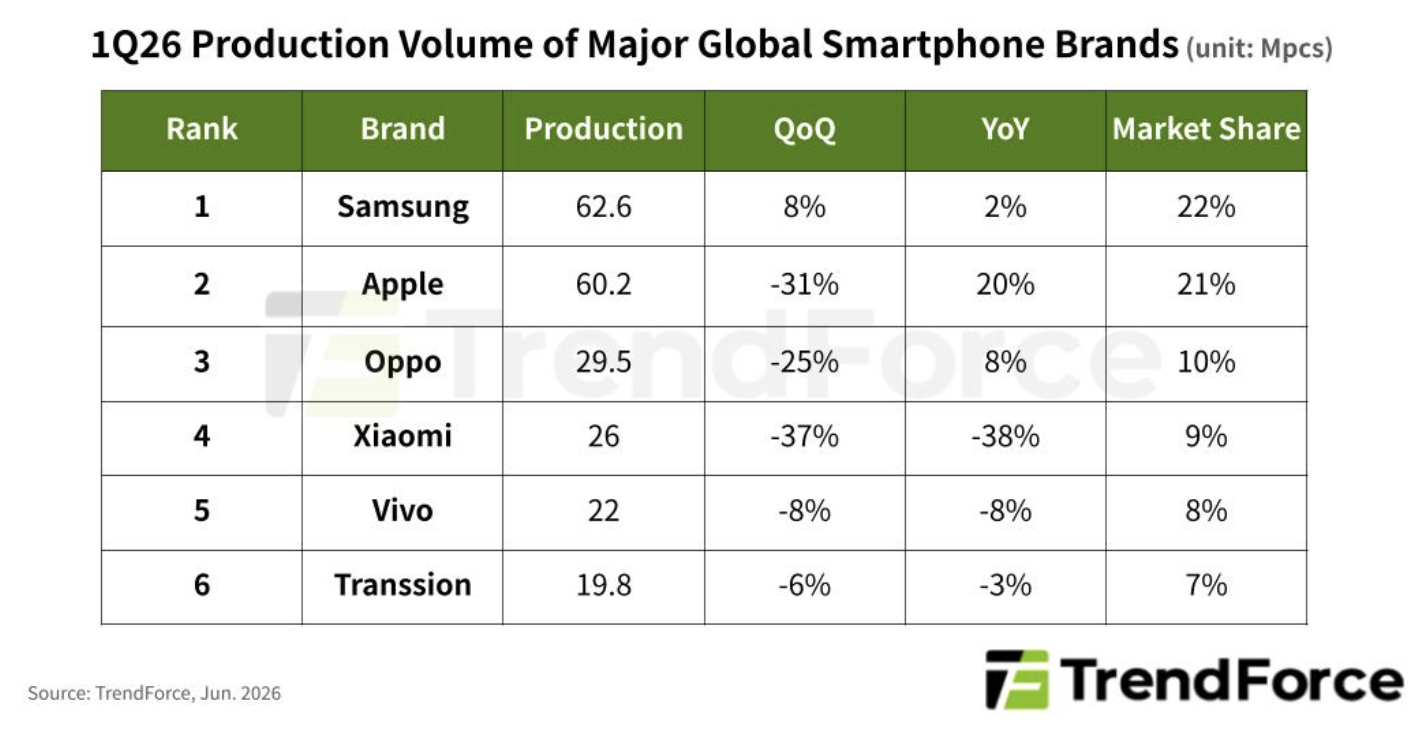
    TrendForce’s latest figures reveal that global smartphone production reached around 284 million units in the first quarter of 2026, marking a 1.7% YoY decline. Despite a sharp rise in memory prices since the second half of 2025, the effect on production was minimal because brands still held inventories of cheaper memory components. Additionally, consumer expectations of higher prices in the future have helped sustain short-term demand, cushioning the impact of rising memory costs on production during the quarter.

    However, as low-cost memory supplies are gradually exhausted and significant ongoing increases in memory prices reduce profits, most smartphone brands have begun adjusting production in the second quarter.

    Looking ahead, TrendForce forecasts global smartphone production to decline approximately 16.2% YoY to 1.051 billion units in 2026. Under a more severe scenario, the annual decline could become even more pronounced if memory price increases remain elevated and brands are forced to raise retail prices repeatedly.

    TrendForce notes that Samsung is relatively well-positioned to withstand the current cost inflation cycle thanks to strong financial backing from the broader Samsung Group and a sizable premium product portfolio. Nevertheless, its significant exposure to lower-end models remains a concern—particularly amid weakening consumer sentiment—making end-market demand a key factor to monitor.

    Apple ranked second with its production of approximately 60.2 million units during the quarter. In addition to ongoing production ramp-up for new iPhone models, output was supported by the launch of the iPhone 17e, resulting in 19.7% YoY growth.

    Compared with competitors that have already entered a margin-protection phase, Apple remains better positioned to absorb higher memory costs while maintaining profitability. TrendForce believes Apple is more likely to prioritize market share expansion during the current downturn as it lays the groundwork for future growth in recurring software and services revenue.

    Xiaomi, Oppo, and Vivo focus on preserving profitability as production plans face greater uncertainty

    First quarter production declined seasonally among the major Chinese smartphone brands, including Oppo (29.5 million units), Xiaomi (26 million units), and Vivo (22 million units). These three brands ranked third through fifth globally by production volume.

    While all three delivered strong market share gains in previous years, surging memory costs are now weighing heavily on profitability, creating significant uncertainty around their 2026 production plans. As a result, production targets may be revised downward if cost pressures persist.

    Transsion produced approximately 19.8 million units in 1Q26, roughly flat compared with the same period last year, placing sixth among global smartphone brands.

    The brand has been particularly vulnerable during the current memory price supercycle given its smartphone portfolio is heavily concentrated in entry-level and budget segments—where profit margins are already thin. Limited access to low-cost component inventories has further amplified the impact.

    Source: TrendForce

    NB: Counterpoint tracks sales, Trendforce tracks production. The production data may include inventory build-up not shown in sales while sales may include drawdowns not shown in production. The two analyses however agree on a market under significant supply-side stress. Profitability is a big concern and availability of components is critical. As noted previously in response to Counterpoint reports, the 2026 full year volumes will probably show the worst decline in decades.
  2. Counterpoint Research: Apple has shipped over 450 million Apple Intelligence-capable iPhones

    Nota Bene

    Don't confuse efficiency and effectiveness

    Apple has cumulatively shipped over 450 million Apple Intelligence-capable iPhones till Q1 2026.

    Apple has the largest number of smartphones with consumers which are capable of GenAI as compared to any other brand.

    At WWDC ‘26, Apple needs to deliver a revamped Siri showcasing practical use cases, making a strong statement.

    Although iPhone sales remain strong, competition is already moving ahead in terms of AI, and Apple must be ready to follow since Agentic AI has the potential to redefine the smartphone industry.

    Source: Counterpoint Research

    NB: Words like "needs", "must", "follow" contrast with minimal evidence of demand.

    Effectiveness is a number. Efficiency is a ratio. No bank has ever accepted a ratio as a deposit. Counterpoint continues: "Although the lack of a more fully AI-featured Siri…

  3. iPhone Share of US Big 3 Carriers reaches 75%, 77% with Verizon

    Nota Bene · 2 comments

    Android down 14.4%. Small players getting crushed.

    Apple’s quarter one (Q1) 2026 iPhone sales volume in the US was up 1.3% year-over-year (YoY), outperforming the country’s overall smartphone market.

    That market declined 5.7% YoY, according to Counterpoint’s US Monthly Smartphone Channel Share Tracker. Apple’s share of volume grew by 4% YoY, as Android device sales declined 14.4% YoY.

    On the impact of the delayed launch,Graham said, “The premium smartphone space in the US is highly consolidated compared to some other markets, with Apple, Google, Samsung and, to some extent, Motorola comprising the vast majority of sales here. When one brand delays a flagship launch, it opens a window of opportunity to fill that vacuum. Apple did just that.”

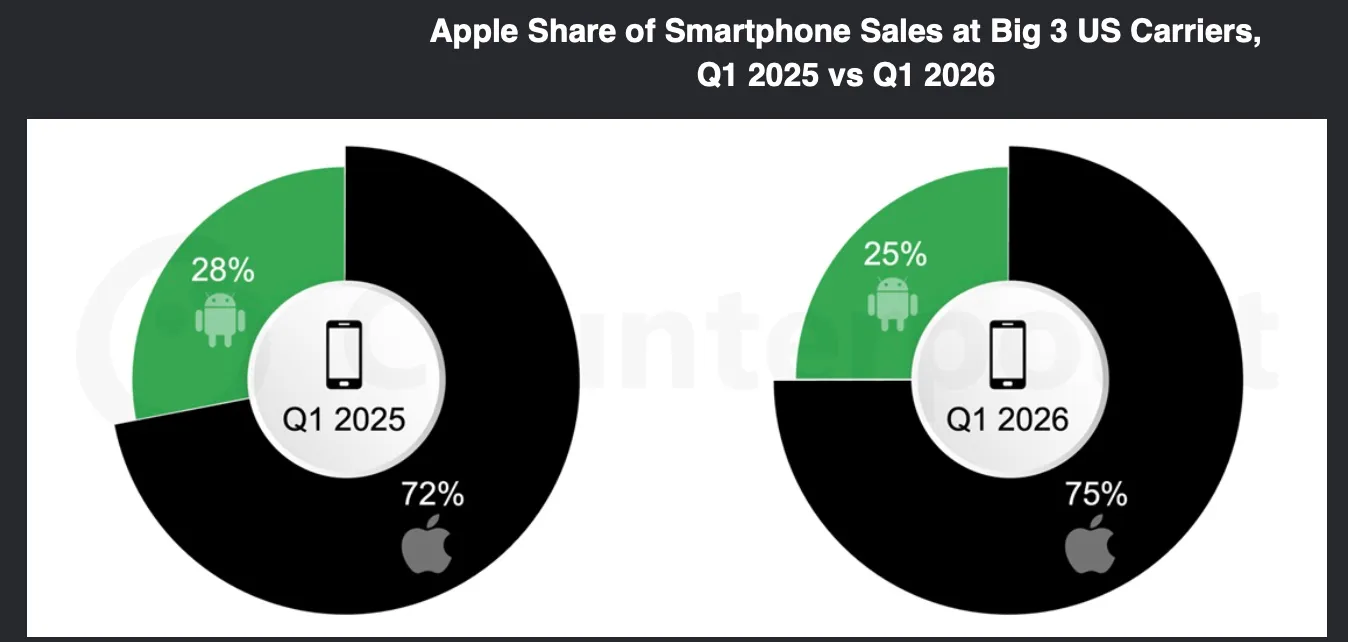
    Apple grew its market share in each of the Big 3 US carriers. Its share grew the most at Verizon to 77% in Q1 2026.

    “If Apple can avoid significant price increases and continue to outpace its peers in promotional dollars, it will be tough for Android manufacturers to keep up in the year ahead, said Klaehne.

    Source: Counterpoint Research

    NB: What are the dynamics of the US market? The split between Apple and the rest of the market seems to be starker than ever. It's ask if there is a K shaped market emerging…

  4. iPhones where first, second, third and sixth most popular phones during the first quarter

    Nota Bene · 4 comments

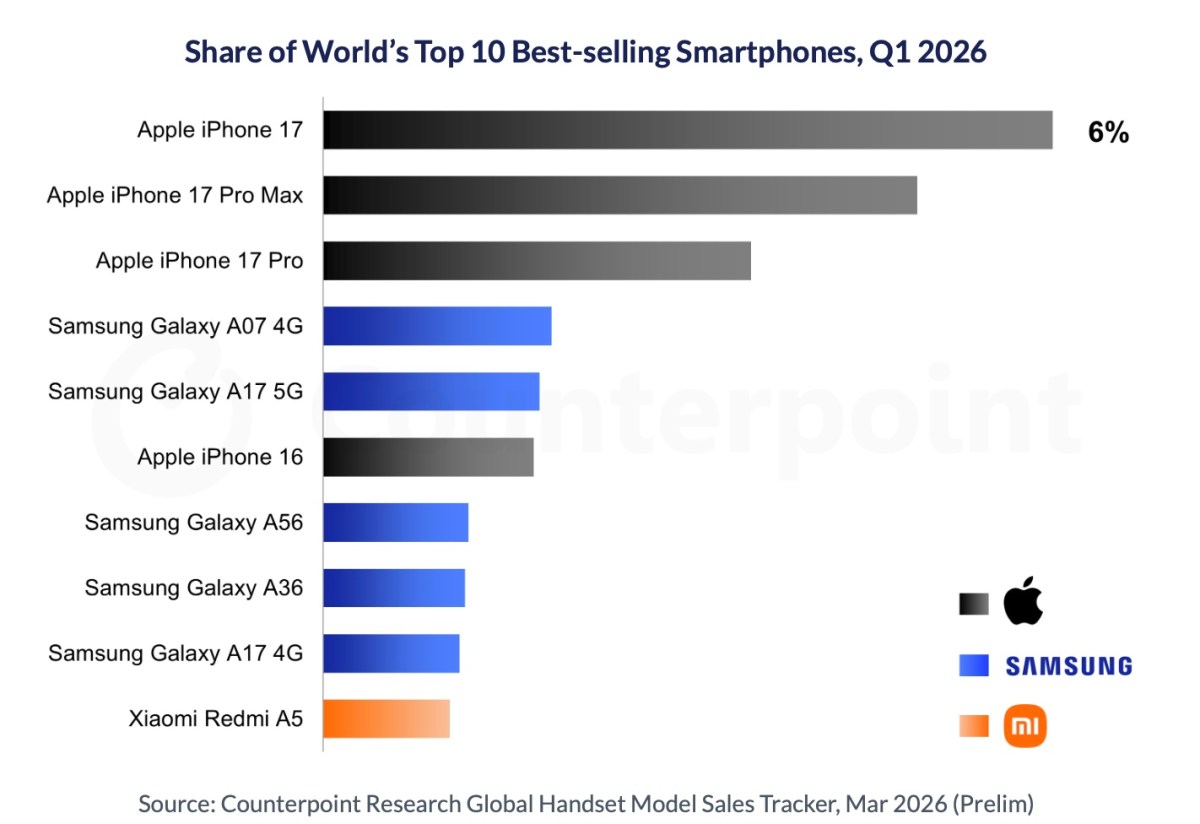
    Concentration into top 10 now highest ever.

    Apple’s iPhone 17 was the world’s best-selling smartphone in quarter one of 2026, capturing 6% of global unit sales, according to Counterpoint Research’s latest Global Handset Model Sales Tracker.

    The iPhone 17 Series captured the top three spots, while Samsung Galaxy A Series was most represented with five models in the top 10. The top 10 smartphones contributed 25% of global unit sales, the highest quarter one concentration ever, according to Counterpoint. This was driven by sustained demand for the iPhone 17 series, alongside pressure on Android manufacturers in mass-market segments as the ongoing memory shortage pushes up component costs, adds the research group.

    Source: Apple World Today

    NB: There are over 450 brands and over 6000 phone models in the market yet 10 models from 3 brands make up 25% of sales. The near future is harsh…

    Daring Fireball visitors: $250 off Annual Asymco One subscription when you use code DF260515 in the next 3 day. Subscribe →

  5. Apple share of the smartphone SoC market grew from 15% to 19% in Q1

    Nota Bene

    Supply disruptions strengthen the strongest

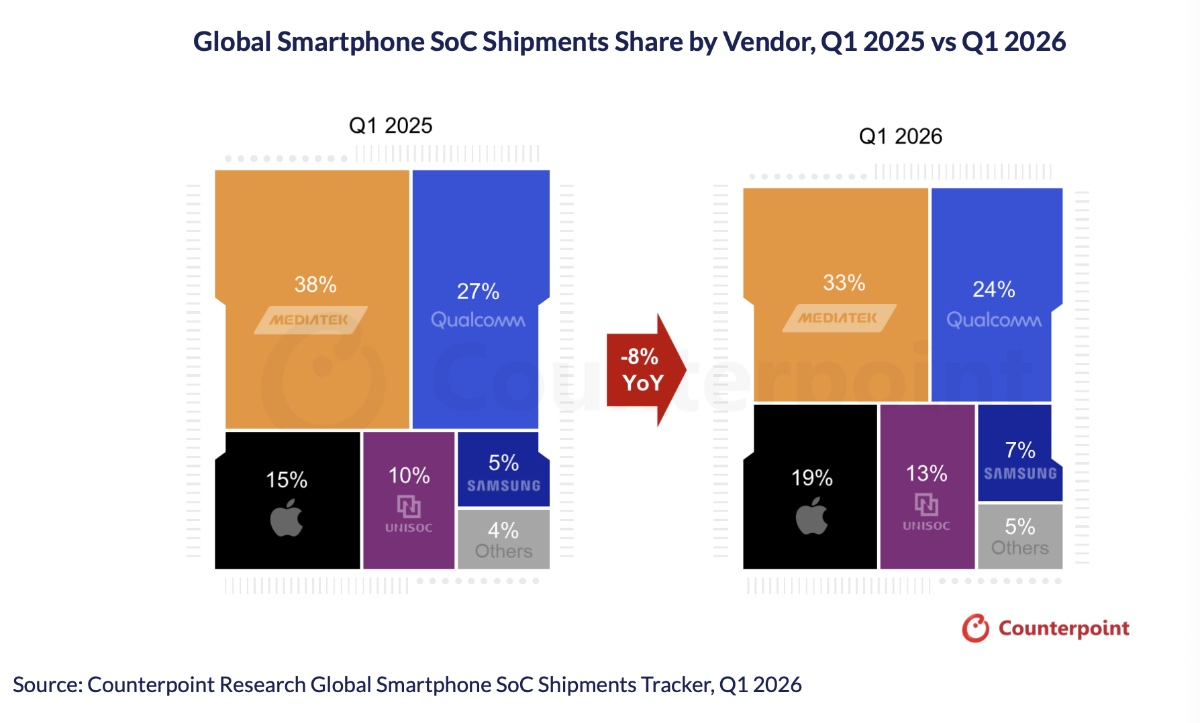
    Global smartphone system-on-a-chip (SoC) shipments declined 8% year-over-year (YoY) in quarter one (Q1) of 2026, according to Counterpoint Research’s latest Global Smartphone SoC Shipments Preliminary View report. However, it’s good news for Apple.

    Counterpoint says the premium segment has remained relatively resilient, with higher costs largely passed on to end consumers. Meanwhile, the entry-level manufacturers are increasingly adopting lower-cost chipsets to keep smartphone prices competitive.

    Qualcomm and MediaTek recorded double-digit declines in shipments. In contrast, Apple, Samsung, Google and UNISOC posted positive growth.

    Apple saw its share of the global smartphone SoC market grow from 15% in the first quarter of 2025 to 19% in the first quarter of 2026. Some explanation: A smartphone SoC (System-on-a-Chip) is a single, integrated chip that combines all essential computing components—CPU, GPU, memory, and connectivity modems (5G/Wi-Fi)—into one unit.

    Apple silicon is a series of proprietary, ARM-based systems-on-a-chip (SoCs) designed by Apple for its ecosystem, providing high-performance computing through a unified memory architecture and specialized components. They power iPhones (A-series), Macs (M-series), iPads, and wearables (S-series), focusing on superior power efficiency and security.

    Source: Apple World Today

    NB: Counterpoint Senior Analyst Shivani Parashar says that their integrated supply chains helped …

  6. IDC: Apple Grows 33.3% in China as Market Declines 3.3% in Q1 2026

    Nota Bene

    Counterpoint says 20% and -4%

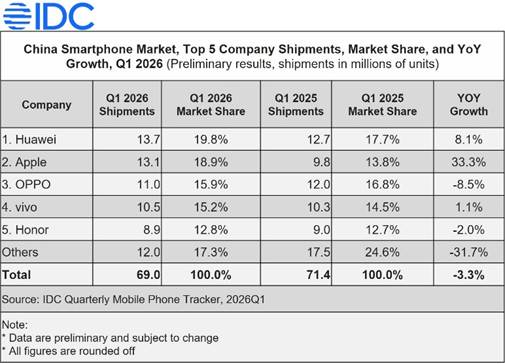
    China smartphone shipments fell 3.3% in Q1 2026 to 69M units, with Huawei and Apple driving premium demand despite rising costs and supply constraints.

    Source: IDC

    Separately, CounterPoint research reports;

    China’s smartphone shipments declined 4% YoY in Q1 2026, as memory shortages disrupted supply and drove up costs across OEMs.

    Huawei led the market in Q1, supported by its domestic supply chain advantages and stable pricing. As a result, the brand recorded its highest-ever quarterly share in China since Q4 2020.

    Apple delivered the strongest growth among the top six brands, and it is widely seen as best positioned to navigate the memory crunch.

    NB: Both researchers say Apple share in China is about 19%, nearly tied with Huawei at 20%…

  7. Asymco One Office Hours Live Q&A with Horace Dediu & Gene Munster: April 8, 2026

    Office Hours

    A lively discsussion of Apple topics such as:

    • Geopolitics: China concentration; Taiwan tail risk
    • Financials: Solid near-term growth
    • AI: Critical narrative shift; to be proven
    • Growth Strategy: User expansion
    • Business Model: Evolution: hardware → services → Personal AI platform
    • Moat: Privacy + integration; trust

    Non-Subscribers:

    Join Asymco One as a Subscriber to participate OR

    Just Register to Watch live.

    Contact us at events@asysmco.com if you have any questions.

    For most up-to-date information, see

  8. Apple, Samsung Dominate 2025 List of Highest-shipping Models Across Regions

    Nota Bene · 1 comment

    Apple led in markets where premium leads

    Apple led in NAM, Europe and Asia-Pacific, while Samsung led in LATAM and MEA.Premium models led in NAM, Europe and APAC, while entry- to mid-tier models led in LATAM and MEA.

    In NAM, Apple’s iPhone 16 5G led the market. Samsung’s Galaxy A16 5G was the only Android device to feature in the top five, driven by volumes in the prepaid segment.

    Within APAC, Apple secured all the top five positions. All top five models in LATAM and MEA were 4G smartphones.

    Apple and Samsung dominated the list of highest-shipping models globally in 2025, with the two brands capturing the top two spots across major markets, according to Counterpoint Research’s Market Monitor Monthly Shipment Tracker, 2025.

    However, regional variations did exist with premium models leading in North America (NAM), Europe, and Asia-Pacific (APAC), while entry- to mid-tier models led in Latin America (LATAM) and the Middle East and Africa (MEA).Top Five Highest-shipping Models by Region, 2025Source: Market Monitor Monthly Shipment Tracker, 2025

    Source: Counterpoint

    NB: Apple led the markets where premium was normative. This suggests that Apple still has opportunities in Latin America, Middle East and Africa. Stay tuned for an in-depth analysis of this at a country level.