Asymco

Asymmetric Intelligence

disruption

  1. Wherefore art thou Macintosh?

    Research · 151 comments

    Managing the Mac product line must be one of the most challenging problems at Apple. That may not be obvious given the product's success. Consider what it has achieved:

    • The product is in its 32nd year of market presence. A longevity that in unmatched by any other PC maker.
    • Apple reached a top five position in the ranking of PC vendors. This was achieved for the first time only this year, far along in the evolution of the market.
    • With about $23 billion in revenues per year, Apple places among the top four PC vendors in terms of revenue.
    • With an estimated $5.5 billion in operating margin Apple is the most profitable PC vendor, capturing over 60% of the available PC hardware profits.
    • The product has retained an average selling price of over $1200 for at least a decade. At the same time the average pricing of Personal Computers has more than halved.
    • Although volumes have fallen for three quarters, the product grew volumes and sales for 22 out of 29 quarters. As a result, volumes almost doubled in eight years. ((The unit volumes in third quarter 2008 were 2.6 million. Eight years later they are 4.9 million and could easily be over 5 million in the holiday quarter.))

    The contribution of the Mac to Apple's revenues is shown in the following graph.
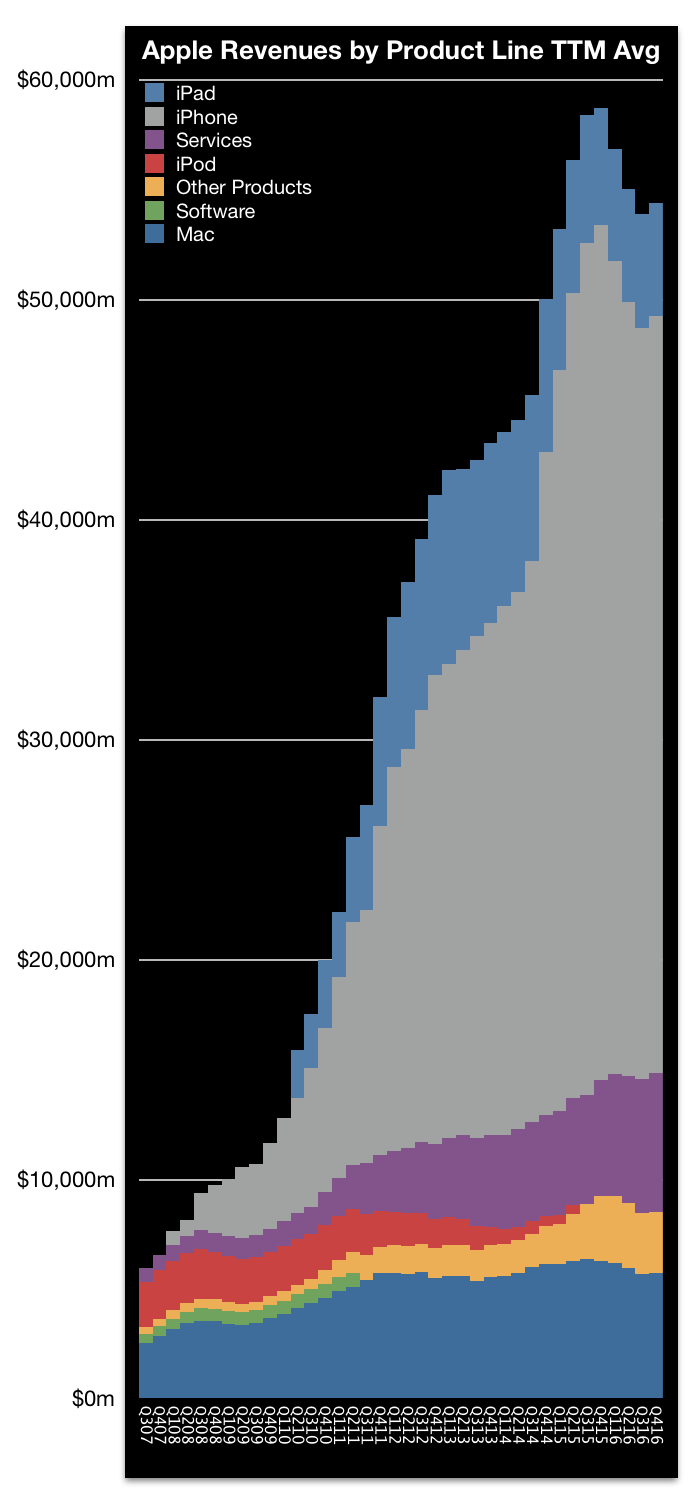
    screen-shot-2016-11-02-at-2-22-23-pm

    It's attractive and convenient to contrast the Mac with the rest of the PC industry. A David vs. Goliath tale of redemption. The classic comeback story. But the split between the two old rivals (Windows/MacOS) focuses the mind into a limited view of the computing market. The big change in computing has not been a growing Mac vs. declining PC. It has been a huge surge in mobile device use vs. a decline in PC use overall.

    This data is visible in many ways. Browsing data shows mobile overtook PC use this year. Shopping data around Black Friday points in the same direction. Data on user interaction captured by comScore is shown below ((Although US only, the global picture is likely to be even more skewed toward mobile as PC didn't saturated global markets before the smartphone swept to power.))
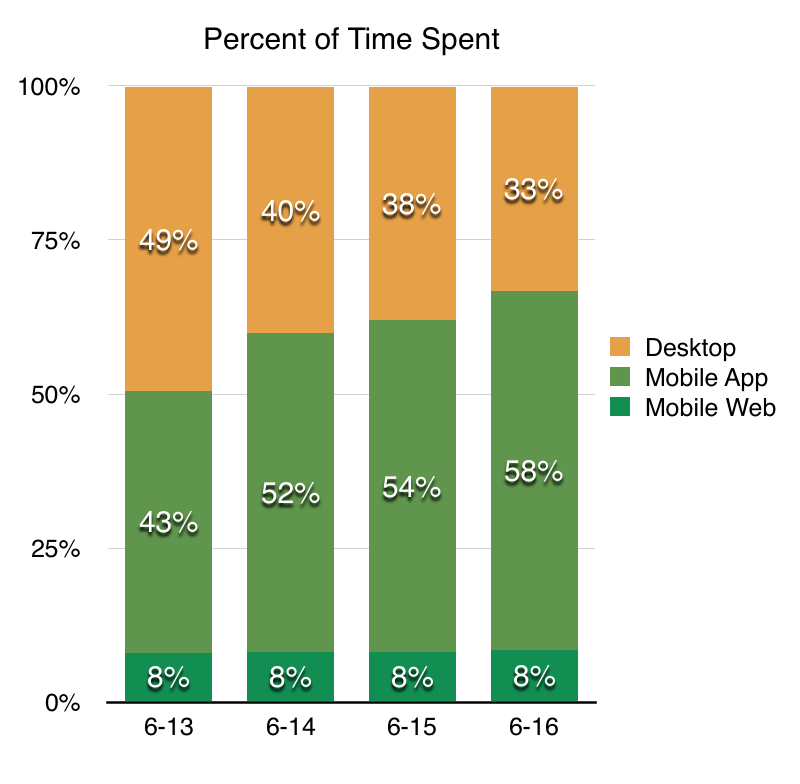
    screen-shot-2016-11-02-at-3-45-49-pm

    PC use went from half to a third of time while mobile went the other way: from a third to half of time within only four years. All the data is consistent: mobile use has swept PC use aside.

    We can see the contrast simply by placing iPhone, Mac and all Windows PC on the same shipment graph.
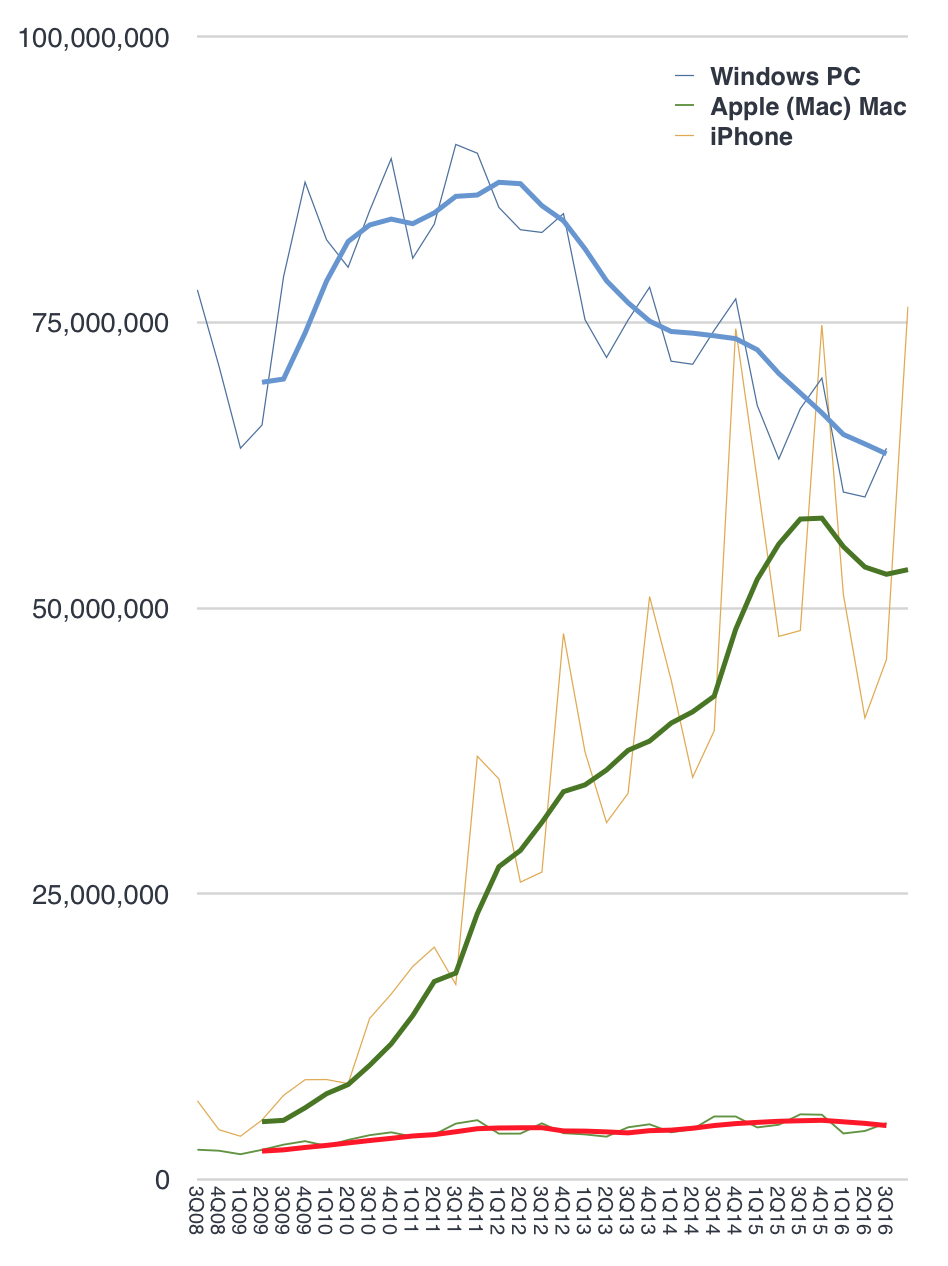
    screen-shot-2016-11-02-at-3-47-05-pm

    This contrast is spectacular.

    I bring this contrast up because I believe it is what focuses the minds at Apple. For them it's pretty clear where the puck is going. And not just now. Mobile has been foreseeable as a disruption to computing a decade ago–at least to some of us.

    And so what do you with the Mac?

    To answer this we have to ask what exactly is the purpose of the Mac in the age of the Mobile device?

    Note that this is not the same as asking what is the PC in this world. The PC is not having to share a resource pool with an iPad/iPhone. It does not have to answer for its existence to a phone. PC makers and Microsoft are not fighting with an usurper in their midst. They may see the outsider challenger but it's not an inside challenger. This makes all the difference.

    Indeed, because no usurper was allowed to emerge, PC/Windows never moved to a mobile evolution of computing. Microsoft's platform future was lost because the antibodies which eat disruptions were left unchecked.

    But Apple's immune system was suppressed. It allowed a disruptor to emerge from within. Apple gave birth to its future by suppressing the reaction to that new seemingly parasitic organism. It took an immense willpower to allow this to happen.

    But it takes us back to the question of what to do with the incumbent, the donor of DNA and resources. The parent that sacrificed for the child.

    The Mac is thus not treated disparagingly. It deserves and gets respect. It is preserved but with limited responsibilities.

    Which brings me to the question of what it is allowed to be and hence what it is. It cannot take on the role of being the future. That belongs to the touch screen devices. It will not morph into a touch device any more than a teen's parent will become cool by putting on skinny jeans. What it will do is become better at what it is hired to do.

    The key to the Mac therefore becomes that which the iPad/iPhone isn't: an indirect input device. The keyboard and mouse/trackpad are what define the Mac. The operating system, the apps, the UX, are all oriented around the indirect input method. The iPhone's capacitive touch brought about the direct input method, a third pivot in input methods (first was mouse, second trackpad/scroll wheel). Each pivot launched a new set of platforms and the Mac is the legacy of the second.

    It's not obsolete but it is a decreasing share of engagement. Alternate ways of doing the jobs it does well with direct input are emerging on the third pivot but they are not yet good enough. The children are still adolescent and making lots of stupid mistakes. There's still life in the parents.

    The management thus has to focus on how to make the keyboard/trackpad interface better while still saying and believing that the future is touch.

    In this context the newest MacBooks Pro are a logical extension of the second wave of computing while avoiding cramming them into the third wave. They are defined by their constraints. Seen thusly, the move from keyboard/trackpad to keyboard/touchbar/trackpad is pure genius.

    The touchbar coupled to the other two inputs is a totally new way to interact with computing products. It's not an "easy" interface as it's not direct manipulation. It remains indirect, a defining characteristic of the second wave. Indirect inputs are powerful and lend themselves to muscle memory with practice. This is the way professional users become productive. The same way keyboard shortcuts are hard to learn but pay off with productivity, touchbar interactions are fiddly but will pay off with a two-handed interaction model. They are not something you "get" right away. They require practice and persistence for a delayed payoff. But, again, that effort is what professionals are accustomed to investing.

    This is a leap forward and a big deal. For 32 years the UX model of the Mac has been two-handed typing with one handed gesturing. Now we have the option of two-handed indirect manipulation: one hand on the touchbar and one hand on the touchpad ((the iPad pro already encourages two handed direct manipulation)). Imagine you've been playing guitar with one hand for years and then someone lets you use your left hand. Holy cow.

    Even so, it may seem that Apple is pulling punches. The product could have evolved into the full-touch, dual screens, pen input, hybrid model of Windows. But that only makes sense if you don't have a mobile product that is promising the same and tearing up the world at the same time.

    You've unleashed a disruptive force and now you're supposed to retrofit the incumbent with the tools to compete. Why not just let the disruptor grow up unhindered.

    The Mac is what it is because it's not alone. It's part of a family. It is a parent. It strives to be better but will not take the future from its child.
  2. My favorite questions

    Research · 1 comment

    • What is an innovation? What is the difference between ideas, inventions, novelties, discoveries and creations?
    • What is a disruption, formally-speaking? Also, what is it informally speaking? Why the distinction?
    • What is Performance (or P-space)? How does Performance relate to utility, quantity, price and other microeconomic concepts?
    • What is a new market? How do we distinguish a new industry from a new market.
    • Do firms matter? Are firms causal to economic growth?
    • What is the role of technology in innovation? Can we innovate without technology? Can we fail to innovate with technology?
    • Do firms have life in the biological sense? If not how do we measure their existence?
    • What are entrepreneurs? What do they do that’s different than what managers or business leaders do?
    • How do you navigate P-space? How do you think about your business and economy in performance terms.
    • What is a diffusion? Is adoption a good measure of technological progress? What is the connection between diffusions and disruptions?
    • How does Capital map to P-space?
    • How can we maximize economic growth? Is there a growth algorithm? What is the role of government policy in growth? What about the role of the creation of customers?
    • What is the difference between consumption and non-consumption? What is non-production?
    • What are the known forms of disruption? Can there be forms we don’t yet know about?
    • Why do customers buy solutions? Understanding the causes of purchase decisions.
    • Are profit motives necessary for growth? What motivates individuals, if not profit?

    If these questions are of interest to you, join the conversation at DisruptiveInnovation.org.

  3. Soft Underbelly

    Research · 38 comments

    Executives at car companies have suddenly had to answer questions about potential entrants into their business. This is a big change. I don't recall a time when this was necessary for over 30 years. For decades the questions have been about labor relations, health care costs, regulation, recalls and competition from other car makers. To ask questions about facing challengers posing existential questions must seem terribly impertinent.

    For this reason, Bob Lutz, in his dismissal of Apple's entry, is not alone. The industry has a century of history and has seen little disruption in the classic sense. I wrote a long piece on the fundamentals of the industry titled “The Entrant’s Guide to the Automobile Industry” which explained why this industry has been so resistant to disruptive change. At best a massive effort over multiple decades usually leads in a small shift in market share.

    However, one should read that post as a thinly veiled threat. Just because disruption seems hard does not mean it isn't possible. Indeed, the better you understand the industry the more easily you can observe its vulnerability and the more rigid the industry seems the more vulnerable it may be to dramatic change.

    The formula for successful entry is the same for all industries: compete asymmetrically. This means introduce products which change the basis of competition and deter competitive responses by making your goals dissimilar from those of the incumbents. This is classic “ju-jitsu” of disruptive competition.

    Here’s how it would work.

    Bob Lutz suggests that there is no profit to be gained from selling cars on the premise that costs are very high while pricing will be held down by competition. That may be true but entrants could deploy new processes that lower the costs of production. Traditional car making is capital intensive due to the processes and materials used. There are however alternatives on the shelf. iStream from Gordon Murray Design proposed switching to tubular frames and low cost composites.  BMW has an approach using carbon fiber and other composites. 3D printing is waiting in the wings. All offer a departure from sheet metal stamping.

    With new materials, costs for new plants can be reduced by as much as 80% and since amortizing the tooling is as much as 40% of the cost of a new car, the margins on new production methods could result in significant boosts in margin.

    There is a downside however. What is usually compromised when using these new methods is volume and scale of production. So that becomes the real question: how many cars can Apple target? 10k, 50k, 100k per year? Could they target 500k? That would be 10 times Tesla's current volumes but only a bit more than the output of the Mini brand.

    Now consider that the total market is 85 million vehicles per year. For Apple to get 10% share would imply 8.5 million cars a year, a feat that is hard to contemplate right now with any of the new production systems. On the other hand selling 80 million iPhones and iPads in a single quarter has become routine for Apple and that was considered orders of magnitude beyond what they could deliver. Amazing what 8 years of production ramping can offer.

    So the answer to the operating margin might be in a combination of new processes and new ramp strategies.

    But there are more levers of change. Car making can be revolutionized through modularity: divide the car into subsystems and act as integrator. Electric cars have the benefit of few moving parts, smaller motors, fewer points of failure and wear, lower heat signatures and more interchangeable systems architecture. This allows companies to enter without needing to design their own engines or many other parts.

    The fact is that engineering cars is actually fairly easy. Building them is the hard part and the costs of engineering new models that are cited as so extraordinary are because most of the effort is in engineering for production (The maxim is that it’s far harder to make a Ford than a Ferrari). You can see this in the proliferation of “boutique” supercars which have hyper performance but low volumes. McLaren, Bugatti, Pagani and dozens of others are all recent hypercars which show the power of engineering and design without worrying about volumes.

    Apple could combine new production methods with modularity in engineering to bring design, integration of experience and iteration to the industry. Not to mention what software could add to that. Couple that with the brand value and Apple’s entry will very likely be hugely successful. I just don’t know if they can manage production at the level of demand that I expect them to create.

  4. Is Tesla Disruptive?

    Research · 72 comments

    To the analyst, the car industry is a wonderful study. Unlike some other "high technologies," whose market births and deaths are separated by a few changes of the seasons the automobile industry has been around for well over a century. It has been sustained through dozens, perhaps hundreds of innovations. Almost everything about the car of a century ago has been improved.

    Not only improvements to the product itself but improvements to the infrastructure that supports it: roads, gas stations, services, insurance, regulation. At the same time, its numbers have increased steadily as the car has spread to all corners of the world through waves of increased production and distribution. Although invented in Europe, the production system that allowed it to reach the mass market took hold in the US. That production system was then exported to Europe then to Japan and then to Korea and now to China.  

    Screen Shot 2015-05-28 at 5.30.54 PM

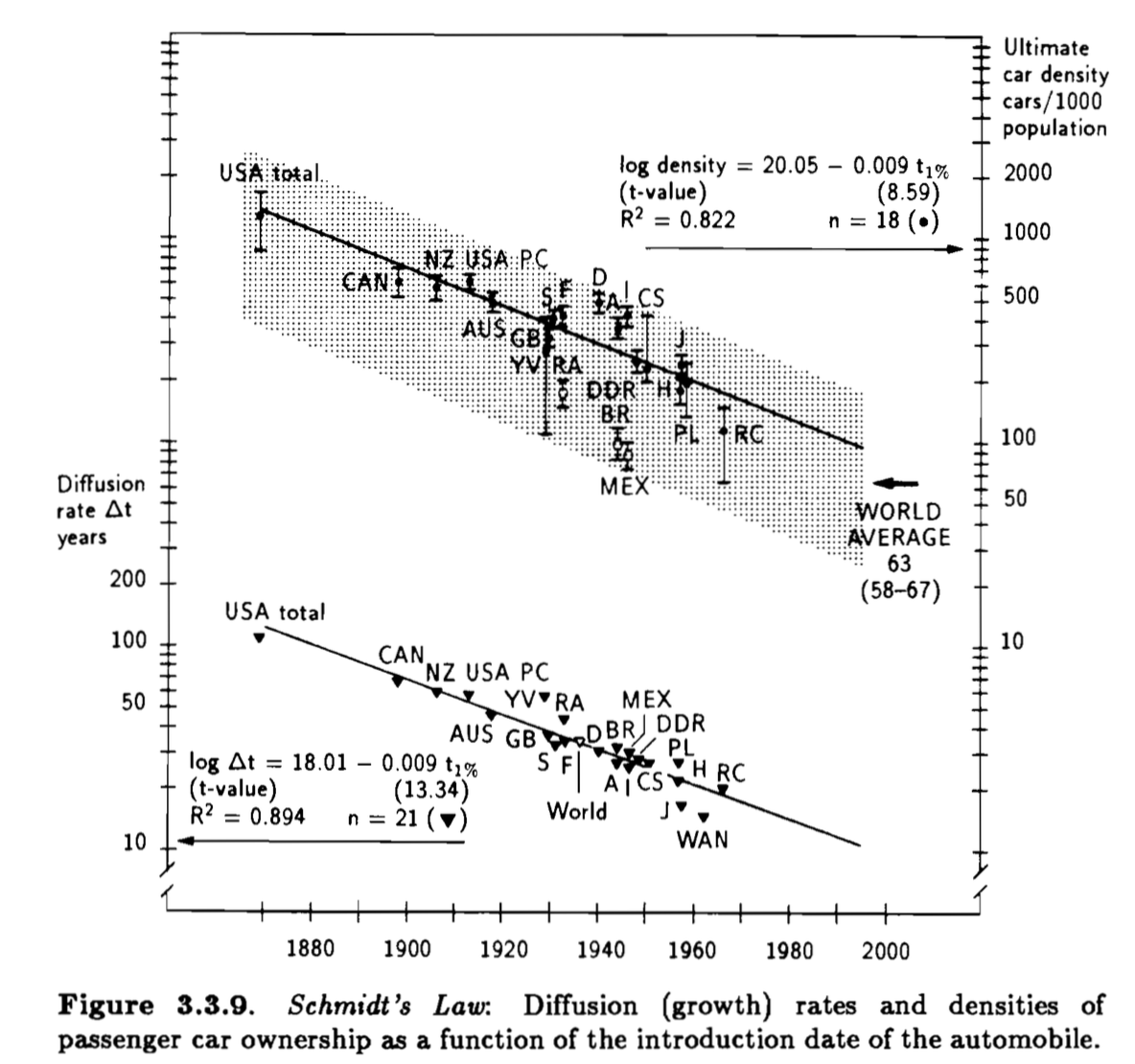
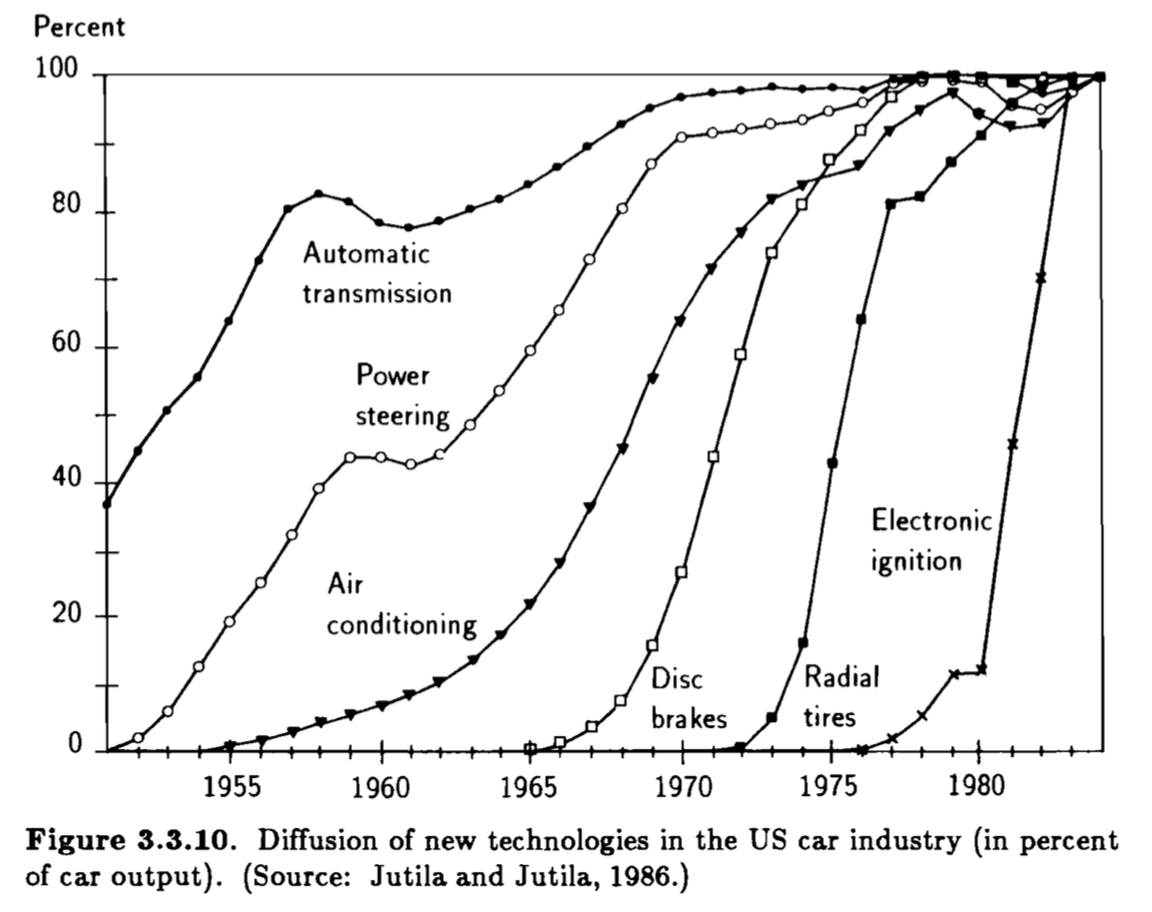
    Figures 3.3.9 and 3.3.10 from Arnulf Grubler's The Rise and Fall of Infrastructures

    However, throughout this century of improvement, the business structure—the way money is made—has not changed. Even with the arrival of Volkswagen in the 1960s and Japanese automakers in the 80s, the network of incumbents has not been displaced. Newcomers have taken share, but there have been few exits suggesting that classical disruption has not taken place.

    When we look at the reasons for the share displacement that did take place, we see innovation in production systems and distribution as the core causes. We see new manufacturing processes and competition against non-consumption. What we don’t see is new technologies. We don’t see diesel engines or anti-lock braking or crumple zones or fuel injection or radial tires or airbags or automatic transmission or air conditioning or electronic ignition or safety glass, or any of the other hundreds of technologies that have been adopted as causing any change in market share.

    Screen Shot 2015-05-28 at 5.32.41 PM

    Every innovation tends to diffuse rapidly throughout the industry, being widely adopted by all manufacturers. Production systems such as the ones from Ford and Toyota have been much slower to be adopted which has offered those innovators an advantage for a few decades, but they too have eventually been widely copied and created normative behavior. The opening of new markets like Asia, Eastern Europe, Latin America, Africa and China have created opportunities for local manufacturers but eventually those advantages too have or will be diminished with time.

    So, given this, we have to ask if the the availability of new power storage technologies would allow an early mover to displace and move aside these established makers. To answer in the positive would imply that the challenger has an asymmetric business model—one which causes the incumbents to flee in the opposite direction. But Tesla is manufacturing cars using the same JIT processes and ramping quite slowly. Toyota-style process-driven innovation does not seem to be even in the works. There is no shortage of manufacturing capacity, indeed there is too much.

    Furthermore, Tesla is selling cars in established markets competing against existing consumption. Volkswagen Beetle or Model T style competition against non-consumption does not appear to be on offer.

    Tesla's product introduction rate is relatively sedate, so a higher rate of product development which might let them “turn inside” the incumbents, does not seem likely.

    Finally Tesla is introducing products priced well above average appealing to the wealthiest of customers, again causing us to ask how this might cause a luxury company to look at their solution and exclaim “Not for us!”.

    Looking from every angle I am unable to find the way that Tesla is asymmetric. Disruption theory suggests that whatever causes it to survive or prosper will be embraced and extended by competitors precisely because it will also cause those competitors to survive and prosper.

    The auto industry may be a lot slower than the computer industry to respond. But once the industry embraces battery-based power, it will convert a world-wide production and distribution system to sustain itself.

    That does not mean Tesla is a bad business. They may carry on with Porsche-like or even BMW volumes for a long time. But that’s not a disruptive outcome, it's a niche strategy.

    There is one more point. As Tesla has chosen to share its intellectual property and as Elon Musk has stated publicly, they welcome others to build the same cars they do. So by their own admission the company does not seek to disrupt. Disruption is a competitive stance.

  5. The Asymco Trilogy With Horace Dediu 1 - New Market Disruption by analyseasia

    Research · 12 comments


    Horace Dediu, current research fellow of the Clayton Christensen Institute and founder of Asymco.com joined us for an epic and insightful discussion focusing on few key interesting topics: (a) new market disruption theories, (B) Apple in China and the luxury market and (c) the Japanese automotive industry and how it shapes up against disruption from Tesla, Uber and Apple. In the first of the trilogy, Horace discussed the origins of Asymco.com and also why he has used Apple as the lens to understand innovation and technology disruption. We also traced back to other Apple-like companies in the past such as Sony in Asia, and look at how Apple and Pixar has displayed a different kind of "DNA" against innovative companies in the past. Last but not least, we discussed the evolution and future of Google and where it might lead them to.

    Listen to it here.

  6. Peak Cable

    Research · 172 comments

    Paying for TV has been a curious consumer phenomenon. There was a time when TV was free to consumers. It was delivered as a broadcast over-the-air and paid for either by commercials (US mostly) or by taxes on viewers (Europe mostly). The consumers were delighted with the idea as it was far better than radio and radio was delightful because it was far better than no radio.

    The process of convincing consumers to pay for something that used to be free was quite interesting. The first benefit to be articulated was that the quality of the picture would be much better. It would, in essence, be noise-free. ((This was in fact the birth of cable TV: a shared antenna for a community in an  electromagnetic shadow))

    The second benefit was an increase in the number of channels. VHF and UHF television would cover about three and 5 channels respectively while cable could offer dozens, many specializing on specific types of content like the Home Box Office (HBO) offering movies and ESPN offering sports only and MTV music videos and CNN news only.

    The third benefit was fewer (or no) commercials for some of the channels. This was especially valued by fans of movies whose interruption by commercials was often detracting from the immersive value and continuity of the cinematic experience.

    These benefits were very attractive during the 1980s, to the extent that about 60% of US households adopted cable. An additional group later adopted satellite-based pay-TV as the technology became reasonably cheap.

    Screen Shot 2015-03-19 at 2.29.06 PM

    These benefits were priced modestly but as the quality and breadth of programming increased, prices rose. An average cable bill of $40/month in 1995 is $130 today ((a 6.1% compounded rate of price growth vs. a 2.4% rate of inflation)). Some of that revenue went into upgrading the capital equipment in use (the plant) and some into paying for the higher production values. Yet more went to the sports leagues and their players whose business models increasingly depended on broadcast rights.

    And so over a period of about 40 years, watching TV went from free to quite expensive. More expensive even than a family's communications costs (i.e. telephone service.) That's quite an achievement at a time when technology diffusions caused huge price reductions in other goods and services. Consider that the TV set used to watch the programming improved dramatically while decreasing in price over the same period.

    Meanwhile, some of the benefits began to be less relevant. Commercials are more abundant than ever. Ad buyers spend about $60/month per household to deliver ads ((Implying that the TV "business" has a $200/household/month revenue model)) The quality of the TV picture is actually worse due to compression than one might get with over-the-air digital broadcast. Finally, the abundance of channels is beyond anyone's absorption rate. Those channels which used to be "pure" became polluted and undifferentiated as each tried to be the other. ((A pursuit no doubt driven by seductive but toxic market research))

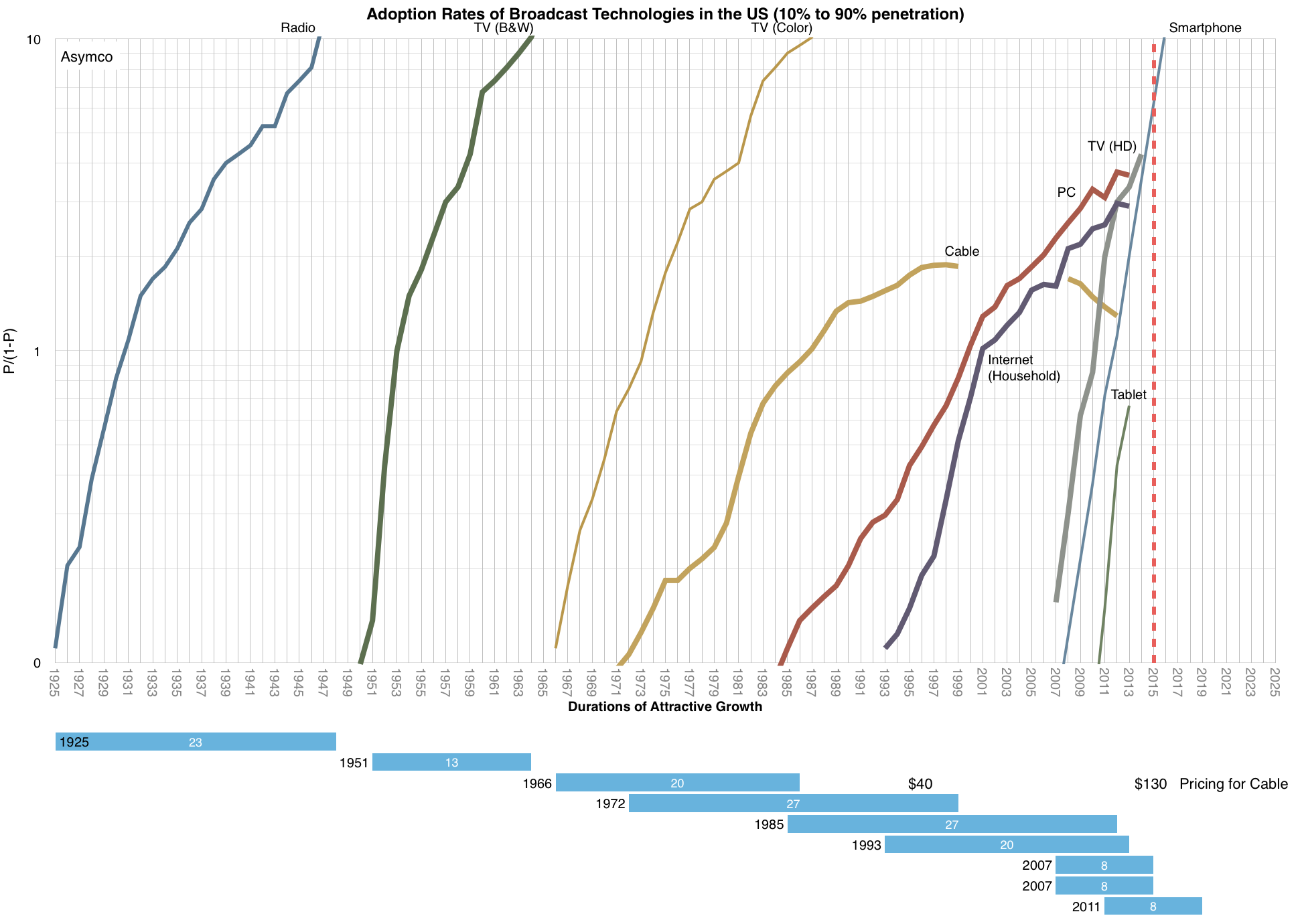
    On top of these paradoxes is the fact that actual penetration of the service has been declining. As the graph above shows, Cable TV has declined (though Pay TV much less so). The industry has reached saturation decades ago and has not offered anything meaningful in terms of innovation.

    Disruption theory suggests that once a product over-serves on meaningful bases of value creation (and underserves on value) it opens the door to disruption. Which leads me to ask not whether cable is past its prime but rather why it's still around?

    The answers are usually immediate and plentiful: conspiracies of monopolists, lobbying, back-room deals, lock-in of content and all kinds of other misdemeanors. To which I would say: You can fool some of the people all of the time and all of the people some of the time but you can't fool all of the people all of the time.

    So again, why have all the people been fooled all this time? Twenty years have passed since the industry reached saturation and prices keep rising. Today the average cable bill is projected to rise to $200/month by 2020.

    My answer is that disruption is predictable. Users are cutting cords, the "uncabled" or "never-cabled" are a significant portion of the population. 13.5% of broadband households with an adult under 35 have no pay-TV subscriptions. 8.6 million US households have broadband Internet but no pay-TV subscription. That's 7.3% of households, up from 4.2% in 2010.  Another 5.6 million households "are prime to be among the next wave of cord-cutters," according to Experian.

    The same phenomenon occurred with mobile vs. fixed telephony. For several years it seemed that mobile was sustaining to fixed or that fixed was immune due to lock-ins. The fixed telephone incumbents insisted that the data was inconclusive. Then the trickle of abandonment turned into a deluge. The quality of service for mobile kept increasing and, with data, it became clear that the mobile devices could unleash unfathomable functionality and value.

    And so it goes. A business dies first slowly then quickly. (('How did you go bankrupt?' Bill asked.
    'Two ways,' Mike said. 'Gradually and then suddenly.' -The Sun Also Rises (1926) Ernest Hemingway)) The exact timing is tricky because of the non-linearity of the phenomenon. It's also hard to declare end-of-life since business zombies are very common. What is clear however is that the economics will change dramatically and the alliances between talent and distribution will shift to entrants and away from incumbents. The point when we will look back and say that cable was finished will probably come by the end of this decade.

  7. Tech.pinions Podcast: Discussing Disruption Theory

    Podcast · 4 comments

    Ben Bajarin:

    A few weeks back Horace Dediu of Asymco and I were having dinner and we got to discussing some of this updated thoughts on disruption theory. One bit in particular was how the luxury tech market was causing him to evolve some thinking on the theory as it relates to consumer markets. I thought it would be great to have him on and we could chat more about disruption and the role it plays in the technology industry in the 21st century.

    via Podcast: Discussing Disruption Theory | Tech.pinions - Perspective, Insight, Analysis.

  8. Apparel is next

    Podcast · 81 comments

    If software can be injected into an industry's product it will bend to the will of the software writers.

    This theory expands on Marc Andreessen's observation that "software is eating the world". The evidence is that software, coupled with microprocessors, sensors, batteries and networking becomes applicable to an increasingly larger set of problems to be solved ((Or, put another way, is eligible to be hired to perform an increasingly large set of jobs)). Software has "eaten" large portions of entertainment (e.g. Pixar, iTunes, video games), telecommunications (iPhone, Android, Messaging), various professions including journalism, management and law, and is entering transportation, energy and health care and poised over banking, finance and government.

    As entry happens, asymmetries are enabled and disruption follows. This is the bending to the will of the writers--who tend not to be incumbents. The incumbents can't embrace the changes in business models enabled by software without destroying their core businesses and thus, invariably, they disappear.

    The pattern is easily observed but the speed and timing of it is difficult to predict and hence investment success is not certain. ((Which, ironically, means that the jobs of venture capitalists are still safe. At least until the theory develops to the point where it can predict with more accuracy winners and losers.)) There are many entrants who try and few succeed and there are many incumbents who will survive longer than a prophet can stay hungry.

    Nevertheless, this process of software-induced turnover in wealth--and, incidentally, vast, additional wealth creation--is inevitable.

    But can we predict anything other than timing? For example, can we predict the next industry to succumb to this force?

    There is hope because the last big disruption was predictable. When looking at what caused telecom to become a domino, the pattern of development of hardware pointed the way. It was clear in the late 1990s that computers would become small enough to fit in one hand. The first instances were PDAs (mid-1990s) and once they proved valuable in solving many jobs it was easy to plot their evolution into phones.

    So if we follow the "packaging" constraint, it's clear that computers are becoming small enough to be worn. Many prototypes exist and even small companies can build them.

    All that is needed is a new user interface and a new platform will be born. Once a platform is born, the creativity of millions can be unleashed to expand the problem set that can be solved. The process then repeats.

    So it's obvious that as a computer becomes wearable it will affect the industry that currently is hired to also be worn: apparel.

    Apparel is the word describing every garment, shoe and accessory product sold and amounts to about $1.2 trillion/yr. ((The US is about $331 billion or 28%.)) ((The Telecom industry is slightly larger at about $1.3 trillion)) This amount of money is not spent only to protect the wearer from the elements--any more than the money spent on telecommunications is spent to convey vital information. Most of the value in apparel, perhaps 80%, is spent on solving psychological needs.

    And therein lies the opportunity. As the value is beyond functional, substitution of psychological jobs by new products is a matter of engineering better solutions. Consider the behavior of US teens: anecdotally, their spending on apparel is fading as the solution to feeling good about themselves increasingly relies on a device and service. Already, in this context, apparel retail is in crisis while buying shifts to devices.

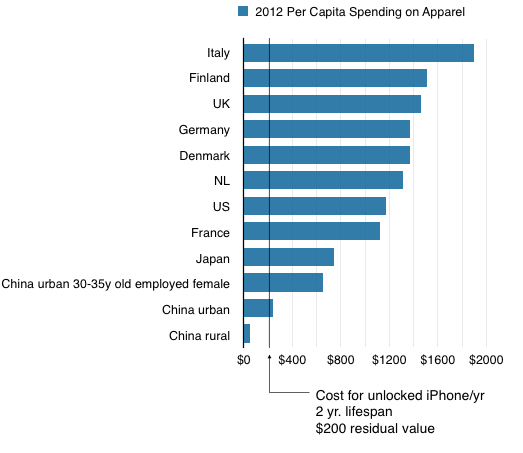
    While looking at the spending, it's also easy to see how much there is to divert from a non-functional to a functional/service bundle:

    Screen Shot 2014-08-28 at 8-28-1.01.40 PM

    In many markets individuals spend more on apparel than on personal technology. And as personal technology increasingly competes for the same jobs to be done, that spending will transfer to the entrants.

    To know who's already planning for this you can follow the trade news on the hiring of talent.

  9. Interview With Horace Dediu: What To Expect When Apple's Expecting

    Research · 24 comments

    My thanks to Eric Jackson for his thought-out questions on Apple. As published in Forbes, here is his Interview With Horace Dediu: What To Expect When Apples Expecting.

    A few excerpts:

    Q: Do you expect to see a sapphire cover on the new iPhone(s)? Is that material significant?

    I expect Sapphire will become a signature feature across many products. I don’t know if they will have capacity to deploy on iPhone this year but on a watch it’s essential. Here’s a clue: if the screen has any curvature, especially around edges, it needs to be sapphire as glass can’t take strain in that shape. The scope of the plant they are building with GT implies that they will have massive volume potential with at least one major iPhone model using the material. It’s a significant material because it allows design freedom in new directions, especially curved (concave) touch surfaces that retain a jewel-like feel. This has Jony Ive all over it.

    Q: Is it fair to conclude now based on the 5C and 5S that Apple will never launch a “cheap iPhone”?

    Oscar Wilde said a cynic is someone who knows the price of everything and the value of nothing. When I see the word “cheap” I never know if it refers to price or value. And even when we talk about price, an iPhone is cheaper than buying all the things it replaces so it’s always been a low end disruptor in my mind. (I saw a tweet with an image of a Radio Shack ad from the 1980s and every single item available on that page is now a part of the iPhone. It would have cost thousands to buy all those things back then–and dollars were worth a lot more.) Furthermore, I think Apple holds a black belt in pricing. They seem to define their position in the market by anchoring certain prices and “owning” them. Given all that I would say that Apple is not going to move their price points much. They will expand the portfolio and offer some iPhones at $300 but they will be older models. The average selling price (ASP) I expect to remain constant on a year-long average.

    Q: In the past, Apple critics were quick to dismiss the new iPad and 5C iPhone as failures upon their introduction.  You never judge. You just report the facts and data.  That said, is there anything about past new Apple products launches that we should look at as a predictor of how a new iWatch might be received by customers?

    When the iPad was imminent the great debate was over whether it would run iOS or OS X. Many imagined a touch-based Mac rather than the “big screen iPod touch”. It was a tough call and one which Microsoft could not and still does not make. Therefore, the interesting question for me with respect to iWatch is: What OS it will run? I will be shocked to the core if it does not run iOS. It is my opinion that making iOS work on it is the entire reason Apple is sweating this segment. They are in it because they are trying to make a platform product with a novel user experience and all the power of an ecosystem run on a wrist. It’s as big a problem as getting a phone-sized device to run a touch UI was in 2007. That is the crucial contribution that Apple is making to this next generation of computing. Now you might ask what users are asking for in this segment. The answer is nothing. Nobody is asking for this. As nobody asked for the iPhone (or the Mac or the iPad). It’s a new computer form factor and how it will be used will be determined by the apps written for it. But it will work and be magical out of the box in version 1. This is in contrast to the single purpose or accessory model of wearables we see to date.

    Q: As a student of disruption, where is Apple most vulnerable to being disrupted?

    Apple is a new market disruptor but much of what is put forward as a threat to it is low-end disruption. I think Apple knows enough about how that happens that it can manage its way around it. The strategy they employ is one of attrition. If you wait long enough a low-end threat tends to wear itself out as it starves of profit and is constantly gnawed-at by alternatives. (You see, if the disruptor cannot manage a profit then they cannot climb up the trajectory to get on top of the incumbent. Being profitable is a key requirement for successful disruption in the long term.) The attrition strategy works as long as you have the fortitude to hold out and the deep pockets to keep improving your product as alternatives flame out. It is my belief that Jobs made sure that thinking is inculcated in the company. So if not low-end is the company vulnerable to new-market disruptors? This is more subtle and the threat here is what Google/FaceBook/Amazon and the other ecosystems are all about. It’s creating new usage models and shifting where consumers place brand value. I think this is more what keeps Apple’s management awake at night. They are not standing still however. iTunes and Software and Services (now with Beats on board) is the way they are staying on top of that threat.

    Lots more here.