Asymco

Asymmetric Intelligence

Facebook

  1. A new platform classification

    Research · 35 comments

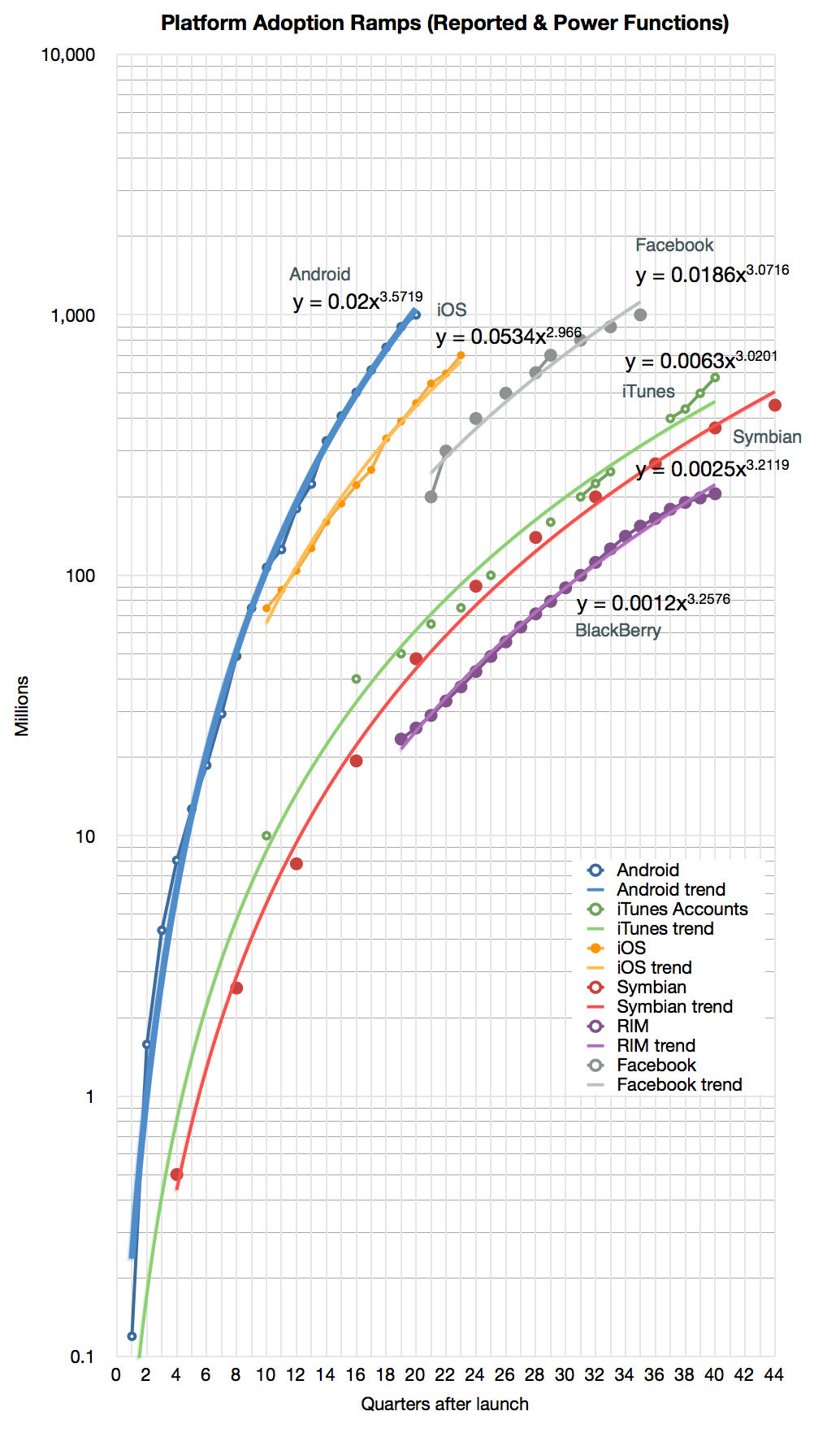
    When looking at the Race to a Billion data I noticed that some platform adoption ramps look quite different from others. It's not just a matter of "slope" or rate of growth but a distinctly different shape.

    If you look at the graph below you might see the difference yourself.

    Screen Shot 2013-09-12 at 9-12-4.41.13 PM

    First, note that the graph is logarithmic. A straight line on a log chart implies exponential growth (the y values are a constant to the power of the x value). However, none of the graphs show straight lines. None of the platforms follow exponential growth ((Except perhaps in the very early periods)).

    Second, we can eliminate linear or logarithmic functions. They simply do not fit.

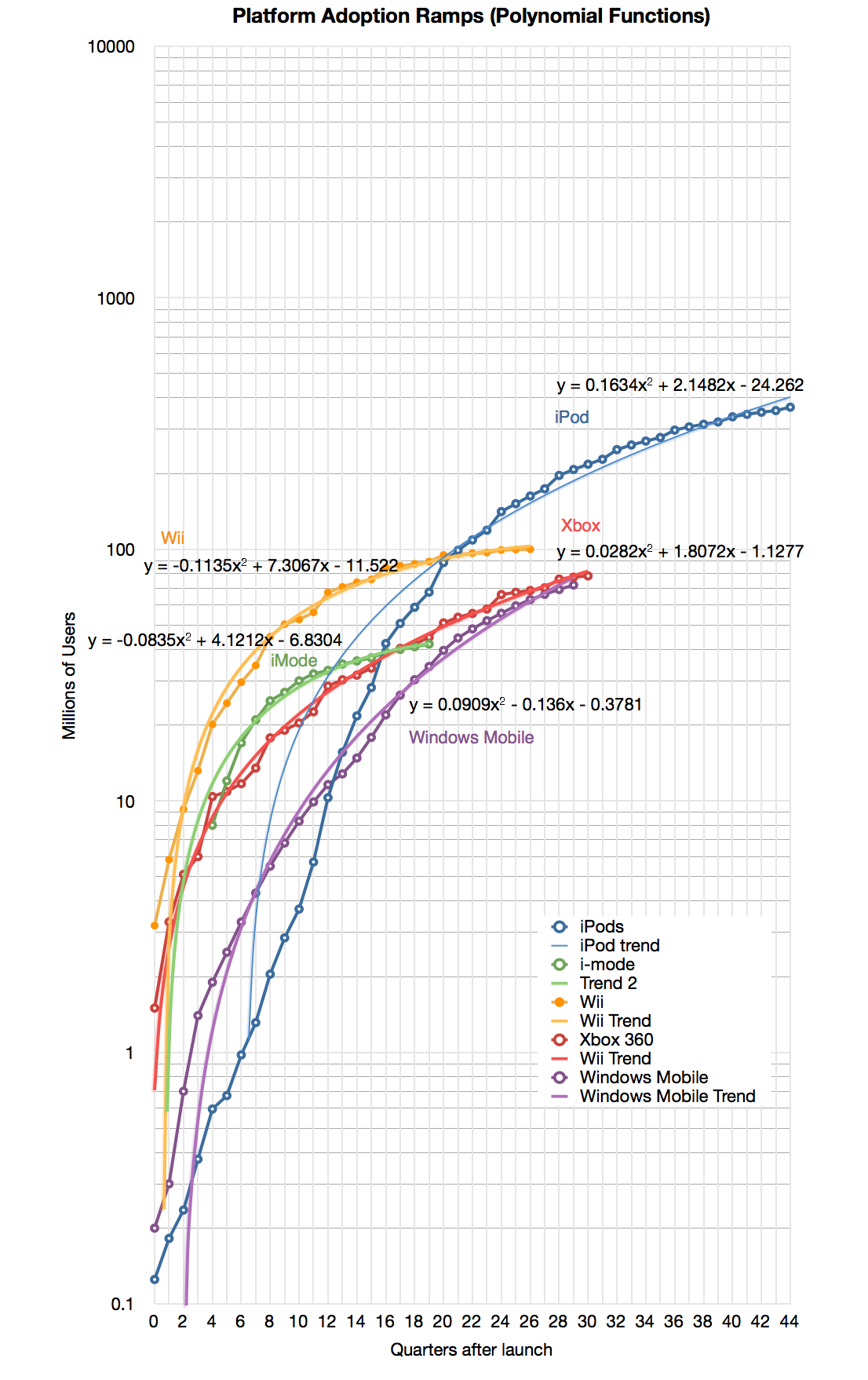
    That leaves: polynomial or power. It's easy to test these alternatives for all the functions and it becomes clear that most of the platforms split into one of these two classes.

    Here are the classes ((Some of the platforms had to be dropped because there was no easy fit. My observation is that some of these platforms went through some crisis or change in strategy during their history which caused the pattern of growth to change)):

    Screen Shot 2013-09-12 at 9-12-4.43.43 PM
    Screen Shot 2013-09-12 at 9-12-4.44.58 PM

    Note that I added the formulas for the selected platforms.

    I named these classes after their function types: "Power platforms" or "Second Order platforms" ((Note that all Polynomial functions found above are second order)).

    This classification has two benefits:

    1. It allows a clearer distinction in scope. Both may exhibit signs of network effects, but Power platforms seem to exhibit "global" or unlimited reach while Second Order platforms may have a strong upper bound on reach.
    2. It allows more reliable forecasting. If a platform classifies as Power, the forecast could be created with fewer data points.
    3. It allows us to guess at the causes of entry into each class for any potential platform challenger.

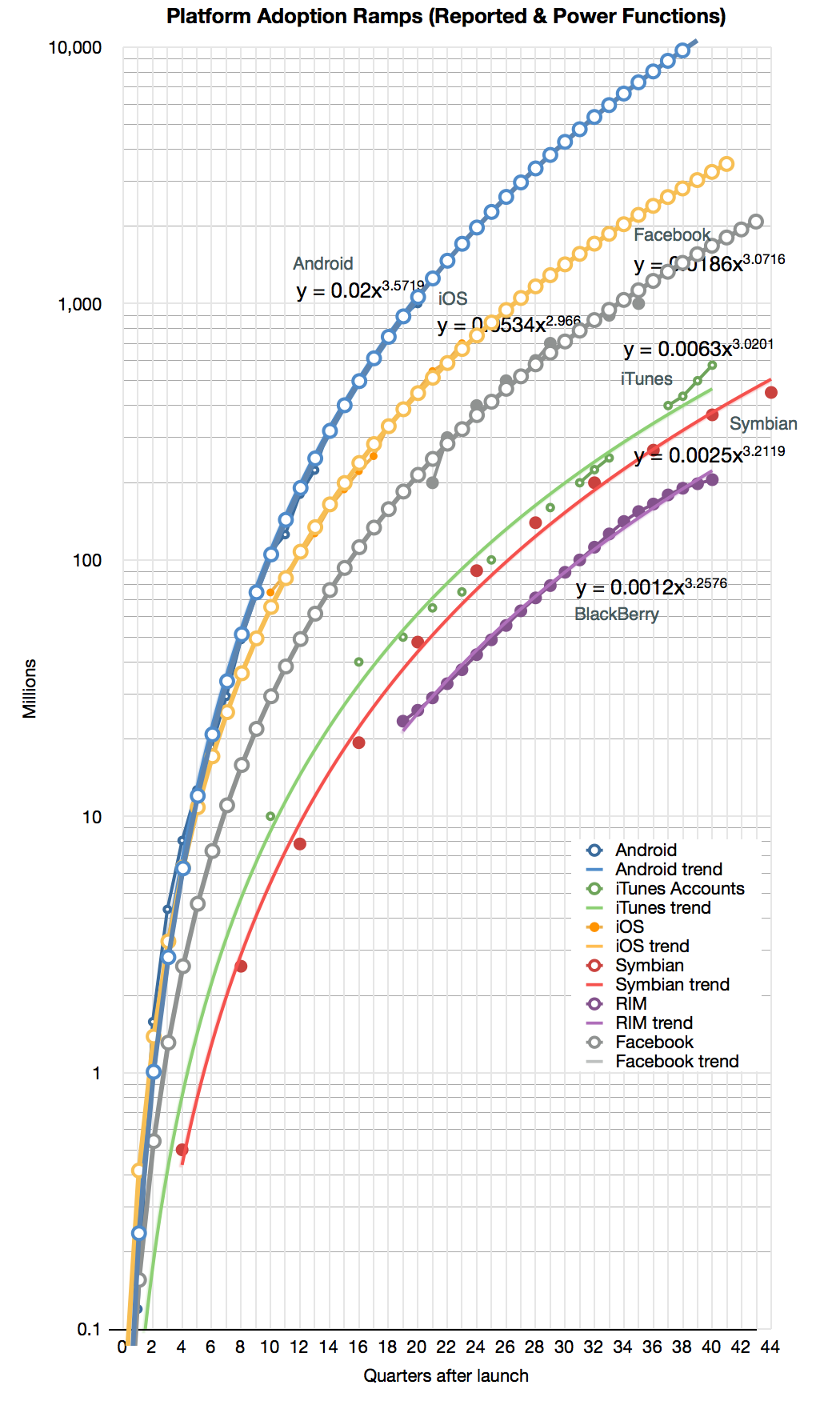
    To illustrate the second benefit, I took the Android, iOS and Facebook power functions and modeled (i.e. extrapolated) them for a few quarters into the future. The result is shown below:

    Screen Shot 2013-09-12 at 9-12-4.46.01 PM

    The forecast shows the following:

    • Android will reach 10 billion activations 10 years after its release (mid 2018)
    • iOS will reach 1 billion units sold by end of next year and 3 billion units by its 10th anniversary in 2017.
    • Facebook will reach 2 billion users by 2015 after the end of its 10th year.
  2. Third to a billion

    Research · 168 comments

    Android is the third platform to reach a billion users ((Although activations are not users, I'm assuming that usage is not far behind and the cumulative sales figures I gather are roughly comparable.)) .  The first was Windows and the second was Facebook. Apple sold around 650 to 700 million iOS and is expected to be the fourth to a billion sometime next year. ((Separately, iTunes reports 575 million account holders.))

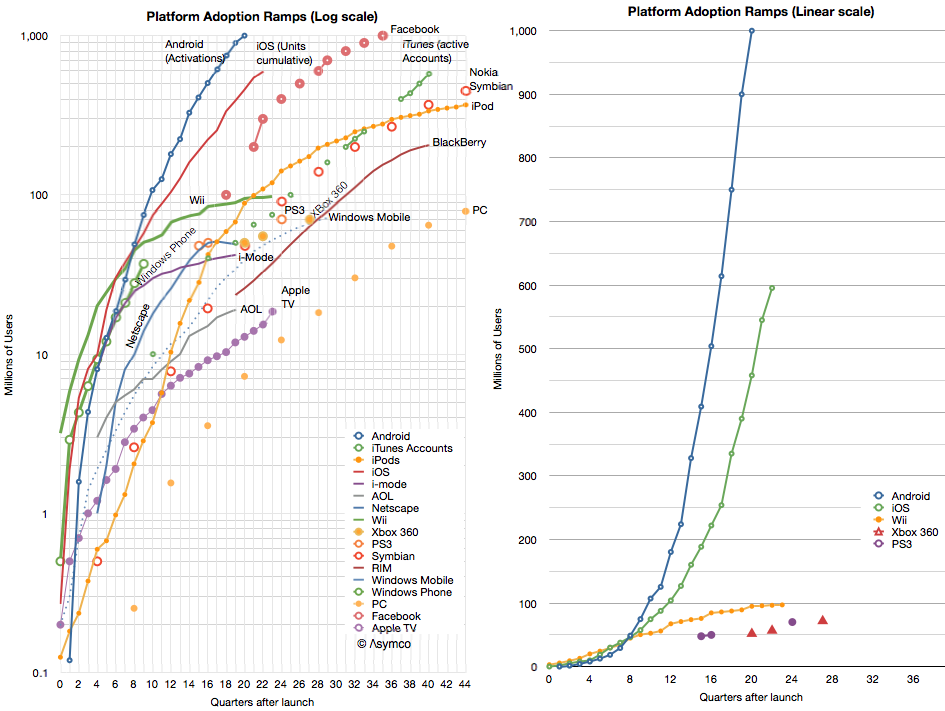
    If we define the Race To a Billion to be bounded by a time limit of 10 years, then Windows does not qualify and Android is actually second. The race is shown in the following graphs (the one on the left is logarithmic scaled, the one to the right includes only a few contenders for illustrative reasons).

    Screen Shot 2013-09-06 at 9-6-4.06.29 PM

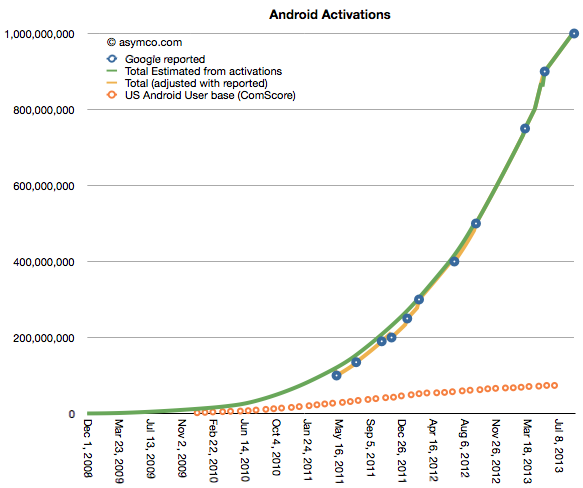
    Android's activations as reported are shown in the following graph:

    Screen Shot 2013-09-04 at 9-4-1.15.38 PM

    Without qualification, Android has been a viral success story. It reached one billion activations in about five years, almost half the time it took FaceBook and far faster than Windows.

    However, Android growth can be qualified. I added another set of data which is the number of US Android phone users as deduced from measurements by ComScore. ((ComScore surveys users on their primary phone. Survey includes only those aged over 13 years and excludes phones issued by businesses.))

    One way to read the two graphs is: Between March and August, of the 250 million Android devices activated, 4 million were to new Android consumers in the US. In other words, In the last six months, 1.6% of Android activations went toward new usage in the US. The equivalent figure for iOS is about 6%. Note that these are new users, not included are upgrades. It's likely that more of the US buying goes toward upgrades because iOS has been in use longer.

    So whereas Android is growing very rapidly, there is a question of reliability of that audience. Engagement is one thing, but in the market which shows highest penetration (and deepest distribution of an alternative) Android is peaking.


  3. Making rain

    Podcast · 72 comments

    The following is a slightly edited transcript of a portion of the Critical Path podcast #79. I am reproducing it here for the sake of brevity and focus of discussion.

    ---

    I'm going to try to put together an analogy together here that maybe will help us think through the Facebook Home and the Google Fiber issue.

    I've been thinking a lot about how to illustrate Google's business model. The problem is that discussion has been polarized: Two camps have formed. One camp suggests that Google is a benevolent entity that does great things and only asks that we indulge their hobby of a business model called advertising. Fundamentally they are about pushing the envelope on technology, making wonderful things happen.

    That is one camp. I call them the utopians. It may not be a nice thing to call them but I frame it as being exceedingly idealistic.

    The anti-utopian camp is one that suggests that Google is an advertising company primarily, and fundamentally and overwhelmingly. And anything they do technologically is in support of that. The implication is that Google is sinister and manipulative, bent on getting away with as much privacy extraction as possible.

    I believe that the anti-utopians dismissing Google as an advertising company sounds a bit incomplete. It's not incorrect. It's not erroneous. It's just not a complete story.

    And also the utopian view that they do everything for us out of the goodness of their hearts and that advertising is something that they are reluctant to do, saying in effect, "We only do it because it earns us enough money so that we can do good deeds." That too is not an accurate picture. Google is a business and its business management team is hard nosed and knows what they're doing and they are not purely idealistic in that sense.

    And so the question could be where across this spectrum does Google lie? Possibly it moves around between these points. Where they are becomes a question of motivation and what they want to become.

    But this is only one dimension. It does not help us answer the question of Home, or Fiber or Reader or Blink. Their actions seem contradictory. Holistic or selfless in one case, greedy and capricious in another.

    Let's step out of this spectrum and try to think of different ways which can describe the situation.

    I propose a way to think about it as: Google tries to make a business succeed through having a huge amount of _flow_ in terms of data, traffic, queries and information that is indexed. So think about this idea of them tapping into a vast stream. The more volume that is flowing through the system the more revenue they generate.

    As so given this very rough analogy I try to sharpen it up by saying: imagine it more as a river. And even more than a river, as a watershed, a river basin. Perhaps a giant basin the size of a continent. The business is, let's say, capturing fish at the mouth of the biggest river, before it exits into the ocean at its delta.

    And so your job (as Google) is to catch fish mostly at one point. It's the most efficient way to catch fish because you have the most flow of water at that point and building nets is not trivial.

    But in order for you to improve your business, to create more opportunity, presumably, you want to essentially have more water flowing.

    And so how would you do that? Think of the Mississippi river. If you've got a net down at the bottom of the river, the question is how would you engineer, through civil engineering, or shaping the earth itself, a way of catching more fish.

    The answer I think, in terms of the way Google might be thinking, is that they want to create more sources of water. So they would look to connect tributaries and lakes. "How about having another river join our river?" Let's make sure that we have "everything east of the Rockies" flow into our river system.

    Now, think of it this way: After you've gotten all the tributaries, what are the remaining sources?

    First, you'll want to make sure that no-one can dam or stop the flow of water into your main channels. And so you become extremely anxious about people building dams. That's the number one concern.

    So your strategy becomes one of "how do we avoid dam building"?

    That's one part of your strategy.

    The other thing you could do to improve your business would be to make it rain more. So there's the question in your mind of: If we had more rainfall, then everything will flow more rapidly and we'll get many more tiny rivers forming and joining together into our main river.

    Android and the Fiber business and even Facebook fit into this analogy rather well. In this context more rainfall means more people using the Internet. If you have more people you'll have more rivers and you'll have more water and hopefully more fish. Fiber means the water will flow more rapidly: you're essentially dredging the riverbed.

    But the two are very disconnected (rain, dredging and fish). So your strategy amounts to not really worrying about the ratio. You don't create incentives to people who make rain in the form of fish catch quotas next quarter.

    In other words, your performance as a manager of cloud seeding efforts should not be measured in fish.

    Leadership should instead simply put out the mandate of "Go out and make it rain".

    So that's the notion of Google going out on these projects and doing all these "great things" for us. They make it rain. The Internet expands. There is minimal censorship.

    By the way, censorship is a dam. Being blocked out of a country is a huge dam. It's actually more like building a mountain range that diverts water flow away from your watershed.

    And so they have these notions of how to prevent these things from happening.

    So it sounds like they are doing good things. It sounds like asking for it to rain; they want to make sure that people don't divert resources; they want to make sure that there are no barriers between the raindrop and getting access to the channel to the ocean.

    So it sounds like they're doing all the good things like a good civil engineer. Like the US Army Corps of Engineers who developed the irrigation, flood control, energy generation and waterway transportation of the United States.

    Google seems to be the world's "internet civil engineer". They are building all these things to make sure that we have good water (i.e internet) supply. That we have plenty of navigable channels. That's the analogy.

    But let's not forget that the only reasons those things are happening is because they are catching fish at some point down the Mississippi.

    From that point of view you have to ask yourself: do they deserve this concession? Because they are ultimately affecting the environment to such a degree; and the environment is the internet; and the whole scope is how the world operates.

    That is where people have to step back and ask themselves: Even a group of civil engineers that have all the best intentions may realize that they didn't think of all the consequences of their actions. A lot of the criticisms may come decades later. From people who'll note an effect on the environment. Dams get silted, a lack of floods reduces nutrients to crops which then need fertilizer, which has a whole other set of problems.

    That is when you have to reflect more deeply on what is right and what is wrong. So saying, as the City Council of Austin might: thank you for coming and paying for installing broadband for us. Fine, but we just don't know what the unintended consequences might be. It all _sounds_ good but we don't know if it _is_ good.

    And similarly, in the case of Facebook, there is a subtle hijacking going on where Android creates more rain, and Facebook and Amazon are essentially putting down nets and catching fish upstream. They're not damming the tributaries. They're not putting up mountain ranges and saying they'll make sure the water flows away from the Mississippi. But rather they are putting nets and saying "Thanks for the rain". They took advantage of what amounts to a public resource. Here the failure of anticipating consequences falls on Google. But they could not have possibly foreseen all that? Or could they?

    Then there is the question of measuring success. It's complicated and hard to measure performance. Even Google's own performance. We don't really know if the cloud projects work. We don't get to run this as an experiment that can be tweaked as data comes in.

    Google does not report performance. When they go off on these rain making projects, it's natural to ask how many fish were caught as a result. Is that incremental new rainfall causing more fish to get caught. And Google won't say anything about the profitability of rain making. They will never give you a profit and loss statement for all these projects: the dam eradication project, the project dredge a channel, the project to seed clouds. They will say that these are projects that will result in only one thing, which we do measure, which is the number of fish we catch in the delta of the Mississippi down by New Orleans. But so far although rainfall seems to be increasing exponentially there are not that many new fish.

    So that's where we struggle as analysts: is rainmaking good? Is the dam destruction process working? We can't answer these question. And we don't even know if Google themselves can. They might think of it as a strategic thing: it's always better to have more rain than less and more water flowing. End of discussion.

    To borrow a phrase from Zuckerberg, it's above my pay grade to know what all the consequences are. I have opinions as environmentalists have opinions and sometimes they have some data to back up those opinions. For instance whether a dam project is a good thing on balance. But they are bound to have partial answers because the cost/benefit analysis is definitely missing a lot of the costs and missing a lot of the benefits as well. You can't put a number on a lot of these things.

    That's where we are today. Google and Android are forces which are are very powerful but which are, to a large degree, uncontrolled, even by their own managers.
     

  4. The race to a billion—2012 Update

    Research · 66 comments

    I last looked at the race to a billion in March 2011. Since then, I've been updating and adding data to the set giving a broader selection of platforms to compare.

    Before we dive in, an explanation: the initial review excluded Windows (PC) and Facebook mainly because (a)  the ramp scale I'm using is about a decade in duration and (b) I was reluctant to compare platforms that require payment to join to those that don't. The (DOS/Windows) PC ramped over several decades (starting in 1981) and Facebook is a service that costs nothing to join. There was much gnashing of teeth and shaking of fists as a result.

    Therefore, in the interest of inclusion, I added both to the data set and let the chips fall where they may.

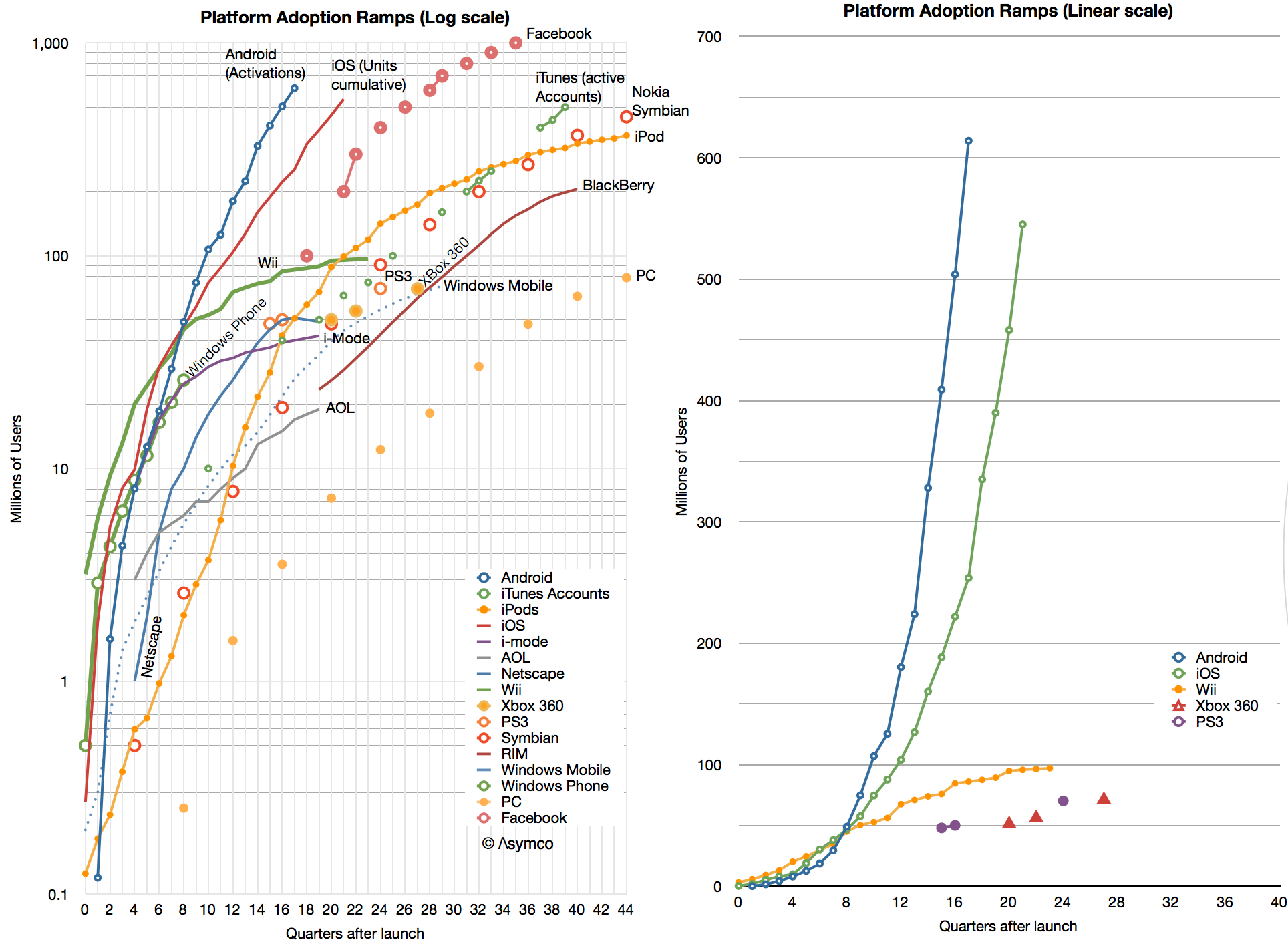
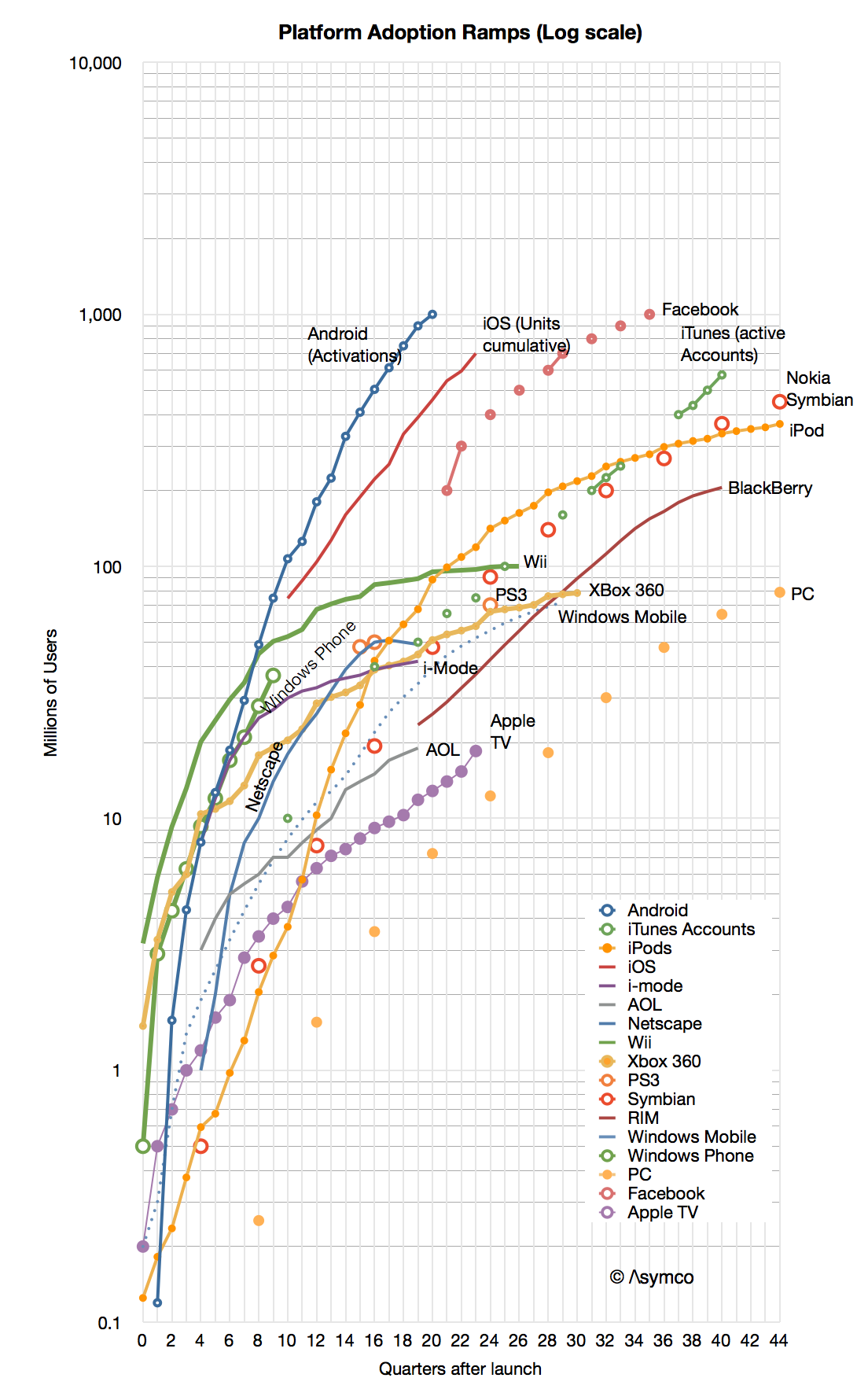
    The data is shown below.

    Screen Shot 2013-01-16 at 1-16-2.11.50 PM

    I kept the scale to about a decade so that individual lines can be resolved. As a result, you'll note that although Windows reached one billion first it did so slowly enough to be off the scale shown. Indeed, the "race to a billion" should be titled  "The race to one billion users in less than a decade".

    In such a competition, the winner would be Facebook which, in October 2012, 35 quarters after launch, reached the finish line. The second looks to be Android (probably this year) and the third iOS (sometime next year.)

    That may sound like the end of it, but what the graph also shows are the more subtle trends:

    • Game consoles seem to saturate at below 100 million total. One can see the difference in ramps between recent mobile platforms and consoles in the second chart. There might be implications for which platforms will end up dominating the entertainment industry. There should also be some explanations of why consoles are so limited.
    • iTunes accelerated with iOS and left the iPod behind. This is unsurprising but it shows that a content platform can be more flexible than one attached to any particular device or architecture. An important lesson perhaps for those in the content businesses.
    • Early mobile platforms like Nokia's Symbian, RIM BlackBerry and Windows Mobile have faded indicating that there was no early-mover advantage in platforms. The same can be said for early PC platforms.
    • Windows Phone began by tracking the Android/iOS ramps but seems not to be accelerating into its second year in a way that implies potential parity.
    • Although Facebook did reach 1 billion rather quickly the slopes of Android and iOS indicate that they may overtake it in overall ecosystem size.

    One billion is significant in several ways: First, because it is the "high-water mark" set by Windows and signifies what a global platform needs to become to be essentially "universal". Second, because it implies sustainability. A threshold perhaps from which network effects are sufficient to sustain (assuming some switching costs and an ability and willingness to adapt e.g. software, content or time investments from users.) Third, because it implies sufficient value to the ecosystem (assuming a monetization mechanism exists e.g. Windows software developers and IT managers.)

    Looking beyond this milestone however, there is no reason why it should be thought of as a barrier. Mobile connections number over 5 billion and computing is likely to reach most of them. Therefore one billion may turn out to be only 20% penetration. In fact, I expect this series of posts will need to be updated in 2013 as "The race to two billion."

  5. 5by5 | The Critical Path #41: Contextual Inquiry

    Podcast · 2 comments

    Dan and Horace talk about the distinction between what Facebook is and what its value is perceived to be. We touch on both the opportunities and the challenges for social media and how these are reflected in the IPO. We note how and why Facebook integration in iOS might happen. Horace has a few words about China, WWDC, and the future of apps on TVs. It's all about context.

    5by5 | The Critical Path #41: Contextual Inquiry.


  6. The end of the dedicated portable device

    Research · 67 comments

    On October 27th, Nintendo published half year results for the fiscal year ending in March 2012. Management stated that the company lost over $900 million with a negative outlook. Nintendo cited weaker than expected sales of Nintendo DS hardware and 3DS software and Yen appreciation as the main reasons for the miss. Is this the end of Nintendo?

    Before we look more closely, here is a quick summary: The company is exclusively involved in selling game hardware and software. Their console platform is the Nintendo Wii, which will be followed by the Wii U late in 2012. The Nintendo DS and Nintendo 3DS are the company’s portable game consoles. The Wii and the DS are nearing the end of their product cycles. On the software side, the company is known for gaming titles such as Super Mario and Zelda. Nintendo also pioneered the licensing model to allow third-party developers to produce games for its hardware products.

    A closer look

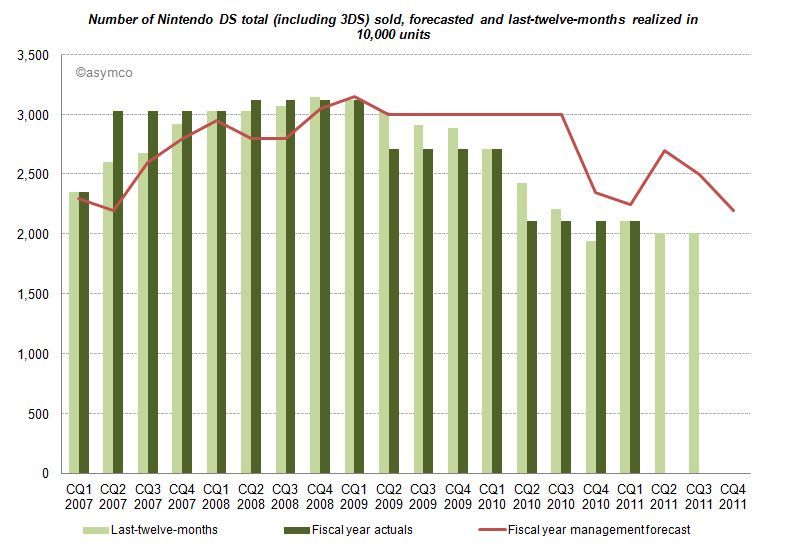
    The good news for analysts is that Nintendo publishes their estimates for hardware and software unit sales. This allows us to measure management predictive accuracy. The red line (management forecast) should be as close as possible to the dark green pillars (realized unit sales in the fiscal year).

    Until CQ1 2009 devices sales grew in excess of forecasts. A similar pattern can be found for consoles and game titles. After Q1 2009 forecasts have been always higher than results, and more worryingly, the deviation between forecast and sales is widening. Management missed and lowered forecasts for two consecutive years. Management's hope for an increase on the back of initial 3DS sales in the launch quarter (CQ1 2011) did not come to pass and they subsequently lowered forecasts again in the following two quarters.

    Looking at all categories, management lowered forecasts almost continuously. The deviation remains the largest in the portable hardware business segment indicating that management was largely surprised about the development.

    What caused this reversal of fortune?

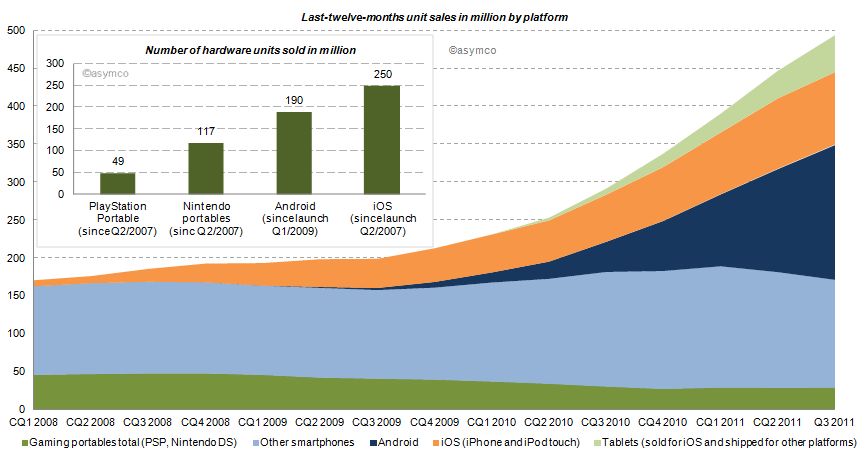
    Two years earlier the iPhone had launched and by CQ1 2009 iOS reached an installed base of about 38 million, half the number of Nintendo portables in the same period. Furthermore, in CQ1 2009 Android phones came to the market. Smartphones (light blue area of the chart below) sold before (and after) the debut of iOS, but the iPhone redefined the category and an avalanche of smarter phones running iOS and Android followed (blue and orange area). Portable gaming devices from Nintendo and Sony declined ever since: 17% in 2009, 31% in 2010 and already 16% in the last twelve months.

    How do the game players stack up?

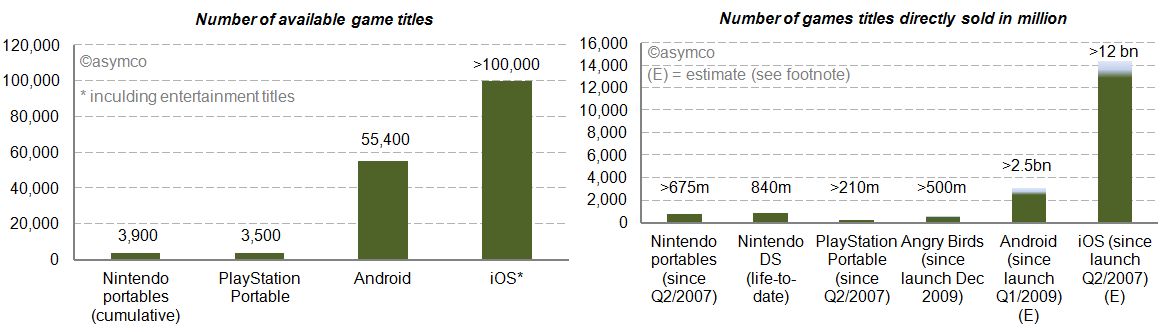
    We already looked at the installed base in the chart above. iOS and Android have outsold Nintendo portable units by a factor of 2.1x and 1.6x. Furthermore, we can see (in the charts below) that the two main mobile platforms have 14 to 26 times more game (and entertainment) titles available. Nintendo and Sony also publish unit sales of directly sold software titles. For Android and iOS we know the cumulative app download statistics. By taking the share of Septembers’ paid and free app downloads as a proxy, we can conclude that also by this measure Android and iOS dwarf Nintendo and Sony [1]. The reach of iOS and Android is further underlined by the more than 500 million downloads of Angry Bird game titles - first released only two years ago - for any platform having sold more than twice the amount of Sony’s cumulative portable game titles and almost as many as Nintendo’s cumulative games titles since Q2/2007.


    Who else has skin in the game?

    Besides Nintendo, Sony, Apple and Google, who else is making a push into mobile gaming? Before investigating, let’s first have a closer look at Sony. Sony, just like Nintendo, is also active in stationary gaming segment with the PlayStation franchise. The Sony group also has access to entertainment most notable through Sony Pictures Entertainment and Sony Music Entertainment. Furthermore, Sony recently decided to buy Ericsson’s stake in the mobile phone joint-venture Sony Ericsson and is making a push with Android to bring its gaming titles as a differentiator for its own products to the platform. And the other major suspects? Microsoft, also active in the stationary gaming segment with its Xbox franchise, is pushing to bring the Xbox experience to mobile phones with Windows Phone. Amazon has retailed software and games for years and has started to distribute software and games via direct download on its own Kindle devices but also for the Mac. On the Kindle, Amazon is relying on a forked Android version on which it leverages its eBook and other entertainment assets. And then there is Facebook, a social network that wants to be on any platform or device. Out of 800 million users, 350 million access Facebook via a mobile device. Around 50% of Facebook members play games on the desktop. With Project Spartan, Facebook is aiming to bring the desktop experience to the mobile device including a stronger focus on gaming and video.

    The competition between Apple and Google is already asymmetrical. Including the other contestants in the competitive landscape reveals Nintendo’s key weaknesses in the portable gaming market: attraction as a platform for developers in terms of ease and reach, pricing of hardware competing with operator-subsidized mobile phones and the jobs-to-be-done or value preposition. The new generation of mobile devices is standing against Nintendo’s dedicated approach. Although slowly adding features such as a browser and “app store” to its portables, Nintendo devices fall short in the variety of jobs-to-be-done compared to smartphones, let alone making a call.

    Average selling prices and financial impact

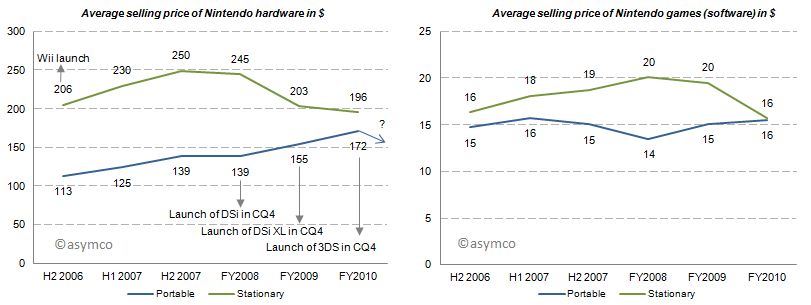
    With this market pressure one would imagine that average selling prices decreased for Nintendo portables. But for the last three fiscal years average selling prices for portables have increased, all things equal, mainly due to new product launches. Game title’s average selling prices have remained relatively flat. Note that these are wholesales prices for hardware and a mix of retail and wholesale prices for games. In 2011, for which we do not have data yet, the price of the newest portable, Nintendo 3DS, was lowered from its U.S. debut of 320 250$ in February to 170$ in July which will have a negative impact on ASP going forward.

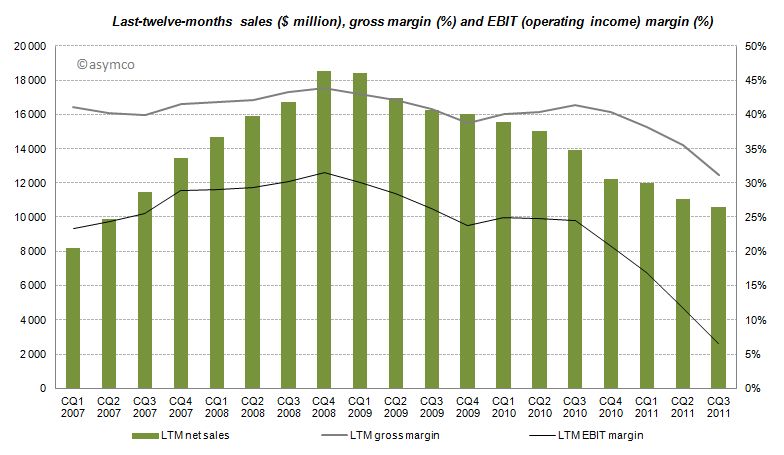
    The effects of Nintendo’s rigid strategy and the fast changing competitive landscape are manifested in the devastating financial performance over the recent quarters with LTM sales, gross margins and EBIT margins declining starting from CQ4 2008 and even accelerating to decline after CQ3 2010.

    Furthermore, even though the company has recognized its own difficulties, Nintendo has no intention of adjusting its strategy:

    CEO Iwata on the question of whether Nintendo plans to bring its game library to other platforms:

    This is absolutely not under consideration. If we did this, Nintendo would cease to be Nintendo. Having a hardware development team in-house is a major strength. It’s the duty of management to make use of those strengths. It’s probably the correct decision in the sense that the moment we started to release games on smartphones we’d make profits. However, I believe my responsibility is not to short term profits, but to Nintendo’s mid and long term competitive strength.

    Although realized and obvious, the disruption’s invisibility is often manifested in the paralysis of the incumbent.

    Conclusion

    According to Isaacson, Steve Jobs apparently always worried who could eat Apple's lunch. The lunch of the iPod, he concluded, was ripe for mobile phones. Subsequently, Apple entered the mobile phone space. Google followed. Since then more powerful mobile phones have eaten the lunch of the dedicated gaming device. The jobs-to-be-done and their priorities in people’s life have not changed, but the tools people use to get them done have. Permanently.

    ---

    Notes:

    1. Estimated by multiplying total cumulative app downloads with September’s share of game downloads: For iOS ranging from 72-80% based on Top 150 free and paid app downloads, for Android ranging  from 38-47% respectively. This is a very crude estimation, but the gist of it is that 4% for iOS and 11% for Android game downloads as percentage of cumulative app downloads would outsell Nintendo.
  7. Facebook to Enter Mobile Phone Market in 2011

    Research · 25 comments

    Despite being based on Android, a Facebook phone would be competition for Google as much as it is for Apple. Google benefits from ad revenue tied to their search and other services which would likely be supplanted by Facebook services on a Facebook-based phone.

    Facebook to Enter Mobile Phone Market in 2011 - Mac Rumors. I wonder if Facebook devices, or Verizon Bing devices will be counted by Google as Android activations.

    See also: asymco | Is a Facebook phone destined to be a Vanity smartphone?

  8. Is a Facebook phone destined to be a Vanity smartphone?

    Research · 4 comments

    What do Palm, Kin, Nexus One, and the Simon have in common?

    Beside being market failures, it's the fact that they were efforts by large companies that had no business in smartphones. What's more important is that the motivation for participation was not well thought out.

    HP, Microsoft, Google and IBM tried (or are still trying) to capture a piece of the hardware revenues from smartphones, but their results were dismally poor. It turns out that with the exception of RIM, HTC and Apple, there have been no smartphone entrants which have succeeded against the incumbent voice phone makers.[1] Furthermore, Apple is the only large technology company to succeed. Studying the efforts that the successful entrants undertook shows that (1) it takes a very dedicated effort, led from the top, and (2) it takes a lot of capital or a lot of time. Those who tried and failed were not dedicated to the concept at a high enough level and were not patient enough for growth.

    I think the real motivation to enter the market is rooted in vanity: appealing to the need management to feel a part of something new and important. If you are an ambitious internal champion skilled in political maneuvering, it's fairly easy to appeal to this vanity in order to secure funding for these efforts.

    This string of vanity-induced failures is not likely to end anytime soon. No doubt Dell will keep trying with the Aero, and we might see the PC companies rush in again as they did with PDAs.

    We also hear today of the evolution of INQ's product (INQ Social Mobile) into some sort of Facebook phone. However, is the Facebook phone project a vanity phone? Maybe, but the counterpoint is that this is not likely to be a smartphone. It's more likely to be a feature phone and, as such, it's not attempting to be something so grand or vain.

    The real comparison might be to the Kindle. A specific, purpose-product built by the most motivated and best-positioned service provider. The Kindle has had some (unspecified) amount of success because it was developed to light specs and with a well-established distribution channel (amazon.com).

    So although the motivation might be more sound, the challenge for Facebook will be the same as for Google: distribution. At the end of the day, without operator support the product will still remain a niche.

    [1] I note here that Android and Windows Mobile are not phones but platforms and this article deals specifically with hardware.

  9. FaceTime and the elevation of emotion over function

    Research · 8 comments

    With 50 million clients installed likely this year, FaceTime is a service which may have potential.  By potential I mean, of course, its potential to make a dent in the universe, the universal goal Jobs has set for Apple so many years ago.

    It's entirely possible that FaceTime will be an inconsequential nice-to-have enhancement to the iPhone platform that sustains and improves the iOS (and OSX) franchise. But it's also entirely possible that FaceTime could become a disruptive challenger to the functional voice-oriented telecom network.

    What you choose to measure determines what you know

    The thing that jumps out at me is the service's under-performance along metrics that the industry defines as critical but over-performance on dimensions that the industry considers non-critical.

    It suffers from poor coverage (WiFi only), a limited network of possible users, high bandwidth requirements which are still hard to match and a steep price point for initial entry.

    But I would say data-oriented devices were similarly met with poor performance 4 to 5 years ago. No 3G, poor coverage, few services and high prices. Even today there are many telecom skeptics who think smartphones are toys for the well-to-do or IT types and not something for the mass market.  As can be easily seen however, all the shortcomings of the mobile-data-oriented-device (aka smartphone) turned out to get ironed out with time. You just need to plot a historic graph of network performance and device price points to see where they're going to go.

    On the other side of the equation FaceTime offers huge performance on the dimension of emotional attachment to a device and to a conversation. The FaceTime experience is qualitatively distinct from either desktop video chat or device-based VoIP. It's intimate, emotional and stirring, (just look at the commercial) not to mention accessible by just about anyone. These new measures of performance cannot yet be quantified with spreadsheets and measuring the effect will not be a priority for anyone in the industry for a long time to come. Therefore, the asymmetry is there implicitly.

    So here we have classic Apple: shifting of the basis of competition so subtly that it's almost imperceptible while under way yet glaringly obvious after the fact.

    So what does FaceTime have to do with FaceBook?

    When FaceBook launched, I don't recall observers predicting that a site allowing college students to keep track of their friends after graduation would grow into the stickiest site by time spent online ever seen. Nor that it would become a site that swallowed all online communications including IM and email. Nor a site that would possibly challenge search consumption. The performance attributes that FaceBook relied on were not in algorithms but in the emotional hooks that relationships have with people. FaceBook was personal, emotive and private, the exact opposite of what the Web offered a decade ago.

    So, like the names imply, both these services are about Faces, the first objects we as humans recognized after birth. That's a powerful image to have a handle on.

    The pattern that emerges is that Web 2.0, Telecom 2.0 and Personal Computing 2.0 will pivot on the elevation of emotion over function. That may be a banality but empires have been built on less.