Asymco

Asymmetric Intelligence

good enough

  1. The Android (in)adequacy: How to tell if a platform is good enough

    Research · 97 comments

    About 10 years ago I met an advertising executive in New York who explained the difficulty of advertising a new brand of deodorant to consumers. “Most people never change their deodorant,” I remember him saying. “They pick one brand when they are young, and stick with it for a long, long time. If it works, why switch?”

    The same theory can be applied to customers who are making the switch to smartphones today. Once they have picked a type of phone, whether it’s Apple iOS, Google Android or something else, it’s difficult, and often expensive, to switch. Consumers become comfortable with the interface and design of the phone and the apps they have purchased on that platform. If it works, why switch?

    Many Smartphone Customers Are Still Up for Grabs - NYTimes.com

    This quote says a lot. The notion that customers remain captive to a platform is well understood. After all, it seems impossible to get people to switch out of Windows (or Mac or iPod). Platform vendors are aware of this as the land grab for users seems to be running at full pitch.

    However, there is a critical condition described in the quote above: "If it works, why switch?"  The condition which keeps users loyal is that the product they chose is good enough--i.e. "it works." That's a symptom of over-service and commoditization. If a product, like deodorant, is good enough you won't be tempted to move to another brand even if it's marginally better since the new brand has switching costs in the form of uncertainties ("Will it be as good? What if I don't like the smell? etc.) People are inherently conservative and you can't compete with comfort and familiarity by launching a marginally better product.

    So with that in mind, why is it that millions are switching mobile platforms?In this blog I've cataloged the massive shifts occurring away from mobile platforms that have been around for years with deeply entrenched user bases. Microsoft's Windows Mobile, Nokia's Symbian, Palm's PalmOS and RIM's Blackberry have collectively lost tens of millions of users. A net of half a million Blackberries are being abandoned in the US every month.

    So we would need to say that the condition of "it works" or being good enough was not met with those platforms. The attraction of something better is clearly greater than the switching cost.

    So this highlights a good test for how to tell if smartphones are good enough: If users are fiercely loyal with a given platform then it's probably good enough but if they are willing to switch (i.e. disloyal) then it's probably not good enough. It seems like a trivial observation but it's a very important clue to the bigger question of whether we can "call the end" of the market. Just like it would have been premature to call the end in 2006 when Symbian and RIM seemed unbeatable, it will seem premature to call the end now in the event that a significant innovation is yet to appear.

    The correct calling of the end has profound investment implications. Do you (like Microsoft) invest billions in a new platform if you know that there is no more room for entrants? Should Samsung bother with Bada or HP with WebOS if the game is already over? Even more, should Apple even bother to improve iOS if they have no shot at switching a billion likely Android adopters. Why not just nurture the current installed base and work on building walls and moats around them?

    So with this hypothesis in mind, it makes sense to analyze whether Android or iOS, the current presumed champions, are "good enough" on the basis of how often users switch out of them. My bet is that neither is good enough and that there will be increasing churn between platforms. I imagine that Android is less sticky (and hence less than good enough) based on app consumption but there is little evidence of churn because most phones in use have been bought less than one device generation ago. More importantly, there have been few opportunities yet for switching as many Android buyers don't even have the choice of other platforms either due to where they live or how much income they have available.

    To really tell where we stand, we would need to collect stats on switchers to know just how satisfactory the platforms may be. Remember that a choice of a new deodorant on the same shelf at nearly the same price is the test for loyalty. For an adequacy test we need to see better distribution and more choices for consumers. It's still very early even in the US for any conclusions to be drawn about the adequacy of Android.
  2. The iPhone at four; growing up or just growing?

    Research · 74 comments

    Ever since the iPhone launched four years ago (to the day), the question on everyone's mind has been: When will Apple expand the portfolio to reach into all market segments? I remember thinking in 2007 whether it would be in six months or a year that they would create a "mini", "nano" and "classic" line-up which served them so well with the iPod.

    Apple however took a different approach. To their credit, they focused on the platform and built a consistent experience around a fixed screen size to nurture an ecosystem. They also improved the power of the device so that experience would improve to be better and more robust. In other words, they treated every iPhone as not being good enough, needful of every megahertz of power, every pixel of screen and every minute of battery life. They polished the OS constantly and added APIs by the thousands.

    In other words, they acted like a computer software company, not like a "device vendor" or like a handset manufacturer which was everyone's (including mine) frame of reference.

    Having expanded from iPhone to iOS and built the platform into non-cellular centric computers like iPad and iPod touch, they clearly showed a nonchalance about the operator channel and the amplification power it offers (an amplification which comes with a hefty price of dependency and strategic illusion.)

    But the mind always wonders back to the question of portfolio. Now that the product is maturing, the hardware is getting nearly "good enough". Perhaps even Apple might now consider letting go of the "frontier" of what's technologically possible and consider expanding its reach to the broader audiences it has willfully kept out of reach.

    And broad they are.

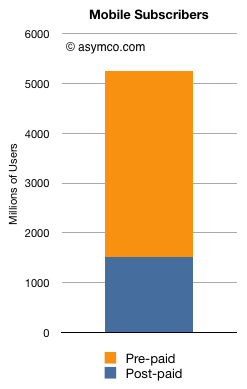
    Based on data published by Deutsche Bank and the ITU, we can calculate roughly how many customers Apple's current iPhone positioning has left unserved. I chose to use pre-paid/post-paid split as a proxy for unaddressed/addressed. This is an imperfect proxy but a pretty good one as most pre-paid subs see a full price for the iPhone (retail around $700 to $1000) vs. post-paid customers seeing a price of $200 or below. The $200 happens to be an important psychological price inflection point where volumes increase dramatically.

    The first chart shows the global split between pre-/post-paid subscribers as of 2010. Roughly 1.5 billion are post-paid and 3.7 billion are pre-paid. That means that nearly 70% of the world is not being addressed by the iPhone as it currently stands. Put another way, a shift in positioning might result in a 250% increase in addressable market.

    Tim Cook alluded to this in the last conference call when he said pre-paid markets, especially in China, are huge with share figures "starting with a nine". He also said separately that they would not be ceding any market--a hint if there ever was one, given the broadening of Android into previously feature-phone price bands.[1]

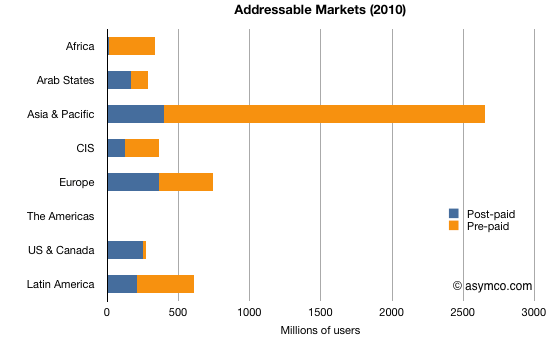
    We can even see the situation more clearly on a regional scale. The following chart shows the same pre-/post-paid split by region.

    You can visualize the iPhone having spent the last four years penetrating into the blue areas of the chart through the expansion of carrier agreements. With half the US & Canada area being finally filled in this year, most of the blue is now more-or-less within reach.

    Given the constraints on production, and given the improvements in the product and the improvements in the hardware (learning curves and price points) it may mean that Apple could finally be turning its attention to those orange areas.

    The time may be soon at hand that maturity coupled with limits of organic growth are leading the four-year-old iPhone to finally be re-defined as more than a post-paid skimming entrant. It may be time for the iPhone to more than just grow. It may be time for it to grow up and take on the whole market. Five billion people are waiting.

    ---

    Notes:

    1. Contrary to a commonly held belief, Apple does not shy away from market share. In the case of the iPod and even the original Apple 2, the company sought and obtained the top share ranking. In fact, the decision to pursue share vs profit is "context sensitive". Steve Jobs, at least, thinks so.
  3. Pattern recognition for smartphone investors

    Research · 42 comments

    I spent the last few days in Hong Kong at a conference discussing the smartphone industry. The participants were mainly investors or investment managers. One of the most frequently asked questions was how to spot investable trends in this notoriously unpredictable sector.

    The data I presented did not offer much of an answer. If anything, it showed just how much the industry has changed and how unlikely it is to remain a facsimile of what it is today.

    But theory allows us to still make some bold claims. Grounding your investment thesis in pattern recognition rather than extrapolation should be the better strategy. So here are the telltale signs I recommend watching for investable ideas.

    1. In hardware look for what's not good enough. The smartphone is great. But it's not good enough for many jobs that we can recognize with little effort. For example, smart devices never seem to have enough battery life. Storage, screen quality and speed are pretty good, but battery life is worse than what voice phones offered years ago. Companies dedicated to improving battery technology or charging technology should be worthy of a bet. Breakthroughs in power saving will be much more valuable than breakthroughs in storage or processing speed or screens.
    2. Pricing needs innovation. Phone pricing is opaque, user unfriendly and often leaves buyers confused and angry. I use the word innovation instead of reduction because it's not about making prices necessarily lower, but removing complexity and defining value clearly through price. The challenge is not just for devices but for service providers as well. Companies innovating by abstracting pricing complexity will do very well. Interestingly, pricing innovation is not as easily copied as it may seem. It is often coupled with business model innovation and cost restructuring.
    3. Applications currently conform to platform needs but there will come a time when platforms will need to conform to application needs. By applications I mean not just apps but the app/service bundle that will drive consumer purchasing behavior. If we consider social media, entertainment and shopping as applications, it will make sense for those applications to eventually take some control or equity in the platforms. Android is the first sign of this: search and services associated with search and advertising sought control over platforms. Perhaps Facebook, Amazon and Baidu will feel a similar need.
    4. As a new medium, apps will eventually be more valuable than the tools used to render them. The global app brands are probably not yet born, but some day they will be as important as Disney, News Corp and Universal Pictures in their heyday. The App Store is the incubator for these embryonic megabrands.

    I realize that these are not specific enough investable ideas but casting your eye on patterns should yield better returns than selecting winners from a set of "current players".  After all the great returns from smartphones to date have come from bets on entrants (HTC, Apple, RIM) and not from incumbents (Nokia, Microsoft or Motorola).


  4. Disruptive failure: How Acer Took Aim at Dell and HP and missed

    Research · 72 comments

    Two years ago:

    With new netbooks, laptops, desktops, and, yes, a smartphone, Acer CEO Gianfranco Lanci explains why he expects to soon overtake No. 2 PC maker Dell

    via Acer Boss Lanci Takes Aim at Dell and HP - BusinessWeek.

    Today Acer CEO and President Gianfranco Lanci resigned with immediate effect. Acer is in trouble. You can read more on Acer's current problems in the wake of the downward revision of its sales targets for two quarters here: Acer Should Overhaul Its Operation: Stan Shih | CENS.com - The Taiwan Economic News

    In a nutshell, whereas Acer under Lanci took aim at Dell and HP, it seems that Apple took aim at Acer. And whereas Lanci missed, Apple's aim was true.

    What is interesting here is that Acer had a very disruptive approach. They used the low end "netbook" concept to take share from incumbents motivated to move up-market.

    But what went wrong? Part of the answer is that "low end" does not just mean "cheap". Low end disruption is about also offering simplicity and performance along a new dimension or trajectory of improvement.

    Mobile computing could not be implemented as a low-end strategy because the modules available to portable computing could not be used to make it expand into new contexts of consumption. Windows and keyboards and all the input methods associated with portables could not be adapted to mobility. You could not use a netbook in places or at times when you did not use any other laptop.

    In addition the business model was not a good match. Low margins could not support development or new integration that could improve that which was not good enough. Acer did not have the means to tackle the problems of not-good-enough mobile computing. They did not build software and low margins meant that they could not even try to build software.

    Competitors also were motivated to respond. HP and Dell built their own netbooks which, arguably, were just as good (or, perhaps more accurately, just as bad) as Acer's. But more problematic was the fact that regular notebook prices dropped to netbook levels and the category came to mean "cheap" not "convenient".

    Finally, Acer's strategy did not have the time horizon necessary for true disruption. It takes many years to polish a product and nurture it up the trajectory. Acer was too impatient for growth and not patient at all for profit.

    Contrast this with Apple's tablet strategy:

    • It dealt with complexity of computing by removing it. This was not easy as simplification required a new platform altogether--something that portable computers could not benefit from.
    • It priced low but held on to margins because removal of complexity also reduced cost
    • The margins allow it to rapidly iterate on integrated development and improve the product
    • Competitors initially were not motivated to respond. They did not have the tools at hand to respond: no integrated operating system for PC vendors, no distribution for phone vendors.
    • Apple is also patient enough to wait for several product cycles. Even though demand is astronomical, the iPad still has a long way to go to become a new computing standard. Time is on Apple's side.

    Apple is effectively disrupting the PC with asymmetry. It contrasts with Acer's reliance on a sustaining, symmetric approach. The market was showing clear signs of over-service, declining margins, in-absorbable features and performance and complexity.

    Calling the winner in 2009 may have been tough given no iPad was visible, but knowing Apple's resources, processes and motivations should have guided observers to the right answer.

  5. Who killed the Intel microprocessor?

    Research · 76 comments

    The recently announced move by Microsoft to support the ARM architecture with their Windows product, indicates something profound is happening in the market for microprocessors.

    Dr. Hermann Hauser puts in bluntly:

    “The reason why ARM is going to kill the microprocessor is not because Intel will not eventually produce an Atom [Intel's low-power microprocessor] that might be as good as an ARM, but because Intel has the wrong business model,” said Dr. Hauser. “People in the mobile phone architecture do not buy microprocessors. So if you sell microprocessors you have the wrong model. They license them. So it’s not Intel vs. ARM, it is Intel vs. every single semiconductor company in the world.”

    via Intel Microprocessor Business ‘Doomed,’ Claims ARM Co-Founder - Tech Europe - WSJ.

    To make sense of that you have to step back and look at what's been happening in microprocessors and how mobile computing is affecting the whole processor value chain.

    The first observation to be made is that, as Dr. Hauser points out, ARM licensees use a different model than Intel. The development of an ARM-based microprocessor is done in a modular way; in contrast to the integrated way that Intel builds their products. ARM supplies a license, and designers build the chip adding various other circuits like Bluetooth or music decoding on the same silicon as the processor creating so-called SOC (system on a chip). Nokia has been doing this for years and Apple began doing it recently with their A4 SOC.

    The design is then sent to a fabricator who actually manufactures the chip (TI and Samsung are some of the bigger ones), often in smaller batches than what an integrated vendor produces.  SOC fabs need to be much more flexible in their production and are much more sensitive to the needs of their customers, the designers.

    In contrast, Intel has a proprietary microprocessor architecture that is not available for licensing and they have their own designers and their own fabs to build chips that they sell from a catalog to device builders. PC or device vendors only get to use what Intel offers and there is little in the way of customization (In a rare exception Apple famously forced Intel to modify the packaging of the first CPU fitted to a MacBook Air.)

    Because of the differences in business models, the markets for SOC and microprocessors are diverging rapidly with subsequent business model priorities becoming completely asymmetric.

    To illustrate, I draw upon an observation[1] that due to Moore’s Law, every year, through the equipment they deploy (e.g. from Applied Materials) fabs make 60% more transistors available on an area of silicon than were available the prior year. Intel almost always takes advantage of this by making more cores or adding more cache.

    But if you look at the ability of SOC designers to utilize transistors, they are only able to utilize 20% more transistors than they were the year before. The reason is that they have constrained design budgets; they don’t have enough money or time to design circuits that are complex enough to utilize all the transistors that Moore’s Law makes available. Plus, when it comes to devices, they don't need the power.

    What that means is, for most of the volume applications in the world, circuit designers are actually awash in transistors.  They are being over-served by the advances in fabrication equipment. However, Intel designers aren't. Being at the very high end they still need even finer line widths and demand that Moore’s Law take the next step to that next leap of technology.

    What value chain evolution theory would then predict is that circuits which had to be proprietary and interdependent in their architecture are following an over-service path. In contrast, to serve the needs of SOC designers, fabs, as suppliers, will have to change their pitch for winning new business to being fast and flexible and responsive and to being able to deliver systems on chips that offer every device exactly the functionality that they need and none of the functionality that they don’t need.

    Now in the world of mobile computing (and almost any situation where logic gets embedded in a system) it’s the device itself that is not yet good enough and, therefore, you cannot back off from pushing all the components to conform to your device's purpose.  For a device to be competitive it has to be optimized with a proprietary, interdependent architecture.  That means that the processor inside of a BlackBerry or an N8 has to be modular and conformable to allow the system to be optimized.

    This is a quirky idea so I'll repeat it: since the device is not good enough it has to be integrated, including the processor, which being good enough, has to be conformable. The processor has to bend to the will of the device market not vice versa.

    This then puts Dr. Hauser's point in perspective: a modular business architecture for microprocessors is a necessary condition to being successful supplying devices. The corollary is that Intel's integrated business model is obsolete in a device world. No amount of polishing of the Atom will help.

    The root cause for this obsolescence is the over-shooting of Moore's law when processing power (and hence circuit density) is superfluous while power consumption, size and flexibility of design are straining to eke out any improvement.

    So this renaissance of ARM is happening now because Moore’s Law has overshot what most circuit designers can utilize. And that overshooting is happening because mobile computing products don’t need a multi-core multi-gigahertz processor, allowing designers to back away from the frontier of what's possible.

    What it culminates in is that the places in the value chain where attractive profits can be earned are migrating in a very predictable way: away from Intel and toward ARM.

    So in a perverse way, it was Intel founder Moore's law that killed the Intel microprocessor.

    ---

    [1] This discussion is inspired by Clayton Christensen's "Capturing the Upside" presentation at the Open Source Business Conference 2004-03-17. Although taking place nearly seven years ago, Clay's vision regarding the future of the microprocessor was astonishingly, though perhaps unsurprisingly, prescient.

  6. The PC clones of the post-PC era

    Research · 28 comments

    Since I spend most of my time thinking about what will happen, at the end of each year, rather than looking forward I like to look back to see how wrong I've been. The great thing about being wrong is that you learn something. Especially if you use a foundational theory to tie concepts together. Theory building is all about finding anomalies that adjust and improve it.

    Fortunately, exactly one year ago, on December 30 2009 I wrote an article asking if Android was disruptive. It turned out to be the right question to ask for 2010.

    What have I learned since?

    My main argument in late 2009 was aimed at the reaction of the recently launched Nexus One. A product hailed as disruptive to mobile operators. I did not see it that way. In that respect I was right. The distribution juggernaut any phone platform faces stopped the Nexus One dead in its tracks.

    I wrote:

    Here’s the problem: since mobile broadband is by all accounts not good enough, it cannot be disrupted. Operators are very critical in building out this new mobile computing future and they are investing and will reap rewards. Bitpipe models will only emerge after 4G when there will be ubiquitous high speed networks and competition will shift away from coverage and more to price and convenience of plans.

    What is happening instead of operator disruption is that mobile voice which is more than good enough is being disrupted. Businesses built around mobile voice (e.g. handset vendors who have not developed a viable business model around data) will simply evaporate and their profits will condense around entrants who have mobile computing platforms.

    So the operators are as strong as ever. But the Android platform lived to fight on, regardless of the Nexus one. And it grew in ways I did not anticipate. I had expected integrated players to maintain a large share because they would be able to improve the product more rapidly than modular vendors (and assuming that the product needed improving).

    Google is moving on this opportunity but they are not executing in a way that ensures they control the future platform due to the their being on the wrong side of the modular/integrated dichotomy.

    So Android grew but it's not yet creating profits. It is perhaps laying the foundation for future profits and defending existing profits for Google but it is not yet a big profit center[1]. That is a cause for worry. Disruptors need to be hungry for profits and patient for growth.

    I concluded:

    Android will disrupt but I expect it will take 10 to 15 years. The life cycle of a new global network generation rollout is about 10 years. We’re in the middle stage of the 3G cycle that traces its beginnings to early this decade. 4G will take another 10 years.

    Given what's happened this year does this forecast still hold?

    Mainly yes. I stand by the notion that operators will be in the driver's seat for a few years to come. However Android has grown in an unexpected way: adoption by unbranded or relatively unknown vendors selling in emerging markets.

    The Grey (market) Elephant in the room

    Until 2010, it was very difficult to sell a phone without a recognizable brand. This is because brands helped overcome purchase anxiety for those buying a device for the first time. Brands mean trust and the lack of brand meant risk. Those who cannot afford to make purchase mistakes are more likely to lean on brands than the affluent.

    But 2010 has seen a shift away from device brand value and more toward platform and function value. This shift was largely unforeseen and is very disruptive.

    The fact one in three phones are sold from "other" unbranded vendors like ZTE, Huawei and G'Five is a bombshell. Right now they're all selling voice products, but I predict that will not last long.

    All those vendors are likely to adopt Android and in doing so will explode the low end of the market. They may even crush the branded voice-oriented market.

    This growth can be slowed by operators but market forces will be very strong. These devices sell in grey markets and are often unlicensed, unbranded, untaxed and unregulated (and may even be illegal due to the absence of IMEI numbers).

    So this is the real wild card for 2011: unbranded devices running Android could be the PC clones of the post-PC era. Will this phenomenon last or will the brands fight back? If they fight, the only weapon they could wield is innovation.

    ---

    [1] Mobile efforts at Google are generating over $1 billion in revenues per quarter however these efforts include various other assets including AdMob which was acquired for $750 million. Furthermore, the headcount for Android and these other efforts is not small. I've heard as many as 3000 people are devoted to Google's mobile efforts.

  7. Why the Mac keeps growing

    Research · 63 comments

    When the iPhone vs. Android rhetorical war heats up, both sides bring up the history of Macs vs. Windows PCs. The commonly held thesis is that Windows triumphed as the PC was commoditized (and modularized). This triumph was at the expense of the over-serving and over-priced Mac.

    This is a largely accurate view of what happened during the 90s. But the problem with this thesis is that (1) the PC's job has been slowly changing in the last decade (2) the Mac keeps growing faster than the PC and (3) Apple keeps capturing a vast portion of the profits in the PC industry.

    These anomalies or contradictions to the thesis imply that something changed. What changed and can these changes turn the tables on the market and create an opportunity for a new computing disruption?

    The PC of the 90s was hired first by companies as a productivity boosting tool and second by consumers as a way to duplicate their work productivity and communications in their personal lives.

    However something changed with PCs when the laptop became "good enough". With portable computing, the job the PC was hired to do evolved. It was more important that the product be well designed (for aesthetic value, usability and reliability) than just fast and spacious. The microprocessors were plenty fast but what mattered more was low power consumption, a low profile and tighter integration with software.

    The product was also purchased in a different way. A desktop could be purchased on specs alone, sight unseen, from a catalog. But a laptop had to be touched, hefted and the screen had to be observed and the whole design contemplated before a purchase decision was made. The product had an integrated keyboard, display, touchpad and storage. It was not easily serviced by end users. It was, in a word, re-integrated.

    You can see how portability changed the job and therefore everything else as well. Consumer tastes became important, retail distribution became necessary and R&D resources had to be applied to solve what was no longer good enough: the whole package.

    Vendors which did not prioritize design, retail and R&D were left flat-footed.

    At the same time, systems software became more commoditized and productivity software became portable. The old measures of performance were being over-shot while the new measures of performance were under-served.

    While this shift was underway on the hardware side, Microsoft continued to improve their product to serve more demanding business productivity jobs. Their software was not getting optimized for this new portable consumer job. They left the new market open to disruption.

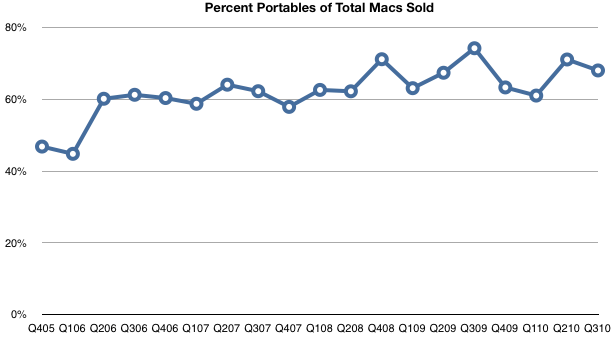
    In stepped the MacBook with good enough (and improving) office productivity. With excellent appeal along the dimensions of performance consumers demand most of all. It was priced higher than other laptops but the price points were affordable and, inflation-adjusted, lower than they'd ever been. It should not be a surprise that Apple was one of the first vendors to see its portables line become bigger than its desktop lines. The market evolved to the point where what Apple had was what the buyers needed.

    The shift to portability is a compelling story for Apple as disruptor in the PC market. It may not result in a complete reversal of the PC hegemony but it allows Apple to grow a product line at triple the growth rate of the market. A market that was considered completely dominated by entrenched incumbents with an unbreakable profit formula.

    But with the iPad Apple is clearly also aiming at disrupting the Mac (and, transitively, the PC as a whole.) The iPad can be seen as an evolution toward seamless portability; the mobile computing paradigm shift.

  8. Is the smartphone a commodity?

    Research · 42 comments

    People throw around the idea of things being or becoming "commodities" but there is little clarity about what "commodity" status implies.

    If you look up the word, it has nothing to do with technology or innovation. In economics, a commodity is something that is substitutable (fungible) and roughly equal to competing versions of the same thing. A mineral good (oil) or agricultural product (pork bellies) is roughly of equal value regardless of where it comes from or who produces it. Commodities also have very liquid markets and are therefore easily priced according to demand.

    Commodities have a "fixed" quality which cannot be and most likely never was improved. It's a product that is essentially frozen in terms of innovation.

    But in technology and especially in terms of complex, rapidly improving and evolving products with uneven distribution a commodity is not easy to identify and there can be a lot of arguing about what is and isn't.

    So here is another way to define it:

    In terms of innovation, a product can be defined as a commodity if it reaches a point where improvements do not create additional value. As the product gets better, it reaches a point where customers can no longer absorb the improvements and therefore they become unwilling to pay for them. Thus the price of the product cannot be increased or maintained in the face of competition.

    In other words, you can't get a premium price for a better product.

    If you can't improve the product, one consequence is that you can no longer differentiate it. Becoming commoditized is a natural result of the improvement of a product beyond the customer's ability to utilize that progress.

    So we're back to the debate about whether a product is good enough. You can argue that commodity status is that point where it over-shoots the market. Before that point is reached the product can obtain a price premium for technology innovation. After that point, the product becomes a "commodity".

    How does this relate to the mobile market today? Again, it's important to ask what is the basis of competition. Is hardware not good enough? Is software? Or is the whole widget?

    For those who say that smartphones are commodities, they have to also account for the inevitable consequence: that improvements will not be valued and hence will not be implemented. It also means that profits will evaporate from the current incumbents to new models of profit capture.

    This is the essential argument for Android. But I'm still struggling with what the argument implies. That the product as it exists today is all that will ever exist.

  9. Law of conservation of modularity

    Research · 32 comments

    When I applied the modularity dichotomy to smartphone operating system there were several implications that came to light. One was the question of whether the market has reached the point where products were "good enough" and the speed of innovation became less important than price. Another was: will integrated vendors be able to hold on to a healthy share of growth against non-consumption?

    Now I bring up another implication of modularity: the concept of "law of conservation of modularity".

    Clayton Christensen illustrated this as follows[1]:

    If you are writing a software application to run on top of a platform, are you permitted to modify the platform to make your application run better?

    If the platform is interdependent, changing it could cause unintended side-effects and you will not be allowed to make them. If the platform is modular, changes are possible and you will have access to the code.

    The reason is not not political. It's that in the case of interdependence, the application has to be suboptimized and conform itself to the platform so that the platform could remain optimized (to its goals). The platform needs to remain optimized is because it needs to keep improving (since it's not good enough).

    In the case of modularity, the application can be optimized and the platform can conform itself to the application because the application needs to keep improving while the platform is good enough and does not.

    Conformability is what constrains up-market progress.

    This also holds in hardware architecture. This was plainly evident in the WinTel era. During that time the microprocessor and the operating systems had a proprietary and interdependent architecture even while Dell’s product has a modular architecture.

    So the microprocessor wasn’t good enough. That meant that the desktop computer had to have a modular architecture to conform itself in order to allow this to be optimized because the line widths on the circuit were not good enough.

    This is what is meant by conservation of modularity: one side or the other of an value chain boundary needs to be modular and conformable to allow what’s not good enough to be optimized. The key question is what's not good enough: the device or the platform (the whole or part?)

    How does this apply today in the post-PC era?

    If you think about it in a hardware context, because historically the microprocessor had not been good enough, then its architecture inside was proprietary and optimized and that meant that the computer's architecture had to be modular and conformable to allow the microprocessor to be optimized. But in a little mobile computer like the smartphone, it’s the device itself that’s not good enough, and you therefore cannot have a one-size-fits-all Intel processor inside of a BlackBerry or iPhone, but instead, the processor itself has to be modular and conformable so that it has on it only the functionality that the BlackBerry needs and none of the functionality that it doesn't need (hence the ARM modular architecture is dominant). So again, one side or the other needs to be modular and conformable to optimize what’s not good enough.

    Now today (and, I believe for some time to come) in smartphones, or in any situation where logic gets embedded in a system it’s the device itself that is not yet good enough and, therefore, you cannot back off the frontier of what’s technologically possible. It has to be optimized with a proprietary interdependent architecture. That means that the processor and the operating system inside of a Smartphone has to be modular and conformable to allow that to be optimized.

    In order for you to believe otherwise you have to convince yourself that smartphones, as a system, have reached the limit of what is technologically possible.

    [1] The source is a presentation by Clayton Christensen at  Open Source Business Conference in 2004

  10. Re-framing the dichotomies: Open/Closed vs. Integrated/Fragmented

    Research · 31 comments

    Google likes to market itself as "Open" in contrast to "Closed" alternatives.

    Apple likes to market itself as "Integrated" in contrast to "Fragmented" alternatives.

    These dichotomies are judgmental and meant to portray "us=good" vs. "them=evil". Neither gets to the point of how the two companies are structuring their businesses relative to the mobile computing value chains and clouds the judgement of observers.

    I propose using a more informative and less judgmental distinction. It's a division defined clearly by Clayton Christensen in his classic "The Innovator's Solution" from 2003.

    He introduced the concept of interdependent vs modular systems.

    Interdependent systems have linkages between elements ranging from product components to the members of a product value chain. Essentially, the pieces communicate or interface via non-public or non-licensed protocols and have only specific partners (e.g. the iPod and iTunes).

    Modular product architectures, on the other hand, are similar to the concept of plug-and-play and resemble building blocks, consisting of standardized interfaces, enabling parts to be easily swapped in and out and multiple suppliers or partners to compete.

    Neither of these architectures is "good" or "bad". They are natural ways to organize according to what business model or point in the evolution of a technology you are at.

    Interdependent architectures are the only way to rapidly and competitively improve the performance of not-good-enough systems. Modular architectures are the only way to squeeze profitability from more-than-good-enough commoditized technology.

    Interdependent systems often lead to higher performance than modular systems because the system is optimized. Engineers can iterate more rapidly to squeeze the maximum performance from sub-systems by connecting them in ways that makes the best complete solution. In contrast, modular systems often lead to lower costs because there are a greater number of suppliers, since interfaces are standardized and pieces can be swapped in and out.

    Interdependency is often required to raise the performance of a new solution. In contrast, modularity is required to lower the cost of an overserving solution.

    Continued interdependency often drives the performance of that solution beyond that which the target market is willing to pay for. The target market then frequently turns to modular solutions which, at that point, often offer good enough performance along with modularity-driven advantages such as lower cost, convenience, or other benefits.

    So the question is not whether one is better than the other but when either one should be used.

    Modular architectures are often the solution when interdependent architectures prove too costly. Interdependent architectures are the solution when modular architectures are not good enough or can't solve new jobs that users discover they need to solve.

    Apple's value systems, priorities and processes are all tuned to interdependent architectures. Google's value systems, business models and competencies are all tuned to modular architectures.

    Apple solves the problems of new markets, Google solve the problems of over-served markets.

    So the winning[1] strategy depends on detecting where a product lies in its march up the performance trajectory. Before it's good enough, interdependent systems win. After it's good enough, modular architecture wins.

    So where is the smartphone on its evolution? If it's still early days, iPhone will keep growing. If it's saturating and improvements are neither valued nor used, then it's time for a modular approach.

    Place your bets now according to your vision.

    ---

    By winning, I mean capturing the bulk of the profits in the industry.

  11. Talk of mobile dominance is bunk

    Research · 25 comments

    I've been asked in comments on this blog who will win the "mobile war".

    I use two analytical tools to answer this question: (1) history (2) value chain analysis.

    History shows that operators are very important and hence very powerful in this market. That makes sense on many levels. They control what phones you get to buy, they decide the pricing and they decide frequently how you can use the phone. This is because the networks are expensive to build and maintain and there is an implicit bargain struck that the user and device should conform to the operator.

    Value chain analysis tells me that as networks are not good enough, tight integration of the business models of the phone vendors and the operators is necessary to climb up the trajectory toward good enough as quickly as possible.

    Therefore, given the distribution of value/bargaining power in the chain, it’s reasonable to assume that it’s operators who will decide which platforms win/lose and to what degree.

    That simply means that no single platform can win a disproportionate share because it would threaten the balance of control the operators require. So talk of “dominance” of one platform or another is hyperbole. The most likely scenario is an even distribution of share between 4 or 5 competitors, so I expect iPhone and Android to get 20% share each.

    This is not “fair” or economical or efficient, but it’s the way it’s going to be for a long time. If you're a fan, don't despair. In a few years, it still means hundreds of millions of units a year for each platform.

    If you want to dream or hope for a more efficient outcome, you’ll have to look outside the cellular network model. I.e. think how iPod/iPad and Android tablets will evolve into communications products.

    (thanks to M for asking).