Asymco

Asymmetric Intelligence

iPod

  1. Asymco One: Mobile Computing

    Research · 2 comments

    As you know, as we crossed into 2001, the great crash occurred.

    Ben Thompson • 25:05
    Yep. And suddenly a job offer from a big phone company sounds pretty great.

    Horace Dediu • 25:09
    Yeah, but the crash occurred and it impacted my startup because I couldn't raise money anymore. And that's why I'm throwing in the towel. I'll take this idea to Nokia and build it inside of this company. So for the first year, I worked out of the U.S. and then they invited me to come to Finland. And I fell in love with it, not to mention finding someone to fall in love with. Yeah, I'm still here.

    So we created an internal venture called media distribution. And it struggled for a couple of years. We partnered with a publishing company here in Finland that is the biggest newspaper and magazine company. And we worked with them. 9-11 happened. We worked with them throughout that period to test this idea of distributing content on phones. That's how I met my wife. She was working for the publishing firm. Remember when Apple News launched? I forget how many years ago it was already. It was five, six years ago. [My wife] texted me during the keynote. She goes, "you realize that's what we were working on together in 2001?"

    It was called Project Melissa. Project Melissa was this idea of Apple News today. And that was [our project] 20 years earlier. That just goes to show you the story of my life. I was doing search 10 years before Google existed. I was doing e-books 10 years before Amazon launched the Kindle. I was doing smartphones and media distribution on smartphones 20 years before Apple showed how it's done.

    So my problem has been that I see things happening or see where things are going, but way too early. And that's why one of the theses I have over time is the idea that the difference between a futurist and a billionaire is knowing when one thing happens. So it's not about knowing what's going to happen. A lot of people are very good at that.

    Ben Thompson • 27:31
    Including Nokia, to your point.

    Horace Dediu • 27:33
    Nokia, science fiction writers, Elon Musk, a lot of people predict this. But getting the timing right is where the money is made. And so that was one of those lessons I learned.

    Ben Thompson • 27:45
    Well, when you talk about the publishing and Nokia and the reading and all those sorts of things, what it makes me think of is when the iPhone comes along in 2007, And I'm very curious to get your perspective on what that was like inside Nokia when the iPhone launches.

    Horace Dediu • 27:59
    I'll tell you exactly.

    Ben Thompson • 28:00
    But before I get there, but to this publishing point specifically, the key bit was the Internet was permissionless in terms of producing content. Like, it's great that you met your wife, but the fact that you needed to be in a situation where you could meet your wife was actually the reason why it wasn't going to happen. Because if you have to make a deal to do everything, it's just never going to get there. Whereas if you can just surf the Internet, the real Internet, and no one needs to do anything to adapt to it, suddenly you get it all for free. And then you get the virtual cycle going where they're making stuff for you. And that was sort of the, that's the timing bit is like the, the external structure around what you're doing.

    Horace Dediu • 28:41
    Yeah, it's, it's, it's complex and it's multi-causal and you're right. It's multiple, the reasons why things happen the way they are. And it's just not foreseeable. The internet was, and by the way, the thing that really caused the project to fail and be abandoned--this media distribution side note-- it was the fixation on DRM.

    DRM actually killed a lot of great businesses with content ideas back in the day, whether it was music or video or textual. It was people just obsessed about protecting it before they obsessed about distributing it and making it great. And this is why when iTunes came along, even though there were some circumstances there with being on a Mac and not on the PC, that the publishers finally said, why don't we go ahead with this?

    So long story there. But as far as what Nokia was doing, after four years of doing this startup inside of Nokia that did not work out, I got into the job of strategy analysis and competitive analysis. So they asked me to do Microsoft.

    Microsoft was the biggest worry for everyone because they had intentions of being in the phone business. They made no secret about it. They had prototypes. They were working with competitors to Nokia. [Intending to] give them the operating system so that [for instance] Samsung running Microsoft [Mobile]. That was the effort.

    They were pushing on all fronts. Nokia was holding out and saying "we've got our own operating system" and so on. So they gave me this job because every other competitor was hardware. All the analysts were covering hardware. I was the only guy who was covering a software company.

    And in doing that, I was also sort of nibbling at Apple a little bit because the iPod had come out. The iPod was doing amazing, but it wasn't a phone product. And I was kind of looking at it a little bit.

    Now Christensen comes back in the picture, because his book had taken off. He had already written the second book, which is The Innovator Solution. And I was like, hang on a second, a lot of stuff that I read in the book, and I remember back from my days at school, applies to Apple here because they're doing a lot of interesting things with being disruptive as the case may be.

    Nokia itself had been disruptive in its early years. But I'm focused on Microsoft. And my point was that we can fight this battle and win, but we got to be very careful. And there's a lot of twists and turns there, but I took it upon myself also to understand what's going to happen with this media product from Apple.

    And then I began to write a few internal notes because nobody was covering Apple. This is interesting and important. Imagine you have a team of a dozen analysts, you could put them on multiple jobs, assign people to multiple problems. No one thought that Apple was a problem to be looked at, even part time. No, there was nothing interesting about it.

    And part of that had to do with the fact that [Nokia perceived that Apple had been] one foot in the grave already in the 90s. And now they were this little toy media company. They didn't really have scale. Phones were on the orders of billions of users already. And this iPod was in the tens of millions, maybe a hundred million. So it was orders of magnitude. There was no real worry there.

    But I was really annoyed at this thing. And I started building a model. I remember distinctly opening a spreadsheet, looking at research reports and thinking to myself, let's look at the history of the iPod, how it's growing. And I started to match that to the Razr, which was the most viral product at the time, the Motorola Razr.

    Even Nokia was jealous about this thing. At that time, [Motorola] had cumulative sales of 50 million, which was considered way too scary. (And BlackBerry was another one, by the way.) So I'm doing this and I'm like, hang on a second, what if they do a phone and it's a combination of the Razr and the iPod, could that resonate? And I just put it out there. I said, it's possible. And there was a rumor of the iPhone coming out.

    Ben Thompson • 33:31
    So Apple did do a Motorola Razr with iTunes functionality. Did that actually end up, because that was a flop. And did that actually make people not as like more relaxed?

    Horace Dediu • 33:46
    Because we knew that it didn't run an operating system. It didn't have a developer API, there was nothing, no hooks in it. It was just an appliance. And as such, it was like a feature phone. And that was not interesting. We had been talking and pounding the table on smartphones already since 2001. Remember, when I joined, we had a communicator. We had Symbian, Series 60. We had the interfaces. We had all picture phones, music, etc.

    Ben Thompson • 34:20
    I was a user as well.

    Horace Dediu • 34:22
    And I had done the numbers, and by 2005, people were burned out on smartphones. Because the projection was like this, but it was more like this. It wasn't growing as much as you thought it would. And so a lot of people said, especially the top management was like, "you guys are very enthusiastic about the software stuff, but it's just not working out. We're going to double down on hardware."

    So there was a lot of burnout. So, but I kept looking at the phone at Apple and I suggested, hey, what if this thing scaled anyway? Like I said "what if they could sell as many as 50 million?" That was my provocation. And people were like, dude... I was essentially taken aside and told, tone it down. First of all, you're not doing yourself any favors by being so provocative. You're just going to lose credibility. My boss, who's a great guy he just took me aside and said, just don't do that. You know, it's bad for you.

    Ben Thompson • 35:22
    And this is like 2005, 2006, around then?

    Horace Dediu • 35:25
    Well, already 2006, because the iPhone was rumored. It wasn't out, but it was like, if you're going to have iPod success and you're going to do this crap phone with Motorola, you're probably thinking, maybe they're going to do something interesting beyond that, because we knew they could, in theory, do something.

    We didn't see the touch interface, but we saw maybe like a scroll wheel or something. You know, Tony Fadell was running the thing. So, bottom line is, when it finally came out, it was January 2007. It came out and was not for sale, but it was on stage. And I was so excited. And I said, this is unbelievable.

    I remember running into the office the next day. Usually you socialize at lunch hour, sitting in the cafeteria, talking to your friends and asking them what do they think about this? And most people just said, oh, it doesn't look that interesting. aspects of it were copied. There were copies from here and there. There are other people that do touch. You know, a stylus has been around for a long time with BlackBerry also doing amazing things with keyboard and so on and so on.

    So there was a lot of cynicism and sort of not really interesting. I said, man, it's running OS X, it was running a full operating system. And I said, this is going to get developers working on it. But again, the other thing, the other head fake from Apple was that Steve Jobs said they're not going to put any apps on this thing unless Apple write them. I was anticipating far more than even was being talked about. And for that reason, it was just super frustrating. Anyway, I left in 2009. But by then, Nokia were still not following Apple.

    Ben Thompson • 37:13
    How is that possible? Like even two years on, this device is out there.

    Horace Dediu • 37:19
    Because it still didn't have distribution. And this is the thing that consumed everyone following the iPhone in the beginning. It's like they had one launch partner. It was initially Cingular, became AT&T. Don't forget that the old AT&T had nothing to do with this AT&T. It was just a rebrand of Cingular, which was a crappy, small, not very small, it was maybe second tier [operator.]

    Ben Thompson • 37:47
    Verizon didn't want to do it. Apple did this again and again. Verizon was number one.

    Horace Dediu • 37:50
    Verizon was number one. Absolutely. But Verizon was in CDMA. But the thing is that it was a crappy network and they didn't have a lot of points to sale. They didn't have distribution. and everybody said this, you need 500 network operators to saturate the global market, right?

    And how fast are you going to be able to obtain distribution was the question. And so they're so cantankerous. You know, Apple is known as being "my way or the highway."

    Verizon said no for years. Nokia was like, this is not going to fly. These guys are, if anything, they're naive. Don't forget, by the way, there's a separate story on how BlackBerry dealt with the iPhone. There's a movie about it, by the way. Everybody should watch it. But basically, everyone had the similar responses: that this is not kosher.

    This is not the way things are done in this business. It's all about relationships with operators. It's about getting shelf space. It's about getting salesmen in the store who are bribed effectively with a commission to tell you what to buy, effectively yank the phone out of your hands and give you another one. So this was a very dirty business at the street level.

    Ben Thompson • 39:19
    So do you know what was the first what was the first article of mine that I think you ever linked to? It was about precisely. No, no, you don't need to know. I know because it was very formative to me. That's what I'm going to tell you. It was basically about talking about this was how distribution worked.

    And what Apple changed about the whole thing was that customers actually switched networks for the iPhone. And it was doing just sort of a traditional sort of business school analysis of and pointing out the power shifted to instead of distribution to the buyers. Basically, what I ended up writing about for 13 years now is demand mattering more than sort of the supply bit. But it was the exact same thing. That's why you linked to it. You are you are already on board with it.

    Horace Dediu • 40:04
    But it was also the thing that resonated for me personally. Not that I knew something about the phone. Mostly I knew how big it could get. I knew that there were billions of people, many more billions than used PCs, which was by far the most dominant influence in technology.

    Most people oriented themselves, like even Gruber and others who were Mac first and then all these accessories. But I knew the phone would be a couple of zeros more. That was number one.

    Number two, there was this problem of the incumbency, which were all the phone makers, who were so far from understanding what the software dynamics of platforms were. By the way, platform theory was developed by Microsoft. They pretty much invented the whole idea.
  2. iPad at 16

    Research · 3 comments

    Redundant or Post-PC?

    Today marks the 16th anniversary of when Apple released the first-generation iPad. After Steve Jobs announced the ‌iPad‌ on January 27, 2010, it launched a few months later on April 3, 2010.

    The ‌iPad‌ was the first device that Apple released with a custom-designed chip, the Apple A4.

    The concept of a tablet device like the ‌iPad‌ actually predated the iPhone, and Apple had a prototype project in the works in 2004. Then-Apple CEO Steve Jobs wanted to prioritize the iPhone, so the ‌iPad‌ was put on hold until after the iPhone was established.

    Apple priced the ‌iPad‌ at $499, and Jobs called it a "magical and revolutionary device at an unbelievable price." Like the iPhone, the ‌iPad‌ dominated the tablet space, and it still continues to do so today. Apple sold a million iPads in the first month, and while competitors like Microsoft and Samsung quickly came out with competing tablets of their own, the ‌iPad‌ has no match.

    Apple has led the global tablet market for over a decade and no competitor comes close to matching its tablet market share. As of the fourth quarter of 2025, Apple's market share was 44.9 percent, with Samsung the next closest at 14.7 percent.

    Apple has expanded its ‌iPad‌ lineup over the years, and we now have multiple sizes at multiple price points.

    Source: MacRumors

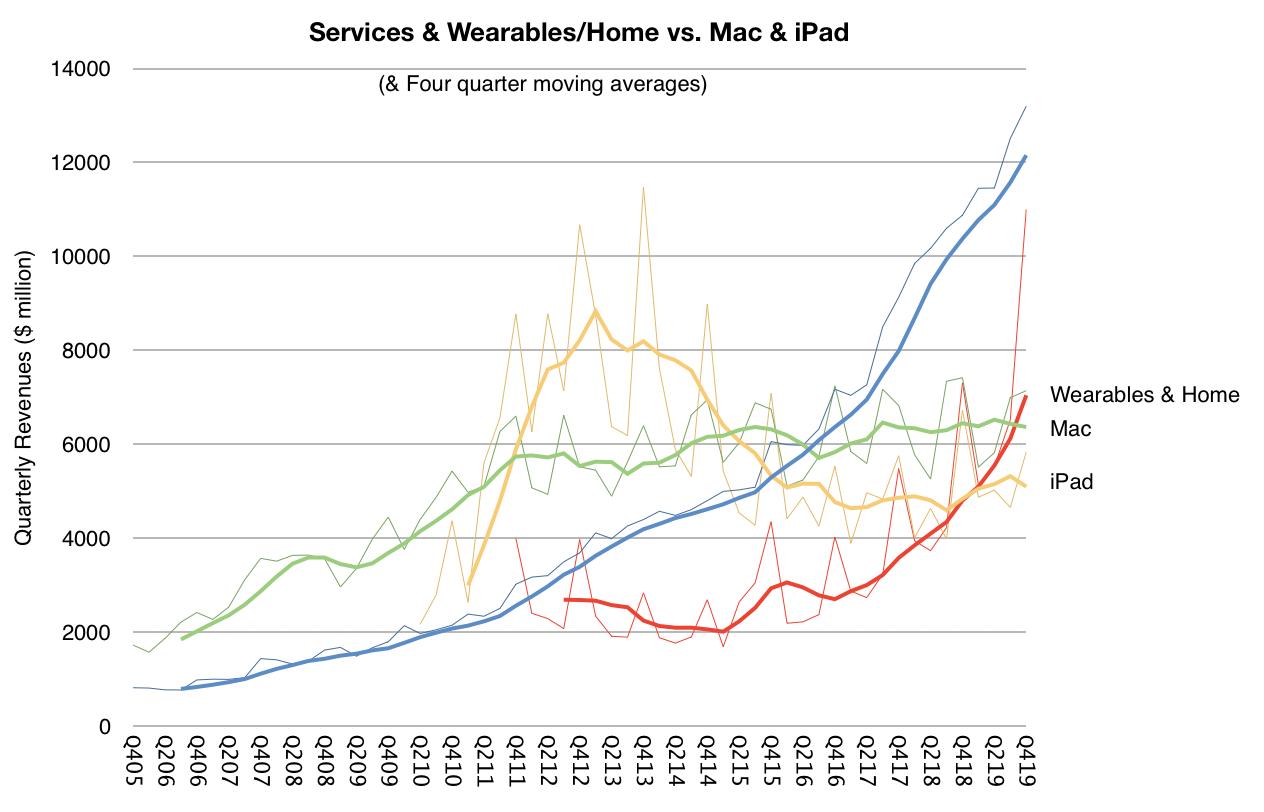
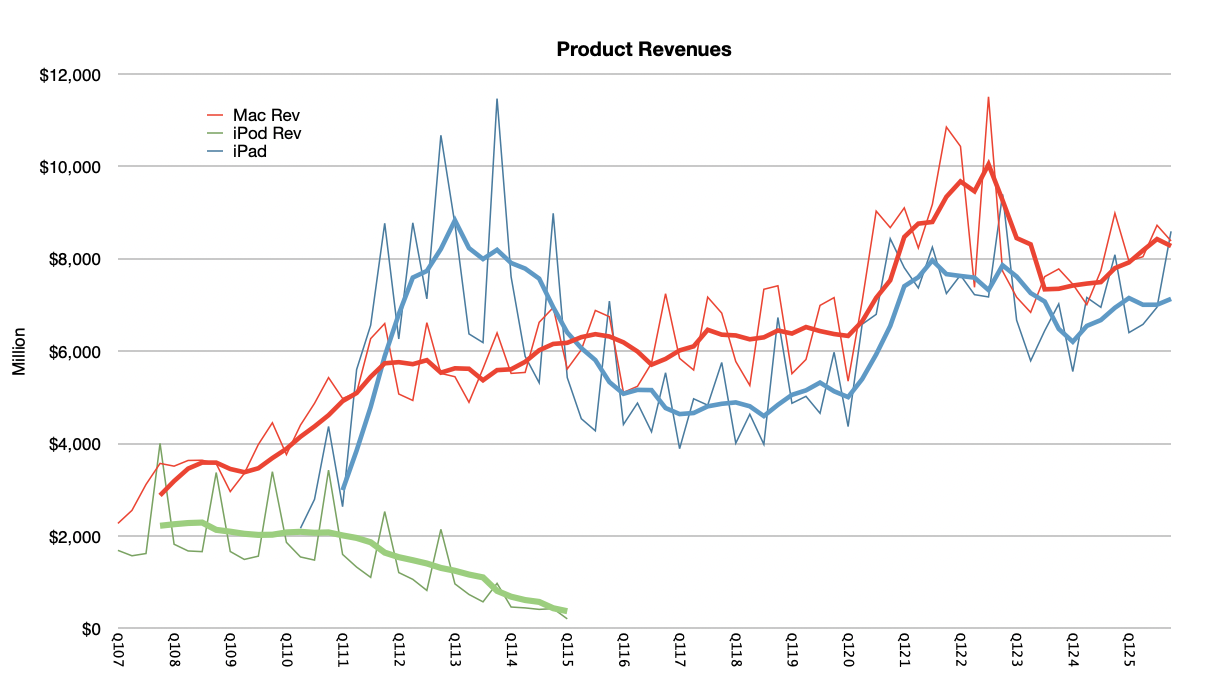
    The graph above shows the iPad revenues compared to the Mac and the iPod. I included the iPod since the iPad was originally dismissed as a "big screen iPod touch". On the other hand, it was also seen as a PC or Mac substitute. To many, including Alan Kay, the tablet form factor makes much more sense than the PC form factor. It's more approachable, more intuitive and certainly smaller and more portable. As the graph shows, quickly after launch, the iPad overtook sales of the Mac.

    What iPad has done is carved a niche that is resilient. After 16 years, I reckon about 910 million have been sold with about 70 million more sold each year. The product has a particularly long lifespan in use and may continue to be used for as long as 10 years. Total lifetime revenuel has been over $403 billion with about $29 billion last year. The total user base is between 400 and 450 million users. In the U.S., the iPad is highly prevalent, with over 40% of Americans owning an iPad in 2024.

    Neither killer nor killed, the iPad is just a great "in between" product with plenty of value. I have no doubt that it will still be popular 16 years from now.

  3. Apple at 50 - Ben Thompson interviews Horace Dediu

    Podcast · 4 comments

    Ben Thompson of the Stratechery interviews Horace on the Stratechery Plus Podcast to discuss Horace's journey to become an influential tech analyst: early career in research, business school under Clayton Christensen, and his time at Nokia during the rise of the iPhone. 

    The conversation further explores Disruption Theory in the context of both smartphones and AI, why Christensen misjudged Apple, and whether AI could challenge today’s tech giants. It also marks the launch of Dediu’s new paid service Asymco One and reflects his continued conviction in Apple Inc. at its 50-year milestone.

  4. The Next 50

    Research · 2 comments

    Make no small plans

    50 already? It seems only a blink of an eye since I wrote Apple at 40. Let's try copy & paste.

    In Apple’s first 40 50 years it shipped 1,591,092,250 5,126,211,000 computers[1].

    This shipment total is higher than any other computer company in its first 40 50 years. Actually there are no other PC makers that are 40 50 years old. One computer maker (IBM) is older but they only sold PCs for 24 years and what they still sell they don’t sell in high numbers.

    That does not make Apple the top seller in a given year. Looking at only the Mac, Apple’s traditional form factor personal computer, Apple is fifth fourth in market share. If including the iPad, it was the top computer vendor in 2011 and, including the iPhone, it was first in 2009.

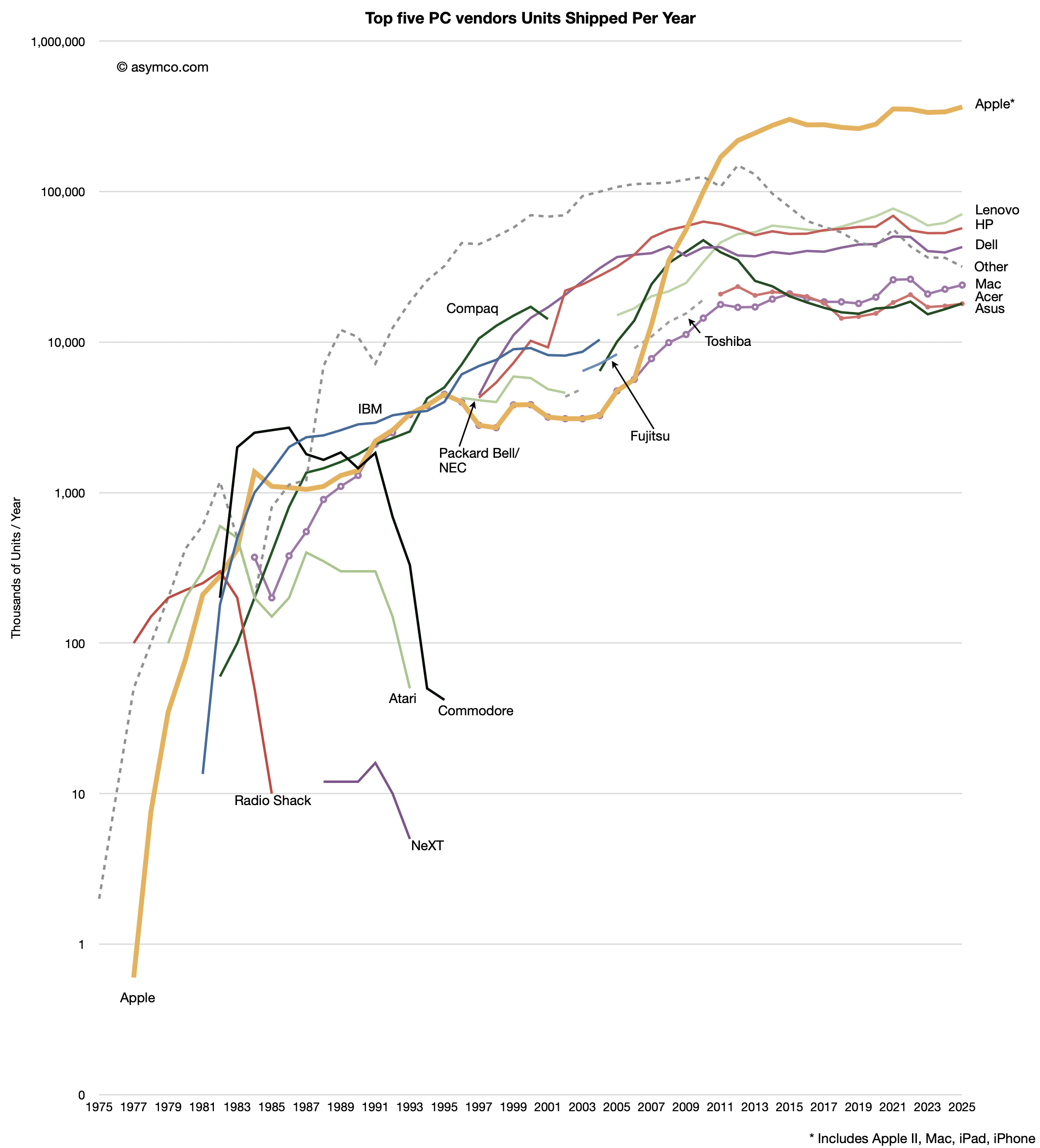
    The following graph shows the top computer makers by units sold since 1975, a year before Apple was founded. (Click on the graph to see a higher resolution.)

    Note that the graph is log scale and in multiples of 1000. Following the yellow Apple line we can see how it started with fewer than 1000 units shipped in its first year to today when it is shipping more than 1 million computers every day[2]. It's also quite remarkable to count how many other companies have come and gone in this top five list and imagine how many came and went in the "other" category.

    Who remembers Atari, Commodore, Packard Bell, Compaq? Few said that they were doomed while they were in the running. Going back to Apple at 40,

    After having a 40 50 year run and after selling more computers than all American and Japanese computer companies put together, how should we think about the next 40 50 years?

    First, clearly Apple shifted from being a “computer company”. It has already changed its name to exclude the word “Computer.” That [came to mean that] it sells devices (which happen to also include computers.) We don't use computers to compute anyway. We use them to make decisions, keep track of things, speed things up and to communicate and to entertain.

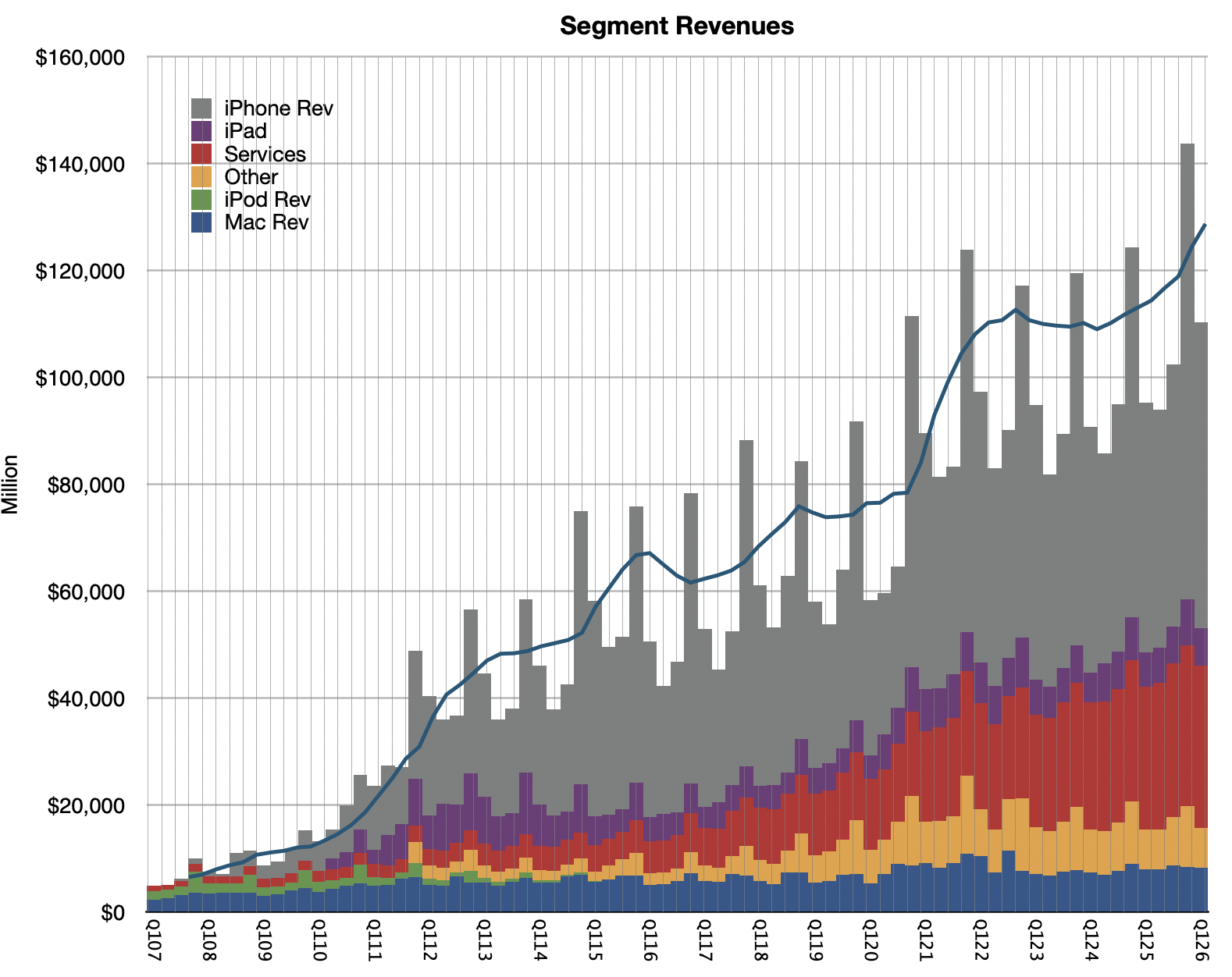
    After convincing the world that it's a not just a computer company, the next challenge has been to convince the world that it's also not just a product company. It did so by launching Services as a group (formerly known as iTunes Software and Services) and then separating the financial reporting so that Services can be measured with its own gross margin. Year after year management emphasized Services growth in its commentary. Services has grown into the second largest segment, 26% of total revenues ($112.8 billion out of 435.6 billion in calendar 2025.)

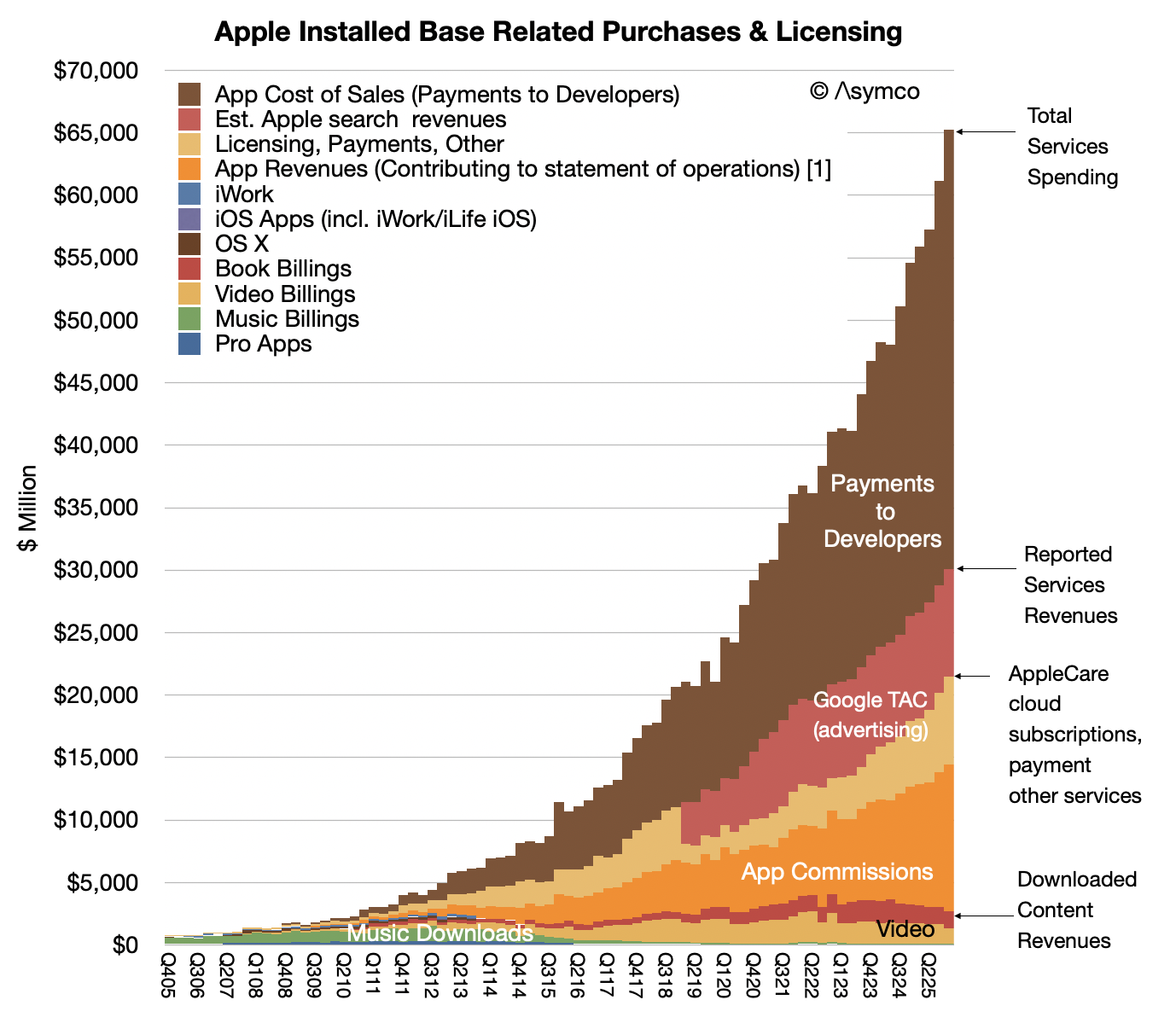
    Services, if it stood alone, would be number 40 in the Fortune 500 list of largest companies by sales. It has been impossible to ignore it. Considering how much customers actually spend on Apps, Content and Services, the total is even bigger at $240 billion last year[3]. As a result, some, perhaps most, recognize Apple as a Products & Services company.

    Apple’s services continue to see increased engagement, spending

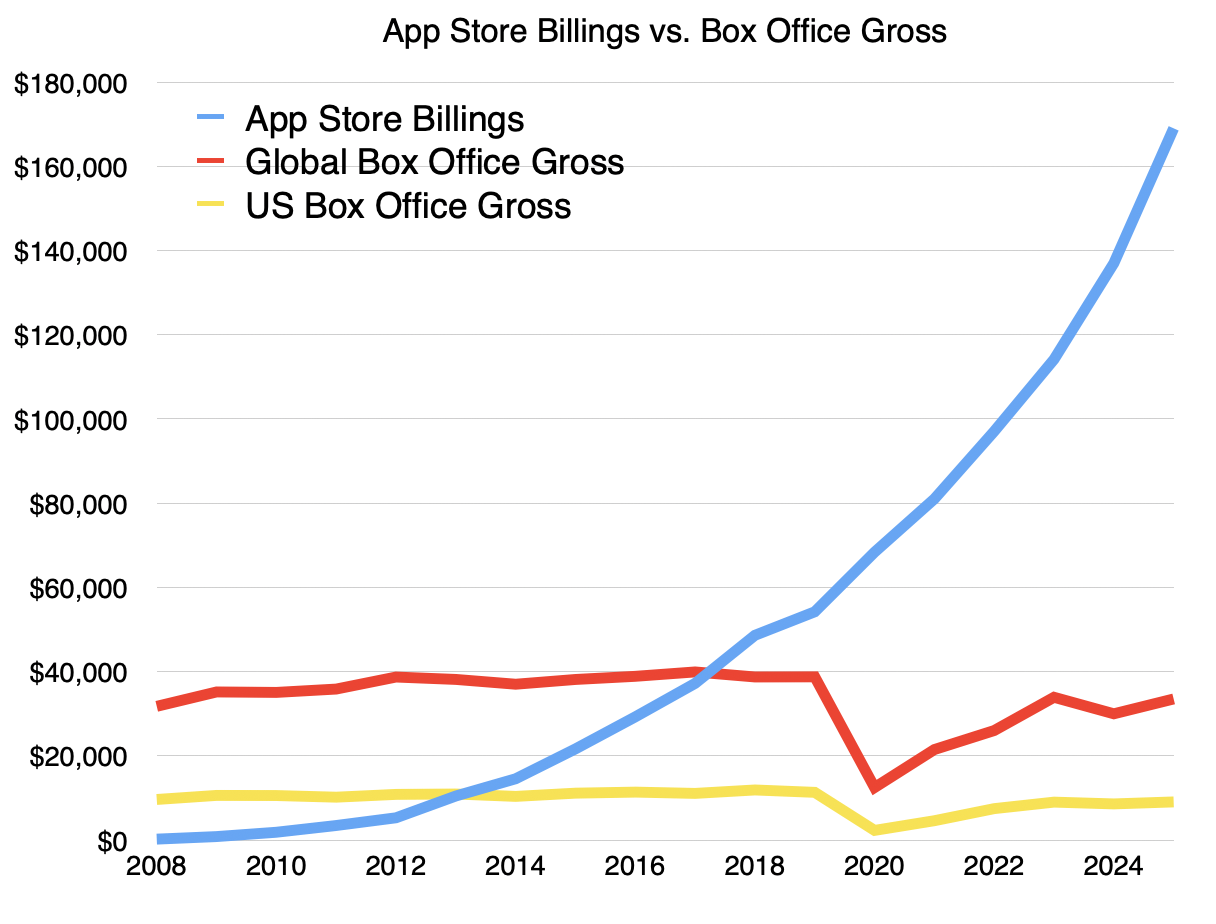
    The App store alone attracts $169 billion in spending per year (2025) and that is now 5x what theatrical movie sales bring in world-wide.[4]

    So if Apple is today at least a bundle of Products and Services then what will Apple be 50 years from now?

    Again from Apple 40:

    My simple proposal is to think of Apple as a customer creator. It creates and maintains customers. The more it creates, the more it prospers. The more customers it preserves the more it’s likely to persevere. This measure of performance for a company is not easy to obtain. It’s not a line item in any financial report.

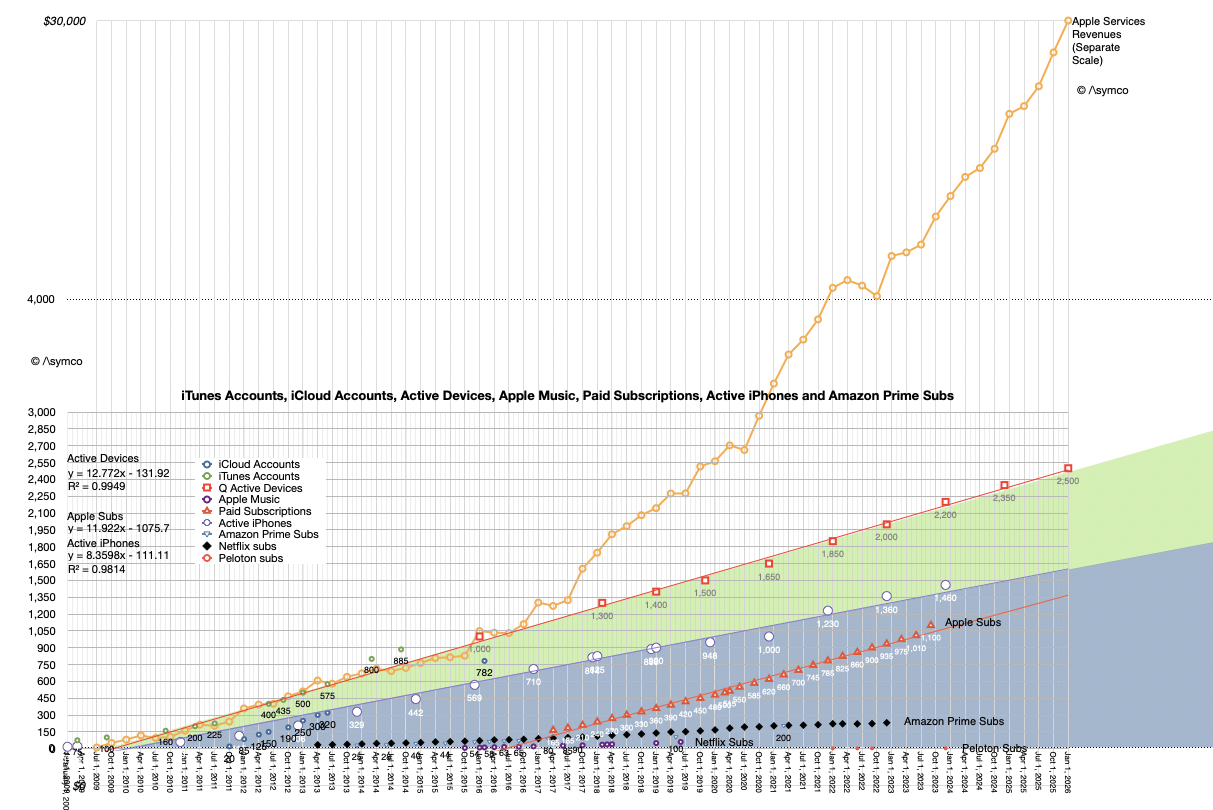
    The closest figure we have is that today Apple has one 2.5 billion active devices in use. It has around 1.1 billion users [5]. Using the devices as a proxy, we can say that this audience has more than doubled in the last decade.

    So we know that at least Apple has created a large number of customers. Knowing total devices sold and number in use means that we can be sure that 63% of all the computers Apple sold are still in use. This means that most customers are recent customers. Are they going to come back?

    If we then factor in the size and persistence of Apple’s audience (customer base) we might conclude that there are factors which will allow it to grow rather than shrink. My analysis based on public data shows that the customer base has been increasing steadily.

    And here is a graph showing the size of device base and implications for subscriptions. services and comparisons with other consumer aggregators. Note the forward looking nature of a linear extrapolation of the historical data.

    10 years ago, I continued:

    Combining the history of customer creation and customer preservation with the value obtained from each customer implies that the next 40 years will be about creating another large tranche of customers whose willingness to spend on whatever Apple creates will be relatively unchanged.

    We don’t know the limit. One billion was hard to imagine even one year ago. We might see two billion devices in short order. Perhaps not. Perhaps as we have a multitude of devices about us all day the number will become less meaningful. But if the number of middle class customers grows and as Apple keeps its products within their reach, there is no reason to think that there will be a reversal of the last 40 years in terms of customer acquisition.

    This analysis contradicts the current perception of the company as reflected by its stock price. That price assumes the audience will wither ((With a P/E ratio of 11, without a change in revenue per user, the only justification would be the audience shrinking by more than 90% over the next 20 years.)) That is not insanity. It is what we could expect if Apple were unexceptional.

    We did see 2 billion. We actually saw 2.5 billion. The assumption of a company in distress as reflected by the P/E ratio of 11 is gone. It's safe to say that Apple is exceptional.

    But note that we are only 10 years into that 40 year forecast from a decade ago. Do we still feel confident that the company can last 30 more years given what we've seen so far? If one company could get through the next 30 I would say it is Apple. And if it is so then I think it will get through the next 50.

    One more Thing

    So, the plan is to make more of the same. It's more than enough.

    1. Including Apple II, Mac, iPhone, iPad and iPod touch; excluding Apple Vision Pro, Apple TV and other iPods. Includes Q1 shipments estimated
    2. 2025 shipments were above 364.9 million excluding Apple Vision Pro, Apple TV, Apple Watch.
    3. A Fortune 15 ranking. This would be the case if payments to developers were counted as sales but that is not the case for accounting reasons. As a result Services margins are an extraordinary 76%, on the order of a software only business like Microsoft Office.
    4. As an aside, when I first started tracking this data it was early 2015. The App store had just overtaken US Box Office revenues and the outrage at my comparison and the skepticism that this sustainable was impressive. Much of the outrage was due to my choice of the headline "Bigger Than Hollywood". You can still read the 72 comments. App store billings are now nineteen times bigger than US Box office billings. I still stand by the idea that the App Store is Bigger than Hollywood. It is in fact bigger than many other forms of entertainment combined--more about this later
    5. Stay tuned for a detailed exposition of this audience
  5. Introducing Asymco One Early Bird Pricing

    Invitation

    The all-in-one on Apple

    In July this of this year Asymco turns 17. In April of this year Apple turns 50. 

    This means that Asymco has been following Apple for one third of its life. I regret that it has not been for longer but oh, what a third it has been.

    • During 2009, Apple Net Sales were $46.7 billion.  17 years later revenues should comfortably top $500 billion. 
    • Earnings per share (split-adjusted) in 2009 were 37c. This year EPS will be around $9.5. 
    • Most importantly, at the end of 2009 Apple had about 107 million active devices (43 million Macs, 33 million iPhones and 30 million iPods!) Today it has 2.5 billion. 

    The increases in multiples:

    • 23x Active devices, or a compounded annual growth (CAGR) of 20%
    • 11x Revenues, CAGR of 15%
    • 26x Earnings, CAGR of 21%
    • Apart from the customer love affair these numbers reveal, investors were awakened.
      36x increase in Apple share price, from $7.5 to about $270. That’s 17 years of 23.5% growth. 

    The appreciation of the share price faster than the other underlying metrics reflects the undervaluation that existed for most of the last 17 years. Its value grew a lot more because it was too cheap to begin with. 

    That was perhaps my most important observation. A recurring undervaluation reflecting a perceived fragility. The more I studied and came to learn how the company operates the more I realized that the perception was wrong. It was in fact the opposite of reality.

    When I started my “Apple model” in 2009 I did it out of indignation. I had access to a few analyst reports covering the company and, when looking at their forecasts and assumptions, I was shocked to read that they treated Apple as a computer company. Two years had passed since the iPhone launched and I had made the radical assumption that the future of the company would be determined by the dynamics of phones--later to be broadened into “devices.” This did not appear radical to me because five years earlier Apple had created the market for music players. A market it came to dominate. It seemed very rational to me that with the iPod (and iTunes), Apple had demonstrated that it was more than a computer company. Or perhaps more accurately, it was so profoundly different as a computer company that it redefined what computers were. Nonetheless, observers seemed stuck with the perception that once a PC maker, always a PC maker.  

    So here is my prediction today: Apple at 50 is no less capable than Apple at 20. Indeed, it is more so.  This is because, even if it has not yet completed its quest, the company has sought self knowledge.  A knowledge which I have sought to gain as a distant observer.

    And so here I am, inviting you to come along with me on this journey. 

    Asymco is being re-launched. Apple at 50 is entering a new era. It has transitioned from Apple ][ to Mac to iPod, iPhone, iPad, Watch and Spatial Computing. But it has always been the company that brought computers to people and people to computers. The new era of computers that appear more like people is dawning and the connection between the two needs to be built. Only Apple is capable of creating this connection. And only Asymco is able to tell the asymmetric story of how it will happen.

    Let’s learn together. 

    To make this research possible we’re launching Asymco One. 

    Asymco One is the analysis you need for understanding everything in the world of Apple. It’s a bundle of seven categories of content:

    1. Curated news and commentary with Nota Bene. 
    2. Reconsider your assumptions with Research. 
    3. Save time with the weekly summary in the Bulletin. 
    4. Supercharge your narrative with Asymetric podcasts. 
    5. Get your questions answered during Office Hours. 
    6. Attend in-person or online the full-day Conference.
    7. Search over 1800 posts, 60,000 comments, 400 podcasts and thousands of graphs since July 2009 in the Archives.

    All while connecting with the most knowledgeable community of thinkers and investors in Apple.

    Asymco One is a bundle which will offer over one thousand updates per year providing the ultimate intuition on Apple for stakeholders and connoisseurs of the most important phenomenon of our time.

    It’s available as a subscription for $1000/yr, about the price of an adequately configured iPhone. 

    For early adopters we are offering a discount of $150 with the code INNOVATE.

    I hope to see you in the Comments, the Office Hours, the only Conference and in person. 

    Yours,

    Horace Dediu

    –
    Asymco One: About | Subscribe
    Use code PIONEER to save 25%.

  6. Introducing Asymco One

    Invitation

    The all-in-one on Apple

    In July this of this year Asymco turns 17. In April of this year Apple turns 50. 

    This means that Asymco has been following Apple for one third of its life. I regret that it has not been for longer but oh, what a third it has been.

    • During 2009, Apple Net Sales were $46.7 billion.  17 years later revenues should comfortably top $500 billion. 
    • Earnings per share (split-adjusted) in 2009 were 37c. This year EPS will be around $9.5. 
    • Most importantly, at the end of 2009 Apple had about 107 million active devices (43 million Macs, 33 million iPhones and 30 million iPods!) Today it has 2.5 billion. 

    The increases in multiples:

    • 23x Active devices, or a compounded annual growth (CAGR) of 20%
    • 11x Revenues, CAGR of 15%
    • 26x Earnings, CAGR of 21%
    • Apart from the customer love affair these numbers reveal, investors were awakened.
      36x increase in Apple share price, from $7.5 to about $270. That’s 17 years of 23.5% growth. 

    The appreciation of the share price faster than the other underlying metrics reflects the undervaluation that existed for most of the last 17 years. Its value grew a lot more because it was too cheap to begin with. 

    That was perhaps my most important observation. A recurring undervaluation reflecting a perceived fragility. The more I studied and came to learn how the company operates the more I realized that the perception was wrong. It was in fact the opposite of reality.

    When I started my “Apple model” in 2009 I did it out of indignation. I had access to a few analyst reports covering the company and, when looking at their forecasts and assumptions, I was shocked to read that they treated Apple as a computer company. Two years had passed since the iPhone launched and I had made the radical assumption that the future of the company would be determined by the dynamics of phones--later to be broadened into “devices.” This did not appear radical to me because five years earlier Apple had created the market for music players. A market it came to dominate. It seemed very rational to me that with the iPod (and iTunes), Apple had demonstrated that it was more than a computer company. Or perhaps more accurately, it was so profoundly different as a computer company that it redefined what computers were. Nonetheless, observers seemed stuck with the perception that once a PC maker, always a PC maker.  

    So here is my prediction today: Apple at 50 is no less capable than Apple at 20. Indeed, it is more so.  This is because, even if it has not yet completed its quest, the company has sought self knowledge.  A knowledge which I have sought to gain as a distant observer.

    And so here I am, inviting you to come along with me on this journey. 

    Asymco is being re-launched. Apple at 50 is entering a new era. It has transitioned from Apple ][ to Mac to iPod, iPhone, iPad, Watch and Spatial Computing. But it has always been the company that brought computers to people and people to computers. The new era of computers that appear more like people is dawning and the connection between the two needs to be built. Only Apple is capable of creating this connection. And only Asymco is able to tell the asymmetric story of how it will happen.

    Let’s learn together. 

    To make this research possible we’re launching Asymco One. 

    Asymco One is the analysis you need for understanding everything in the world of Apple. It’s a bundle of seven categories of content:

    1. Curated news and commentary with Nota Bene. 
    2. Reconsider your assumptions with Research. 
    3. Save time with the weekly summary in the Bulletin. 
    4. Supercharge your narrative with Asymetric podcasts. 
    5. Get your questions answered during Office Hours. 
    6. Attend in-person or online the full-day Conference.
    7. Search over 1800 posts, 60,000 comments, 400 podcasts and thousands of graphs since July 2009 in the Archives.

    All while connecting with the most knowledgeable community of thinkers and investors in Apple.

    Asymco One is a bundle which will offer over one thousand updates per year providing the ultimate intuition on Apple for stakeholders and connoisseurs of the most important phenomenon of our time.

    It’s available as a subscription for $1000/yr, about the price of an adequately configured iPhone. 

    But for you, dear reader, who have been with us for so long, I am offering a discount of $250 with the code PIONEER.

    I hope to see you in the Comments, the Office Hours, the only Conference and in person. 

    Yours,

    Horace Dediu

    –
    Asymco One: About | Subscribe
    Use code PIONEER to save 25%.

  7. Apple is Doomed, Revisited

    Research

    Before the iPhone launched in late 2007, Apple was trading consistently at a P/E ratio above 30. Here is a table for the P/E ratio on each Friday's closing price from May to August, 2007. The iPhone launched on June 29, 2007.

    Apple's P/E ratio around the iPhone launch
    DateP/E Ratio
    5/23/0731.5
    5/30/0731.6
    6/6/0734.1
    6/13/0733.7
    6/20/0734.6
    6/27/0733.6 (2 days before iPhone launch)
    7/11/0737.2
    7/18/0734.6
    7/25/0734.3
    8/1/0733.3
    8/8/0734.2
    8/15/0730.2

    Apple was not super powerful but it was not doomed either. It was a time when the iPod was dominant and the Mac was still alive. iTunes re-wrote the rules of the music industry and debate was raging whether Apple should be considered a media company. Platforms were not its strength but Steve Jobs showed he was still able to distort reality.

    These good times did not last. The first year of the iPhone was a period of minimal contribution from the new category with Apple still largely valued on the basis of the iPod. The predictions of failure for the new communications product, especially given its high price, were legendary. It wasn't until 2008 that the iPhone began accelerating and making a meaningful contribution to the bottom line.

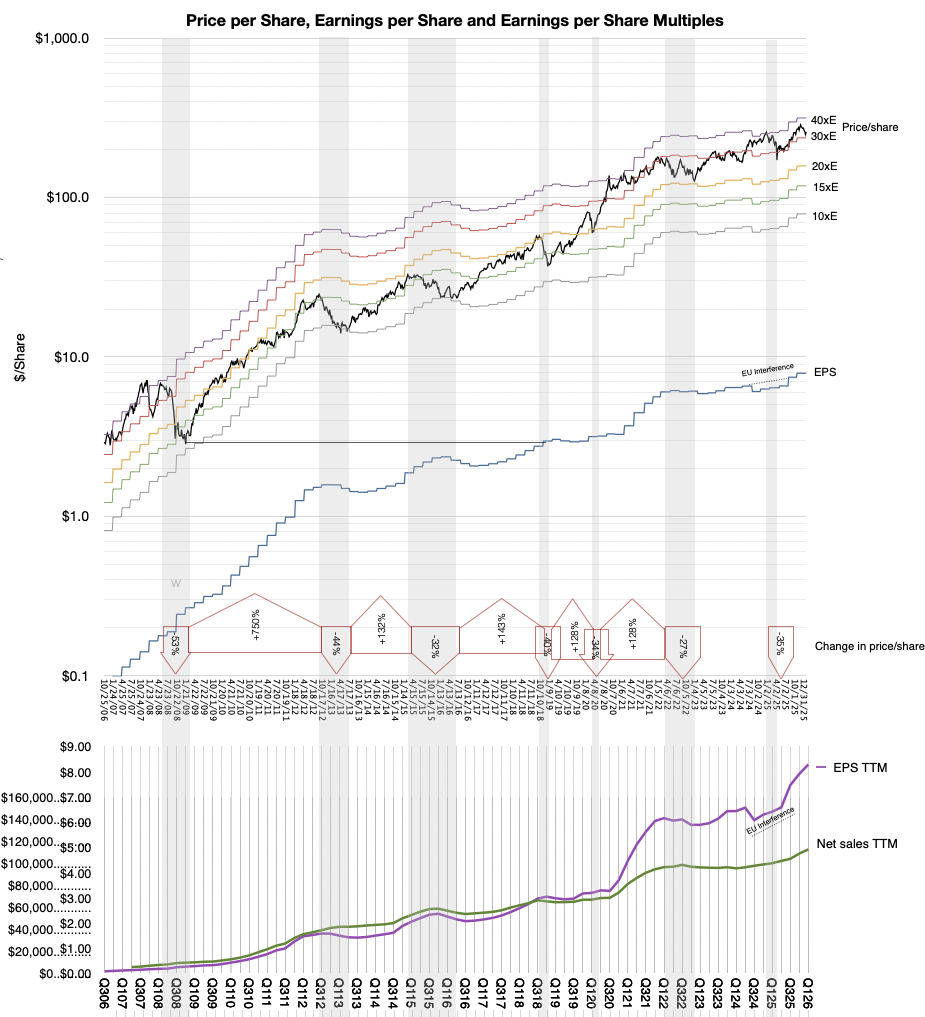
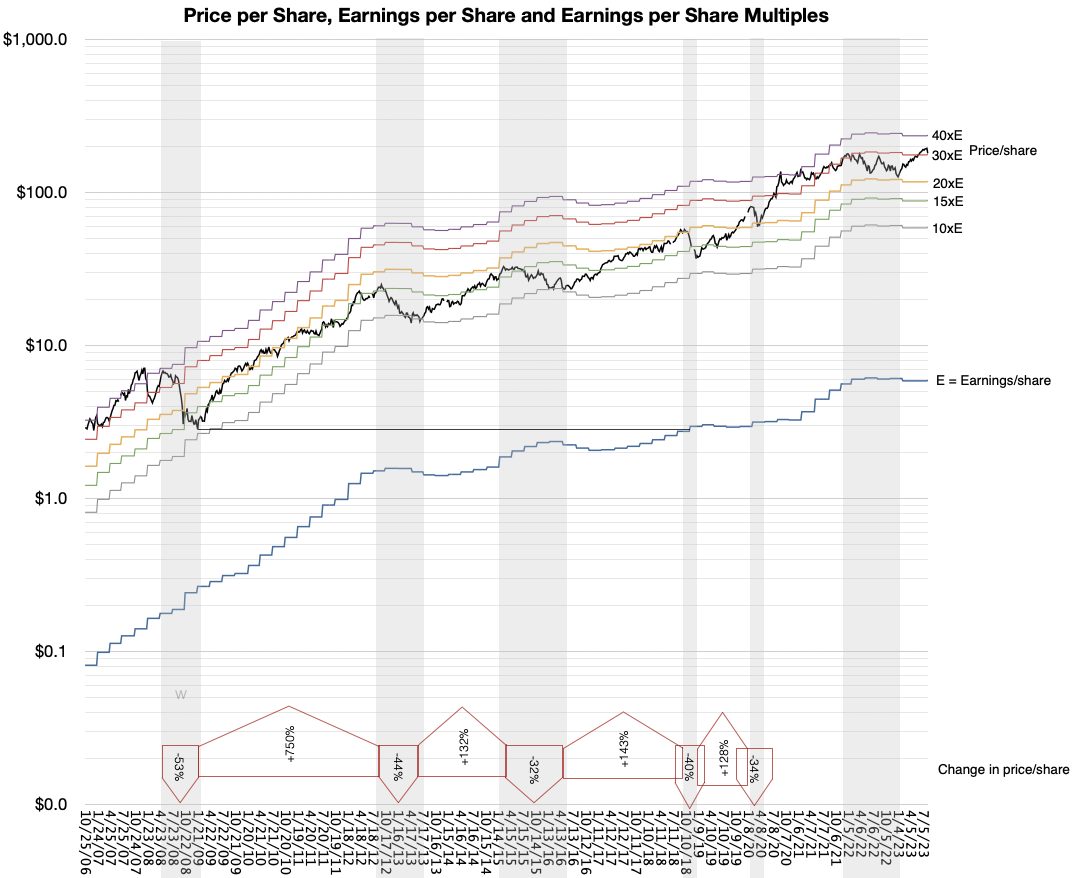
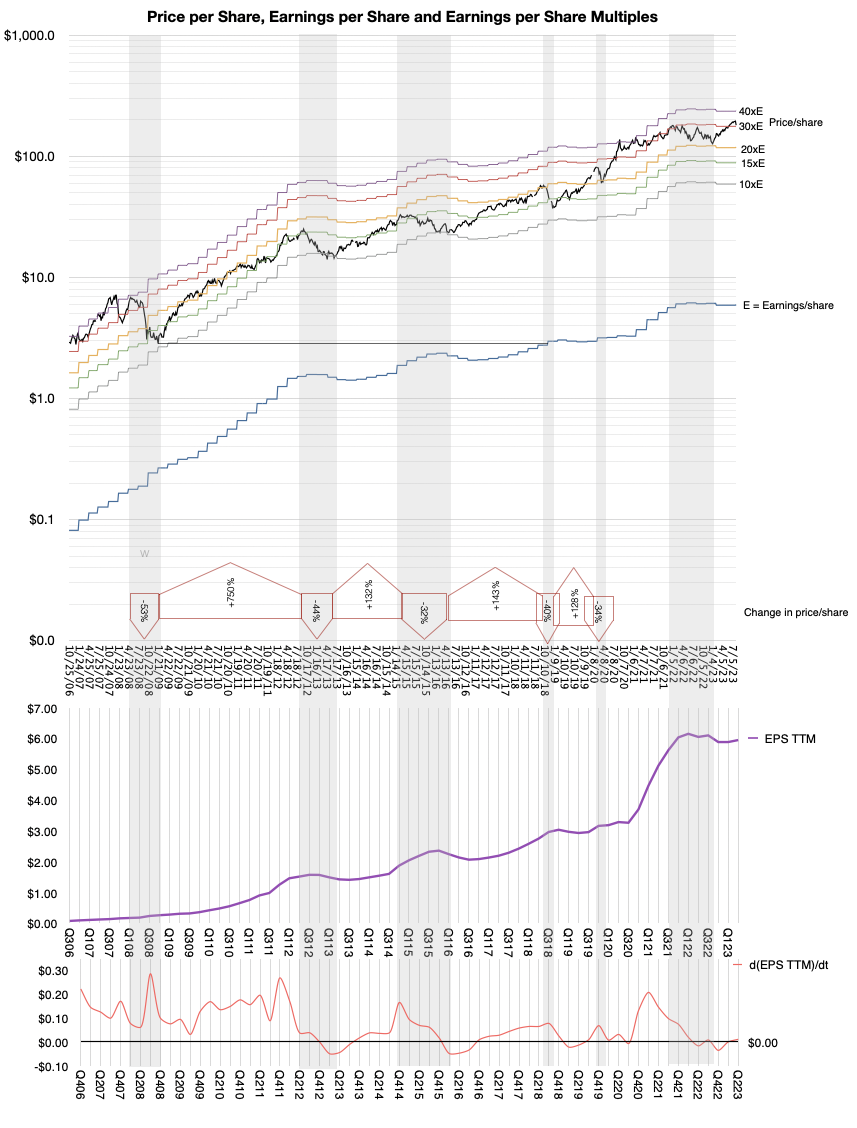
    It was then, in late 2008, that Apple's valuation broke. The P/E ratio fell from above 30 to nearly 10. The following graph shows the catastrophic 53% share price collapse coupled to the triple digit surge in earnings which led to the P/E ratio tanking.

    [The graph shows earnings per share for the trailing 12 months (blue line) and 10x, 15x, 20x, 30x and 40x that value (colored lines). The share price is the black line. The share prices are sampled every Friday. The graph is notably logarithmic. The grey shaded areas are periods of significant contraction. The percent drops/increases during these periods of contraction/expansion are shown in the annotation arrows near the bottom.]

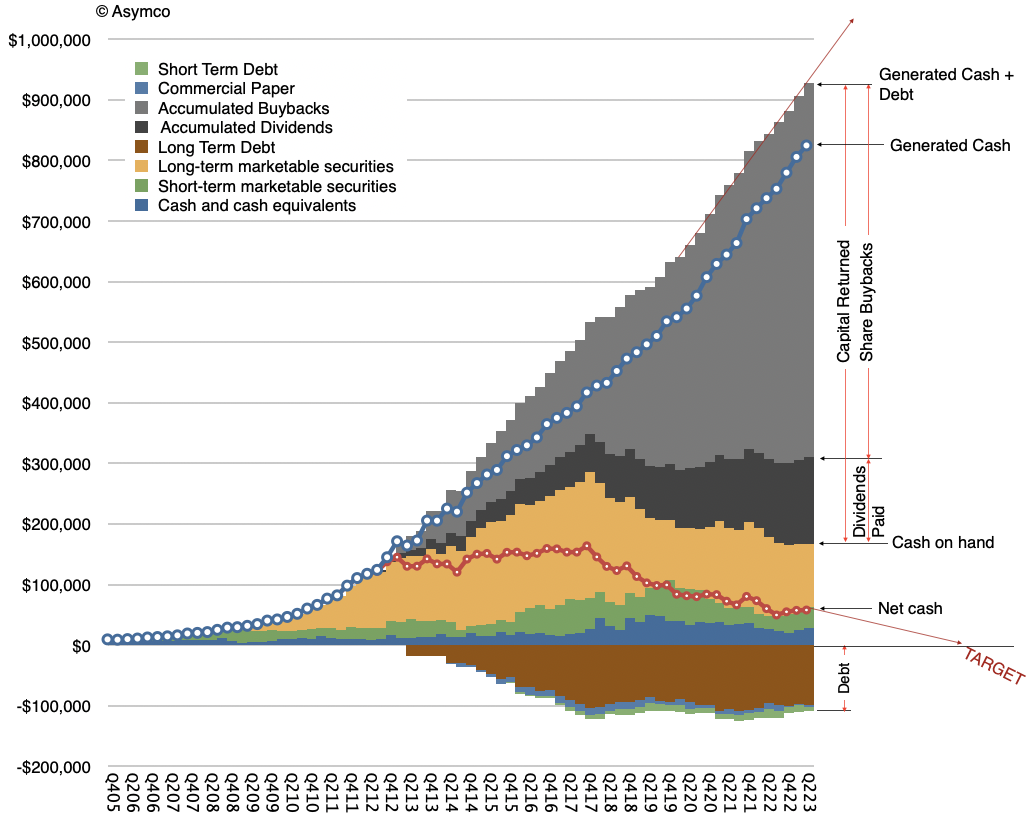
    The valuation remained broken for 12 years, between late 2008 and late 2020. This period being, arguably, the most remarkable wealth creation event in history of business. For evidence see the following graph showing the amount of retained earnings returned to shareholders building inexorably toward one trillion dollars. This is not share price appreciation but cash returns. [If you have evidence of a larger wealth-creation event do let me know.]

    The creation of $800 billion of shareholder wealth at fire-sale share pricing.

    As I explained throughout this period, motivation to dispose of shares which create immense wealth is explained by the fable The Goose That Laid the Golden Eggs but the question some are asking now is whether more wealth can still be created, and if so, can we expect Apple's valuation to collapse accordingly?

    I should note that during the long, dark years of wealth creation, other technology companies such as FaceBook, Amazon and Netflix, Google (so-called FAANG) and Microsoft enjoyed far higher multiples than Apple, sometimes 3x higher. This was not seen as abnormal by analysts because those companies were always assumed to have higher growth potential, with a diverse portfolio of opportunities while Apple's growth was perpetually in its past, based on one product.

    Paradoxically perhaps, since the Covid-19 pandemic Apple shares have enjoyed P/E ratio roughly equivalent to the other tech companies. For instance, peaking at 42 in January 2021, the P/E ratio has averaged about 27.5 since then. Simultaneously, diversified companies such as FaceBook (now Meta) and Netflix collapsed due to serious business model flaws (based on single sources of income) and Google (now Alphabet) and Amazon have slowed growth and are facing anti-trust scrutiny. Having lost any presence in mobile computing Microsoft has become entrenched in enterprise, finding new businesses in cloud and (possibly) generative AI. As a result of these reversals, the contrast between Apple and the mega-cap cohort has become fuzzy.

    So back to the question: does it make sense to price Apple in the 30x P/E or should it go back in the gutter at 10 to 20?

    I would argue that the big change in perception hasn't been the surge in earnings during Covid (see graph below). The big change is the realization that Apple is no longer about to go out of business.

    How could Apple not be going out of business?

    Remember that a P/E ratio in the teens is a clear signal from the market that the company is a questionable "going concern". This is parlance indicating doubt that the company will continue in its present form..

    What has changed since 2020 is that even though there were a multitude of crises—from war to pestilence—the eggs kept coming. Perhaps, perhaps, Apple was not doomed after all. In that time it managed to create 1 billion customers. Perhaps having 1 billion customers was a positive outcome. Perhaps counting iPhones during a single quarter was not the only way to value the company. Perhaps having 1 billion satisfied customers made it viable. Perhaps having 1 billion satisfied and loyal customers returning every year was interesting. Perhaps having 1 billion satisfied wealthy customers meant the end is not around the corner. Perhaps having 2 billion active devices in use was sustainable. Perhaps providing services to 1 billion customers using 2 billion devices delivered through 1 billion subscriptions made some sense. Perhaps having all this data in a linear graph made it predictable?

    Perhaps. Though Apple provided updates on these figures regularly, the questions everyone asked were still on unit shipments (which Apple stopped providing.) While Services grew at double digits and 70% margins the questions from analysts on conference calls persist on the iPhone and currency or production "headwinds". Perceptions take time to change. They are still changing.

    Maybe at this point it's time to agree that Apple's end will not come through being easily replaced by the competition (first Windows then Android, etc.) but by having access to its markets restricted. Being the only American company to have cracked the China puzzle, it's surely vulnerable there. And please don't mention India.

    Apple is no longer doomed because it's too weak. It's doomed because it's too strong.

    It seems that it's not too hard to believe the end is still near.

  8. iPods Pro

    Research

    At time of writing (December 12, 2019) AirPods Pro delivery wait time is over 4 weeks. It's been like this since they shipped. I tried stores in several countries and although units can make an appearance on a shelf, they sell out immediately.

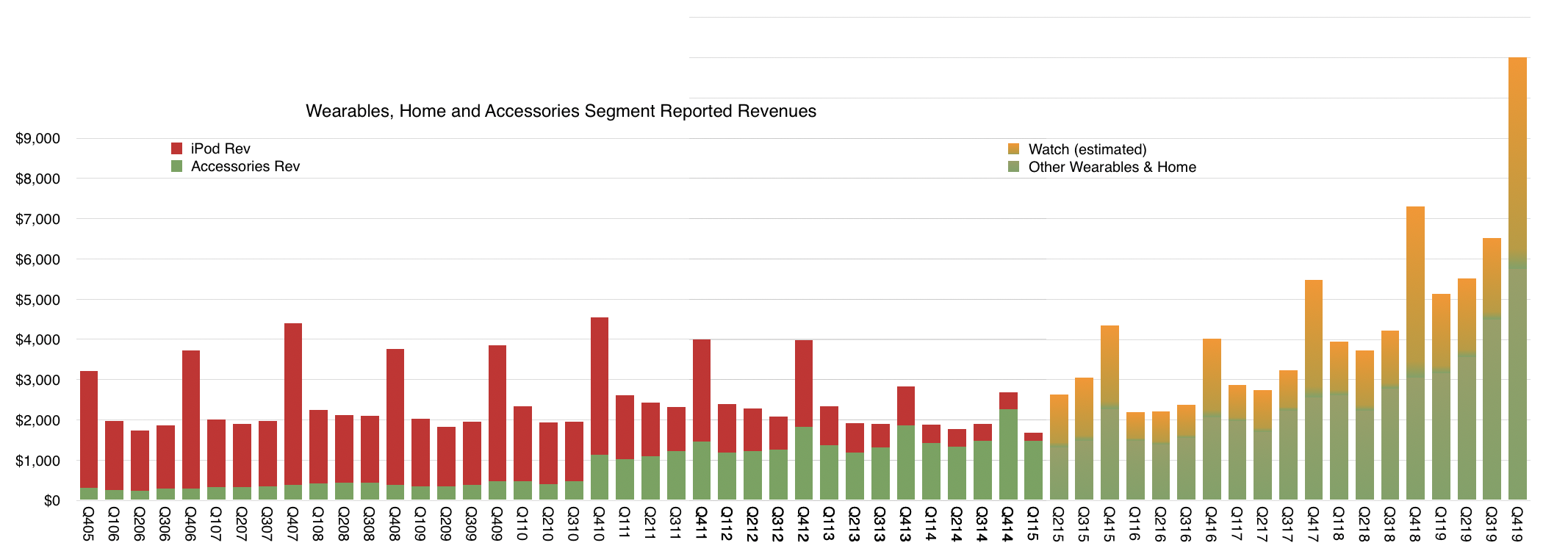
    AirPods are part of the "Wearables & Home" category for Apple which used to be called Other Products and include also the Watch, iPod, Apple TV, Beats and HomePod (among other items.) iPod revenues were broken out as recently as 2015 but as the graph below shows, there have been no specifics on any product in "Wearables & Home" since then.

    Wearables, Home and Accessories in a historic perspective with the iPod.

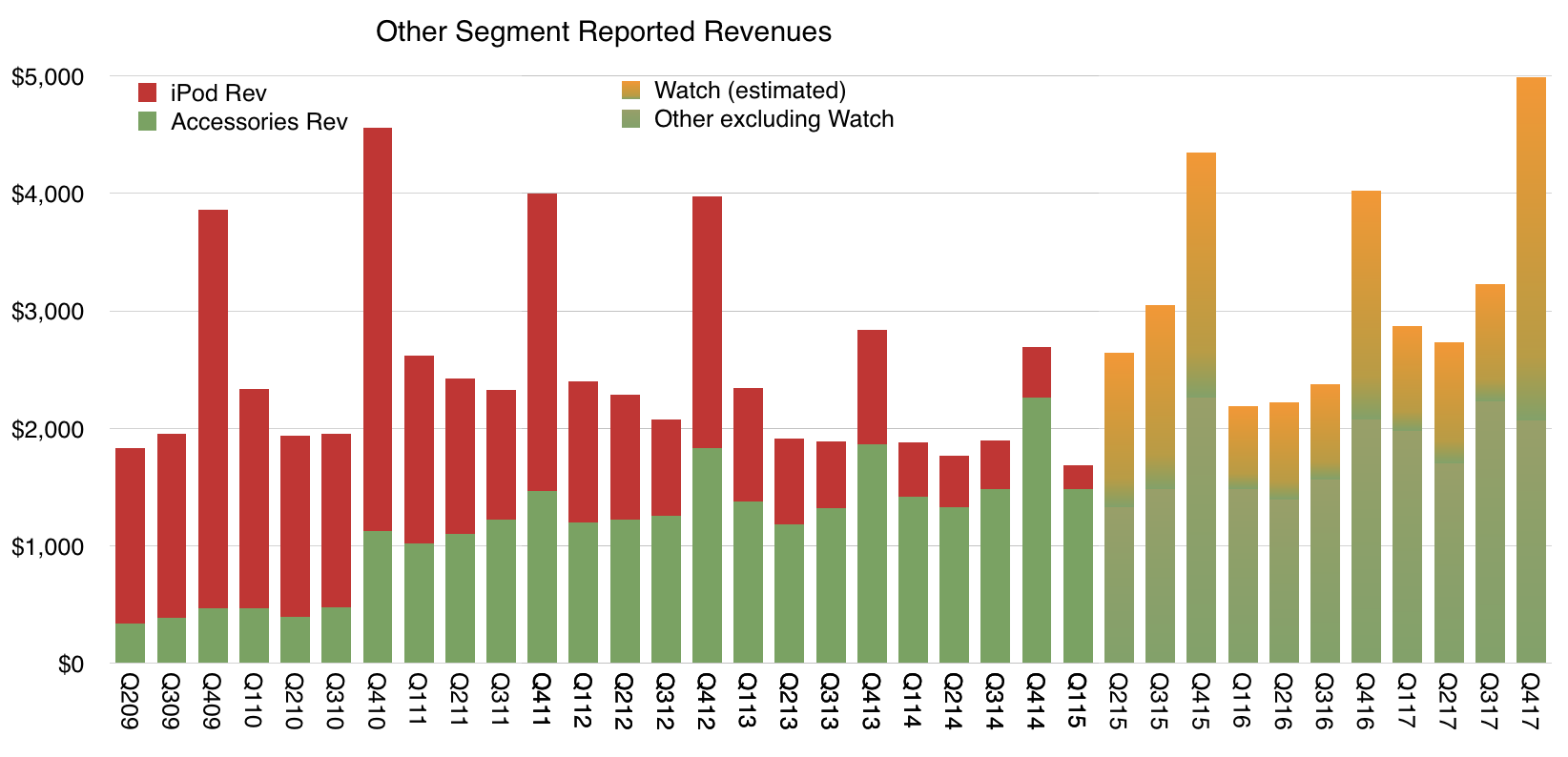
    It therefore falls upon us to estimate how much of the entire category is any one product. It's been very difficult as the only clues lie in growth rates, sometimes cited for the Apple Watch and sometimes for "Wearables" alone. As far as I can tell from the available clues, the split is roughly as shown between the Orange and Green areas. Orange reflects estimate for Watch and Green everything else.

    This analysis helped me conclude the Apple Watch overtook the historic "peak iPod" which occurred in the fourth quarter of 2007 at $4 billion. My Watch revenue estimate was $4.2 billion in the fourth quarter of 2018. This conclusion was confirmed by statements from the Company.

    The problem lately has been that AirPods have become huge unto themselves. There is literally no information about AirPods sales as a product category. The only option is to guess Watch and subtract it from Wearables and then guess again the portion of "non-Watch Wearables & Home" that is AirPods.

    Looking forward to the next quarter, I am expecting a 51% increase y/y for Wearables and 24% growth in Watch. This results in a Watch revenues about $5.2 billion and non-Watch $5.7 billion. Now if we assume $1.7 billion for non-Watch-non-AirPods (i.e. Apple TV, HomePod, Beats, iPod, other) then this quarter AirPods will have overtaken peak iPod.

    Remember that iPod was the phenomenon which reset all expectations for Apple. It caused Apple to cease calling itself Apple Computer. It (at least psychologically) laid the foundation for iPhone and everything else that followed. In 2005 and through 2007 Apple was "the iPod company". I remember people working in a large search engine company calling Apple "that media company" as a result of over-intellectualizing iTunes.

    (One more footnote on the AirPods Pro is that at $250 a pair and $300 for Apple Watch, throwing in a case puts these attached accessories for an iPhone at roughly the same average selling price for the iPhone of a few years ago.)

    For the AirPods to overtake the iPod highlights just what a phenomenal category Wearables has become. In combination with Home and other accessories the category is going to decidedly overtake the Mac, having already passed the iPad.

    And so it goes, something dismissed as inconsequential–"does not move the needle"–ends up becoming a massive force of change. The iPod was that, the original Apple II, the Mac and yes, also the iPhone. It's the asymmetry of humility that this happens over and over again.

    To hear more about the profundities of AirPods Pro tune in to the next Critical Path podcast.

  9. AiriPods

    Research

    The Apple Watch is now bigger than the iPod ever was. As the most popular watch of all time, it's clear that the watch is a new market success story. However it isn't a cultural success. It has the ability to signal its presence and to give the wearer a degree of individuality through material and band choice but it is too discreet. It conforms to norms of watch wearing and it is too easy to miss under a sleeve or in a pocket.

    Not so for AirPods. These things look extremely different. Always white, always in view, pointed and sharp. You can't miss someone wearing AirPods. They practically scream their presence.

    For this reason wearers, whether they want to or not, advertise the product loudly. Initially, when new, they looked strange, even goofy. But the product's value to the wearer overcame any embarrassment and for those courageous enough to wear them, they became a point of pride. As all things distinctive enough, the distinction rubs on the user and that distinction begets new users and new distinction, and so on. So now we have a bona fide cultural phenomenon.

    I have both my son and parents angling to get these things. I have not seen this universal appeal recently, even for the watch. You have to explain the watch. The AirPods explain themselves. The only thing which AirPods do remind me of is the original iPod. The iPod-and-white-earbuds had a similar signal/function ratio. Looks distinctive, works well, nails the job to be done and is self-describing. The "iconification" of white was the phenomenon of its decade.

    One wonders how much of this behavior is by design or, more precisely, engineered by designers. Did Jony Ive's team plan on users "flexing" with their AirPods? Did they make them distinctive on purpose with the stalks pointing down vs,, for example, wrapping around the back of the ear for a more discreet look? Was it just good luck and the form followed function? It's hard to imagine that taste could be engineered but here we are.

    Whether planned or not, the newest AirPods offer a functional upgrade with no visual upgrade. This is noteworthy because whatever they got right with the original design they decided not to mess with it. You can't tell if someone is wearing the newest AirPods or the originals.

    As far as the added functionality it is typical Apple: faster connections due to a new chip, longer talk time, longer listen time, voice-activated Siri and wireless charging. Broadly speaking they are just better in ways that need to better and not better in ways they are good enough.

    The product is part of the "wearables" category at Apple which includes watch and is growing almost 50%/yr. and not from a small base either. The following graph show the history of the segment since 2009 (before the iPod peaked).

    As can be seen, Wearables and Home segment grew out of the iPod segment, through "Other" products and is now almost double what the iPod used to be alone.

    It should be noted that the AirPods can be paired directly with the Apple Watch and used independent from the iPhone. If not from this point alone, culturally the iconic white AirPods and jewel-like Apple Watch embody the spirit of the iPod.


  10. The Sound of Music

    Research · 34 comments

    One of the more common statements out of Apple is that "Music is very important to us." This is one of those easily dismissed Apple platitudes. Like caring about products or customer privacy or other such nonsense. But if you pay attention you notice music is always a consideration for the company. The obligatory music act at the end of Apple events, the multitude of speakers and audio accessories in an Apple Store, the headphones branded Apple and Beats, the music-heavy ads. It's as if Apple's brand had a musical score.

    And of course there is the history.

    Steve Jobs not only put music at the heart of the brand but he re-built Apple's business around music starting in 2001. The Rip, Mix, Burn campaign, the iPod and iTunes which not only oriented the company away from Computers but also disrupted the "record industry," unbundling the album and destroying peer-to-peer sharing at the same time.

    Apple was so powerfully oriented around music that I remember someone at Google in 2006 dismissing Apple as "that media company".

    So there is some good reason to honor music at Apple. If it wasn't for music, Apple would probably not exist today.

    But it seems that music has faded in importance or at least in mindshare. Music is the least exciting media type in an age of increasingly pervasive visual stimuli. AR, VR is what we're supposed to dream of and of course screens, screen are everywhere. I note that at least in the US TV screens are now placed in public spaces bombarding us with imagery instead of speakers pumping out muzak.

    Music has been relegated to offering personal space. We only use it through headphones to isolate us from the auditory pollution around us. Racks of audio components and enormous speakers are gone from our living rooms replaced with outrageously large screens.

    And so pundits are calling for Apple to "do something" about video. To buy Netflix or to chase after content and build or buy properties. Look, Disney just bought Fox and Amazon is making movies and so is, apparently, everyone else.

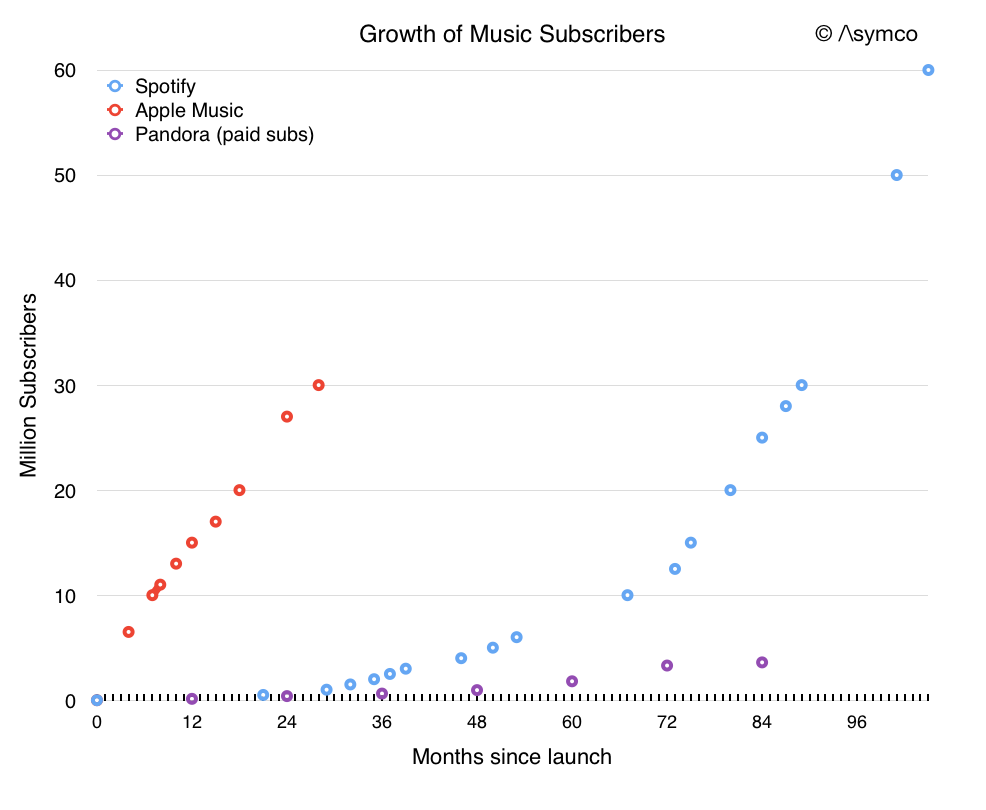
    But instead Apple sill sells songs and has a radio station. And it has a streaming subscription with "only" 30 million subscribers.

    Even when it comes to original video content it rolls out a Karaoke show, of all things. It still maintains an app called GarageBand. It goes and buys Shazam, and paid $3 billion for Beats and still makes AirPods and is about to launch a speaker. Yes, a loudspeaker called HomePod.

    How quaint.

    But all the cynicism around music is tone deaf to the sheer emotion that music can create. Music touches people like nothing else. I've seen young and old cry and burst with joy listening to music. For its low bandwidth, music delivers enormous emotional bandwidth. It always has and always will. It's not obsolete and will never be. Music imprints itself in hearts and remains there for a lifetime.

    It's poetry for the senses.

    Business models for music will come and go but music consumption is increasing. Access to the long tail has meant genres proliferated and production has spread to everyone who cares to try to make music.

    And so it is that more people listen to music on their widescreen iPods in more places and more times than ever before.

    Apple realizes this and the acquisition of Shazam and the launch of AirPods and of HomePod are to serve music.

    Siri or intelligent assistance are nice new services but they are not in lieu of the need for music. Chatty robots are appealing to intellect. Music appeals to the soul. These new products are in service of music because music is what people hire far more than advice.

    HomePod will surprise not because it will be a better at chatting. It will surprise because it will cause you to sit down and listen in awe.

  11. When Watch surpassed iPod

    Research · 18 comments

    The last time Apple reported iPod unit and revenues was for the third quarter of 2014. Thereafter the product segment called “Other Products” was used to include what was formerly the iPod segment and the “Accessories” segment. Exactly two quarters later Apple began to sell the Apple Watch. Apple Watch was not broken out as a separate product segment and remained a part of Other Products along with iPod touch, Beats, Apple TV, and Apple-branded and third-party accessories. Soon the HomePod will also join the Other products.

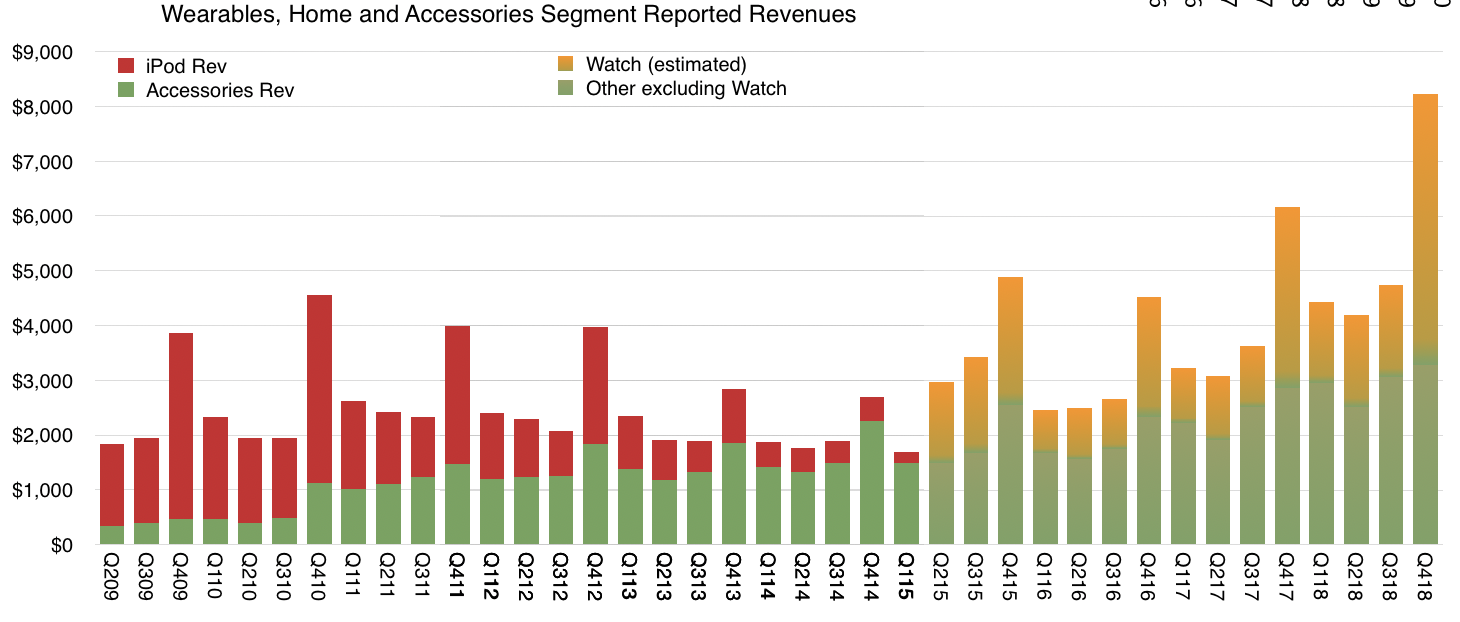
    The combined iPod, Accessories and “Other” product sales are shown in the following graph. ((Two quarters include estimated iPod revenues: Q4 ’14 and Q1 ’15. The iPod contribution is estimated with a simple extrapolation using the previous four quarters’ average rate of decline))

    Note that an attempt is made to estimate the contribution of Apple Watch to the mix. The method is simple: if you can estimate the non-Watch sales trajectory then the Watch is the difference between Other total and this trajectory.

    If we discount the iPod, the non-Watch revenues come down to Apple TV and Beats, mainly.  Note that the data shows the contribution of Beats (Q4 2010) but it’s hard to parse specifically the growth of Beats. Since the Watch launched we also saw the introduction of AirPods and new Apple TVs, both of which probably contributed to some growth to “Other excluding Watch.”

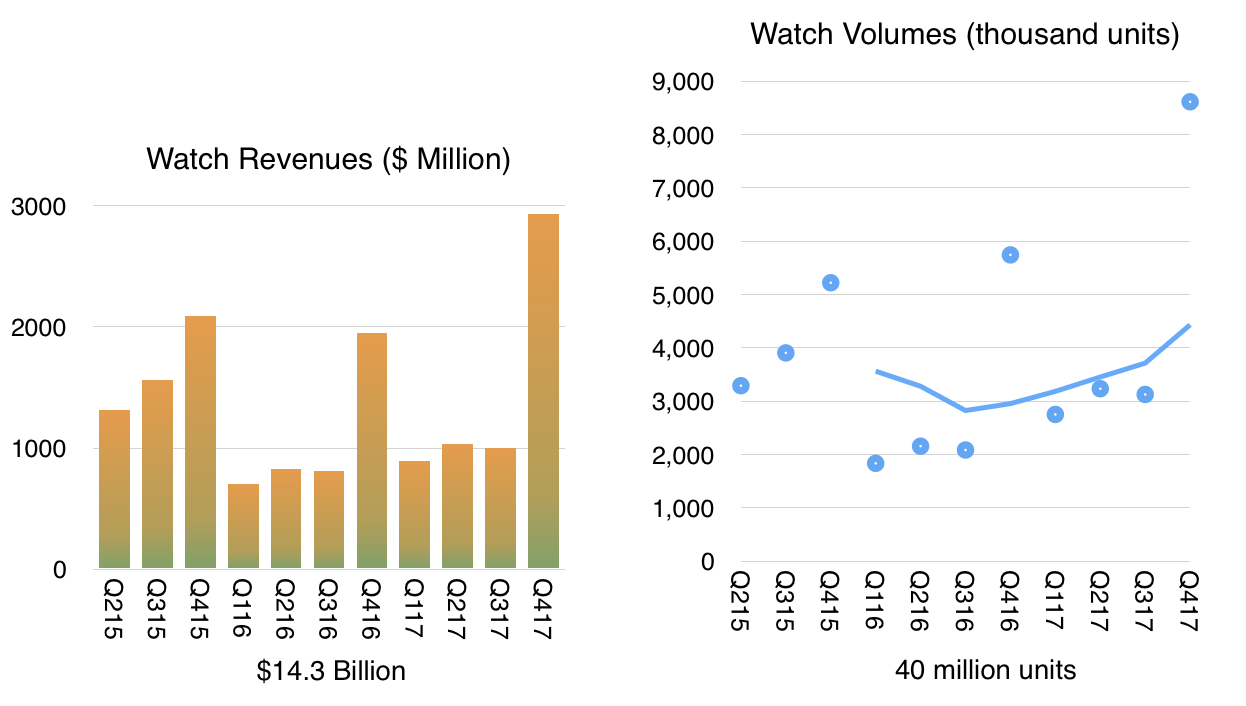
    We can take a stab at the first 6 quarters of Watch by projecting Other with some nominal growth. Thereafter Watch can be modeled using growth assumptions. Apple stated that growth was above 50% during the past three quarters. There are a few quarters where we must make guesses but overall the picture that emerges, shown below, is fairly robust. Note that I’ve included estimates for the fourth quarter of 2017 assuming continuing 50% growth. This is driven primarily by the launch of the LTE-enabled Series 3.

    The result is a cumulative sales value of $14.3 billion and a volume of 40 million units (based on average pricing assumptions).


    But what most catches the eye is the transition from iPod to Watch. Watch entered nearly at the same time as iPod bowed out. Its contribution to sales seems to mirror the iPod as well. The interesting question then becomes if the Watch will eventually match and indeed exceed the revenues from iPod.

    I’d say the better question is _when_ Watch will overtake iPod. From a revenue point of view, I believe next year’s fourth quarter will see the Watch generating higher revenues than the highest quarter for the iPod. ((That was in Q4 2007 when iPod managed $4 billion.))

    In terms of yearly unit sales it may take longer. The biggest year for iPod units was 2008 when about 55 million iPods shipped. Watch is now running at about 16million. If it could sustain 30% growth then it would take until 2022. 40% growth would mean 2021 and 50% 2020.

    It’s not easy to predict growth but my bet remains that Watch will get there eventually becoming the third most popular Apple product. Perhaps even second.

    Overtaking the iPod is quite an achievement considering that the iPod was once synonymous with Apple itself. Although Watch may overcome iPod, Apple may never be known as the Watch company. That’s perhaps for the best. I’ve noted before that Apple was once seen as the Apple II company, became the Mac company then the iPod company. Now of course it is thought of as the iPhone company though it’s no more that than it ever was any of the other things.