Asymco

Asymmetric Intelligence

iTunes Store

  1. (Much) Bigger than Hollywood

    Research · 47 comments

    Eddy Cue seems like a nice guy. I can't say that for sure as I've never met him, but he seems to be amiable enough. Maybe it's because he has a seat on Ferrari's board of directors. Maybe it's because he enjoys dancing.

    Or maybe it's because he's in charge of the only real "division" at Apple. All the other senior managers have functional roles. Eddy has a bona-fide business unit called Services.

    Services is Apple's division of many things. It has the iTunes stores (Music, Video, Apps and iBooks). It has Software with consumer bundles like iWork and iLife and Pro tools like Aperture, Final Cut Pro and Logic Pro. It still has OS X as a product, though revenues are pretty low as updates are now free. It also includes Services with iCloud, Apple Music and Applecare.

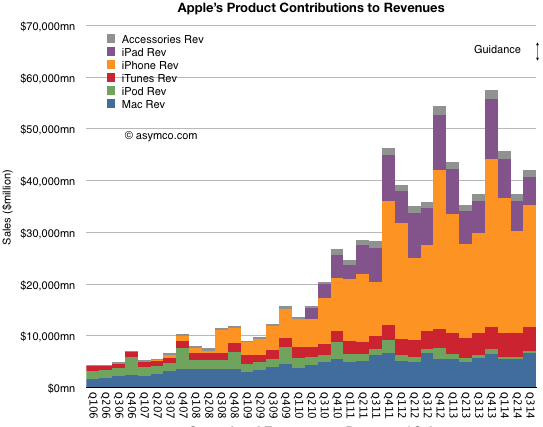
    These things are not iPhones or iPads but they are many and all together they form a modest little unit. I say modest because not much is said about it. When seen in contrast to the other Apple product lines, it's hard to be impressed. In the graph below it's the purple area.
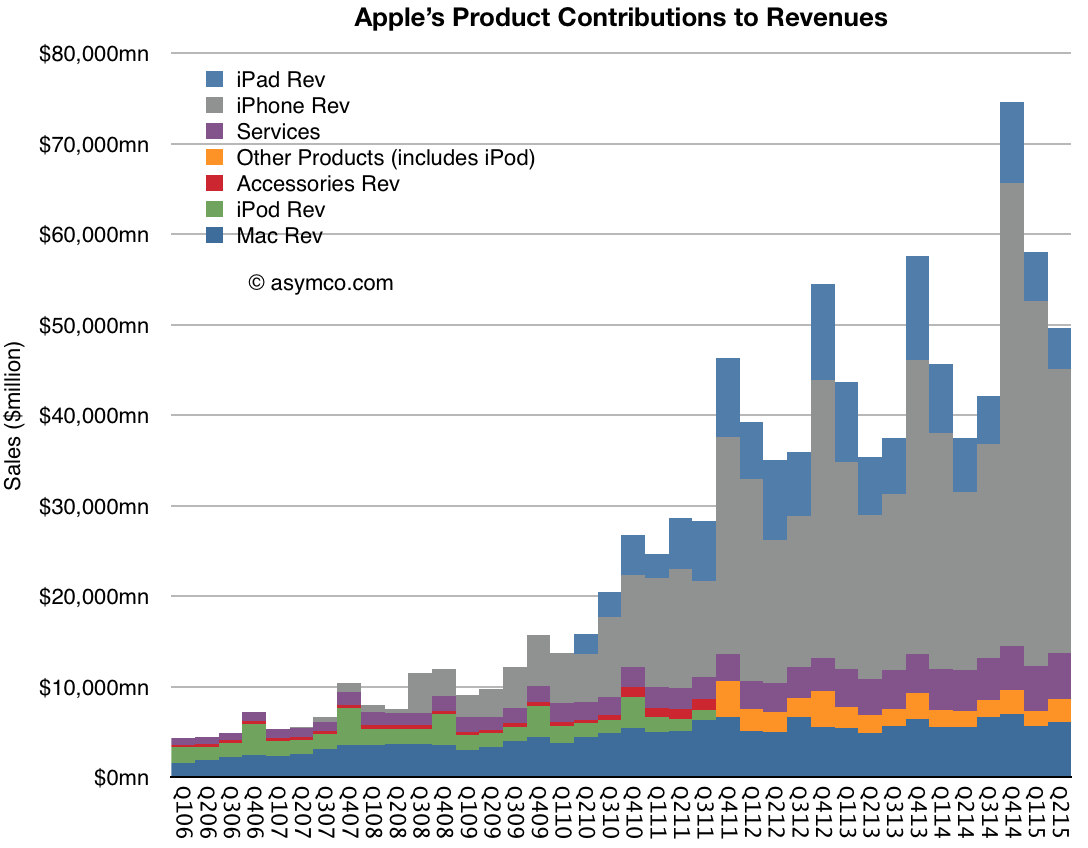
    Screen Shot 2015-08-25 at 5.56.19 PM

    Apple does not help much. Occasionally  Apple offers updates on iTunes/Services using various (rarely the same) metrics. For example, in early August, Eddy Cue offered an update during an interview with USA Today on Apple Music relating how many users there were one month after the service started (11 million).  It was worth a few headlines.

    However he also noted in passing that the App store did $1.7 billion in transactions during July. If you convert that to a yearly run-rate it comes out to about $20 billion/yr. Digging through previous announcements, the equivalent figure for 2014 was about $13.7 billion. Nice growth.

    But is $20 billion of "transactions" of any significance? It's not even a figure that Apple reports as revenue. For apps, Apple reports only the 30% fee as revenues so 70% of that transaction value passes through to developers and is therefore not part of its statement of accounts. ((From SEC filings: For third-party applications sold through the App Store and Mac App Store and certain digital content sold through the iTunes Store, the Company does not determine the selling price of the products and is not the primary obligor to the customer. Therefore, the Company accounts for such sales on a net basis by recognizing in net sales only the commission it retains from each sale. The portion of the gross amount billed to customers that is remitted by the Company to third-party app developers and certain digital content owners is not reflected in the Company’s Consolidated Statements of Operations.))

    However perhaps we should consider the figure in some way. It represents transactions in an economic sense--the amount people spend on apps. It's therefore comparable with what people spend on other forms of entertainment. Movies for example.

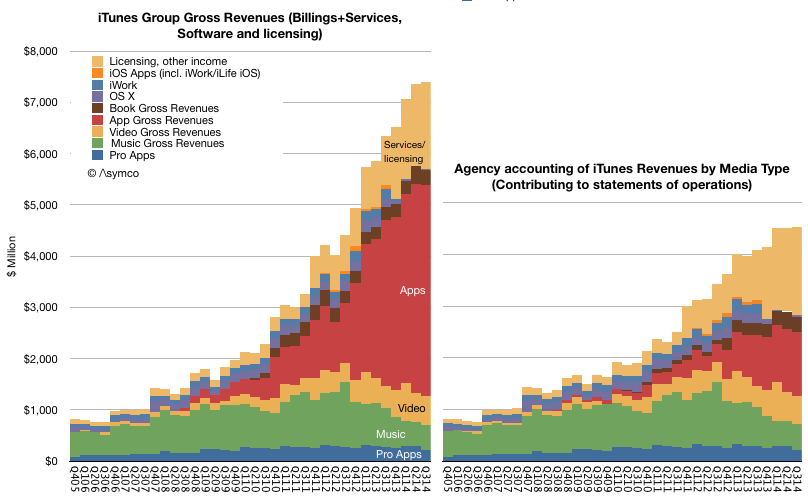
    The following graph shows the spending on apps within the iTunes App Store ((note that this does not include Google's Play Store whose transaction values are not public and is therefore not a gauge of all apps.)) as well as spending on other forms of iTunes stores as well as Services. It also shows how all the services compare with box office revenues from movies. Both the US and World-wide. And how these figures changed over the few years that the App Store has been in existence. The individual service line items are shown in the graph on the left and the stacked totals are on the right.

    Note that already last year App Store Billings overtook US Box Office gross revenues and that Services a whole overtook Global Box Office gross revenues. It's not likely to happen this year but next year Apple's Apps will almost certainly overtake global Box Office in revenues.
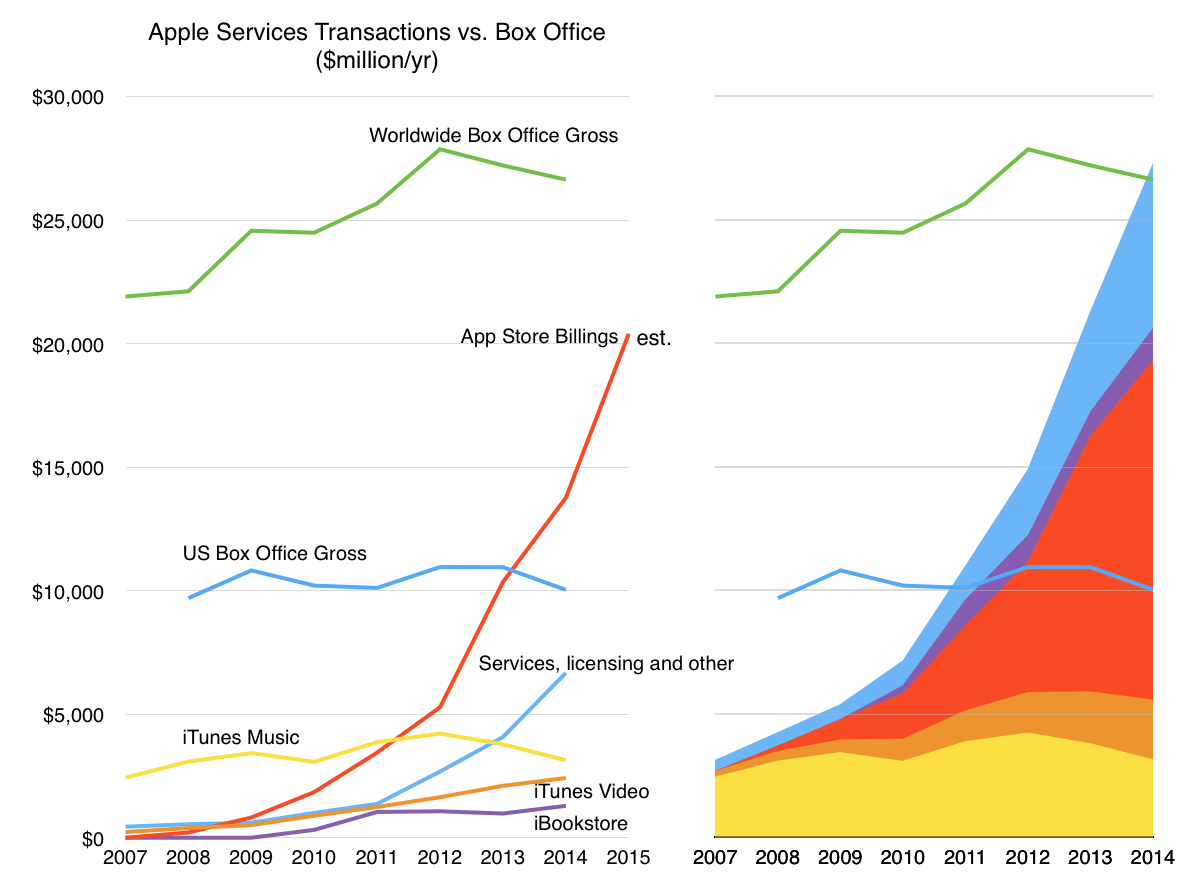
    Screen Shot 2015-08-25 at 5.39.08 PM

    This contrast with movies gives some perspective on the creation of a new market. Apps did not exist as a medium in 2007. But, together with Android apps, apps are likely to have already overtaken revenues from an industry that is a century old. And not just any industry. Hollywood represents more than an economic power, it has a cultural power affecting perceptions and political opinion. And although universally envied, it has not been successfully replicated.

    So having created this market and becoming bigger than Hollywood, and grossing more than what 90 countries produce, Apple's Services not something that is interesting to many who think about technology or even to many who think about Apple.

    Which is why I think Eddy's such a nice guy. No matter how little attention is paid to his economic empire, he always seems to be in a good mood. Maybe he knows something we don't.
  2. How big is iCloud?

    Research · 24 comments

    Apple has declared that what used to be "Other Music Related Products and Services" ((Includes revenue from sales from the iTunes Store, App Store and iBookstore in addition to sales of iPod services and Apple-branded and third-party iPod accessories.)) plus "Software, Service and Other Sales" ((Includes revenue from sales of Apple-branded and third-party Mac software, and services.)) which was formerly known as "iTunes/Software/Services" ((Includes revenue from sales on the iTunes Store, the App Store, the Mac App Store, and the iBooks Store, and revenue from sales of AppleCare, licensing and other services)) is about to become "Services".

    "We'll also have a category that we refer to as services and this will encompass everything we report under the heading of iTunes software and services today including content, apps, licensing and other services and beginning this month it will also include Apple Pay."

    "Services" will therefore encompass a massive amount of revenue. The reported revenues for the fiscal 2014 were $18 billion. Including all billings, the turnover in sales is over $28 billion. For next year, assuming that Apple Pay, which is just getting started, is unlikely to contribute greatly to revenues, Services turnover will top over $35 billion. That figure would make Apple Services alone one of the top 90 companies in the Fortune 500.

    Screen Shot 2014-11-14 at 5.11.47 PM

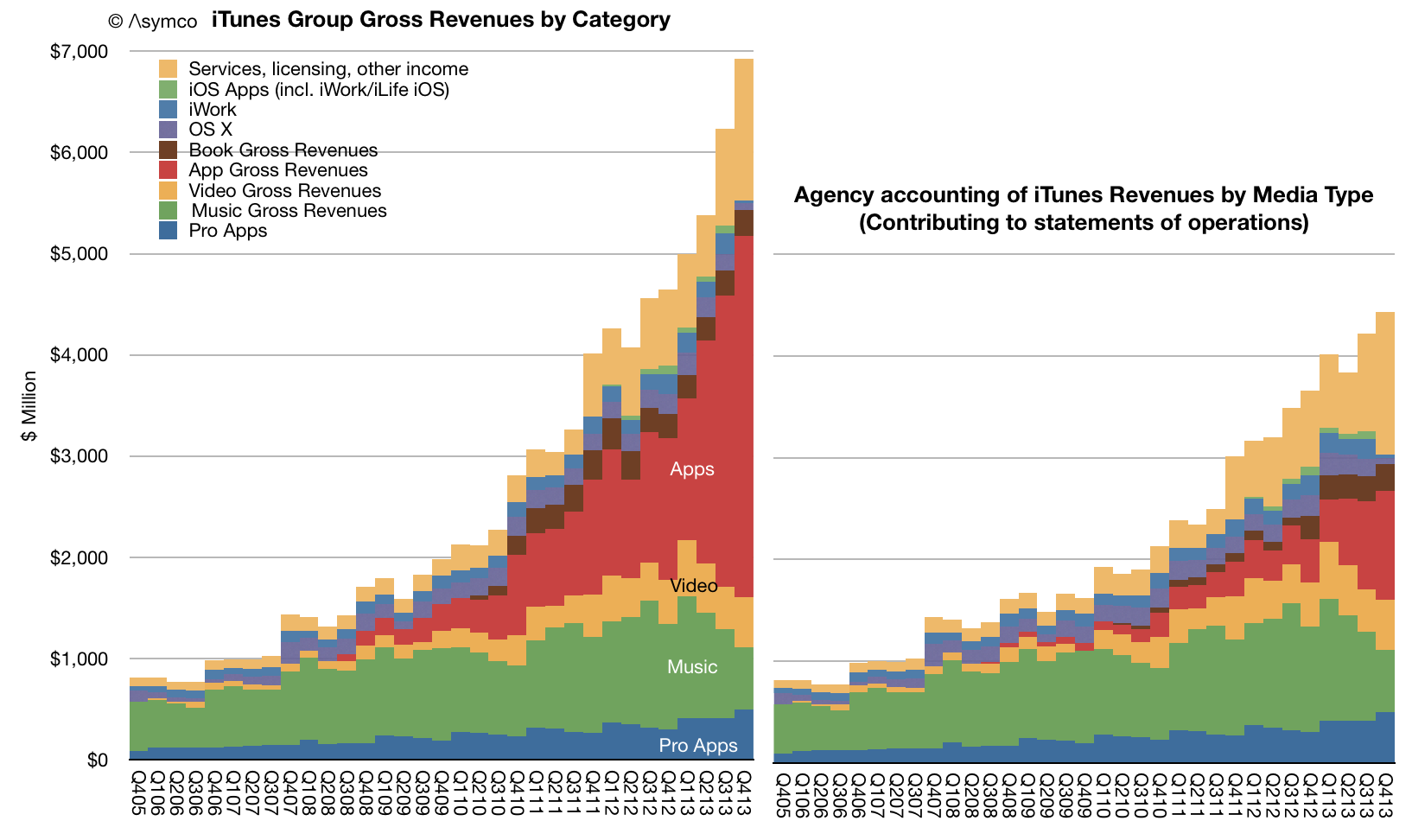
    Regardless, as a component of overall sales, the group formerly known as iTunes/Software/Services (shown in red above) was a modest 7% of total sales in the last quarter. Using all available information regarding downloads, payouts and reported financials, an estimate can be obtained on how this 7% is itself divisible into nine sub-segments:

    Screen Shot 2014-11-14 at 5.15.08 PM
    • Pro Apps
    • Music
    • Video
    • Apps
    • Books
    • OS X
    • iWork
    • iOS Apps
    • Licensing and other income

    These are shown above as either contributing to statement of operations (i.e. as reported, on right) or using billings (or the actual "cash register takings", on left). ((The primary distinction is in Apps billings where the 70% paid to developers is not shown as revenue.))

    What would be ideal in understanding this Services segment would be to break the "Licensing and other income" into its component parts. Namely:

    • Licensing revenues including Google's payments for traffic acquisition (TAC)
    • AppleCare
    • iTunes Match
    • iTunes Radio
    • iAd
    • iCloud
    • (and soon, Apple Pay)

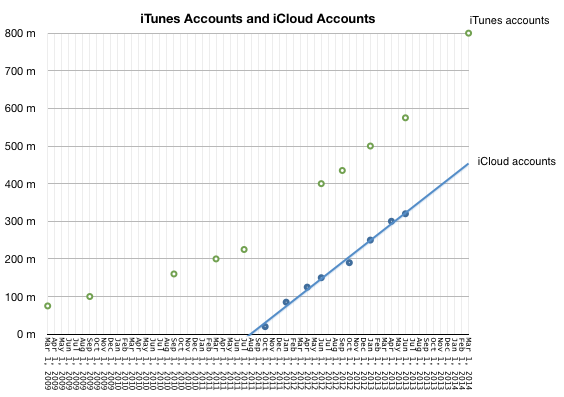
    In particular, it would be very interesting to know exactly how much revenue could be coming from iCloud. We have not heard from Apple on iCloud user numbers since mid-2013 and this was the data at the time:

    Screen Shot 2014-11-14 at 5.30.27 PM

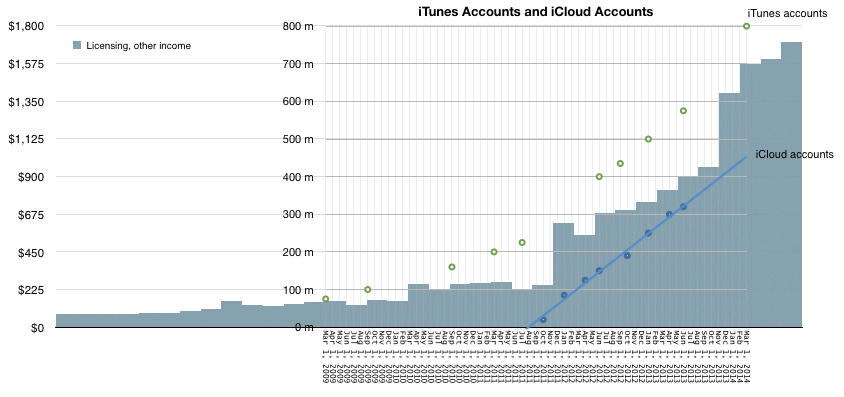
    Couple that to "Licensing and Other Income" as deduced from Services accounting yields the following picture:

    Screen Shot 2014-11-14 at 5.38.30 PM

    It would appear that iCloud accounts are growing in proportion to "Licensing and Other Income". Note that at the point that iCloud accounts were zero, revenues from Licensing were about $225 million/quarter and growing slowly. The real growth kicked in when iCloud accounts started ramping up. Since revenues from iCloud has to be in the "other income" and since no then it is, I believe, reasonable to assume that the iCloud user base growth is a principal driver of growth ((Of course, AppleCare could also be a driver but AppleCare should follow overall device sales patterns and this is not clearly evident in the Licensing/Other curve))

    Also, bursts in the Licensing and other income line occurred after several iCloud-specific marketing events:

    Mobile Me migration started in October 2011 and on September 30, 2013 the complimentary iCloud storage plans expired and were automatically adjusted to the free 5 GB plan (with an offer to upgrade to a paid plan). Correspondingly, Q1 2012 and Q1 2014 showed the largest increases in Licensing and Other Income.

    This is a multiplication of many assumptions, but there is some intuitive logic. The only place iCloud can be found seems to be growing in proportion to iCloud users and plan marketing.

    So how much does iCloud contribute to Apple's sales? My guess would be about $1 billion per quarter. That would be spread over 500 million iCloud accounts and therefore an average revenue per account of $2/user/quarter or $8/user/yr.

    The lowest non-free iCloud pricing is about $12/yr (5GB plan is free). This would imply that two thirds of iCloud users are paying users (and one third are opting for the 5G plan).

    I realize that this attach rate to a paid service is astronomical. Anything over 10% is unheard of. I would say the error in my estimates could be 20% but that still leaves a huge gap to what seems reasonable.

    [Put another way, if the attach rate were only 10% then iCloud revenues would have to be in the $600 million range and thus only about 10% of what Licensing and Other income seems to be. This would force the question of what could be generating the remaining $5.6 billion/yr.]

  3. Fortune 130

    Research · 74 comments

    The increase in net sales of iTunes, Software and Services in the first quarter of 2014 compared to the first quarter of 2013 was due to growth in net sales from the iTunes Store, AppleCare and licensing. The iTunes Store generated a total of $2.4 billion in net sales during the first quarter of 2014 versus $2.1 billion during the first quarter of 2013. Growth in the iTunes Store, which includes the App Store, the Mac App Store and the iBooks Store, was driven by increases in revenue from App sales reflecting continued growth in the installed base of iOS devices and the expansion in the number of third-party iOS Apps available. Net sales of digital content, including music, movies, TV shows and books, from the iTunes Store was relatively flat in the first quarter of 2014 compared to the first quarter of 2013.

    Apple Inc. Form 10-Q.

    During the last quarter Apple changed the pricing for iWork and OS X to zero ((OS X server is still priced at $20 and iWork for previously unlicensed devices and computers is still priced above $0)).

    I estimate the net effect to have been a reduction in revenues from those software titles of about $350 million for the quarter. Nevertheless, increases in services and app revenues means that the iTunes total reported revenues increased to a new record.

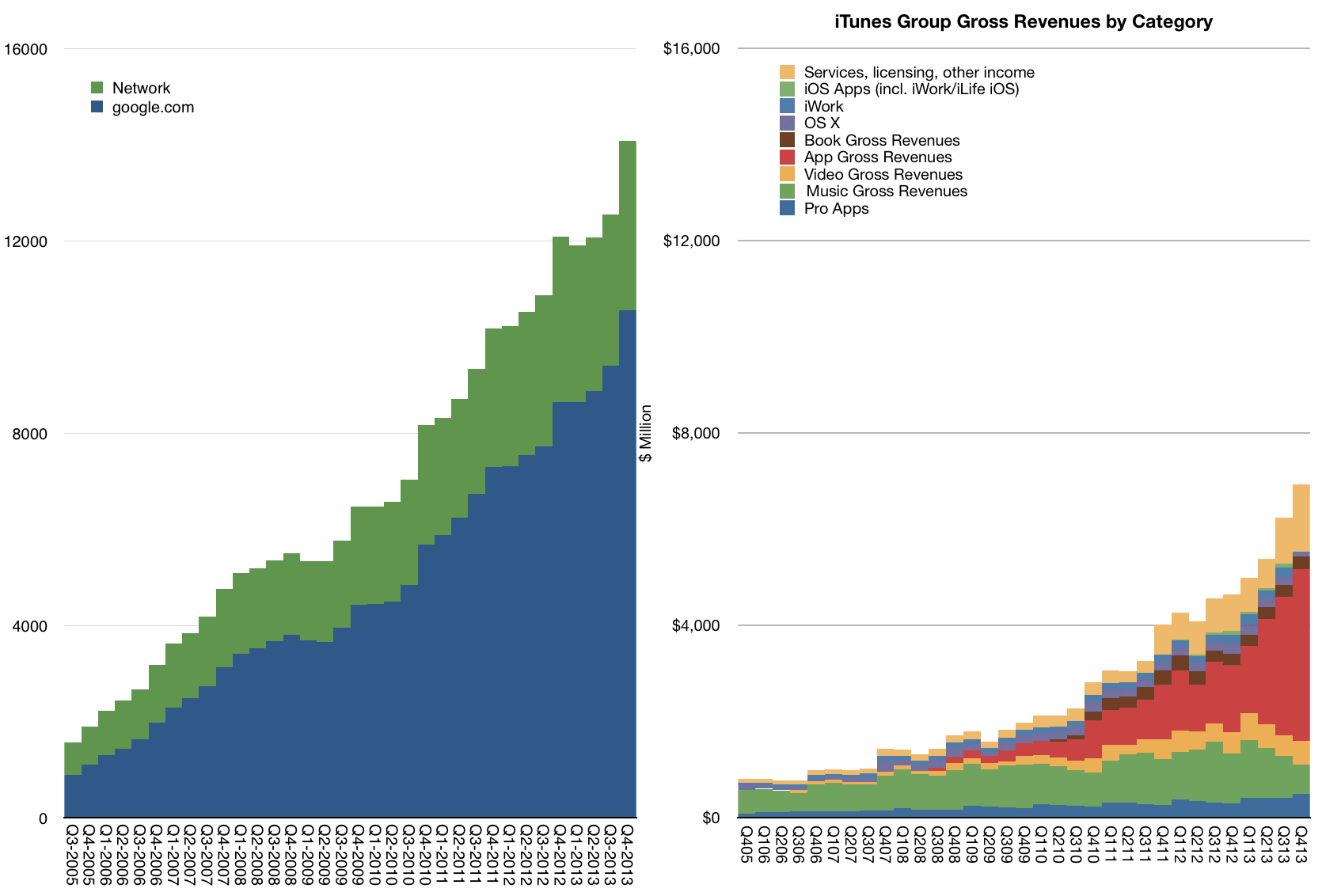
    The total with estimated contributions by media and service components is shown below right.

    Screen Shot 2014-02-10 at 10.05.11 AM

    Note that revenues do not reflect total billings. As Apple reports only the 30% of App transaction values, the full iTunes/Software/Services transaction values are shown in the above graph on the left.

    The "gross" revenues are now nearly $7 billion per quarter. On a yearly basis the iTunes/Software/Services group had gross revenues of $23.5 billion with growth of 34% y/y.

    Screen Shot 2014-02-10 at 10.03.28 AM

    Other estimates for full year 2013 growth are:

    • Third party content +46.6%.
    • Music downloads -14%
    • Video +19%
    • Apps +105%
    • Books -9%
    • Services +37%
    • Pro apps +29%
    • OS X -8%
    • iWork and iLife -8%

    Although iTunes/Software/Services are not usually included in a "sum-of-the-parts" total contributing to Apple's overall enterprise value, the scale of volume and value of transactions is becoming harder to ignore.

    To illustrate this, I plotted the history of gross iTunes revenues vs. Google's search business ((Excludes Motorola and "Other" segments as reported by Google))

    Screen Shot 2014-02-10 at 10.03.55 AM

    On a yearly basis iTunes/Software/Services is nearly half of Google's core business and growing slightly faster.

    The iTunes "empire" of content and services would be ranked as number 130 in the Fortune 500 ranking of companies (slightly below Alcoa and above Eli Lilly).

  4. So long, break-even

    Research · 113 comments

    The following is another excerpt from a report titled "iTunes Business Review" which will soon be available for purchase through the Asymco Store. If you are interested in the product please get in touch.

    ---

    iTunes store will be 10 years old next month. From its inception Apple has stated that it aims to run the store "at break-even".  The business has grown so rapidly however that its profit-free nature has come under severe pressure.

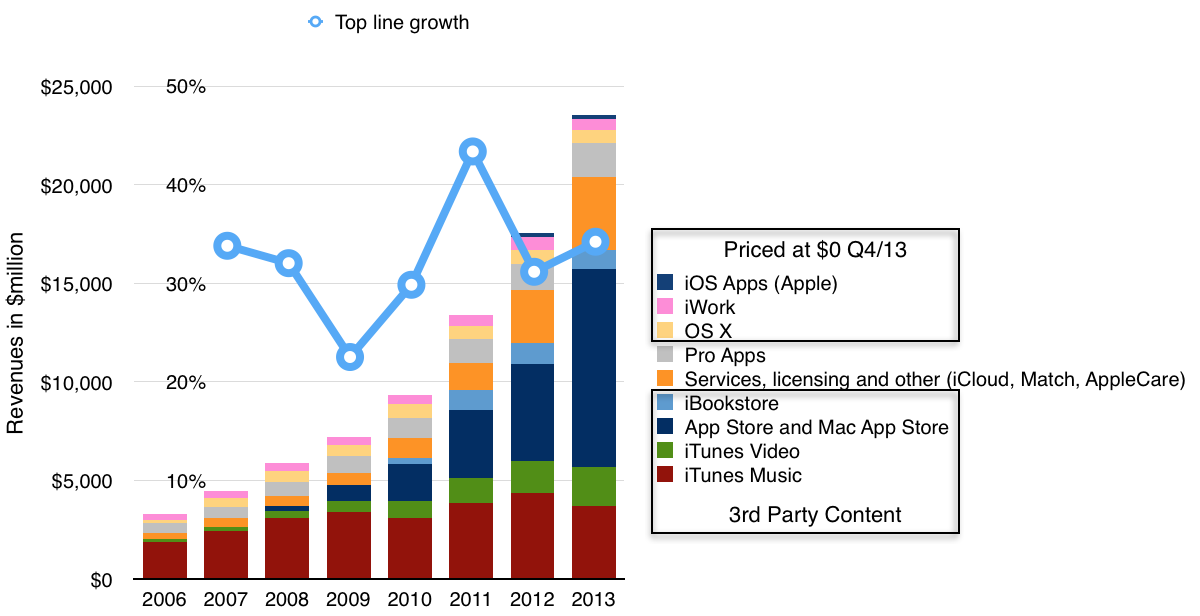
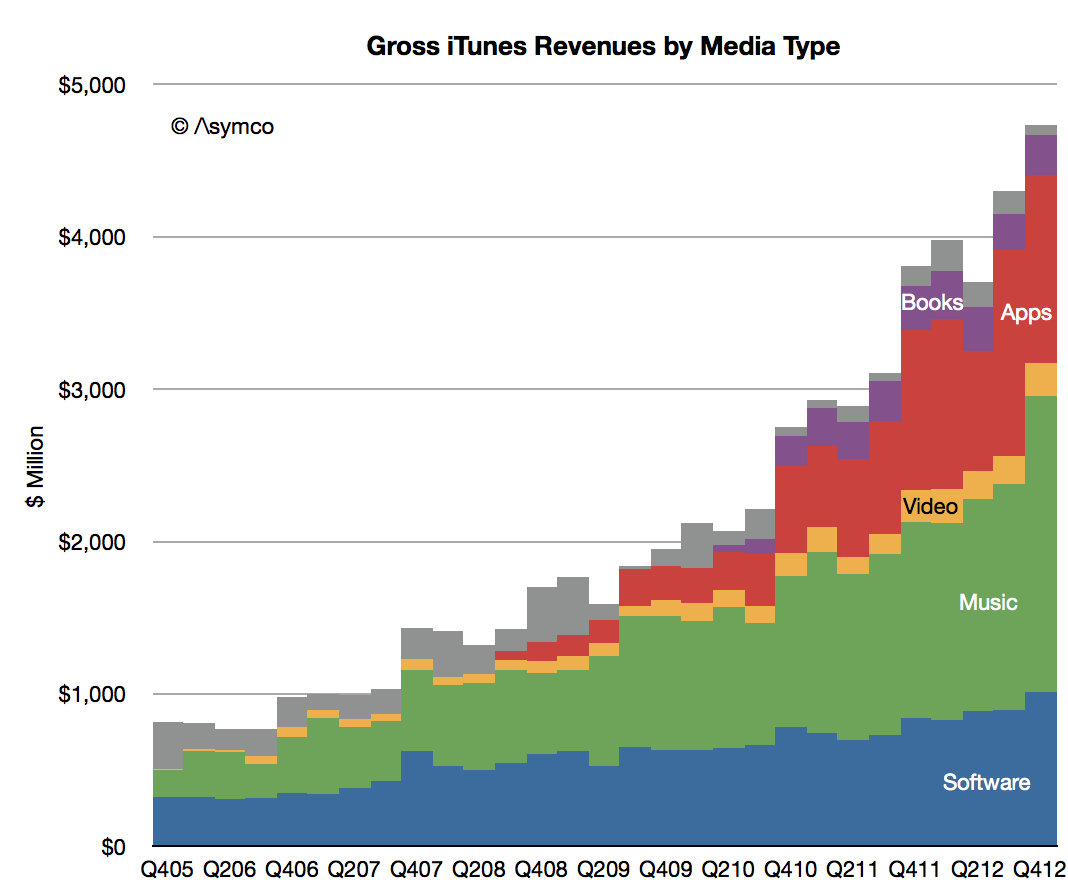
    The reasoning goes that as more media types have been added costs have increased but revenues have increased even faster. Consider the estimated gross revenue base as shown below:

    Screen Shot 2013-03-22 at 3-22-2.39.55 PM

    What is known as iTunes today has quintupled in seven years. Although cost of content sales are likely to have been preserved as a ratio (about 30%) the vastness of transaction volume (estimated at 23 billion item transactions in 2012 alone) implies that there are some significant economies of scale.

    This implies that the operating costs are spread more evenly and that therefore the possibility exists for some operating margin.

    Put another way, at break-even the cost of operating iTunes stores would be about $3.75 billion. It's hard to imagine this level of operational expense for digital content.

    For this reason, management has begun since 2010 to suggest that at least the App Store is run "a little over break-even". How little is a good question. A one percent operating margin (from gross revenues) would imply as much as $45 million margin. I estimate 2% is possible on Apps and 1% on Music.

    That's $150 million in margin content. Heady stuff.

    However, since folding its Software group into iTunes (the blue area in the graph above) the margin picture changes dramatically.

    The Software group is one of the forgotten heroes of Apple.

    Apple’s software division “Apple Software” is responsible for the following products:

    • iWork which includes Pages, Numbers and Keynote. These are available through the Mac App store at about $20 per product and the iOS App Store for $10.
    • iLife which includes iMovie, iTunes, iPhoto, GarageBand. The OS X versions are available free with new computers but they are also available as paid downloads for OS X through the Mac App Store at $15 each and for iOS devices through the App store at $4.99 per app.
    • OS products including downloads of iOS and OS X. These are mostly free but some OS X updates are not free (typically $19.99 for new version including the server version of OS X.)
    • Professional tools which include the following products: Final Cut Pro (Video editor $299.99), Logic Pro (Music editor $199.99), Aperture (Professional Photo workflow $79.99), Compressor (additional features for Final Cut Pro $49.99), Motion (video transition editing for Final Cut Pro $49.99)
    • Administration and development tools which include:  Xcode integrated development environment which is free Apple Remote Desktop which is priced at $79.99.

    All these products are now sold through either iTunes App Store or Mac App Store. They used to be sold as traditional boxed software for many years but Apple has transitioned them all to be download-only and folded them into the catalog of third party apps while lowering prices.

    My estimate is that Apple’s own software generated $3.6 billion in Revenues in 2012. As you can imagine, this is a high margin business  which grows at nearly 20%/yr. Although I estimate that the software business has been overtaken by the Apps and Music businesses in gross revenues, it keeps an operating margin similar to that of Microsoft or about 50%.

    This means that iTunes inclusive of Apple's own Software generates as much as 15% operating margin on gross revenues. That's over $2 billion a year.

    So much for breaking even.

  5. Hiding in plain sight

    Research · 67 comments

    Guessing the next Apple product has become the parlor game of choice for a whole generation of technology journalists and analysts. The premise of the game is that given a track record of breakthrough products, there is always another one just around the corner. Being the one to predict this next breakthrough product creates credibility and demonstrates the domain knowledge of the predictor. If the prediction fails to materialize there is consolation in dismissing the actual announced product as disappointing, unsophisticated or, worst of all, uninteresting.

    Most often, these guesses are as much a reflection of the analyst as they are an analysis of the company. Too many predictions are designed to impress or demonstrate the imagination or knowledge of the predictor. They typically anticipate a giant leap of functionality, power or market re-structuring. They envision revolution not evolution; a cutting of the Gordian knot not a polishing of ugly rocks.

    Yet nearly all of Apple's launches have been sustaining improvements in existing products, technologies or platforms. To name just a few:

    • The iPad is an evolution of the iPod touch
    • The iPod touch is an evolution of the iPhone
    • The iPhone uses OS X and Objective C from the Mac
    • OS X came from NeXT
    • The app store market model came out of the iTunes store
    • The iTunes store came from iTunes which came first to the Mac as a media sync tool for the iPod
    • etc.

    John Gruber explained the process last spring as it relates to many of Apple's launches. Although the iPhone did introduce a new user input method and experience that takes consumption in a new direction, its building blocks were there for all to see for many years. The iPhone is a natural evolution of the computer with a handy little "Phone" app.

    Likewise, the iPod came seemingly out of nowhere but by watching the original launch you see it as part of a "media hub" strategy that envisions the Mac as a personal server. The very products which ended up disrupting the Mac/PC began as extensions of their victims.

    You can trace the DNA of almost all of Apple's products to previous products. If Apple did not have these foundations, the slow-motion revolutions would not have happened. Rather than a deliberate big bang, Apple's disruptions are the result of a discovery process. A test, iterate and improve loop. This is why they seem obvious after the launch but also why they seem to be such an anti-climax.

    Therefore, the challenge of predicting Apple's next product should be tackled not only through an act of imagination but by carefully projecting the current products and understanding where they can evolve.

    So it is that I approach the question of Apple's TV disruption. My working assumption about the next Apple TV is that it already exists. It's none other than the existing Apple TV, improved.

    Here are the clues or hints I noted:

    • It uses iOS and the hardware from the devices that run it. It originally ran a PC architecture and shared a kernel with Macs.
    • It has been integrated with iTunes media stores (with the notable exception of the iTunes app store)
    • It has begun to introduce channels other than downloads (ESPN, Wall Street Journal) thus establishing its own distribution for traditional content
    • It is a global product, depending only on the Internet protocols and independent of the balkanized cable standards
    • Through AirPlay it is integrated with Macs and Apple devices.
    • Through display mirroring, iOS devices can use the TV as an external monitor and can even change their own behavior when doing so

    This last point is intriguing. I have not seen discussion of this feature, but if using an iPad 2 or iPhone 4S with iOS 5 and an Apple TV with the latest software updates it's possible to have an iOS device become a controller for TV-based game experiences. Developers are already using the API. When using a pinball game with screen mirroring, the device becomes a controller while the action takes place on the big screen. Switching display mirroring off bring the action and control back onto the small screen. There are still problems with lag and the processors are over-taxed on high frame rates, but the APIs are already there for developers. (I could also mention the potential of new a Bluetooth standard for better wireless response).

    What these signals point to is Apple defining the TV as an iOS portfolio product. This means integration with iTunes, including an app store. This, in turn, means unleashing developer/creative talent through new monetization opportunities. This means new user experiences in discovery. This means FaceTime-like communication through the TV. This means many other things but mostly it means that the TV will be a platform product.

    The only challenge is a (currently lacking) smooth interface. Perhaps that's where voice comes into the picture. But whether that is built-in at the next rev of the product or not is not the story. The story is going to be the sustaining improvement in the original Apple TV. A wonderfully asymmetric product begging to be ignored. A product that because of its apparent lack of success, effectively hides all its secrets in plain sight.

  6. iTunes has paid over $2 billion to app developers and $12 billion to record labels

    Research · 13 comments

    The last analysis of the iTunes content store showed amazing acceleration in download rates. Since we know something about the pricing of apps in aggregate, we can make some guesses about the income from apps for both Apple and suppliers.

    The key assumptions are:

    1. Average selling price per app $0.29 (as reported in June 2010 here).
    2. Price per song $.99 increasing to $1.05 over time
    3. Music gross margin 10%
    4. App gross margin 30%

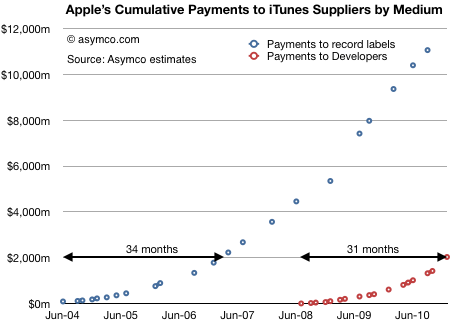
    The first chart shows the accumulated payments made to suppliers of content to the iTunes store over time.

    Although the music suppliers received in aggregate much more than developers, the iTunes store has been open much longer. When comparing sales acceleration, the App store is ramping faster having paid out $2 billion in 31 months vs. 34 months for the first $2 billion paid out for music.

    My guess is that a follow-the-money analysis would show that apps as a medium will absorb talent and capital away from existing mediums and the industries they support.

  7. Star system vs. flea market: How Apple and Google target talent

    Research · 8 comments

    The iTunes app store has gone over 310k apps approved and has 250k apps in its catalog. The Android Market, in spite of (or perhaps because of) an abundance of copyright infringements, is growing nearly as quickly. According to at least one source, there are over 130k apps.

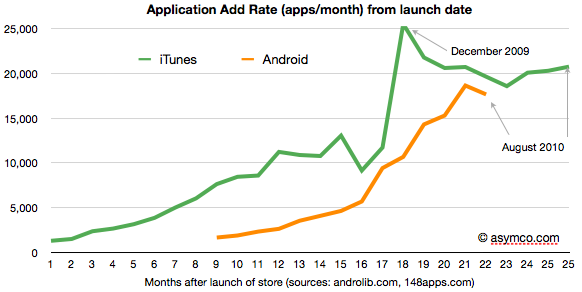
    The way to study these two catalogs is to look at the number of new applications being approved (or added) on a monthly basis.

    Even better would be to index to the same starting date, as in the following chart.

    The Android Market grew grew more slowly than the iTunes store for the first two years but has accelerated to nearly the same rate now. Meanwhile, the iTunes Store has shown seasonality around the holidays (though we'll have to see if it repeats this year) and has held fairly steady at 20k/mo.

    The policies are also shifting: On one hand, Apple has also signaled that they are not willing to accept "me-too" copies of simple apps. On the other hand they clarified policies and began to allow interpreted code apps. Google has not yet reacted to infringements on its store but it's probable that they will have to respond with some policing as download volumes grow.

    The fact that the Android store is not policed or curated reduces the barrier to listing for developers and, in theory, should encourage a more rapid add rate. But the Star system of the iTunes store encourages more attempts to find hit apps. So in many ways we see that the two have an orthogonal approach:

    • The iTunes store is a hit-driven star system with long tail paid app value model
    • The Android Market is a flea market model with an ad-supported value model

    There are few conclusions we can draw at this time about long term sustainability--after all these are ongoing and fairly young experiments.  It does seem that both platforms are attractive enough today to create critical masses of apps, perhaps exactly because they don't put forward the same value model.

  8. New data on iTunes: 11 billion downloaded

    Research

    When Steve Jobs announced 150 million accounts with credit cards on the iTunes Store, iBookstore and App Store, he stated that as far as he knows it has "the most accounts of any store on the web".

    More interesting is the claim that iTunes has enjoyed 16 billion downloads.

    Subtracting the 5 billion app downloads, that leads to Music+Video adding up to 11 billion (books at 5 million is still too small to make an impact.)

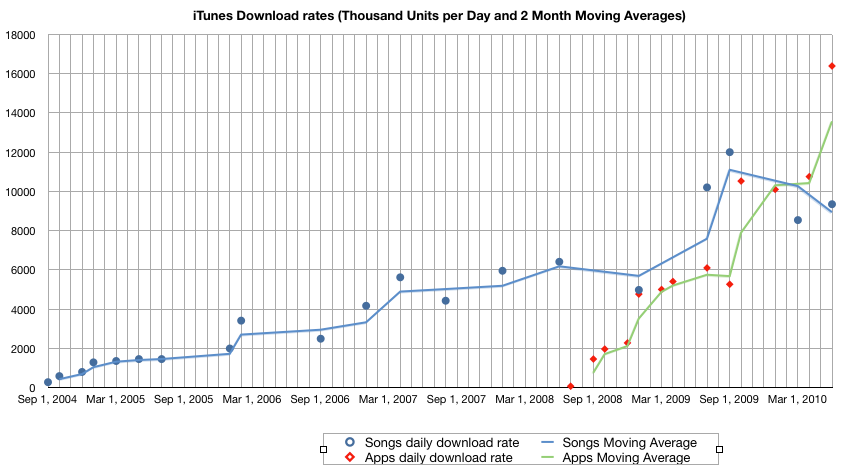
    The last download data on iTunes was in February when Apple reported 10 billion songs downloaded. The new data implies the daily download rate is about 9.3 million per day.  The forecast I had suggested 11.1 billion by June 1 so it's come in a bit less than expected.

    12 billion songs is expected in September.

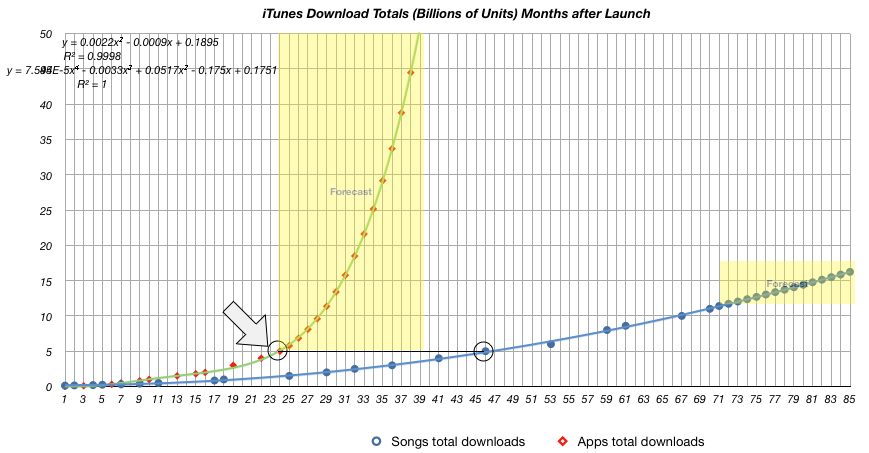
    The graph that follows shows actual and forecast cumulative downloads for the App Store and iTunes store based on months after launch.  As it shows, 5 billion apps took 24 months whereas 5 billion songs took 46 months.

    This graph shows the download rates.  The green line (apps) clearly overtakes the slowing blue line (songs/media).

  9. Nokia shutters U.S. flagship stores

    Research · 1 comment

    In other news:

    • Nokia shutters flagship Regent Street store in face of Apple retail’s domination - December 08, 2009
    • Nokia sees flat market share as Apple gains - December 02, 2009
    • Nokia Chief Strategist: Apple will remain a niche player in smartphones, just like in computers - November 30, 2009
    • Nokia to cut another 330 R&D jobs - November 20, 2009
    • To understand market share vs. profits, look no further than Nokia vs. Apple - November 11, 2009
    • How Apple passed Nokia to become the world’s most profitable handset vendor - November 11, 2009
    • Strategy Analytics: Apple passes Nokia to become world’s most profitable handset vendor - November 10, 2009
    • Nokia sues Apple claiming iPhone infringement of Nokia GSM, UMTS and WLAN patents - October 22, 2009
    • Nokia posts loss of 559 million euros on weaker smartphone sales - October 15, 2009
    • Nokia’s earnings plummet 66 percent - July 17, 2009
    • Jim Cramer: The problem with Dell and Nokia is that no one wants their products; Buy Apple - July 17, 2009
    • Nokia’s failures vs. Apple’s vibrant iPhone platform puts market share at risk - June 24, 2009
    • Nokia Ovi Store launch a complete disaster - May 26, 2009
    • Nokia ships 19% fewer phones in Q1, bleeds more share - April 16, 2009
    • Nokia axes 1700 jobs worldwide - March 17, 2009
    • Nokia halts sale of iPhone killer; 5800 handset plagued with major problems - March 02, 2009
    • Nokia hops on bandwagon, unveils knockoffs of Apple’s iTunes Store, App Store - February 16, 2009
    • Nokia profit collapses 69% in fourth quarter 2008 - January 22, 2009
    • Nokia’s profits plummet 30 percent - October 16, 2008
    • Nokia’s fatally flawed ‘Comes With Music’ service no Apple ‘iTunes Store killer’ - October 03, 2008
    • Nokia fumbles iPhone lookalike-not-workalike launch in U.S. and Europe - October 02, 2008
    • Nokia sputters that iPhone ‘not worthy of discussion’ - August 13, 2008
    • Apple takes top spot from Nokia on AMR Research’s 2008 Supply Chain Top 25 list - May 30, 2008
    • Nokia shares slammed in wake of miss; Nokia CEO calls Apple iPhone ‘niche product’ - April 17, 2008
    • The knockoff parade continues: Nokia exec shows Apple iPhone lookalike ‘Tube’; dismisses Apple - April 08, 2008
    • Nokia previews blatant Apple iPhone knock-off (with video) - August 29, 2007
    • Nokia CEO challenges Apple over iPhone - February 13, 2007

    http://www.macdailynews.com/index.php/weblog/comments/nokia_shutters_us_flagship_stores_as_floundering_cellphone_maker_fails/