Asymco

Asymmetric Intelligence

lens

  1. A Long-Lens Look at Apple and Disruption—Part 1: Is Apple Disruptive?

    Research

    Recently, I met Farshad Nayeri and Dave Sundahl—formerly of Christensen Institute, now at Disruptive MBA (dx.MBA)—when the topic of M1 Macs came up. The result was a multifaceted conversation where we took a long-lens look at Apple & Disruption around three core questions:

    1. Is Apple Disruptive?
    2. Is Apple Overserving with M1 Macs?
    3. How does Apple defy Disruption?

    You can read part 1 of our conversation at A Long-Lens Look at Apple and Disruption on the dx.MBA blog.

  2. The Disruption FAQ

    Research · 28 comments

    Q1. What is disruption?

    Disruption happens when the strong are defeated by the weak. More precisely it’s when those with unconstrained access to resources have them taken away by those with minimal or no resources. It's a phenomenon that is in contrast to sustaining competition where the strong get stronger.

    Q2. How can disruption happen? Don’t the strong always have an advantage over the weak?

    The strong can be defeated when the fight is unfair. More precisely, "strength" is only a perception based on convention or historic precedent. The entrant may be weak in resources but may be strong in a way that is not seen as conventionally useful or valuable such as agility or a willingness to learn.

    Q3. What makes a fight unfair?

    A fight is unfair if the opponents fight according to different rules. This is also called asymmetric competition. Asymmetry is an important concept in game theory, economics and military science.

    Q4: Is there a way to know disruption is about to happen?

    Disruption theory is an attempt to reliably identify winning challenges. It includes a method of analysis of "the setting" of the fight and "the weighing” of the fighters. In other words, it measures whether the challenger is sufficiently asymmetric and whether the incumbent is flexible enough in their likely response. If there is insufficient asymmetry the theory would suggest the challenger will lose, and vice versa.

    Q5: How often does it happen?

    In some industries it happens quickly and in some industries slowly and in some never at all. Determining the cause of the rate of disruption is an important research topic. We can hypothesize that industries which show frequent disruption also show a high degree of wealth creation. The inverse is also true: industries that don't get disrupted don't create much wealth.

    Q6. How do incumbents react to asymmetric challenges?

    This quote (mistakenly attributed to Gandhi) describes it best: "First they ignore you, then they laugh at you, then they fight you, then you win." The main test of asymmetry is to ask whether a challenger’s entry is ignored (or welcomed) by the incumbents. Most asymmetric challenges are not taken seriously because they initially benefit the incumbent. The side-effect is that it lulls them into a sense of security resulting in a lack of response. Challengers have the child-like advantage of rapid growth and learning while incumbents are encumbered by their size and lack of flexibility.

    Q7: Why don’t challengers respond in kind?

    Mainly because they don’t feel that they need to. The newcomer is either not seen as a threat or welcomed because the customers they obtain that are not seen as valuable. In some cases the business model of the entrant is contrary to that of the incumbent. In other words, the challenger makes money in a way that would cause the incumbent to lose money. Often the challenger is actually invisible because she misdirects attention. They may be seen as competing in one market with a certain set of competitors but their effect is in another market which never had to deal with a challenger.

    Q8: If there are different ways disruption can be observed, doesn’t that mean there are different types of disruptions?

    Yes. When a competitor challenges with a cheaper product that seems to perform poorly and has low margins and the incumbent accepts the entry because it allows them to concentrate on more profitable customers then this is called a “low-end disruption”. Here the asymmetry is in cost structure. The entrant has lower costs and accepts lower profit margins and may “make money” in new or different ways.

    When a competitor misdirects attention by selling a product that draws usage from existing customers and adds non-consuming new customers because it enables new uses, then the incumbent feels no pain from the entry because they don’t sense a reduction in customers. We call this a "new market disruption". The challenger gains a foothold and grows/evolves, eventually capturing customers exclusively. Here the asymmetry is in the basis of competition and measurement of "performance". The new product does not actually do the same thing as the incumbent product or does a subset of valuable tasks poorly while excelling at menial tasks. The entrant may be highly profitable but they are not taking profits away from incumbents because they "grow the pie", capturing value by fulfilling unmet needs.

    Disruption can also happen to professions and institutions when less skilled individuals are enabled to perform complex jobs or when professionals can establish good enough services that used to take institutional support. This is called professional services disruption.

    Technological change is often (but not always) the core enabler in creating disruptions. The analogy is that technology is a weapon that allows asymmetric combat but the combatant is the disruptor, not the weapon ((See David vs. Goliath: using a projectile allowed David to overcome Goliath but only when wielded skillfully)).

    Q9: It sounds like the trick to spotting disruption is in perceiving when the fight becomes “unfair” and an outsider advantage is gained. Does the theory make this easy?

    It makes it possible but not easy. Understanding when a basis of competition changes and where competition is shifting is still very difficult. It is notoriously difficult to sense when it’s happening to you because you are working toward a strategy with assumptions that have been tested and proven to be correct. In other words, you, your colleagues, your competitors and everyone you’ve ever met knows the rules of the fight. Insider status makes you an expert, your knowledge is far beyond a lay person’s and you have a track record of winning. Hubris and pride makes it difficult to accept a challenge from an ignorant outsider.

    Furthermore, an outside analyst who is not suffering from these psychological weaknesses may not have the means to measure change because they don’t have access to market metrics. So you can’t typically hire a consultant to help you spot it. This is where the theory helps. If you are a practitioner then you can use the theory as a lens to see the patterns in the operating data.

    The proper application of the theory requires domain knowledge or deep reading of weak signals. It’s best employed by incumbent operating managers analyzing their own industry. It’s a tool that can be used to overcome the perception of incumbent invulnerability. It is not a tool that can be used by armchair generals. They can pick up the lens but, not having any data to look at, they have have no patterns to recognize. (This last point is disputed. See comment.)

    By the way, entrants don’t benefit much from it either because they act disruptively by instinct. They enjoy the freedom of having nothing to lose.

    Q10: How long does this take? Isn’t a shift in competition natural over a few decades?

    The speed of disruption is changing rapidly. It used to take decades but now it takes years and in some software industries it could be happening in less than one year. When it used to take decades it did not matter much because the “victims” of a disruption usually could spend a career in the firm being disrupted and would not have to adjust their behavior or assumptions. The consequences would have been felt by future generations. The rate of disruption today is so rapid that many careers and lives and families are having to deal with the consequences, sometimes more than once. Estimating the acceleration and scope of disruptive change is a great research topic.

    Q11: Is the theory complete? Can't we just write an app for it?

    It’s not complete. It cannot be encoded as a deterministic algorithm. It’s not even likely that expert systems or neural networks or machine learning can help. This is because perception of change in competition is a skill informed as much by intuition as by data and rules. If the theory is developed further, through a process of theory building, then it might become an app.

    Q12: If the theory is not complete, then isn't it useless?

    A theory is not useless if it's imprecise or difficult to use. Data that would make conclusions precise is often missing or unavailable. The theory relies on weak signals and explains what used to be unexplainable. Many sciences developed from empirical analysis similar to where we are with disruption theory. Theories benefit from development.

    Q13: Is the theory being developed further?

    Yes. There is a process for theory building which has been ongoing for over a decade where many researchers, students of disruption and practitioners are contributing.

    Q14: Can the theory be applied outside of business competition?

    Yes, institutions can be disrupted as can individuals. Possibly even economies and states. This is because a growing technological base and communications enable asymmetries of ever-greater scope and speed. The research needed to establish how this happens is under way. However it's important to know the limits of the phenomenon. Incumbents are getting wiser as they wield the theory and some "settings" show resistance to change and thus prohibit technological cores to be utilized disruptively. The study of these anomalies is essential to the process of theory building.

    Q15: Is disruption a force of nature? Has it always existed? Will it never end?

    Oral traditions suggest that people have been aware of disruptive forces for all of history. We feel it in the school playground and in many personal relationships. It's in the Bible and the classics that predate it. It's visible in all cultures. Disruption theory as applied to business and government is only an extension of this causal individual behavior into complex systems. It’s possible that awareness of it might cause the behavior to change, or, put another way, that if you observe and understand the phenomenon, that knowledge could cause it to stop happening. But the systems involved are vast and learning curves are long. Enlightenment may take a few lifespans.

    Update:

    Here are questions which have been added based on reader feedback. Please feel free to suggest others in the comments.

    Q16: Isn't Disruption just evolution of business models?

    Business models evolve, but if the evolution sustains an existing incumbent then it's not a disruption. If an evolution is  adopted by an entrant who then proceeds to strip the assets and profits from an incumbent then it's a disruptive change. The key question is why do some changes get adopted and not others.

    Q18: What have been the major improvements in the theory since its introduction in 1997's The Innovator's Dilemma?

    From Clay Christensen's work alone: New Market Disruptions, Professional Disruption, Value Chain Evolution Theory, Jobs to be Done Theory. The Innovator's Solution including how to respond with autonomous self-disruption, the role of acquisitions, the study of Healthcare and Education as targets of (and anomalies to) disruptive change. The process of theory building. The Capitalist's Dilemma and how economies create incentives and disincentives to disruptive innovations.  Many other contributions from researchers too numerous to cite here.

    Q19: What industries cannot be disrupted

    Industries which experience no disruptions are "anomalous" in that the theory suggests that technological progress forces change and technologies have proliferated in almost all industries..  Industries or institutions which have remained largely undisrupted include Energy, Education, Government, Healthcare, Airlines and Hotels. The study of these anomalies continues and explanations identify conditions that prevent growth. Dependencies on regulation, infrastructure, and absence of technological core enablers caused some of the atrophy to date. However signals of change are appearing in all these industries and paths to disruption are clearly possible.

    Q20: How is it possible that companies which were claimed to be disrupted are still around and some which are claimed to be disruptors have vanished?

    Being disrupted does not mean ceasing to exist. Being disrupted is a loss of a specific encounter, but not necessarily a terminal loss. Being a disruptor is a win in a specific encounter and not a guarantee of immortality. Indeed many disruptors come to be disrupted and the theory suggests sustainable growth requires self-disruption. Also a disrupted company can be re-configured post-disruption into another entity or can muddle along with limited value indefinitely. Sometimes they can rise up and become disruptors again.
  3. How many iPhones will be upgraded next year?

    Research · 70 comments

    Last week I proposed that there were two significant markets for the new iPhone: 1) the existing iPhone user base 2) smartphone "non-consumers". Today I want to dig a bit deeper into the first market to get an idea of what it amounts to.

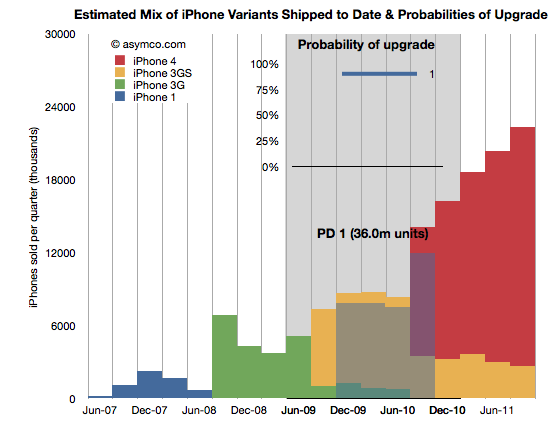
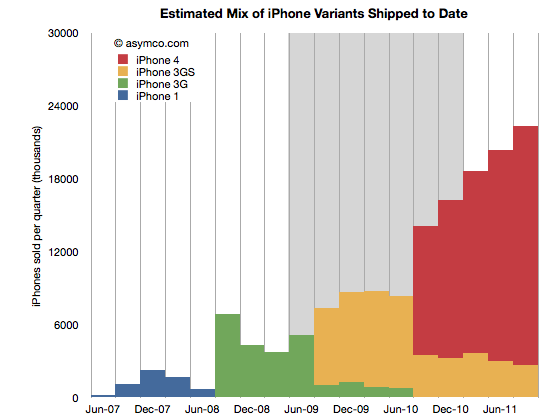
    The following chart shows the total iPhone shipments over time with an estimate for the mix of models during the last two years.

    The way I calibrated the mix is by taking into account the statement that Tim Cook made that half of all iPhones shipped were iPhone 4. I first estimated that this past quarter (ending September) included about 22.3 million units. That makes the total iPhones to end of Sept 151.3 million. Half would be about 75 million. Therefore the red area needs to add up to that total. The remainder must therefore be the yellow, 3GS volume.

    This mix implies that the following shipments by variant (through end of Sept 2011):

    • iPhone 1: 6.1 million
    • iPhone 3G: 24.4 million
    • iPhone 3GS: 45.4 million
    • iPhone 4: 75.4 million

    I also highlighted in grey the most likely target market for upgrades during the next 12 months. What I'm assuming is that recent buyers will not be likely to upgrade but those having purchased an iPhone two years hence will probably be looking to replace it. The naive approach is to assume all the iPhones beyond a certain age will be automatically upgraded. That would give almost 70 million units. However, not all those phones are in use and many of those phones may have already been upgraded to iPhone 4s. 70 million is a theoretical maximum. We have to be more specific.

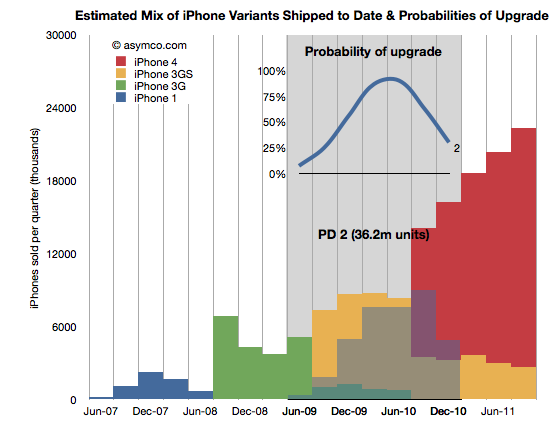
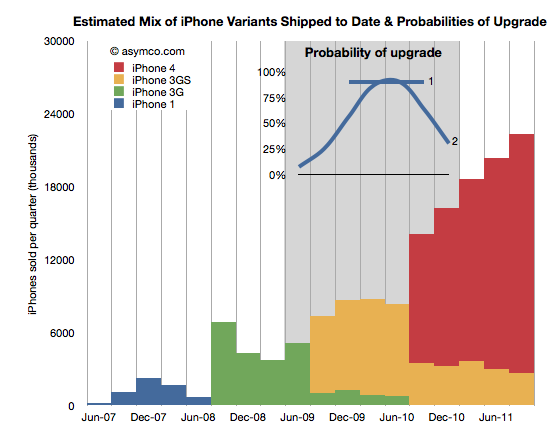
    In order to get a better figure for this I created a probability distribution (PD) which suggests the likelihood that the phones purchased in that quarter get upgraded in the next 12 months. I created two such PDs illustrated in the inset chart below:

    PD 1 is the simplest. It assumes that 90% of two year old iPhones will always be upgraded. PD 2 is a bit more nuanced where it assumes that there is a range of probabilities over a wider period, but with a peak in the 2 year old zone. These PDs are guesses but consider them starting points for debate.

    By multiplying the probability in the line chart (PD1) with the area below it (the units it covers) we get get the shaded area indicating which phones (and variant) will be upgraded next year.

    The areas not shaded are either left un-upgraded or represent phones which were already upgraded to iPhone 4's last year. The PD1 assumption yields 36 million units.

    Doing the same with PD2 yields a different upgrade set shown below:

    This assumption leads to about 36.2 million units upgraded in the next 12 months. Very similar to PD1 but approached from a different angle. Are these figures credible? I don't know. The real PD may be quite different but I think these are pretty conservative figures. They are about half of the theoretical maximum.

    Why is this Interesting?

    This is interesting because of two reasons.

    Firstly, it lets us calibrate our forecast for iPhone sales next few quarters. My own estimate stood at 140 million prior to this analysis. Is it reasonable? Remember that the target market includes non-consumption or non-iPhone, non-Smartphone users. Given the "guaranteed" market above at least 36 million, it makes the non-consumption target about 104 million. Does it sound reasonable?[1]

    Yes. Primarily because most iPhones sold during the last 12 months were sold to non-consumers. And there were 76 million of them. Apple's distribution has increased since and will continue to increase[2]. That means that Apple does not need to stretch much more than it already has to get the additional growth from un-penetrated markets. We know that this market is still measured in the billions of users. The demand is there.

    Secondly, this is interesting from a competitive point of view. When competitors like Microsoft claim that Apple left open an opportunity by not launching a new iPhone "5" they are not looking at the world through the lenses shown above. From their point of view each new phone sold must come from their installed base or non-consumption.

    But they don't have any installed bases over 2 years old looking to upgrade. There are few Galaxy users who are yearning to upgrade since they just bought their first units. There are no Windows Phone users (and no Windows Mobile users) who are ready to upgrade to Mango. Since they don't don't see the world through upgrade "lenses" they see their marginal buyer as somebody who might have bought an iPhone 5 because it was the latest and the greatest in terms of specs or novelty.

    However they cannot be hopeful that any existing iPhone buyer will switch because they know the satisfaction scores are above 90%. They also know the legendary Apple brand loyalty that keeps Mac and iPad and iPod users glued to their devices. They are also aware of the moats of iTunes, iCloud, hundreds of installed Apps and iMessage all designed to preserve Apple's customer base.

    Competitors have none of these things. They don't have upgraders, or switchers to target. They can only target non-consumers. There their odds are better but Apple's are at least as good.

    ---

    Notes:

    1. The 140 million target for next 12 months is probably well above consensus. It assumes a growth rate of 84%. I've seen a few estimates where the growth is forecast at less than 30%. If we are to believe the analysis above, the consensus begins to appear catastrophic.
    2. Apple's distribution measured as number of carriers and countries covered is still about half that of RIM and about a third that of Nokia or Samsung.
  4. A new way to value Apple

    Research · 38 comments

    Almost all valuation models for Apple assume it's a hardware company. The modeling algorithm for hardware is simple:

    • For each year in near future
    • For each product line
    • Compute contribution
    • Determine company value by summing contributions and multiplying by a P/E ratio

    The major difficulty is in predicting the growth of each product line. This is difficult because buyers can be fickle. Companies employs all sorts of tools in order to secure repeat customers but if switching costs are low, the company can crash in value. For this reason, analysts pick various ways to predict device  sales. Some choose to index each product on production (channel checks), demand (customer surveys,)  or even on a top-down share of total (market research on growth of whole market and assumptions of share).

    Although simple and convenient, this model does not probably match the way Apple is managed. The company does not build hardware products to sell and forget. It builds platforms which are best seen as sources of recurring revenues. Users are incentivized to continue buying devices. iCloud, iTunes and other Apple properties are expressly designed to that goal--and they are not cheap to run. So, the company must see the world through a different set of lenses than the default model shown above.

    To think about the business like they do, we need to put the data through a similar set of lenses. I began with a modest proposal last month to value each user as a source of recurring revenue. Now it's time to expand on this method.

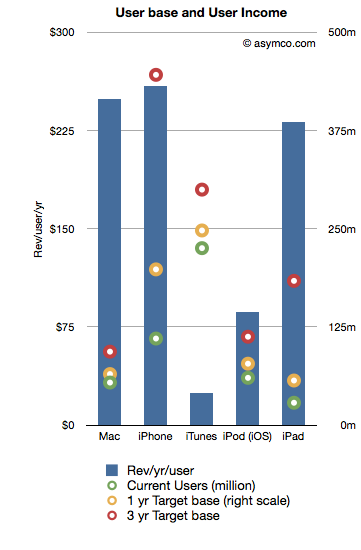
    The following chart shows the recurring revenues per user by product and the current and possible future size of user bases.[2]

    Revenues/yr/user are bars with the left axis and the User bases are various colored circles indexed with the right axis.

    The assumptions that went into the data are as follows:

    1. Device life span is as per previous article linked above
    2. User base growth for 1 year is: Mac 20%, iPhone 80%, iTunes 10%, iPod 30%, iPad 100%
    3. User base growth for 2nd and 3rd years (recurring): Mac 20%, iPhone 50%, iTunes 10%, iPod 20%, iPad 80%.
    4. The Revenue per user is assumed constant

    Note that the user base growth figures are lower than the product growth levels seen historically. Obviously, the model is highly sensitive to these growth assumptions so they need to be scrutinized and tested rigorously.

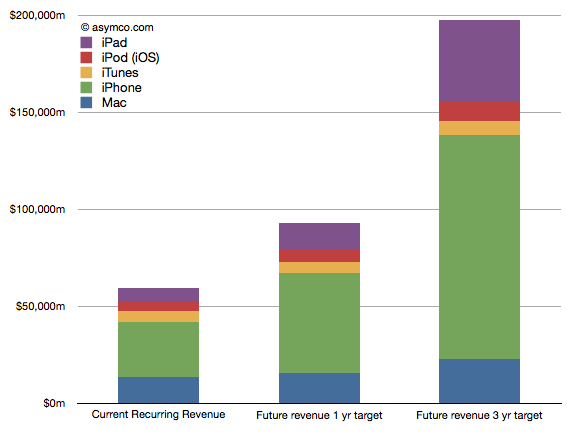
    Nevertheless, as a straw-man proposal,  the recurring revenues for all these products[1] is shown in the following chart:

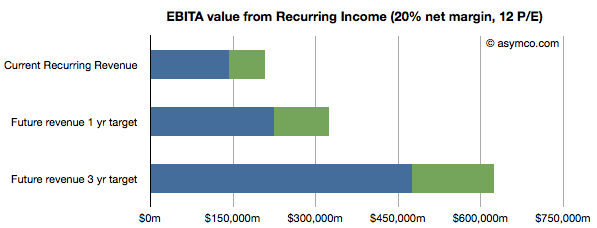
    Once the income is estimated, we can take that value and assume a profit margin (net) and then multiply the earnings by a multiple. Using a 20% net margin and 12x P/E yields the following chart.

    (I added an assumed level of cash in green.)

    This model would imply that the company today could be valued at $208 billion on the basis of its installed base alone. That value would be about $323 billion in one year and $620 billion in three years. Dividing by the number of shares outstanding (935m this year increasing at 2% a year) yields a share price of $222, $339 and $629 by mid 2014.

    These values can be considered "lower bounds" on valuation since they assume income from previously secured customers. The speculative part of investment would be based on what the future bases will look like (so, for example, if one believes these assumptions, the $629 figure could be considered a target to be discounted to today).

    ---

    Notes:

    1. Excludes Software, Peripherals, non-iOS devices, and any other service revenue.
    2. Compare this char to social media companies (MIT Technology Review)
  5. The American Wireless Galapagos Syndrome: How the industry set itself up for a rout

    Research · 193 comments

    AT&T's intent to acquire T-Mobile USA is subject to regulatory approval. Will regulators look at the deal through the lenses of sustaining the traditional industry's profit allocation or through the lenses of device-led disruption?

    In theory, regulators are to make a determination on whether the deal will reduce customer choice. But the question is really choice of what? The focus is presumably on the choice of service plans. That's understandable, however coupled to that choice is the choice of devices and even more importantly, the choice of platforms.

    The trouble is that US consumers have never had much choice and the US wireless marketplace has been a minefield of incompatibilities and obstacles to market forces.

    To begin with, US carriers maintain multiple incompatible network standards. Phones which work on one network do not work on any other. A Sprint phone won't work on AT&T or on Verizon. In fact, some Sprint phones won't work on all of Sprint's network as it still uses the iDen standard legacy from the Nextel acquisition. Even the iPhone which is designed for the AT&T network does not handle T-Mobile's version of 3G. So a consumer cannot make a decision on devices independent of a decision on carrier. This is a phenomenon unique to the US[1].

    Secondly, in the US carriers charge for incoming minutes and have shunned pre-paid customers. There was a time when SMS messages were not compatible between networks, which led to the emergence of RIM as the only wireless messaging solution available, though initially not to the average teenager.

    Thirdly, because of the multiple incompatible standards, network coverage in the US is still abysmal. Each carrier has had to build out parallel (incompatible) networks at great expense using non-standard equipment over a vast landmass. The result is not only a very expensive network whose capex demands high service fees, but a very poor quality network which is always both spotty and capacity constrained. Operators are therefore keen to lock customers in to post-paid plans to ensure cash flows that drive capital allocations. This is essentially an upmarket flight which does not encourage low end innovation.

    These idiosyncrasies are rooted in historical regulatory rulings that led operators to create a uniquely American wireless market. The key regulation was that the US shall have no single wireless standard. In the spirit of laissez-faire this may make sense. But the result has been failure of the common good. This is sharply contrasted with other developed countries which (with notable exceptions) deliver superior service with high efficiency.

    The US is so unique that it developed its own "Galapagos syndrome". Few global brands can be bothered to invest in it. Vodafone tried to play in the US with Verizon, but its minority position offered no leverage because Verizon spent the better part of a decade avoiding global networking standards. Now T-Mobile is desperate for an exit after trying to leverage the foothold it paid dearly for and failing to offer devices that capture users' imaginations (because they were railroaded into another incompatibility with 3G). Conversely, no US brands have been able to expand internationally. US operators are non-entities abroad, even in what would be natural expansion territories like Latin America or the Caribbean.  Those markets belong to European investors today.

    Given this background, it's very likely that regulators will look at the deal in terms of balancing what is essentially a deeply flawed, cobbled together industry.  Companies can argue that they are rationalizing through consolidation but regulators can argue that "choice" is decreasing. These arguments are mostly moot. The problem is that the US wireless market is balkanized and byzantine.

    It's therefore perhaps stunning that the platforms that are currently winning in mobile computing are American: iOS and Android[2]. Note further that none of these winners came from the world of wireless or telecom. These new points of profit condensation in the industry entered from a different industry: computing. But are they now pursuing telecom-compliant strategies? Arguably no. I choose to call them mobile computing and not phone platforms specifically because they will tolerate the cellular regimes as long as they need to, and no longer. Once they will reach the perch of power, the industry will conform to them, not vice versa.

    ---

    Notes:

    1. Japan has a similar problem but less pronounced.
    2. Microsoft is still in the running as is Palm, both American.