Asymco

Asymmetric Intelligence

Microsoft

  1. Surface Tension: The effect of Surface on Windows revenues

    Research · 34 comments

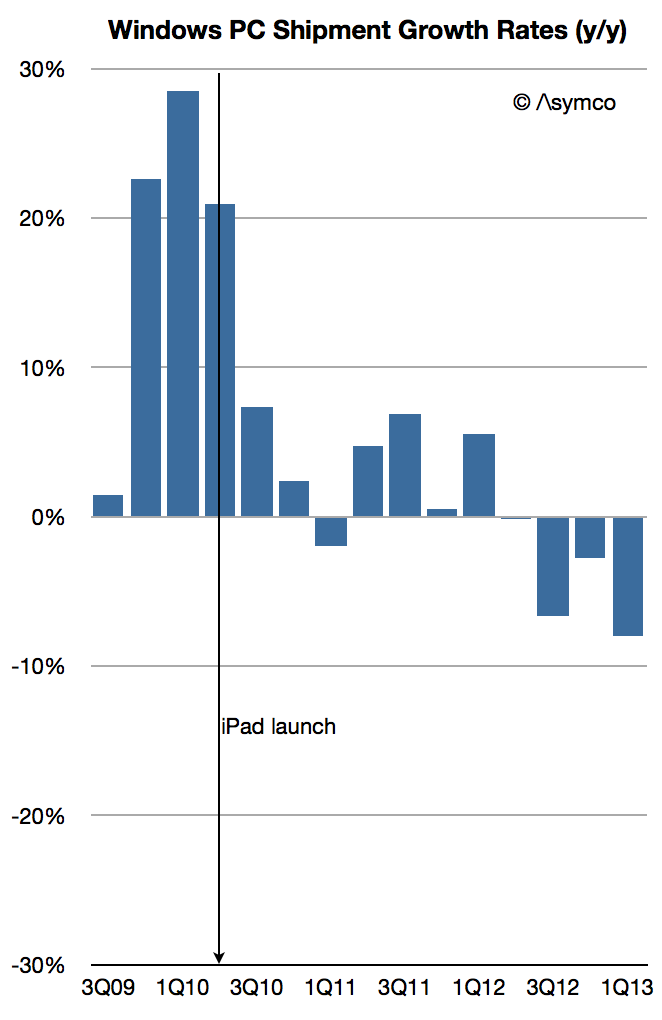
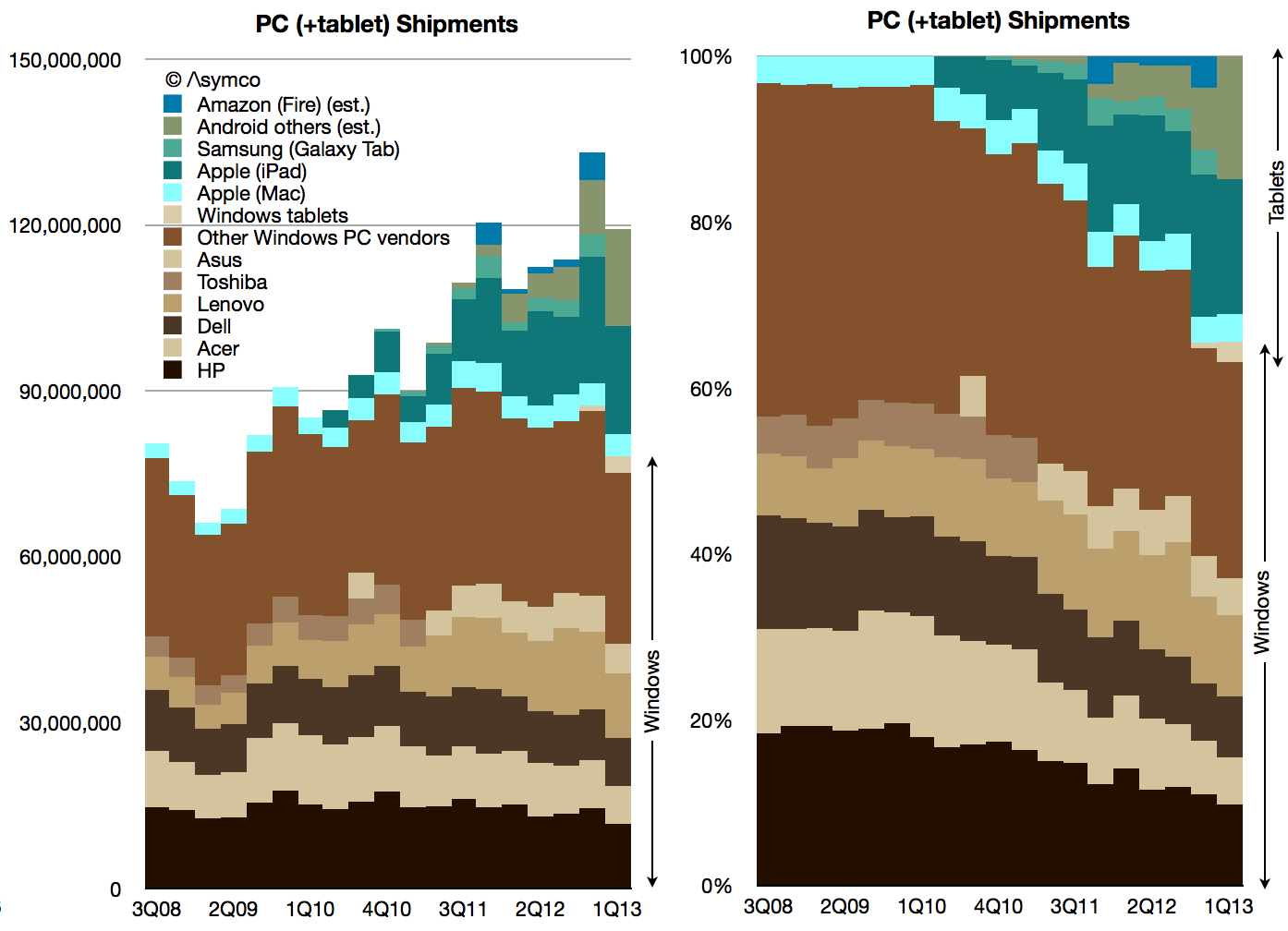
    According to Strategy Analytics 3 million Windows-based tablets shipped in Q1. That is not inconsequential. It would add 4% to the total Windows-based computers and reduce the decline in Windows PC growth to -8% (from -11%). You can see the effect of those units on share in the following graphs.

    Screen Shot 2013-05-02 at 5-2-2.06.21 AM

    Note the "boundary layer" of pale blue Macs between the brown-hued Windows and the green-hued tablets.

    Including tablets of all kinds, here is the market share growth in Windows PCs.

    Screen Shot 2013-05-02 at 5-2-2.06.30 AM

    As the post-PC disruption evolves, Microsoft has made an effort to shift its business model. I discussed this some time ago and there remain quite a few questions about the sustainability of the strategy.

    However, there might already be evidence that it's working. The clue is in the growth in Windows revenues at a time when PC shipments (at least traditional ones) are declining rapidly. Some of that might be due to deferrals and software assurance revenues which are insensitive to shipments. However some have to be due to the Surface.

    Remember that Surface launched with an RT version priced starting at $499 (which did not sell well) but received a boost in Q1 with the Pro version priced at $899 to $999. If we assume a 80:20 mix of Pro to RT and an average price of $950 for the Pro and $550 for RT, 3 million units would generate at least $2.5 billion in gross revenues. Accounting for retail margins of 20%, Microsoft could still be recognizing $2 billion in revenues. That's a significant portion of $5.7 billion in Windows revenue.

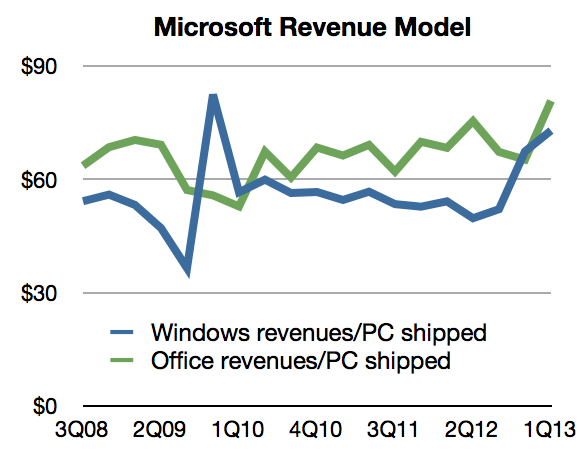
    We can back into this figure from another direction: Prior to Surface launch, the Windows revenue per PC shipped (combining Microsoft's revenues and Gartner's estimates) was about $50. After the Surface Pro shipped the revenue climbed to $73/PC.

    Screen Shot 2013-05-02 at 5-2-2.06.38 AM

    Assuming the same pre-Surface revenue/PC and given the shipment figures for Q1 we would get about $3.7 billion for Windows. The difference to actual revenues is about $2 billion.

    So the extrapolation of Windows royalties approach yields $2 billion in Surface sales and the Price x Units estimate also yields $ 2billion. It would suggest that Surface has had a significant impact already: More than a third of Windows revenues depend on it.

    [UPDATE: I've been informed that not all the Windows tablet sales reported by Strategy Analytics are Surface products. As many as 1 million might not be. That would reduce the revenues as calculated to about $1.4 billion. In addition, not all Windows revenues are current with much of that deferred. Actual revenues were $4.6 billion. With both of these adjustments considered, the impact of Surface might be only 30%.)

  2. Interview with Chosun Daily of Korea about Apple

    Research · 65 comments

    The following interview took place by email on April 15th, 2013.

    1. What are the truth and false about the 'Apple shock' currently? In what perspective should we see this?

    First, I'd point out that during Steve Jobs' time the company suffered many such shocks. The stock fell many times far further than it just did for trivial and irrational reasons. Recently Warren Buffett himself pointed out that his own company had 50% drops in value four times in the past. Share prices are not always good indicators of potential and markets are not always efficient. I catalogued the dramatic share price declines in Apple during the last decade here.

    Second, I'd point out that the number of people watching and commenting on Apple has grown almost as fast as its sales and earnings. When Apple was small the people who studied Apple were few. (You could see this today for other, modest tech companies. There aren't 50 analysts writing reports every day and 2000 bloggers tweeting about Lenovo even though it's a successful and growing PC company.) Because of this growth, I would guess 80% of the observers have not observed Apple's prior painful episodes first hand. For them this is the first time a "dominant" Apple has slowed. The amplification of so many voices raising alarm makes it seem truer, but it isn't.

    Third, the failures being cited are not significant. In terms of increased competition, before Samsung there was Nokia and Motorola and the mobile Operators and Microsoft and Dell and many others long forgotten. They were all about to "defeat" Apple. As a quick example when Apple was "the iPod company," iTunes was considered vulnerable and fragile due to DRM concerns or the Beatles not being on it. Microsoft was launching "Plays for Sure" and Zune and Creative was suing Apple over patents. These battles are long forgotten. Before those there were concerns about the viability of the Mac that go back decades. At the time those were actually very valid concerns. At the time Apple did not have half a billion users. It depended on one product. But what saved them was a process of development of new products not the products themselves. iPod faded, Mac faded. What mattered is that they created new things to replace them.

    Finally, what is not commonly understood is that the mechanism for creating things at Apple is unchanged. Its functional organization is inherently unstable and chaotic, sometimes looking like it will derail. But that's the way it was designed to be. You just have to have faith that it's a system that works. Those who did in the past were well rewarded.

    2. What possibilities out of 1~10, do you think, Apple will suffer the same downfall as Steve jobs has left the company in the past in current?

    The threat is negligible. During the first departure of Jobs, the intention of management was to make the company into "a proper company." The plan was, essentially, to remove the chaotic model that Jobs had put in place and replace it with something more "rational" and "grown up." After he returned he set about not just returning the company to the way it was but to also codifying and identifying exactly what that was so that it did not happen again. You have to appreciate that the greatest thing Jobs ever created was not a product but Apple itself.

    Note that Apple managers stay in their roles the whole time they are there, sometimes for decades. There is no "general purpose" manager and the whole company has been organized along these functional lines. The way to think about it is that during his first departure the new management tried to undo what Jobs had built which is why it became dysfunctional: the DNA did not match the body it was operating. His return re-aligned the culture and operations to what was originally developed. As long as new management does not try to undo that, they'll be all right.

    3. Apple is now defined by some people, as 'the company who modifies well', not 'the company who innovates' well. What they made was ipad, ipod, iphone, apple tv and all the modifiers of the original products. Do you agree? If you do why?

    Innovation is not invention. Innovation is the application of invention in ways that solve new needs. I'm always amazed at how misunderstood this term is even though the definition is easy to understand:

    ("Innovation differs from invention in that innovation refers to the use of a better and, as a result, novel idea or method, whereas invention refers more directly to the creation of the idea or method itself.")

    Apple is an innovation machine. It does invent but that's not valuable in itself. Not all inventions are applied and not all innovations depend on internal inventions. Innovation is applied invention just like engineering is applied science. A better way to think about Apple is to think about Pixar. It's a blockbuster manufacturer. It makes blockbusters and nothing else. That means it does not make many of them and not always regularly and that the ideas may not be original, but the results are always very popular. Pixar is not like any other studio that makes some hits and some flops. Pixar is also a functional organization. It's not an accident that they were both built by the same person and that they are both successful after he left.

    4. Google is forecasted to release lots of products this year, but Apple isn't really looking forward to so many innovations. Inside Apple, is the innovation team really making a new innovative product? what are their longterm plans to fight with Google, or Samsung and the rest of the competitors?

    People outside of engineering organizations, especially large ones, don't appreciate the time scales involved. Products you see today were designed, planned and developed many years ago. We see plenty of evidence of this but we tend to ignore it. Consider that some prototypes end up on ebay showing they were built years before launch. It is the same with evidence presented in trials proving work on the product 4 to 5 years before it was launched. This is not the case just for Apple but all other technology companies.

    For this reason, what is happening in the market and what is happening inside the company are two completely different universes. The tendency is to assume a direct relationship between market momentum and current management decisions. These are connected but with many years in-between.

    For example, globally accurate Maps require a minimum of five years of development. Decisions on what ended up being Apple Maps had to have been made by Jobs himself. Namely, he must have decided whether to buy or build Maps. Contrast with Nokia's decision in 2007 to buy maps for a cost of $8 billion; instead Apple licensed and then decided to build later. In 2007 Jobs decided that it was more important to work on the product itself, meaning the iPhone (while Nokia didn't prioritize product innovation.) The results are visible today: Apple is behind and needs to accelerate with Maps and Nokia with its great maps must find a way of staying in business.

    Apple is not only working on the next product but probably 15 new products, of which 14 will be discarded. Again, I cite Pixar. Each movie is produced with multiple stories, multiple character decisions and different plots in parallel. Much ends up being thrown away. We don't see any of that.

    Apple is extremely "myopic" in that it is very concerned with execution and there is no visible "strategy plan".  That's by design. The product comes first and then comes the market and then comes strategy. To create great products you need to tune out almost everything else. However, they do have a "strategy" and that has to do with which problems they should attack and which they shouldn't. Usually they are successful because what they can attack nobody else can. That is due to their integrated, functional approach.

    5. Isn't Apple, relying too much on semiconductor manufacturers? Meaning, isn't Apple only try to be 'stable company' to supply their products on time? sometimes when companies have disruptive technologies, they have hard time supplying products.

    You're touching on the question of the problems of integration. Yes, there are vulnerabilities but that's the way it has to be. To mitigate this Apple is increasing its integration of the value chains. For example developing its own chip design and owning a lot of capital equipment.

    6. If you were Tim Cook, what would you do?

    I'd buy Intel and turn them into Apple's microprocessor design and manufacturing group. They won't have much to do in a few years and they'll be cheap.

    7. what are the reasons that Apple try to make a 'apple watch', 'apple bicycle'? How do you define these products, since, watchs and bicycles are a total different paradigm which is a totally different industries? Is Apple realizing that smartphone industry is hard for them to innovate?

    Computers are becoming more personal, intimate. It's a natural evolution from large to mini to micro to portable to handheld. I don't see this slowing and Apple should re-define the user experience during every such shift. Here again integration is essential.

    8. what are some of the stuff that we don't know about Tim Cook?

    I can't help you there. Only thing I can say is that people who know him have told me he's not soft and gentle as a manager. He's tough.

    9. How will Samsung and Apples patent fight come to conclusion?

    Again, I can't add much to this. Litigation is often a decision made outside of market conditions so it can be arbitrary.

    10. how does employees or executives inside apple think about their company?

    It's hard to describe this without sounding soft, but the employees at Apple tend to love the brand. You can't measure that but I can think of one proxy: the number of applicants to retail jobs are in the hundreds for each opening.

    [Update: Bono made an important observation regarding Jony Ive which was published after this interview: What the competitors don’t seem to understand is you cannot get people this smart to work this hard just for money. Jony is Obi-Wan. His team are Jedi whose nobility depends on the pursuit of greatness over profit, believing the latter will always follow the former, stubbornly passing up near-term good opportunities to pursue great ones in the distance]

  3. Lumia: Is the light visible?

    Research · 64 comments

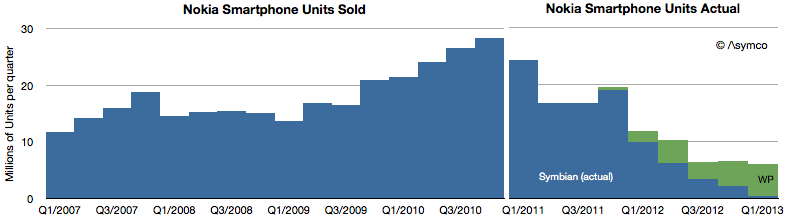
    The following graph shows the history of smartphone volume shipments from Nokia.

    Screen Shot 2013-04-18 at 4-18-1.48.21 PM


    Lumia sales have increased to 5.6 million units last quarter. Up from 4.4 during the previous quarter. Symbian devices have nearly disappeared from the market with only 0.5 million shipped.

    This puts an end to Symbian sales after over a decade since sales start and two years after it was declared that sales would end.

    The bad news remains that smart devices as defined by Nokia are still not profitable. If volumes grow it's possible that the cost structure (without further cuts) can be sustained and perhaps the business will get its footing.

    The level of 6 million units/quarter is about where HTC and RIM are today but only half of what ZTE and Huawei are probably shipping. As a hardware business it might work, barely. It certainly helps to have $250 million as platform support payments from Microsoft.

    As a platform it's still a very long haul for Windows Phone. Even if we assume a nominal $15 revenue/ Windows Phone license and ignore the kickback, at this level of sales the platform generates less income than what Microsoft gets from licensing IP to Android vendors.

  4. LG's new Tele-vision

    Research · 17 comments

    LG Electronics has acquired HP's WebOS for an undisclosed amount. When last it changed hands WebOS was part of Palm which was purchased for $1.2 billion in 2010.

    Palm has thus been effectively divided into several smaller pieces distributed as follows:

    HP will own:

    • Support of existing Palm users
    • Palm back-end assets including source code, infrastructure and talent
    • webOS patents

    LG will own:

    • Stewardship of the Open WebOS and Enyo open-source projects where the source code resides
    • Associated talent
    • WebOS websites
    • License for IP related to webOS

    LG announced that it plans to offer an "intuitive user experience an Internet services across a range of consumer electronics devices." In an interview, the CTO of LG said that given the current situation with Android, LG does not plan on making smartphones running webOS but will use it in televisions and other devices such as cars, signage and appliances where there are no embedded OS's. "We'd like to secure a software platform across all devices."

    Most commentary regarding the deal focused on the use of the platform for TVs but management seems to consider all devices, perhaps even phones, at some future date, to be webOS targets.

    The TV however seems to be low hanging fruit today. The TV as an app platform will be the new ecosystem war and no platform today has a lock on the developers or users. The way this rivalry will shape up will not mirror other device classes for the same reason that current device classes are platform silos.

    PCs, music players, tablets and phones all have different super-majority platform leaders. The association of a platform with a device class depends first on the distribution model, which favors a specific business model which favors a specific vendor which favors a specific platform. As each device is distributed differently, a different platform takes precedence.

    Consider that the PC has historically been purchased by IT departments which led to a monoculture of Windows which led to a persistent leadership for Microsoft.

    The music player created dominance around iTunes mostly because the distribution model for music labels was baked-in. With network effects, the iPod quickly gained and perpetually retained market share leadership.

    The smartphone business initially favored Symbian and BlackBerry because they had the market access through operators. After the touch UI became dominant (and incumbents failed to respond in a timely manner), Apple and Google took leadership as soon as they accepted the operator distribution model. Android in particular is especially resonant with operators and has been developed with their requirements in mind.

    The tablet business is more like the PC business but without enterprise requirements or patterns of purchase. This has meant that app/content ecosystems and retail distribution were the key gating factors. The story is still unfolding but so far Microsoft has not found a foothold while iOS and Android and Amazon have.

    That leads to the question of how will smart TVs be sold and which business model (or go-to-market strategy) will succeed. Steve Jobs pointed out the difficulty in trying to deliver innovation into a value chain dominated by cable companies which can effectively block it. A TV which is an application execution device rather than a content terminal will require a re-definition of the category. That will require a re-positioining of this product. Few companies are able to do that. [See also my post Tele Vision from mid-2011].

    Which brings us back to the question of webOS. As long as LG sells TVs as content terminals they might not obtain much value from webOS. If, on the other hand, LG were to use webOS to re-define their televisions to be something else entirely, namely software execution devices, sold differently and hired to do a different job than a TV, then webOS becomes not only necessary but potentially a source of great prosperity.

  5. Bits v. Bytes: Follow the money

    Research · 68 comments

    Google announced its first computing product: the Pixel. It's not the first Chromebook but it is the first device which is uniquely branded as a Google product (Motorola notwithstanding.)

    It's a curious choice given that companies which have "crossed-over" from being service or software oriented to hardware have started with more "mobile" devices. Amazon launched the Kindle as a low-end product and gradually moved it up-market. Microsoft launched with the Surface tablet and then followed with the Pro version as a hybrid laptop/tablet.

    It's also curious since Google has spent years contributing to the development of mobile phones and tablets under the Nexus sub-brand. This was an approach consistent with earlier Chromebooks as well.

    But the Pixel is a high-end product. It's priced at the top of the range of what a laptop computer might cost (given the dimensions).  Perhaps it's part of a pattern where Google will hone its hardware skills toward releasing a phone or tablet it can call its own. Starting with a more traditional computer is "easier" than trying to deliver on the more demanding smaller form factors.

    And yet, the more obvious question is why would Google want to be in the hardware business? Isn't being a web-focused company implicitly suggesting that hardware is a commodity to be farmed off to perpetually impoverished and violently abused OEMs?

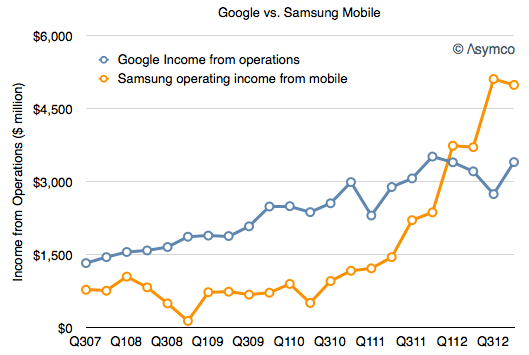
    The truth is quite different from this. Samsung currently makes far more operating profit from Android phones than Google does from all its operations. 

    Screen Shot 2013-02-22 at 2-22-3.47.58 PM

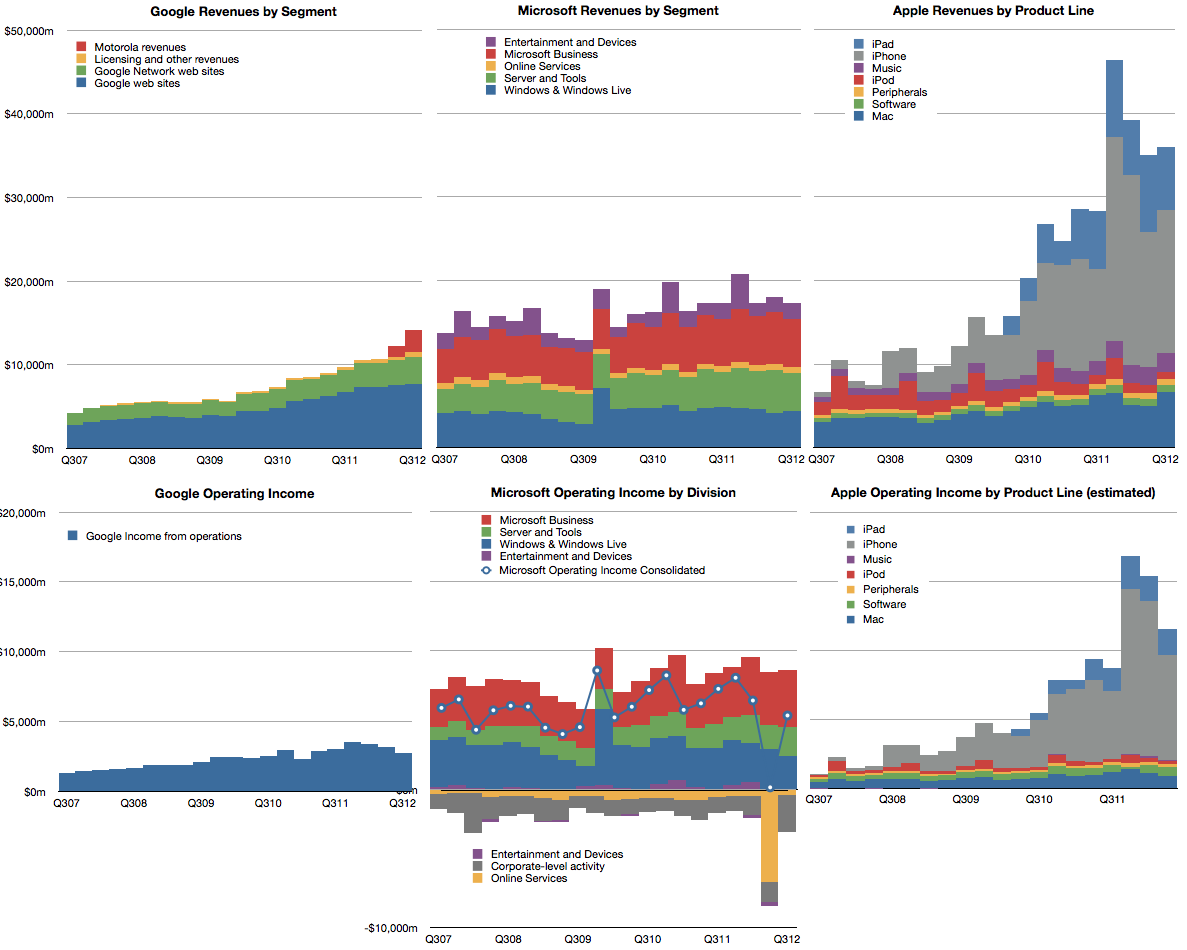
    When looking at the patterns of sales and profit capture for hardware vendors since 2007 the contrast is stark:

    Screen Shot 2013-02-22 at 2-22-3.32.46 PM

    Apple and Samsung tower over the fortunes for software only Microsoft or service-oriented Google and Amazon. Although all companies are growing, the value, as defined by the buyer, resides in the whole product. Putting aside all the theory, the numbers are staggering. Google, Microsoft and Amazon are skimming profits but they are not particularly efficient at profit generation vis-a-vis the integrated Apple (and increasingly integrated Samsung.)

    The question is which of the companies illustrated above will prosper from the value chain evolution under way?

  6. Why doesn't anybody copy Apple?

    Research · 239 comments

    Apple's products are the envy of the world. They have been spectacularly successful and are widely imitated, if not copied. The expectation that precedes a new Apple product launch is only matched by the expectation of the replication of those products by competitors.

    This cycle of product mimicry was succinctly summarized by Marc Andreessen regarding a rumored Apple TV product:

    And once the television launches, everyone will scramble to copy it. "There's a pattern in our industry, Apple crystallizes the product, and the minute Apple crystallizes it, then everyone knows how to compete."

    This idea that the basis of competition is set by Apple and then the race is on to climb the trajectory of improvement is so well understood that it's axiomatic: "It's just the way things are." Apple releases a product that defines a category or disrupts an industry and it becomes obvious what needs to be built.

    But what I wonder is why there isn't a desire to copy Apple's product creation process. Why isn't the catalyst for a new category or disruption put forward by another company? More precisely, why isn't there another company which consistently re-defines categories and repeatedly, predictably even, re-defines how technology is used.

    Put another way: Why is it that everyone wants to copy Apple's products but nobody wants to copy being Apple?

    Note that I don't suggest that there isn't a capability to copy. It may or may not be possible, but capability comes after desire and without desire there can be no capability. What I'm suggesting is that there isn't a desire to "be like Apple". If there were a desire, we would be seeing a massive search and debate into what makes Apple successful. Management consultants would be pounding the pavement pitching the "Apple way". Wall Street would be sizing up companies to a standard of "Apple-ness" and rewarding those who conform and punishing those who don't.

    None of this is happening. I can think of two reasons why:

    1. Apple is not to be imitated because it's not worth copying. I.e. Apple is not a successful company.
    2. Apple is successful but Apple cannot be copied because its success is a magical process involving sorcery.

    There is a great deal of evidence for the first hypothesis. The idea of Apple being successful is not something reflected in its stock price. Being valued at a lower P/E ratio than its competitors, and indeed lower than the average company in the S&P 500, indicates that to whatever degree Apple was successful in the past, it's not seen by the vast majority of observers as successful in the future (no matter when you choose to make this observation).

    Why should one bother copying Apple if it results in being punished with a low valuation? You work really hard at innovation and then that innovation becomes commoditized very quickly. Why should one bother?

    And yet if we look outside the investor community, especially if we ask operational managers and entrepreneurs, there are some who would say that Apple is actually a success story. However, when asking innovation practitioners what makes Apple successful the answers regarding the causality of this success border on the mythical. Answers which reference "skills", "culture" and "teams" abound. The culmination of this hypothesis is the "chief-sorcerer" theory of success which places one magician in charge of casting all the right spells. These resource-defined explanations are unsatisfactory because they are vague. Without specificity they don't help us understand why they can't be copied.

    But what about Apple's own opinion of what makes it tick?

    Bill C. Shope: How do we think about Apple's culture of innovation today?

    Timothy D. Cook: Innovation is deeply embedded in Apple's culture. The boldness, the ambition, the belief that there are no limits, the desire among our people to not just make good products [but to] make the very best products in the world. It's in the values. It's in the DNA of the company.

    Now if you look at some essentials for innovation, there is no formula.
    If there was a formula, there would be a lot of companies that have a lot of money that would gone out and bought their ability to innovate.

    Some of the essentials for us are skills and leadership. Apple is in a very unique, and, in my view, unrivaled position because Apple has skills in software, in hardware, and in services.

    […] arguably, where you can innovate in hardware, [where] you can innovate in software, [where] you can innovate in services; the real magic happens at the intersection of these.

    And you know, the iPad is very magical. And it's exactly because our company was doing all of those things. And so for many years this idea ... [which] some people call vertical integration, ... it was out of favor. People thought it was kind of crazy. And we never did.

    And so through all of those years, we continued to build. And these skills, this isn't something you can just go write a check for. This is something that you work decades for. Building this experience. And so I think we bring that. I think we're unique in that. I think we're unrivaled in that. I think there are people trying desperately to catch up in that. And I think they're finding that it's not so easy to do.

    Tim Cook refers to integration and a great team as unique Apple advantages (but also note the references to magic and belief.) It's a better explanation but it is still hard to understand why nobody copies this approach. Integration is something that can take a long time, but it is possible with a Herculean effort. A few companies are starting to make moves in that direction (e.g. Microsoft.) But efforts are half-hearted. There is no "move the Earth" panic to become an integrated company from Samsung, Google or Microsoft.

    Maybe others haven't quite balanced both the cost and the benefit of being Apple. It's clearly still mysterious and unclear why one would want to do this. It's much easier to use what you already have and how you operate to copy what Apple produces rather than how they produce it.

    My own suspicion is that Apple is more aware of what makes it special than they are letting on. In other words, I believe that Apple is self aware but being careful not to share what it knows. However, as Tim points out, it's not a formula. There is no silver bullet, no single trick.

    It's complex, it's subtle, it defies explanation but it's not magic. It's a process that requires a degree of faith and fortitude. It's collecting but ignoring data and trusting judgement when data tells you to move in a different direction. It's a lot of willful rejection of conventional wisdom. It's asymmetric approaches to competition. It's art as much as science. And most of all, it's a lot of mind-numbing polishing while trusting that only by doing great work is survival even possible.

  7. Cracking the China code: Microsoft vs. Apple

    Research · 87 comments

    In 2011 Microsoft's CEO bemoaned that revenue in China was about 5% of what it obtained in the US. Yesterday Apple's CEO suggested that revenue from China will overtake the US in the near future.

    The contrast is even more stark when one considers the time and effort each company has made in China. Microsoft has been investing and promoting itself in China for decades while Apple barely had any presence 3 years ago.

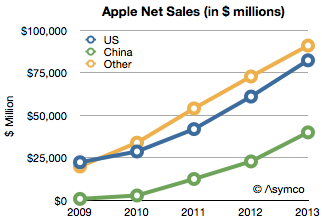
    To put a finer point on this I show below Apple's sales by region:

    Screen Shot 2013-01-11 at 1-11-10.08.26 AM

    Apple's China net sales in fiscal 2009 were only 769 million. In 2012 they were $22.8 billion. That is a figure greater than US sales three years earlier. Put another way, China sales grew in three years as much as they did in the US in 33.

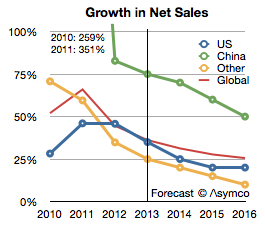
    The growth rates were astronomical: over 250% in 2010 and 350% in 2011. In 2012 the growth slowed to 83% but that is still almost twice the US or the global average. The growth rates are shown in the following chart:

    Screen Shot 2013-01-11 at 1-11-10.09.19 AM

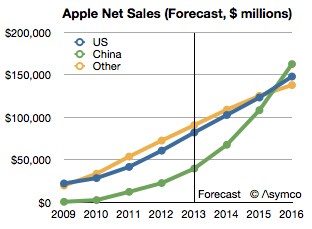
    I added an estimate for growth into the future moderating to 50% for China and 20% for the US. If that happens then China will become the largest market for Apple by 2016 as shown below.

    Screen Shot 2013-01-11 at 1-11-10.10.46 AM

    The reason for this growth is, of course, the iOS product lines. Growth started when the iPhone was introduced and surged with the iPad and every time updates were released.

    The contrast with Microsoft now comes back into focus. China and the US have a roughly equal number of PCs but the mobile users in China exceed the US by a factor of three to one. The pool of users is so great that Apple obtained its growth even with reaching only 30% mobile network distribution coverage.

    Without a mobile portfolio Microsoft is severely hampered. Of course, Microsoft is trying and has made several attempts to place its Windows Phone in the hands of Chinese users. It's a tough sale however because Microsoft must work through partners. They need to get vendors to license the OS and the operators to range the devices and retailers to push it. Given the flood of "free" Android variants they are having trouble even starting down that long road.

    But more fundamentally, Microsoft's software licensing business model is severely limited in China because what it offers is not what is valued. Both on the PC or on the mobile device, what China values is the tangible. Software can be made valuable only if it can affect the purchase decision of hardware and it can do so only if it's sold as part of an integrated product. With Surface, Microsoft shows that it understands this. What does this imply for a Microsoft phone?


  8. Below the Surface

    Research · 83 comments

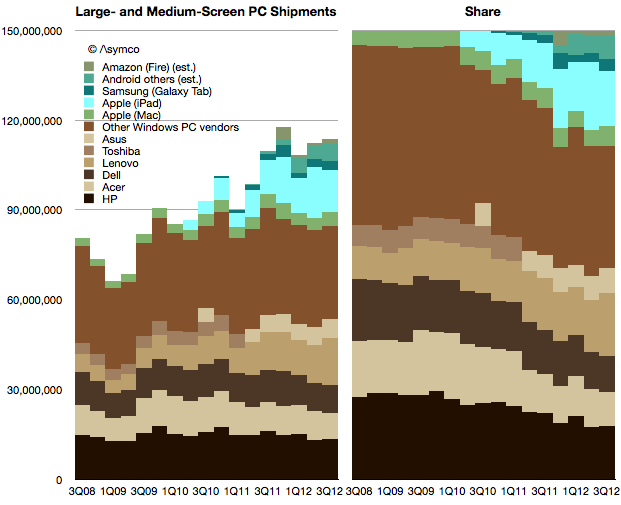
    Early data shows that the PC market has not experienced a "pop" from Windows 8. Market watchers have been anticipating this pop since every previous version of Windows has led to a surge in shipments. PC vendors have also been hoping for this to lift their volumes. Volumes have been stagnant for a while, as the following chart shows:

    Screen Shot 2012-12-13 at 12-13-3.45.58 PM

    If we combine the traditional PC and tablet markets—what I refer to as "large and medium screen PCs"— there has been growth. However the growth is all due to the tablets. When seen in a share split (blue tablets vs. brown Windows PC's) the shift toward tablet computing is clear.

    The question is whether Microsoft will be successful in shifting to this new computing model? Microsoft's problem is not that it has difficulty offering an operating system for tablets. The problem is that the economics of both systems and application software on tablets is destructive to its margins.

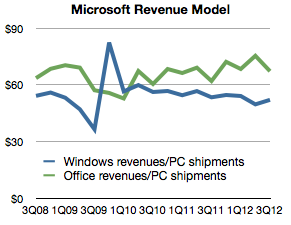
    A PC has for several decades been "taxed"[1] with a Windows and Office license. The exact figure is imprecise because of subscription accounting used by Microsoft, but we can take Microsoft revenues for Windows and Office and divide by PC shipments to get an average.

    Screen Shot 2012-12-13 at 12-13-3.47.14 PM

    This view shows how Windows revenues per PC have held steady for the last three years and Office have moved up slightly. In the latest quarter Windows "captured" $52 per PC shipment and Office "captured" $67.

    The problem for Microsoft is that pricing systems software at $50 and a suite of apps at $67 for a tablet that costs $200 to the end-user is prohibitive.

    Firstly because an OEM could not justify paying $50 to Microsoft while competing with another vendor whose (Android) software license costs nothing. It implies an increase in his bill of materials without the ability to charge more for the product and hence a reduction or elimination of margin.

    Secondly because consumers (or IT buyers) would have a hard time justifying $67 for an Office license for every tablet when most apps are either free or under $10. (Apple charges $9.99 each for iOS versions of Pages, Numbers and Keynote which can be installed on several devices.)

    The economics of tablets imply a "commoditization" of system and application software. So what's Microsoft to do?

    The answer is Surface where the software margin is captured in hardware. This explains the pricing of Surface. The price isn't significantly below what Apple charges because Microsoft wants to capture a comparable (30%+) margin. On a $500 product that amounts to $150. After subtracting hardware operating and distribution costs we can get pretty close to the $120 it currently obtains from a PC.

    This also explains the lack of appetite for "partnerships". OEMs which would normally compete on hardware would have to deal with zero margins (or less) after license fees and would be encouraged to cut corners and shave costs, compromising the experience and causing the platform to suffer.

    Microsoft does not like the phrase "post-PC" because it implies the end of its hegemony. They like to think of the PC becoming a new form factor in which they have the same role they've always had. However, looking beyond the form factor we see that mobility itself is disruptive in the implied modularity of the PC.

    Device economics offer the explanation for an otherwise perplexing Surface strategy. The question remains how many Surface units could Microsoft possibly sell to maintain its revenues.

    --

    1. A "tax" is implied only when purchases are mandatory.
  9. The new age of Capital Intensity

    Research · 117 comments

    In the post reviewing Samsung's Capital Structure I noted that its component divisions have historically taken 90% of capital investments and that the overall capital intensity for Samsung Electronics has increased in proportion to its component revenues.

    In another post regarding the capital structures of other technology companies with different business models I noted that Apple has changed its capital structure to a significant degree over the previous three years.

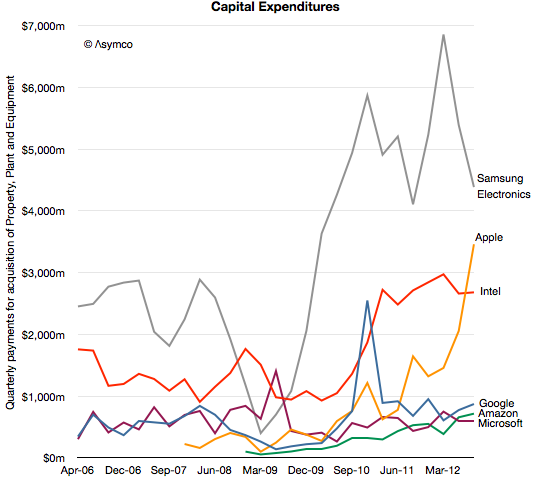
    In the following graph I combined these observations to show how capital expenditure patterns may be used to discern the underlying business model.

    I would group "cloud" or "platform" based companies like Google, Amazon and Microsoft as a cohort which, although spending significant amounts on capital equipment, do so mainly to support services. Their primary employment of capital is to sustain the infrastructure of data centers necessary to deliver the services underpinning their business models.

    I would group Intel and Samsung as "component" based companies which use capital to build production capacity that delivers, hopefully, a control point in the value chains they participate in. Note that I am assuming that Samsung Electronics' CapEx primarily targets semiconductors and displays as it did during the 2006 and 2007 period when data was available.

    Therefore, given the patterns over the last six years, it might be possible to classify a company's core business by just looking at its CapEx: The services group showing growth but relatively stable patterns and the components group showing more volatility, macroeconomic sensitivity and an overall higher level of spending, especially as a percent of sales.

    The question that pops up then is in what category does Apple fall?

    My observations for over a year have been that Apple is increasing its capital spending to such a degree that it is neither fish nor fowl. It operates data centers but presumably does not operate fabrication plants. And yet it spends more than Intel and Google combined.

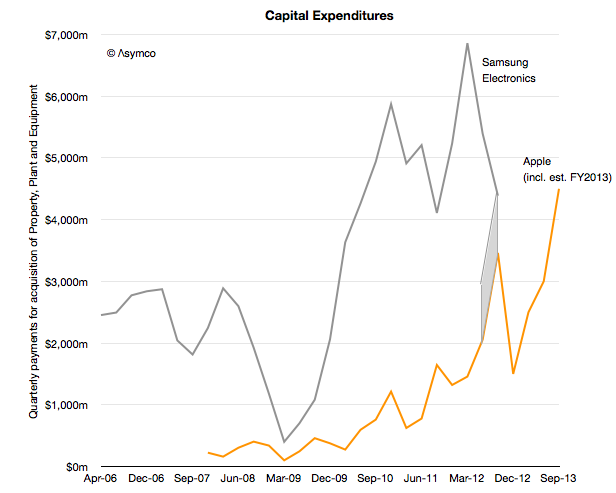
    Contrasting Apple and Samsung Electronics tells an even more interesting story. In the following graph I've added two additional items of information: First, although CapEx spending is recorded in the cash flow statement, Apple reported in its yearly (10K) report that it spent an additional $2 billion for equipment which did not pass through cash flow.

    If we were to add $1 billion to each of the previous two quarters, the graph would look like this:

    The second piece of information is that Apple projected its spending for the following fiscal year. I've added that spending in a pattern matching the last fiscal year.

    Apple is still spending less than Samsung. In its fiscal year 2012 Apple spent about $10 billion while during the same time frame Samsung spent nearly $22 billion. However, Apple has begun to bump against Samsung's spending level on a quarterly basis.

    I consider this extraordinary evidence of an extraordinary shift in strategy.

    For a year we've been debating here to what degree Apple has a "capital intensive" business and what exactly could it be spending capital on. One early hypothesis has been that it's on data centers or on real estate for spaceship campuses. These can be easily dismissed on the knowledge that they can't cost that much (and that the spending happens gradually). Another hypothesis is that the tooling for milled aluminum cases and other mechanical components is expensive and Apple has to buy a lot of it. But, again, the level of expenditure is in the league of Intel and Samsung which make vast quantities of semiconductors in very expensive plants. It's hard to imagine milling machines being cost equivalent to chip foundries.

    The comparison with Samsung, whose vast capital commitments are legendary and are its primary strategic asset puts Apple in a new light. Perhaps we can't yet call Apple a semiconductor company or even a fabricator but they are putting their "money where their mouth isn't". We can infer that it's not going where the company currently operates. The capital is being deployed almost silently and, though vast in scale, barely gets a mention from analysts. Not even a single question has been raised at any earnings call about this spending.

    So what tale does this capital tell?

    One interpretation is to apply the value chain disruption theory and ask whether Apple is acting to counter a potential disruption. In other words, that this is a specific threat response from an incumbent. There is some logic to this because  the antagonism between Samsung and Apple is so strong that it might justify a reaction of this kind.

    However, I believe that there is a more measured process at work over a long period of time. The one distinguishing advantage and attribute that Apple has  is its preference for integration. This preference is not a secret and Tim Cook repeats it often. The integration is evident with their move into retail and component design, in other words in both directions along a value chain. So my hypothesis is that this is part and parcel of an ongoing re-alignment of their role in the value chain.

    This second explanation suggests that Apple simply wants to control all the areas which affect the value they produce. First because they feel that there are areas that are not good enough and the product/experience cannot be good enough if its constituent parts are not good enough. Second because without control there are constraints to what it can do strategically.

    Whatever the reason, I read the evidence of increasing commitment and engagement in parts of the value chain as part of a continuous evolution of Apple's role. Furthermore, it's something that should be seen as a signal of a new era in how technology companies operate. We see hints of "vertical integration" with Microsoft building hardware, and Google buying Motorola and Amazon selling devices. Apple did all these things and now it casts an eye over the next frontier: components.

    ---

    If you want to learn more about the future of the technology industries and the evolution of value chains, consider participating in Asymconf.

  10. The cost of mobile clicks

    Research · 26 comments

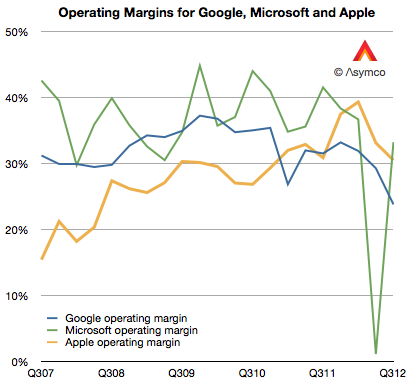
    Google's operating margins fell to 23.7% last quarter. This level is the lowest I'm aware of. From 2007 to late 2009 margin went from about 31% to about 37%.  Then from early 2010 until present they fell. The history is shown the the following graph.

    [I included Microsoft and Apple operating margins for comparison.]

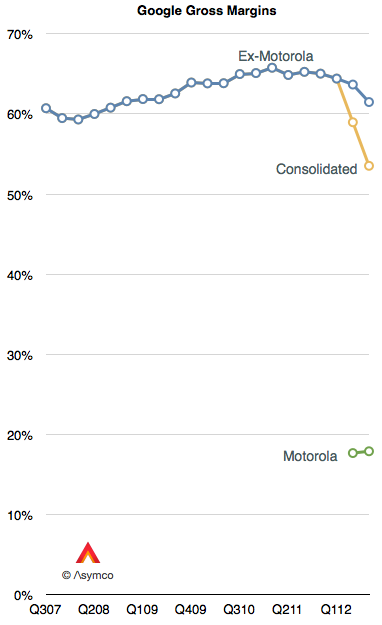
    Some of the recent decline is due to the inclusion of Motorola into consolidated earnings. Motorola gross margins were therefore 18%. Excluding Motorola, Google gross margins (Revenues-Cost of Revenues) were 61.5% of revenues.  However, even excluding Motorola, Google's core margins dropped.

    One reason for the decline in core margins is the reduction in cost per click (-16% for search and -18% for network sites.) This is what Google pays to partners for access to traffic. The trend is not new. It was first discussed in January.

    The bottom line is that an individual click is not as valuable as it used to be. Would a larger volume of mobile usage be a reason? Google won't say.

    The overall result in the bottom line is shown below. Microsoft and Apple are again put forward for comparison.

    Reminder: Register for Asymconf.

  11. Hey Big Spender

    Research · 64 comments

    In previous posts I described the patterns of asset value growth for Property Plant and Equipment at Apple and how that change has been thus far correlated to the production of iOS devices.

    The analysis was based on looking at the declared value of the PP&E assets on Apple's balance sheet. These values include depreciation so they reflect not only the "spending" on new assets but also the value lost due to wear and tear. As such it's not a perfect measure of investment.

    The better approach is to use declarations on the cash flow statement. Apple reports a specific cash flow related to PP&E: Under Investing Activities, Payments for acquisition of property, plan and equipment.

    In the latest 8-K the amount for the 12 months ended September 29 the value was $8.295 billion.

    Compare this with the statement in the Annual Report from one year ago:

    The Company anticipates utilizing approximately $8.0 billion for capital expenditures during 2012, including approximately $900 million for retail store facilities and approximately $7.1 billion for product tooling and manufacturing process equipment, and corporate facilities and infrastructure, including information systems hardware, software and enhancements.

    Compare also with the PP&E net asset value on the Balance Sheet currently at $15.452 billion but valued at $7.777 billion a year ago (an increase of $7.7 billion).

    This means that Apple intended to spend $8 billion, actually spent $8.3 billion and realized a net asset gain (after depreciation) of $7.7 billion.

    So there are no major surprises. The spending was only about 4% above expectations a year earlier.

    The other pattern to observe is that the spending rose dramatically into the fourth quarter. The fiscal quarterly spending was:

    1. $1.32 billion
    2. $1.46 billion
    3. $2.06 billion
    4. $3.46 billion

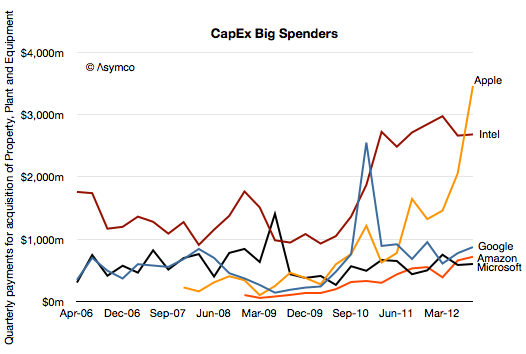
    I illustrate this pattern (and previous quarterly spending) in the following chart.

    The question remains what is this $8.3 billion being spent on?

    To help answer I also added the comparable spending (from cash flow statements) of a few other technology companies. Google, Amazon and Microsoft have been spending in the same range of $500 million per quarter. Over the past eight quarters the average spending of these companies has been:

    • Amazon $487 million
    • Microsoft $583 million
    • Google $800 million

    Intel is different. Its average spend level has been $2.6 billion/quarter.

    But Apple has just spent about 30% more than Intel. And it spent three times in Q3 than Google, 4.8x Microsoft and 3.8x Amazon.

    The level of spending and growth from a far lower level implies to me that Apple is spending primarily on process equipment (aka tooling) rather than servers. Data centers are expensive at $1 billion for a large one, but they are not being built fast enough to account for $3.5 billion in one quarter.

    Note that Apple's CapEx is above that of Intel whose fab-based semiconductor production method is known as particularly capital intensive. And Intel's Capital Expenditures have been increasing to all-time highs.

    If Apple spent at Google levels on server infrastructure it would only be spending a quarter of what it's actually spending. If Apple spent on production at Intel levels it would only be spending three quarters of what it's spending.

    In other words, Apple is spending at the equivalent of one Intel of fabrication and one Google of server infrastructure.

    In a few days we will learn what the plan for expenditure for fiscal 2013 is. Historically, the company has roughly doubled spending for each year of the iOS platform. If that continues then Apple will be spending the equivalent of several Intels and several Googles.