Asymco

Asymmetric Intelligence

Palm

  1. Subscribe Again

    Research

    In March 2016 Ben Bajarin and I put on an event called SUBSCRIBE where we asked, among other things,

    • How will the online services business models evolve?
    • How will hardware affect software and services and vice versa?
    • How will  users, usage, and capital connect?

    Now is a good time to look back on that event.

    For the keynote I prepared a model which predicted the mobile ecosystems for iOS, Android and Chinese Android over the next 5 years (to 2020). The methodology involved taking a measurement of the revenues of the top internet service companies, building up the categories these companies occupied, estimating how much of those revenues are through mobile distribution and then splitting the result among the three platforms of iOS and the two Androids.

    Adding to that the "native" app and content revenues for each platform would yield the Ecosystem total value. Applying a growth rate would offer some visibility into the future.

    The following images are screen captures of the Perspective presentation.
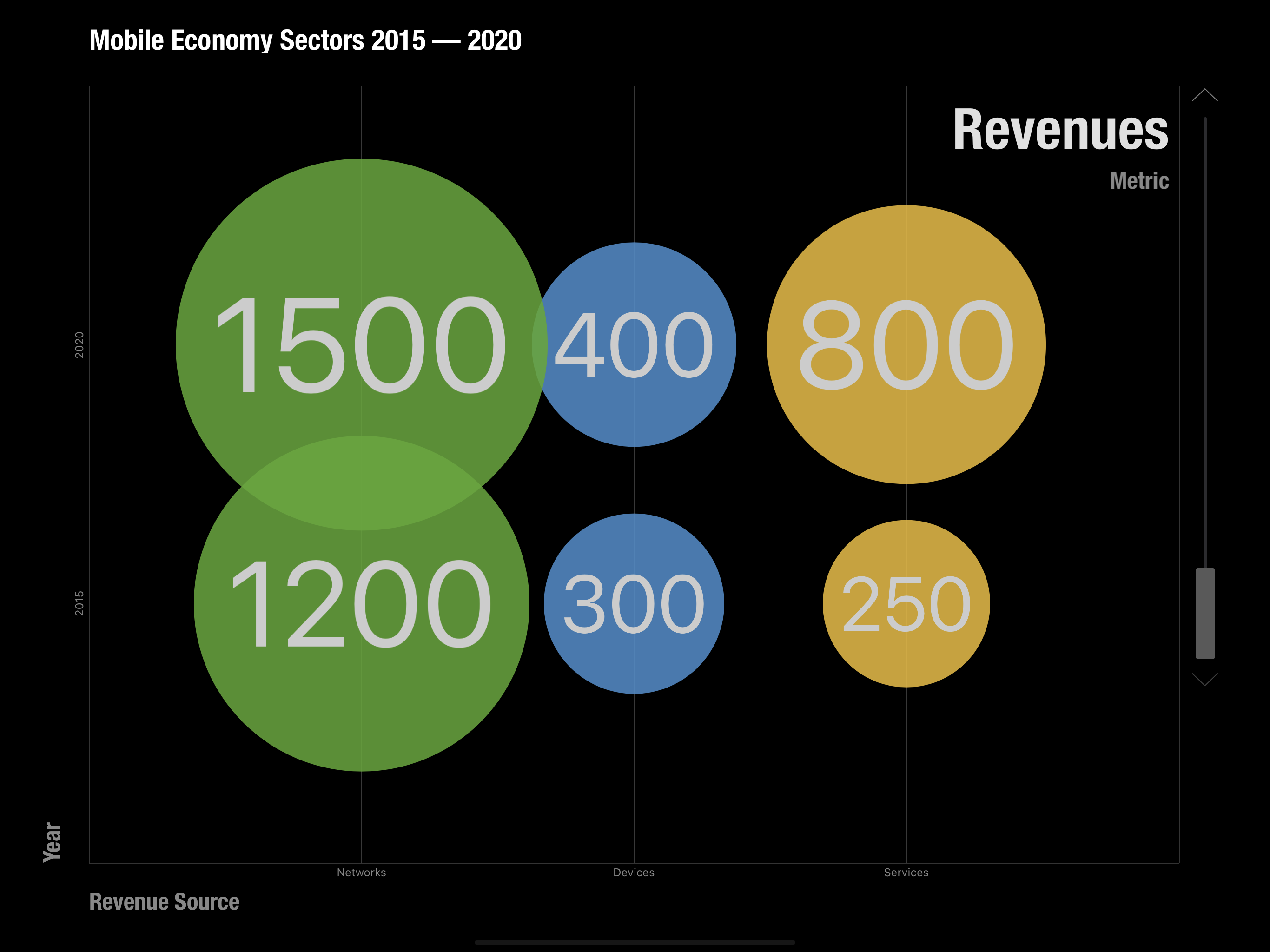
    Revenues across Networks, Devices and Services 2015 to 2020 (estimated March 2016)
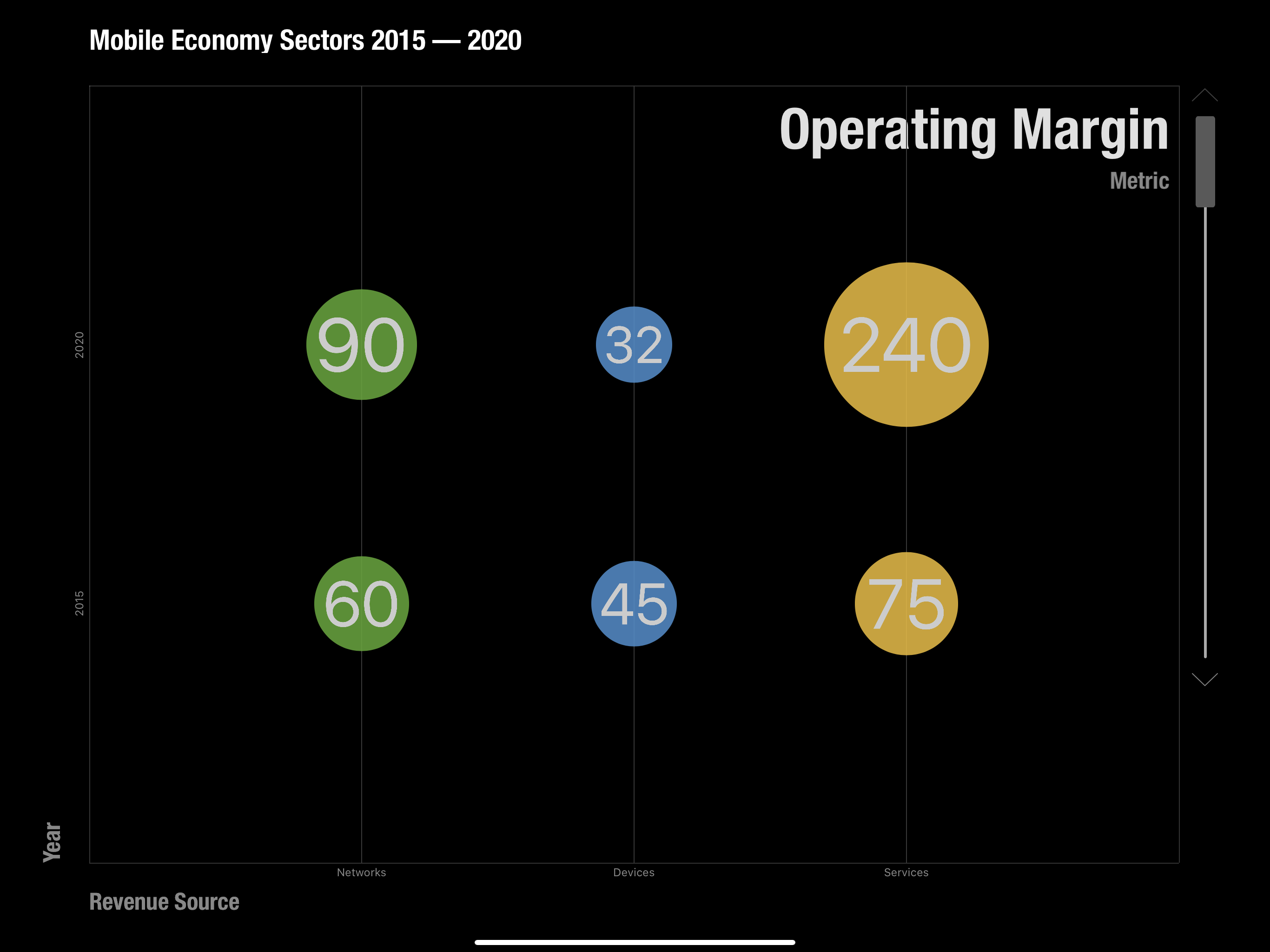
    Operating Income across Networks, Devices and Services 2015 to 2020 (estimated March 2016)
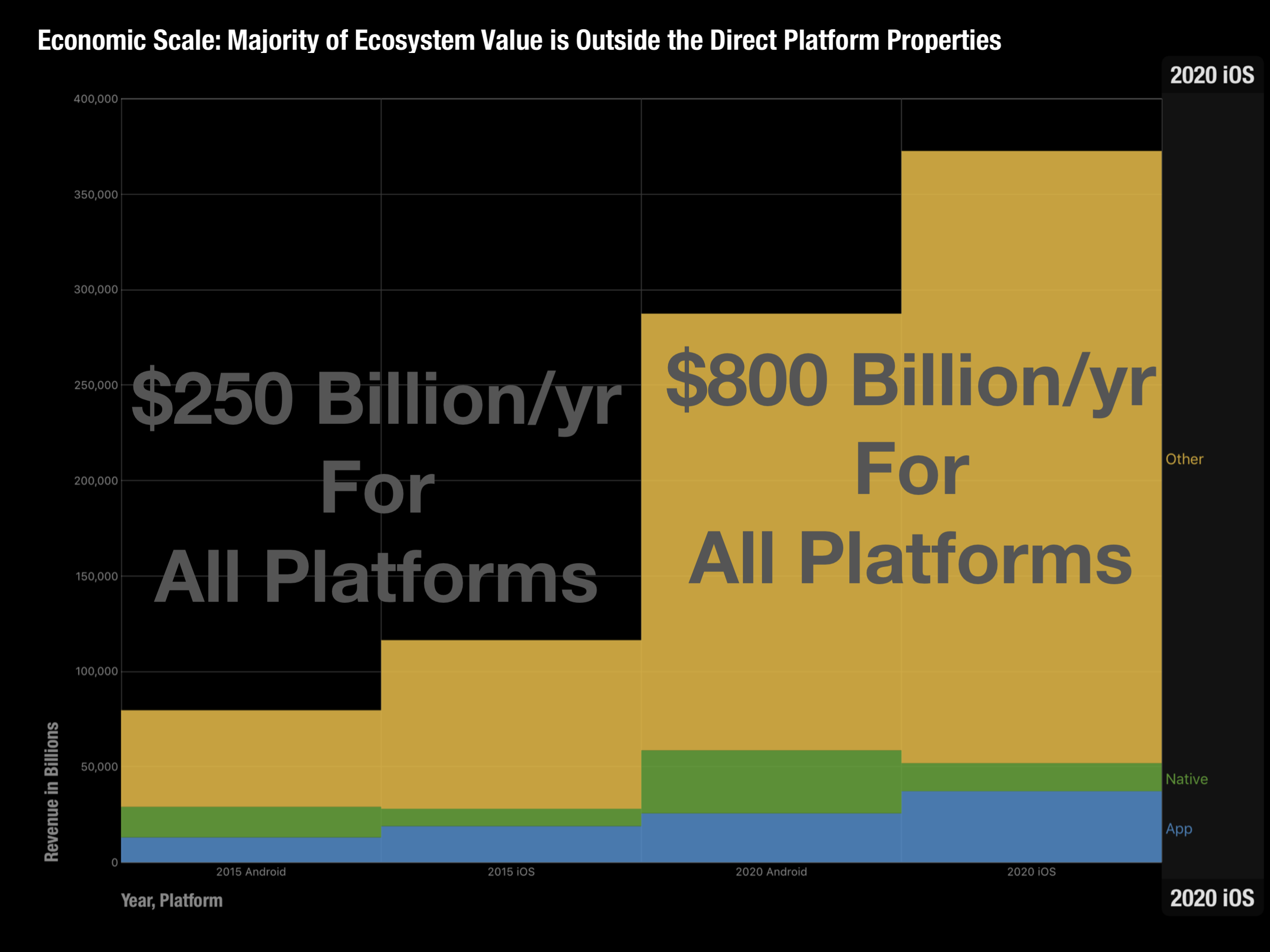
    Ecosystem composition (Third Party App, Native Apps, Other) 2015 to 2020, Android vs. iOS.
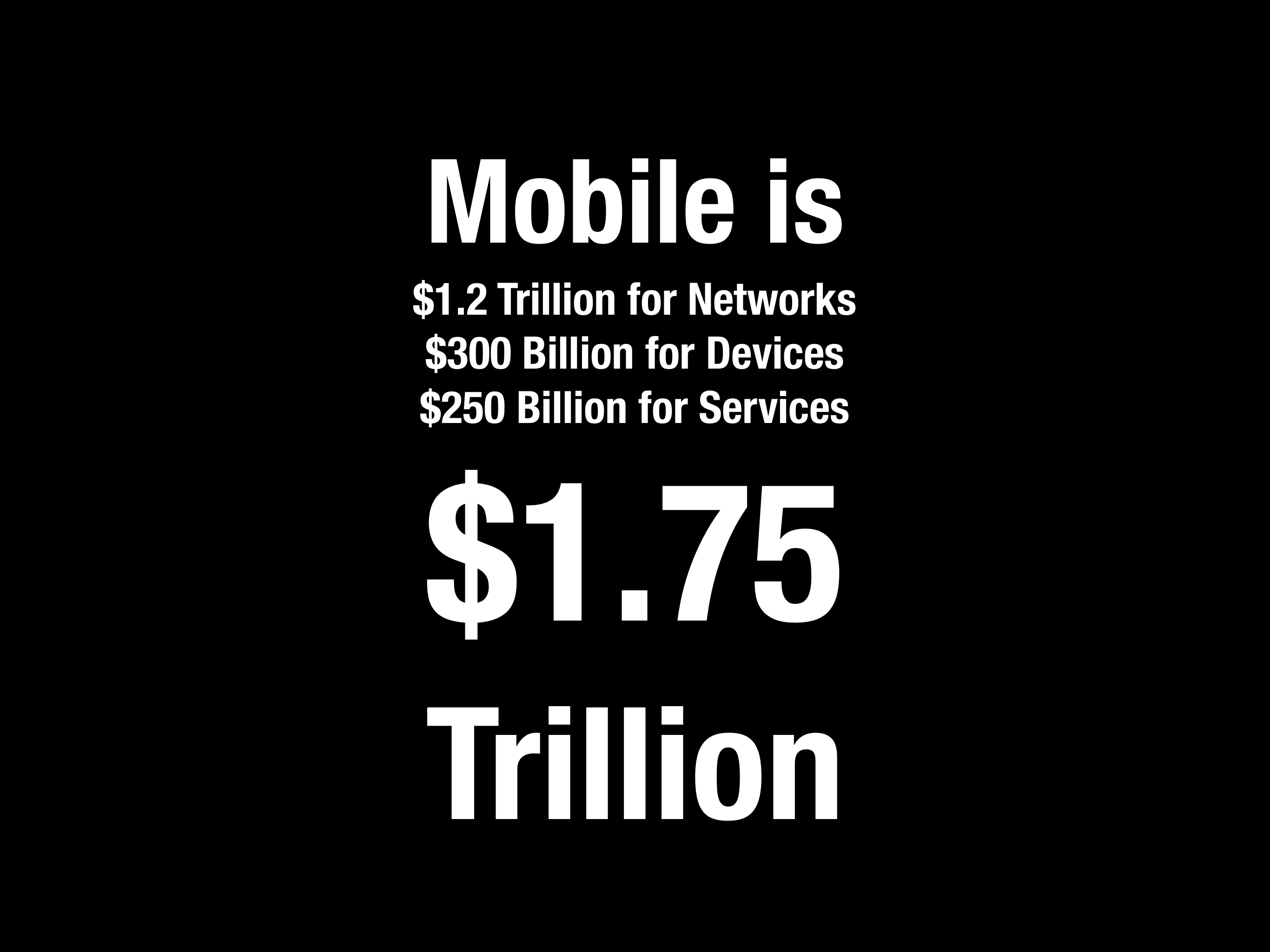
    Estimated mobile ecosystems total value by 2020 estimated in 2016.
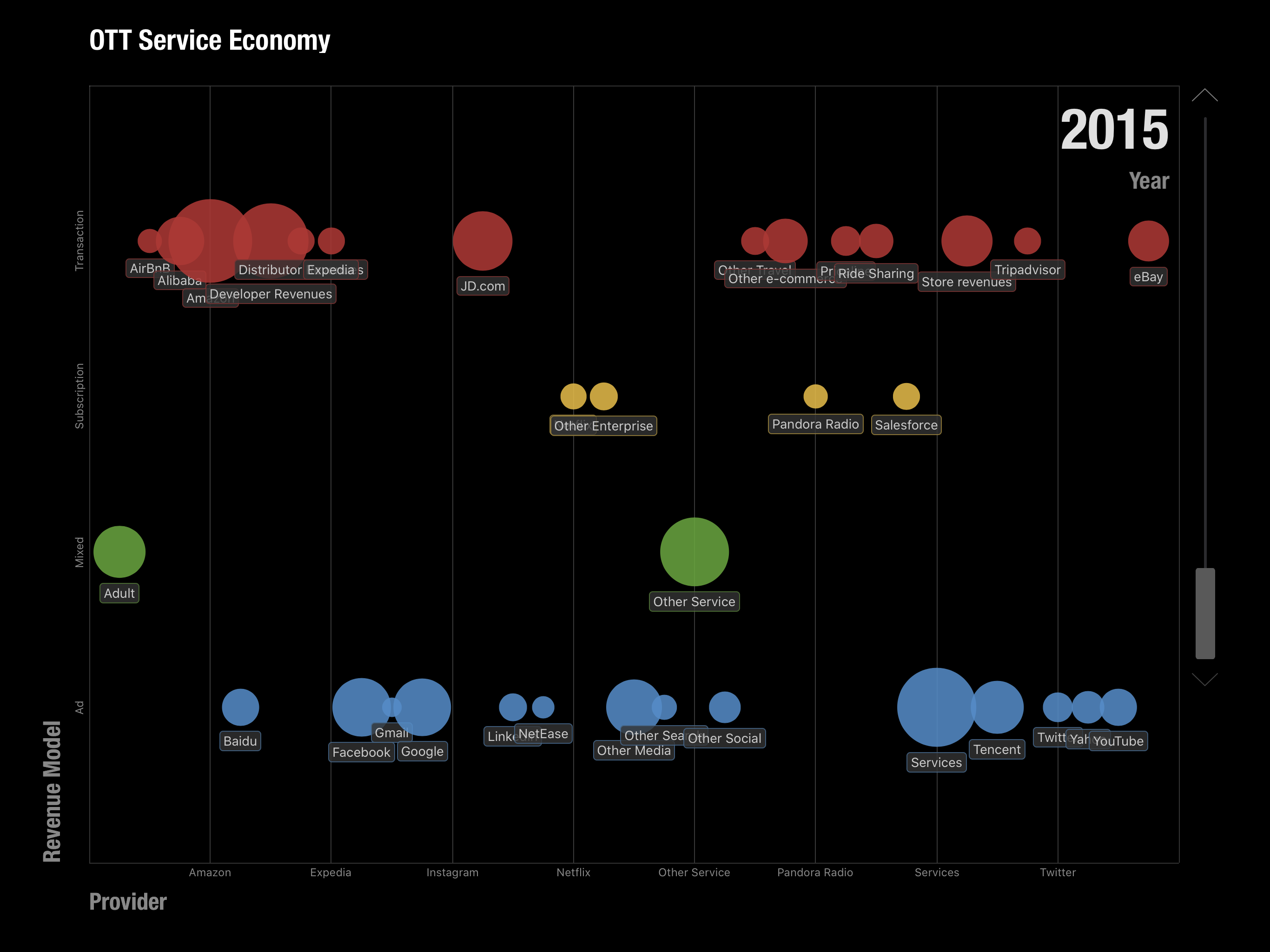
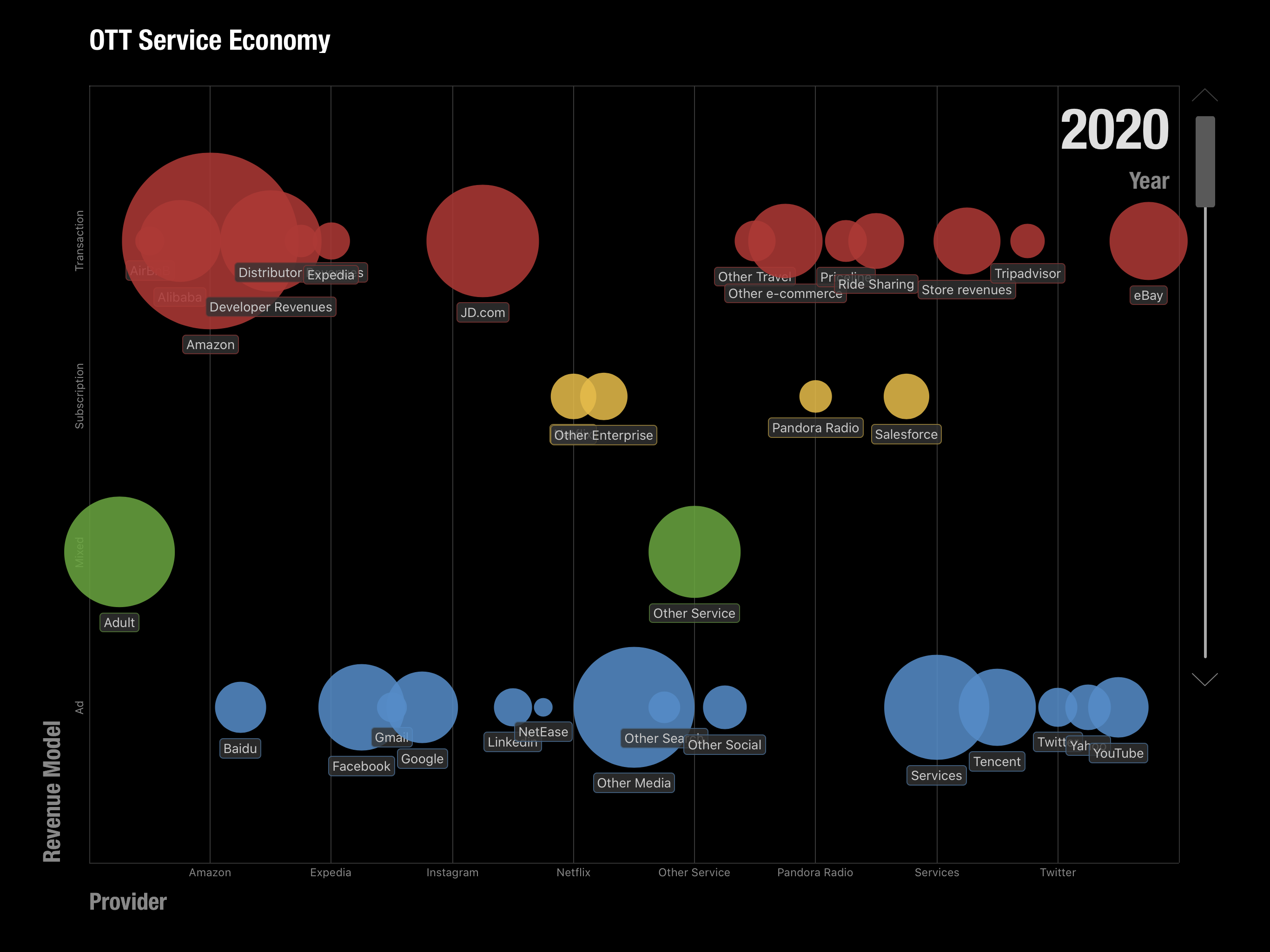
    Over the top (OTT) service components by revenue model in 2015 estimated in 2016.
    Over the top (OTT) service components by revenue model in 2020 estimated in 2016.
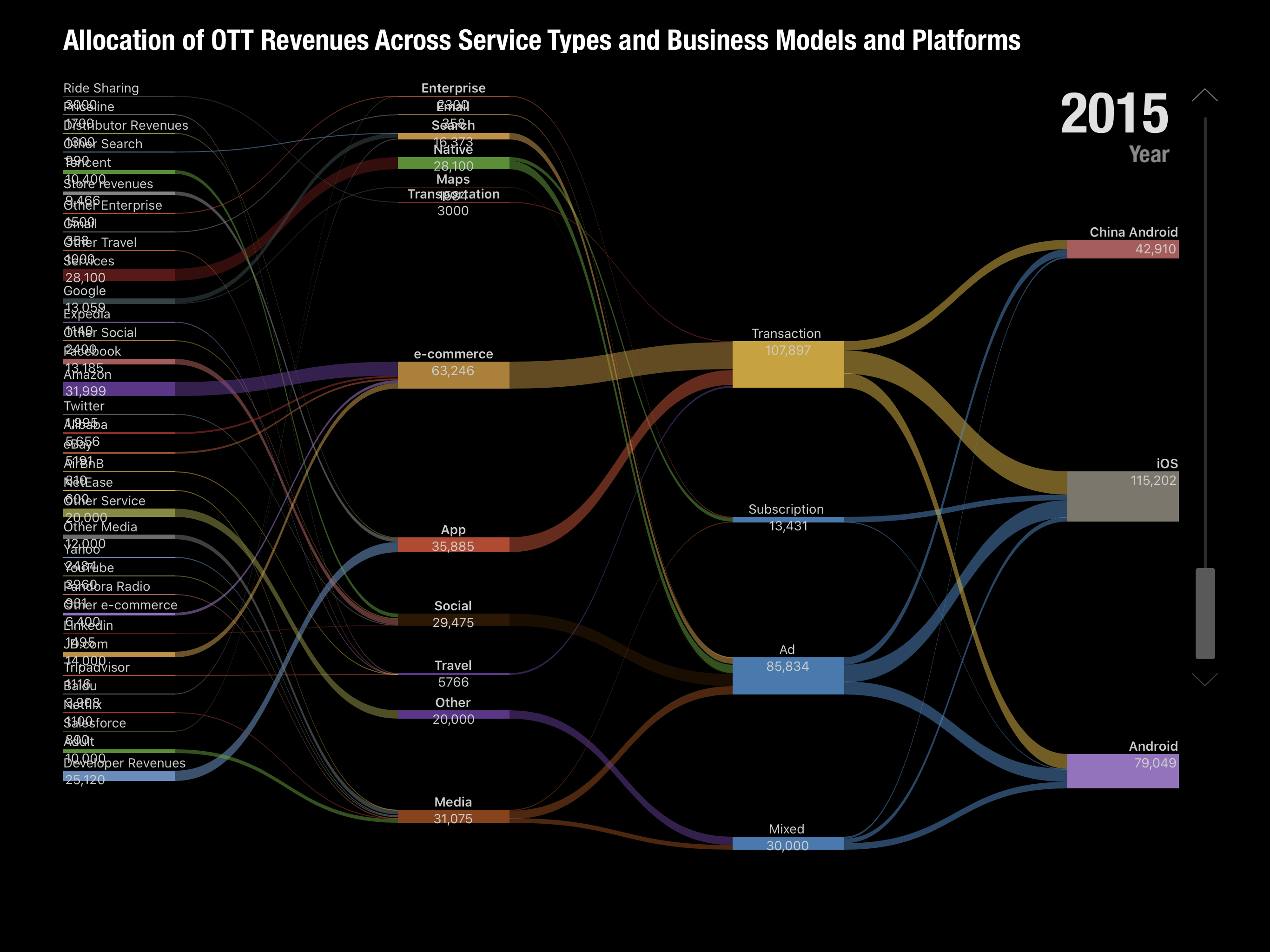
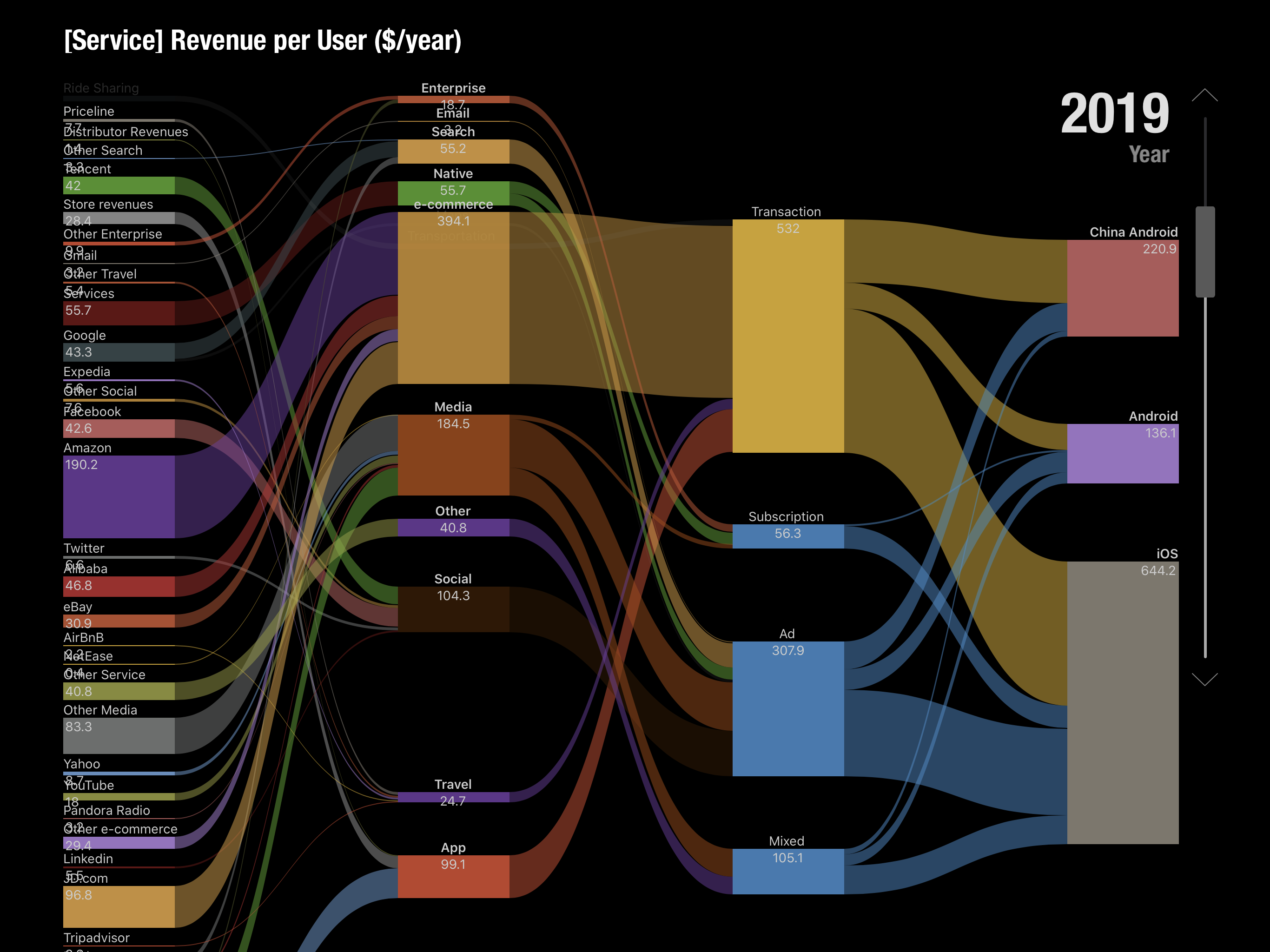
    Allocation of OTT Revenues Across Service Types and Business Models and Platforms 2015 (estimated in 2016)
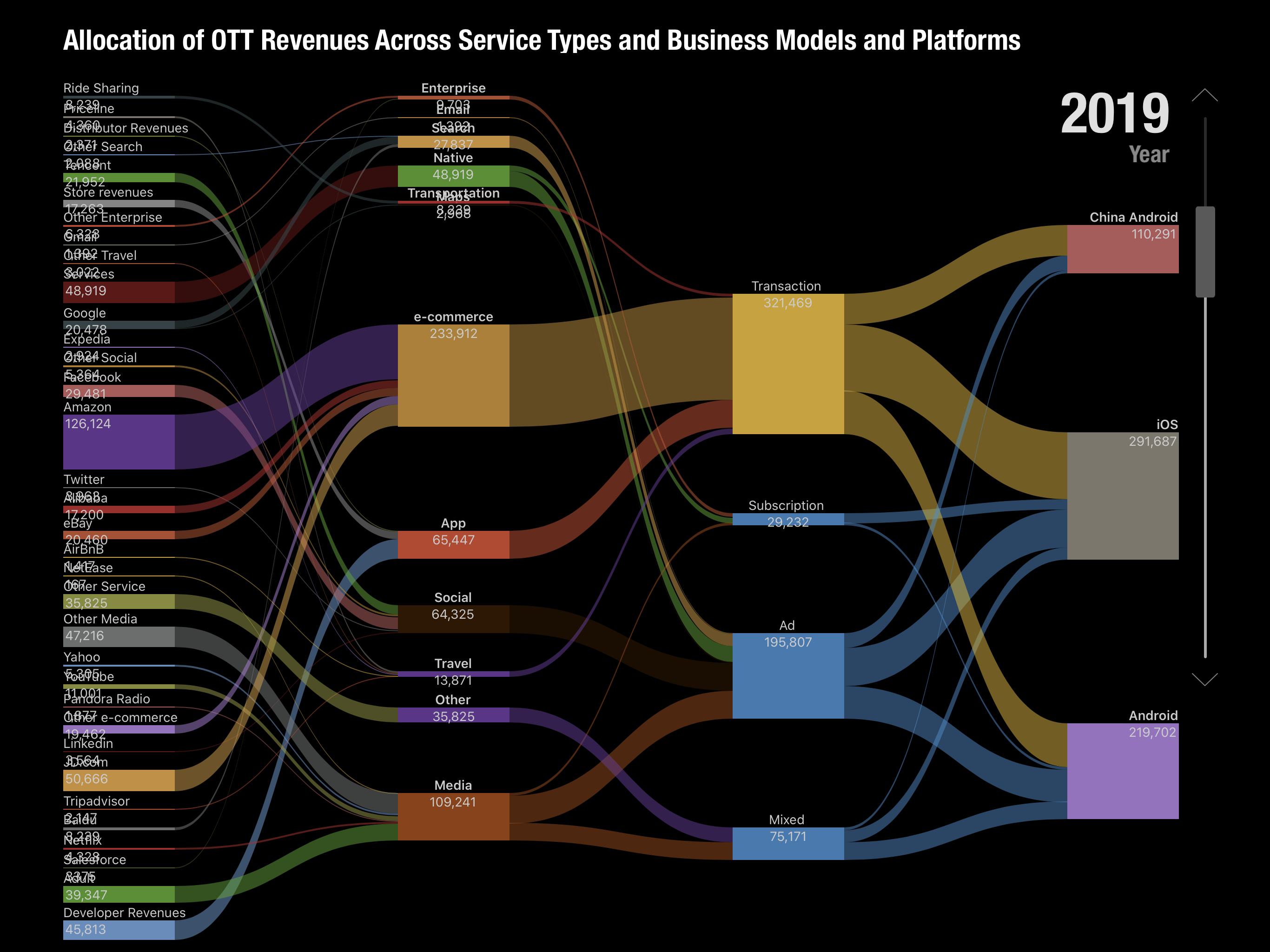
    Allocation of OTT Revenues Across Service Types and Business Models and Platforms 2019 (estimated in 2016)
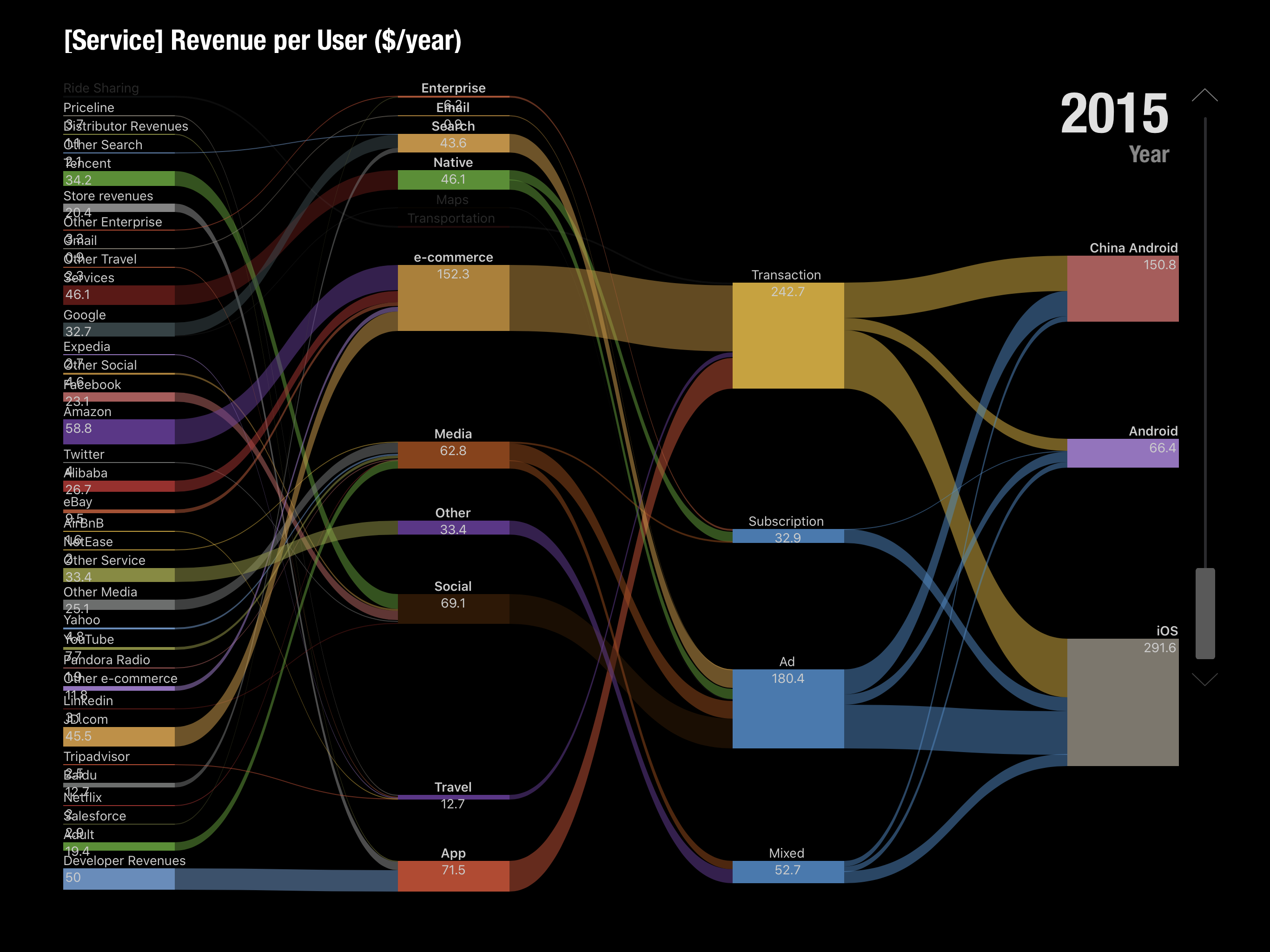
    Composition of service revenues per user ($/year) for mobile platforms in 2015 (estimated in 2016)
    Composition of service revenues per user ($/year) for mobile platforms in 2020 (estimated in 2016)

    Of course there are several potential errors in this methodology. The categories were not all inclusive. I used Social, Media, Search, Maps, email, Messaging, e-commerce, Travel, Enterprise, Storage, Transportation, Travel and Other as the top level categories. There are many products and services who would end up in Other. Moreover, these categories were anchored by the top companies in each category and the share of the top names was not always clear. Finally, the growth rates for these categories were based on historic trends which could change either way.

    The online services ecosystem (all platforms) was thus estimated to be $450 billion in 2015, growing to $820 billion by 2019 and $914 billion by 2020.

    The mobile split would vary by segment but would be roughly 75% by 2020 (25% would not be mobile). The final assumption was based on the split among the existing mobile platforms. I put a multiple of roughly 50% for iOS and 35% for Google Android and the rest for China Android.

    Multiplying all these assumptions gave me a figure of $275 billion for the iOS portion of the global online services market in 2019. (Incidentally, Android was estimated at $207 billion and China Android $110 billion.) Note that this does not mean this was an expectation of Apple's revenues or that this was the opportunity of Apple obtaining any percentage of this revenue. It was simply the value of what would transact through iOS, a platform which would act as a commerce enabler. This was to be the size of the iOS "ecosystem" or co-dependency between Apple and the companies delivering through its platform.

    Ecosystems are a powerful idea. As I recall, this term applied to mobile was coined by a Palm executive in the late 1990s when he referred to the value of all the apps built for the Palm Pilot. The biological term refers to the system of multiple species living in close proximity. It implies an equilibrium as each species benefits from the others and the environment. There might be predators and prey but biodiversity is the successful construct.

    The idea of an ecosystem for a platform was also the core strength of Microsoft's Windows which created the network effects around it and it has been the goal of every platform since. The nature of computing and networking implies that these systems grow faster and are more resilient than the more traditional value networks of other businesses or industries.

    Now this ecosystem was something we wished to highlight in 2016 as a core strength for Apple. It was not considered as such at the time and I thought putting a figure of $275 billion in 4 years' time was a way to highlight the potential. Time since has proven us right.

    This week Apple highlighted the result of another research team who attempted to measure the iOS ecosystem. Their conclusion was that billings and sales facilitated by the Apple App Store Ecosystem in 2019 was $519 billion. More than twice the amount I had so optimistically forecast four years earlier.

    The authors also emphasize that this is a conservative estimate and should serve as a baseline.

    I feel partly vindicated about that figure as my attempt at a figure was intended to highlight the scope of the ecosystem and it is better to have underestimated it than overestimated it. The authors' methodology was also similar in being bottom-up summation of components by categories of services but the information available today is enhanced by the new data Apple made available on subs and Services revenues and install base.

    Note that in the graph below the salient data points of subscribers (red triangles) had not begun until 2017 causing the acceleration in Services revenue (yellow line). Note also the additional square points representing install base.
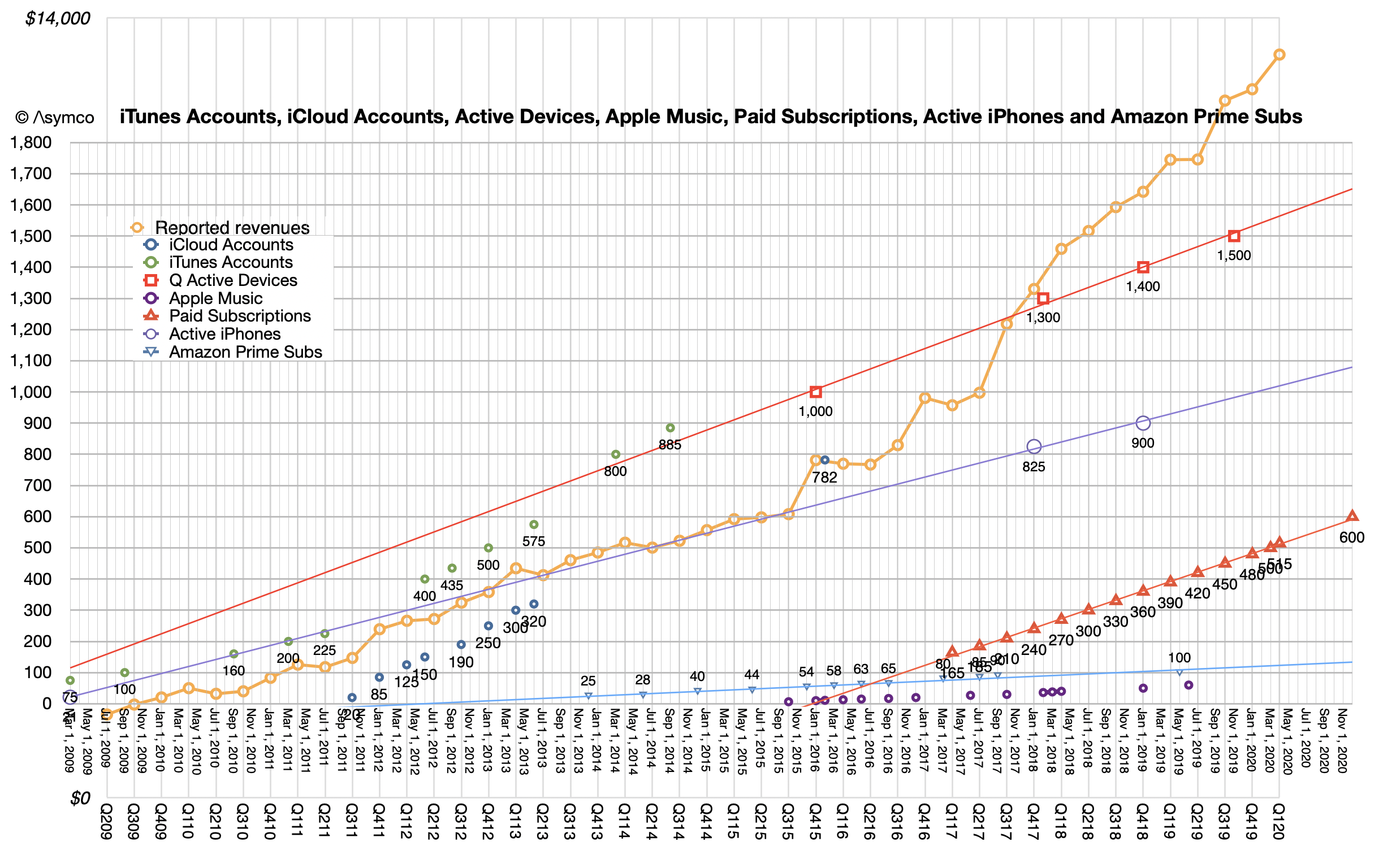
    This figure of more than half a trillion dollars of value transacted through iOS should give some pause. It it a very powerful figure that can be combined with the other data from Apple:

    • More than 1.5 billion active devices
    • More than 1 billion iPhone users
    • More than 500 million paid subscriptions
    • More than $1/day iPhone hardware revenues for Apple

    The half-trillion per year on services implies between $335 and $520 in spending per user (likely closer to $500) per year. This would be in addition to the approximately $365/yr in hardware spending per user (which Apple books as hardware revenue). In the case of the iPhone there is yet more: the cellular network service which may average $350 per year.

    To simplify, the "average Apple user" spends $1/day for each device, $1/day for the network and $1.4/day on items bought through the device. Adding a margin of error, that's between $3.4 and $4 per day each user spends. Oh, and there are about a billion such users.

    The total spending enabled by iOS thus is close to $1.4 trillion/yr.

    That's a significant amount. It's bigger than many industries. There are only about 12 countries with higher GDP (Spain is about the same.)

    How does Apple benefit from this?

    Apple captures 30% of billings through its App Store. My estimate for these billings were $67.9 billion in 2019 which means App Store billings were 13% of the 2019 ecosystem. Apple's 30% cut of Billings amounts to 3.8% for the whole ecosystem. It's hardly an oppressive number.

    If Apple only captures 3.8% what use is this to Apple?

    The last decade has seen Apple emerge as the world's largest company in terms of market capitalization, and not doing so with a wild multiple of revenue or earnings, quite the opposite. It did this by creating the world's greatest customer base. Not in absolute scale. Android and Facebook have larger customer bases with multiple billions of users.

    No, Apple's one billion users are simply the best billion users. They are the most likely to stick with Apple and they are the most likely to buy more from Apple and—this is crucial—they are the most likely to buy everything else. Those other companies whose sales come from Apple customers have been taking note. They know that Apple customers are desirable customers and choose to target Apple customers, as much as they can. Associating your company with Apple makes a lot of economic sense.

    I will admit however that my argument that Apple created a customer base is contrived. The fact is that Apple creates products and services and those products are the root of its power to attract the right customers. By choosing to create the best products it coincidentally chooses to create the best customers. The power flows from product not from pricing or positioning. This is a lesson lost for many.

    Developers and regulators might feel Apple's massive power is perhaps too much. In the last decade, the narration around Apple has shifted from Apple being perpetually "doomed" to it being too dominant. Although I'm sure there are some who will try to conflate the two declaring that dominance will inevitably result in doom, most critics of Apple went from laughing (at it) to crying (about its practices).

    The argument that Apple should change its practices developed to price as it does, distribute as it does or design as it does because it was too successful or is "unfair" is getting the causality wrong. Dominance won't be altered by a few points of percentage change (on a tiny fraction of ecosystem transactions). Fairness won't be altered when there are thousands of business models and many remain to be invented. Case in point is pornography which is not permitted on the App Store but which exists in abundance thorough other access methods.

    The argument is that Apple should be more generous. That it should decrease the "cut" it takes for distribution. Or that it should not enforce revenue split for the customers it exposes to others.

    But this is problematic on many levels. The playing field for all developers needs to be level. The customer must be respected and access to that customer should be constrained or certainly metered. Abuses must be policed and that requires leverage.

    These practices are inter-dependent and the effect multiplicative, not additive. Apple has a monopoly on iOS and on MacOS and WatchOS and iPadOS. It does this to control the experience, security and safety of the user. It's that control which created the customer in the first place. It should naturally control access to its hard-earned customers.

    It does not monetize the distribution of content or apps unless the developer/creator directly charges for the product or service. Distribution is not cost free and to offer it for free is a subsidy which would create additional market and innovation disincentives. The loyalty of Apple users is evidenced by the 600 million paid subscriptions (end of year estimate) that are booked through the App Store. Developers benefit directly as a result.

    One could argue that the abundance of services which don't distribute through the App Store is evidence that the system works as intended. Apple's App store front is its property and it reflects its core values.

    Being on the shelf in the App Store means you operate on the terms of the shelf owner. If the rules are not agreeable then the half trillion dollars of ecosystem activity is testament to the availability of alternatives.
  2. LG's new Tele-vision

    Research · 17 comments

    LG Electronics has acquired HP's WebOS for an undisclosed amount. When last it changed hands WebOS was part of Palm which was purchased for $1.2 billion in 2010.

    Palm has thus been effectively divided into several smaller pieces distributed as follows:

    HP will own:

    • Support of existing Palm users
    • Palm back-end assets including source code, infrastructure and talent
    • webOS patents

    LG will own:

    • Stewardship of the Open WebOS and Enyo open-source projects where the source code resides
    • Associated talent
    • WebOS websites
    • License for IP related to webOS

    LG announced that it plans to offer an "intuitive user experience an Internet services across a range of consumer electronics devices." In an interview, the CTO of LG said that given the current situation with Android, LG does not plan on making smartphones running webOS but will use it in televisions and other devices such as cars, signage and appliances where there are no embedded OS's. "We'd like to secure a software platform across all devices."

    Most commentary regarding the deal focused on the use of the platform for TVs but management seems to consider all devices, perhaps even phones, at some future date, to be webOS targets.

    The TV however seems to be low hanging fruit today. The TV as an app platform will be the new ecosystem war and no platform today has a lock on the developers or users. The way this rivalry will shape up will not mirror other device classes for the same reason that current device classes are platform silos.

    PCs, music players, tablets and phones all have different super-majority platform leaders. The association of a platform with a device class depends first on the distribution model, which favors a specific business model which favors a specific vendor which favors a specific platform. As each device is distributed differently, a different platform takes precedence.

    Consider that the PC has historically been purchased by IT departments which led to a monoculture of Windows which led to a persistent leadership for Microsoft.

    The music player created dominance around iTunes mostly because the distribution model for music labels was baked-in. With network effects, the iPod quickly gained and perpetually retained market share leadership.

    The smartphone business initially favored Symbian and BlackBerry because they had the market access through operators. After the touch UI became dominant (and incumbents failed to respond in a timely manner), Apple and Google took leadership as soon as they accepted the operator distribution model. Android in particular is especially resonant with operators and has been developed with their requirements in mind.

    The tablet business is more like the PC business but without enterprise requirements or patterns of purchase. This has meant that app/content ecosystems and retail distribution were the key gating factors. The story is still unfolding but so far Microsoft has not found a foothold while iOS and Android and Amazon have.

    That leads to the question of how will smart TVs be sold and which business model (or go-to-market strategy) will succeed. Steve Jobs pointed out the difficulty in trying to deliver innovation into a value chain dominated by cable companies which can effectively block it. A TV which is an application execution device rather than a content terminal will require a re-definition of the category. That will require a re-positioining of this product. Few companies are able to do that. [See also my post Tele Vision from mid-2011].

    Which brings us back to the question of webOS. As long as LG sells TVs as content terminals they might not obtain much value from webOS. If, on the other hand, LG were to use webOS to re-define their televisions to be something else entirely, namely software execution devices, sold differently and hired to do a different job than a TV, then webOS becomes not only necessary but potentially a source of great prosperity.

  3. The parable of RIM

    Research · 155 comments

    Here are the highlights from RIM's latest quarter:

    • 14.1 million BlackBerry smartphones shipped, 13 million sold through
    • 150k PlayBook shipped with sell-through slightly higher. 800k PlayBooks shipped so far.
    • BlackBerry subscriber base up to 75 million
    • High growth cited for U.K., France, South Africa, Mexico and Argentina, Indonesia, Saudi Arabia and South Africa. RIM is the #1 smartphone vendor in the Latin America and Caribbean region. Sales outside the US, UK and Canada were 61% of revenues. US is now 20% of sales, UK 11%.
    • Hardware growth outside the US was 56%
    • There are 630 carriers
    • 50k apps in App World with 5 million downloads per day
    • Forecasting 11 to 12 million smartphones next quarter

    Given the channel fill with a new product, the device business was marginal at best. The company obtained -1% growth y/y in units but 31% sequential growth from a transitional quarter. The average selling price (inclusive of service revenues) is $354 and about $280 excluding service revenues. I estimate that operating margins have dropped to about 11%. Not a good story, but one we have been warned to expect.

    But a crucial new twist to the story is that RIM announced that they don't expect new BlackBerry 10 devices until late next year. That came as a surprise and the stock sold off significantly, valuing the company at well below book value.

    Stepping back, the biggest surprise is that the company seems to have had no plan for sustaining itself.

    Let me explain.

    If you go back to 2005 or so the world of smartphones was a mix of modular OSs and integrated platforms, much as it is today.  Not unlike Android today, Windows Mobile was successful in licensing to dozens of vendors who in turn released hundreds of products. Symbian also was licensed but most volumes came from Nokia and they held the lion's share. Then there was the BlackBerry integrated solution which worked smoothly and had devoted fans who upgraded every chance they had and operators who were joyous at the new ARPU. There was also PalmOS as offered by PalmSource trying to be a "third horse" and unseat stodgy old Microsoft.

    It was into that fray that both Apple and Google jumped. Google acquired Android in 2005 and Apple was busy polishing a version of OS X that would became iOS. In three and two years respectively these platforms would be in the market.

    Regardless of the actions of rivals, all competitors must have faced the same questions in 2005: As technology was changing rapidly and as they all had access to component roadmaps, what is the best technology approach to this market? Should they embrace certain innovations to sustain their business trajectory? RIM had a tightly integrated software, hardware and service offering. What could make it better? Nokia was also basing its products on a more loosely integrated offering (nominally it was modular, but only just). It saw the writing on the wall and began developing a Linux variant (Maemo) as a potential candidate to replace Symbian. Microsoft was basing its solution of a modular approach. Windows CE was ok as a kernel but they had layers on top which were optimized around stylus-based user experiences (analogous to mouse actions). Could it take on a rich computing experience?

    There were many experience candidates. Stylus, keypad, keyboard all had adherents. There was a lot of hesitation. After the iPhone launched with capacitive (finger) touch, resetting user expectations, it still took a year for many of the vendors to re-consider their technology plans. The weakest changed first.

    Microsoft felt the pain quickest. They also had the least to lose since revenues from Windows Mobile were paltry. By 2008 internally they turned 90 degrees. They embarked on re-building their user experience and orphaning the Windows Mobile ecosystem and many of the vendor relationships they had built. Palm dropped PalmOS and built WebOS internally quite quickly. They licensed Windows Mobile as a stop-gap. Around the same time Nokia doubled down on Maemo and joined with Intel to form MeeGo. They did not orphan Symbian though and kept trying to adapt it to the new experiences and input methods.

    But RIM did nothing. Almost nothing. They were the healthiest competitor. They felt no pain from iPhone's entry. The platform they had built was still growing and they were tweaking it constantly. There were always improvements to point to but fundamentally the code was limited. It was very difficult to adapt it to touch input and the first attempts at a touch UI were embarrassing. But there were no signs of a new platform that reflected the Unix-like competition.

    As I pointed out in an earlier post, Unix-like operating systems were having their revenge. To a computer scientist the future of mobile computing would mirror that of personal computing in terms of architecture. The foundations of the early smartphones were built on constraints that were disappearing while being unable to accommodate new input methods. In other words, the early efforts were optimized around those constraints and sub-optimal for rich user experiences. They had to be. There were limited processors, memories and screens and battery life.

    It turned out that all the early mobile operating systems were unsuitable for the advances in technology that came after 2007. Companies which were able to adapt or embrace Unix-like operating systems in a mobile context gained the ability to grow with the new input methods. The sooner they "pulled the trigger" on the shift, the better off they were. This is in fact what enabled entrants to gain footholds. Entrants entered with Unix-like OSs straight away while incumbents had to justify changing and the more successful they were the harder it was to justify changing.

    RIM had trouble justifying this change. It waited until 2010 to finally acquire the QNX asset that would offer them a stronger software foundation.  It still had to adapt this acquisition and it looks like it won't be done until at least 2012, seven years after they should have started. And this should be seen as a sustaining technological change. A new OS is not a disruptive technology to what is already a mobile computer.

    However, delays like these can be fatal. We see the impact on Microsoft who was earliest to push the reset button in 2008. It still took two years to rebuild Windows Mobile into Windows Phone and is now still struggling to regain lost share (less than 2% today). We see the impact on Nokia which was unable to affect a transition to MeeGo due to a litany of issues and had to throw in the towel on self-determination. We see the impact on Palm which lost its independence as WebOS was a bit too little too late.

    These companies had the right technical strategies but suffered from execution and business architecture issues. RIM is years late in embracing what appears to be a sustaining improvement.

    But whenever you see what appears to be a coordinated effort by companies to fail simultaneously you have to ask if the change they struggle with is really sustaining or disruptive. The pattern makes me suspicious that what RIM, Microsoft, Palm and Nokia faced was more than a failure to embrace a sustaining improvement. I suspect that the failure is evidence of tectonic shifting of business models.

  4. Revolutionary User Interfaces

    Research · 226 comments

    A few years ago, around the middle of the last decade, the mobile phone market was characterized by the rivalry between a few established vendors. These were Nokia, Samsung, LG, Motorola and Sony Ericsson. These incumbent companies had a broad portfolio of devices including smartphones and feature phones and basic phones. Many also sold networking equipment and were deeply engaged with their customers, network operators.

    There was also a set of entrants who offered only smartphones.  They were quirky. HTC was a a prominent "ODM" or original design manufacturer who built phones for companies who added their brands and sold and supported the product. HTC made phones and PDAs for operator brands and for some large PC companies. It also began to sell phones under its own brand. RIM was also offering products that had evolved from pagers into email appliances with added voice capabilities. But RIM's products were not very good as phones. Voice was so poorly integrated that many people carried both a BlackBerry and a voice phone. Then there was Palm with something called a Treo which promised many things but did not quite deliver.

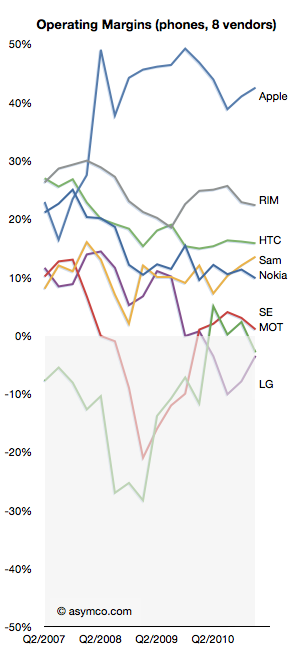
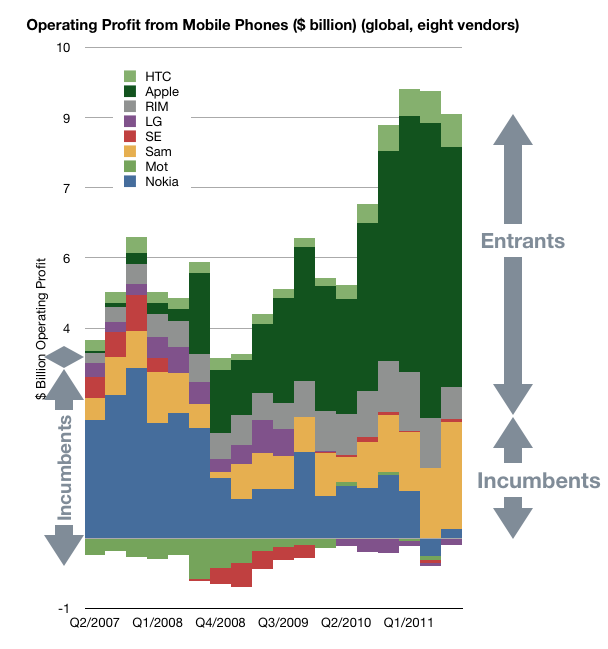
    In 2007 something happened which changed the industry. It took a few years to even realize it was happening but by the time it was obvious, it had changed to such a degree that huge companies found themselves in financial distress. This chart illustrates the effect.

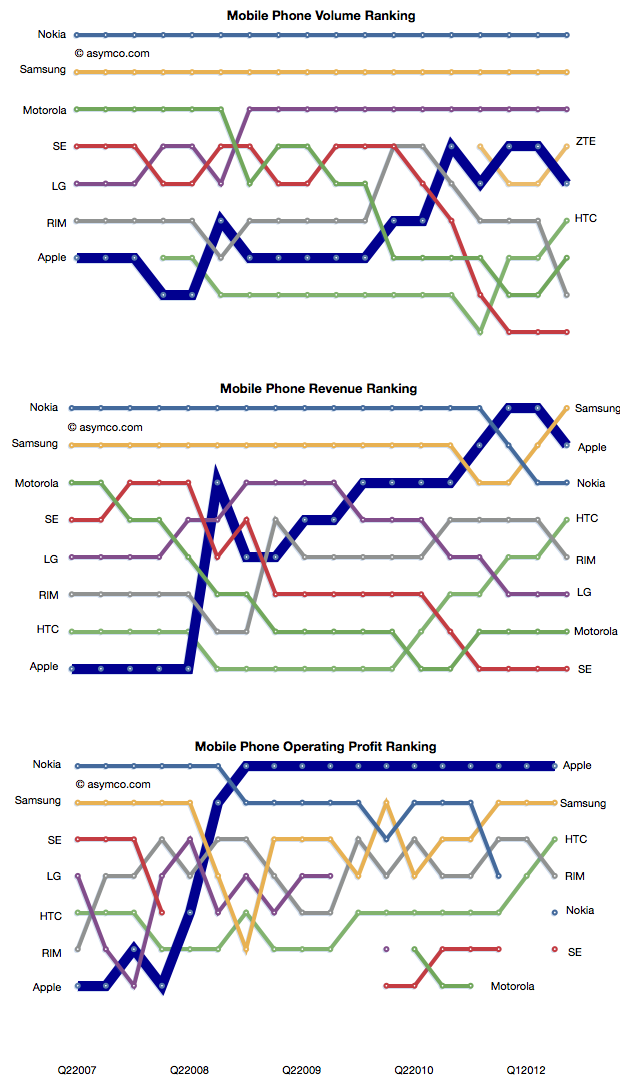
    In a few short years the rivalry between incumbent handset makers has evolved into a rivalry between mobile platforms where the incumbents were caught in an increasingly unprofitable role of hardware integrators. Motorola is now being absorbed by a search company. Sony Ericsson is being absorbed into a consumer electronics company. Nokia is going through a potentially existential crisis and even abandoned its platform. Acquisition talk surrounds LG's phone efforts. Samsung is prosperous but sill at the mercy of its software suppliers. Even the entrants are starting to feel beleaguered. RIM, the oldest pure play smartphone company is trading below book value and has regressed in value to 2004 levels. Palm evaporated. A view into the changes is the rankings of the companies in terms of volumes, sales and profit as shown below.

    How did large, powerful, smart companies let this happen?

    It happened despite having a clear, front row view of the transition of the industry from mobile voice to mobile computing. The shift in the basis of competition from "connecting people" to "connecting people to data" ended up being a classic disruptive trap. Many will argue that it was the failing of individual managers. Perhaps, but how did they conspire to fail simultaneously?

    When you see disruption happening, it's natural to seek out a cause, a pivotal magical "force" or event that enabled the weak to humble the strong--the proverbial sling that enabled David to defeat Goliath.

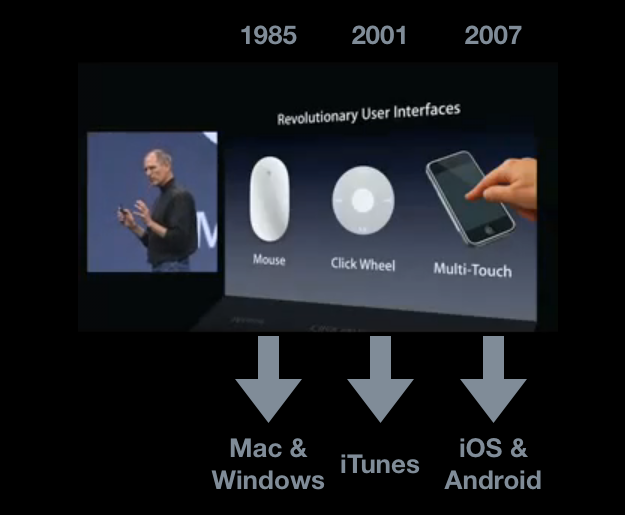
    My hypothesis is that The Primary Cause for the shift of profits from Incumbents to Entrants has been the disruptive impact of a new input method. I illustrated this with the help of the January 2007 slide presented by Steve Jobs at the launch of iPhone.

    Screen-Shot-2011-11-03-at-11-3-10.45.20-AM

    Each new input method led to not just a disruption but new platforms and new business models. Each new "sling" victimized a set of historic companies. Mainframe and minicomputers, consumer electronics giants and now telecoms.

    Just like David's sling, these technologies are not powerful in and of themselves, but rather, the way they are used makes them unpredictably sinister. The context of using capacitive touch on a handheld device rather than on a table-top makes it disruptive. Coupling it with high-speed mobile networks and powerful but efficient microprocessors made it into a force.

    That is now ancient history. The consequences and repercussions are still being felt and weighed, but the smart money should be focusing on the next shift. From the time frame in the diagram above, it's clear that the cycle time between "Revolutionary User Interfaces" is shrinking. It's been five years since multi-touch. Is the next "RUI" already here? Is Siri the next RUI?

    There are many things going for it:

    1. It's not good enough
    2. There are many smart people who are disappointed by it
    3. Competitors are dismissive
    4. It does not need a traditional, expensive smartphone to run but it uses a combination of local and cloud computing to solve the user's problem.
    5. It is, in a word, asymmetric.

    My disruptive hypothesis for Siri is that it shifts the competition from platforms positioned on a device to a "coupled" super-platform dependent on broadband and infrastructural computing.

    Just after collecting enough data and observing patterns in it that give us clarity, It looks like things are about to change all over again.


  5. Does the phone market forgive failure?

    Research · 59 comments

    One of the details of Nokia's warning which did not get a lot of attention was the mention that profitability for the current quarter could not be guaranteed. That is to say that Nokia may make a loss, perhaps for the first time in more than a decade.

    This may not be that newsworthy except for the strange fact that as far as I've been able to observe, any company in the mobile phone market that ended up losing money has never recovered its standing in terms of share or profit (i.e. AMP index value has never recovered).

    Here is a list companies that have "hit the rocks" in terms of mobile phone profitability and their fates (in no particular order).

    1. Alcatel of France. Sold its brand and operations to TCL Communications of China in 2004.
    2. Siemens of Germany. Exited in 2005 through acquisition by BenQ of Taiwan.
    3. BenQ of Taiwan. Mobile devices division declared bankruptcy in 2006.
    4. Ericsson of Sweden. Exited by merging with Sony in 2001 even though third in volume share the prior year.
    5. Sony of Japan.  Joined with Ericsson to form Sony Ericsson in 2001. Held less than 1% share prior to merger.
    6. Motorola of the United States. Even though once the largest vendors, after a period of severe distress, Motorola spun off Motorola Mobility. Market value shows long-term viability still a concern.
    7. Casio of Japan. Merged with NEC and Hitachi in 2010.
    8. NEC of Japan. Merged phone units with Casio and Hitachi in 2010.
    9. Hitachi of Japan. Merged phone units with NEC and Casio in 2010.
    10. Fujitsu of Japan. Merged with Toshiba in 2010. Held 15 percent of Japanese market prior to merger.
    11. Toshiba of Japan. Merged with Fujitsu in 2010. Held 4% share in Japan.
    12. Palm of the United States. Sold to HP in 2010.
    13. Handspring of the United States. Sold to Palm in 2003.

    That makes 13 large phone brands that, in less than a decade, have either exited or lost independence after suffering crises of profitability.

    As the following chart shows, at this time Motorola, Sony Ericsson and LG are still operating but have been dipping into the red.

    The three suffered severe volume contractions in feature phones and have no differentiation in software or platform products which makes their position precarious.

    This cursory survey shows that it's difficult to be optimistic once a company reaches a point of crisis. It's a curious outcome given that the market is so vast and growth is so robust.

    But the fact is that because of the technology cycle time, rapid business model evolution and fairly low barriers to entry, there is great rivalry between competitors. Profitability is the canary in the coal mine. It causes a brand to be tarnished in the eyes of distributors who, because of sales cycle times, are extremely sensitive to obsolete inventory. A loss maker is seen as a maker of damaged goods.

    It then turns off the tap of incentives, promotions and hence visibility in the eyes of consumers. It's a vicious cycle from which few (if any) can recover. Past greatness offers no succor.

    And so, with Nokia about to join the list of loss-makers it's only natural to question its fate as an independent company.

  6. The Allegory of Treo

    Research · 35 comments

    The following is a work of fiction.

    The combination seemed unthinkable just a few years ago. Nokia envisioned itself as a substantial rival to Redmond, threatening to head off its computing dominance as the power of desktop computing shifted to pocket-size devices. But a series of miscues substantially weakened the company, leaving it little choice but to team up with the world's largest software maker.

    Although Nokia has pledged to continue using the Symbian OS in both handhelds and phones, the company has now significantly tied its fortunes to the rival it once denounced.

    In doing so, Nokia is making a tough bet. The company is gambling that Microsoft's operating system has advanced far enough to power a decent cell phone, while still having enough rough edges that Nokia can carve out a niche by going beyond the standard Windows Phone software. In doing so, Nokia hopes it can avoid the fate of being just another clone cranking out hardware on Microsoft's behalf.

    Microsoft, meanwhile, has scored a significant win in its decade-long quest to crack the mobile market. In wooing Nokia, Microsoft has brought a one-time rival into its fold and ideally gained a new creative force as it tries to move its PC empire into the burgeoning market for cell phones.

    "Nokia always did great work, and so we lusted after some of those things that they do well," Ballmer told reporters at Monday's launch.

    The partnership is not totally out of the blue, of course. The two companies offered a glimpse at the detente last year, announcing a pact that allowed Symbian OS-based smartphones to connect directly with Microsoft's Exchange servers for corporate e-mail and calendar information.

    In its secret meetings, Nokia execs managed to convince their Microsoft counterparts to build several software hooks they needed into the latest version of Windows Phone. The changes allowed Nokia to add some handy features into the Windows version of the N series phones. One new trick allows Nokia owners to ignore an incoming cell call, instead sending a brief text message to the caller. A second feature allows Nokia owners to navigate multiple voice-mail accounts using VCR-like buttons, rather than having to know that "5" is the key for fast forward or remember that "7" saves voice mail at work, but deletes it at home.

    A key question, though, is whether Microsoft will give Nokia enough room to innovate in the future, now that it has successfully wooed the device maker. By going with Microsoft, Nokia is letting go of one of the key differentiators between its products and those from better-known competitors.

    Elop said he understands the risk and only undertook it with assurances that Nokia would be able to build enough software on top of the OS to make his products stand out.

    "It was the only way we felt it could work for us," he said at the Monday press conference.

    Executives from both companies suggest that the Nokia-Microsoft relationship, forged at those meetings in Cannes and New Orleans, will continue to be close. But it remains to be seen whether Nokia will retain its individuality now that it has the Microsoft imprimatur.

    Wirt acknowledges that there are no formal procedures in place that ensure that Nokia will get the things it asks for the next time, or the time after that. "It's functioned more as a relationship-type thing."

    Elop said Nokia could try to patent particularly strong advances, but in general he said the company believes the best way to stay ahead is to keep cranking out new products.

    "We have ideas about many things that we didn't get to do in this version," he assured reporters.

    But for all its ideas, Nokia is still a relatively small company. And given that it has pledged continued support for the Symbian OS, it must now divide its limited engineering resources between two incompatible efforts.

    Elop acknowledged that the challenges of developing for two entirely different operating systems are enough to keep his firm hopping. He emphatically shook his head back and forth when asked if Android and MeeGo-based Nokia phones might be next.

    "We don't need another operating system," he said, adding later, "It's too much effort."

    This fictional article was created by taking an actual article from 2005 about Palm and Microsoft (Palm's tale of Treo intrigue - CNET News) and changing the words "Palm" for" Nokia", and "Colligan" for "Elop", "Ballmer" for "Gates", "Treo" for N series (or Nokia) and "Symbian" for "PalmOS". A few paragraphs about the mechanics of the deal process were deleted.

    Credit: This tweet from Charles Arthur.

  7. In memoriam: Microsoft's previous strategic mobile partners

    Research · 223 comments

    Microsoft's new "strategic partnership" with Nokia is not its first. For a decade the software company has courted and consummated relationships with a variety of companies in mobile and telecom. Here are the ones I can remember:

    • LG. In February 2009 Microsoft Corp. signed a multiyear agreement for Windows Mobile to be included on devices from LG Electronics Inc. LG would use Windows Mobile as its "primary platform" for smartphones and produce about 50 models running the software.

    What happened? LG made a few Windows Mobile devices but with WinMo uncompetitive, they abandoned the platform and moved to Android losing years of market presence and all their profits.

    • Motorola. In September 2003, Motorola  and Microsoft announced an alliance. "Starting with the introduction of the new Motorola MPx200 mobile phone with Microsoft Windows Mobile software, the companies will collaborate on a series of Smartphone and Pocket PC wireless devices designed to create a virtual "remote control" for the Web-centric, work-centric, always-on-the-go mobile professional." In addition, the alliance includes cooperation on joint marketing and wireless developer programs.

    What happened? Motorola launched a series of Windows Mobile phones culminating in the Motorola Q "Blackberry killer". As Motorola hit the rocks in profitability new management reached for the Android liferaft. The company now relies exclusively on the Droid franchise.

    • Palm. In September 2005 Palm and Microsoft announced a strategic alliance to "accelerate the Smartphone market segment with a new device for mobile professionals and businesses. Palm has licensed the Microsoft Windows Mobile operating system for an expanded line of Treo Smartphones, the first of which will be available on Verizon Wireless’ national wireless broadband network."

    What happened? Palm shipped a few Windows Mobile, famously dismissing Apple's potential entry as something "PC guys" could never achieve. A new CEO, a private placement and an acquisition later the company is a division of HP making its own operating system.

    • Nortel. When Steve Ballmer was famously laughing at the iPhone and saying that he likes the Windows Mobile strategy "a lot" he was sitting next to the then-CEO of Nortel (Mike Zafirovski formerly of Motorola) with whom the company had just closed a strategic deal.  "an alliance between Microsoft and Nortel announced in July 2006 ...  includes three new joint solutions to dramatically improve business communications by breaking down the barriers between voice, e-mail, instant messaging, multimedia conferencing and other forms of communication".

    What happened? Nortel declared bankruptcy two years later.

    • Verizon. In January 2009 "Verizon Wireless has selected Microsoft Corp. to provide portal, local and Internet search as well as mobile advertising services to customers on its devices. The five-year agreement will go into effect in the first half of 2009 when Microsoft Live Search is targeted to be available on new Verizon Wireless feature phones and smartphones." The deal would ensure Bing distribution to all of Verizon's smartphone customers.

    What happened? Bing did ship on some devices but in October 2009 Droid came to Verizon.

    • Ericsson. In September 2000, "Ericsson and Microsoft Corp. today launched Ericsson Microsoft Mobile Venture AB. This previously announced joint company will drive the mobile Internet by developing and marketing mobile e-mail solutions for operators. The first solutions are expected to be on the market by the end of the year. The company is part of a broader strategic alliance between Ericsson and Microsoft"

    What happened? Ericsson divested itself of the mobile division forming a joint venture which would go on and make more strategic alliances with Microsoft over Windows Mobile culminating in a loss of profits and eventual flight to Android.

    • Sendo. In February 2001, Microsoft announced a partnership, in which Microsoft bought $12m of Sendo shares and a seat on the board. Sendo was to be Microsoft's "go to market partner" for the Stinger smartphone platform that would become Smartphone 2002.

    What happened? Sendo after litigating IP issues with Microsoft went bankrupt in 2005.

    And finally,

    • Nokia. No, not this OS deal, but in August 2009 "The worldwide leader in software and the world’s largest smartphone manufacturer have entered into an alliance that is set to deliver a groundbreaking, enterprise-grade solution for mobile productivity. Today, Microsoft Business Division President Stephen Elop and Nokia’s Executive Vice President for Devices Kai Öistämö announced the agreement, outlining a shared vision for the future of mobile productivity. This is the first time that either company has embarked on an alliance of this scope and nature."

    The plan was to bring "Microsoft Office Mobile and Microsoft business communications, collaboration and device management software to Nokia’s Symbian devices."

    What happened? One and a half years later the same Stephen Elop announced that Symbian will be deprecated.

  8. Of Platforms, Operating Systems and Ecosystems

    Research · 21 comments

    In the earnings Q&A Stephen Elop used the word 'Platform' once, 'Operating System' three times and 'Ecosystem' 15 times.

    Though they seem interchangeable, the three phrases have significant differences in meaning. Briefly put, a Platform is a business model concept,  an OS is a technology concept and an Ecosystem is a marketing concept.

    Platform

    A platform, as the New York Times recently pointed out, can take many forms. The Barbie doll is a platform as is the US Interstate Highway system. These are products or infrastructure that allow other products to be 'built on top' and can thus charge rents from them. When building platforms, a company needs to think of how to make their work foundational so it can support other structures. Other examples of platforms are browsers, the Apple 30 pin dock connector, Game Consoles and Facebook.

    In terms of innovation theory, a platform is a signal to industry that the company is willing to allow its innovations to be extended and thus share in the creativity of adopters. There is however a down side: platform adopters may also create so much value that users will shift loyalties to the layers above the platform thus restricting the freedom of the platform owner to modify or modernize the underlying platform.

    This loss of control over the roadmap often forces platform owners to institute draconian limits to the extensibility of the platform (e.g. the iPhone developer restrictions.) In other cases, platform owners have acquired and integrated various core apps or services so that the platform and core apps can be upgraded in sync. This was the impetus to the development of Microsoft Office. Office was motivated by a need to prevent Lotus from slowing the upgrade path for Windows not, as it's assumed, to create a new revenue source. However, again, the effect is the destruction of the ability to innovate on that particular area (no new Word Processor or Spreadsheet programs for 20 years).

    It takes a great deal of work to platformize a product. I would guess 10x more than a similar product which does not allow collaborative innovation. Platforms are difficult to build, require delicate balancing acts to maintain but can be enormously valuable due to network effects.

    Operating System

    In contrast an Operating System has a very clear technical definition. It has been extended to include many applications and services, but it's basically the control system of a computer. An OS may or may not be a platform. For example embedded operating systems typically do not have APIs to support applications. Some basic mobile operating systems support applications through a sandbox like JaveME (in this case the platform is Java) and are therefore also not platforms.

    A company licensing an OS may not accept the platform with the license or may not consider it valuable. It's even possible to license an OS and consider the platform value to be a liability to your own strategy (arguably HP fits in this scenario as regards to Windows. HP had its own operating systems and tried to build alternative platforms in spite of Windows).

    An example of an OS with minimal platform value may be WebOS which has a very limited API for native applications.

    Ecosystem

    The word ecosystem as it applies to technology was coined by Palm to describe the app vendors that built apps and the accessories for its Palm Pilot. This is not a common word as it's largely equivalent to Platform. The subtle difference is that it's used in a marketing context to signal platform value. Having a large ecosystem implies the acceptance of a platform by a large base of developers.

    For example a platform may not have a viable ecosystem if there are few developers and/or little economic value 'on top' of the platform. Symbian is often cited as being a decent OS, but a poor platform with a mediocre ecosystem.

    So these three phrases are overlapping but have a different tone. Although perhaps unintentional, Elop's emphasis on Ecosystem vs. Platform or OS, might signal that what's missing from Nokia's strategy is the motivation or encouragement of developers to participate. My prediction of WP7 licensing may not fit well with this deficiency but perhaps Microsoft's ecosystem building potential is still greater than Nokia's.

    I should also point out that Nokia's platform strategy has also included an intermediate layer called Qt that enables cross-platform ecosystems, thus making the OS irrelevant. Technically this may have merit, but it's a long haul to getting an ecosystem for it.

  9. Resetting Motorola

    Research · 31 comments

    Motorola—like HTC—is thus a bellwether for makers of Android phones, whose sales have now caught up with those of the iPhone—about 300,000 a day worldwide. Some industry analysts doubt that it will be able to create a big market for its devices and make enough profits before cheaper providers move in. If they are right, the smartphone market may eventually become like that for personal computers: a handful of huge competitors with tiny margins. The difference will be that these firms will hail from around the world rather than being mainly American.

    via Motorola: Breaking up | The Economist.

    When I argued that the meek shall inherit Android, the profitability data was the core evidence. That argument, made in August, was:

    So here we have the real challenge to Android:  partnership with defeated incumbents whose ability to build profitable and differentiated products is hamstrung by the licensing model and whose incentives to move up the steep trajectory of necessary improvements are limited.

    In other words, Android’s licensees won’t have the profits or the motivation to spend on R&D so as to make exceptionally competitive products at a time when being competitive is what matters most.

    The surge in emerging market Android entrants has been the latest setback for branded Android vendors. What should be the long term strategy for companies like Motorola and Samsung?

    Paradoxically, Motorola, being the weaker, has the best chance for successful recovery. The clue lies in both what Palm (now HP) and Microsoft did: starting with a clean sheet of paper and building their own platforms.

    This might seem futile given the network effects that current platforms are gaining, and there is a big execution risk, but the alternative is no alternative at all. The big incumbents cannot fight against the clone makers.

    Technically, building a new platform is not as daunting a challenge as it used to be. Palm, a small company, managed to do it in about 2 years. Microsoft, a large company, took 18 months. Google built theirs in about 2 years.

    They all took advantage of existing code bases (Linux or Windows CE). They also rely on web standards for their APIs (.NET or Java or HTML5).

    The challenge is bigger in attracting developers, though again, some core set of apps and developers can be obtained on the promise of brand power alone. Intel and Nokia is using this power for MeeGo.

    Motorola's advantage today is its new autonomy and singular focus on mobility. It has hit the reset button. There is no better time to be courageous and there are no sunk costs to confuse investment priorities. Android was a necessary stop-gap measure and the Droid timing was very good (before the clones and before iPhone distribution expanded). However, now would be a good time to start building a Motorola platform for the future.

  10. The parable of the the PDA: predicting the smartphone's future

    Research · 55 comments

    When reading the comments disputing the possible end of the voice-phone era I'm reminded of similar comments disputing the end of the PDA era.

    Although the Apple Newton pioneered the market in 1992 and John Sculley came up with the acronym, the Newton did not sell in significant volumes. It wasn't until 1997 with the Palm Pilot that the PDA market took off. Microsoft quickly followed with a licensed OS based on Windows CE. In 2001 Microsoft launched the Pocket PC brand to cement its attack on the PDA market. The first phones using a Microsoft OS were using something called Pocket PC Phone Edition. The first Nokia smartphones (Communicators) were built like mobile PDAs.

    The logic was quite compelling. The original PDA was built to mobilize contacts, calendars and notes. They replaced bulky paper organizers and seamlessly synced to PC productivity software like Outlook. It was a compelling product in the US where small business customers needed to keep track of hundreds of contacts. Users could even 'beam' contacts to each other via infrared. The idea of adding a phone function to the device made sense insofar as contacts could be immediately dialed from the contact app rather than typed into another device's phone keypad.

    By the early 2000's PDAs were forecast to sell by the hundreds of millions. There were millions of dedicated users who downloaded apps and thousands of developers being courted by platform builders. Palm even invented the word "ecosystem" as it refers to mobile platforms.

    However, I remember reading sites dedicated to this community and there were many people who rejected the concept of a PDA with an integrated mobile phone. They liked the fact that the PDA was not bundled with a phone plan. They upgraded PDAs in a different cycle from phones and besides, phones are for talking and PDAs were for something else.  It was even more difficult to justify the conflation of the two products when considering the corporate purchasing of PDAs. PDAs were procured by IT departments and phones came with contracts that were managed by a different department.

    What's a device vendor to do? The most avid customers of PDAs did not like the idea of burdening the product with a phone. RIM was doing its thing with moving pagers to include voice, but that was a different job to be done. The story is picked up here by this comment:

    I was hired by RIM in 1999 just before they began work on their first phone .... Coming from a two-way pager background, RIM decided that phones should have two-way push synchronization of pretty much everything that Exchange provided along with a limited WML browser. The general thought was that phones would never have sufficient power density or radios sufficient bandwidth to allow anything more. That was incredibly predictably wrong, but it's how things went down.

    Along with RIM was Ericsson, Palm, Motorola, and Qualcomm. Motorola came from a similar background as RIM and went on to build very similar devices. Both Nokia and Ericsson had come from phones and had decided feature phones should have far more sophisticated PDA functions. Palm started with PDAs then moved to the phones, but adamantly dismissed ideas like wireless synchronization for years making their first attempts at smart phone far more like early Nokia Communicators than early Blackberrys...

    So the point is that all these companies were fighting over what amounts to overgrown PDAs with phones and wireless stacks strapped on. Everyone assumed power density was no where even close to what was needed for general computing, that a full featured browser and heavy duty Internet services were impossible due to bandwidth and latency. Take a look at how our Java expert groups named standards, how people at the time talked about what features smart phones should have, and its clear that no one thought an iPhone was possible. Even Danger, which eventually went on to work on to create Windows Phone 7 and Android, was just working on a better Blackberry.

    via: shacknews

    But what does this have to do with the future of voice-phones?

    The problem is that the vendors that lost this game failed because they listened to their customers. Like with PDAs or with the original mobile phones or first generation of PCs, early adopters are not the audience that should be consulted on how to improve the product.

    Early Windows Mobile users were ecstatic about the platform and rejected new UI metaphors because they wanted a "mobile Windows". Palm fans stuck with the PalmOS even though it was well past its shelf date in the Treo because they treasured the original PDA metaphors.

    Every company paying attention to the market in 2005 would have been eagerly pursuing corporate buyers of PDAs and aiming complex products at enthusiastic PDA users.

    And yet, non-consumers should also not be trusted with their opinions. Most early surveys would show that the vast majority of consumers found that mobile phones were not good value for the money. Later the same audience would declare that smartphones were not worth buying.

    There are many voice-only users in the world who are happy with their products and not interested in any new options.

    So what's a marketer to do?

    If you can't ask early adopters and you can't ask non-consumers for hints then where can clues be found?

    What history shows is that consumers have been happy to trade up to technology that offers more option value.

    • Television went from cheap/free over-the-air broadcast with limited channel options to expensive cable with large option value in channels. Even if most of those options went unused, they are still valued.
    • Telephony went from low cost reliable landlines to high cost, less reliable but with much more option valuable mobility. Having the option to call a person vs. calling a place (where a person might be) changed the calculation of whether you make the call. Calling became much more popular.
    • Data as well went from metered dialup to unmetered high option valued broadband. From a luxury, to the least likely service an unemployed user might give up.
    • Emerging market users hungered for mobile phones even though they cost more than several months' wages because they gave access to information and increased the option value of their labor.

    Each of these huge technology transitions came associated with increased costs for the consumer, but that cost went toward the purchase of a far larger option value.

    The problem is that users cannot calculate option value in their minds when faced with a market research questionnaire. How can they envision all the ways they would use a new product they've never used before? How can they "get it" without observing it in use or spending time thinking of "how they would use it" or asking someone who tried it? In a nutshell, users are willing to pay for option value but can't envision or quantify this value without observing a finished, polished product in use.

    This is the problem faced today by branded phone vendors. Asking or observing current users of smartphones does not provide any incentive to sell low end versions. Asking or observing non-consumers seems to indicate no interest in newfangled complex or costly products.

    But the calculus that must be made is one of option value. Does the new product offer significant option value? Will this option value be easily realized? This is not easy to determine, but it's a method that is far more promising than asking users their opinion.

    The PDA was not a product that was introduced by the incumbent computer vendors because their customers did not ask for it. Once established, the PDA was not replaced by a product that PDA users asked for either.

    Smartphones are following this well trodden path. The high end devices are evolving into computer replacements nobody asked for (but everybody will use). The low end products are adding data option value to voice-oriented users who never asked for anything more.

  11. HP/Palm's Rubinstein believes in integration

    Research · 34 comments

    In other words, to differentiate and succeed in the mobile device space, you need to own a veritically integrated stack strategy — software, hardware and services — like the one Palm is now building out with the help of HP’s not inconsiderable resources

    via Palm Chief: By Birthright, Palm Should Have Owned the Smartphone Market | John Paczkowski | Digital Daily | AllThingsD.

    I would not write Palm/HP off in this market.