Asymco

Asymmetric Intelligence

processor

  1. Who killed the Intel microprocessor?

    Research · 76 comments

    The recently announced move by Microsoft to support the ARM architecture with their Windows product, indicates something profound is happening in the market for microprocessors.

    Dr. Hermann Hauser puts in bluntly:

    “The reason why ARM is going to kill the microprocessor is not because Intel will not eventually produce an Atom [Intel's low-power microprocessor] that might be as good as an ARM, but because Intel has the wrong business model,” said Dr. Hauser. “People in the mobile phone architecture do not buy microprocessors. So if you sell microprocessors you have the wrong model. They license them. So it’s not Intel vs. ARM, it is Intel vs. every single semiconductor company in the world.”

    via Intel Microprocessor Business ‘Doomed,’ Claims ARM Co-Founder - Tech Europe - WSJ.

    To make sense of that you have to step back and look at what's been happening in microprocessors and how mobile computing is affecting the whole processor value chain.

    The first observation to be made is that, as Dr. Hauser points out, ARM licensees use a different model than Intel. The development of an ARM-based microprocessor is done in a modular way; in contrast to the integrated way that Intel builds their products. ARM supplies a license, and designers build the chip adding various other circuits like Bluetooth or music decoding on the same silicon as the processor creating so-called SOC (system on a chip). Nokia has been doing this for years and Apple began doing it recently with their A4 SOC.

    The design is then sent to a fabricator who actually manufactures the chip (TI and Samsung are some of the bigger ones), often in smaller batches than what an integrated vendor produces.  SOC fabs need to be much more flexible in their production and are much more sensitive to the needs of their customers, the designers.

    In contrast, Intel has a proprietary microprocessor architecture that is not available for licensing and they have their own designers and their own fabs to build chips that they sell from a catalog to device builders. PC or device vendors only get to use what Intel offers and there is little in the way of customization (In a rare exception Apple famously forced Intel to modify the packaging of the first CPU fitted to a MacBook Air.)

    Because of the differences in business models, the markets for SOC and microprocessors are diverging rapidly with subsequent business model priorities becoming completely asymmetric.

    To illustrate, I draw upon an observation[1] that due to Moore’s Law, every year, through the equipment they deploy (e.g. from Applied Materials) fabs make 60% more transistors available on an area of silicon than were available the prior year. Intel almost always takes advantage of this by making more cores or adding more cache.

    But if you look at the ability of SOC designers to utilize transistors, they are only able to utilize 20% more transistors than they were the year before. The reason is that they have constrained design budgets; they don’t have enough money or time to design circuits that are complex enough to utilize all the transistors that Moore’s Law makes available. Plus, when it comes to devices, they don't need the power.

    What that means is, for most of the volume applications in the world, circuit designers are actually awash in transistors.  They are being over-served by the advances in fabrication equipment. However, Intel designers aren't. Being at the very high end they still need even finer line widths and demand that Moore’s Law take the next step to that next leap of technology.

    What value chain evolution theory would then predict is that circuits which had to be proprietary and interdependent in their architecture are following an over-service path. In contrast, to serve the needs of SOC designers, fabs, as suppliers, will have to change their pitch for winning new business to being fast and flexible and responsive and to being able to deliver systems on chips that offer every device exactly the functionality that they need and none of the functionality that they don’t need.

    Now in the world of mobile computing (and almost any situation where logic gets embedded in a system) it’s the device itself that is not yet good enough and, therefore, you cannot back off from pushing all the components to conform to your device's purpose.  For a device to be competitive it has to be optimized with a proprietary, interdependent architecture.  That means that the processor inside of a BlackBerry or an N8 has to be modular and conformable to allow the system to be optimized.

    This is a quirky idea so I'll repeat it: since the device is not good enough it has to be integrated, including the processor, which being good enough, has to be conformable. The processor has to bend to the will of the device market not vice versa.

    This then puts Dr. Hauser's point in perspective: a modular business architecture for microprocessors is a necessary condition to being successful supplying devices. The corollary is that Intel's integrated business model is obsolete in a device world. No amount of polishing of the Atom will help.

    The root cause for this obsolescence is the over-shooting of Moore's law when processing power (and hence circuit density) is superfluous while power consumption, size and flexibility of design are straining to eke out any improvement.

    So this renaissance of ARM is happening now because Moore’s Law has overshot what most circuit designers can utilize. And that overshooting is happening because mobile computing products don’t need a multi-core multi-gigahertz processor, allowing designers to back away from the frontier of what's possible.

    What it culminates in is that the places in the value chain where attractive profits can be earned are migrating in a very predictable way: away from Intel and toward ARM.

    So in a perverse way, it was Intel founder Moore's law that killed the Intel microprocessor.

    ---

    [1] This discussion is inspired by Clayton Christensen's "Capturing the Upside" presentation at the Open Source Business Conference 2004-03-17. Although taking place nearly seven years ago, Clay's vision regarding the future of the microprocessor was astonishingly, though perhaps unsurprisingly, prescient.
  2. The $85 Smartphone and the imminent extinction of non-smartphones

    Research · 136 comments

    In a recent article I made the claim:

    My bet is that by the end of 2012, it will be hard to find any branded phones which won’t run a smartphone

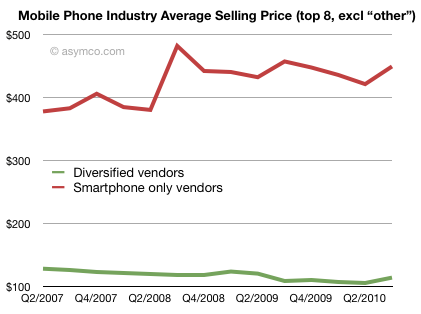
    I also showed how pricing has evolved over the last three years.

    Two days later an article in Fortune's Google24/7 blog highlighted the possible price points of low-end smartphones:

    I had a chance to speak with Jim Tran, VP/GM – Handset Line of Business for Broadcom, who was able to elaborate on the details of the new processor and what it meant for the industry.  Here are some of Broadcom's bullet points:

    The BCM2157 baseband, since it combines many functions on one chip, is able to run more efficiently, meaning less battery power will be needed than on current basic handsets

    Low-cost, low-power, 65 nm digital CMOS process means the silicon will be cheap

    The dual-core processors will run at 500-800mhz.

    Supports portable Wifi hotspot and Android 2.2 and up

    But the kicker is the price.  Tran says that phones made from the BCM2157 chipset will retail for under $100 and may dip as low as $75.  Those devices should debut in just 3-6 months (and we might hear about them next month at CES)....

    To be clear, That sub $100 price is not the cost of materials, it is the suggested retail price after the manufacturers (and carriers) have taken their profits.

    via 2011 will be the year Android explodes - Google 24/7 - Fortune Tech.

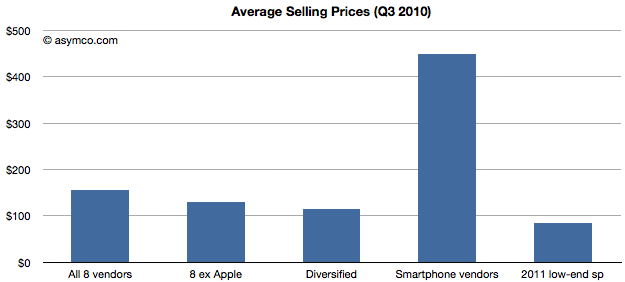
    My own data shows that the average selling price for the top eight phone vendors for Q3 of 2010 was $156. Smartphone-only vendors were charging $450 on average and diversified vendors selling both smart and non-smart phones were charging $144 on average.

    Nokia's ASP for its entire line-up was $88 (spread over about 84 million non-smart and 26.5 million smartphones).

    What strikes me about the claim from Broadcom is that a $100 retail price for a smartphone implies an ASP of about $85 or so (assuming $15 or a very modest 18% channel mark-up).

    That means that a smartphone could be built using this chip which would have nearly half the average price of all branded phones sold last quarter.

    It would also be priced cheaper than the average price Nokia charged for all its phones (75% of which were non-smart phones.)

    And this type of phone could be available not in three years in three months.

    The chart above shows how prices could collapse.

    Of course, low price is not the only condition for the widespread substitution of smart devices in vendor portfolios. But it does take away a significant objection. It no longer seems far-fetched to say that in another two years the price points for smartphones will be low enough to make them marketable in all markets. This may in fact be true next year.

    I suspect that non-branded vendors will lead the way and make these devices widely available in emerging markets. The question will then be entirely up to the branded vendors whether they will follow or will they try to market dumb phones vs. smart phones at similar price points. Will buyers opt for a branded device with no ecosystem or unbranded device with the Android ecosystem?

    It becomes harder to envision any reason why non-smart devices will earn positions in portfolios two years from now.

    Note that I'm not suggesting that the market for high-end smartphones is threatened yet--there is still a lot of innovation that still needs to happen to shape that market into one of mobile computing (vs. mobile phoning).

    Instead, what I am suggesting is that the bottom of the phone market is very vulnerable to becoming smart. This may sound like an odd sort of disruption, but it's a very sinister threat to companies who are in the business of selling brands and not platforms.

  3. Law of conservation of modularity

    Research · 32 comments

    When I applied the modularity dichotomy to smartphone operating system there were several implications that came to light. One was the question of whether the market has reached the point where products were "good enough" and the speed of innovation became less important than price. Another was: will integrated vendors be able to hold on to a healthy share of growth against non-consumption?

    Now I bring up another implication of modularity: the concept of "law of conservation of modularity".

    Clayton Christensen illustrated this as follows[1]:

    If you are writing a software application to run on top of a platform, are you permitted to modify the platform to make your application run better?

    If the platform is interdependent, changing it could cause unintended side-effects and you will not be allowed to make them. If the platform is modular, changes are possible and you will have access to the code.

    The reason is not not political. It's that in the case of interdependence, the application has to be suboptimized and conform itself to the platform so that the platform could remain optimized (to its goals). The platform needs to remain optimized is because it needs to keep improving (since it's not good enough).

    In the case of modularity, the application can be optimized and the platform can conform itself to the application because the application needs to keep improving while the platform is good enough and does not.

    Conformability is what constrains up-market progress.

    This also holds in hardware architecture. This was plainly evident in the WinTel era. During that time the microprocessor and the operating systems had a proprietary and interdependent architecture even while Dell’s product has a modular architecture.

    So the microprocessor wasn’t good enough. That meant that the desktop computer had to have a modular architecture to conform itself in order to allow this to be optimized because the line widths on the circuit were not good enough.

    This is what is meant by conservation of modularity: one side or the other of an value chain boundary needs to be modular and conformable to allow what’s not good enough to be optimized. The key question is what's not good enough: the device or the platform (the whole or part?)

    How does this apply today in the post-PC era?

    If you think about it in a hardware context, because historically the microprocessor had not been good enough, then its architecture inside was proprietary and optimized and that meant that the computer's architecture had to be modular and conformable to allow the microprocessor to be optimized. But in a little mobile computer like the smartphone, it’s the device itself that’s not good enough, and you therefore cannot have a one-size-fits-all Intel processor inside of a BlackBerry or iPhone, but instead, the processor itself has to be modular and conformable so that it has on it only the functionality that the BlackBerry needs and none of the functionality that it doesn't need (hence the ARM modular architecture is dominant). So again, one side or the other needs to be modular and conformable to optimize what’s not good enough.

    Now today (and, I believe for some time to come) in smartphones, or in any situation where logic gets embedded in a system it’s the device itself that is not yet good enough and, therefore, you cannot back off the frontier of what’s technologically possible. It has to be optimized with a proprietary interdependent architecture. That means that the processor and the operating system inside of a Smartphone has to be modular and conformable to allow that to be optimized.

    In order for you to believe otherwise you have to convince yourself that smartphones, as a system, have reached the limit of what is technologically possible.

    [1] The source is a presentation by Clayton Christensen at  Open Source Business Conference in 2004