Asymco

Asymmetric Intelligence

Samsung

  1. The near-death experience prerequisite

    Research · 3 comments

    All phone vendors saw smartphones coming.  They hired all the right market research companies and spent lavishly on analysts to confirm that phones with operating systems were imminent.

    Nokia was one of the early movers, establishing its own software platforms group as early as 2002 while others like Samsung licensed Windows Mobile or PalmOS as early as 2003. Yet not much happened to sales. The number of smartphones units sold as percent of total has been fairly low.

    The following chart shows the number of smartphones sold as a percent of all phones sold for the top three vendors (as of the time when the chart starts early 2007). Note that the percent of smart products shipped did not accelerate or grow dramatically for the largest two vendors even into last year.  It's still a pittance at Samsung (<5%) and even less at LG.
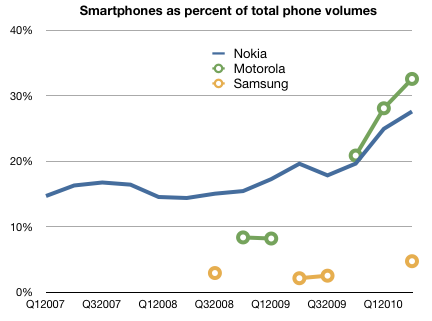
    The one vendor that did stage a shift was Motorola. (and Sony Ericsson, though later and softer) Both converts did this shift when faced with near-death experiences of sequential earnings losses and catastrophic market share collapses.

    Nokia is showing signs of a secular shift to smartphones but it's been a decade-long process so far, a slowness that ripped shareholder value to pieces.

    So is the precondition for a shift to smartphone focus a collapse in the core business?  It certainly seems so from the data. Motorola first, Sony Ericsson second, Nokia presently and Samsung and LG later.

    Each of these decision points reflect precisely the timing of pain points with the core businesses.

    Why this asymmetry? At first glance, the smartphone business should be sustaining and an attractive option to be exercised as soon as possible.  It offers better margins, better prices and a better return on capital.

    So why is there this disconnect? As regular readers of this blog can probably guess, my hypothesis is that the smartphone business is disruptive.  Incumbents are motivated to ignore this business because it makes money in ways they cannot control. More importantly, their best customers are signaling (in non-transparent ways) that they don't want their top vendors to participate in this market.
  2. Visualizing the winners and losers of three years of smartphone share growth

    Research · 2 comments

    Many consider June 2007 to have been a pivotal moment in the history of mobile phones. Apple's entry with the iPhone has re-defined the market in many ways. However, there was a smartphone market before then. About 28 million smartphones shipped the quarter when Apple launched out of an overall phone market of 265 million. Apple's entry with 270k phones was a drop in the bucket.

    I thought it would be instructive to chart what happened between that quarter, exactly three years ago and today. I collected the data from IDC, Gartner and Canalys and company reports to paint a few pictures.

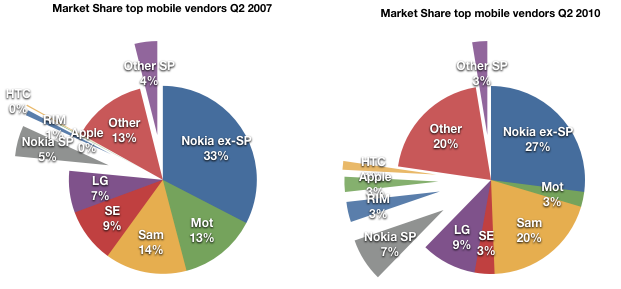
    First, the market shares (by units) of the top mobile vendors, Q207 vs. Q210. I highlighted the smartphone vendors by separating their wedges from the pie. Note that I also separated Nokia's smartphones from Nokia's regular phones as two separated wedges--Nokia ex-SP for no smartphones and Nokia SP as their "converged" units. I did the same with "other".

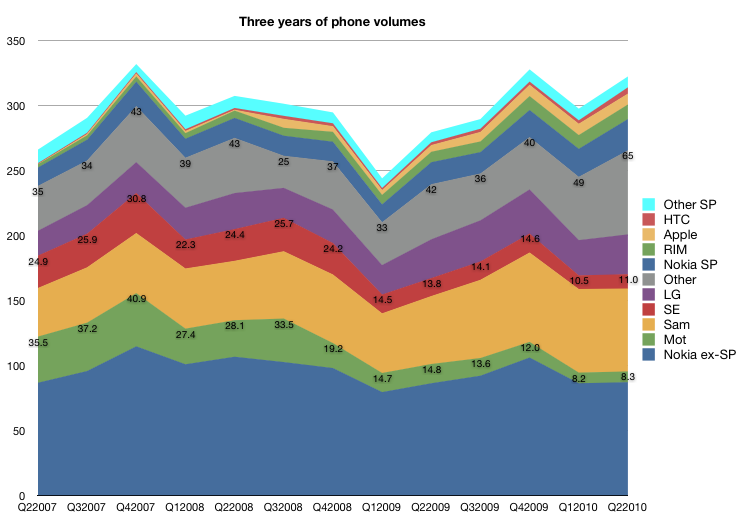
    The first thing to note (beside the large increase in smartphone share) is that "other" non-smartphones are a huge part of the pie. At 20%, the share of "other" is now equal to the share of Samsung. Other consists of a group of mostly low cost Chinese vendors. The growth of the low end "other" went from 35 million units in Q207 to 65 million in the last quarter. It's this competition that is driving profit out of the core businesses of Nokia, Samsung and LG and forcing a flight to smartphones (more about this later).

    The second thing to notice is that Motorola and Sony-Ericsson are highly visible victims of the last three years. Sony Ericsson shipped 25 million devices in Q207 and only 11 million three years later going from 9% share to 3%, on par with RIM and Apple. Motorola did even worse, shipping 35.5 million in Q207 and a mere 8.3 million last quarter, losing 10 out its 13 points of share.

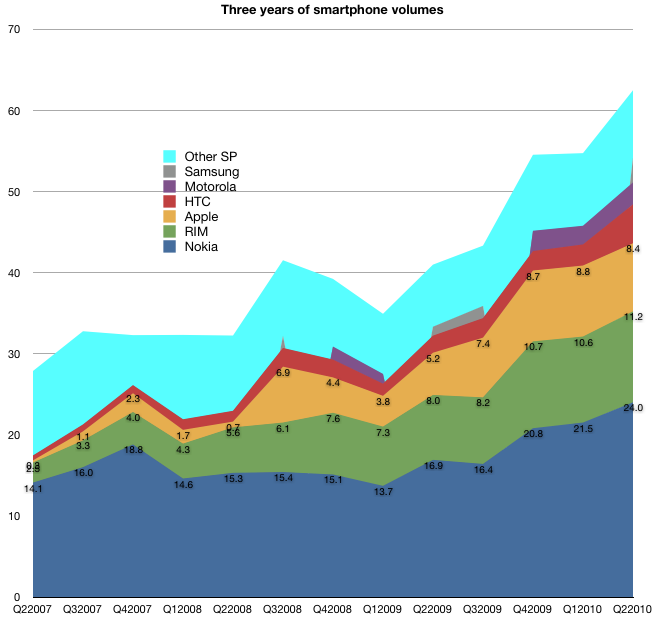
    Viewing the overall units market, one can see the gouge in units that the recession took out. The following graph shows three years of volumes by the top vendors with the smartphones separated at the top (Nokia SP, RIM, Apple, HTC and Other SP--everything above the grey band are smartphones).

    However, separating out the smartphones, one can see their volume increased with barely a ripple during the recession. Although Nokia retains the top share spot, the entrants have jointly grown much faster.  I have annotated a few of the competitors' volumes with the actual values.

    One thing to note is that "other smartphones" has traditionally consisted of Windows Mobile licensees but that is quickly shifting now to Android. I also had only fragments of data for Samsung and Motorola, so their bands are incomplete.  However, one could note how minimal their participation has been in the market.  LG has been practically absent from this market.  For these latecomers to smartphones, it's clear what Android offers: a chance to stay in the game.

  3. Bad(a)

    Research

    http://www.electronista.com/articles/09/11/09/samsung.may.deal.microsoft.severe.blow

    This prediction says that WinMo and Symbian are out at Samsung. Not a big surprise there.

    The real news is some new "proprietary" OS is to take a majority share of the portfolio moving Android out of the picture gradually after 2011.

    You will infer from my previous comments that the reason any deep pocketed vendor would shun Android is the same as why they would shun WinMo: no "control" over the whole product and hence no differentiation vis-a-vis an integrated competitor.

    The Android devotees would then have to depend on their platform reaching critical mass without Nokia, Samsung, Apple, Palm and RIM, all of which will be shipping integrated products. LG got bought off by Microsoft and they will wallow in the mire.

    Where does that leave Android? Moto and SE? They barely make up 10% of all devices and negligible smartphone share today and both are borderline going concerns.

    That just leaves HTC, which shipped 80% of all WinMo. My bet is that they will ship 80% of Android, but that still tops them out at 10% share WW.

    Looking at the platform game top-down and bottom-up you get the same story.

  4. Nokia Quarterly Results

    Research

    Nokia's latest quarterly results and forecast caused a 15% drop in the share price on a day when the S&P rose by about 1%. The drop was the largest single day change in the company's valuation since 2004. The cause for the drop was not macroeconomics or performance in the previous quarter, but the guidance provided.

    The shock was in an unchanged low margin and a flat market share. Both of these measures of performance were expected to improve as the overall market improved. What Nokia is saying, in effect, is that it will perform no better than the market average. Naturally, its value should therefore be no higher than the market average.

    The trouble is that the "market" for mobile phones is abysmally free of value and hence of profits. Taking the sum of profits for all the major incumbents (Nokia, Samsung, LG, Sony Ericsson and Motorola) we find that net profits for the entire industry are, at best, flimsy, at worst, negligible. But this begs another question: why is value missing in mobile devices--a market that seems to be growing faster than almost any other technology market?

    First a few facts:

    • Focusing only on Devices & Services, Nokia did make a net profit of EUR763 million on sales of 103.2 million phones. That's EUR 7.39 average operating profit per phone. In Q1 Nokia Devices made about EUR 6 per phone, so a slight improvement, but down from about EUR 20 a year ago.
    • Sony Ericsson entered its fourth quarter of losses.
    • Motorola entered its 9th consecutive quarter of losses.
    • Samsung and LG are at about break-even.

    So if one were to look at the incumbents, the ~1 billion phones they sell a year seem to be generating barely EUR2 per phone, most of it in the hands of Nokia.

    The exceptions are, of course, the entrants RIM and Apple with EUR 60 and EUR 120 profits respectively per phone, orders of magnitude above average.

    Nokia seems to be the best of a bad lot. Can Nokia expect to join the entrant cohort or sink with the incumbents? Answering this question forces us to go through a deep examination of what correlates with value in the new device market.