Asymco

Asymmetric Intelligence

semiconductor

  1. The great memory panic of 2026

    Research · 2 comments

    Office Hours question asked by by Ian H. on May 1, 2026

    Q: Memory prices could move from 15% to 40% of the BOM of a device. This seems incredible. So how can Apple deal with this?

    This has been on people's minds now for what, three, four months? I think since January. I call it the Great Panic of 2026. The great memory panic.

    First of all, you have to understand the scale that Apple operates at. The number of devices in the hundreds of millions. It's not just iPhones, obviously. All of the Apple products consume some memory. And there's a lead time. When you're dealing with scale, there's a lead time. There's usually a couple years of lead time. And every supplier who works with Apple is doing it because they love volumes.

    Now, volumes are good for suppliers because they can also predict things in their own operations. They can plan, they can raise capital. Usually they need loans to do that, and they get good terms on loans if it's a long-term payback. And there's a lot of moving parts there that benefit scale.

    The difference with memory pricing that we're seeing a lot of anxiety around is at the margin. That is to say, there's a base production, and then there's a variable production. That variable production comes when somebody orders, "Hey, can I have something next month?" And the smaller suppliers tend to not have that long-term planning or the volumes that can fill the pipe. And so the marginal pricing on memory has gone through the roof. It spiked, and that's what we're seeing. But that's on the variable bit.

    So Apple negotiates on the base load. Now, of course, that marginal cost is going to eventually infect, if it continues long enough, base price. In fact, suppliers are going to say, well, even if it's two years out, we're going to have to ask for more, because there's so many other players that also we anticipate will be two years out. But then Apple can negotiate on another basis and say, well, if you don't do us a favor here and give us a better rate, then maybe we won't work with you when all this settles down. You know things are going to settle down. These things are always cyclical. There's never been a semiconductor boom that's not followed by a semiconductor bust. Never. And they know it.

    So they're happy to make mint on this volatility right now. So much so that I heard Samsung's making more money now with memory than Nvidia's making with their processors. So memory suddenly is the new gold. A year ago, two years ago, it was about compute. Now it's memory. Who knows what's next?

    But if you're in this business for the long term, and you want to play games, Apple's going to be there a lot longer. You could believe that AI is going to be going at this rate forever. We'll see if the profit model can sustain it. But I just speak from experience. There's a lot of these things that happen in the phone space with all kinds of components. There were always some shortages.

    There was storage. The iPod killed a hard drive supply chain. Apple monopolized the CNC machines that made the aluminum Macs. And these things happen. By the way, that monopoly is no longer in effect. Eventually, somebody built enough of the tooling and sold them to Apple's competitors. And if they want to make an aluminum enclosure, they can do so now. But that's how it is in this game, and nobody plays it as well as Apple does.

    If you read the book on China — Apple in China — there's a lot of anecdotes about this. So I can't get excited about any of these stories about supply crunches, other than there being a windfall for somebody and an anxiety, a panic for somebody else.

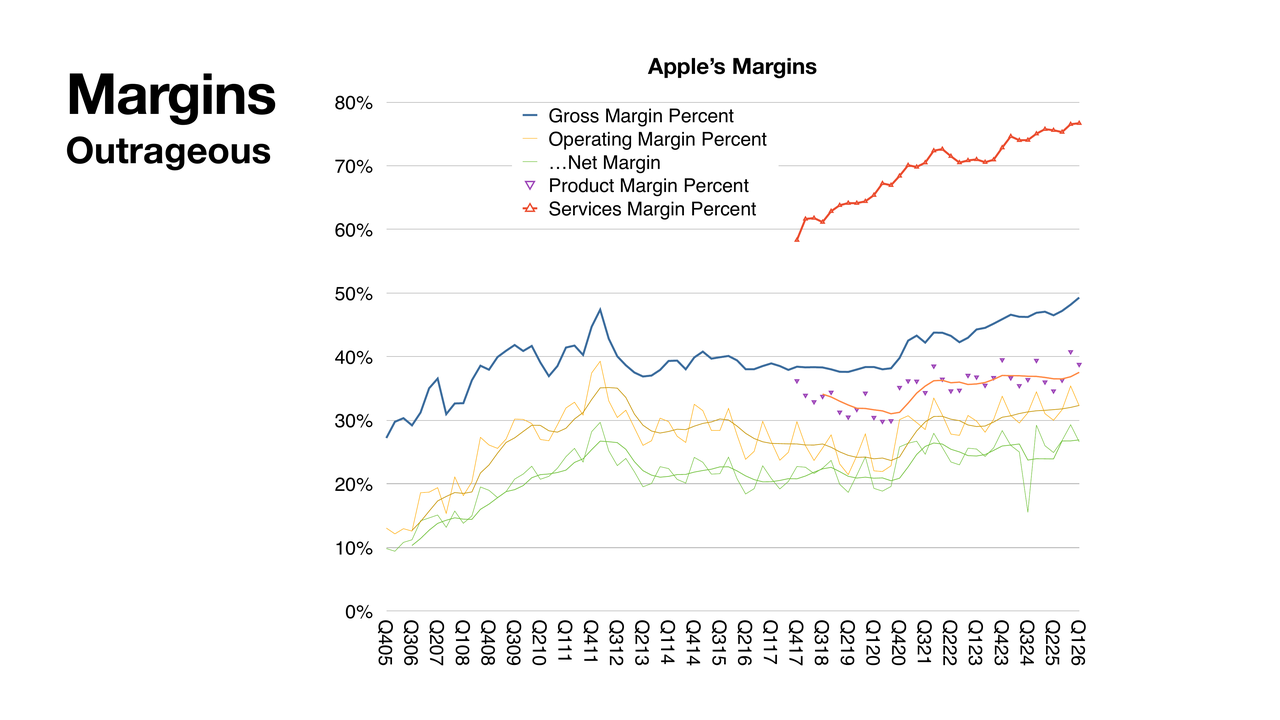
    And again, other analysts are starting to come around to notice that maybe this all settles into Apple gaining a whole lot of share, because all the other competitors won't be able to get any memory. So Apple could also just lock up everything and say, alright, we've got the biggest checkbook in the business, we'll take a hit on margins. As if we care, as if that matters. We go from 49% to 45%. Which is where we were two years ago. And then in doing so, we're going to take out everybody but Samsung. So we get in a situation where a lot of marginal players just disappear. And Apple locks up even more.

    And when you go for the jugular, you do all this, and then you launch a low-end product that's even cheaper, which is what the Neo looks like to me. I mean, Neo might be a prototype. The Neo might be John's trial balloon out there. Maybe he has a theory — I'm just speculating now — that Apple is going to go for the jugular on the iPhone in a couple of years. The iPhone's going to be $499. It'll be as good as the best iPhone today. And they're going to launch that against a landscape where everybody else is losing money at $800 a phone. And so they'll just quit.

    Now, it's uncharacteristic, but it's a low-end disruption coming from Apple. It's completely possible. It's well within their ability. And if they want to, they could. There's a lot going on here with what strategic intent is from John, and I think he comes with a fresh thinking on this. Not that Tim was unwilling, but I think he knew what works, and he was not willing to stray too far from what was reliable. And John may just think that, I know we can pull this off. And we'll go for a different way. Who knows?

    —

    This was one of the questions asked by the participants in Asymco's May 2026 Office Hours live Q&A session, open to Asymco One subscribers.

  2. Samsung's profit center

    Research · 41 comments

    Will there come a time when Samsung will earn more profits from the iPhone franchise than from its own Galaxy product line?

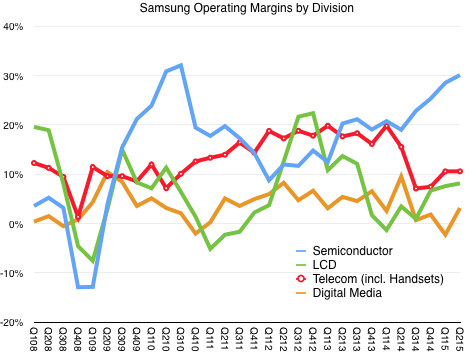
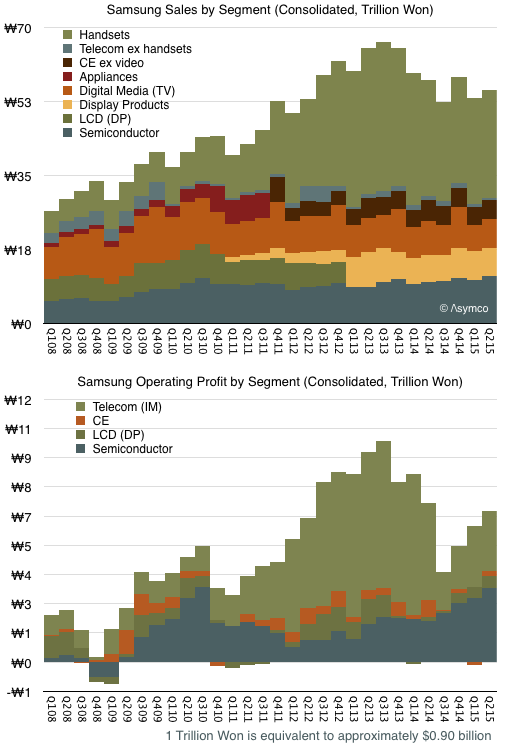
    The problem for Samsung is that although it still sells the most phones ((over 80 million but we don't have a precise figure)), and the most smartphones, the price and margins for these products are collapsing. The pattern is shown in the graphs below:

    Screen Shot 2015-07-30 at 7-30-8.20.29 PM
    Screen Shot 2015-07-30 at 7-30-8.20.22 PM

    Phone operating margins peaked in Q1 2014 at 20% but are half that level today. These margins have dropped to levels Samsung had in 2009, before the Galaxy launched and before they had any substantial revenues from smartphones.

    In contrast, the semiconductor group is growing both revenues and margins. Margins and operating profits are both 50% higher than those of devices.

    We also know that Apple is Samsung Semiconductor's single biggest customer. We can't be sure how much of the total revenue/profit comes from Apple but if the pattern continues then Apple could be the greatest contributor to Samsung's profitability in the near future.

    How could this be? Wasn't Samsung supposed to "disrupt" Apple?

    The reality is that Samsung's own smartphones are being disrupted by good-enough Android devices, typically made by Chinese brands. This low-end disruption is also affecting LG, another phone maker and Apple supplier.

    Unlike Samsung and LG, Apple is less susceptible to low-end disruption. What Apple offers is a brand promise, an ecosystem, associated products and services and what amounts to a new market. It's this parallel value network that competes with Android/Google, rather than with Samsung.

    Samsung is a supplier in the Apple network and a licensee in the Google network. As a result, it has a near monopoly position with a platform controller (Apple) and a commodity position with a platform licensor.

    Neither position is one of control, but the current market stage benefits Samsung within the Apple ecosystem more than  in Google's ecosystem. It's a situation analogous to one where Intel made both x86 chips and PCs that ran Windows. Long term it's likely that the sole-source chip business does a lot better than the multi-source systems business.

    That should be a warning to others who hoped to survive as Android OEMs. They don't have semiconductors to sell to Apple.


  3. iPhone, killer

    Research · 253 comments

    Screen Shot 2015-05-13 at 5-13-8.20.01 AM


    Searching for "iPhone killer" returns millions of hits. It's hard to remember any phone/product/service/platform/initiative/merger/startup which was not at some point considered an iPhone killer. A sampling is offered here.

    In reality, the killers seem to have all faded away while the iPhone continues. We could just shake our heads and move on, but a deeper analysis is possible. Take a look at the graph above. Note that iPhone's (and hence Apple's) ascent has not caused decline in its nominal competitors. When seen in the context of the graph above, the success of the iPhone has in fact been complementary to those companies who would be its killers.

    Consider that the iPhone drives a large portion of Google's revenues as it is the home to many Google services and engagement through the iPhone is higher than any other platform, including Google's own. iPhone users tend to make better customers. In exchange Google pays a great deal for traffic acquisition on iOS devices. The placement of search on Safari is probably the biggest single cost item on Google's income statement ((Estimates are a few billion dollars a year.))

    The iPhone example drew Google to build Android as a facsimile and that, coupled with Brobdingnagian spending on marketing, led to Samsung's Galaxy success. That success seems to have peaked and the brand is now a victim of low-end disruptors which copied it and the iPhone in turn. However, Samsung electronics benefits from the iPhone in terms of its semiconductor division. Apple is Samsung's biggest customer and the semiconductor division is now the largest source of operating profits.

    The explosion of Android has led to IP licensing revenues for Microsoft and now Microsoft is extending its software applications to iOS, hoping to participate in the iOS ecosystem rather than competing with it. The time may come when Microsoft shows growth from the iPhone.

    Finally, although it may seem oblique, Amazon is benefiting from the iPhone. Instead of killing it with the Fire ((presumably as a low-end disruption)), the iPhone and iPad offered much more mobile shopping opportunities to the Amazon store. Data shows that iOS leads in shopping traffic and order size precisely at a time when Amazon obtains its largest volumes. Amazon's AWS also handles a great deal of iOS-originated traffic.

    This alternate reality shows that the benefits from the iPhone revolution are broad and deep. It's not just the direct revenues (($25 billion paid so far)) from app sales on the App Store but also the creation of entire new communications modalities (Instagram, Snapchat, WhatsApp) new services (Uber, Airbnb) and the multi-billion dollar accessories markets. These benefits are largely unmeasured and therefore not visible in accounting systems. They are perceivable however.

    Users perceive the value, developers perceive the value and, in the end, the only account that matters, the brand, accrues these perceptions to grow in value.

    As the brand flourishes, the perception of vulnerability dissipates and the narrative shifts from Apple getting killed to killing it.

    It's taken eight years and 500 million loyal users but, perhaps, just perhaps, this change in perception is entering the collective consciousness.


  4. In the weeds

    Research · 55 comments

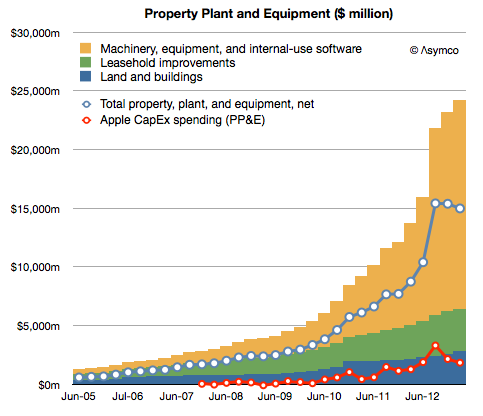
    Although discussions related to how Apple will "use its cash" center on acquisitions of companies, Apple's has been busy acquiring, just not companies. It has been buying capital equipment. Capital meaning (in the original sense of the word[1]) the means of production.

    Since the launch of the iPhone Apple has spent $21.1 billion on the acquisition of property, plant and equipment. The company has already stated that they will spend another $10 billion or so for the current fiscal year. This has been mostly machinery and equipment used in manufacturing.

    The result in asset value is shown below:

    Screen Shot 2013-05-30 at 5-30-6.29.53 PM

    [The Net value, shown as a blue line, is after accumulated depreciation. The red line represents spending as reported on the cash flow statement.)

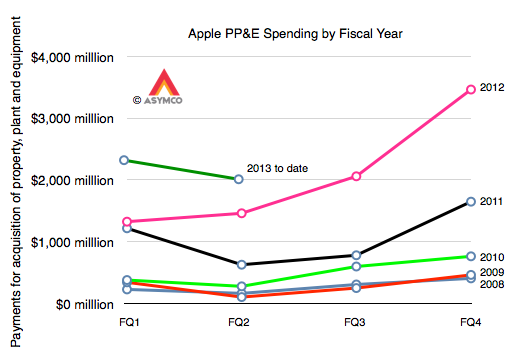
    The change in spending year/year (fiscal) is shown in the following graph:

    Screen Shot 2013-05-30 at 5-30-6.31.27 PM

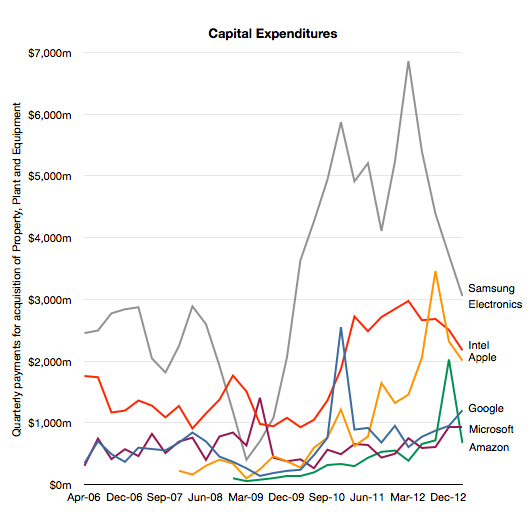
    So these are very large numbers, even compared to other capital-intensive semiconductor manufacturers:

    Screen Shot 2013-05-30 at 5-30-6.48.22 PM

    Given this enormous spending one could imagine it's the subject of intense scrutiny. However the only question on the subject that I've ever seen was from Steve Milunovich of UBS to which Peter Oppenheimer, CFO offered an explanation:

    Steve Milunovich - UBS
    …second question would be on CapEx, you spent almost as much Intel does. I think you guys have said you’re not going to become vertically integrated per se but in a sense you are since [you buy] equipment for your partners, could you talk about the strategy here and how much of a differentiator this gives Apple in terms of your ability to ramp new products over time? And maybe a little bit more about how deep you will go in terms of semiconductor components for you, etc.?

    Peter Oppenheimer - Chief Financial Officer
    Sure. Steve it’s Peter. We expect to spend about $10 billion in CapEx this fiscal year that will be up little under $2 billion year-over-year. We expect to spend a little bit under $1 billion in the retail stores. And the other $9 billion is spent in a variety of areas. We are buying equipment that we will own that we will put in partners’ facilities. Our primary motivation there is for supply, but we get other benefits as well. We are also adding to our datacenter capabilities to support all the services that Tim spoke about in answering Ben’s question and in facilities and in infrastructure. So, that’s where the capital is going.

    I would say that this is not a very satisfying answer, which is why I thought it merits further questioning[2].

    Alas, no.

    Whereas there is a constant clamoring for Apple's to use its cash to "acquire" or "buy" something, anything, maybe people not looking hard enough. If you need the satisfaction that comes from knowing that money is being spent, a glance at the Cash Flow statement and Balance Sheet shows that Apple buys the equivalent of one Yahoo! every three years[3].

    The main difference with this type of acquisition is that there is less value destruction. Using the capital to ensure access to capacity, differentiation and hence a high margin is better than writing off the goodwill after a few years.

    --

    1. The term capitalism, in its modern sense, comes from the writings of Karl Marx
    2. I am prepared to be alone in this quest as it seems to merit no mention from others
    3. or 10 Tumblrs every year
  5. My questions for Tim Cook

    Research · 253 comments

    Next week at AllThingsD's D11 conference in LA, Apple CEO Tim Cook will be interviewed by Kara Swisher and Walt Mossberg.

    Here are some questions I'm hoping they will ask:

    1. Why is the iPhone not sold as a portfolio product? Meaning, why, after six years, is there no iPhone product range being updated on a regular basis. Having a portfolio strategy is not only followed by every phone vendor but also by Apple for all its other product lines, including the iPad, which came after the iPhone. In other words, please explain why the iPhone is anomalous from a product portfolio point of view.
    2. There are more than 800 operators world-wide so why are there only about 250 of them carrying your phone? Competitors large and small (from BlackBerry to Nokia to Samsung) have cited relationships with more than 500 operators so Apple is being uniquely selective. My question does not stem from a lack of patience: this total number of iPhone distributors has not increased markedly for over a year. Are you limiting distribution through conditions placed on operators (like the availability of sufficient quality data services) or are operators finding the distribution agreement too onerous (e.g. too high a minimum order quota)?
    3. In 2012 Apple's capital spending has reached the extraordinary level of $10 billion/yr, higher than all but the most capital-intensive semiconductor manufacturers. This is unusual for Apple as it was less than $1 billion in the year before the iPhone launched. It's also unusual for Apple's competitors in phones, PCs or tablets. It's on a level matched only by semiconductor heavyweights. What is the purpose of this spending and what should we read into it leveling off at $10 billion for 2013?
    4. Depending on one supplier is an operational faux pas, and yet Apple has found itself in that situation with Samsung for mobile microprocessors. It may be excusable in PCs with Intel having an architectural monopoly but it's not excusable for a chip that you designed yourself and purchase in massive quantities. Why did you give Samsung such a concession, especially knowing their potential as a competitor vis-à-vis alternative suppliers who had no such potential? Does the answer have something to do with the previous question?
  6. The cost of building Galaxies (and iPhones)

    Research · 33 comments

    Although Samsung and Apple are acclaimed as the leaders in profit capture for smart (and otherwise) phones, what is not lauded is how much they spend on capital equipment used in the making of these phones.

    In 2012 Samsung spent around $20 billion while Apple spent about $10 billion (excluding leasehold improvements or Apple stores but including real estate).

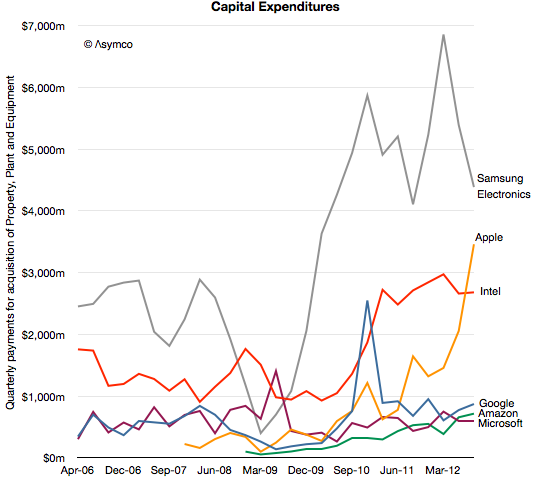
    Compare these figures with Intel at $11 billion, Google at $3.2 billion, Microsoft about $2.8 billion and Amazon $3.8 billion (including presumably new distribution centers.)

    Screen Shot 2013-04-04 at 4-4-5.51.15 PM

    What each company spends on differs depending on its business model, but as the graph above shows it's easy to see that there is a class of "big spenders" who spend so much that it makes it hard to imagine just what $10 billion/yr could actually buy.

    To get an idea of just how big that figure is consider that a Nimitz class aircraft carrier costs about $4.5 billion to build and it takes several years to do it. Or consider that the largest data center in the world probably costs about $1 billion or that the largest office building will cost between $4 and $5 billion. Either of these infrastructure projects are massive multi-year projects. Apple, Intel and Samsung spend well more than this every six months.

    So it's a special class of equipment which falls in the multi-billion dollar range: semiconductor process equipment.

    Whereas in the case of Intel it's the obvious target for the funds, how can we assume it's the case for Apple and Samsung.

    We don't have proof but there is a remarkable correlation between CapEx and Semiconductors in Samsung's divisional financial reports:

    Screen Shot 2013-04-04 at 4-4-5.58.22 PM

    We also have the historically reported allocation of CapEx as reported prior to 2008:

    Screen Shot 2013-04-04 at 4-4-6.00.26 PM


    Therefore I consider it safe to assume that the bulk of Samsung's Capital Expenditures are in support of semiconductor production (note that this does not include display panels).

    Note however that in the first graph, Samsung's expenditures seem to be declining. Measured in Won, the level in Q4 '12 was about the same as that in Q1 2010 and down 30% y/y. Apple's spending also dropped sequentially in Q4 but was up 75% y/y. It's also nearly ten times higher than what Apple spent in Q1 2010.

    So the question I would ask is whether Samsung's reduction CapEx (which is safely assumed to be supporting semiconductor production, and which, in turn, is, to a large degree, supporting Apple) is being picked up by Apple.

    If so then then this would be evidence of the re-alignment of role and control in the value chain of a terribly important industry.

  7. The new age of Capital Intensity

    Research · 117 comments

    In the post reviewing Samsung's Capital Structure I noted that its component divisions have historically taken 90% of capital investments and that the overall capital intensity for Samsung Electronics has increased in proportion to its component revenues.

    In another post regarding the capital structures of other technology companies with different business models I noted that Apple has changed its capital structure to a significant degree over the previous three years.

    In the following graph I combined these observations to show how capital expenditure patterns may be used to discern the underlying business model.

    I would group "cloud" or "platform" based companies like Google, Amazon and Microsoft as a cohort which, although spending significant amounts on capital equipment, do so mainly to support services. Their primary employment of capital is to sustain the infrastructure of data centers necessary to deliver the services underpinning their business models.

    I would group Intel and Samsung as "component" based companies which use capital to build production capacity that delivers, hopefully, a control point in the value chains they participate in. Note that I am assuming that Samsung Electronics' CapEx primarily targets semiconductors and displays as it did during the 2006 and 2007 period when data was available.

    Therefore, given the patterns over the last six years, it might be possible to classify a company's core business by just looking at its CapEx: The services group showing growth but relatively stable patterns and the components group showing more volatility, macroeconomic sensitivity and an overall higher level of spending, especially as a percent of sales.

    The question that pops up then is in what category does Apple fall?

    My observations for over a year have been that Apple is increasing its capital spending to such a degree that it is neither fish nor fowl. It operates data centers but presumably does not operate fabrication plants. And yet it spends more than Intel and Google combined.

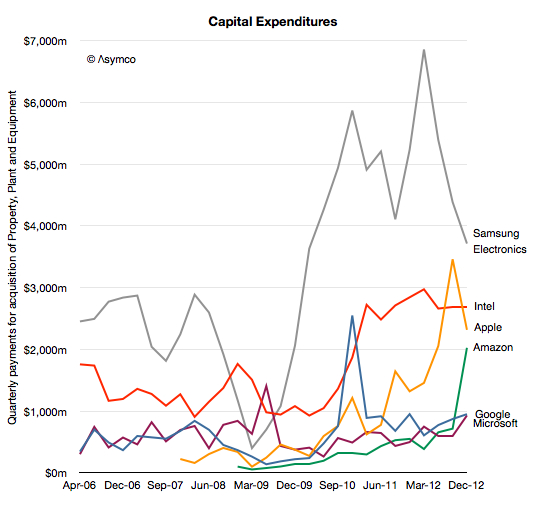
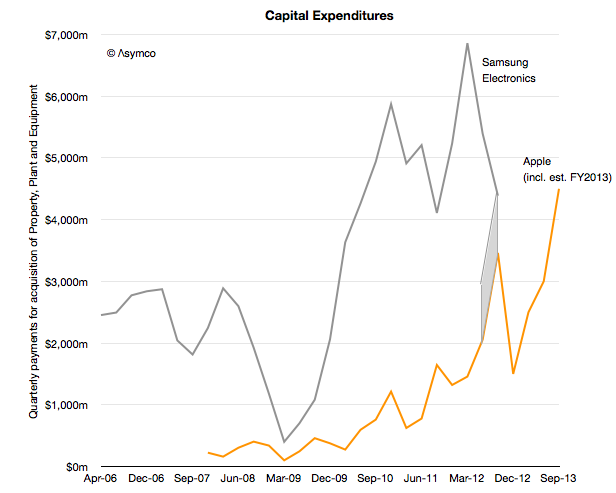
    Contrasting Apple and Samsung Electronics tells an even more interesting story. In the following graph I've added two additional items of information: First, although CapEx spending is recorded in the cash flow statement, Apple reported in its yearly (10K) report that it spent an additional $2 billion for equipment which did not pass through cash flow.

    If we were to add $1 billion to each of the previous two quarters, the graph would look like this:

    The second piece of information is that Apple projected its spending for the following fiscal year. I've added that spending in a pattern matching the last fiscal year.

    Apple is still spending less than Samsung. In its fiscal year 2012 Apple spent about $10 billion while during the same time frame Samsung spent nearly $22 billion. However, Apple has begun to bump against Samsung's spending level on a quarterly basis.

    I consider this extraordinary evidence of an extraordinary shift in strategy.

    For a year we've been debating here to what degree Apple has a "capital intensive" business and what exactly could it be spending capital on. One early hypothesis has been that it's on data centers or on real estate for spaceship campuses. These can be easily dismissed on the knowledge that they can't cost that much (and that the spending happens gradually). Another hypothesis is that the tooling for milled aluminum cases and other mechanical components is expensive and Apple has to buy a lot of it. But, again, the level of expenditure is in the league of Intel and Samsung which make vast quantities of semiconductors in very expensive plants. It's hard to imagine milling machines being cost equivalent to chip foundries.

    The comparison with Samsung, whose vast capital commitments are legendary and are its primary strategic asset puts Apple in a new light. Perhaps we can't yet call Apple a semiconductor company or even a fabricator but they are putting their "money where their mouth isn't". We can infer that it's not going where the company currently operates. The capital is being deployed almost silently and, though vast in scale, barely gets a mention from analysts. Not even a single question has been raised at any earnings call about this spending.

    So what tale does this capital tell?

    One interpretation is to apply the value chain disruption theory and ask whether Apple is acting to counter a potential disruption. In other words, that this is a specific threat response from an incumbent. There is some logic to this because  the antagonism between Samsung and Apple is so strong that it might justify a reaction of this kind.

    However, I believe that there is a more measured process at work over a long period of time. The one distinguishing advantage and attribute that Apple has  is its preference for integration. This preference is not a secret and Tim Cook repeats it often. The integration is evident with their move into retail and component design, in other words in both directions along a value chain. So my hypothesis is that this is part and parcel of an ongoing re-alignment of their role in the value chain.

    This second explanation suggests that Apple simply wants to control all the areas which affect the value they produce. First because they feel that there are areas that are not good enough and the product/experience cannot be good enough if its constituent parts are not good enough. Second because without control there are constraints to what it can do strategically.

    Whatever the reason, I read the evidence of increasing commitment and engagement in parts of the value chain as part of a continuous evolution of Apple's role. Furthermore, it's something that should be seen as a signal of a new era in how technology companies operate. We see hints of "vertical integration" with Microsoft building hardware, and Google buying Motorola and Amazon selling devices. Apple did all these things and now it casts an eye over the next frontier: components.

    ---

    If you want to learn more about the future of the technology industries and the evolution of value chains, consider participating in Asymconf.

  8. Samsung's Capital Structure

    Research · 28 comments

    Having described the Revenue, Operating Margin and cost structure for Samsung Electronics it's time to review their investment strategy.

    The Economist summarized it well:

    [Samsung's] businesses look remarkably disparate, but they share a need for big capital investments and the capacity to scale manufacture up very quickly, talents the company has exploited methodically in the past.

    Samsung's successes come from spotting areas that are small but growing fast. Ideally the area should also be capital-intensive, making it harder for rivals to keep up. Samsung tiptoes into the technology to get familiar with it, then waits for its moment. It was when liquid-crystal displays grew to 40 inches in 2001 that Samsung took the dive and turned them into televisions. In flash memory, Samsung piled in when new technology made it possible to put a whole gigabyte on a chip.

    When it pounces, the company floods the sector with cash. Moving into very high volume production as fast as possible not only gives it a price advantage over established firms, but also makes it a key customer for equipment makers. Those relationships help it stay on the leading edge from then on.

    The strategy is shrewd. By buying technology rather than building it, Samsung assumes execution risk not innovation risk. It wins as a “fast follower”, slipstreaming in the wake of pioneers at a much larger scale of production. The heavy investment has in the past played to its ability to tap cheap financing from a banking sector that is friendly to big companies, thanks to implicit government guarantees much complained about by rivals elsewhere.

    Can we find evidence of this capital intensity?

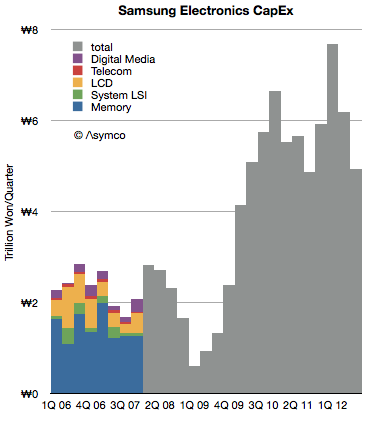
    To answer, I reviewed Samsung Electronics CapEx as reported in their quarterly cash flow statements. The following graph illustrates the data:

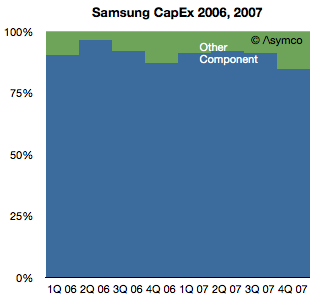
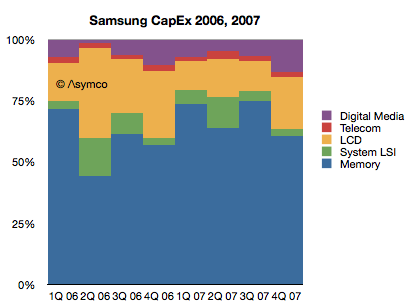
    Note that during 2006 and 2007 the company specified expenditures on an operating divisional level. Since 2008 it has reported only a total. For the years where divisional detail is available, the percent split looks as follows.

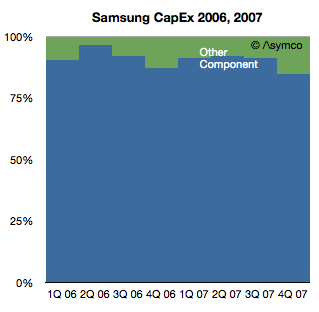
    If we combine the Semiconductor division (Memory and System LSI) with the LCD group and classify this as "components" the split looks as follows:

    Therefore, for the two years when information was available, the component divisions consumed 91% of expenditures and Consumer Electronics (Digital Media) together with the Telecom (mobile phones, mainly) were a combined 9%. The least capital intensive division was Telecom, the mobile phone group, with only a 2% allocation of capital.

    The other observation is that, after a contraction in the recession years of 2008 and 2009, CapEx expanded greatly in 2010 and 2011. [1]

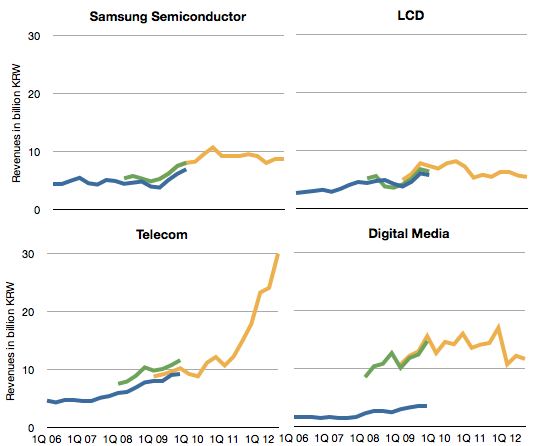
    Coincident with the growth in CapEx, the company's revenues grew dramatically as well. However, as the graphs below show, the growth has come predominantly from the Telecom division.[2]

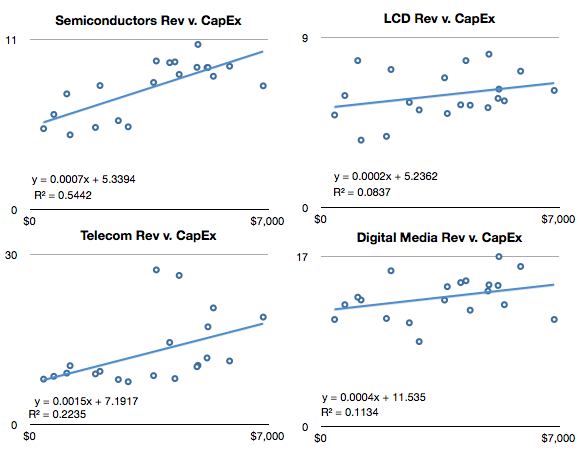
    I calculated the correlations between each division's revenues and the growth in CapEx (total) for the time periods 2006 to present and 2008 to present and obtained the same results: The division with closest correlation to CapEx remains the Semiconductor group.

    This stands to reason. Capital expenditures are mainly in the service of semiconductor manufacturing. Semiconductors, or components in general, require more capital than assembly of devices or consumer electronics.

    However, the revenues and operating income for devices have grown far faster. Samsung's investment in capacity would have been largely profit-free had they not also been assembling the devices which capture the margins.

    One might conclude that Samsung would be better off abandoning its capital-intensive components business and focusing on the devices. However, as James Allworth points out if you only do the devices, you may find yourself vulnerable to value chain disruption. Whoever is involved "upstream" in the value chain will inevitably learn the device business from a base of "commodity" manufacturing and pose a threat.

    Now the question poses itself: Which of the usual suspects understands this?

    Stay tuned for evidence of an incumbent response.


    If you want to learn more about the future of the technology industries and the evolution of value chains, consider participating in Asymconf.

    ---

    Notes:

    1. Some of this growth is due to a new (K-IFRS) accounting standard in use after 2010, but the expansion was significant regardless.
    2. The revenues data is was reported using three different accounting methods and each is shown with a different line color: Blue is "Parent basis", Green is "Consolidated basis" and Yellow is "K-IFRS".
  9. Samsung Electronics Segment Revenues and Operating Income in Context

    Research · 42 comments

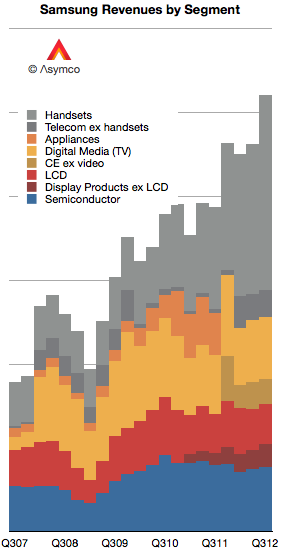
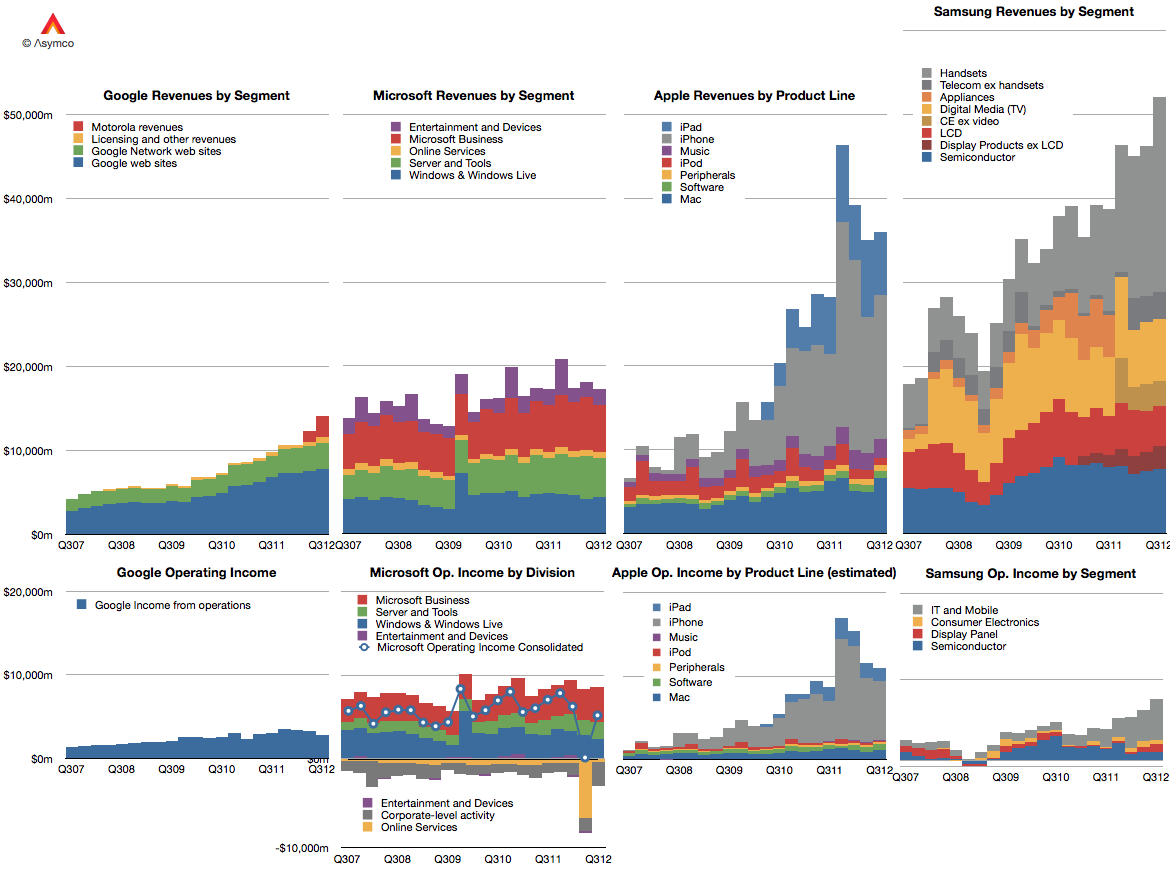
    As first introduced last week, Samsung's revenues have grown primarily due to the expanding volumes of smartphones. In today's post I convert the revenues and operating incomes to US Dollars and compare them to a set of companies.

    First, I should note that Samsung has changed both the designation of its divisions and the way it reports revenue. Broadly speaking, Samsung Electronics has four major divisions:

    1. Semiconductors. This includes memory products as well as systems such as CPUs.
    2. Display products. This used to be called "LCD" but has been re-named Display Products.
    3. Telecom. This is mainly mobile phones but includes additional products and services for telecom operators and PCs. The division has recently been re-named IM (IT and Mobile communications).
    4. Consumer Electronics. This group has changed names from Digital Media and Appliances to CE. The majority of sales value comes from televisions but also includes consumer electronics and appliances.

    The company further combines Semiconductors and Display Products into a group called DS (Device Solutions) and Consumer Electronics and IM into DMC (Digital Media & Communications).

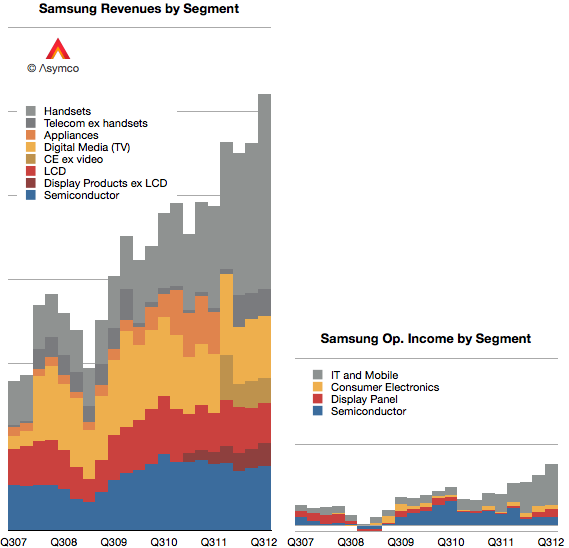
    I tried to reconcile these various nomenclatures with color coding in the following graph. Semiconductors are blue, Display components are red, Consumer Electronics are Yellow and Mobile are grey.

    Each gridline represents $10 billion.

    One more point to note about revenue recognition: Relatively recently the company has switched from reporting consolidated revenues to gross revenues. This means that current sales include inter-segment sales. So, as much as it is possible, the data above shows sales from division to division as well to external customers.

    When it comes to reporting operating income, the company offers four segment values: Consumer Electronics (Appliances, TV, "Digital Media"), IT and Mobile (including mobile phones), Display Panel (formerly LCD), and Semiconductor.

    I used the same color coding to show the income values in the same scale as the graph showing income:

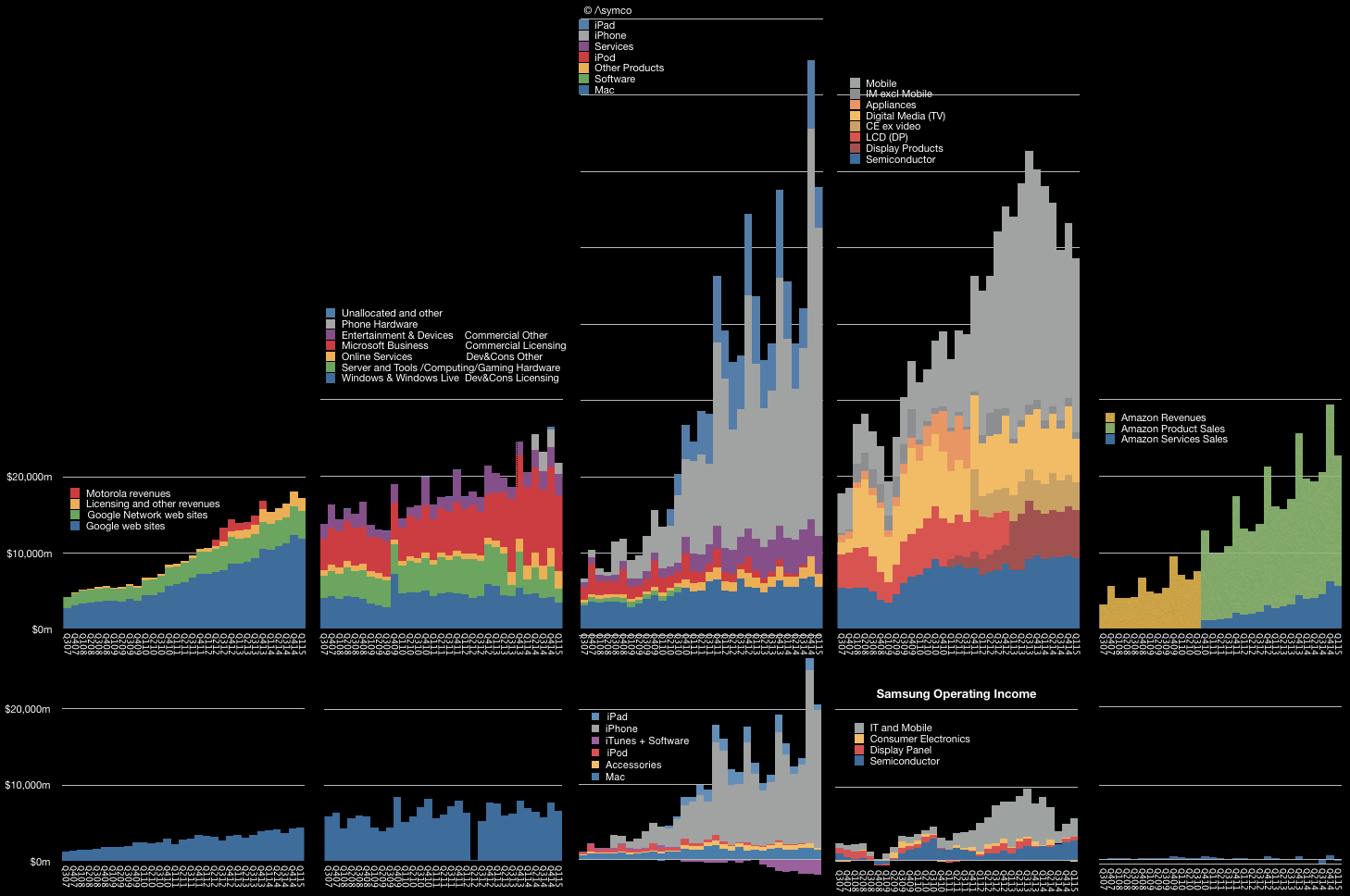
    It's now possible to compare Samsung Electronics with Google, Microsoft and Apple in terms of divisional (as a proxy for product-line) revenue and profitability over a five year period.

    At this time, a portion (majority?) of Samsung's grey area in the operating income graph represents the vast majority of profits obtained from Android across the entire ecosystem.

  10. The parable of the transistor

    Research · 6 comments

    This weblog could be read as a diary of the disruption of the mobile industry. There is lots of topical analysis and opinion, but sometimes I'll post on the "theory" which describes what's going on in a more abstract, and long-term, level. Theory is like a bullion cube: savory, but too concentrated to be enjoyed undiluted. For this reason, the most palatable way of administering theory is through example. So we kick off with an example of what happened to another technology industry as a result of the emergence of a disruptive technology.

    The following is a draft article I wrote describing the "electronics industry" for POSTWAR AMERICA: AN ENCYCLOPEDIA OF SOCIAL, POLITICAL, CULTURAL, AND  ECONOMIC HISTORY. It is itself based on a presentation by Clayton Christensen at the Open Source Business Conference in 2004.

    ----

    The consumer electronics (CE) industry began in 1920 when radio broadcasting commenced in the United States. Radio technology sustained a growing electronics business throughout the 1930's and 1940's, however, the electronics industry underwent a major transformation after the war. The critical development came after 1948 when the transistor was first invented. The transistor and the subsequent development of solid-state semiconductors dramatically and profoundly changed the industry. The change the transistor brought was not just evident in measures of technical performance but also in the economics of the industry and the business models required of its participants

    "Electronics" has a precise definition: technology based on the controlled flow of electrons. Prior to the transistor, the control of electron flow in a system was through a component called the electron tube (or vacuum tube). The tube in its simplest form is a gas-filled glass cylinder, much like an incandescent light bulb, with two electrodes or terminals inside. When the negative terminal is heated it emits a cloud of electrons which the gas inside the tube carries to the positive terminal. This device allows current to flow in only one direction since the positive terminal is not capable of emitting electrons. It is called a diode and is simply a one-way current or conduction valve. Hence the "semi" in semiconductor. Semiconductors can be designed into complex products that amplify, store and communicate; the core applications of CE devices.

    The transistor is significant because it is a "solid-state" semiconductor. Solid-state means that it is composed of solid components, unlike tubes which required a sealed gas to operate. The consequence of this shift from gas to solid components completely changed the industry and created unforeseen growth, wealth and societal change.

    NEW ECONOMICS

    The invention of solid-state semiconductors allowed new economies of production: components were smaller, cheaper and could be produced with a process closer to printing than to assembly manufacturing. Because of the subsequent advances in assembly, the cost of electronics products decreased even as quality and reliability increased. Power requirements and physical dimensions were also reduced, allowing greater portability.

    These implications might have seemed foreseeable to the engineers and businessmen of the 1940s who first looked at a transistor, but what happened is something completely unexpected: almost all the companies dominant in the electronics industry in the 1940s and 1950s who spent huge fortunes to perfect the transistor for their products went out of business or withered away to insignificance. New, giant CE companies emerged in Japan who perfected new product categories rather than challenge the incumbents and their existing products.

    The emergence of Japan as a powerhouse of CE has been debated as a motivation for changing US industrial policy toward a more interventionist model. Transistor technology was seen as a strategic national defense asset and the innovations and production associated with it were not to be allowed out of US control. Additionally, American politicians argued the case that it was US taxpayer-funded defense, educational and space efforts which produced these innovations, hence they "belonged" to the United States government, and future innovation will similarly need taxpayer funding. Unless something is done, Japan would dominate American industry.

    What happened in fact was far more mundane. The transistor disrupted the industry. Small upstarts were able to take the invention, wrap a new business model around it that motivated the current players to ignore or flee their entry. They thus successfully displaced the entrenched incumbents even though the incumbents were investing heavily in the technology and the entrants weren't.

    THE INDUSTRY THAT EMERGED

    The postwar half-century began with the radio as the center of the CE world. It ended with the television dominant, alongside a whole galaxy of mobile devices.  All employed the transistor, which itself underwent dramatic increases in power and equally dramatic decreases in size. Some of the significant breakthroughs along the way are listed in Table below. Note in the table the absence of any companies which dominated the CE industry before the transistor (RCA, GE, Zenith, Westinghouse, Philips, Magnavox, Curtis-Mathes, ITT, Packard-Bell, Philco, Siemens, Sylvania, Western Electric).[3]

    • 1957 Sony TR-63 Transistor Radio. Portability enabled privacy which allowed young people to listen to Rock-n-Roll.
    • 1960 Sony portable TV. Made a second television in the bedroom possible.
    • 1962 Sony CV-2000, first home videotape recorder. The concept of "time-shifting" was born.
    • 1970 Olympus Zuiko Pearlcorder Microcasette recorder. Audio recording became a discrete affair.
    • 1972 Pulsar Quartz Digital Watch. Quartz meant cheap but accurate watches for everybody.
    • 1972 HP-35 Pocket Electronic Calculator. The end of the slide-rule.
    • 1976 Atari Pong Game. A new use for TV: interactive games.
    • 1976 JVC HR-3300 VHS VCR. Mass-market cartridge-based video recording. Video rentals took off.
    • 1977 Atari 2600 Game Console. Game cartridges added a new category of content consumption.
    • 1979 Sony Walkman. Portable high fidelity music for your ears only.
    • 1980 Sony Boom Box. Portable high fidelity music for you and your neighborhood.
    • 1983 Sony CDP-101 CD Player. Loss-less audio reproduction for all.
    • 1984 JVC Camcorder. Home videos were born.
    • 1986 Motorola Bravo Pager. Contact somebody even if they are not near a phone.
    • 1996 Toshiba SD-3000 DVD Player. Loss-less video reproduction for everybody.
    • 1998 Nokia 5100 mass-marketed phone. Easy to use, customizable cheap mobile phone.
    • 1998 Diamond Multimedia Rio. Mobile digital compressed music consumption.
    • 1999 Tivo Series1 Digital Video Recorder. Skip commercials and freeze real-time video.
    • 2001 Apple iPod. All your music with you all the time.

    DISRUPTIVE IMPACT

    When the transistor was introduced in the late 40s and early 50s, most designers considered it inferior to existing vacuum tube technology as far as performance was concerned; transistors could not handle the power that was required to be used in the main CE products popular at the time, notably, the big tabletop radios and floor standing televisions. The transistor could not amplify sound as well as a tube, but it was small, solid, and used low power. Therefore, RCA, Zenith, and Westinghouse looked at the transistor as a electronics component with great potential, but one needed to be improved to match the tube as an amplifier before it could be used as a substitute.

    Every CE company was required to receive a license for the transistor from its creator AT&T, before they could put it in their products. But they took out these licenses in order to experiment with the new technology, hoping they themselves could improve it sufficiently for use in the CE products.  Altogether, these CE companies spent an aggregate $2 billion (in today’s dollars) trying to make solid-state electronics good enough that they could make popular high-end CE products with them.

    And while tube companies were trying to fit the transistor into large products, other companies, especially in Japan, were developing the first transistor-based products.  One critical one was a transistor hearing aid, first marketed in 1952. While hearing aids were a tiny market in comparison to radios and televisions, it was a market that valued the miniature size and low-power requirements of the transistor. In 1955, Sony introduced its first pocket radio. The sound quality and reception of those radios was very poor relative to the "console" systems available in living rooms. But Sony chose to sell the pocket radio to teenagers. Teenagers were delighted to have a product that was inexpensive and that they could carry with them, allowing them to listen to the rock and roll music their parents may have disapproved of.

    Thus, a booming new market emerged based on a hitherto neglected feature that transistors made possible: portability. Meanwhile, the existing big American CE companies felt no need to change their business plans because the new products, in their opinion, were going to new customers not existing customers. Had Sony tried to sell its pocket radio to the parents, the product would have been judged to be inferior because they had the alternative of a high quality vacuum tube radio in their homes. Then in 1959, Sony introduced its first portable television, and again, the portable television was marketed to a whole new cohort of consumers who could not afford expensive, tube-based consoles. Since the alternative for these consumers was no TV at all, they were willing to accept a product with a somewhat inferior picture and reception.

    By the 1960s, solid state electronics had become capable of handling the power required to make larger CE products, making it possible for the big American CE companies to incorporate solid state electronics in the big home products area that they dominated.  And, indeed, by the end of the decade all of the products for the mainstream living room market were using solid-state semiconductors. However, they were largely being made by Japanese companies. The Japanese perfected the semiconductor components through their foothold markets to such an extent that the American offerings were not nearly as good. The venerable vacuum tube companies were doomed.

    THE CYCLE REPEATS

    The table ends with four company names that are distinctly non-Japanese. The phenomenal process of innovation-based disruption is under-way again. This time, the incumbents are the same Japanese companies that used the transistor to disrupt the previous incumbents while the new entrants are small companies focused on microprocessor-enabled digital media or communications. In a cruel irony, the incumbents framed the innovation of digital media products as not good enough for the living room while the entrants saw it as good enough for a new, non-consumptive mobile or time-shifted usage. The existing customers saw the digital products as inferior while the new customers saw portability as a fair trade-off for quality.

    A future article will discuss how the telecom industry saw voice mobility as sustaining but data mobility as disruptive.
    ----

    REFERENCES

    1. Electronics (2nd Edition), Allan R. Hamley, Prentice Hall, August 3, 1999.
    2. The Innovator's Solution, Clayton M. Christensen, Michael E. Raynor, Harvard Business School Press, September 2003.
    3. "The Top 100 Gadgets of All Time", Chris Null, Mobile PC, March 2005.
    4. Sony, John Nathan, Mariner Books, April 2001.
    5. The Road Ahead, Bill Gates, Nathan Myhrvold, Peter Rinearson, Viking Press, November 1995.