In the second part of our WWDC wrapup, we delve into the large-scale shift represented by iOS 7. Siri guides us on the journey from navigation to consumption in our latest AsymCar segment, and Horace examines what iWork for iCloud means.
A few years ago, around the middle of the last decade, the mobile phone market was characterized by the rivalry between a few established vendors. These were Nokia, Samsung, LG, Motorola and Sony Ericsson. These incumbent companies had a broad portfolio of devices including smartphones and feature phones and basic phones. Many also sold networking equipment and were deeply engaged with their customers, network operators.
There was also a set of entrants who offered only smartphones. They were quirky. HTC was a a prominent "ODM" or original design manufacturer who built phones for companies who added their brands and sold and supported the product. HTC made phones and PDAs for operator brands and for some large PC companies. It also began to sell phones under its own brand. RIM was also offering products that had evolved from pagers into email appliances with added voice capabilities. But RIM's products were not very good as phones. Voice was so poorly integrated that many people carried both a BlackBerry and a voice phone. Then there was Palm with something called a Treo which promised many things but did not quite deliver.
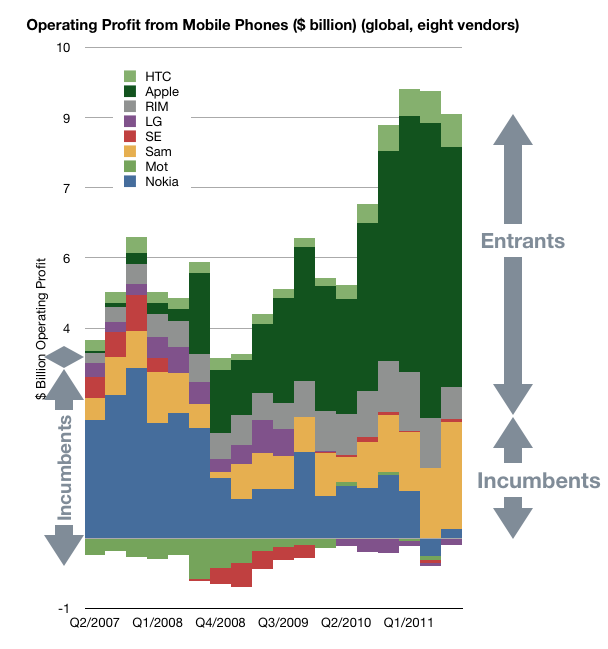
In 2007 something happened which changed the industry. It took a few years to even realize it was happening but by the time it was obvious, it had changed to such a degree that huge companies found themselves in financial distress. This chart illustrates the effect.
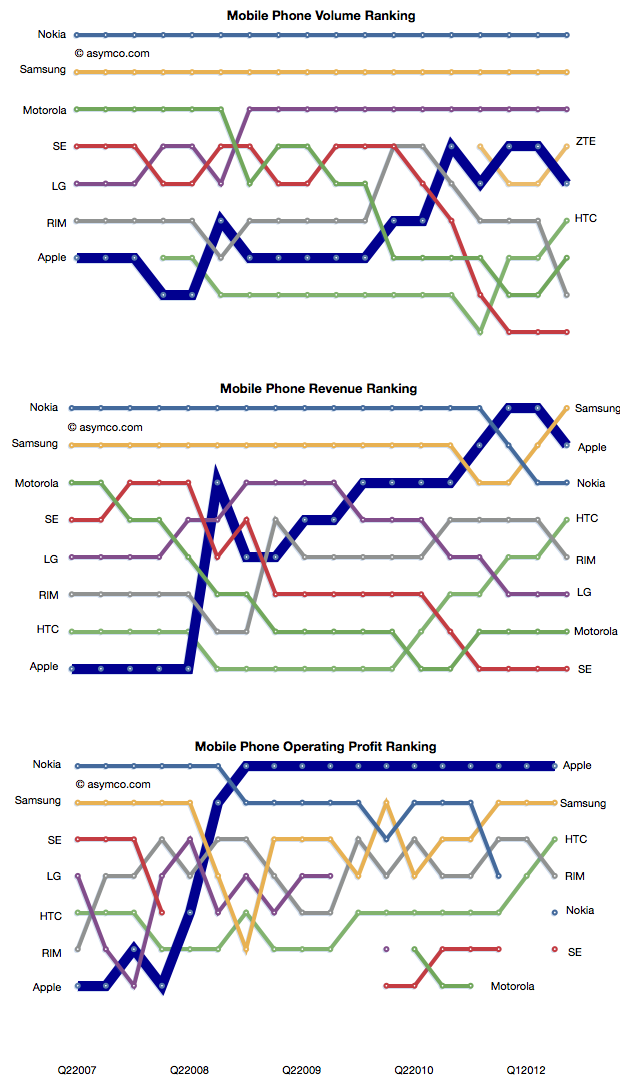
In a few short years the rivalry between incumbent handset makers has evolved into a rivalry between mobile platforms where the incumbents were caught in an increasingly unprofitable role of hardware integrators. Motorola is now being absorbed by a search company. Sony Ericsson is being absorbed into a consumer electronics company. Nokia is going through a potentially existential crisis and even abandoned its platform. Acquisition talk surrounds LG's phone efforts. Samsung is prosperous but sill at the mercy of its software suppliers. Even the entrants are starting to feel beleaguered. RIM, the oldest pure play smartphone company is trading below book value and has regressed in value to 2004 levels. Palm evaporated. A view into the changes is the rankings of the companies in terms of volumes, sales and profit as shown below.
How did large, powerful, smart companies let this happen?
It happened despite having a clear, front row view of the transition of the industry from mobile voice to mobile computing. The shift in the basis of competition from "connecting people" to "connecting people to data" ended up being a classic disruptive trap. Many will argue that it was the failing of individual managers. Perhaps, but how did they conspire to fail simultaneously?
When you see disruption happening, it's natural to seek out a cause, a pivotal magical "force" or event that enabled the weak to humble the strong--the proverbial sling that enabled David to defeat Goliath.
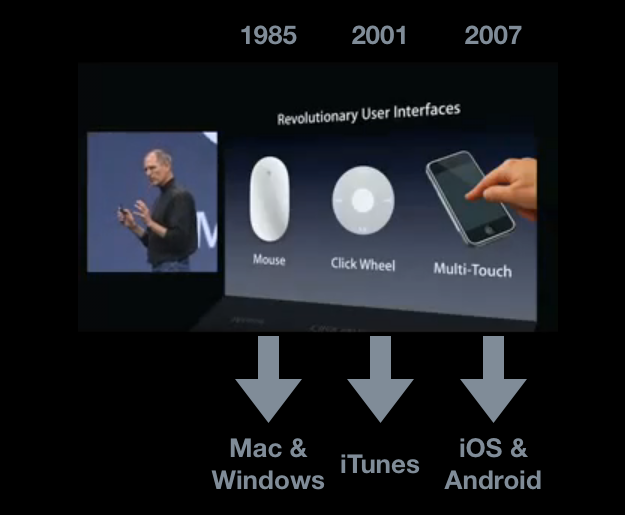
My hypothesis is that The Primary Cause for the shift of profits from Incumbents to Entrants has been the disruptive impact of a new input method. I illustrated this with the help of the January 2007 slide presented by Steve Jobs at the launch of iPhone.
Each new input method led to not just a disruption but new platforms and new business models. Each new "sling" victimized a set of historic companies. Mainframe and minicomputers, consumer electronics giants and now telecoms.
Just like David's sling, these technologies are not powerful in and of themselves, but rather, the way they are used makes them unpredictably sinister. The context of using capacitive touch on a handheld device rather than on a table-top makes it disruptive. Coupling it with high-speed mobile networks and powerful but efficient microprocessors made it into a force.
That is now ancient history. The consequences and repercussions are still being felt and weighed, but the smart money should be focusing on the next shift. From the time frame in the diagram above, it's clear that the cycle time between "Revolutionary User Interfaces" is shrinking. It's been five years since multi-touch. Is the next "RUI" already here? Is Siri the next RUI?
There are many things going for it:
It's not good enough
There are many smart people who are disappointed by it
Competitors are dismissive
It does not need a traditional, expensive smartphone to run but it uses a combination of local and cloud computing to solve the user's problem.
It is, in a word, asymmetric.
My disruptive hypothesis for Siri is that it shifts the competition from platforms positioned on a device to a "coupled" super-platform dependent on broadband and infrastructural computing.
Just after collecting enough data and observing patterns in it that give us clarity, It looks like things are about to change all over again.
At the Open Source Business Conference in March 2004 Clayton Christensen gave a presentation. It's available as an audio file for download here: Clayton Christensen | Capturing the Upside. I strongly recommend listening to the whole thing because it's the quintessential Disruption lecture.
It has relevance in many areas of analysis, but when I was trying to think of a way to characterize the potential for Siri I recalled one particular passage that I saw as almost clairvoyant. Seven and a half years ago, Clay said:
... the next time you go to a computer superstore, go to the voice recognition software shelf and pick up a box there that’s called the IBM ViaVoice. Now don’t buy it, but just look at it! They have a picture of the customer on the box, and it’s an administrative assistant who is sitting in front of her computer wearing a headset speaking rather than word processing.
You think about the value proposition that IBM has to be making to this woman. She types 90 words a minute. She is 99% accurate. If she needs to capitalize something, she just instinctively presses shift and cruises through. And IBM has to say, “No, don’t do that anymore. I want you to put this headset on and teach yourself to speak in a slow and distinct and consistent manner in complete sentences. If you must capitalize, you must pause, speak the command “capitalize,” pause, speak the word you want to capitalize, pause, speak the command “uncapitalize,” pause, please be patient, we are 70% accurate, this will get better we promise.”
This is not an attractive proposition to this customer. And IBM has -- I’ve not worked with them at all, but as I understand it -- they’ve spent maybe $700 million trying to make voice recognition technology good enough that it can be used in that market. This is a very difficult technical hurdle to surmount. Meanwhile, while they are investing that aggressively, Lego comes up with these robots that recognize “stop,” “go,” “left,” “right,” and the kids are thrilled with the four word vocabulary, and then "press -- or -- say -- one" kinds of applications take root, and now directory assistants ask you to say the city and state and so on, and much simpler, and an interesting market is emerging.
I bet maybe the next place it takes route is in chatrooms because the kids don’t spellcheck or capitalize anyway, and they would rather speak than type. And maybe then the next application would be, when you see these stubby fingered executives with their BlackBerrys trying to peck out emails, and their fingers are four times the diameter of the keys, they’re only 70% accurate. If somebody gave them a voice recognition algorithm that really didn't have to be very good so that they could speak their wireless email rather than peck it out, I bet they’d be thrilled with the crummy product. And ultimately, as it takes route in these new applications, it may get good enough that we can do word processing with it, but it’ll be a long time.
The thing that strikes me about Siri is how "crummy" it is. It's trying to be an intelligent assistant but it's not nearly good enough. Many have called it "toy like". It was so uninteresting that there was minimal coverage of it after the keynote launch. One can almost forgive the cynics. It was "yet another feature".
However, it does seem to be good in a very limited set of tasks. It is something you can hire for some minor jobs that you'd rather not do. Basic calendar booking, context aware search and a few delightful surprises. But it's not trying to be much more. It's not trying to be a typist. It's not trying to be a companion. It's not trying to be smarter than you and make you redundant. It's only trying to help lubricate your life. This is what makes it so exciting.
Like the example of the toy robot that delights the child, Siri delights with simple competence. It's not profound but as Clay points out in his talk, it's a necessary first step. What must follow are many more steps. Siri must get better. And because it will have at least 200 million users, I'm betting it will. So over time it will take on more tasks and will eventually help us in ways that we cannot yet conceive possible today. This is just like the introduction of the capacitive touch screen. Popularizing the touch screen has led to experiences with phones and tablets which we did not think possible four years ago.
But it takes time. Like any truly useful breakthrough, it takes a long time to mature. And also like any disruption, the potential of Siri is rooted in four principles:
Humble early goals which it accomplishes well
A large population of enthusiastic adopters who give it sustenance
Plenty of headroom in improvement giving it areas to grow into with positive feedback
A patient sponsor who makes a stable living
There's no magic to it. In fact it's banal. These are only the principles that every parent uses to raise a child.