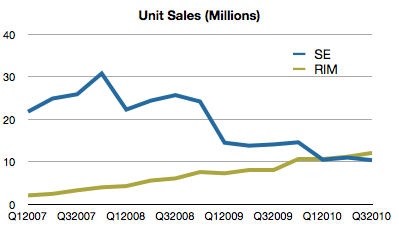
Sony Ericsson is to stop making smartphones featuring Nokia’s Symbian operating system.
The move means that the troubled Finnish mobile maker is likely to be the only significant user of Symbian.
Analysts said Sony Ericsson’s decision confirmed the “failure” of Symbian as an open source platform, given that it was supposed to be used by several large mobile makers.
“Our third consecutive quarter of profitable results illustrates that Sony Ericsson’s overall performance is stabilizing. Our strategy to focus on the smartphone segment is succeeding and smartphones now comprise more than 50% of our total sales,” Chief Executive Bert Nordberg said in a statement.
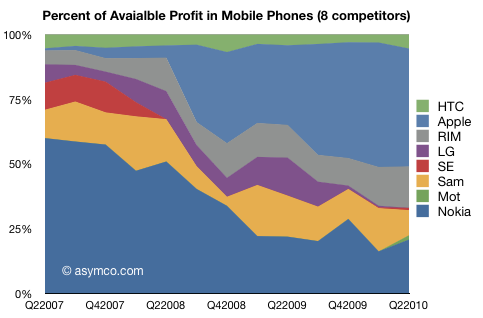
A quick update on the analysis of mobile phone profits. If the available profit[1] (i.e. excluding losses) were summed and each vendor's profit were measured as a percent of this total, this chart would tell the story of the last three years:
Note that profit share has mostly shifted from Nokia to Apple, though Sony Ericsson and LG were also casualties and Motorola has not had anything to lose.
Some assume that the future belongs to the Koreans but we see that the relatively small amount of profit that Samsung has (less than RIM actually) has not changed much. HTC is also shown to be a steady performer but not having displaced much from competitors.
Will Android change this picture? As I've argued before, Android is most attractive to the unprofitable and the strategically constrained. Can having undifferentiated new products change this? As Nokia is unlikely to license Android, and RIM seems very unlikely and Apple is out of the picture, the only possible contenders are Samsung, LG, HTC, Motorola and Sony Ericsson.
Motorola and Sony Ericsson have both returned to profitability but with a very small volume Android strategy. However the incumbents fielding Android are really facing a far more sinister threat: the smaller local brands in China (e.g. ZTE) and emerging markets.
On profitability, the smaller challengers are unlikely to make a large impact, but they will constrain the profits of other licensees. The distribution of phones on a global scale is challenging without a brand, and brands are very expensive to build. It's still possible over a longer timer frame that a small brand like HTC can emerge on a global stage. But in terms of profit capture, challengers will mostly "steal" from the already constrained big brands running with Android.
--
[1] Profit is not the only measure of success and can sometimes be a deceptive indicator. For this reason I look at a longer time frame so that anomalies, seasonality and business cycles are smoothed over. As flawed as it is as a measure, the most important reason to pay attention to profit is that it's the only fuel for growth in the long term. Companies that are consistently unprofitable (e.g. Motorola) face diminishing degrees of strategic freedom further lubricating a downward slope toward financial distress.
The mobile phone market is intertwined with the telecommunications industry which is vast and there are numerous competitors which are much more dynamic and better capitalized than the moribund PC or music player vendors. It’s also a regulated and fragmented global market with 1.2 billion units and 5 billion consumers—far greater than any of the markets Apple played in for its first 30 years.
Nevertheless, the iPhone has had a huge impact on the industry. To show just how much of an impact, I dove in and pulled over 500 data points on three years’ financial performance of seven competitors responsible for 80 percent of units being shipped today. The time frame covers the iPhone’s participation in the market so it allows for “before-and-after” comparisons.
Now I turn my attention to draw a bottom line from all the data above, namely the operating earnings (EBIT or Earnings before Interest and Taxation).
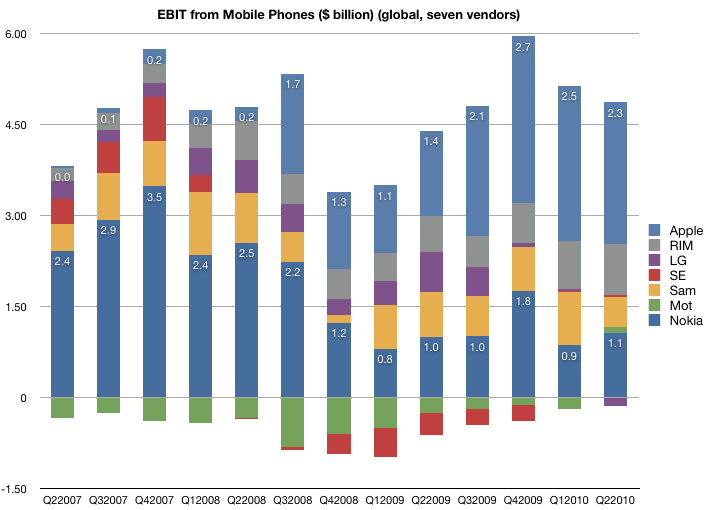
The first chart shows the EBIT from the top seven vendors of mobile phones since the quarter when the iPhone launched. I annotated Nokia and Apple's bars to give perspective.
The total available profits in the industry dipped to a bit under $4 billion at the trough of the recession, and have recovered to nearly $6 billion in the holiday quarter last year. However, not all vendors are profitable. As you might expect from looking at the operating margins, Motorola and Sony Ericsson have been generating losses for most of this time period. They have both reached profitability in the last quarter, though at very low levels and after having lost a large part of their sales. LG has turned negative this past quarter after being a modest earner for some time. Samsung has maintained a fairly even consistency in its profit capture, though with its expanding market share, it seems to have come at the cost of pricing.
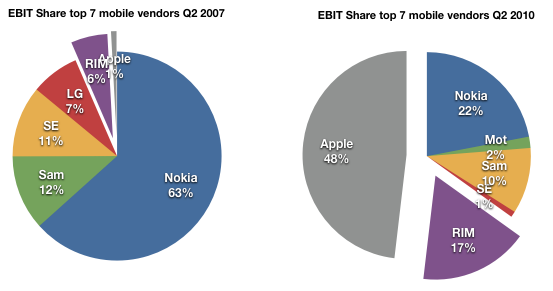
Finally, looking at the pure smartphone vendors RIM and Apple, the picture is nothing short of astonishing. This before-and-after share-of-available-profit chart shows that the two entrants went from about 7% profit share to 65% in three years.
Apple in particular is capturing about half of the available profits with three percent of the units. It dwarfs all the other vendors, more than double the nearest (Nokia). All that in three years and with the added burdens of only three models, a recession and limited distribution.
What does it all mean?
Here are my conclusions, enumerated:
The lack of a real response. The recurring theme in this series of articles has been that giant multinational incumbents in a vast and rapidly growing industry, enjoying all the advantages that size and incumbency, have had their profits taken from them. And they don't seem to have put up much of a fight.
It's all wealth transfer. Note the total amount of profit available has not increased markedly; this is not about incumbents growing the pie. Two thirds of what should have rightly been theirs moved from the incumbent shareholders to the entrant shareholders.
Speed. This shift of profit occurred over an unprecedentedly short period of time. Three years is no more than two product cycles in the industry and it's an order of magnitude faster than what happened historically to other industries.
Disruption is the diagnosis here. The incumbents were caught in the headlights. Disruptive innovation leads to asymmetric competition and this is what we just witnessed. History has shown that the shift of profits is usually the last stage of disruption and is usually irreversible because the change in business models cannot happen at the rate of change of profit transfer.
Which leads me to one final point.
When analyzing the potential for challengers to the new winners, the most cited is Android. Can Android affect this redistribution of profit once again? And to whom?
If Android is to become the dominant platform, does it depend on the success of its licensees? Who are these licensees and what are the chances that they will be able to align their businesses to what Android offers (a new revenue model based on services and advertising).
One problem I see is that Google is making a bet on those same vendors who are now squeezed in the middle of that last pie chart: Samsung, LG, Motorola and Sony Ericsson. Nokia, Apple and RIM will certainly not take the OS over what they already have as it dilutes their differentiation and margins. That means Android is aligned with the biggest losers in the industry.
So how likely are these disrupted ex-giants to recover and take Android forward? My bet: slim to none. Android does not offer more than a lifeline. It is not a foundation for long-term profitability as it presumes the profits accrue to the network and possibly to Google. Profit evaporation out of devices to Google may be a possibility at some time in the future, but only if the devices don't need too much attention to remain competitive. But because they're still not good enough (and they won't be for years to come), it's certain that attention to detail is what will be most important to stay abreast of Apple.[1]
So here we have the real challenge to Android: partnership with defeated incumbents whose ability to build profitable and differentiated products is hamstrung by the licensing model and whose incentives to move up the steep trajectory of necessary improvements are limited.
In other words, Android's licensees won't have the profits or the motivation to spend on R&D so as to make exceptionally competitive products at a time when being competitive is what matters most.
[1]: I would argue the same lack of symmetry with licensed software vendor Microsoft is what led the the failure of the same incumbents to make a dent in the industry with Windows Mobile [2003 to 2010].
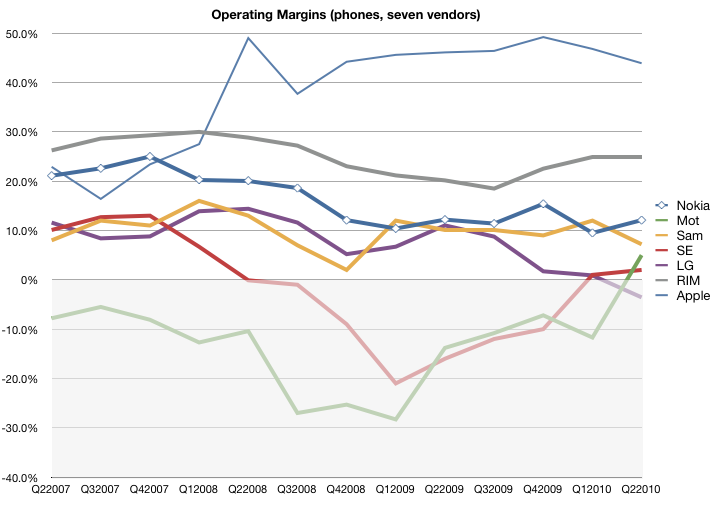
After ASP, Sales, and Unit Volumes we look at the three year history of operating margins for the seven most significant mobile phone vendors (Nokia, Samsung, LG, Motorola, Sony Ericsson, RIM and Apple).
The following chart shows the OM from mobile phone sales. These figures are as reported by the companies with the exception of Samsung and Apple. Samsung reports OM for its telecommunications unit as a whole and we have to assume that it's largely accurate for mobile phones. Apple does not report margins for its iPhone but it's possible to estimate gross margin percent for the iPhone and then subtract its overall OPEX as percent of sales. This assumes that OPEX is allocated to the iPhone in proportion to sales, which is the best assumption we can make at this time.
The data shows that the iPhone has been considerably more profitable, due mostly to a high ASP, than other vendors. Motorola and Sony Ericsson have been "underwater" with respect to margin for much of the time period, with LG recently dipping into the red.
Nokia's margin erosion is a source of significant angst but note that it has just reached Samsung's historic level (around 10%). LG, long seen as an up-and-coming vendor who took over the number three spot from Motorola is shown to have done so with moderate-to-low profit margins.
Overall, the phone incumbents have an unweighted average operating margin of 4.5%, down from 8.6% three years ago. In contrast, RIM and Apple have an average OM of 34%, up from 24%. In other words, profitability has halved for the volume leaders while it has increased nearly by half for the entrants.
This goes a long way toward explaining the "smartphone gap" which is being filled by Android. As vendors see their unit growth, ASP and operating margins under pressure from low end disruptors, there is a tendency to flee to the high end that smartphones represent. Android offers an irresistible siren's song.
All phone vendors saw smartphones coming. They hired all the right market research companies and spent lavishly on analysts to confirm that phones with operating systems were imminent.
Nokia was one of the early movers, establishing its own software platforms group as early as 2002 while others like Samsung licensed Windows Mobile or PalmOS as early as 2003. Yet not much happened to sales. The number of smartphones units sold as percent of total has been fairly low.
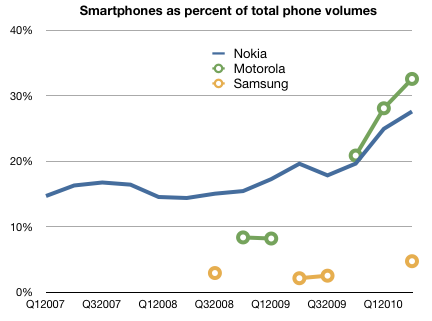
The following chart shows the number of smartphones sold as a percent of all phones sold for the top three vendors (as of the time when the chart starts early 2007). Note that the percent of smart products shipped did not accelerate or grow dramatically for the largest two vendors even into last year. It's still a pittance at Samsung (<5%) and even less at LG.
Nokia is showing signs of a secular shift to smartphones but it's been a decade-long process so far, a slowness that ripped shareholder value to pieces.
So is the precondition for a shift to smartphone focus a collapse in the core business? It certainly seems so from the data. Motorola first, Sony Ericsson second, Nokia presently and Samsung and LG later.
Each of these decision points reflect precisely the timing of pain points with the core businesses.
Why this asymmetry? At first glance, the smartphone business should be sustaining and an attractive option to be exercised as soon as possible. It offers better margins, better prices and a better return on capital.
So why is there this disconnect? As regular readers of this blog can probably guess, my hypothesis is that the smartphone business is disruptive. Incumbents are motivated to ignore this business because it makes money in ways they cannot control. More importantly, their best customers are signaling (in non-transparent ways) that they don't want their top vendors to participate in this market.
Many consider June 2007 to have been a pivotal moment in the history of mobile phones. Apple's entry with the iPhone has re-defined the market in many ways. However, there was a smartphone market before then. About 28 million smartphones shipped the quarter when Apple launched out of an overall phone market of 265 million. Apple's entry with 270k phones was a drop in the bucket.
I thought it would be instructive to chart what happened between that quarter, exactly three years ago and today. I collected the data from IDC, Gartner and Canalys and company reports to paint a few pictures.
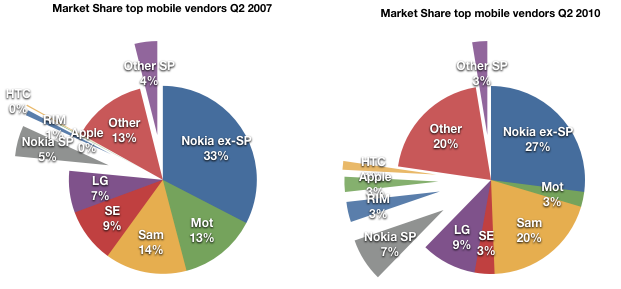
First, the market shares (by units) of the top mobile vendors, Q207 vs. Q210. I highlighted the smartphone vendors by separating their wedges from the pie. Note that I also separated Nokia's smartphones from Nokia's regular phones as two separated wedges--Nokia ex-SP for no smartphones and Nokia SP as their "converged" units. I did the same with "other".
The first thing to note (beside the large increase in smartphone share) is that "other" non-smartphones are a huge part of the pie. At 20%, the share of "other" is now equal to the share of Samsung. Other consists of a group of mostly low cost Chinese vendors. The growth of the low end "other" went from 35 million units in Q207 to 65 million in the last quarter. It's this competition that is driving profit out of the core businesses of Nokia, Samsung and LG and forcing a flight to smartphones (more about this later).
The second thing to notice is that Motorola and Sony-Ericsson are highly visible victims of the last three years. Sony Ericsson shipped 25 million devices in Q207 and only 11 million three years later going from 9% share to 3%, on par with RIM and Apple. Motorola did even worse, shipping 35.5 million in Q207 and a mere 8.3 million last quarter, losing 10 out its 13 points of share.
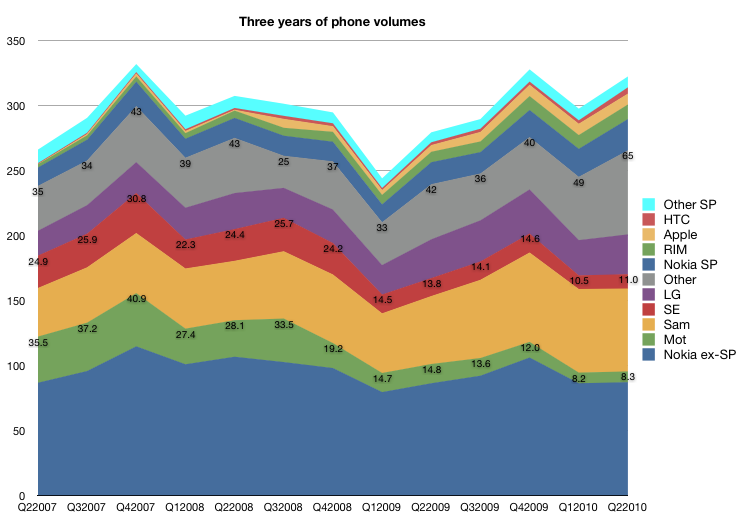
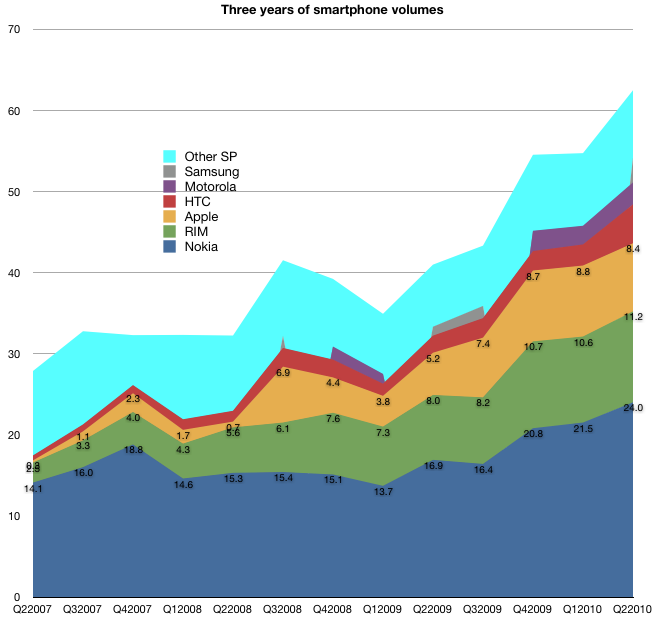
Viewing the overall units market, one can see the gouge in units that the recession took out. The following graph shows three years of volumes by the top vendors with the smartphones separated at the top (Nokia SP, RIM, Apple, HTC and Other SP--everything above the grey band are smartphones).
However, separating out the smartphones, one can see their volume increased with barely a ripple during the recession. Although Nokia retains the top share spot, the entrants have jointly grown much faster. I have annotated a few of the competitors' volumes with the actual values.
One thing to note is that "other smartphones" has traditionally consisted of Windows Mobile licensees but that is quickly shifting now to Android. I also had only fragments of data for Samsung and Motorola, so their bands are incomplete. However, one could note how minimal their participation has been in the market. LG has been practically absent from this market. For these latecomers to smartphones, it's clear what Android offers: a chance to stay in the game.
Sony Ericsson shipped 11 million phones at an average selling price of EUR160 in the second quarter, compared with 13.8 million units at an average price of EUR122 a year earlier. Sales rose to EUR1.76 billion from EUR1.68 billion, against expectations of EUR1.79 billion.
The company's estimated share of the global handset market remained flat from the previous quarter at around 4%.
The company reported net profit of EUR12 million for the three months to June 30, compared with a EUR213 million net loss the year before, missing analysts' expectations for a EUR50 million profit but sustaining the turnaround that started in the first quarter.
[Sony Ericsson] said it shipped 10.5 million units in the quarter, a 28 percent decrease compared with the same three months in 2009. It was down from the 14.6 million units shipped in the fourth quarter.
A few weeks ago RIM said it shipped 10.5 million devices.
With Apple claiming 85 million installed base of iPhones and iPod touches vs. 75 million last quarter, it's safe to assume at least 10 million Apple smart devices shipped in Q1.
By units at least, SEMC, RIM and Apple are neck and neck.
The problem will be in using some comparable as a measure of reference. This is a problem because first, there is no equivalent product in history, second, there are few similar products that are pre-ordered and sold without user samples being available, and third it's being sold through a very limited channel (on-line Apple Store). Lastly, the number includes only delivered units vs. reservation for pick-up.
Nevertheless, the figure is intriguing. One class of comparable products might be new smartphone products from companies that were launching on new platforms.
One example is the Android G1--the first Android device. It sold 663k units in the launch quarter. Another is the Nokia 5800, Nokia's first touch capable device. It sold 536k units in the first quarter (up to 1 million in the first 3 months). Sony Ericsson's first Windows Mobile device was the X1. It sold 237k units in the first quarter of sales. The first Sense UI HTC device (the Diamond) sold about 1 million units. The RIM Storm, RIM's first touch device sold 1.6 million units. Finally the iPhone which sold 1.1 million units in the first full quarter of sales (about 1.4 million if we include the weekend sales that fell outside the first quarter).
The iPad does seem to be doing rather well relative to these products. Again, their figures were for a full 90 days of sales and were sold through physical retail channels in a variety of geographic markets.
I will be surprised if the number of units sold in Apple's CQ2 don't exceed 1 million. (Apple will book all these sales only on delivery which means they won't appear in CQ1 sales figures). This will probably mean better performance with a new platform than Nokia, Google, Sony Ericsson or HTC and perhaps better than the iPhone.
I calibrate my growth rates on the assumption that Apple will overtake the combined share of the two money-losing handset vendors.
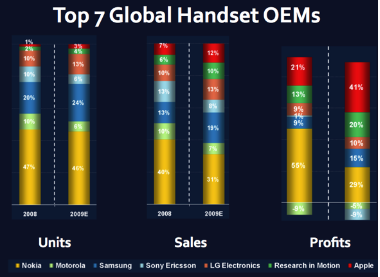
Sony Ericsson and Motorola are the weakest competitors in terms of portfolio and competence with software. Their sales, units and profits shares for 2008/2009 are shown in the graph above (source: Morgan Stanley).
Therefore, my thesis is that Apple could beat these two weakest competitors in 3 more years.
Here is the basic top-down view:
In 2009 174 million smartphones were sold out of a total of 1.13 billion phones (IDC, Strategy Analytics). Using a 10% CAGR on this figure gives 1.65 billion phones in 2013
Apple obtained 2.1% share in 2009 and about 1.5% share in 2008. My forecast share for Apple:
2010: 3%
2011: 4.1%
2012: 5.5%
2013: 7.5%
During the last quarter, Sony Ericsson held 4.5% share and Motorola 3.7% therefore my 2013 target for Apple is a little less than the sum of what these two hold today.
This results in unit sales for Apple of 125 million units for 2013 and a compound annual growth rate of 50% a year.