Asymco

Asymmetric Intelligence

Sprint

  1. The Inevitability of Combining the Digital and Physical Worlds
    Research · 1 comment

    Seeing is believing

    AI is attracting all the attention but one should be careful because if there is one thing about technology is that timing is everything and when attention is concentrated it signals that time is distorted.

    In a recent interview Apple management was asked about AI, which is perceived as an area where Apple has been struggling. Greg Joswiak replied:

    We've been doing things with intelligence for many years, right? And gen AI allows us an opportunity to do that even more. So I'm excited about that, but boy, this is not a sprint. This is a marathon, right? We're going to be doing stuff with intelligence for decades, not months or years.

    He also declined to comment on smart glasses, but said we're in the "early innings of spatial computing," while Ternus said that combining the digital and physical world is an "inevitability." The two were tight-lipped about any upcoming Apple products, but Joswiak said Apple is "working on some pretty cool stuff."

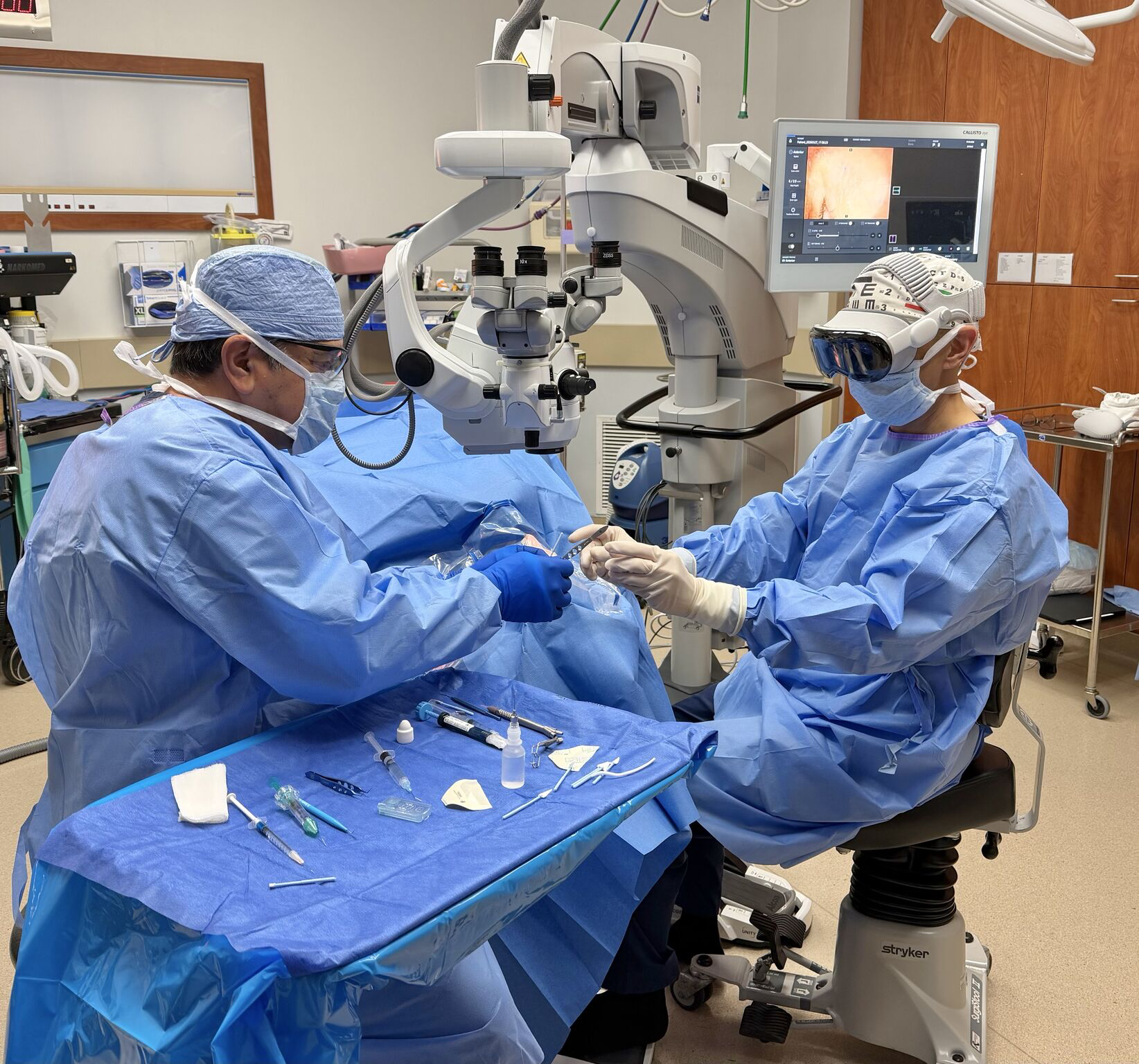
    In San Diego, Dr. Tommy Korn has been performing surgery with the Apple Vision Pro.

    We’re studying how spatial visualization may redefine microsurgery.
    • IRB-approved[1]
    • One of the first of its kind in microscopic eye surgery
    • Safety & feasibility study

    Technology used:
    • Apple Vision Pro - 2nd generation M5
    • ZEISS Medical Technology Artevo 850 3D Digital Microscope
    • ClearSphere spatial app from ClearSurgery

    Source: LinkedIn

    The idea of adding a layer of information or enhancing vision through a wearable computer being used to repair the vision of damaged eyes, I'd say that's pretty cool stuff.

    To oversimplify, the Apple Vision Pro is being used to substitute looking directly through microscope eyepieces, freeing the surgeon from neck and eye strain and allowing additional information to be shown without averting their gaze from the procedure. This improves outcomes and reduces fatigue allowing more procedures to be performed by the same surgeon or allowing more surgeries to be performed by more individuals with fewer obstacles to training.

    Spatial computing (SC) is also not a sprint. Joz said it's a product that has been brought from the future into the present and, as I use it, I feel that is indeed the case. And like AI, there are benefits being measured today. But what strikes me is the contrast in attention.

    Far more attention and capital is being applied to AI vs. SC but both are inevitable. The contrast might have something to do with psychology or attention markets but it shows that opportunities are not secrets. They are just unnoticed.

    1. An Institutional Review Board (IRB) in surgery is an independent ethics committee that reviews, approves, and monitors research involving human surgical patients to ensure their safety, rights, and welfare. It acts as a mandatory watchdog, evaluating surgical trials, new devices, and techniques to maintain high ethical standards.
  2. How many iPhones will T-Mobile USA sell?

    Research · 54 comments

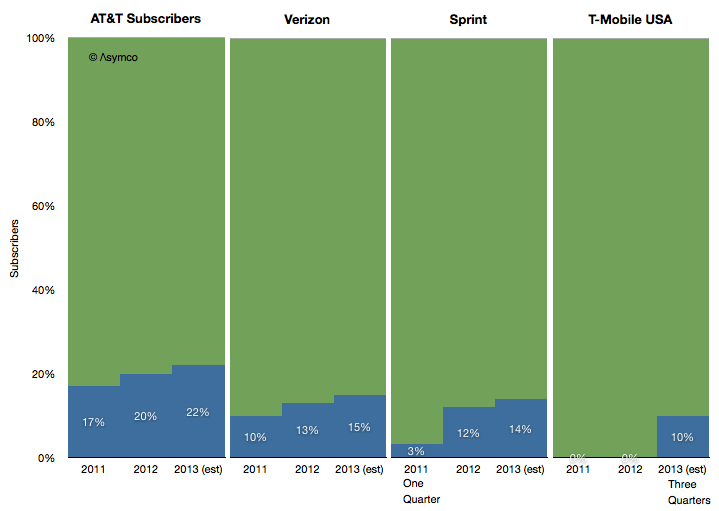
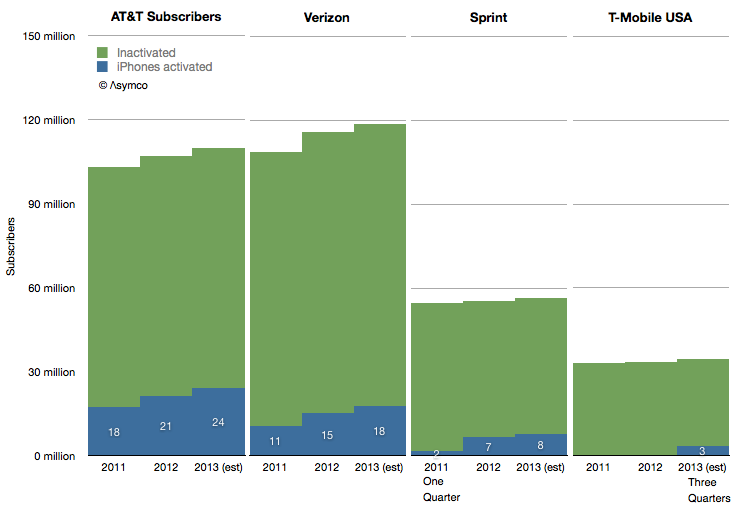
    From the initial product launch until the end of 2012, AT&T has activated 72 million iPhones. Verizon began selling iPhones four years after AT&T and managed to activate 26 million since. Sprint began nine months after Verizon and has activated 8.5 million.

    In proportion of their subscriber bases, the activations are shown in the following graph.

    Screen Shot 2013-03-28 at 3-28-12.50.06 PM


    I identified the reported iPhone activations with blue areas while the sum of green and blue areas represent total subs at the end a the given year.

    I also took the liberty of forecasting 2013 data in order to try to estimate T-Mobile's contribution.

    The method used was to look at the percent of total subs that each operator has been activating. Accounting for the limited sales period for Sprint in 2011, the sales patterns are consistent across the carriers. The longer the product is available, the higher the activation rate.

    Screen Shot 2013-03-28 at 3-28-1.01.35 PM

    Therefore I estimated that in 2013 T-Mobile USA will sell about 10% of its subs base an iPhone. That would make its contribution to iPhone sales about 3.4 million.

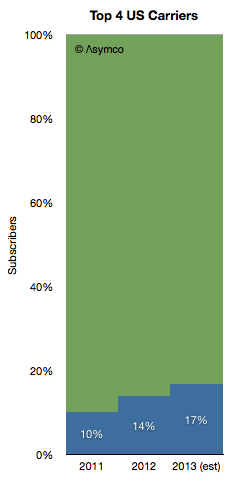
    It would also imply US sales among the top operators of 53 million iPhones in 2013.

    That itself is 17% of 320 million subs.

    Screen Shot 2013-03-28 at 3-28-1.02.25 PM

    So perhaps it's time for Apple to celebrate. This year, after six years, Apple will have completed entry into its first major phone market. The rest of the world will not be as quick.

  3. The iPhone MOQ

    Research · 21 comments

    [Kaoru] Kato, president of NTT DoCoMo Inc., said that the firm would want to add the iPhone to its lineup of serviced smartphones if it could form a mutually beneficial contract with Apple, Inc.

    Apple requires that carriers servicing its devices sell a fixed amount per year. Katō said that his company could handle such quotas if iPhones accounted for approximately 20%-30% of its overall smartphone sales.

    via NTT DoCoMo President Interested in Servicing iPhone — BrightWire

    When thinking about an iPhone launch, especially with a new operator, the crucial question is what is the minimum order quantity (MOQ). Some of the iPhone production is sold direct (as in the case of orders coming from Apple's online store) but the majority of units are sold via operator who order in batches.

    This issue came to light when Sprint's order was leaked in late 2011.  I discussed the order size at the time and put it in context. I concluded that Sprint MOQ was on average 7 million/yr., ramping with 4, 6, 9 and 12 million over a four year period.  I concluded that this was not a particularly aggressive gamble.

    Data published since then shows that Sprint actually sold 6.3 million during the first year, well ahead of my expected minimum order of 4 million and above even the expectations for the second year of sales. So far then Sprint and Apple gauged minimum demand quite accurately.

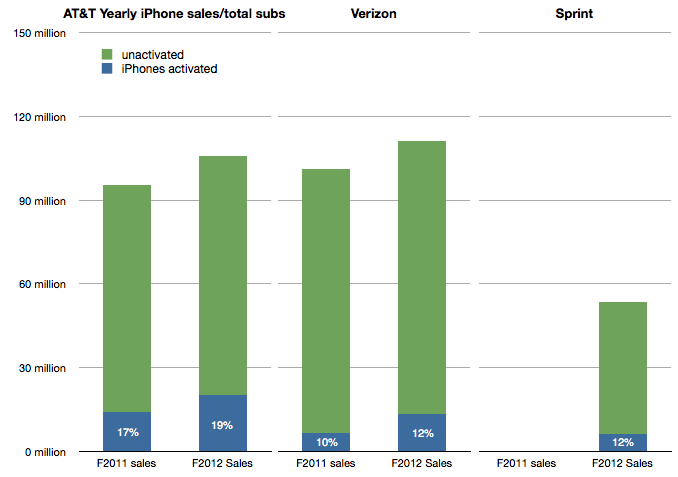
    I also showed that the Sprint MOQ was probably indexed off their sub base. I suggested that, based on subs data at the time, Sprint was committing to roughly 13% of its subs buying an iPhone every year. This was indexed off the data showing that 17% of AT&T subs were buying iPhones every year and 10% for Verizon. (I also assumed that this run level would be ramped over time).

    The updated totals for the 12 months ended October 2012 are 19% of AT&T subs purchased an iPhone, 12% for Verizon and 12% of Sprint. The performance is shown in the following graph:

    Screen Shot 2013-01-17 at 1-17-3.33.10 PM

    Which leads us to think about how the MOQ for the iPhone is calculated. If we assume Sprint and Verizon performance is typical it would imply that an operator like DoCoMo would be required to purchase iPhones at the rate of about 10% to 12% of its sub base each year, modulated to some degree by a ramp.

    NTT DoCoMo had 60.7 million subs in September 2012. 10% is about 6 million. Is Mr. Kato's quote above of 20%-30% of smartphone sales consistent with this?

    In an earlier interview (in July) Mr. Katō also stated that the target for smartphone sales in the year to March 2013 was 13 million. 30% of that would be 4 million units.

    This suggests that the iPhone MOQ for DoCoMo is only about 6% of subs. (4 million) Perhaps this is the basis of negotiation for an iPhone deal. Apple may have held out for 10% subs/yr. with Sprint on the basis of performance of the iPhone in the US but might be willing to settle for 6% subs/yr with DoCoMo, at least for the first year.

    The MOQ figure as percent of subs for China Mobile would also be an interesting point of debate.


  4. The US temporarily regains relevance for Apple's iPhone

    Research · 16 comments

    Sprint reported its first iPhone quarter sales at 1.8 million. You may recall my analysis of Sprint's "gamble" where I estimated that Sprint will easily sell the 31 million iPhone which they committed to buy from Apple. I had estimated that they could sell an average of 7 million units a year but perhaps conservatively they could ramp at 4, 6, 9 and 12 over the four year period rumored to be in the contract.

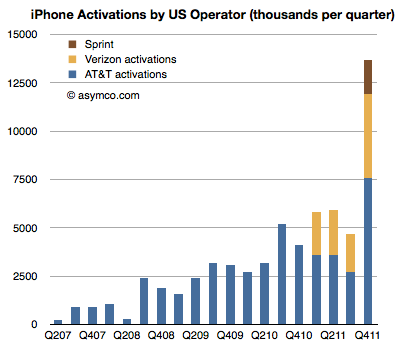
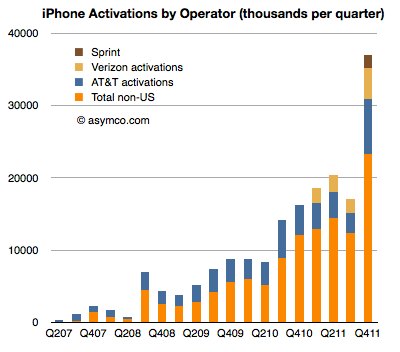
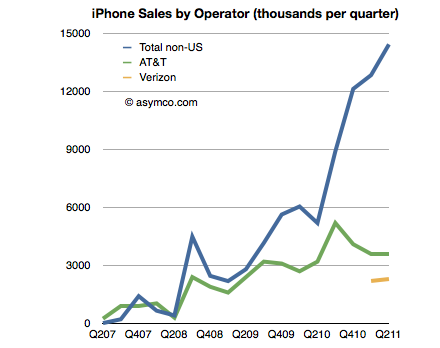
    Given the pent-up demand I also estimated that the first quarter could reach 2 million units. They managed 1.8 and that's a solid start. Overall the US carriers activated 13.7 million iPhones. Here are the iPhone activations by US Operator:

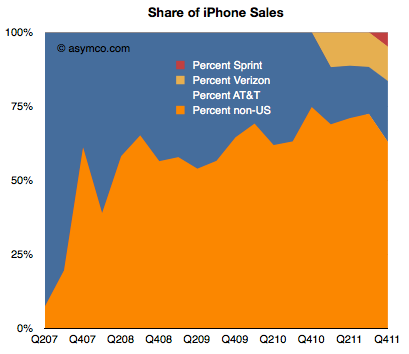
    That's 37% of the total market in Q4, shown in area and bar charts below:


    Note that the percent of total activations outside the US has dropped but that is due to the limited distribution of the iPhone 4S outside the US in the launch quarter. The long-term trend is for the US to decrease as a percent of total iPhones even with the additional US distribution.

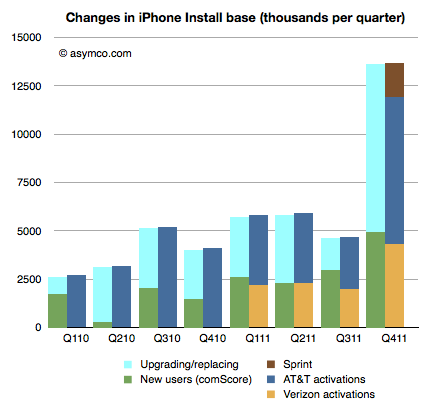
    By comparing the net adds to US install base from comScore survey data, we can estimate that about 63% of US purchases of iPhones were replacements and that 8.7 million iPhones were put out of use in the US last quarter.

  5. Estimating iPhone sales in the US during Q4

    Research · 56 comments

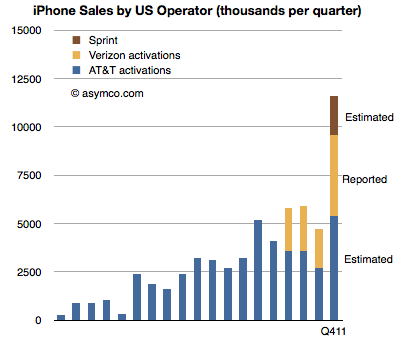
    Verizon has been the first source of data on iPhone sales for Q4. They reported 4.2 million iPhones sold. The first quarter of Verizon iPhone sales had 2.2 million units, followed 2.3 million in Q2 and 2 million in Q3. The total for the calendar year came at 10.7 million.

    The total for AT&T during the first three quarters has been 9.9 million. If we assume the same 2x sequential increase in Q4 relative to Q3 as observed by Verizon we obtain an estimate of 5.4 million iPhone for AT&T.[1]

    The quarter also saw the addition of Sprint to the US iPhone distribution network. Sprint is rumored to have committed to buy 30.5 million iPhones over the next four years. My estimate for the first year was 7 million, placing first quarter sell-in at about 2 million.

    An approximate total for Q4 US iPhone activations results in 11.6 million. The following chart illustrates these estimates:

    Notes:

    1. AT&T reported that smartphone sales during October and November totaled over 6 million units. Assuming only 2 million for December and a 70% iPhone mix yields 5.6 million units.
  6. Sprint's gamble

    Research · 62 comments

    The Wall Street Journal reported that Sprint Nextel made a "multibillion-dollar" gamble on the iPhone. This is based on information that Sprint committed to buy 30.5 million iPhones over the next four years.

    Wall Street Journal reporters calculated that the deal is worth around $20 billion on the basis of iPhone ASP during the last quarter (about $650). That Sprint would get that price is possible but not necessarily correct as there is likely to be some discount and the ASP Apple receives includes accessories.

    But the "gamble" is more than the deal value. The way it's being reported is that Sprint bet the company on being able to sell this many iPhones. So naturally we have to ask: how hard can it be to sell 31 million iPhones?

    First, note that the order is over a four year period. It's also not likely to be linear, with volumes accelerating over time. If I estimate a ramp where in year one the commitment is for 4 million, year two 6, year three 9 and year four 12 million we get a total of 31 million. Can Sprint sell this volume?

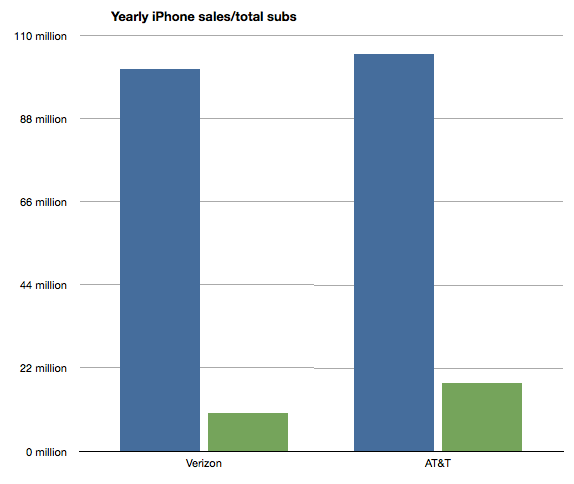
    To get an idea we can look at the sales rates for the other US operators. I built a table of iPhone sales by Operator last July. The data is shown in the following chart:

    What is interesting is to see the number of iPhones sold in a given time frame as a percent of subscriber base. I chose to measure a year's worth of iPhones where I extrapolated Verizon's volumes from the six months reported so far.

    The ratios are that Verizon sold iPhones at the rate of about "10% of its subscriber base per year". AT&T has been selling at the rate of about "17% of its subs per year". If we average these two we get about 13.6%.

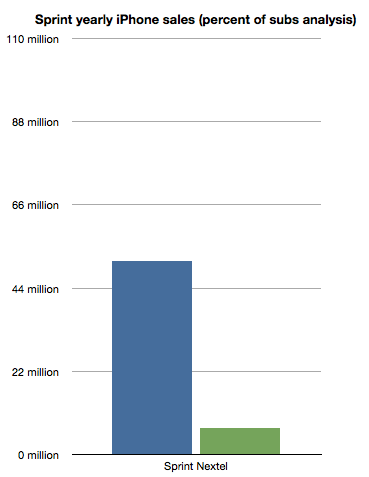
    So if we assume that Sprint can sell iPhones at about the same rate as Verizon or AT&T (as a percent of their user base which was 51.1 million) we get about 7 million iPhones per year.

    That's right in the middle of the range it needs to get to 31 in four years [4,6,9,12]. I charted the projection on the following chart:

    So the gamble Sprint is taking is that they will be able to sell iPhones at the same rate as Verizon and AT&T.

    How is this risky?

    The deal seems to be inline with what is known about the product's popularity and the pattern of purchasing and upgrades that US consumers have been exhibiting for a few years.

    As with AT&T and Verizon, volumes ramp up over time. As with AT&T, users are loyal and they upgrade regularly. As with Verizon, there is competition from Android and Blackberry. As with both, payment is expected up-front with payback over the duration of contract length. As with the others, there will be incentives to keep churn down.

    If anything the riskiest thing for Sprint would have been not to do the deal at all. Indeed, we'll get to see the effect of that option on T-Mobile.

  7. The American Wireless Galapagos Syndrome: How the industry set itself up for a rout

    Research · 193 comments

    AT&T's intent to acquire T-Mobile USA is subject to regulatory approval. Will regulators look at the deal through the lenses of sustaining the traditional industry's profit allocation or through the lenses of device-led disruption?

    In theory, regulators are to make a determination on whether the deal will reduce customer choice. But the question is really choice of what? The focus is presumably on the choice of service plans. That's understandable, however coupled to that choice is the choice of devices and even more importantly, the choice of platforms.

    The trouble is that US consumers have never had much choice and the US wireless marketplace has been a minefield of incompatibilities and obstacles to market forces.

    To begin with, US carriers maintain multiple incompatible network standards. Phones which work on one network do not work on any other. A Sprint phone won't work on AT&T or on Verizon. In fact, some Sprint phones won't work on all of Sprint's network as it still uses the iDen standard legacy from the Nextel acquisition. Even the iPhone which is designed for the AT&T network does not handle T-Mobile's version of 3G. So a consumer cannot make a decision on devices independent of a decision on carrier. This is a phenomenon unique to the US[1].

    Secondly, in the US carriers charge for incoming minutes and have shunned pre-paid customers. There was a time when SMS messages were not compatible between networks, which led to the emergence of RIM as the only wireless messaging solution available, though initially not to the average teenager.

    Thirdly, because of the multiple incompatible standards, network coverage in the US is still abysmal. Each carrier has had to build out parallel (incompatible) networks at great expense using non-standard equipment over a vast landmass. The result is not only a very expensive network whose capex demands high service fees, but a very poor quality network which is always both spotty and capacity constrained. Operators are therefore keen to lock customers in to post-paid plans to ensure cash flows that drive capital allocations. This is essentially an upmarket flight which does not encourage low end innovation.

    These idiosyncrasies are rooted in historical regulatory rulings that led operators to create a uniquely American wireless market. The key regulation was that the US shall have no single wireless standard. In the spirit of laissez-faire this may make sense. But the result has been failure of the common good. This is sharply contrasted with other developed countries which (with notable exceptions) deliver superior service with high efficiency.

    The US is so unique that it developed its own "Galapagos syndrome". Few global brands can be bothered to invest in it. Vodafone tried to play in the US with Verizon, but its minority position offered no leverage because Verizon spent the better part of a decade avoiding global networking standards. Now T-Mobile is desperate for an exit after trying to leverage the foothold it paid dearly for and failing to offer devices that capture users' imaginations (because they were railroaded into another incompatibility with 3G). Conversely, no US brands have been able to expand internationally. US operators are non-entities abroad, even in what would be natural expansion territories like Latin America or the Caribbean.  Those markets belong to European investors today.

    Given this background, it's very likely that regulators will look at the deal in terms of balancing what is essentially a deeply flawed, cobbled together industry.  Companies can argue that they are rationalizing through consolidation but regulators can argue that "choice" is decreasing. These arguments are mostly moot. The problem is that the US wireless market is balkanized and byzantine.

    It's therefore perhaps stunning that the platforms that are currently winning in mobile computing are American: iOS and Android[2]. Note further that none of these winners came from the world of wireless or telecom. These new points of profit condensation in the industry entered from a different industry: computing. But are they now pursuing telecom-compliant strategies? Arguably no. I choose to call them mobile computing and not phone platforms specifically because they will tolerate the cellular regimes as long as they need to, and no longer. Once they will reach the perch of power, the industry will conform to them, not vice versa.

    ---

    Notes:

    1. Japan has a similar problem but less pronounced.
    2. Microsoft is still in the running as is Palm, both American.
  8. Palm Minnow is Swimming with Sharks

    Research · 2 comments

    Palm CEO "I've never used an iPhone" Rubinstein quoted in the earnings conference call:

    "We had an arrangement with Sprint that when we launched with Sprint that they would invest in marketing and carry the product and for that they would get an exclusive for a period of time. That really determined when we could do our launch at Verizon. I agree with your premise that if we could have launched at Verizon earlier, prior to Droid, that we would have gotten the attention that the Droid got and since I believe that we have a better product, I think we would have even done better."

    So we are led to believe Droid launched into a window in Verizon's launch schedule. A window which was shut to Palm due to their exclusive with Sprint. It's a matter of timing.

    Then again, Droid got $100 million in advertising and marketing budget from Verizon and Motorola. It's unlikely that Palm could leverage that kind of muscle, and their product ended up being positioned on a female demographic.

    Palm was either late or under-funded or mis-positioned or all of the above.

    Essentially, Palm's problem is not the quality of the product (which is arguable) but their ability to market and distribute in a highly competitive market. In other words, it's not that they're not smart enough, but that they're not strong enough.

    Sadly, it's not enough to be smart or good. They're in the wrong market if they think having a clever product is a winning strategy. Mobile Computing is the toughest technology market today. Because the stakes are so huge, it's a market that is targeted by enormous resources.  This is no place for start-ups.

    Palm is simply too weak to make it.

  9. Palm: Pacific Crest Downgrades; Merrill Cuts Target To $5; Needham Fears “Oblivion”

    Research

    Palm: Pacific Crest Downgrades; Merrill Cuts Target To $5; Needham Fears “Oblivion” - Tech Trader Daily - Barrons.com

    Palm unveiled the webOS and Pre on Jan. 8th, and the stock skyrocketed from $3.30/share the day before to $7.14/share on Jan. 15th.

    January 2009 predictions for Palm by Morgan Keegan:

    About Palm at Sprint: Storm/iPhone-type Success At Sprint For the Palm Pre Would Lead to About 630k-1mm/quarter

    Our 450k/quarter Estimate For Pre Look Wholly Realistic Based On Success Of Other "Hero" Campaigns

    Your correspondent, January 2009:

    Now that the land grab is over, expect Bono to get his payoff as Palm gets acquired by a hardware vendor desperate for relevance. As Motorola is on its knees, my bet would be on Samsung, though a bidding war with Sony Ericsson would not be a surprise.

    Now I'm not so sure. Faucette of Pacific Crest today:

    While we believe that Palm could ultimately be a very attractive acquisition target, we are concerned that if the company is not prudent in maintaining balance-sheet resources, any potential acquirer may be content to just wait until things become even more desperate.