Asymco

Asymmetric Intelligence

supply chain

  1. Tata Electronics' workforce expands to 75,000 from 15,000

    Nota Bene · 1 comment

    Measuring how far India will go in production.

    According to The Economic Times, citing unnamed sources, "Tata Electronics has expanded its workforce to 75,000, surpassing Taiwanese rival Foxconn's headcount in the country, making it Apple's largest contract manufacturer by headcount currently." The report added that the expansion has been driven primarily by its large-scale Hosur facility in Tamil Nadu.

    Supply-chain sources said the company's workforce growth marks a sharp increase from about 15,000 in 2023, reflecting an aggressive scaling strategy supported by major capital investment, factory acquisitions, and rapid capacity buildout. The expansion includes its 500-acre Hosur campus, which has become the core hub of iPhone assembly in India.

    Tata Electronics has combined acquisitions of Taiwanese contract manufacturers' Indian assets with greenfield investment to accelerate entry into Apple's supply chain. It acquired former Wistron(3231.TW) and Pegatron(4938.TW) facilities, while simultaneously expanding its Hosur plant, which began iPhone assembly operations in 2025.

    In addition to assembly, the company is also moving upstream into semiconductor assembly and test (OSAT) and component localization, supported by large-scale funding injections in recent fiscal years. These investments aim to build a vertically integrated electronics manufacturing base spanning assembly, packaging, and supply chain services.

    The reported figure of 75,000 employees reflects both direct and acquired operations across Tata Electronics' manufacturing footprint in southern India. One source noted that the rapid scale-up has enabled the company to meet Apple's production requirements while overtaking Foxconn(2317.TW) in local headcount, although industry participants expect rankings to fluctuate as other facilities ramp up.

    Source: Source

    NB: If we add Tata and Foxconn, we are probably in the 200,000 range this year. The comparable China model is …

  2. UBS Raises Price Target from $280 to $287 but Maintains Neutral Rating

    Nota Bene · 1 comment

    Neo and Claw incrementals

    Apple is set to report fiscal second-quarter results on April 30, and investment firm UBS is expecting a “slight” upside to the consensus, based on Mac and iPhone-related strength.

    “Supply chain checks and analysis of sell-through data suggest modest upside to our iPhone estimates while demand for the Neo and Mac mini suggests demand at least in-line with our Mac rev forecast,” UBS analyst David Vogt wrote in a note to clients. Vogt reiterated his Neutral rating on Apple but raised his price target to $287 from $280.

    Turning to guidance, Vogt said he is expecting a “solid” offering for the June quarter and upped his earnings estimates as a result.

    “Rising memory prices and Apple's ability to secure adequate supply is driving smartphone share gains for the iPhone product line at the expense of the broader Android ecosystem in our view,” Vogt explained. “In addition, solid demand for the Mac portfolio in part driven by initial success of the lower priced 'Neo' as well as demand for the 'mini' increasingly used to run AI agents like OpenClaw should drive incremental upside relative to our expectations.”

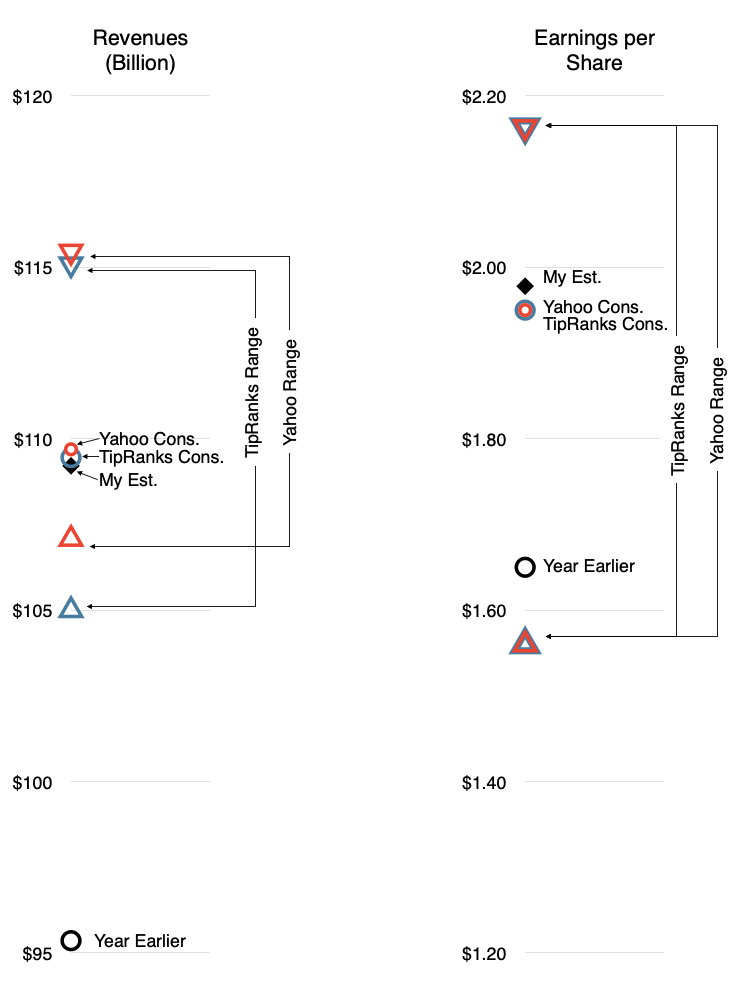
    A consensus of analysts expects Apple to earn $1.94 per share on $109.73B in revenue for the fiscal second quarter.

    Source: Seeking Alpha

    NB: Missing the forest for the trees. Tune in to the post earnings discussion on Office Hours.

  3. Asymco One Office Hours Live Q&A with Horace Dediu & Gene Munster: April 8, 2026

    Office Hours

    A lively discsussion of Apple topics such as:

    • Geopolitics: China concentration; Taiwan tail risk
    • Financials: Solid near-term growth
    • AI: Critical narrative shift; to be proven
    • Growth Strategy: User expansion
    • Business Model: Evolution: hardware → services → Personal AI platform
    • Moat: Privacy + integration; trust

    Non-Subscribers:

    Join Asymco One as a Subscriber to participate OR

    Just Register to Watch live.

    Contact us at events@asysmco.com if you have any questions.

    For most up-to-date information, see

  4. iPhone becomes India's top single export item

    Nota Bene · 1 comment

    Five iPhone assembly plants — three operated by Tata Group entities and two by Foxconn — supported by a supply chain of around 45 companies

    Apple Inc.'s iPhone became India's top single export item in 2025, with shipments worth $23 billion, largely to the US, driven by the government's PLI scheme and supply chain diversification from China. Smartphones emerged as India's leading export category with Apple contributing 76 per cent.

    Smartphones were India's top export category for the first time, surpassing automotive diesel fuel, with a total $30.13 billion worth of exports in the January-December period. Apple accounted for 76 per cent of total smartphone exports. Apple's five‑year PLI window is scheduled to end in March 2026.

    Source: International Business Times

    NB: During the last Active conference I discussed with the author of...

  5. Supply Chain Checks Show Non-Doom Scenario has Legs

    Nota Bene

    GF Securities said a recent survey on the tech giant's supply chain suggests a “solid outlook.”

    “Following the earnings call on Jan. 29, 2026, we did a supply chain research which indicates strong iPhone build momentum (incl. 2H26’s models) as well as cost management aiming to keep the starting selling prices of iPhone 18 Pro/Pro Max unchanged or at [a] similar level of iPhone 17 Pro/Pro Max,” analyst Jeff Pu wrote in a note to clients.

    “Additionally, [the] Gemini partnership is to work on the Apple foundational model to power the Apple Intelligence, including the personalized Siri, which is the next key to watch in WWDC 2026.”

    Pu reiterated his Buy rating and upped his price target [] on the back of higher 2026 and 2027 estimates.

    Delving deeper, Pu said the upcoming fiscal third-quarter should see another “strong” iPhone build, with around 54M units, which would suggest a year-over-year acceleration. “For 2H26, we note that Apple is expected to launch 3 new iPhone 18 models (Pro, Pro Max, Fold), compared to 4 iPhone 17 models a year ago,” Pu added. “Yet, we expect a solid iPhone 18 build plan in 2H26 of 82m, compared to 89m of iPhone 17 in 2H25, despite [a] much higher [average] selling price. We attribute the key drivers to the new foldable model and Apple’s strategy of keeping iPhone 18 Pro/Pro Max pricing largely the same as that of iPhone 17 Pro/Pro Max by managing
    memory/display cost. That said, we expect a significant iPhone ASP
    increase in CY2H26 driven by mix.”

    On the company's recent earnings call, Apple management, led by CEO Tim Cook, said revenue is expected to grow between 13% and 16% year-over-year.

    Looking to the cost of the iPhone 18 Pro and Pro Max, Pu said the recent impact of surging memory prices should be manageable. “For DRAM, we believe Apple has been negotiating with Samsung Memory and SK Hynix to reach favorable deals, considering Apple’s support in the past memory downcycle and the likely capital investments,” the analyst explained. “For NAND, we estimate the cost to be up ~70% QoQ in F2Q and suppliers are asking for 50-60% QoQ in F3Q. Overall, we expect the BOM cost of memory to increase from 9- 10% in F1Q to 12-13% in F3Q. To partially offset the cost of memory price and 2nm A20 Pro, we expect efforts on other big items such as
    display, cameras, etc.”

    Source: MSN, SeekingAlpha.

  6. Margin Call

    Research

    While the commentariat assumes the worst, Apple delivers the best.

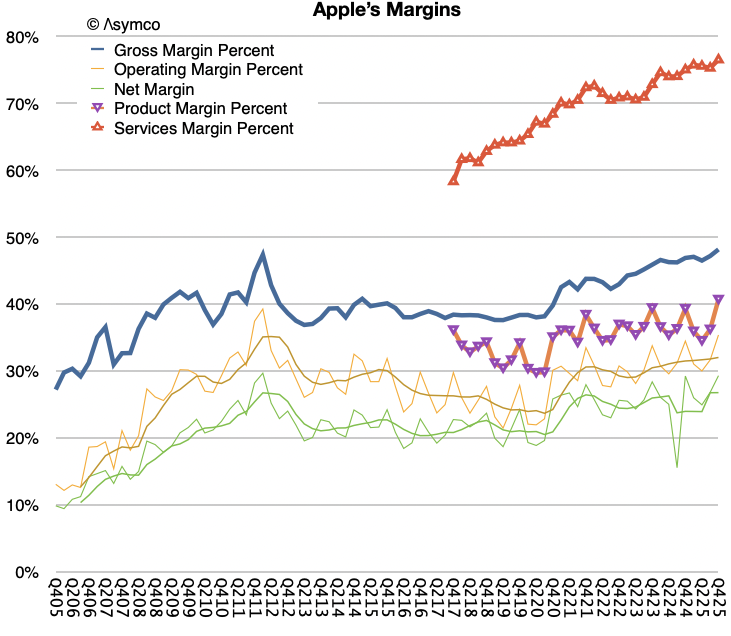
    Last quarter Apple delivered a gross margin of 48.2%. This was above the high end of their guidance range and up 100 basis points sequentially. Management commented that this was "driven by favorable mix and leverage."

    Further, products gross margin was 40.7%, up 450 basis points sequentially, driven by favorable mix and leverage. Services gross margin was 76.5%, up 120 basis points sequentially, driven by mix.

    This performance is even more astonishing considering the history shown below. Apple is quite simply, delivering at the highest gross and net margins in its history.

    Line graph depicting Apple's profit margins over time, including Gross Margin, Operating Margin, Net Margin, Product Margin, and Services Margin percentages, with data spanning from 2010 to 2023.

    Note that the graph actually projects forward one quarter because we have the following guidance: "We expect gross margin to be between 48-49%." The graph reflects the high end of this guidance range.

    So what's going on? Especially as a drumbeat of constant doom is being broadcast by pundits. The conference call itself seemed to be dedicated to margins. It became what I call the Margin Call.

    Amit Daryanani, the first questioning analyst, specifically kicked off with the following:

    "there is a lot of focus on the impact of memory to host the companies, and I would love to kind of get your perspective when you are first guiding gross margins up into March. Talk about, a, your comfort in securing the bit that you need for shipment and b, how do we think about memory inflation flowing through Apple's model over time?"

    Tim Cook answered:

    We are currently constrained, and at this point, it is difficult to predict when supply and demand will balance. The constraints that we have are driven by the availability of the advanced nodes that our SoCs are produced on. And at this time, we are seeing less flexibility in the supply chain than normal, partly because of our increased demand that I just spoke about. From a memory point of view, to answer your question, memory had a minimal impact on Q1. So the December gross margin. We do expect it to be a bit more of an impact on the Q2 gross margin, and that was comprehended in the outlook of 48 to 49% that Kevin gave earlier.

    what Apple is saying is that they are constrained by production of silicon but not of memory. They do see some impact in the future but that is included in a guidance of margin expansion.

    Analysts still could not believe this, the following exchange soon followed:

    Ben Reitzes: So the next question is on gross margin. I am pretty shocked I gotta hand it to you, Tim. I am, you know, that you are able to do 48 to 49. What is really going on there? How are you doing that with this memory, the NAND prices? Is it due to mix that there is a good less hardware and more services? Services and services margins are going up. How are you doing it to keep it at 48 to 49?

    Kevan Parekh: Yeah, Ben. This is Kevin. [] Let me start maybe by just reflecting on the Q1 gross margin. I think we talked about the fact that we landed at 48.2%, so just above the high end of the range we provided, [], on the last call. [] if you look at that performance, [], we were up 100 basis points sequentially. We talked about the fact that we had favorable mix. [], as you know, when we have a good product cycle, strong price cycle we are seeing for iPhone, that does lend itself to a bit more favorable opportunity on the [] leverage side.

    So we are having a strong iPhone cycle as Tim outlined. And so that also translates itself. So we talked about products sequentially went up by 450 basis points. So I think, in general, I think we are just seeing, [], favorable mix dynamics as well. [], service continues to contribute as well. That business is growing, [], double digits, so that also is a contributor. And I think that, [], if you looked at our guidance, [], we are providing a similar range to where we reported in December. There are going to be a few puts and takes. [], we do expect to see favorable mix in the services.

    As you know, when we move from Q1 to Q2, that tends to be the case, and that is partly offset by a seasonal loss leverage. So there will be puts and takes, but again, we feel pretty good about the guide of 48 to 49%, which is similar to the range we reported in December.

    Still not enough. Two more questions followed on margin. I will quote one here.

    Aaron Rakers: Yep. And then as a quick follow-up, you know, kind of tied to memory, maybe not so much, but part of this current generation iPhone cycle is you clearly deepened some of your own internal silicon capabilities on the device. I am curious if that if we should think about that as a lever and maybe a supportive factor to gross margin that might be underappreciated and any thoughts on where we go from here as far as continual opportunities of internalizing your own silicon? Thank you.

    Timothy D. Cook: Yeah. I will let Kevin talk about the gross margin. But in terms of the product, which is at the heart of what we think about in the user, Apple silicon has just been an incredible game changer for us. Starting with iPhone and then on iPad and, of course, the Mac as of a few years ago. And so we believe it is a game changer and a major advantage.

    Kevan Parekh: Yeah. And as far as impact on gross margin, yeah, we have been, as you know, investing in core technologies like our own silicon and our own modem. And certainly, while those do provide opportunities for cost savings and can be plugged in margins, they also importantly provide, [], the differentiation that is really important for our products as well and us more control of our roadmap. So I think there is a lot of strategic value to it, but also we are seeing, [], investments in our core technologies impacting, [], gross margin in a positive way.

    After all this, the financial commentariat continues to assume that Apple will be hit with margin pressure from memory and that has presumably been affecting the share price since the call.

    Well, we've seen all this before. Before the great memory crisis Apple was going to be constrained by tariffs, by China, by developer dissatisfaction, by AI, by regulators, etc.

    The feeling one gets is that Apple is always navigating through a minefield of pitfalls and gotchas. The opposite is true. It's highly likely that Apple has sufficient leverage which increases its access to supply and that everyone is keen to work with the company. Leverage comes from scale, from lead time, from vertical integration and from engineering. Management is saying as much. Indeed, the evidence of leverage across the supply chain and over the entire ecosystem and economy is evident in its margin expansion story told in the graph above.

  7. Asymcar #33 Concept, Outcome and Pivot

    Podcast · 1 comment


    Sam Abuelsamid reflects on the origins of BMW's i program, today's economics and the application of lessons learned.

    We veer into supply chain details and consider the path that the legacy automakers have chosen.

    The show closes with a discussion of Apple's entry assets, supply chain power and business model evolution.

    Source: Asymcar #33

  8. The real threat that Samsung poses to Apple

    Podcast · 430 comments

    [The following is a post written by James Allworth.

    James is the co-author of How Will You Measure Your Life?. He has worked as a Fellow at the Forum for Growth and Innovation at Harvard Business School, at Apple, and Booz & Company. It follows and builds on a discussion we had on the 56th Critical Path podcast.

    You can connect directly with James on Twitter at @jamesallworth -ed]

    A lot of ink has been spilled in the wake of the recent Apple Samsung patent disputes, and the legal wars see no sign of abating any time soon. The rise of Samsung's phone business has been meteoric, and Apple is right to be concerned. But the real threat that Samsung poses to Apple has very little to do with the copying (or not) of Apple's designs. The lawsuits have simply been a convenient (if expensive and risky) way to attempt to quash a threat that is of Apple's own making. While there's no doubt that Google has played a key role in Samsung's success by handing out a free mobile operating system to pretty much anyone who wants to build one — it is actually Apple, more than any other company, that is responsible for Samsung's present success.

    How? By outsourcing as much work to Samsung as they have. And it's impossible not to wonder whether Tim Cook's announcement yesterday on bringing back Apple's manufacturing to the USA is the beginnings of an attempt to rectify the problem.

    But first, I want to establish why copying is actually less of a threat to Apple than you might think. Daring Fireball's John Gruber wrote last year on what he termed "The New Apple Advantage". Like most people who appreciate Apple and its products, the starting point for Gruber's appreciation of Apple is its design — he says as much in the article. But the realization that Gruber has in the article on Apple's true competitive advantage is what's really interesting:

    So let’s be lazy for a second here, and attribute all of Apple’s success over the past 15 years to two men: Steve Jobs and Tim Cook. We’ll give Jobs the credit for the adjectives beautiful, elegant, innovative, and fun. We’ll give Cook the credit for the adjectives affordable, reliable, available, and profitable. Jobs designs them, Cook makes them and sells them.

    It’s the Jobs side of the equation that Apple’s rivals — phone, tablet, laptop, whatever — are able to copy. Thus the patents and the lawsuits. Design is copyable. But the Cook side of things — Apple’s economy of scale advantage — cannot be copied by any company with a complex product lineup. How could Dell, for example, possibly copy Apple’s operations when they currently classify “Design & Performance” and “Thin & Powerful” as separate laptop categories?

    This realization sort of snuck up on me. I’ve always been interested in Apple’s products because of their superior design; the business side of the company was never of as much interest. But at this point, it seems clear to me that however superior Apple’s design is, it’s their business and operations strength — the Cook side of the equation — that is furthest ahead of their competition, and the more sustainable advantage. It cannot be copied without going through the same sort of decade-long process that Apple went through.
    (emphasis mine)

    The argument is beautifully made. The design part of Apple's equation is to their ability to redefine new industries as they did with the iPhone. Whether they go after the TV market next, or something else, it's this integrated design component that will be crucial to their initial success. But compared to the business side of Apple, design actually generates much less sustained strategic advantage in any one product category, once performance in that category becomes "good enough". The tech industry has always revolved around copying. Once folks work out how it's done, everyone piles on. And at that point, it becomes much less about design than it does about how you operate your business.

    It is the last part of the Gruber quote that really drives things home. "It cannot be copied without going through the same sort of decade-long process that Apple went through". He's right — it's very hard for a competitor to outright replicate what Apple has achieved without going through all the same steps. But it got me thinking of a concept — and a related story — that I learned from someone I was fortunate enough to have as a teacher: Clayton Christensen. Perhaps a competitor didn't have to copy Apple.

    What happens if Apple had already taught them?

    Christensen first wrote about the dangers of outsourcing in The Innovator's Solution, explaining how seeking to maximize efficiency by employing third party vendors to do the "low value-add" work for you can be a lethal strategy. In the Solution, Christensen and Michael Raynor gave the example of two fictional corporations—"Component Corporation" and "Texas Computer Corporation". I had the good fortune to work with Clay on his most recent book, How Will You Measure Your Life?, and we recount a similar story; only without any of the players being disguised. The story is that of Asus and Dell, and how by outsourcing its work—starting with just basic circuit boards—Dell equipped a competitor:

    Asus came to Dell and said, “We’ve done a good job fabricating these motherboards for you. Why don’t you let us assemble the whole computer for you, too? Assembling those products is not what’s made you successful. We can take all the remaining manufacturing assets off your balance sheet, and we can do it all for 20 percent less.”

    The Dell analysts realized that this, too, was a win- win...

    That process continued as Dell outsourced the management of its supply chain, and then the design of its computers themselves. Dell essentially outsourced everything inside its personal-computer business—everything except its brand— to Asus. Dell’s Return on Net Assets became very high, as it had very few assets left in the consumer part of its business.

    Then, in 2005, Asus announced the creation of its own brand of computers. In this Greek-tragedy tale, Asus had taken everything it had learned from Dell and applied it for itself. It started at the simplest of activities in the value chain, then, decision by decision, every time that Dell outsourced the next lowest-value-adding of the remaining activities in its business, Asus added a higher value-adding activity to its business.

    There are two sides to this story: the part that relates to Dell, and the part that relates to Asus. Dell, in its quest to maximize its financial efficiency, continued to outsource way beyond manufacturing components and assembly. They outsourced a long way up the value chain. But there's also the side of the story that relates to Asus — a small components manufacturer that was, in effect, nursed to success by Dell. The extent of the schooling delivered by Dell to Asus was pretty profound, given how far up the value chain Dell outsourced its operations.

    But here's a question: at what point did Dell seal its fate? When was it that Dell had outsourced enough that Asus, with a desire to simply get out of the low-value work, could have made it all the way to the point that it did? I'm beginning to wonder whether just component development and assembly was enough. In the case of Samsung, it seems that everything else they needed to learn, they did by entering the emerging market, which Apple has largely left alone.

    Now, it's obvious that there are some very clear differences between the decisions that Apple have made in terms of outsourcing, and the decisions Dell have made. Dell outsourced its business all the way up to the design of its products. In many respects, Apple is doing the opposite — going so far as to even bring chip design in house. Horace has done some fantastic work detailing the extensive amount of investment Apple has made in its supply chain and it's clear that they've spent a lot of money investing in equipment used in production.

    But there's also no denying that Apple has begun to rely extensively on a network of suppliers across Asia.

    It's when you start putting the two arguments together that you realize that Apple may have a more serious problem on its hands. I want to again recount the final two lines of Gruber's argument:

    It’s their business and operations strength — the Cook side of the equation — that is furthest ahead of their competition, and the more sustainable advantage. It cannot be copied without going through the same sort of decade-long process that Apple went through.

    He's right — generating that scale requires a long gestation period — one that Apple went through. And it can't be copied without significant time and effort on the part of a competitor. But there's one big implicit assumption here — that suppliers won't turn around and start developing their own offering. Because when Apple went through this transformative process, where the design whittled down the broad range of offerings to just a few, and they generated the scale on the business side that accompanied that — they weren't actually the only one to go through that process. Apple's partners — their suppliers — went through it with them. And they've got very big, and very good at what they do. Samsung, obviously, is among those partners.

    Now, the response I often hear to this line of reasoning is: Apple hasn't outsourced anywhere near as much as Dell has. How are the situations analogous? But I think it's actually the wrong question. Instead, the question is: has Apple already outsourced too much?

    For all intents and purposes, we're at a level of maturity in the smartphone market where I believe design — particularly on the hardware side — has largely become commoditised. Performance is now "good enough". Whereas it was not so long ago that consumers sat on the edge of their seats to find out what the new iPhone had to offer ("please, fix the battery life", or "please, make it faster") the recent release of the iPhone 5 seemed not to generate the same intense reaction. Now, I'm not saying it won't sell well — in fact, it will probably become the best selling phone of all time — but people aren't making these decisions based on huge design differences between the devices. The basis of competition has shifted. HTC recently learned this the hard way when it introduced the One X — a phone that, to the critics, at least, was considered the best Android phone available — "a masterpiece",  "one of the best mobile devices I've ever used". Yet it has been absolutely crushed in the marketplace by Samsung.  How? Well, Samsung used its business scale to, as Horace put it on Twitter, "invite operators to a better party with an eye-watering marketing budget". This has nothing to do with Samsung making a better phone (they probably didn't), or Samsung copying Apple (indeed, HTC may have just done a better job of copying Apple). Instead, it has everything to do with the fact that Samsung has had its business sucked along in Apple's slipstream.

    There's another way of seeing just how deep the problem lies. Jobs promised "thermonuclear war" on the copied devices, and so far, the biggest target of Apple's many legal warheads has undoubtedly been Samsung. Getting a $1 billion judgement certainly proves Apple was serious about it. But doesn't it seem strange to you that the target of such a devastating strategy on the legal side, just so happens to be… one of the most important suppliers for Apple's new phone?

    The problem that Apple is facing right now has nothing to do with their designs being copied. There is a long history of copying in the tech industry; patents being deployed in lawsuits by giants often signify desperation more than anything else. Rather, the problem that Apple faces is that it now is going up against at least one competitor that has been a beneficiary of the scale that Apple has achieved on the business side. Samsung has clearly demonstrated that, like Asus, it was not satisfied being a low-margin ODM — of doing all the menial work while somebody else made the big bucks. Suing Samsung over Android patents isn't going to change that — if Google's operating system gets too expensive to use, there'll be a switch made to Microsoft. Or to another operating system altogether. It doesn't really matter, because design in the smartphone space has been commoditized. It's good enough. Manufacturers are now creating performance that most consumers aren't able to absorb. Instead, as we've moved into a world where performance is now "good enough", the world has flipped into one where it's the business side — operational scale — that matters most.

    Apple have taken steps to minimize the ability of competitors to duplicate their business advantage. There's a great post here on Quora describing how Apple has used its supply chain as a competitive advantage and how competitors end up subsidizing Apple's use of the technology. But the approach of "locking in" key new technology so nobody else can get them works best in a world where consumers need more performance from their devices — a world is rapidly slipping away.

    So, what's Apple got to do? In so much as it is able to trust its suppliers of key components not to become competitors, it can continue to use them. But where it can't, or where those suppliers have already become competitors, it has only one sensible choice — replace them. It has two choices here: the first (and obvious one) is with another supplier. But that risks the same thing happening all over again — Apple nursing another supplier into a competitor. The second choice: for components and services that are critical to maintaining competitive advantage in the markets which Apple plays, Apple needs to build the components themselves.

    Most companies wouldn't be in a position do that. But Apple is almost already there. I also hear that there might be a country out there with relatively high unemployment rate, looking for some jobs to be brought back home. Funnily enough, it seems that's just what Tim Cook is doing right now. This approach might just be a good way of on-shoring some of those untaxed offshore profits (I imagine the tax benefits for building a few factories in the US would be quite high), all the while taking away business from competitors — both current and future.

    But there's one question that still remains. In the instance of the threat that Samsung poses to Apple: is it already too late?

    –

    Looking for more information on the renaissance of production and its effect on the technology industries? Then come to Asymconf and take part in the debate.
     

  9. The iPad slowdown and impact from the Japanese disaster

    Research · 41 comments

    Tim Cook explains that there was no material impact from the Japanese disaster:

    "Regarding our global supply chain, as a result of outstanding teamwork and unprecedented resilience of our partners, we did not have any supply or cost impact in our fiscal Q2 as a result of the tragedy, and we currently do not anticipate any material supply or cost impact in our fiscal Q3. To provide a bit more color on this, we sourced hundreds, literally hundreds of items from Japan, and they range from components such as LCDs, optical drives, NAND Flash and DRAM to base materials such as resins, coatings and foil that are part of the production process at several layers back in the supply chain. The earthquake and subsequent tsunami and the associated nuclear crisis caused disruption for many of these suppliers, and many unaffected suppliers have been impacted by power interruptions.

    But since the disaster, Apple employees have literally been working around the clock with our supplier partners in Japan, and have been able to implement a number of contingency plans. Our preference from the beginning of this tragedy has been to remain with our long-term partners in Japan. And I have to say, they have displayed an incredible resilience that I personally never seen before in the aftermath of this disaster. So while we do not anticipate -- currently anticipate any material impact to our component supply or cost in our fiscal Q3, we do need to caution everyone that the situation remains unpredictable"

    via Apple Management Discusses Q2 2011 Results - Earnings Call Transcript - Seeking Alpha.

    Still, the message did not get through to everyone:

    However, the supply chain impact on Apple from Japan’s earthquake, tsunami and nuclear power crisis is the culprit behind the only product line that came in below expectations – iPad. Apple sold 4.7 million units of iPad, vs. analysts’ expectation of 6 million.

    The Rise and Rise of Apple: Time For A Split? - Seeking Alpha

    The shortfall in iPad units was explained by Tim Cook as ramp-up challenges:

    "Let me mention a few things for you to consider, Toni. First off, product transitions are never simple. And as you can probably appreciate, we are in a position that we have to call them for many, many weeks in advance in terms of how many of the current product we want to produce and the dates at which we will announce the new product. We drew the channel down on the current product or the original iPad, I should say, by 570,000 units during the quarter. And we added at the end of the quarter 170,000 of the new iPad 2s although most of that was in transit at the end of the quarter. And so the net reduction was 400,000. And so our sell-through was above 5 million for the quarter. And again, this has to be planned quite a ways in the future. I think the key point here is --

    [also the dates, just to remind you, we set out an invitation to the event toward the end of February. We had the event in early March. We placed the unit on sale in the United States on March 11 and our quarter ended about 2 weeks thereafter. And so there was some expectation of a new product, and we would have obviously factored that into our thinking about the product transition as we plan the number of the original unit to build.]

    And so I think the key point here is that I'm extremely pleased with the progress that we were making on the manufacturing ramp. We have gotten off to a materially better start and produced a lot more units than we did on the original ramp of the first iPad. And when we're so confident with our ability to supply that we've already put on 25 additional countries at the end of March, and we'll be placing on 13 more next week and we'll do even more as we stepped through the quarter."