Asymco

Asymmetric Intelligence

Toshiba

  1. Take the money and run

    Research · 26 comments

    In August 2007, during the HD format wars between HD-DVD and Blu-ray format, Toshiba offered Paramount and Dreamworks $150 million to produce HD versions of their movies exclusively as HD-DVD.[1]

    This type of deal is equivalent to an "advance" offered to a book author. The DVD manufacturer pays studios up-front cash for the right to make its DVDs. From an accounting point of view this is treated as an advance that the manufacturer recovers by selling the DVDs back to the studio's video division in the same way a publisher earns back the advance it gives an author.

    In this case, the payment was so large and the sales of HD-DVDs so small that Toshiba was unlikely to earn back the entire advance. The way the deal made any sense for Toshiba was that it was exclusive: the studios could not continue to release their movies in Blu-ray. The deal was done explicitly to hobble a competitor and create "critical mass" of content for its own format.

    But then in March 2008, Toshiba threw in the towel and abandoned the HD-DVD format. The way the deal worked, the studios got to keep almost all of the $150 million. They then re-released all their movies in the Blu-ray format. The only "cost" to the $150 million windfall was that there was a nine month delay in the eventual release to Blu-ray--a small price to pay for an emergent format without a large install base.[2]

    Platform owners go to great lengths to ensure "content" for their platform. They will, essentially, finance an ecosystem when there are barriers to entry or when competing ecosystems are far more lucrative.

    This scenario for movies is being played again with Netflix, Hulu and other distributors who need to fill their pipelines. Netflix's content acquisition costs are exploding and putting the whole company's future in doubt.

    But this scenario is also being played out with app developers. Most recently, news broke that developers are receiving payments from Microsoft for Windows Phone ports of popular apps. In mobile platforms, apps are the new content and developers are the new studios.  It's also a practice that is not without precedent[3].

    This is as it should be. The value of the platform lies mainly in what is built on top of it just like a foundation is not much use without a house on it. However, the practice of "priming the pump" with cash payments for porting is not ideal. Like spiffs, those who receive payments may become used to it and withhold development if there is no payment. Also, those who did not get payment offers may feel shunned and retaliate in kind. Those who receive payment may become cynical about it and may not put in the extra effort (or, more probably, outsource) to make the work spectacular.

    Or, like Paramount, they may just take the money and run if/when the platform fails.

    ---

    Notes:

    1. Source: The Hollywood Economist 2.0: The Hidden Financial Reality Behind the Movies by Edward Jay Epstein.
    2. Paramount made $250 million more from three "replication output" deals: $50 million from Toshiba for agreeing to release Titanic on DVD in time for Christmas sales, $150 million from Panasonic for agreeing to allow them to take over video replication from Thompson, and $50 million from the law firm Ziffrin, Brittenham and Circuit City stores for agreeing to support the DIVX format. Paramount got to keep the money even though DIVX never launched.
    3. Although it's never been reported that Apple pays developers for building iOS apps, some developers do benefit from promotional placement and visibility during launch events and from early access to devices or SDKs under development.
  2. Does the phone market forgive failure?

    Research · 59 comments

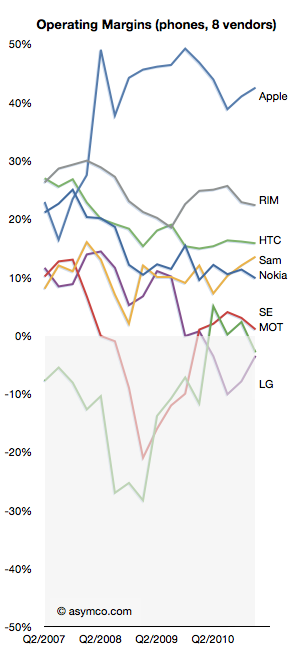
    One of the details of Nokia's warning which did not get a lot of attention was the mention that profitability for the current quarter could not be guaranteed. That is to say that Nokia may make a loss, perhaps for the first time in more than a decade.

    This may not be that newsworthy except for the strange fact that as far as I've been able to observe, any company in the mobile phone market that ended up losing money has never recovered its standing in terms of share or profit (i.e. AMP index value has never recovered).

    Here is a list companies that have "hit the rocks" in terms of mobile phone profitability and their fates (in no particular order).

    1. Alcatel of France. Sold its brand and operations to TCL Communications of China in 2004.
    2. Siemens of Germany. Exited in 2005 through acquisition by BenQ of Taiwan.
    3. BenQ of Taiwan. Mobile devices division declared bankruptcy in 2006.
    4. Ericsson of Sweden. Exited by merging with Sony in 2001 even though third in volume share the prior year.
    5. Sony of Japan.  Joined with Ericsson to form Sony Ericsson in 2001. Held less than 1% share prior to merger.
    6. Motorola of the United States. Even though once the largest vendors, after a period of severe distress, Motorola spun off Motorola Mobility. Market value shows long-term viability still a concern.
    7. Casio of Japan. Merged with NEC and Hitachi in 2010.
    8. NEC of Japan. Merged phone units with Casio and Hitachi in 2010.
    9. Hitachi of Japan. Merged phone units with NEC and Casio in 2010.
    10. Fujitsu of Japan. Merged with Toshiba in 2010. Held 15 percent of Japanese market prior to merger.
    11. Toshiba of Japan. Merged with Fujitsu in 2010. Held 4% share in Japan.
    12. Palm of the United States. Sold to HP in 2010.
    13. Handspring of the United States. Sold to Palm in 2003.

    That makes 13 large phone brands that, in less than a decade, have either exited or lost independence after suffering crises of profitability.

    As the following chart shows, at this time Motorola, Sony Ericsson and LG are still operating but have been dipping into the red.

    The three suffered severe volume contractions in feature phones and have no differentiation in software or platform products which makes their position precarious.

    This cursory survey shows that it's difficult to be optimistic once a company reaches a point of crisis. It's a curious outcome given that the market is so vast and growth is so robust.

    But the fact is that because of the technology cycle time, rapid business model evolution and fairly low barriers to entry, there is great rivalry between competitors. Profitability is the canary in the coal mine. It causes a brand to be tarnished in the eyes of distributors who, because of sales cycle times, are extremely sensitive to obsolete inventory. A loss maker is seen as a maker of damaged goods.

    It then turns off the tap of incentives, promotions and hence visibility in the eyes of consumers. It's a vicious cycle from which few (if any) can recover. Past greatness offers no succor.

    And so, with Nokia about to join the list of loss-makers it's only natural to question its fate as an independent company.

  3. It's time for Apple to look at owning factories again

    Research · 95 comments

    Toshiba plant to make LCD panels for Apple: report | Reuters.

    Apple will invest in a portion of the investment for the factory, the Nikkei said.

    This is one of the more interesting news items I've seen for a while.

    [UPDATE] Toshiba denies rumor Apple will invest in mobile display subsidiary

    There was a time when Apple designed and owned factories. From an interview with John Sculley:

    That went all the way through to the systems when he built the Macintosh factory. It was supposed to be the first automated factory but what it really was a final assembly and test factory with a  pick-to-pack robotic automation. It is not as novel today as it was 25 years ago, but I can remember when the CEO of General Motors along with  Ross Perot came out just to look at the  Macintosh factory. All we were doing was final assembly and test but it was done so beautifully. It was as well thought through in design as a factory--a lights out factory requiring many people--as the products were.

    During the 90s the manufacturing function moved outside Apple's ownership umbrella. It was more economical, more flexible and more scaleable to outsource manufacturing to Asia. The time has come to rethink this.

    For the past few decades outsourced manufacturing has grown in scale and scope as prices fell and quality increased. However there are signs that this global web of suppliers and assemblers is reaching a point of disruptive change.

    Press attention has focused on labor practices, pay structures and the enormity of factory towns where literally millions of workers are employed and housed. As is often the case press attention only hints at some causality and as such misses the point. Journalists looking for a story about child labor or suicidal workers might serve us better by putting the spotlight on the fact that factory towns are not competitive.

    centralized Manufacturing is not good enough for the coming mobile computing disruption

    The real problem with Chinese factory towns is that they are not flexible enough. By concentrating facilities and workers, electronics manufacturers have improved on measures of scale and quality but are still only able to ramp up and down on individual products once or twice per year. This does not meet the need to increase responsiveness to markets and the pace of development and design. It also reaches some critical overweight mass. Capacity cannot double or triple again to meet the need of six billion consumers. There are signs that the business model must change.

    Typically a product is born in Product Marketing, progresses through Design, R&D and then to Manufacturing and finally to Sales. Each of these stages of development has to be re-started for each new product, often in a pipeline fashion. However, some of these stages are increasing their cycle times while others are at their limits. This limits the throughput of the whole chain. If, for example, R&D can put out two product designs in the space it takes for one Sales cycle then they need to be tasked with different product while they wait for "capacity" in Sales to catch up.

    My contention is that the bottleneck in device product development is now manufacturing. The evidence is that Apple (among many others) cannot meet demand. Sometimes it's a lack of components, but often there is a forecast error and capacity is simply not allocated. What I also see is that this bottleneck is not solvable with the current value chain architecture. When there are 5 billion consumers of platform devices, centralized factory town manufacturing does not match the cycle time of either design or of consumption.

    The answer to low capacity is more investment in more lines of production, more workers and more suppliers. However the problem is that this takes time. The window of opportunity for a product is less than six months.

    Consider the iPhone product cycle. A new variant goes into development 18 months to two years before it's launched. It's ready for manufacturing a few months before launch. The R&D team is off making the next version long before the product hits any shelves. The cycle time for R&D changes unpredictably. Sometimes it slips, sometimes it may be shorter because the changes are minor. Perhaps marketing sees the need to react to changing market conditions. However, manufacturing plods along at an inflexible rate.

    How can it be fixed?

    I'm not an expert in this area, but as a student of disruption I see signs of opportunity to re-engineer the manufacturing business model. The patterns from history are plain to see: Centralized systems get broken down and re-aligned with new bases of competition. Value chains disintegrate and re-integrate as profit algorithms change.

    The new algorithm says you need to ramp production quickly (up and down) and to increase "product turns" from one to two each year. Each ramp needs to be even bigger than they are now. Maybe by a factor of two. Products should be built closer to where they are consumed to drive costs and delays out of transportation and tariffs. Carbon footprints need to be reduced.

    Sounds daunting. But the rewards could be enormous. The business model may need re-definition. By owning the means of production, the value added can be shifted to another point (i.e. production can be run at a loss in exchange for higher margins elsewhere.)

    All this requires capital. Lots of it. Apple has it. I see no better use for it than to re-define production as a synchronized development module.

    It's time to look at owning factories again.

  4. Mobile phone companies consolidate while the smartphone market expands

    Research · 2 comments

    In Japan’s second cell-phone merger this month, Fujitsu and Toshiba said Thursday they will merge their handset operations ... NEC, Casio Computer and Hitachi merged their phone units earlier this month.

    via Fujitsu and Toshiba to Merge Cellphone Units - DealBook Blog - NYTimes.com.

    Mergers usually happen in a mature industry when there is excess capacity and decreasing growth.  In the mobile phone market we've seen several companies disappear or merge over the past decade:

    • Ericsson
    • Sony
    • Alcatel
    • Siemens
    • Casio
    • NEC
    • Hitachi
    • Fujitsu
    • Toshiba
    • Palm
    • Handspring
    • Motorola tried but failed to get itself acquired.

    But we've just seen forecasts where the smartphone market is growing and is expected to continue growing at 40%. Why is there consolidation in a growing market?

    The obvious answer is that none of the companies listed above had any significant smartphone businesses.  But that begs another question: why? Is the smartphone market so different than the mobile phone market?

    If the answer is yes, then there is an implied asymmetry.  Asymmetry is symptomatic of disruption. Disruption then leads one to ask how the other incumbents will cope?