Asymco

Asymmetric Intelligence

ZTE

  1. 400 million phones per quarter and everything's topsy turvy

    Research · 40 comments

    Sony Ericsson is no more. The company remains but the brand is gone. Now the phones it makes will be sold under the Sony name. Unfortunately, that means we no longer get reports from the company on its volumes, profitability and sales. The units will be part of "Other" from now on.

    That vendor's data disappears as did HTC's and Samsung's earlier reporting. Bit by bit, vendors are withdrawing information. RIM stopped reporting its average selling prices some time ago, Motorola may disappear completely and they already stopped reporting tablet sales.

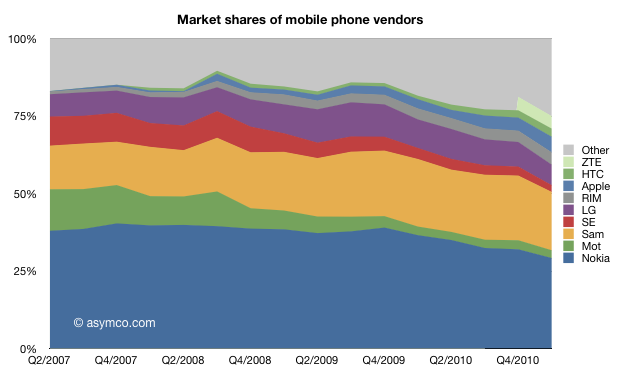
    This makes the picture of the market fuzzier each quarter. We have to rely more and more on analysts who publish estimates. I try to pick from the available data the best assumptions but the errors are undoubtedly increasing. Here are the charts showing unit volumes in terms of absolute, share and ranking.
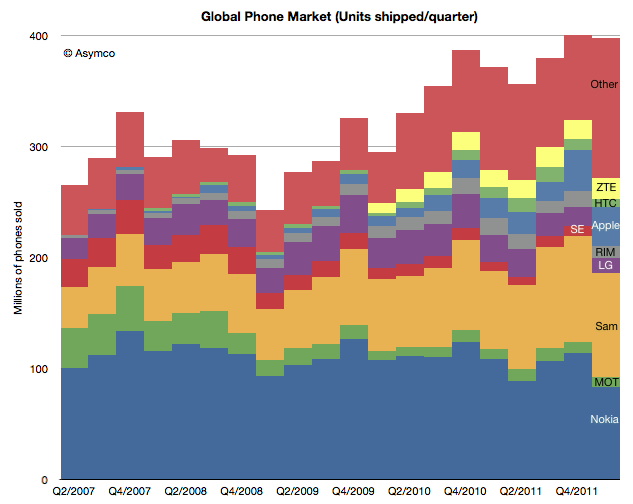
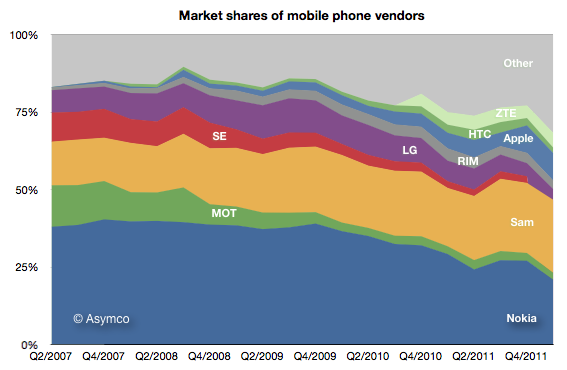
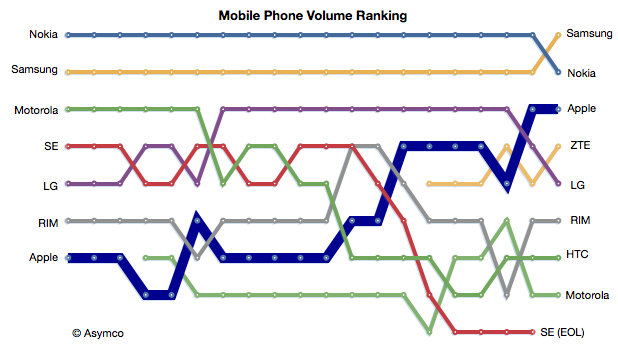
    As I wrote previously, Samsung has overtaken Nokia which lost the top spot in unit shipment ranking, a spot it held for 14 years.

    Of all the participants, only three brands enjoyed growth this last quarter: Apple, Samsung and ZTE. ZTE, like Apple, is noteworthy for its late entry. The others are in a mess: Motorola -4%, Nokia -24%, RIM -26%, HTC -29%, LG -44% in terms of unit growth y/y. This, while the market managed a modest gain.

    It still find it fascinating that such a large market, selling 400 million units every quarter can exhibit such rapid change in participant ranking.
  2. The end of phone vendor tiers

    Research · 25 comments

    It's time to review the mobile phone market at the end of the first quarter of 2011. Before I begin, I'd like to remind that this analysis will span multiple posts and that many details will be published separately due to time and space constraints. Data about platforms, sales, profitability and pricing will be posted separately.

    All data sets and chart data will be available for interaction and download through Asymco Interactive when complete. You can purchase a license to Asymco Interactive anytime and you will have access to any new data sets for next 90 days so don't hesitate to pre-order the report.

    The overall phone market grew at a compound rate of 9% over three years. The pattern of entrants focused on smartphones and mobile computing growing faster than the incumbents continues. The compound three year unit growth for the tracked vendors in descending order is:

    1. Apple 122%
    2. HTC 55%
    3. RIM 50%
    4. Samsung 15%
    5. Other 14%
    6. LG 0%
    7. Nokia -2%
    8. Sony Ericsson -29%
    9. Motorola -30%

    To give an idea of the split between smart and non smart, Nokia's smart business grew at 18% compounded while its non-smart units contracted at -6% rate.

    In terms of y/y growth the market grew at 26% and the vendor ranking is:

    1. HTC 194%
    2. Apple 113%
    3. Other 103%
    4. ZTE 75%
    5. RIM 42%
    6. Motorola 13%
    7. Samsung 9%
    8. Nokia 1% (smart: 13%, non-smart -2.3%)
    9. LG -10%
    10. Sony Ericsson -23%

    Sequentially, the growth rankings are:

    1. Other 28%
    2. Apple 15%
    3. HTC 7%
    4. RIM 5%
    5. ZTE -10%
    6. Nokia -12%
    7. Samsung -13%
    8. Motorola -18%
    9. LG -20%
    10. Sony Ericsson -28%

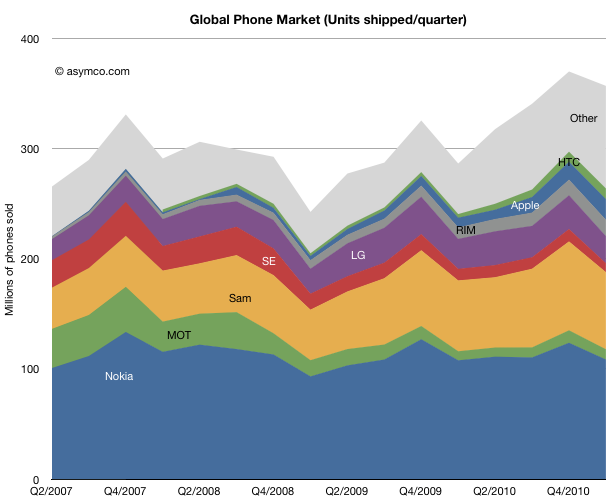
    In terms of market share, the field is becoming more crowded.

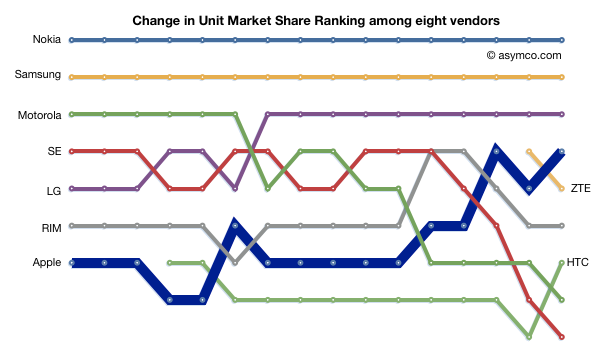
    The ranking of units shows a continuing relegation of Sony Ericsson and the increase of HTC to 7th spot. Apple reclaimed its fourth spot from ZTE.

    As the number of vendors increases and the share of incumbents decreases it becomes harder to identify who is a "top tier" vendor or, in fact, what the tiers are.

    It's pretty clear that on a unit basis there are nine vendors selling significant volumes. The other important observation is that vendors like ZTE are graduating from "other" while "other" is still growing, now at 25% of the market.

  3. The certainty of unforeseeable growth: The rise of ZTE and Huawei

    Research · 37 comments

    • According to rumors, Huawei shipped 30 million phones last year. The target for this year is 60 million of which 15 will be smartphones.
    • According to IDC ZTE is now the fourth largest mobile phone vendor with 51.8 million units in 2010. Assuming 70% for 2011, ZTE could ship 88 million units in 2011, 25 million of which would be smartphones.
    • These data imply that ZTE and Huawei will ship nearly 150 million phones in 2011 of which 40 million would be smartphones.
    • That would imply approximately 7% share of the global smartphone market for these two companies together.

    What is remarkable about this is that the market share of these vendors was zero in the previous year.  It's hard to get comfortable with this market entry. The challenge for forecasters and analysts is that there is little history to draw upon. How will the entrants affect the rivalry between firms? Will the distribution be overlapping with incumbents or will the entrants be competing with non-consumption?

    The only thing we can be certain of is that the adoption of smartphones is increasing at a faster rate than is foreseeable.

  4. 20% vs 33% for "Others": Why are Gartner and IDC so far apart on mobile phone market estimates

    Research · 39 comments

    The latest mobile phone estimates from Gartner made a startling claim that "Others" vendors increased share from 16% a year ago to 33%. Doubling share in a year is possible if you're at 1% share but to double from a base of 16% is sounding improbable. They allege that the "Others" now sell more phones than Nokia. And Others don't even include ZTE and Huawei, the prototypical low end challengers.

    They emphasize this point in their discussion and state that the incumbent vendors are being pressured by these low end entrants. They go on to explain that the same set of vendors will probably use Android to enter the smartphone space.

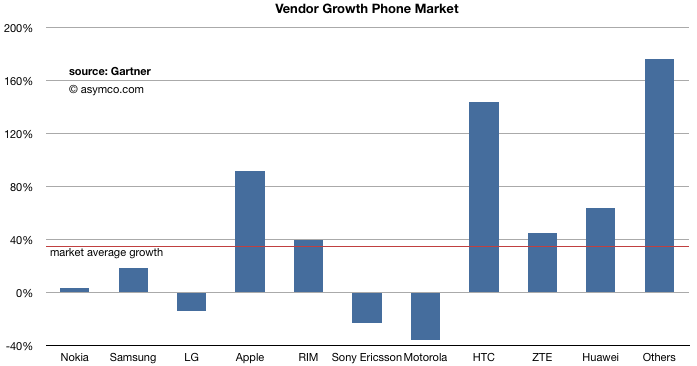
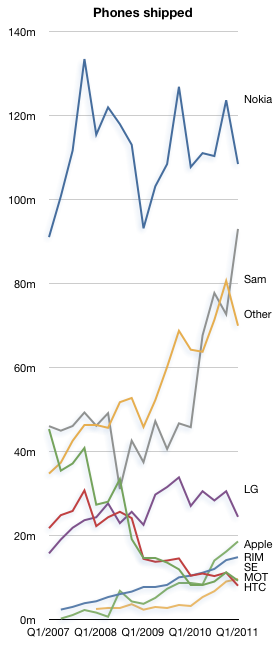
    To illustrate, the growth of individual companies is shown here (all phones).

    Also puzzling is that ZTE and Huawei did not share in this boom. They barely beat market growth and were growing at half of "Others". Until recently ZTE and Huawei were themselves Others, so the new vendors are truly unbranded "white box" vendors.

    To put it in perspective, their year-on-year growth is astronomical: 176%, selling 87 million more phones this third quarter than last year's. This is equivalent to saying that a new company was born in the last year and has already become the second largest in the world. The growth in volumes is higher than the total units Samsung sold!

    Mind the gap

    Extraordinary claims require extraordinary evidence. Can we check what other analysts estimated and do some form of validation of the claims?

    Yes we can.

    IDC reports the same data and they only reported 340.5 million phones sold (vs. Gartner's 417 million). Excluding ZTE and Huawei the total share for "Others" in IDC would be about 20%.

    20% share vs. 33% share is a big gap.

    IDC and Gartner both agree on smartphones, so the difference is even more glaring when you consider the "non-smart" comparisons:

    Non-smart phones:

    Total Market: millions of units sold____3Q2009______3Q2010
    Gartner268337
    IDC244260

    For added emphasis, I added a comparison of last year's quarter. Last year the Gartner total estimate was about 10% higher than IDC. This year they are 30% higher.

    How could the difference in the total phones sold be so big: 77 million phones?

    If Gartner is right, how could IDC miss 77 million phones. If IDC is right how did Gartner conjure up 77 million phones in one quarter? That number is nearly as big as all the smartphones sold (81 million). This is not within any margin of error for whatever sampling method they use.

    Perhaps they need to clarify this because until they do, neither is credible.

    --

    Note: My own models are built from individual company public reports. The only data I depend on from IDC and/or Gartner is this total market size which allows me to back out what the "Others" are doing. If the total market estimates disagree so much, I'll be forced to throw out the "Others" all together.