Is an iPhone worth 8 Nokia phones or 2 Blackberries?
Research #Industry · 4 comments
by Horace Dediu
Pricing is a leading indicator of value. Some might argue price and value are often out of whack but, in the long term the two converge.
So it's instructive to measure how a vendor creates value by what it's able to charge for its goods. In the case of mobile phones, price is summarized by something called ASP (average selling price) which is measured each quarter across a vendor's entire portfolio.
Again, there might be local fluctuations, but the trend is your friend here.
Take a look at these charts I prepared based on the group of seven vendors I previously analyzed in terms of their sales and volume performance.
First, a history of pricing since Q2 2007. All figures are in US dollars current as of time of reporting.
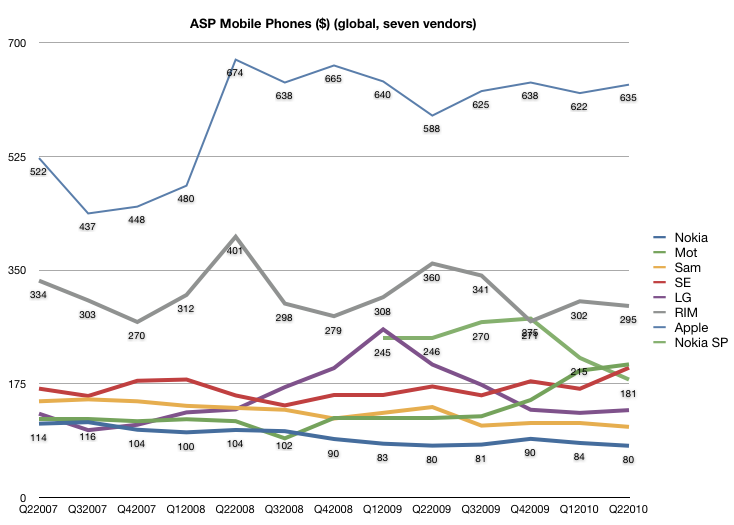
Here we see the ASP erosion inherent in the large incumbents with Nokia and Samsung both seeing price slides. LG went through a phase of price growth but has returned to a point near to where it started three years ago.
While Sony Ericsson and Motorola were following the downtrend until 2008, they reversed and began an ASP climb while fleeing upmarket (at the expense of volumes).
Finally we have RIM and Apple both holding the line on pricing while growing volumes. Not only are the lines steady (with Apple slightly increasing and RIM slightly decreasing) but they are way above their competitors; Apple's shockingly so.
Here is the before-and-after view:
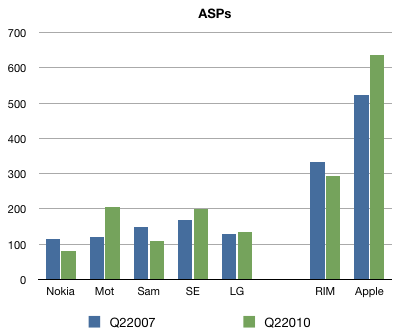
During the three year window we're looking at, Apple and RIM showed ASP durability while incumbents showed ASP erosion.
Pile these data points on top of the volume and sales data and we can move forward.
(In answer to the question in the headline, the answer is: Yes.)
4 comments
JoshKo ·
ASP is useful for comparison if vendors are selling in the same product category. RIM and Apple are comparable because arguable they only sell smartphones or advance OS phones.
Nokia on the other hand sells a lot of dumbphones. If its dumbphone unit growth is faster in absolute units than it smartphone growth you are going to get ASP erosion. This does not necessarily indicate poor performance. I'd say its profitability that is far more important.
Not backing up Nokia or anything, just pointing out that ASP comparison is an apples and oranges comparison because you are looking at at least two product categories. Smartphones and dumbphones. A far more valid comparison would be if you could segment out Nokia smartphones.
asymco ·
Nokia's dumbphone unit is not growing as fast as its smartphones. I'll be posting on profitability tomorrow.
However, after years of treating the two separately, I want to deliberately merge the dumbphone and smartphone categories. My working assumption is that all phones will be smartphones and separating the two leads to cognitive illusions. For example the share of units leads to artificial ceilings. Is 40% smartphone share "saturation"? Can RIM and/or Apple grow even though they have only 2% global phone share?
When iPhone launched Steve Jobs said their aim was 1% share by end of 2008. Note that was share of all phones. I think they made their target all phones and they continue to target all phones.
JoshKo ·
My main point is that an ASP comparison of say apple vs nokia does not make sense. Even if you think that all phones would be smartphones an ASP comparison would not make sense until a significant majority of Nokia's unit sales are smartphones.
That being said smartphone units sold may outnumber dumbphone units in say 5 years, but in phones in use will be dumbphone dominated for at least 8-9 years.
Smartphone saturation points will also vary by country and and the saturation points themselves will change especially in countries will rapid economic growth such as China. All phones in use may eventually switch over to smartphones but you are looking maybe 20 years out for that to happen. The main reason is that developing economies have little use for smartphones, as they are worrying about accessing basic needs first which dumbphones can provide. Smartphones require an ecosystem of developers who create relevant applications, website services/applications that provide value, localized media content video/audio that is accessible. Smartphones pretty much need a developed 3G network in the area for data access as well as enough people who are willing to pay for data access. Additionally smartphones work best in part when they are managed by a laptop/desktop. All these issues are why dumbphones have a long long life left.
asymco ·
I've added data on Nokia Smartphones ASP, to the extent they are available. The line in in light green above. The Nokia SP ASP has been falling and at $181 today is roughly inline with Sony Ericsson and LG, but well below RIM and Apple.