When will smartphones become phones?
Research #Industry · 31 comments
by Horace Dediu
The US smartphone penetration continues to accelerate.
ComScore has been reporting the estimated absolute number of smartphone users and the last month saw a significant increase of 1.58% in penetration. About 30% of the 234 million US cellphone users (above age of 13) use smartphones. That number was 21% in May of last year.
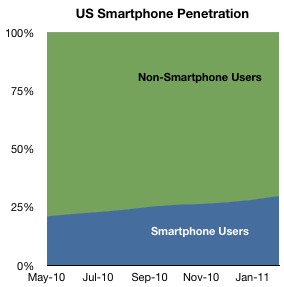
That means that over 20 million people stopped using voice-only or feature phones in the last 10 months. Equivalent to a rate of 2 million per month.
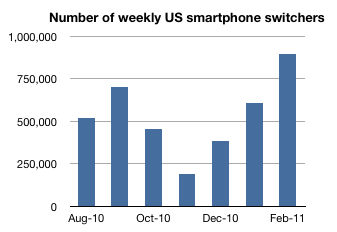
However, the rate of switching has not been steady. The following chart shows the number of switchers per week. In February it's been about 900,000 per week and it's quite possible that in March we've seen 1 million per week.
To bring the point home, I have put together a countdown timer which will be updated monthly with my estimate of the date when 50% of US cell phone subscribers will be using smartphones. (There is a link to the timer at the top right of every page on this blog).
I pinned that 50% figure because by then I hope people will stop calling them smartphones and begin calling them phones.
31 comments
Roger ·
I have a computer in my pocket that happens to make phone calls.
Ryan Tracey ·
I think 50% is a far threshold, Horace. To be perfectly honest, I'm surprised the percentage of smartphones isn't higher at the moment, because every cellphone I see seems to be a smartphone. Maybe people who own non-smartphones are hiding them?
Ben ·
Can you post your working definition of what constitutes a smart phone? A data plan? Or just the ability to text?
FiXedNcome ·
My wife and I share a vehicle and a feature phone. Whoever has the vehicle has the phone. We purchase one 1,000 minute/1year plan for $100/year, and still have minutes left over. On the other hand, we save $25/month by not paying for residential trash pickup (we take most to the recycle center). That pays for 3G for the iPad, which is easy on our eyes and if we have to, we can make calls with Skype. It's unlikely we'll ever get a smartphone with a tiny screen.
Sergio ·
Why the US-centric obsession on adoption? I can understand a US-centric bias when it comes to technology creation, as the US are still pretty much on top of their game on this, but on technology adoption (and after you've clearly explained all the irregularities in the US mobile market in previous articles) surely this is a global game, where Europe and China matter as much. I'd like to see similar charts on Europe and APAC to balance the picture (even if they come with big caveats as the data is no doubt more fragmented and difficult to gather).
MattF ·
... and when penetration gets past 50%, it'll be time for a new disruption. Ca plus change...
asymco ·
Neither. I see a smartphone as a mobile phone with an operating system that has published native APIs. Functionally, a smartphone can run downloadable apps written to take advantage of that phone's specific hardware.
asymco ·
The main reason people with landlines took to mobile phones is that they could start calling people not just places. It sounds like you don't have a mobile phone, but your car does. Keeping in mind that there is no right or wrong way to do it, what you hire the phone for is completely different than what most other people hire it for.
Omar ·
I agree, feature phones or dumb phones will be extinct in a few years, permanently replaced by what we refer today as smart phones. It's the natural evolution of technology and it should and will be embraced as a welcome change.
asymco ·
> I'd like to see similar charts on Europe and APAC to balance the picture
So would I. The data exists but it's behind very, very steep pay walls. We are just feeding on the crumbs falling off a table where wealthy companies are gorging.
Omar ·
When will they combine data & texting as the same resource, because truthfully, to text is nothing more than data. It never made sense to me why they were differentiated in the industry other than pure greed.
davel ·
I thought it already has?
At 30% I would think smartphone customers make more revenue for VZ,T than the others. So that is where the focus is on the street on the train you see more smartphones than regular phones. At least that seems to be true in NYC.
LTMP ·
How steep is it? Perhaps we could raise the capital from Asymco readers? I'd gladly put in $20 or $30 to see your analysis. Even if I don't get a t-shirt. If the money was raised, what are the restrictions on the release of your analysis?
Hamranhansenhansen ·
Is the jump in US smartphone adoption in February the Verizon iPhone?
I would love to see iPod users overlaid on this. Everybody I know who has a feature phone has an iPod touch.
Rob Scott ·
"I pinned that 50% figure because by then I hope people will stop calling them smartphones and begin calling them phones."
This is my biggest hope too. The current classification is failing us and it has dumbed the discussion.
Steven Noyes ·
But VZ, AT&T et al also have higher startup costs when they subsidize their customers to the tune of $200 to $300 for their phone. Thant might make the break even point 8-10 months into a 2 year contract.
Horace, do you have any thoughts in how the added data costs outweigh the higher subsidizes?
Sergio ·
Oh I see, so carriers never disclose their figures freely in those regions... How about the manufacturers?
Justin ·
Look at the history of SMS (e.g. on Wikipedia: "The key idea for SMS was to use this telephony-optimized system, and to transport messages on the signaling paths needed to control the telephony traffic during time periods when no signaling traffic existed. In this way, unused resources in the system could be used to transport messages at minimal cost.").
MMS is nothing more than data. SMS, however, is a novel use of a waste product of the voice service. (Over-)charging for SMS is the problem... but as SMS becomes more popular than voice, it is not surprising that carriers charge for what people see value in.
@Accent_Sweden ·
I agree. This is the low-cost solution or simply the stuck-on-Verizon solution - a feature phone with an iPod Touch. My sister's example could be typical. She used an iPod Touch for two reasons: AT&T had no coverage where she lives and she rationalized that the iPhone was too expensive. Then the Verizon iPhone arrived and she "dropped" her camera and suddenly she rationalized she could afford the Verizon iPhone without having received a pay raise. It replaced her camera and phone. I suggest her thought process is similar to how many other people think. While it wasn't an option, it was unnecessary. Now that she can have it, it seems a reasonable purchase.
@neonzebra ·
Cool countdown. Makes a nice little Dashboard widget in OS X. :)
Calcifer ·
In the Netherlands ,smartphone market share has overtaken dumb phones in march. This was announced by market researcher Gfk today on a presentation. Smartphone share was 51.7%
asymco ·
The restrictions on redistribution are pretty severe. As a matter of policy I don't use non-public info.
Perhaps a business model for analysis will emerge where it's more valuable to share data and charge for insight rather than vice versa.
asymco ·
It's unlikely. comScore surveys are 3 month rolling windows. The one ending Feb covered only 18 days (out of 90) with iPhone on Verizon. What's more, it measures installed base, not sales during that period. I think some of the growth came from the iPhone on VZ but the momentum is still mostly Android and iPhone on AT&T. These surveys are most useful to spot long-term trends rather than any event.
Ryan Tracey ·
Good point!
asymco ·
Manufacturers don't either. Very rarely there might be some regional detail (e.g. Apple breaks down regional sales for the Mac.) There are data gathering organizations that poll various channels (retail, distribution, etc.) and build models on that basis, but they are also estimating.
asymco ·
I believe it, but keep in mind that Gfk measures sales per month. The data above is the number of current users or installed base. Half the people who were buying were buying x last month is not the same as saying half of all people have x.
relentlessfocus ·
The phone is just one software app on these devices. Why would you want to call it a phone?
berult ·
Smart phone is to phone what non commodity is to commodity, what development is to maturity, what vanity is to self-assuredness.
We'll eventually call it a phone for the same reason we call a woman a woman; it's kinda redundant to call a woman smart, although the same cannot yet be said of a man ...as it cannot yet be said of a smart phone.
I bet 'phonekind' gets a promotion to 'phonehood' way ahead of 'mankind' getting a demotion to manhood...
SVE ·
I think they'll skip the transition from "smartphone" to "phone" altogether. They'll just jump straight to "handheld computer". It's no more a phone than it is a GPS unit, or MP3 player, or digital camera, or handheld game player, or alarm clock, or ...
Matthew Shepherdson ·
I'll consider getting a smartphone when they stop being artphones & go back to being smartphones. In the housing bubble (near full employment), Treos & BlackBerries ruled & were business- & productivity-oriented (PDAs w/ phone functionality). Now people are carrying portable TVs/gaming consoles (what I call artphones, i.e. serving aesthetic & not practical functions) -- I believe because so many are un- or underemployed & have so much time to goof off. If I want my cell phone to do anything else, it's to help me keep organized, not waste time.
Adam ·
My niece and nephews call iPhones "telephones".