Apple Stores have seventeen times better performance than the average retailer
Research #Industry #Market · 49 comments
by Horace Dediu
Thanks to RetailSails we have some data on retailers in the US which can be used to calibrate the performance of Apple retail. RetailSails compiled a table of the top 20 chains by sales per square foot (annual basis). The total sample was 160 American retailers (excluding restaurants) that publicly report results.

Sales per unit area is a standard and usually the primary measurement of store success. Here are some benchmark figures:
- Annual store sales in the range of $300 per square foot is considered respectable in the US.
- The US national average for regional malls is $341.
- The average for specialty apparel retailers is $400 per square foot.
- The average for jewelers is in the range of $600 per square foot.
- The median for the best 20 US retailers is $787/sq. ft.
The data for the top 20 is shown in the following chart:
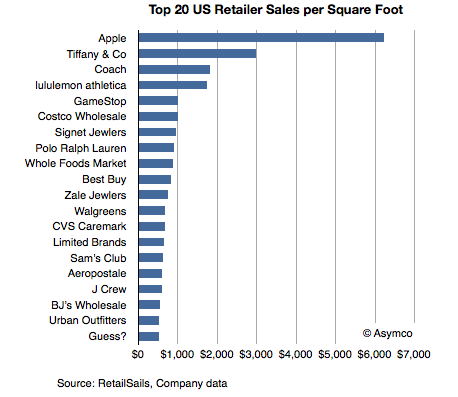
The data shows Apple leading by a significant margin. It's more than twice as efficient as the second place Tiffany and Co. It's also more than seven times the median of the top 20 and seventeen times better than the average mall retail space.
Note also that this data includes only physical retail and excludes e-commerce, catalog or services revenues. It should only be used to compare physical retail performance.
The achievement is also remarkable when measuring growth in overall sales.
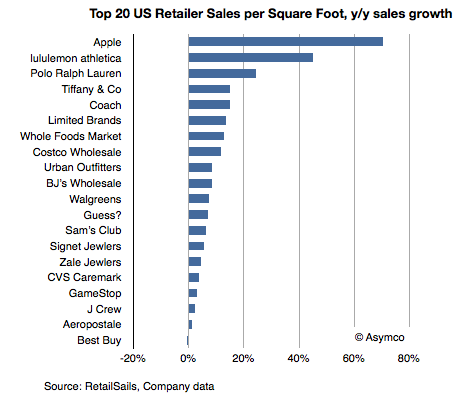
Apple leads in absolute performance but also in growth.
Note also the performance of electronics retailers that might be comparable to Apple. Only Best Buy and GameStop are on the list, but their growth is among the poorest, with Best Buy going in the wrong direction (data was current as of August 2011).
We'll be getting an update on Apple retail at the next earnings call in a few days. To read more about Apple retail see:
49 comments
RobDK ·
The figures for Apple cannot be true - there must be something wrong?!
That there is such a disproportionate difference between Apple and other retailers shows once again that Apple is in a class of its own.
Richard ·
This is an incredible statistic. Many of us knew the stores were a great success but this is off the charts (literally). I think we can track this directly to the wisdom of Jobs in bringing Millard Drexler onto the Apple board who no doubt pushed them to hire Ron Johnson and build the retail stores. I highly recommend reading this profile of Drexler in The New Yorker:
http://www.newyorker.com/reporting/2010/09/20/100920fa_fact_paumgarten?currentPage=all
Ron Johnson may be gone (to Penny's who will be selling Apple products) but they still have Drexler.
Lex McFarley ·
Apple stores treat the customer and being very important, while other stores are indifferent or treat you like you are bad. For example, I can go into an Apple store, and buy certain products by just scanning them with my iPhone and walk about with an electronic receipt. At Costco or HomeDepot I have to show my receipt at the door.
The CW ·
it's not the stores, it's the products the stores are selling. As Apple growth goes so go the stores.
Horace Dediu ·
The products are important but so are the stores. The two are part of an integrated offering to consumers and they benefit from each other.
Stephen Howard ·
I think The CW is onto something. It's hard to know how much of the numbers above are an indication of Apple's retail prowess, and how much of it is an effect of how well Apple is doing as a whole compared to the other companies listed. It would be good to cross reference these numbers with broader sales data for each company.
Alisher ·
This is really helpful. It'd be nice to also compare Apple vs other retailers in terms of retail capex/store. I looked recently, I think Apple has been investing between $15-20M for every new store it added in 2011.
The CW ·
It would be interesting to compare online stores as well. Does Apple's online store produce similarly impressive sales figures relative to other online retailers? Are there stats available for that sort of comparison?
SamLowry ·
it might be interesting to watch J.C. Penney, wouldn't it?
procrustes ·
Looking at the article data link it appears that the numbers are for global sales for US chains and not sales in the US. It's still impressive but a bit unclear, and I'm not sure that this is a straight forward apples (sorry) to apples comparison. "all figures are based on global results for the most recently reported trailing 4 quarters (through fiscal Q3 ending 6/25 for Apple)."
Jesse-Douglas Mathewson ·
"the median of the top 20"
So, the average of #10 and #11...
Adrian Constantin ·
One way to validate the assumption that the store has added value in the sale of the product is to compare the performance of the Apple stores to that of other stores selling Apple products, e.g. AT&T sale points. Unfortunately the methodology would be quite complicated, because AT&T sells only iPhones + other smart and non-smart phones + subscriptions, so the product mix is very different. I wonder if there is any reasonable way to run such a comparison or if there is any other way to cross-check the cause and effects.
David H ·
Actually the numbers could have been far more disproportionate, if Apple stores were not so much larger than the average retail establishment . . . surely that has held there performance down when you are measuring on a per/square foot basis.
Mgp ·
Its easy to be efficient with ONE product line.
Jon ·
Is it really fair to compare when Apple has so few stores? Let's say based on their size, Apple should have 3 times the stores they currently do, then their sales per sq. foot are more in line with Coach et al. Just shows that Apple is milking a limited footprint, no?
TD ·
Apple stores are much larger than the average retail store? I thought if anything the opposite was generally true
Martyn ·
And would that one product line be desktops, laptops, tablets, phones, monitors, iPods, Apple TV's, software or third party products?
Steven Noyes ·
Apple could open 3X as many stores and have the new stores sell no items at all and still make more per ft^2 than coach.
No?
Jesse-Douglas Mathewson ·
#1 Apple's stores outnumber #4 lululemon, and #2 Tiffany & Co, so I'm not sure which part of the comparison you find unfair.
Big Awards ·
Have you been in an Apple store? You can barely get into mine and when you do there is a line to buy something! They will surely be the Retailer of the Year!
qka ·
My local Apple Store is next door to a Coach Store. Apple is always packed, Coach is usually deserted. I'm surprised Coach did so well in the statistics.
Z Kariv ·
In addition, the Genious Bar and other services that often are resulting in no sale, further coraborate this idea that one is complimenting and benefiting each other. The emphesis on satisfing the customer rather than "pushing the sale" is a well design and executed concept proving by these numbers. Thanks Horace for this article
Jesse-Douglas Mathewson ·
I think he means there's so much more open space in Apple Stores than in other retail establishment. This has always been an Apple Store trademark--that and the general luminescence of the parcel.
But one of the reason that Apple Stores are so successful is because of their layout, and one aspect of that layout is the free flowing experience that customers enjoy when they walk in.
Horace Dediu ·
I estimated about $10 million/Apple store based on the data here: https://fnayeri-ulqtb.wpcomstaging.com/2011/10/14/how-much-does-an-apple-store-cost/
Horace Dediu ·
The data is for global sales and the comparison is to US average. However, the vast majority of Apple stores are in the US (246 out of 363). It's unlikely that non-US Apple stores are affecting the sales/sq. ft. average overall to a large degree. (The question would be: why would traffic be higher/lower in non-US stores? My assumption is that it would be roughly the same.)
Horace Dediu ·
Given the distribution, I thought a median measure would be more representative. The average of the top 20 is $1222 or one sixth of the Apple stores.
Horace Dediu ·
The Apple stores are larger than the average mall store, but not larger than the average of the sample. The average size of the Apple stores is 7886 sq. ft. The average of the 20 samples above is 26,170 square feet. Costco, Sam's Club and BJ's are warehouse stores with huge areas. Whole Foods is a supermarket with a size of about 38k and Best Buy average is nearly 14k sq. ft. Tiffany's however is only 4.4k and lululemon is about 2.8k. The smallest is GameStop with 1.4k.
Horace Dediu ·
Of the sample above, in terms of stores, Apple has 327, Urban Outfitters 392, Polo Ralph Lauren 371, J Crew 337, Whole Foods 308, Tiffany & Co. 232, BJ's 190 and Lululemon 138. In terms of total available area, Apple is 14th. Six chains have smaller total areas.
steve moore ·
Have you got measures of retail ops costs Horace to provide retail-only profitability comparisons?
S
Gustavo Valencia ·
Great Data, not enough analysis. Would be a much better article if they provide a clue on how Apple achieves this... Although there are a few good comments that may not have any background...
Horace Dediu ·
The data is available for Apple but I don't have it for others.
Horace Dediu ·
You may want to read the articles linked at the bottom of the post.
Eric Schatz ·
What's next for Apple? How about outlet mall stores to move previous-year refurb/returns? Or a whole new lower-price-point brand?
Bodenste ·
This isn't rocket science. Most apple stores range in size from 3000 to 6000 square feet (http://www.ifoapplestore.com/the_stores.html). To achieve $6000 in sales a store must sell 3 average Apple laptops or 10 iPads.
So for a typical 5,000 square foot store that sells half iPads and half laptops that's 7500 laptops and 25,000 iPads. That's 21 laptops a day and 70 iPads a day. The store is open for 10 hours a day, so about 2 laptops an hour and 7 iPads an hour.
Is that rocket science? Not really. Last time I went to my suburban apple store in the middle of the day they were easily achieving that.
They do it by selling very little. Whomever shot off about "all that other stuff they sell," go back to the store. That is totally 5 years ago. They sell very little other than accessories for iPads and iPhones right now. 3rd party software for OS X? I mean the App store?
Horace Dediu ·
The average size of a store is better estimated from Apple's published total retail space in the Annual report (10-K). The last report from October stated "approximately 3.0 million square feet related to retail store space." Dividing that by the 361 stores open gives about 8300 square feet.
Test ·
Yet Apple is the only company that seems to care about this "easy" way to make vast amounts of money?
spuy767 ·
I actually find it more remarkable that Costco can manage $1000 per square foot given that the average Costco is about 150,000 square feet, if memory serves. That would mean that the average Costco bangs out $150,000,000.00 in sales in a year. Wow.
Rando ·
Currently Asia/Pacific accounts for 20% or more of total retail, despite being just a fraction of the stores. Trying to find it, but I thought one of the China retail stores did the most business overall at one point?
Sigivald ·
Or not, because why would they want to bother?
sachxn ·
Its absolutely amazing....its was all slow and steady process and Apple has won the race with high margins....awesome
aardman ·
A lower-price-point brand, if it ran OS-X would just decimate the current high end line. If it ran a hobbled version of OS-X, no one would buy it.
aardman ·
I stopped by the Genius Bar to drop of my iMac for overnight diagnosis and repair. I walked out of the store with a brand new iPad in hand. I think I know now why it's called the "Genius Bar".
aardman ·
My local Apple Store is right across a Microsoft Store. Why Microsoft chose to locate there, so that people can see how few people walk into their store compared to the Apple Store across the hallway, is beyond me.
Couple of weeks ago there was a line formed outside the Microsoft Store. They were giving away Windows phones.
ChKen ·
Costco, Sams and BJs sell virtually the same items in the same format. Interesting that Costco does so much better per soft.
Horace Dediu ·
Shanghai is the biggest store, but I have not heard a figure of retail sales by region. If you find a source, please post it.
richard wills ·
Apple sells specific products that consumers & businesses want to purchase and use. And then they provide superb support services afterwards.
Tiffany & the other jewelers have their advantage of constrained trade in diamonds and other gem and precious metals for which there are high mark-ups at each distribution level.
Coach & other luxury retailers have the advantage of perceived value in their trademarks. And they constrain trade in re-distribution through competing retailers.
Windows and Android users are mainly two groups. A narrow band of highly skilled, experience technocrats who demand personal control & command of their technology. If it helps, visualize them as street racers who do their own mechanics. The must larger group are the inexperienced and new users, to whom low equipent prices and integration with their employers information systems are most important.
Once that second group gets some experience in real-life usage, many of them will trade up to Apple products. This is one of phenomena propelling Apple sales the last decade. They learned the hard way that there is nothing as expensive as a bargain or "free". And to hell with the petulant whining from the IT technocrat priesthood.
Lead, follow or get kicked aside from a remorseless public.
Dave ·
I was in the retail leasing business for a long time. Apple's sales per square foot are so unbelievably extraordinary....there has never been anything like it to date. Apple has managed to create a magic brand. Real high end, luxury product for the masses. High demand products, plus relatively high price points, plus a panache tied to the product....and it reaches masses of people....way beyond that of the store with 2nd highest efficiency/sales per square foot.
put it all together and add the panache of actually buying the product at an apple store than say a best buy.....it has led to something that comes along once in a blue moon.
Nalini Kumar Muppala ·
The same source has another report in the month following the data you quote http://retailsails.files.wordpress.com/2011/09/rs_spsf.pdf The numbers and ranking are quite different.
adolf ·
u r gay