How many mobile platforms can a market sustain?
Research #Industry #Theory · 83 comments
by Horace Dediu
Using logistic curves to measure diffusion of innovations is a powerful method of analysis. However there are limits to what can be learned. The methodology helps in understanding how quickly a pervasive technology is adopted. It assumes that the technology "fills all available space" within a market. It therefore also assumes that whatever problems the technology solves are universal problems.
Put another way, if a technology is not universally useful, it tends to peak before a market saturates. This "universality" condition is in evidence when observing that pervasive technologies are adopted not only by all members of one national market but also all nations and through all means of government and regulation. In other words that the jobs that the technologies are hired to do are so important that they bulldoze any and all obstacles placed in the path of adoption.
The only difference is one of timing. Some regions are quicker than others. Institutionalized obstacles essentially defer rather than deter adoption. They impede rather than block.
And I am pretty sure that smartphones solve universal needs and their adoption will be nearly 100%. They also have fairly low impedance given the speed of adoption (50% penetration in most large markets seems to come in less than 5 years.)
That's the story for the technology, but how value is captured is another story.
Who captures and how it's captured are questions of commerce not economics. They are informed by competitive advantage and business models. The puzzle seems to be that individual companies don't capture value in the patterns of Logistic curves. Or at least I don't think they do.
Consider the graph below.
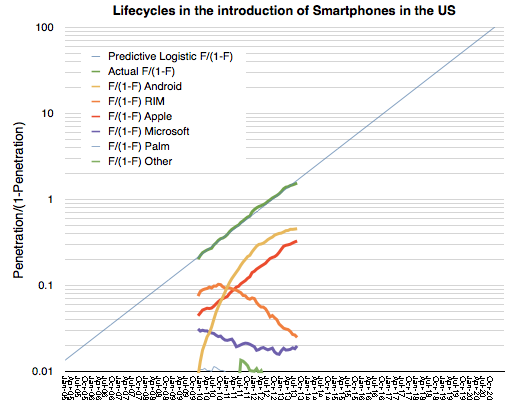
It shows the transformation of a logistic curve into a linear representation. It's a log-scale graph of fractional shares of smartphones in general (Blue/green Lines) and individual platforms in the US.
The individual platforms are shown as (Platform x share of all phones/share of all others). This is a "logistic substitution trajectory". ((Fisher and Pry, 1971, proposed a similar model to study the replacement of old by new technologies. The basic assumptions of the Fisher-Pry model are: (1) The substitution process is competitive. (2) Once substitution by the new technology has progressed as far as a few percent (i.e., "lock-in"), it will proceed until a complete takeover occurs. (3) the rate of fractional substitution F1 is proportional to the remaining substitution 1- F1 possible. Source: Grübler, The Rise and Fall of Infrastructures Physica-Verlag 1990.))
The problem is that whereas the overall category (smartphones) reaches saturation, it's not at all clear that any individual platform does. At least from the data we have so far, there is far too much volatility in platforms to see a clear pattern of monopoly emerging.
I'm not sure if this is "proof" enough to convince anyone that this market supports any number of platforms, but it certainly disproves that there will be only one. ((The odd pattern here seems to be Apple's consistent (i.e. parallel) adoption. One hypothesis could be that Apple is different in solving the prevailing job to be done while rivals jockey for positional advantage.)) We're too far along for churn to convert existing users before saturation sets in.
83 comments
EW Parris ·
The trajectory of Android creates the impression that the iPhone created pent up demand for affordable touch screen devices. Android allowed consumer electronics firms to flood the market with dozens of devices that filled that bill without requiring the effort of paying to develop their own OS.
In short, the existence of iPhone served as marketing for the entire industry.
Luis Alejandro Masanti ·
quote: "The odd pattern here seems to be Apple’s consistent (i.e. parallel) adoption. One hypothesis could be that Apple is different in solving the prevailing job to be done while rivals jockey for positional advantage."
The "odd" questions maybe is Why is Apple always different? And (most) always for the right reason? It is like they are behaviouring as a "perfect" logistic curve for it "own" platform (a.k.a. a percent of the maket).
poke ·
It looks like the chart is consistent with there being two markets: the smartphone market and a separate iPhone market. Many people have argued that the iPhone was an entirely new device (an "app phone") and Android can be viewed as a sustaining response by traditional handset manufacturers. Is this evidence?
wangthony ·
the iPhone *created* the entire industry...
ankushnarula ·
Seems like Apple's consistency is based on discipline and market leadership. They set the pace and rhythm for innovation via incremental product evolution and vertical integration of features and services. "Android" will eventually be Motorola Nexus. Samsung is trying hard to differentiate with their own (non-cloud) features and ecosystem - possibly sans Google. HTC will likely be acquired by Amazon. Microsoft will also emerge soon enough. They're not giving up.
EW Parris ·
There were "smart phones" and touch screen devices previously. They were just terrible.
wangthony ·
agreed, I'm just defining the current market as "non-terrible touchscreen smartphones"
Emilio Orione ·
It seems iPhone is saturating high end, while others are competing for low end.
dvhwgumby ·
This isn't completely on topic for this post but I have to dispute one point: you say," [smartphones] solve universal needs and ... have fairly low impedance given the speed of adoption (50% penetration in most large markets seems to come in less than 5 years.)" If you started that graph earlier, with treos and later BB, there's a long slow period. The iPhone changed the definition (i.e. people's expectations) and it's that LATTER curve you've graphed.
Now you could say, "well, since the iphone redefined the word, what we're talking about is that new word." But the interesting story is how you find that critical level of functionality that causes the phase change in the market.
obarthelemy ·
I'd think of it the other round: there's no external mathematical/economic law, it's differentiation vs network effects and economies of scale, and the ability of... someone... to whip up something compelling enough.
Differentiation can be targeted at OEMs, carriers/resellers, or customers (individuals or companies). I'm not sure how many market segments there are, nor how possible it would be for one of the 2 incumbents to address them. Also, the market has already seen several upsets; I think we've reached ossification (with iOS and Android here to stay), but I might be wrong.
One segment for sure is content providers: Amazon are doing their own ecosystem, using a variant of Android-the-OS. Barnes and Noble failed with Nook. I'm notsure there are that many companies with enough content sales potential to justify the expense of designing/forking an OS and setting up a PlayStore and PlayServices equivalent.
Android's OEMs are very free to accomodate carriers' whims, so I'm not sure that one is pushing for different ecosystems. Maybe to get a cut on content by displacing the PlayStore, but that's a difficult and expensive proposition.
Another segment is the very low end. 50% of people don't have a smartphone yet... they probably don't want one very much, since OK Android handsets start at $200. I'm actually surprised Apple haven't come out with an iPhone nano, with non-web-use in mind, only social and games.
I'd say there's another segment for pure Entreprise, but both Apple and Samsung, and MS, seem to be tackling that one aggressively. Also another for nerds, the ones who are installing Linux on desktops (currently filled by Android)
obarthelemy ·
What innovations have Apple come up with in the last 3 years ?
obarthelemy ·
I think iPhone is the only luxury phone. Not quite the same as high-end (specs and features are a wash), but the only other OEM that could aspire to luxury status is Sony, who are only now starting to recover from a calamitous joint-venture.
Will see how the decidedly not luxurious-looking iP5C fares
obarthelemy ·
If you define axiomatically that high-end = Apple, Yes. Otherwise, if you add sales of the premium Android models (Samsung GS4 and GNote, HTC One, Sony Z1 and LG G2), it's probably 50:50.
Samsung alone sold 27m (22m GS4 and 5m Galaxy Note) in Q2 2013, while Apple sold 38m (that's including the 4 and 4s). I don't have the other Android sales at hand.
normm ·
The extrapolation from Apple's straight-line trend on this graph is that Apple will have 90% of the market in six more years.
charly ·
I see Samsung selling them for 60 euro so $200 is probably to high
iPhone nano? Games require more power than webbrowsing and bringing a iPhone out without apps don't make sense
The nerd one will be filed by the Android distributions, sailfish and Ubuntu
charly ·
The curved phones from Samsung and LG are in my mind luxury too. And HTC is trying
melci ·
If you're going to include the Galaxy Note and all the other big screen phones that are tablets as well, then you'd better include the iPad and the iPod touch as well.
After all, we are talking operating systems here which is what platforms are all about.
That then puts Apple's iOS sales at almost 50 million for Q2 2013.
obarthelemy ·
Well, OP was talking about iPhones, not mobile devices in general. The Galaxy Notes are phones, large ones but not the largest. iPads and iPods aren't.
Horace Dediu ·
That's correct. Caveat emptor.
Sent from my iPad
Sergei ·
Too numerous to mention. They are all listed at www.apple.com
HelloWorld ·
Other than self-crashing cars, what innovations has Google come up with in the last 10 years?
obarthelemy ·
Are there any examples of Google cars actually crashing ?
Also, Google are not the ones going on and on about innovation and magic.
obarthelemy ·
gold casing ?
melci ·
If you're going to include tablets like the 6.3" Galaxy Mega (that happen to incorporate phone capability) this comparison of operating systems is only useful if you include at least the 7" iPad mini and the iPod touch as well. Heck many iPads also have 3G and LTE capabilities as well.
After all, when comparing "mobile platforms" it is the app platform that is the distinguishing factor. Otherwise, if the phone capability was the important feature, you would include dumb phones in this analysis.
The title itself says "mobile platforms" so should logically include all devices in those operating systems if the comparison is to be of any use to developers, advertisers, content providers and ultimately customers.
Otherwise it is as useless as comparing the Windows, Mac and Linux platforms but only counting laptops and ignoring desktop computers. A very artificial distinction that is far less useful than comparing all devices in each OS.
Chaka10 ·
I'm sorry, but you're being way too loose with your numbers. 38 mm for iPhone is for Apples fiscal 2Q, which is actually calendar 1Q. For calendar 2Q (i.e., the June ended quarter), Apple sold 31.4 mm iPhones. What are your sources for the GS4 and Note? I know it's not Samsung.
obarthelemy ·
I googled it, which you can do too; Anyway, it's pointless: the "saturation" affirmation is wrong, whther by 50% or 60% or 40% is immaterial.
Chaka10 ·
Wait, how do you know that Emilio's comment "(iPhone is saturating high end") is wrong, unless you have reliable data on sales of other high end devices? Sorry, "googled it" doesn't do it for me as a source, and as you might suspect, I follow this stuff very closely (looking for reliable data).
obarthelemy ·
You can try and novlang your way into iPhone being the only smartphone, but anything I can stick to my face (one-handed) and talk into is a phone. That does rule out 10" tablets (several do have phone capability, which does make sense for some users), and in my case 7" ones too but not by much, maybe when bezels get thinner... Also, the Mega (and the even bigger Sony Xperia Z Ultra) only come with 3/4G and are sold subsidized with contracts. they are huge phones, but they are phones.
The OP says iPhones, he's the one I'm replying too ?
melci ·
So why are you not counting dumb phones in your numbers? If the important distinction is that you stick them up to your face and talk into them, them featurephones qualify.
I'm also arguing with Horace. Comparing operating systems but only counting smartphones is pointless, but I understand it is because the analysts who publish the figures Horace uses are stuck in the old days of telephones and don't acknowledge that these platforms are bigger than that now.
They don't want to admit that comparing platforms but not counting all devices in those platforms is a recipe for hysterical headlines like "Android has 80% marketshare", when the reality is that the iOS platform is actually 700 million versus 1 billion Android devices - a much less sensational headline.
obarthelemy ·
Because I'm replying to a post about "high-end" ?
melci ·
Sorry obarthelemy for going off on a tangent - it always bugs me when people talk about platforms, but then ignore why distinguishing between platforms is important in the first place.
Your comment just happened to be the trigger this time. No offence.
Sacto_Joe ·
This isn't going to happen often, but I agree with obarthiemey. The main driver for Apple's growth curve seems to me to simply be producibility, which is typical of a luxury good. Apple continues to make progress in growing its production capacity logarithmically, but unlike the established mobile companies, it has had to do so basically from scratch.
obarthelemy ·
No probs. See my response to Horace's post, where I segregate Amazon from Android ^^
Bananaj ·
First retina display on a tablet (iPad 3rd generation)
World's thinnest smartphone (iPhone 5)
World's thinnest and lightest full size tablet (iPad 2 (at the time), iPad Air)
First 64 bit chip on a phone (iPhone 5S)
First usable fingerprint scanner on a phone (iPhone 5S)
32 track sound recording on a phone (GarageBand)
first to use Thunderbolt (Macs)
first to all-day battery life in a laptop (MacBook Air)
CoreMidi
iBeacon
obarthelemy ·
Those are all incremental things, except - the music which I think is true - the fingerprint scanner which I know is false.
BTW, thinnest phone is also false, all-day battery too.
charly ·
32 track is an example of an improvement but not innovation. It is more of the same not something new. The whole list is IMHO not of innovations but of improvements.
Steven Noyes ·
Why does no one use all of those GS4 and Notes. Serious question. Why are their usage statistics so far below the iPhone 5S (by 1/3 to 1/4)?
Steven Noyes ·
64 BIT ArmV7 married to Imagination's Rouge.
Bananaj ·
Which Ultrabooks have better battery life than the MacBook Air, and what OS are they running? I understand there are thinner phones than the iPhone 5 now, but a year ago?
It of course depends on how we are defining innovation. An iPad is "just" an incrementally bigger iPhone. An iPhone is "just" an incrementally more usable touchscreen smartphone. How big a change does it have to be to be regarded an innovation rather than an incremental improvement?
Innovation connotes "first", an introduction of something new. So being the first to market with an incremental improvement is important to the concept of innovation, but perhaps only if it sells and therefore changes the market - a "game changer"? If it wasn't important that the iPad had a retina screen, why do all competitors now have a high resolution screen? It was an innovation, something that Apple did first which quickly became a necessity. We'll see how things pan out with the fingerprint sensor, maybe it's just a gimmick, or maybe every phone will end up having one?
The new Mac Pro isn't an incremental improvement, it's a complete redesign. But it's still "just a computer". Is enabling realtime 4K video editing an incremental improvement? Yes, but it's an order of magnitude incremental improvement. 32 tracks on a phone is an order of magnitude of difference, only made possible by the speed of the A7 chip. It means a pro album could be recorded and mixed on an phone.
What innovations have Apple's competitors had in the past 3 years? First hybrid tablet/laptop that doesn't sell? First smart watch that nobody wants? First heads up display that isn't out yet? Smart Stay? What are people expecting? Hover phones? Phones that turn into robots? Would an iPhone with week-long battery life just be an incremental improvement?
obarthelemy ·
This is a true question: do you have a source for that ? I keep reading about iOS vs Android, but could never find anything about iOS vs **high-end** Android, for stuff such as app spend, page views, time spent...
obarthelemy ·
Apple have very nice; very smartly targeted SoCs. What give me pause is 1- "combining ARM's tech with Rogue's tech": it's very derivative 2- it's incremental; it doesn't do nor enable anything new, just same old, same old, but quicker
If that counts as innovation, most any new version of anything also does.
Bananaj ·
Magical: def.
A nonsense term used by Apple to describe order-of-magnitude UX experience improvements.
Innovation: def.
1. A nonsense term used by Apple to describe incremental improvements.
2. Any new feature or incremental improvement added to a product by Google, Microsoft or Samsung.
HelloWorld ·
http://jalopnik.com/5828101/this-is-googles-first-self+driving-car-crash
HelloWorld ·
The Prius — recognizable as a Google self-driving prototype from the roof equipment that's smaller than a typical Google Streetview image collector — have rear-ended another Prius.
thinner ·
What was a thinner smartphone at the launch of the iPhone 5?
obarthelemy ·
http://bit.ly/17h3BAS
thinner ·
You misspelled smartphone but there were no results on the first page that were relevant. Maybe try again?
thinner ·
I think you'll want to retract your comment as your own linked google search shows that you were wrong.
obarthelemy ·
first link lists 3 of them.
obarthelemy ·
Honestly, i don't think there's that much innovation. Improvements ans tweaks, but not innovations (things that allow new uses, not make old uses better/faster, ie a faster CPU/GPU doesn't count unless it really enables something meaningful, and even then, Moore's law feels kinda like a railroad anyway). And not things ported over from other domains (typically, desktop computing, such as voice recognition that I was doing 15 years ago on my PC).
I'm hard-pressed to spot "real" innovations. I don't think commercial success is a criteria, most innovations fail 1st time around. Once you realize phones are pocket+connected computers, pretty much everything we've seen follows. What I personally noticed on phones is IR transmitters (been around since Palm though), wireless charging, and pen input. Maybe widi/airplay/..., though ChromeCast sounds like a much smarter way to do the same, if it gets traction. Windowing on my tablet changed quite a bit my usage patterns, but is it really innovative when any computer has been doing that for ages ?
Edit: fingerprint scanner certainly is one, if it allows phone to become secure ID agents. requires a lot more than the hardware though.
obarthelemy ·
Hum. From the article: "One of our goals is to prevent fender-benders like this one, which occurred while a person was manually driving the car.""
obarthelemy ·
From the article: "One of our goals is to prevent fender-benders like this one, which occurred while a person was manually driving the car.""
thinner ·
All of which are thicker than the iPhone 5. Great work, Columbo.
obarthelemy ·
No. DROID RAZR, Ascend P1s, ZTE Athena . All from http://www.webpronews.com/these-phones-are-thinner-than-the-iphone-5-2012-09 which is the first link.
I going to assume you're not getting the same results, because otherwise....
mjw149 ·
Well, US only. Adoption curves have certainly varied by culture/region, based on economics and less quantifiable things.
thinner ·
Please do the simple legwork of verifying you're not saying things that are easily falsifiable. All three of those are thicker than the iPhone 5. Let's do 15s of image searching…
DROID RAZR: http://i-cdn.phonearena.com/images/articles/73772-image/drz.jpg Ascend P1s: http://www.digitaltrends.com/wp-content/uploads/2012/01/Huawei-Ascend-P1-S.jpg ZTE Athena: http://www.gadgetenthusiast.com/wp-content/uploads/2012/06/zte-athena.jpg
Notice a pattern? All have unsightly tumours on the back for cameras, batteries, etc, that are thicker than an iPhone 5. “Let me google that for you” indeed.
obarthelemy ·
I'm not sure a mini-bump on 2% of the back matters much. Then again, I'm not sure 0.5mm either way qualifies as innovation, either.
thinner ·
I think believing everything you read, uncritically, when it supports your worldview and opinions is called “confirmation bias”. Are you going to apologise to the person you mistakenly “corrected”?
obarthelemy ·
Sorry, not mistaken. Let's put it another way: if the bump was on Apple hardware, would you count it ?
thinner ·
I don't understand the question. It isn't, what does that have to do with your mistake, why would i be incentivised not to count it, and under what circumstances is a useful definition of the thickness of something “we picked some arbitrary point and measured it there”?
charly ·
Problem with fingerprint scanners is that they weren't first and that fingerprint scanners are notorious easy to crack. So easy in fact that they lead to false sense of security.
Steven Noyes ·
http://gs.statcounter.com/#mobile_resolution-US-monthly-201209-201309
Compare the 480X586 resolution to the 1080X1920 resolution. That represents the iPhone 5S compared against all 1080P handsets sold.
For the US. You have to compare region by region with stat-counter as the World Stats are unweighted and don't relate to real world usage.
This repeats for major region after major region. In France, for example, usage of 1080p handsets is so low it does not even make the graph.
Steven Noyes ·
From your view, no company has had anything innovative for the past 20 years. It is all just "same old, same old, but quicker". You can do everything with DOS you could with Windows 95. Symbian did everything Android did. Palm OS was just as good as Symbian just derivative. Google Glass is just derivative of existing HUD glasses shown at CES since 2010. The question is, do you judge Google's, MS's, Samsung's, HTC's, Sony's... engineering even 1/4 as hard as you judge Apple's engineering?
Yes, you strongly dislike Apple and think everything they do is derivative, boring, unimaginative and obvious. We get that. Show me another company, however, that has ArmV8 working with Rouge?
Steven Noyes ·
And all of them, like the Droid Razr, are actually thicker than the iPhone 5 since Moto lied on their specs by measuring from the thinest average thickness and the thickest point. Ascend and ZTE did similar things. That is why the mechanical specs are different in some countries (like the UK where they HAVE to use the thickest point and not the thinest).
BTW: You misspelled smartphone.
obarthelemy ·
I could point you to Qualcomm, who like Apple do their own ARM implementation, but unlike Apple also do their own graphics. Granted, they're not at 64 bit yet, but designing a GPU is way more difficult than implementing ARM v8 6 months ahead of the rest.
Also, ARMv8 is ARM's IP, not Apple's. Apple just did the implementation, not the design. They were good and quick at it tough.
(BTW, it's not Rouge, it's Rogue)
obarthelemy ·
Dammit, Disqus ate my answer... again:
1- I'm confused about the rez you're using for the iPhone, I'm assuming we want to filter the iP5, I can't find it. I'm not sure which line represents the iP5.
2- You're using Apple's rez of 12 months vs Samsung's (and Android's in general) rez of 6 months. That's very biased; Let's add 720p ?
3- Lets do wwide instead of cherry-picking the single most favorable country for Apple ? http://gs.statcounter.com/#mobile_resolution-ww-monthly-201209-201309
HelloWorld ·
Top 10 lies from Google:
1) "Our self-driving cars never crash".
2) "When our self-driving cars crash, they are driven by a human driver".
3) "One of our goals is to prevent fender-benders like this one, by making sure a human driver is always driving our self-driving cars".
4) "Our so-called self-driving cars can totally drive without a human driver".
5) "1 trillion Android phones are activated every day".
6) "There is no Android fragmentation".
7) "Android is more secure than iOS".
8) "We never share your personal data with the CIA".
9) "Google Glass will never serve ads".
10) "We have never paid Obarthelemy for his trolling".
obarthelemy ·
OK, let's be semi-exhaustive.
1- A data set (say, thickness) can be summed up by average, median, minimum, maximum (I'll leave variance and function aside ^^). These 3 phones are "thinner" on 3 out of 4 measurements.
2- functionnaly/aesthetically, a small bump is nothing like an overall more thick shell.
3- we're splitting hairs anyway, 0.5mm don't matter
4- *and* don't constitute innovation even in the most permissive sense.
obarthelemy ·
Mmmm... have they actually said a single of those things, ever ?
HelloWorld ·
They said everything except #10. You yourself have quoted #3 just a couple posts above.
charly ·
Statcounter historically has always had a much higher Apple share (world 7%, EU 7%, North America 12%) than one would reasonable expect from computer sales. They also only cover a tiny share of the pageviews because 17 billion per month sounds like a lot but it is only 500 million a day or 140 million a day for the US. The US pageview of the page http://www.google.com is probably higher.
This leads me to the conclusion that they are not used by any big site but by smaller sites with a heavy bias to core Apple users so much higher iPhone usage shoud be expected
charly ·
You need 64 bit (or something like pae) to use more than 4 gig of memory. That much memory will be in every phone in 5 years time so 64 bit is not innovation but an expected improvement.
Problem with Apple fans is that they believe everything is invented by Apple while it is a company that is good at polish and finding the next big thing but not that doesn't really invents the next big thing
Steven Noyes ·
Add 720p. iPhone 5 still eats those for lunch on usage stats in market rich counties over and over again. Yes, their ate exceptions but the general trend is I seriously question the number banter about on GS4 sales with 0 empirical data to back it up.
Steven Noyes ·
Actually, 12% US share is close. StatCounter is in-line with many other analytic sites but they are the only one that provides detailed data available with a commons lisense.
anon2610 ·
To the author (Horace Dediu):
"Who captures and how it’s captured are questions of commerce not economics. They are informed by competitive advantage and business models."
1st) Commerce IS an economic matter. 2nd) Competitive advantage is a subject of economics.
In an effort to sound knowledgeable and eloquent you end up showing your ignorance and lack of articulateness.
Avoid writing in a self-indulgently verbose way, or risk loosing credibility and respect.
handleym ·
A model of invention that assumes a single solitary genius (or genius company) that creates something de novo has been irrelevant to the real world since at least the WW2 (and was already becoming irrelevant in the late 1800s with the creation of the great industrial labs in Germany and the US).
Innovation IS the ongoing refinement of what already exists, along with rearrangement of existing parts. What do you imagine would count as a realistic innovation (ie something that's actually going to happen, not some nonsense like "warp drive" or "teleporter") which does not fit this model (refinement and rearrangement)?
Space Gorilla ·
Please use the word 'loose' correctly, or risk *losing* credibility and respect.
anon2610 ·
True, I misspelled a word. I'm so sorry Mr. Internet Police officer, it won't happen again. But that doesn't take away from the CONTENT of the message, which is the important aspect. Hence I'm not risking losing anything.
It's not my fault that a simple misspelled word cause havoc in the English language ;-)
Horace Dediu ·
Your argument is pedantic and therefore a pedantic critique applies.
Horace Dediu ·
Business management is to economics as engineering is to math. It's appropriate to make a distinction. Indeed it's possible to be competent in management without a grasp of economics and to be an engineer without a grasp of higher math.
My point is that theoretical economic models are insufficient in explaining commercial successes. The counterpoint would be to explain how economists would make better business decisions.
anon2610 ·
Touché
anon2610 ·
You see what you did there on the second paragraph? Succinct. Straight to the point. Good job.
You know what would've been better? Without the first paragraph. Oh well...
Horace Dediu ·
The same could be said of your patronizing reply.