When Will Apple Halve?
Research #Financials · 1 comment
by Horace Dediu
So far it's down 44.4%
The Apple share count peaked at 26,549,208,000 shares in the third quarter of 2012. Today there are about 14,748,158,000 shares outstanding. The history of the shares outstanding is shown below:
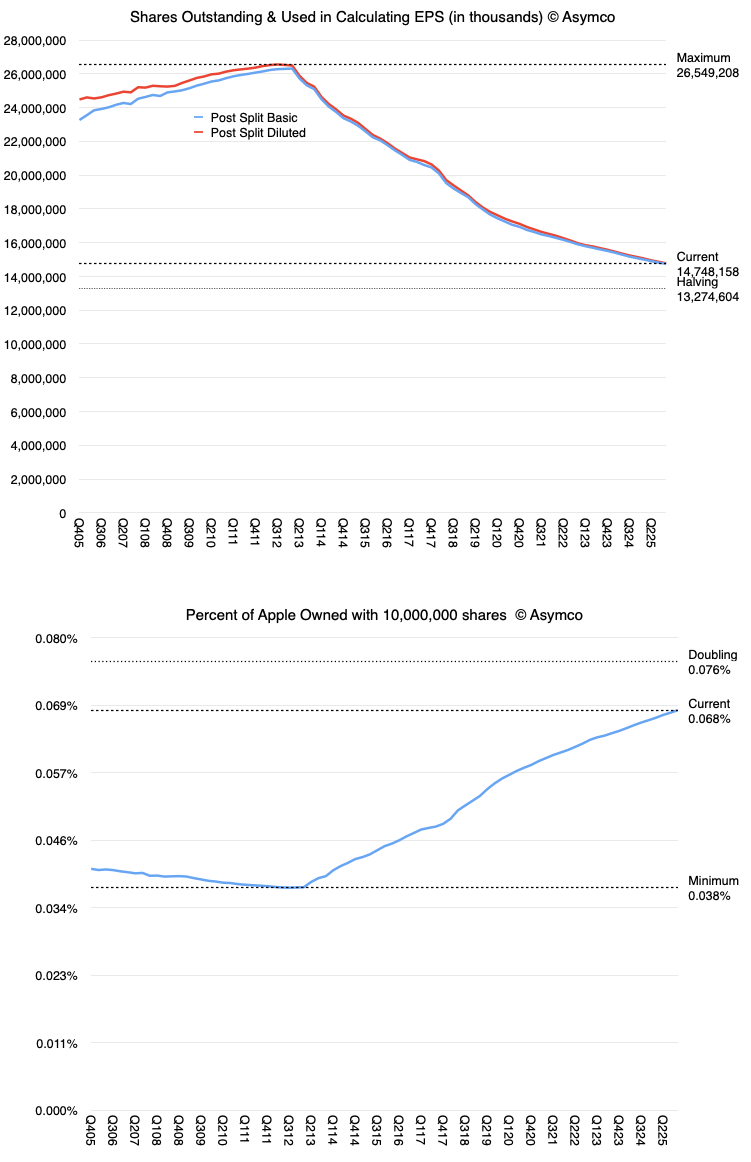
Also shown in the second graph is the percent of the company owned by 10 million shares.
I highlighted a point representing the "halving" point, which is what I call the number of shares necessary for a reduction by 50% from peak share count. The halving point is 13,274,604,000 shares. Today's share count represents a reduction of 44.4%, meaning that there is 5.6% to go. The challenge in predicting when this point will be reached is that the rate of retirement is variable.
For instance during the last year 340,509,000 shares were retired. During 2024 the number was 425,776,000 and in 2023, 379,077,000. This variability is because whereas the company receives a "budget" in terms of capital to be returned via share repurchases every year, the choice of when to buy is up to management and the price at the time of purchase obviously varies greatly.
Nota bene: By definition, share buybacks are insider trades as the buyer is an insider. But it is not illegal insider trading. The SEC has specific rules about procedures for share buy-backs that establish a safe-harbor for the company. While legal, they are restricted to pre-planned programs, we just don't know what these programs are.
The rate of retirements therefore is dependent on the nature of the program, which is not public, and the price of the shares, which varies widely. Naturally, if the share price increases, the reduction in shares slows down. This is rather by design. If it did not happen then as the share count drops and price remains the same, then the shareholders don't benefit much from the value of the shares, though they may well benefit by other means.
For instance, from the investor's point of the concentration of shares has a "rate of return" which can be represented as a percent (trailing twelve months retirements as a percent of the total a year earlier). In other words, how quickly is one's position in the company concentrating. The following graph shows that rate.
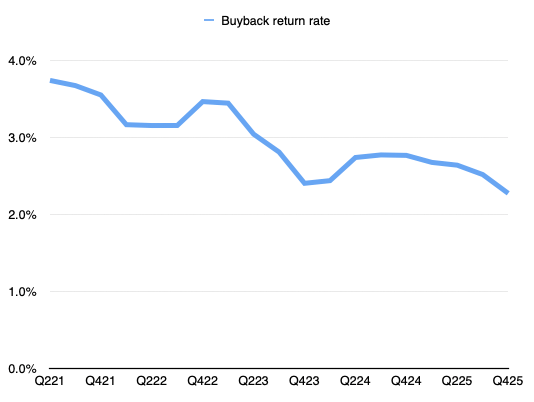
By this metric, with 5.6% remaining, the point of halving should arrive around the middle of 2029. Of course, if share prices rise rapidly, and Apple does not increase its capital return budget this halving point will need to be delayed.
1 comment
David Goffin ·
So what does this mean to investors when this halving point is met?