Is a Crash Coming?
by Horace Dediu
A Series on Valuation in the age of AI
Apple recently hit an all-time high. Today the stock is trading at a P/E of 35. The P/E ratio is the current share price P divided by the last four quarters’ net earnings per share E. But we also have a pretty good idea of the earnings for the next quarter, ending June (now almost half-way completed). The guidance very clearly suggests that on a one Quarter forward basis the P/E ratio is 34.
I’ve maintained for at least 15 years that a reasonable multiple for Apple is 35. This was mainly because other large cap technology companies were also trading around that number. While at this ratio, if a company is growing at 22% it means that an investor will make their money back in about 10 years. Thereafter all free cash flows will go entirely to the investor’s pocket. That seems a reasonable return. It’s not a particularly risky bet to assume 20% growth for 10 years if you look at (a) history and (b) how many people in the world have not yet started using Apple products and (c) assess how well management is doing their job.
So by this measure, Apple seems to be reasonably priced. Historically it has not been reasonably priced but that is due to the disconnect between understanding the business and falling for the usual false tropes. The following graph shows the share price and where it fell between the bands of Earnings multiples. The grey areas represent periods of significant share price decline.
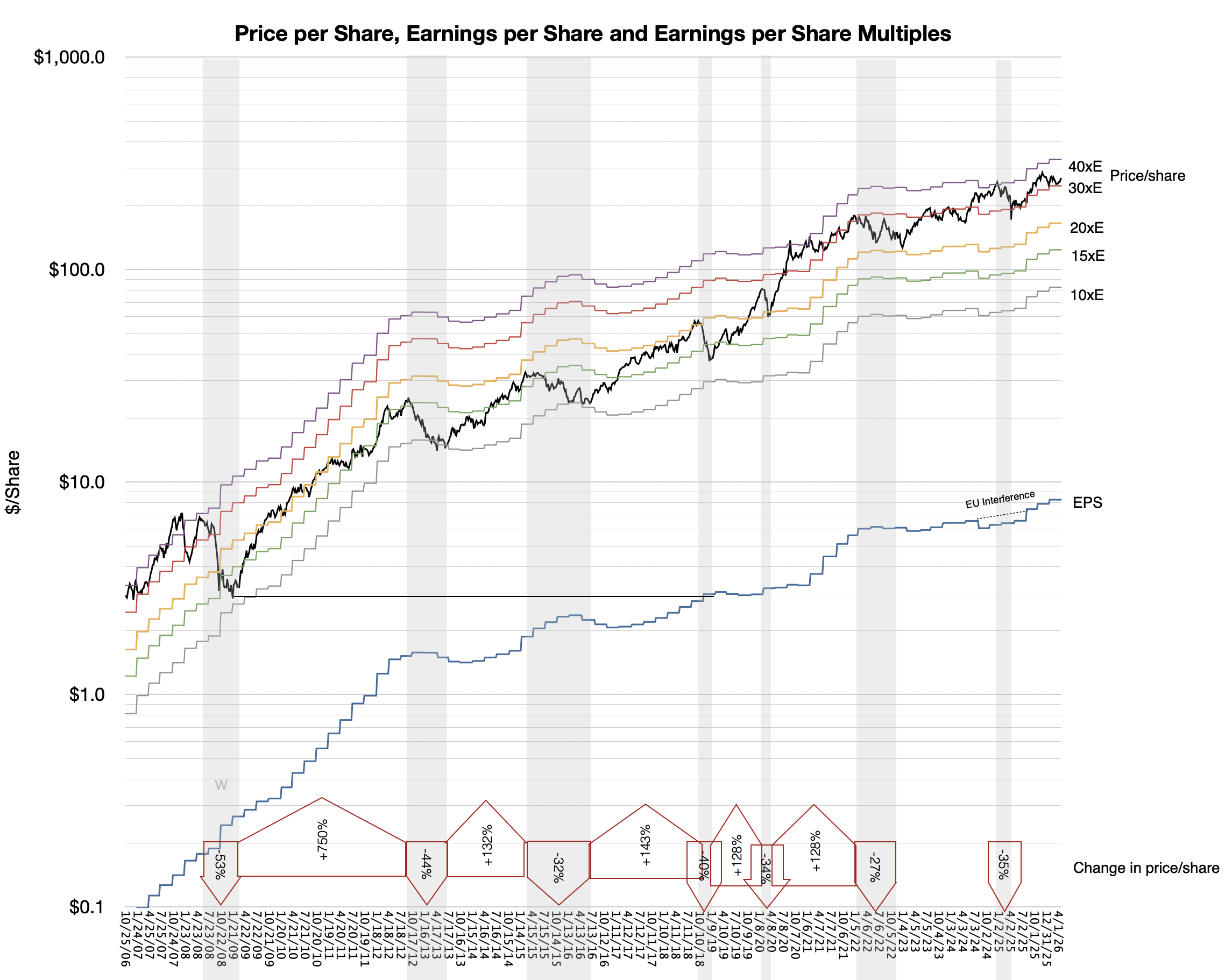
But much of the volatility of the stock is also due to overall sentiment collapse. That has happened on many occasions, most notably the 2008 financial crisis and “great recession.” (Another was the Covid crisis.) In these cases, regardless of underlying strength, the shares were available very cheaply.
Today perhaps we should ask if a bubble is forming due to exuberance around AI which is inflating the market in unsustainable ways.
There are four reasons why the current asset value explosion is different.
First, it is highly concentrated in a handful of names.
| 2005 S&P 500 top 10 | % of the S&P index | 2026 S&P 500 top 10 | % of the S&P index |
| Exxon | 3.1% | NVDA | 7.8% |
| MSFT | 2.5% | GOOG | 7.3% |
| Citigroup | 2.2% | AAPL | 6.4% |
| GE | 2.0% | MSFT | 4.6% |
| Walmart | 1.7% | AMZN | 4.4% |
| BoA | 1.6% | Broadcom | 3.0% |
| J&J | 1.6% | TSLA | 2.4% |
| Pfizer | 1.4% | META | 2.3% |
| Intel | 1.3% | Walmart | 1.6% |
| AIG | 1.3% | Berkshire Hathaway | 1.5% |
| Total | 18.7% | 41.3% |
Second it is fueled by equity not debt. Third, it involves disproportionate capital expenditure rather than M&A. Fourth it is accompanies by sharply growing revenues (though not as sharp as investment growth.)
In other words, whereas the equity value is growing rapidly, so is income and investment without leverage. This is a low-debt with high income scenario. Previous crises were high income with high debt (2008) or low income with low debt. (Dot Com).
That’s not to say that we have uniform fair equity values. We need to do quite a bit more due diligence to determine the state of the valuations precisely because we have unusual capital allocation strategies.
To cover this topic I’ll will break the analysis into multiple posts. They are:
- Why the most common metrics for valuation are insufficient — the problem with the P/E ratio
- What are the alternatives that into consideration exceptional cash and capital expenditures — The EV/FCF ratio
- How does the P/E ratio differ from EV/FCF and what does it mean if they diverge one way or another
- How do the Mag 7 et. al. appear on these Metrics
- How to complement snapshots like valuation ratios with the time series of fundamentals
- Why payback measures are the ultimate measure of valuation
- What are the current payback measures for the Mag 7 et.al.
- Compare Apple to its peer group
- Finally assess whether a collapse in confidence is imminent
Please return to these pages in the next few days to read these posts.
7 comments
FredHS ·
May we add one more topic? Disruption from below.
Much of today's valuation is based on hyperscalers' LLMs. This applies to compute and memory suppliers who enjoy extraordinarily high margins (sustainable?); and the hyperscalers' CAPEX (subject to write-down?).
If Google, or other entities, dramatically drop the cost per token, that impacts the aforementioned valuations. Likewise, if Apple devices take work-load from cloud, could that impact revenue to hyperscalers and their suppliers.
Sacto Joe ·
Hi, Fred. I think there is a kind of disruption going on right now, so I agree that it needs to be covered. The disruption I'm talking about is taking the shape of this huge and growing demand for Apple Macs. Turns out it's very AI-related, because you can "build" a smallish kind of AI farm that (1) helps create anonymity between the "user" of AI LLMs and the purveyor of AI LLMs , and that simultaneously reduces the cost. I'm going to quote from my stepson, who is presently diving deeply into the AI world from a computer security expert's POV. This grew out of a question on Apple 3.0 about "units of compute" as a separate commodity:
"You could get 10 used Mac minis with 16 GB of RAM each for about $5000 - $7000, and that's like 160 GB of shared, unified memory when they are linked with the Thunderbolt port. Now, you wouldn't be able to share memory the same way in a distributed, P2P compute network, but it doesn't matter so long as there is ~64 GB of memory or more for the node."
I can't say I fully understand this, but it sounds awfully attractive, assuming the result is anonymized queries of an AI LLM in a way that doesn't cost an arm and a leg, and if the "farm" can in fact handle sufficient "users" of this secure access to pay a ROI.
FredHS ·
Thanks Joe,
Some AI searches say that Apple will offer considerably more SRAM with the M5-ultra rumored for later this year - post WWDC. So...
Please ask your stepson for his thoughts. Having more SRAM being on the SoC (or CoWoS) is big boost for AI by reducing latency. BTW, the big Cerebras IPO today celebrates their massive on-wafer SRAM, a breakthrough in memory bottleneck.
Apple won't compete w/ Cerebras, a race to peak. Apple can run circles around any other edge device, especially with more SRAM.
Sacto Joe ·
Note: I posted something here, and it didn't show up. How deeply are these posts being monitored? And how long can one expect before a post gets released? Just curious...
AAPL ·
Trailing PE is now 37.4. Is AAPL at $308 overpriced, fairly valued, or underpriced? Historically, this PE is at the higher end of its past ranges.
Horace Dediu ·
Hi Joe, as we get our content production working consistently, we are turning attention to community more and more. I will be dedicating more time to answering comments and dialogue. As an aside, there is a distinct change in quality of interaction on social media so I have already decided to spend less time there.
Horace Dediu ·
Recommend calculating P/E on one quarter forward as we have guidance on that already. On that basis I have TTM earnings at $8.62 in June. That puts current price ($310/share) at exactly 36xE. To assess this, I always said that 35 is "fair" and anything below 30 is "cheap." I think above 40 starts to look "pricey." Keep in mind that for the last 20(!) years the earnings have had a compound annual growth rate of 26.9% while the stock price has grown at a CAGR of 27.2% (consistent!). Paying 35x for 27% growth seems reasonable to me: You get your money back in 9 years and all earnings after that are retained. If you believe the company will be around for 9 years and generate profits thereafter to pay interest for last 9 years, that is your exposure. Anything more than that is upside. The devil is always in consistency.