Asymco

Asymmetric Intelligence

AAPL

  1. Goldman Raises Price Target Ahead of Q3 Earnings

    Nota Bene · 1 comment

    Goldman Sachs reiterated a Buy rating on AAPL stock and raised its price target ahead of Q3 FY26 earnings.
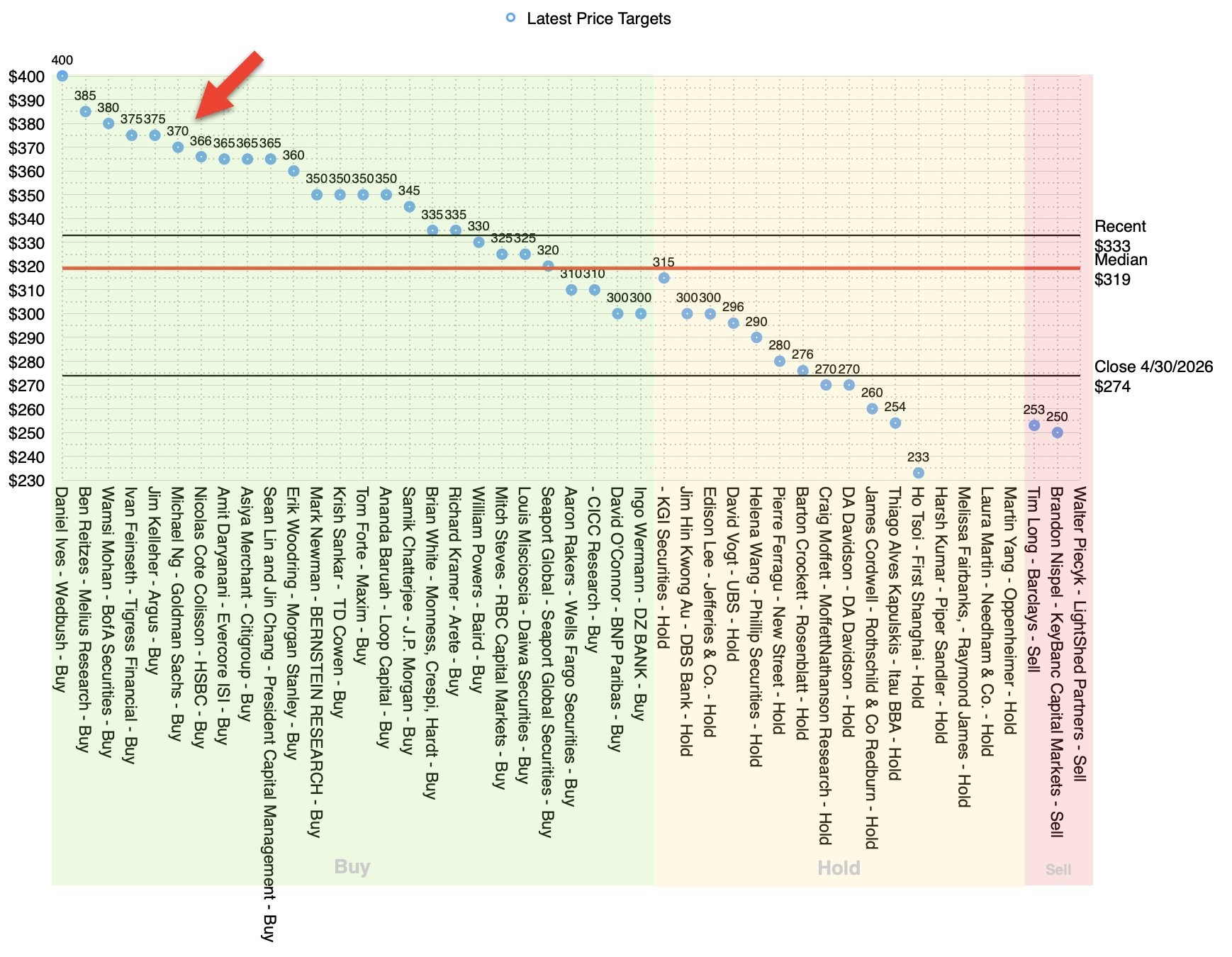
    The analyst raised his price target for AAPL stock to $370 from $330, increasing his valuation multiple to reflect his growing optimism in the company’s iPhone replacement cycle and AI efforts.

    Ng expects Apple to report better-than-expected Q3 FY26 earnings, driven by 17% revenue growth to $110.1 billion, which is at the high end of AAPL’s revenue growth guidance range of 14%-17%. He also expects iPhone revenue of $54.8 billion (23% growth), above the consensus estimate of $53.7 billion. Ng expects iPhone revenue growth to be driven by a 15% unit growth and a 7% rise in ASP (average selling price) on a premium mix shift.

    Additionally, Ng projects 15% growth in Apple’s Services revenue, in line with the Street’s expectations. Within Apple’s Services business, Ng noted continued slowdown in App Store growth due to lower commission rates across markets such as China and Japan. Nonetheless, the analyst expects double-digit growth in the Services business, driven by strength in the services tied to Apple’s products (such as iCloud+ and AppleCare+).

    Ng noted that Apple stock is outperforming the broader market since the beginning of the second quarter, as investors rotated away from traditional AI infrastructure stocks. He added that investor sentiment also improved as Apple gained market share despite industry-wide price hikes due to elevated memory costs. Furthermore, the progress in Apple Intelligence following the WWDC event also helped address AI disruption concerns.

    Meanwhile, Ng expects Apple’s recently announced price hikes for Mac and iPad to support earnings growth over the next few quarters, as he believes that the company’s user base is “relatively price inelastic given brand stickiness, U.S. carrier subsidies, and availability of recent low-cost product launches (iPhone 17e, MacBook Neo).”

    Source: TipRanks

    NB: Ng is near the high range for both his price target and quarterly estimates.
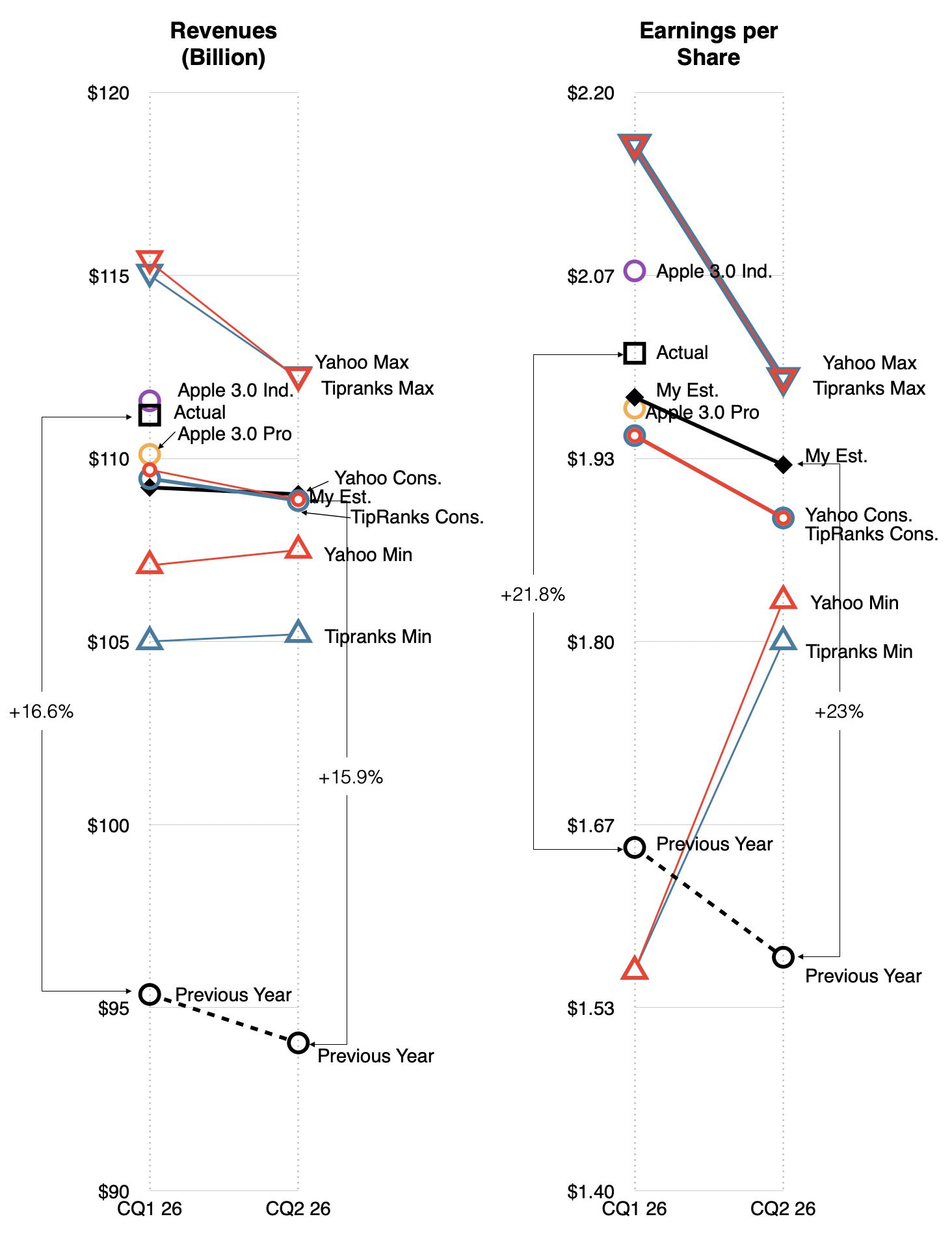
    My estimate is higher on the iPhone unit growth but lower on the ASP growth. Regarding iPhone revenue growth, my estimate is 21% vs. his 23%. We are $1 billion apart on net revenues, almost all attributed to the iPhone ASP difference.


  2. Is a Crash Coming?

    Research · 7 comments

    A Series on Valuation in the age of AI

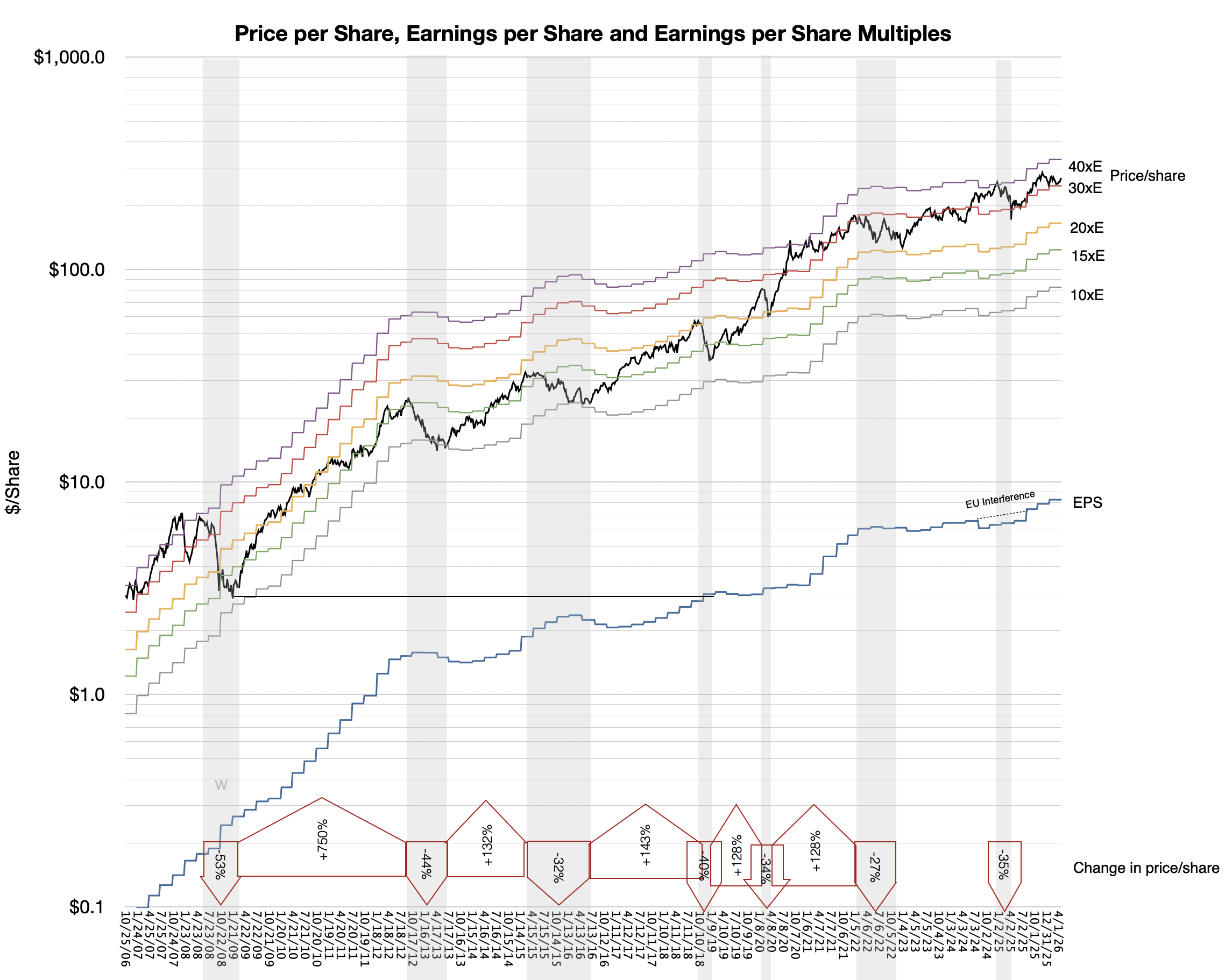
    Apple recently hit an all-time high. Today the stock is trading at a P/E of 35. The P/E ratio is the current share price P divided by the last four quarters’ net earnings per share E. But we also have a pretty good idea of the earnings for the next quarter, ending June (now almost half-way completed). The guidance very clearly suggests that on a one Quarter forward basis the P/E ratio is 34.

    I’ve maintained for at least 15 years that a reasonable multiple for Apple is 35. This was mainly because other large cap technology companies were also trading around that number. While at this ratio, if a company is growing at 22% it means that an investor will make their money back in about 10 years. Thereafter all free cash flows will go entirely to the investor’s pocket. That seems a reasonable return. It’s not a particularly risky bet to assume 20% growth for 10 years if you look at (a) history and (b) how many people in the world have not yet started using Apple products and (c) assess how well management is doing their job.

    So by this measure, Apple seems to be reasonably priced. Historically it has not been reasonably priced but that is due to the disconnect between understanding the business and falling for the usual false tropes. The following graph shows the share price and where it fell between the bands of Earnings multiples. The grey areas represent periods of significant share price decline.

    But much of the volatility of the stock is also due to overall sentiment collapse. That has happened on many occasions, most notably the 2008 financial crisis and “great recession.” (Another was the Covid crisis.) In these cases, regardless of underlying strength, the shares were available very cheaply.

    Today perhaps we should ask if a bubble is forming due to exuberance around AI which is inflating the market in unsustainable ways.

    There are four reasons why the current asset value explosion is different.

    First, it is highly concentrated in a handful of names.

    2005 S&P 500 top 10% of the S&P index2026 S&P 500 top 10% of the S&P index
    Exxon3.1%NVDA7.8%
    MSFT2.5%GOOG7.3%
    Citigroup2.2%AAPL6.4%
    GE2.0%MSFT4.6%
    Walmart1.7%AMZN4.4%
    BoA1.6%Broadcom3.0%
    J&J1.6%TSLA2.4%
    Pfizer1.4%META2.3%
    Intel1.3%Walmart1.6%
    AIG1.3%Berkshire Hathaway1.5%
    Total18.7%41.3%

    Second it is fueled by equity not debt. Third, it involves disproportionate capital expenditure rather than M&A. Fourth it is accompanies by sharply growing revenues (though not as sharp as investment growth.)

    In other words, whereas the equity value is growing rapidly, so is income and investment without leverage. This is a low-debt with high income scenario. Previous crises were high income with high debt (2008) or low income with low debt. (Dot Com).

    That’s not to say that we have uniform fair equity values. We need to do quite a bit more due diligence to determine the state of the valuations precisely because we have unusual capital allocation strategies.

    To cover this topic I’ll will break the analysis into multiple posts. They are:

    • Why the most common metrics for valuation are insufficient — the problem with the P/E ratio
    • What are the alternatives that into consideration exceptional cash and capital expenditures — The EV/FCF ratio
    • How does the P/E ratio differ from EV/FCF and what does it mean if they diverge one way or another
    • How do the Mag 7 et. al. appear on these Metrics
    • How to complement snapshots like valuation ratios with the time series of fundamentals
    • Why payback measures are the ultimate measure of valuation
    • What are the current payback measures for the Mag 7 et.al.
    • Compare Apple to its peer group
    • Finally assess whether a collapse in confidence is imminent

    Please return to these pages in the next few days to read these posts.

  3. Will Apple preserve iPhone 18 Pro pricing at 17 Pro levels?

    Nota Bene · 4 comments

    History says yes.

    The global smartphone market is facing structural pressure from rising memory prices. In particular, the spread of AI technology is sharply increasing demand for high-performance memory, tightening supply and pushing prices up quickly. As a result, some Android manufacturers have raised prices on new products, and low-margin budget models could shrink in the market. The industry also sees the trend as potentially leading to a contraction in the overall Android market size.

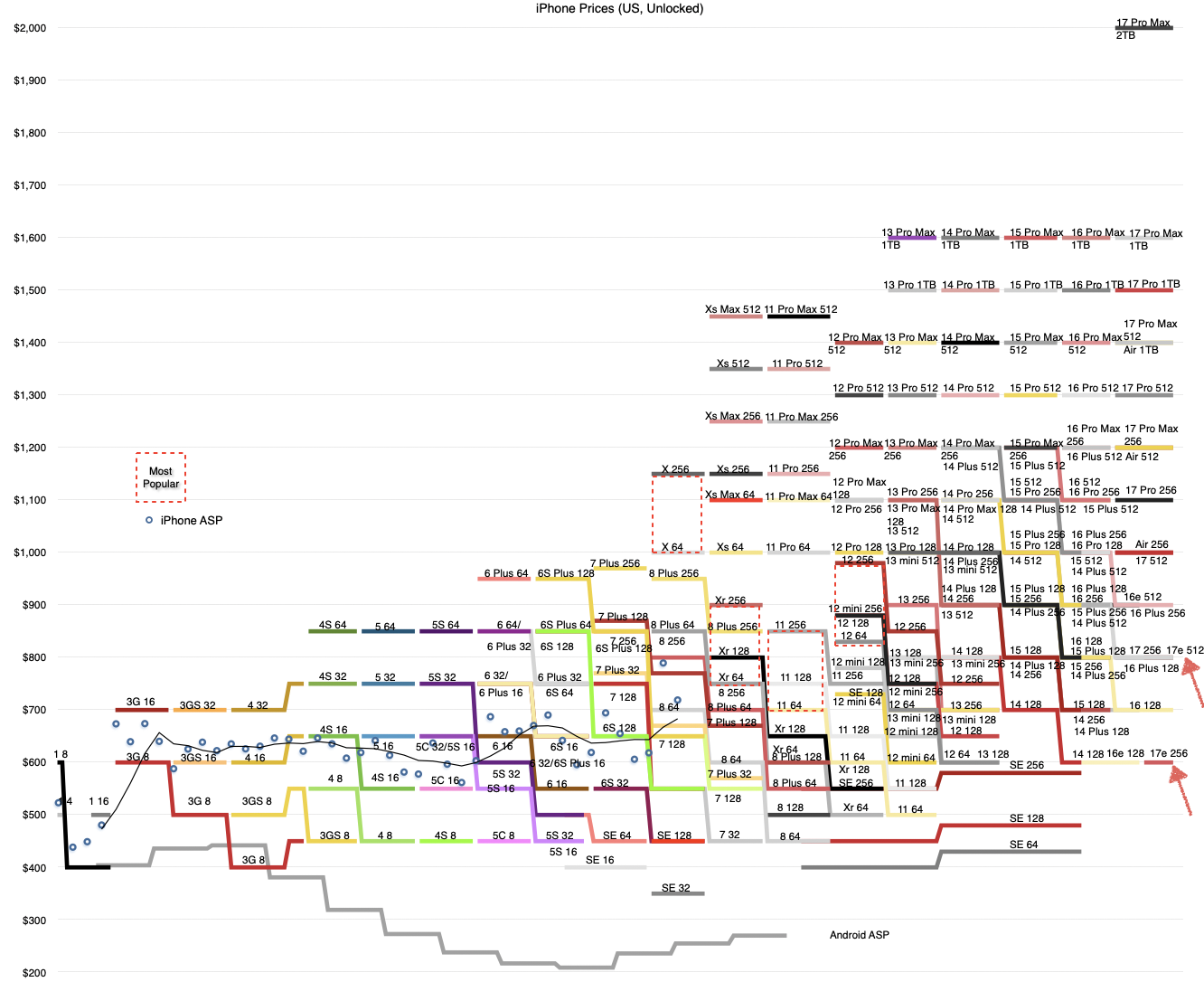
    Against this backdrop, Apple has chosen a strategy of keeping prices for its main models unchanged. Pu’s analysis said the iPhone 18 Pro is likely to start at $1,099 and the Pro Max at $1,199, maintaining the existing price range. That would be the same as the previous model. It is interpreted as a strategy to secure price competitiveness even if Apple accepts some margin decline to defend market share.

    Apple is also expected to pursue a two-track strategy that considers both price accessibility and profitability. It would keep base-model prices to lower the barrier to entry, while raising prices for higher-end models with larger storage capacity to offset profits. It has also been suggested that an ultra-premium iPhone 18 Ultra could be added, and the overall average selling price (ASP) is expected to rise.

    Ultimately, Apple’s strategy aims to exploit weaknesses in the Android camp, which is under pressure to raise prices. While rivals face demand contraction from higher prices, Apple could keep prices relatively stable and expand user inflows. A recent rise in demand from Android users switching to iPhones has also been detected, raising the likelihood that Apple will strengthen its influence in the premium market through this strategy.

    Source: 디지털투데이 via Analyst: Jeff Pu

    NB: There is always a huge surprise when Apple does the same thing it always does.

    Rule 1: Pricing choices Apple makes are based on a strategy.

    Rule 2: Apple does not respond to competition with changes in pricing

    Rule 3: Apple does not respond to supplier pricing with changes in pricing.

    Rule 4: The secondary market absorbs low end demand.


  4. Goldman Reiterates Buy and Bernstein Reiterates Outperform

    Nota Bene

    $330 and $325 Price targets, respectively.

    Investment bank Goldman Sachs discussed Apple Inc. in January. It reiterated a Buy rating and a $330 share price target on the firm. The bank discussed the firm’s App Store performance in its coverage. It outlined that the App Store spending trends were improving as spending grew by 7% in January to accelerate by one percentage point over December’s 6% growth. Goldman added that the App Store growth should contribute meaningfully to Apple Inc. Services business.

    Along with Goldman Sachs, Bernstein also praised the firm. It reiterated an Outperform rating and a $325 share price target. Bernstein cited Apple Inc.’s record iPhone revenue and optimistic growth guidance to point out that the firm was correctly navigating the turmoil in the memory industry.

    Source: Insider Monkey.

    NB: I remember when both of these banks had negative ratings on Apple.