Apple Upgrade: down to the penny, up to an algorithm
Office Hours Research #2026FQ3 #Q&A · 2 comments
by Horace Dediu
An Office Hours question asked by Bob V., July 31, 2026.
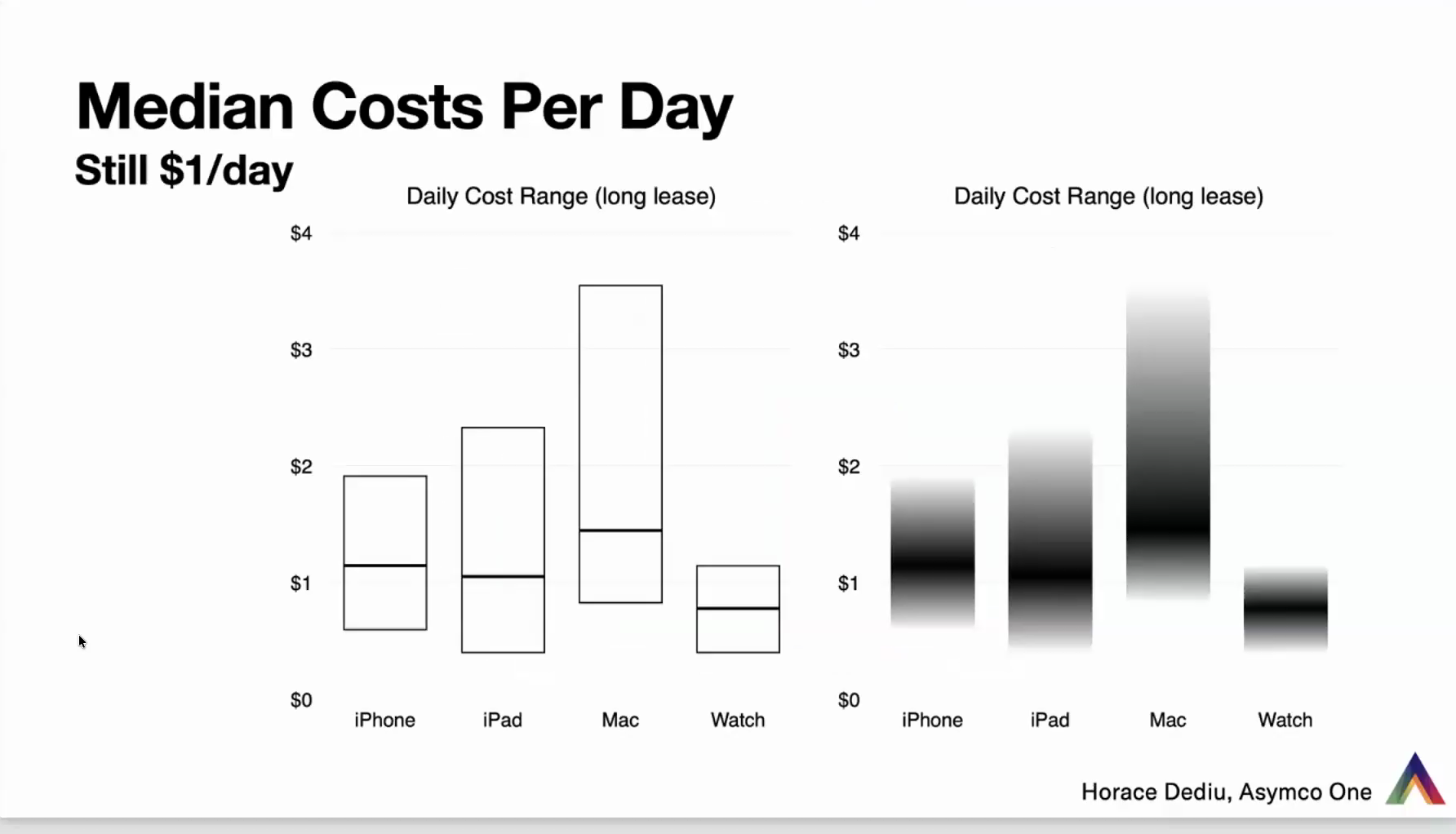
Q: Is there any “message” in the short-term versus long-term lease price difference between the iPhone and the iPad? I recall the iPhone being about 1:1.5 and the iPad being closer to 1:1.
This was a surprise to me, because I've never bothered with trying to figure out all the permutations and configurations of iPads out there. When I did it, I thought: wow, there's a lot more than I thought. (The back catalog is even more, but they took away a lot of options when you do the lease.) As it happens, the medians tend to move around.
Why is there this similarity between the short term and the long term on the iPad? It might have something to do with the depreciation rate. iPads, as opposed to phones, probably last longer, and they calculated these prices on that basis. Remember, they have to consider the residual value: what are they able to get for the product once they get it back.
I think all these prices are algorithmic. You couldn't have somebody suggest the price; you would have to calculate it every time. You see $50.01 — that's the two-terabyte 11-inch iPad Pro. You could give this as a research topic for a business school student, to try to understand what's going on here. It's fascinating, because I spent a long time trying to figure out iPhone pricing, and the feedback I got was that there's a very directed approach — they're doing it on purpose. The choice of prices is part and parcel of the product development. This is somehow different. Maybe it learns from that, it feeds into it, there's human input, but then they calculate these prices based on the economics of the product in use. That's probably what's going on here.
We'll have to see if they change this. We have to track it — build an AI to scrape all this data, because there's no easy way to do it. You have to click a lot to get even what I got. It's a full day's work. Someone has to sit and do it every day to make sure prices haven't changed. Somehow we need to automate this and track the evolution of pricing as if it were a market signal.
When I saw it, I said: something's different. This is not the way Apple's ever done things. Maybe it's reading too much into it, but think about the implications even from the accounting point of view, because this is not a sale. Do they book it as a sale if the product is in the hands of the consumer? Do they put it in Services somehow? I don't think technically you're allowed to declare a sale unless Klarna buys it from you, or something like that. The answer would be to look at how accounting for leased products is done.
Editor's Note: This was one of the questions asked by participants in Asymco's July 2026 Office Hours live Q&A session, held the day after Apple's FQ3 2026 earnings and open to Asymco One subscribers.
Subscribe to Asymco One for full access to this and other content.
2 comments
FredHS ·
Might Apple start selling used iPhones, iPads, and Macs just as car makers do, certified Pre-owned, CPO?
Win/win: With automated testing and refurbing, Apple could bring down the cost for this process. The on-line platforms for selling and buying used kit has friction, so both sellers and buyers benefit.
farshad ·
Like this?
https://www.apple.com/shop/refurbished