What's Going on with Smartphones?
by asymco-admin
A state of the union look at the market for mobiles.
Looking at the IDC data on smartphone shipments (2014 to present), the pattern shows a peak in 2017.
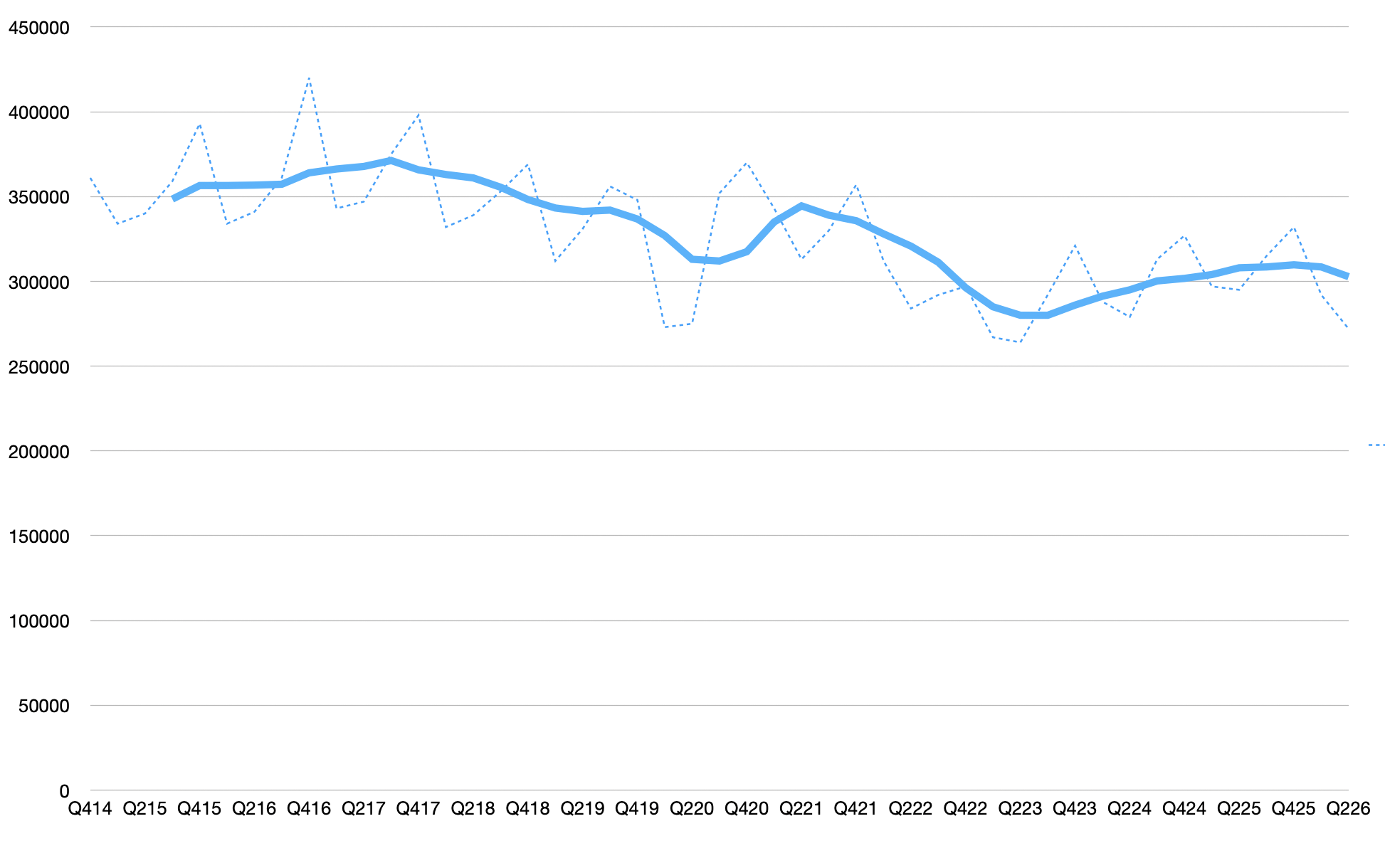
Covid caused a contraction and recovery but since then the unit market has not reached pre-Covid levels. Moreover, the current memory supply crisis is expected to cause a dip unlike any of the previous ones.
IDC expects the market in 2026 to roughly 1.09 billion units and another 1.1% decline in 2027. This may be optimistic. Yearly volumes could drop below 1 billion.
The sub-$100 entry-level device tier remains permanently constrained or uneconomical, pushing average selling prices higher. Emerging markets will fall the most. The Middle East and Africa are forecast to drop roughly 23%, Central and Eastern Europe down 19%, and Asia-Pacific (excluding Japan and China) down 14%.
In the US, Counterpoint says that sub-$100 smartphone sales declined nearly 65% during Q2 2026 compared with the year-ago period. The rest of the market fell by 45% as smaller manufacturers struggled to navigate component cost increases.
US Q2 smartphone market update:
Overall: -5%
Top 4 OEMs Apple, Samsung, Motorola, Google: -4%
All others: -45%
Prepaid: -11%
Sub $100: -64%
Apple reported N. American sales +11%.
Yet the number of smartphone users is not decreasing. There are approximately 5.78 billion unique smartphone users worldwide, accounting for over 70% of the global population. Moreover, there are over 7.6 billion active smartphones in use globally. (1.3 phones per user.) According to data trackers like Counterpoint Research, the active installed base grows by low single digits annually.
The history and near future of these measures are shown below:
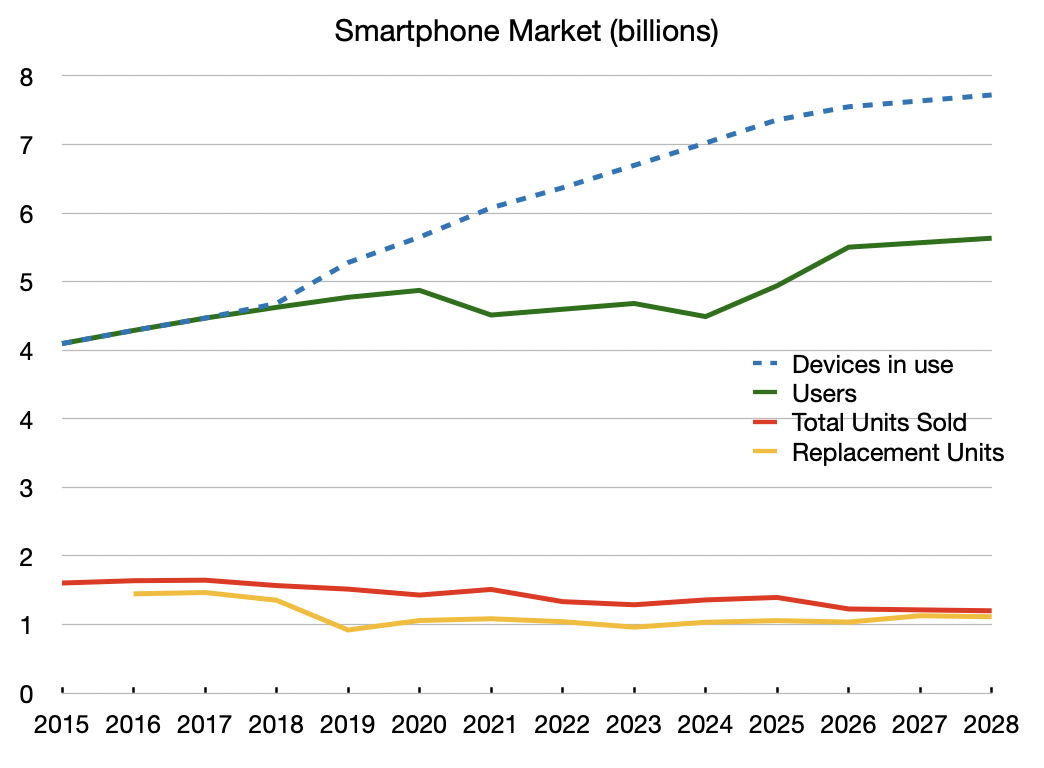
Note the confluence of two trends: the increase of users and devices in use and the decline in unit sales. I also pointed out in the graph that of the units sold a certain number must be going to new users (as long as new users is growing). The remaining units (shown in yellow) are replacement units. That means they are used to maintain the base which is shown as the dashed blue line.
But if the dashed line is increasing (from 4 to nearly 8 billion) and the replacement number is constant (about 1 billion) then the phones in use must be lasting longer.
Dividing the base by the replacement rate gives the implied device lifespan, shown below:
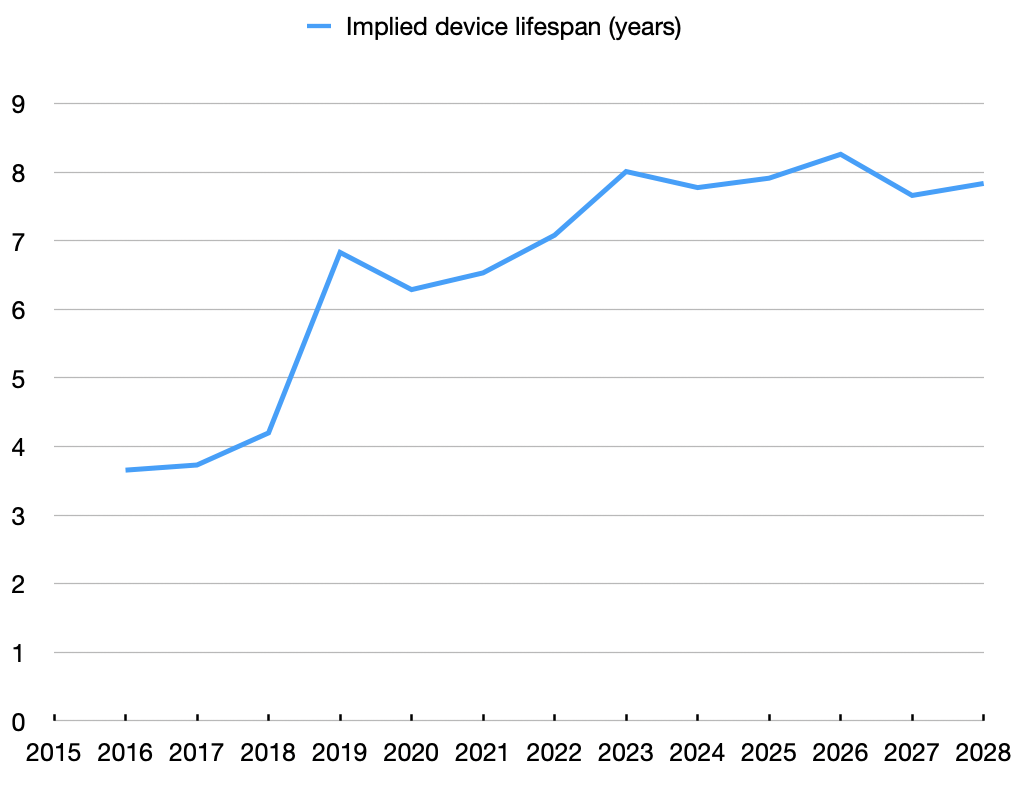
If the sales and base data is correct then the lifespan must have grown from below 4 years in 2016 to about 8 years in 2023. It has held steady since and may stay there through 2028.
Eight years is a much longer time frame for an average phone's life than many may consider reasonable. No Android vendor supports their phones that long. However, Apple supports iPhones with major iOS software updates for about 5 to 7 years from their release date. They often provide critical security patches for an extra 1 to 2 years after a phone stops getting main iOS upgrades. This means Apple support lasts about 8 years.
To confirm this we should analyze at the iPhone separately from the global market in the same way: installed base, units sold and implied longevity.
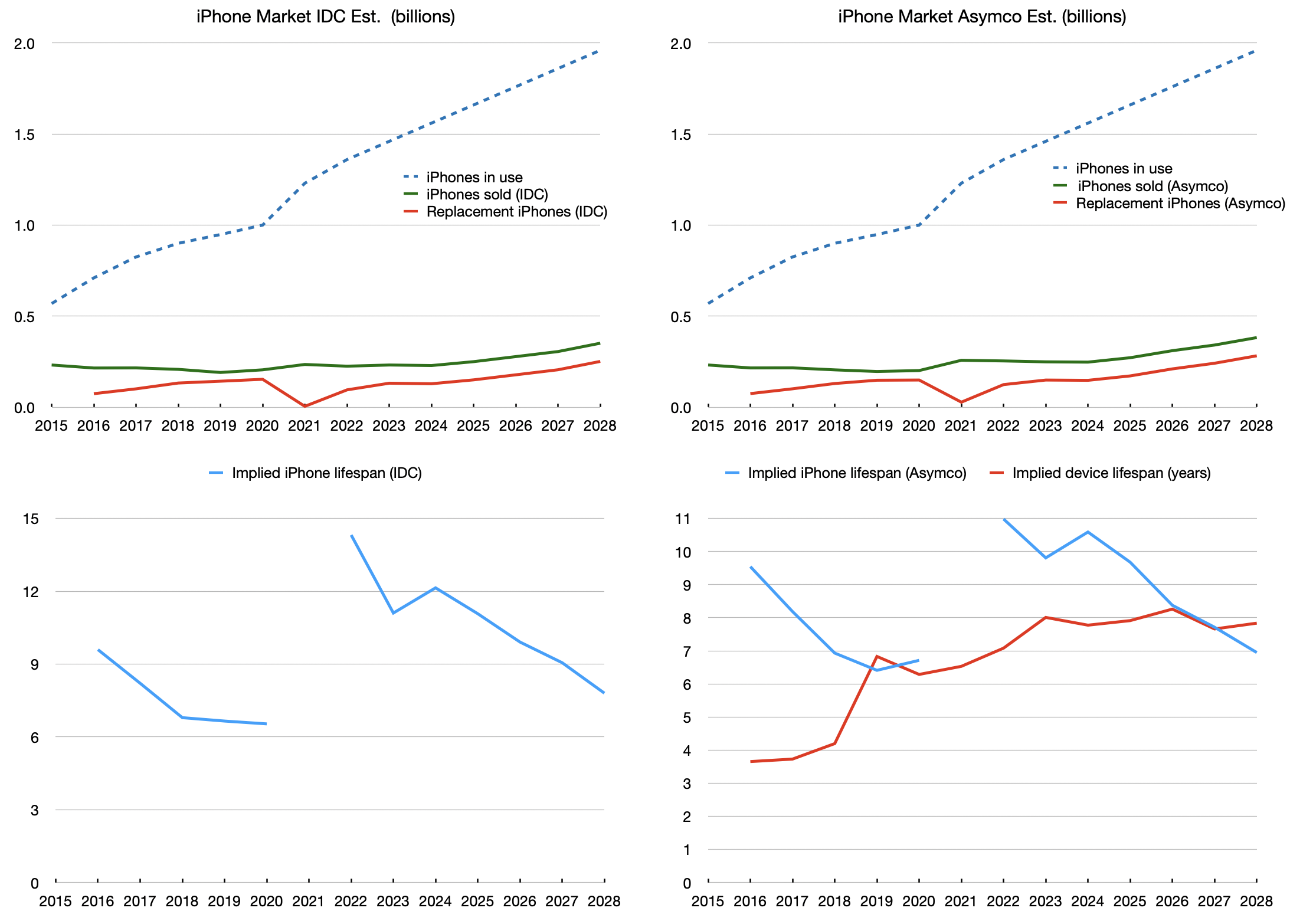
I used IDC data for iPhone unit sales in the graphs on the left and my own estimates in the graphs on the right. The installed base is based on Apple released data and extrapolations.
Apart from an anomaly in 2021 due to the recovery from Covid, the average lifespan for the iPhone (blue lines in the bottom graphs) holds at 8.5 in my data and 9.4 in the IDC data.
There are two reasons I believe my estimates to be more likely correct. First, because they also align with the overall market data (red line, right bottom graph) and second, they align with the support that Apple grants.
One more thing.
IDC also offers estimates of Samsung and Xiaomi unit sales. I show these estimates below.
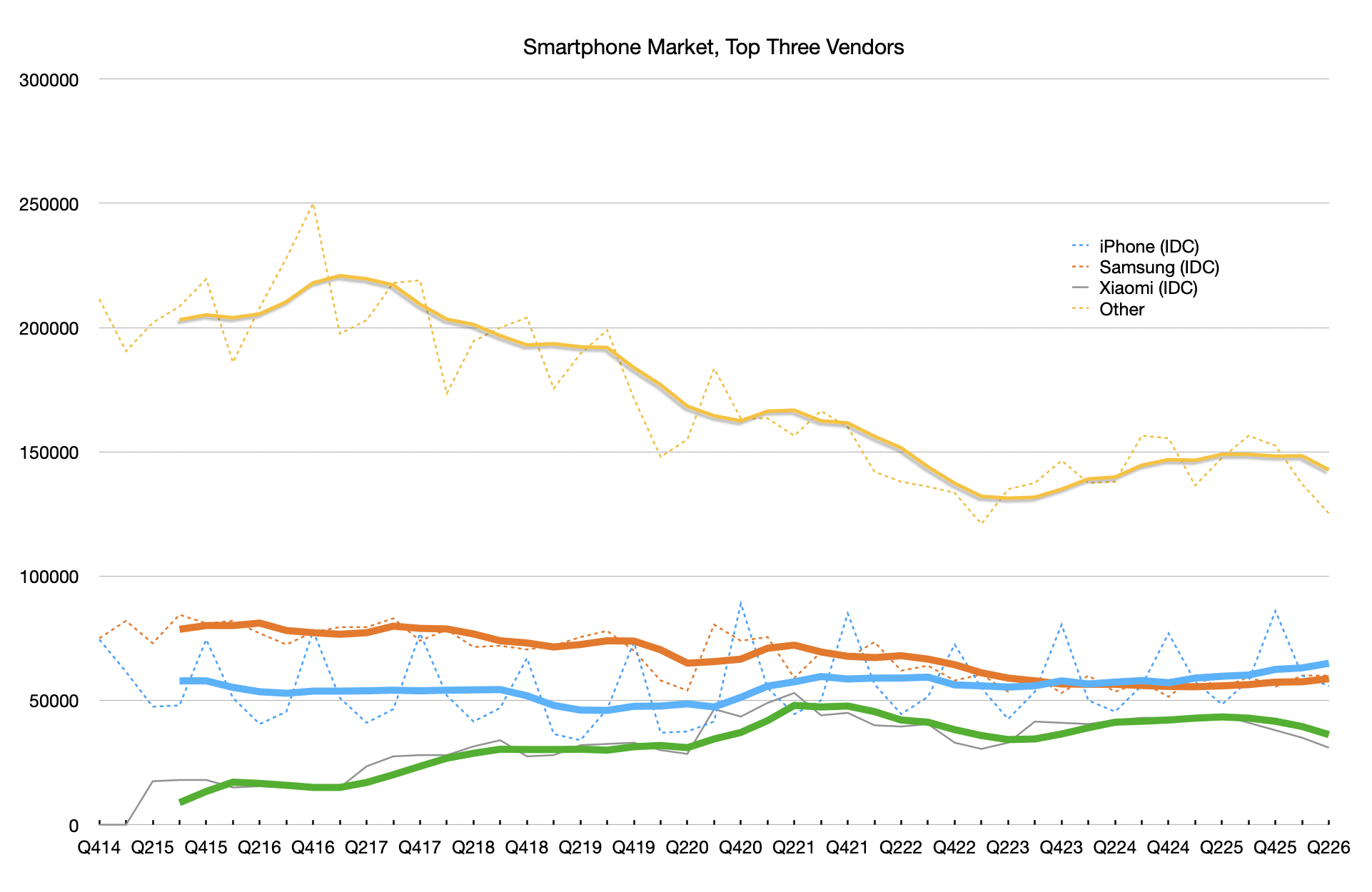
To remove the noise of seasonality, I provided twelve-month averages (solid lines). Note that their estimate for the iPhone (which is lower than mine) puts Apple ahead of Samsung since 2024.
Also note that the "Other" vendors combined are in a secular decline in volumes which will accelerate into the rest of 2026 and 2027. It's unknown whether this trend will continue in the longer term.
So what are the takeaways from this state of market review? Where are Smartphones going?
- Apple the volume leader. It's been the profit leader since inception. It's been the sales value leader as well for a very long time. Being the volume leader may be a surprise to some. Moreover, we might be seeing a shift in strategy intended to drive even higher share gains and install base gains into new markets. There are profound implications when Apple is no longer only 20%. It already has the best quintile but can it harvest the second?
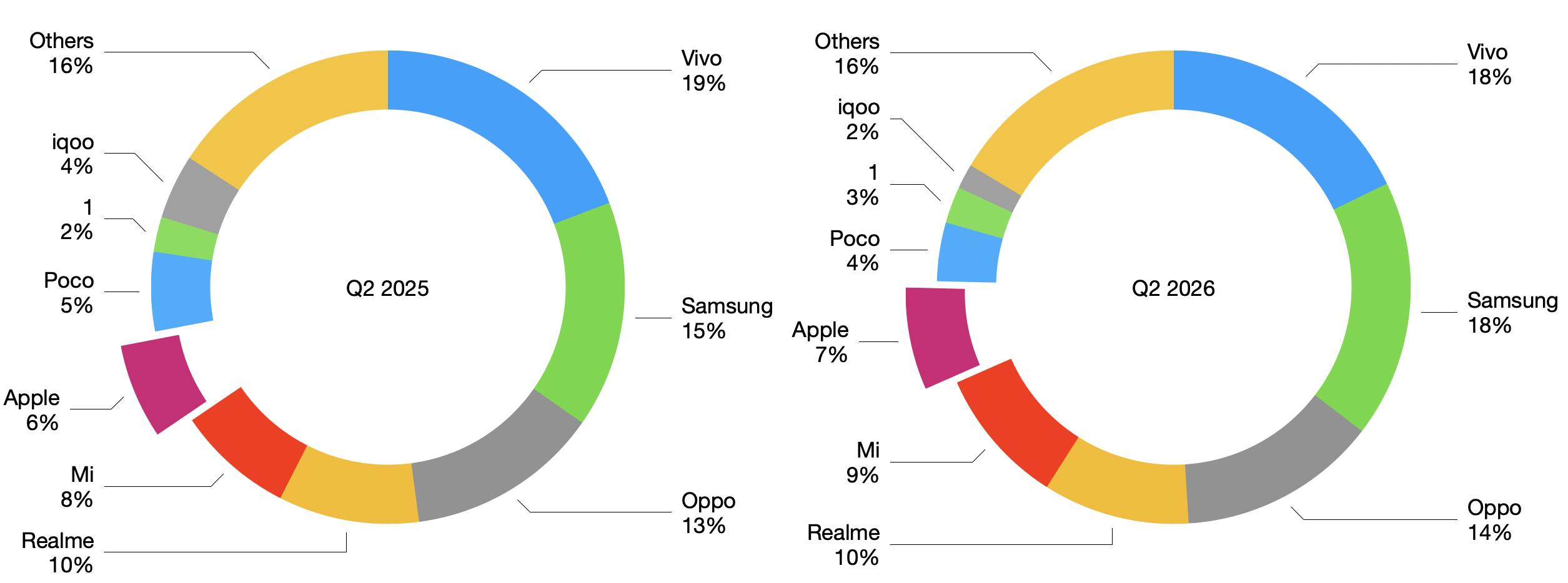
- The low-end market may be in check-mate. The premiumization of the market has been underway for a while but apart from Apple, vendors are having a hard time profiting from phones. History has seen the exit of many phone makers. Nokia, Motorola, Sony-Ericsson, Panasonic, and many others are gone. They were all huge at their peak. Now we see brands such as Oppo, Vivo, Poco, RealMe, iqoo in the top 10. See the graph below for the Indian market. They are losing share and the lower the volume, the less likely the recovery.
- Longevity matters. Support for 8 years should be standard but it isn't. Apple saw this early and made the infrastructure commitment to carry users to a future device lifespan. This includes the secondary market. This is reflected in the residual value of the phones and in their desirability in the used market. As phones last longer they are also more expensive; a natural tradeoff.
- The user base is nearing a peak. 6 billion may not yet be it, but there are only 8 billion people on the planet. I would guess that 7 billion might be saturation. However, we're seeing 1.3 units/user attach rate. That may increase, as it has been.
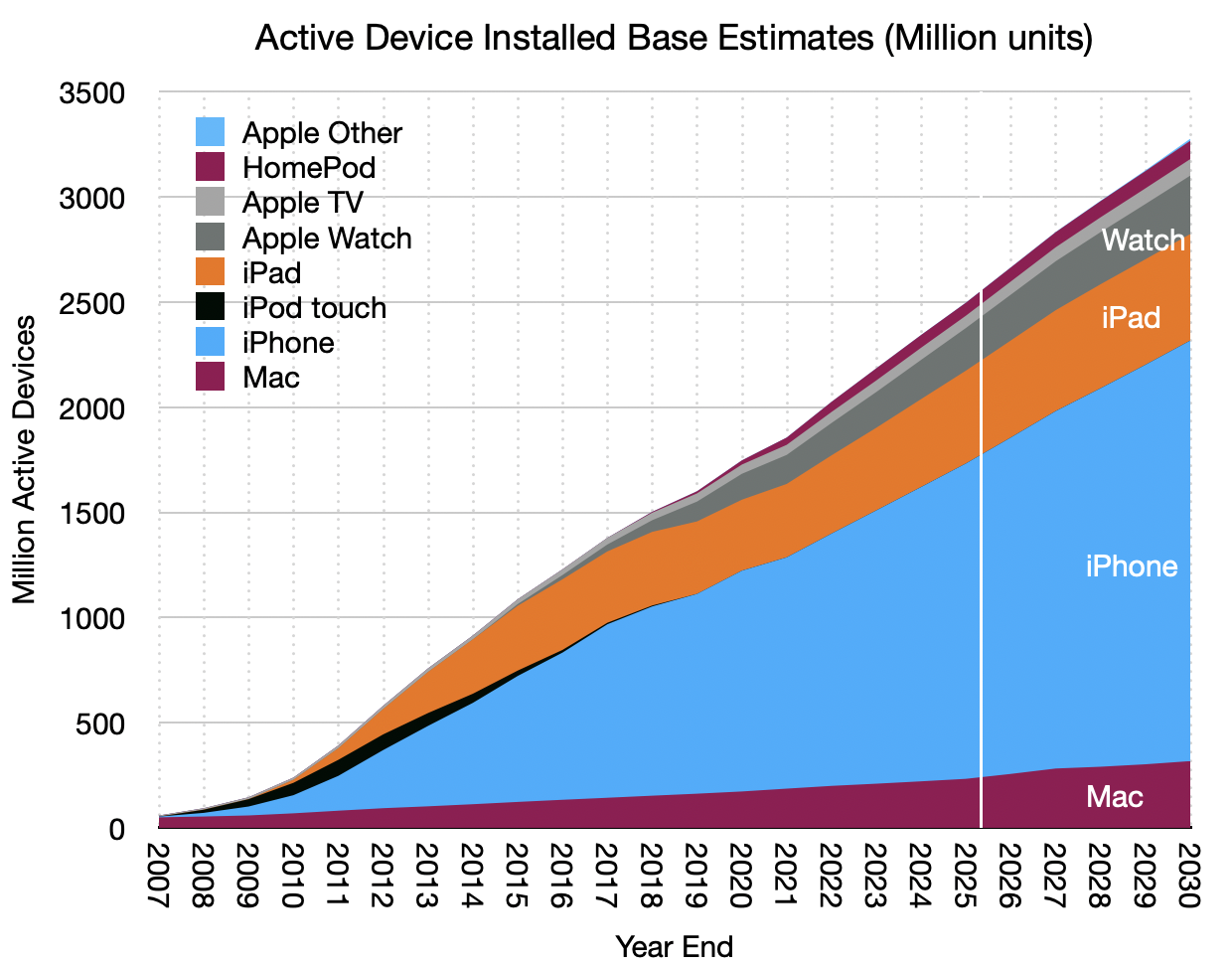
- The total smartphone base thus may reach 10 billion (1.4 attached to 7 billion). The iPhone should be able to reach 2 billion in use with a total Apple active device base near 3.5 billion. This could easily happen by 2031.
5 comments
deemery ·
A question on phone purchases/phone 'carrying'. A neighbor works for the government, he has 2 iPhones. One is his own, and the other (very much locked down) is Government Issued. (He can't carry his personal phone on base.)
How much of the installed iPhone base is in phones owned by employers?
Sacto Joe ·
Thank you SO MUCH for these graphs, Horace! They are stunning to anyone who has an actual rational mind, and they clearly show Apple's long run strategy and that it is paying off.
It is remarkable to see the inroads Apple has been slowly but surely making over the years in installed base. Also, I don't trust IDC's numbers any farther than my 1 1/2 year old granddaughter can throw them. Yours I trust implicitly.
In terms of installed base, I am expecting Apple to benefit from the present "hostage situation" with RAM. They are wisely choosing to pass along some of the cost, but other vendors will not be able to do so. China will, of course, continue to subsidize its products, but the bottom line is that there is a cost that needs to be paid by someone. In Apple's case, it is the affluent user up front, but it will also be the less affluent user as well, since it is predictable that the resale value of Apple products will be going up. Eventually, folks will realize the worth of "buying quality", and it is not a coincidence that Apple is offering a way to defer costs of purchasing their products over time.
Bottom line: Most people are frugal, but frugal doesn't mean blind to a value proposition, which Apple is.
masanti.luis ·
By 2030… or earlier, maybe… we will see that Apple ‘had solved‘ this device decline… thru ’Apple Upgrade.’ The program will allow users to ‘get new devices‘ and Apple will get ‘refurbished devices‘ to sell in the secondary market. (In a humble way… I think that the Apple is the only person that is smarter than Horace Dediu in ‘predicting‘ the future… with the added advantage that Apple also can… change the future.)
FredHS ·
Thanks Horace, for teasing out the "signal", supporting my New Year's resolution, "tune out noise'. "The top three vendors" chart shows iPhone long term share gains over time despite cyclical and season noise.
And used iPhones take even more share.
oonlan ·
A direct comparison between iOS updates and Android updates is nonsensical. Android is mostly 3-layered : core OS, system services, 1st-party apps. The apps and system services, and now even some parts of the core OS (graphics drivers...) are updated independently from the headlline "years of support" via the PlayStore not "OS updates". iOS is more monolithic, even just a Safari bugpatch is an iOS update. OS updates are not a reason to upgrade even an Android stuck at 4 yrs ago's version.
Hardware neither. Around me, people don't feel the need to upgrade their phones the way they used to when apps were barely running. Apps are the same as 5yrs ago, and they were running fine 5 yrs ago they don't need today's hardware. There's actually some backsliding on the creature comforts side: it's getting harder to find a phone with an SD slot, Audio jack/FM radio, even just good sound. Batteries are wildly improving though. AI is failing to create new demand.
People get a new phone when the old one physically dies.
There are small minorities who need/want the latest security patches, or the shiniest bling, or the best camera, or the latest features. of the 20 ppl closest to me, I got one serious photographer, none of the rest. And even he upgrades like every 4 yrs.
My PC is 13 years old. My phone is 5 yrs old. I'm happy with both, though the phone is on 3yo Android (my PC is still up to date, for another year, yeah Windows 10 ^^)