Deploying Enterprise AI on Apple Hardware is Suddenly a no-Brainer
by asymco-admin
Apple's AI angle in the enterprise
There was a time when Apple's point to the Enterprise buyer was that Apple products were ultimately more cost effective and productive. The total cost of ownership was lower as the products were cheaper to maintain and lasted longer and users were more productive as the user experience frictions were lower than Windows.
The problem was that Apple devices were at odds with IT policies and standards. Everything from device management, software licensing, identity and authentication management, migration, training, security were built excluding the Apple platforms. The Microsoft world was interlocking and impenetrable even if it was sub-optimal on metrics of performance.
It began to change with the subversive iPhone and iPad. As not only some early adopter employees but management itself began to bring their personal devices to work and ask IT to make the "systems" work through them. Thus the infiltration was not as much through the "grass roots" but through the top of the food chain. The canonical example was the CEO demanding to use an iPad to speed run meetings all day.
And from that crack Apple penetrated enterprises to such an extent that today the MacBook Air is the world's best selling enterprise laptop. The iPhone and iPad are also the best selling enterprise phones and tablets. More Apple devices are purchased in enterprise than any other brand.
Though MacOS and iOS are still not the majority platforms, in some verticals such as surgery, Apple Vision Pro has been established as the only viable option.
But now that AI is becoming a new wave of software/service for Enterprises, Apple is surprisingly in the driver's seat for being the best platform for deployment.
By "best" I mean objectively best in performance, security and, most shockingly, cost.
Best Performance
Though there are lower cost alternatives, the top of the line Mac Studio in a cluster configuration can provide 2TB of unified memory, 1.2 TB/s of bandwidth and handle up to to 1.6 trillion active parameters.
It's hard to visualize these numbers but what it boils down to is that enterprises can deploy vast models to run locally. Why locally? Because many examples from healthcare to aviation to transportation to financial services require privacy, off-line or compliance which disallow cloud-based services.
By one estimate, 50% of Enterprise AI inference will be processed locally by 2030. Half of the market for enterprise AI will be on device. This is profound.
Best Security
Apple offers built-in security at every layer: Service layer, Network, App, Data, System, and Silicon hardware. This is religion for Apple and not an after-thought. As such, the frameworks were ready before even the new AI as a service has been invented.
Best Price
This is the most surprising and most consequential development.
Apple devices already have the higher residual value, highest employee affinity, lowest operating cost (due to security mainly), lower energy cost and lower support cost.
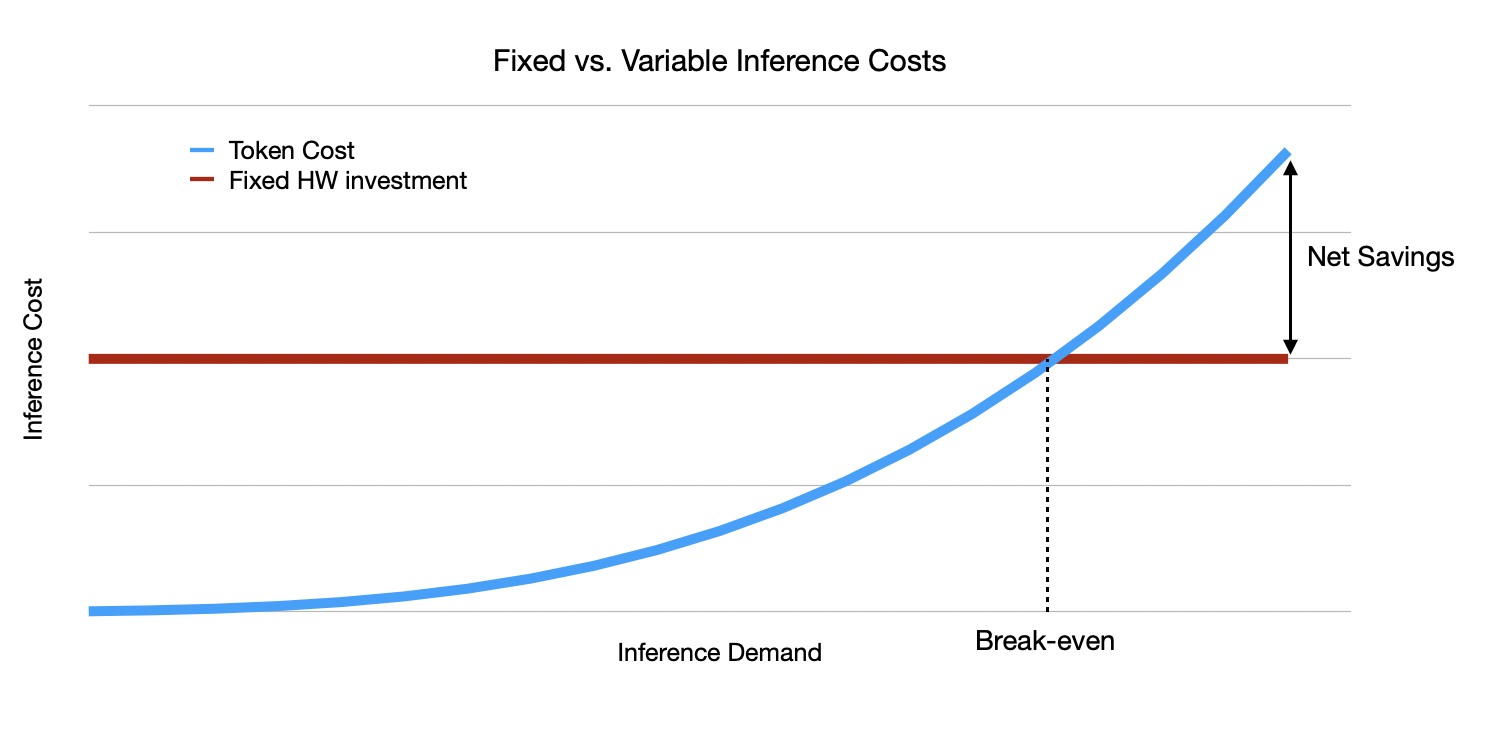
But now, when running AI, localized inference delivers a capped cost structure vs. an unlimited risk for token costs. The math is shocking.
Two examples:
- A 26B parameter business analysis model running for 4 hours a day consuming 150 million tokens a month results in a cost of between $450 and $850 per user per month. The alternative is to buy a MacBook Pro and run that same model at zero cost. The acquisition cost of a 16" M5 Max with 40-core GPU and 128GB of unified memory is $6500. The payback period is 7 to 14 months. Thereafter the savings are $5400 to $10,200 per year.
- Agentic coding using an 80B parameter model running 12 hours a day and consuming 300 million tokens a month will cost between $900 and $1500 per user per month. The alternative is to buy a Mac Studio M5 Ultra 80-core GPU and 256GB 4TB storage for $11,219. The payback period is 7 to 12 months, saving $11,000 to $18,000 every year thereafter.
The graph at the top of this post illustrates that this net savings is available above a certain threshold. These are serious numbers when the number of possible users is in the hundreds. The fixed hardware investment is a significant game changer in AI implementations.
The questions changes from why should we use Apple devices to why shouldn't we?
History has shown that computation tends to distribute itself to "the edge" of the network. It's been so since microprocessors were first developed in the 1970s. The logic at first is one of control and flexibility but it soon becomes one of cost. Early PC users in the enterprise loved the ability to have local spreadsheets and word processing at their fingertips and under their own ability to operate. Later it was desktop publishing and image editing and a multitude of applications.
That has been Apple's story in the enterprise: first it was a set of really unique experiences and degrees of creative freedom. Now we are at the stage where it just makes enormous financial sense. That is a watershed moment.
The corollary here is that AI is not much more than computing demand. If that demand is local or remote is a question of requirements. It so happens that local is desirable for a lot of people, and not just consumers.
The counter-argument is that the model must always evolve and thus the local becomes outdated or stale. But there are many forms of intelligences which do not require global or world models. The information an enterprise relies on for operations is not going to constantly change based on factors outside of its control.
When we look back on this period we will probably be amazed at how Apple was able to "pivot" to becoming the platform for Enterprise AI. The real magic is that it was always on the same path.
7 comments
masanti.luis ·
This article is a clear demonstration how much… with all due respete to your site… vas peen out of the bucket John Gruber when in 2025 wrote his “Something id rotten in Philly“ —OK, it was in other place—, Silicon development takes around 3-4 years from ‘request to delivery‘… so actual M5 and M6 were ‘defomed‘ in 2023, the least. Alamos everything that now is in the mouth of every AI company was said down by Apple in 2024… local processing, privacy, etcetera. Yes, the implementation took almost twice as much time time, but the foundations were perfectly defined at the beginning of 2024 or late 2023. Apple has also designed and is building… energy efficient Apple Intelligence servers… (I suppose that Gruber thinks that Apple stared designing those servers after his article).
Apple also pre-thought the price increases —although not ro so high levels— and develop Upgrade program. Can you recalculate your cost ’leasing’ the hardware.
Excelente article! Keep doing your good job.
deemery ·
IT policies were to optimize IT's convenience and control. I worked for MITRE, at one time one of the largest users of Macs (back in the mid/late 80s.) When they got a CIO, they turned into a Windows shop. But since MITRE is an engineering organization, there was a fair amount of at least informal/ad-hoc measurement for Total Cost of Ownership. The best example was Y2K Remediation. Corporate IT had a 1 Hour project charge for Windows, 1/2 Hour for Macs. In my department, most Windows boxes took -2 hours-, the record was the guy who was down for -3 days-. The few of us with Macs did it ourselves, and that was just changing a couple of settings in Mac OS, and downloading patches for Microsoft Office. At the time, Corporate had just one guy for the set of maybe 100-150 Mac users, and he was there mostly for hardware problems.
Remember, CIOs don't have a direct measure of effectiveness. Mostly they score themselves by headcount, and anything that creates more control, justifies headcount, and makes their jobs easier are "good things." Microsoft realized this early, and focused their attention not on end users, but on IT administrators.
This changed, of course, with the iPhone. That taught corporate executives that, despite what the CIO said, computers don't have to suck.
FredHS ·
There's another case for using Macs for Agentic work, the non-dedicated case. Many info workers consume AI casually, $10's or $100's per month while the Mac does its old 'day jobs' for these workers. This long-tail use case won't appear in any analyses, only a modest uptick in Mac upgrades and upsells.
And it helps Mac expand its IB share, slowly, and relentlessly.
Sacto Joe ·
Bingo! Been looking at this for a while now…
Turns out, by default, I’m about to have a combined Mac-based 240 GB of unified memory, once I tie three systems we already own together with Firewire.
I’m excited!
rbgayle ·
The Apple Upgrade price for that Studio is about $250 a month. So instead of the capital expense of buying it, leasing it ma make better sense for some companies.
deemery ·
IANA Accountant, but I think Lease expenses are a different category than Purchase expenses.
rbgayle ·
Yes, I believe that is correct. No taxes or capital expenses get tied up. In fact, for tax purposes, the lease payments can be deducted as a direct business expense based on the percentage of business use rather than by depreciation. Plus, the cars are always under warranty, and the company can get new ones every few years without incurring a capital expense and new taxes. I imagine the bottom line also looks better without those capital expenses.