Asymco

Asymmetric Intelligence

asymco-admin

  1. The Genealogy of the MacBook Pro

    Research · 18 comments

    I was an early user of the first MacBook Air. When that product was launched I saw in it something different: a dedication to a new measure of performance: thinness and conformability. The key image used to launch the Air was the laptop sliding neatly into an inter-office envelope. The implication was that the laptop does not need to have its own special "laptop bag". It could fit into any bag. Users would be able to slip it into all manner of new contexts. It sought to compete with computing non-consumption.

    The Air was launched by Steve Jobs in 2008 and was almost universally panned. It was considered underpowered and the dedication to thinness was seen as irrelevant to what consumers wanted. The stock price fell.

    The product went on to become Apple's most popular laptop. It still is. It grew the base of Mac users to over 100 million today.

    For the same reason, I was an early adopter of the newest MacBook Retina. The even thinner new MacBook was spectacularly thin. It was smaller than an iPad. It had no ports except one USB-C and a headphone jack. It required dongles for physical connections. It had a new keyboard that barely registered movement and it had a new trackpad that did not move at all but played mind tricks to make you think it did.

    As I used it over the last year, I became used to it. It was not my only laptop. I had an older 15 inch Pro, but over time I came to use the MacBook Retina exclusively. I thought I could not do "real work" with it but I managed. I got used to the keyboard. I got used to the trackpad. I got used to the need for a dongle to connect a display. But these challenges were more than offset by delightful improvements. I was delighted by the small power brick and the ability to use any USB power to charge it. I was delighted at the all-day battery life which meant I would charge it the way I charged my Phone: at night.  I was delighted that I could use it in places where I could not use a laptop: on any airplane tray, stowing it in the seat back pocket. And I no longer cared what bag I had for my computer. It did not make me productive by completing tasks more quickly. It made me more productive by letting me be do things when and where I otherwise couldn't. I love my MacBook.

    Now Apple launched a new Pro Mac laptop.The new Pro laptop has the same (slightly improved) keyboard as my MacBook. It has the same (larger) trackpad as my MacBook. It has the same (but more of) USB-C port.  It has something new called a Touch Bar which puts function keys into a touch screen but mainly it feels like a grown-up version of my MacBook Retina. It's faster too.

    Overall, the new MacBook Pro feels to me like an evolution of the MacBook of 2015. I remember at the time thinking that this baby MacBook is probably the wave of the future: the new keyboard, new trackpad, new thinness, new USB-C, deprecation of other ports. These required enormous engineering efforts and it would be silly to leave them on only one model. In any case, from where I was standing all these were "better". Not along the previous definition of goodness but along a new definition: making the computer more conformable and easier to put into use in more places. The very ideas that drove the development of the Air of 2008. Indeed the very idea that drove the development of laptops since the 1990s.

    What's fascinating to me from a product management point of view is that the groundbreaking new features which re-define the product's direction are not designed to trickle-down from the top-of-the-line to the bottom, but rather that they trickle-up. The low-end product gets the updates first and the the Pro products adopt them later.

    And we can even trace this genealogy of features through to an even "lower-end" product: the iPhone. The iPhone "ethos" of usability and conformability has permeated through to the Macs, starting from the lowly and advancing to the top of the range. The question of where Apple's design direction comes from can be answered: the bottom.

    All this is consistent with a strategy of "low-end evolution". A way to defend the low-end rather than abandon it in pursuit of what the most demanding customers are asking for. Rather, Apple seeks to incubate a new performance measure. Re-defining goodness.

    So is this new MacBook Pro a worthy successor to the MacBook Retina? My attention is riveted by the Touch Bar. It seems a completely new way of interacting but requires discovery and practice. What Apple has to achieve is allow the product to work well without it but also to allow users to evolve their experience with it. Over time we got used to trackpads instead of mice (many resisted the change). We got used to a different, small travel keyboard. We got used to new ports (HDMI vs. VGA) and we got used to wireless everything (it may seem easier, but remember having to always enter credentials vs. plugging in a cable).

    The touch bar is a new UI metaphor. It will take time but it is looking at me right now, winking.
  2. Asymcar 30: The Big Bang Theory

    Podcast · 2 comments

    We talk finance and other curiosities with Sviatoslav Rosov PhD, CFA, Analyst.

    Beginning with Henry Ford's "Old Fashioned Layaway Plan" followed by the launch of General Motors Acceptance Corporation, the Certified Pre-Owned sleight of hand and today's auto sales finance and reporting controversies all shaped the industry. Finance is one of many vectors which tie the system together into what its is.

    We once again explore the other vectors that might open disruptive opportunities for an entrant. Wide ranging discussion touching all the big points ultimately asking whether Big Bang change is coming. Or will it the big whimper?

    Source: 5by5 | Asymcar #30: Asymcar 30: The Big Bang

  3. Asymcar #29

    Podcast · 1 comment

    Horace and Jim begin with the industry's rhetorical bubble. We consider the auto eco-system's atmospherics on auto companions and quickly revert back to the reality of today's manufacturing practices and industry lead times.

    Source: Asymcar #29

  4. SUBSCRIBE: The future of online services

    Conference Research · 4 comments

    Some say that advertising keeps the internet lights on. Advertising is a great business model for services but it has limits. There are only so many ad budgets to go around.  What will fuel an internet that outgrows all the ad money in the world?

    This is the topic that Ben Bajarin and I will explore in our next event: SUBSCRIBE: The Future of Online Services. 

    We will explore:

    • How will the online services business models evolve?
    • How will VR affect entertainment and communications?
    • How will AI affect shopping?
    • How will blockchain affect economics?
    • How will hardware affect software and services and vice versa?
    • How will  users, usage, and capital connect?

    Join us to learn more about the internet economy by studying the economics of the internet.

    SUBSCRIBE is a 1/2-day event taking place on both coasts. Register at:

    The first 20 registrants receive an early-bird discount.

    Learn more about SUBSCRIBE at SubscribeConf.com.

  5. What it means to be great

    Research · 126 comments

    What makes a product great? I struggle with this question because being great is not just being better than good. Greatness is to goodness as wisdom is to smarts. Just like getting smarter and smarter may never make you wise, getting better and better does not mean ever becoming great.

    Greatness is transcendental. It's hard to pin down. It inspires debate. It divides as much as it unites. It creates emotions as much as thoughts. It builds legends. It engages and persists. It lives in memory and penetrates culture. It implants itself in our consciousness persistently, to linger and dwell in our minds while we are bombarded with stimuli.

    We use words such as "iconic" or "epic" to capture this permanent "mental tattoo" that we get from greatness. As important as this notion is, we struggle to define it. We don't even have a proper word for it. Perhaps it is what art tries to be, or what drives us to achieve beyond surviving. As vague a notion as it may be, it is one of the most important notions I can think of. Greatness is the cause, perhaps, of our ascent.

    In the absence of any measurement of greatness, how do we spot it?
    It may just be down to "knowing when we see it". But not everybody does. ((Language is another indicator. When people attach brands to entire categories we get an indication of ubiquity and permanence. As much as the brand owner fears it, the genericization of a trademark is very probably an indication of greatness in consumer products. Aspirin, iPod, xerox, jell-o and app are examples where brands became words.))

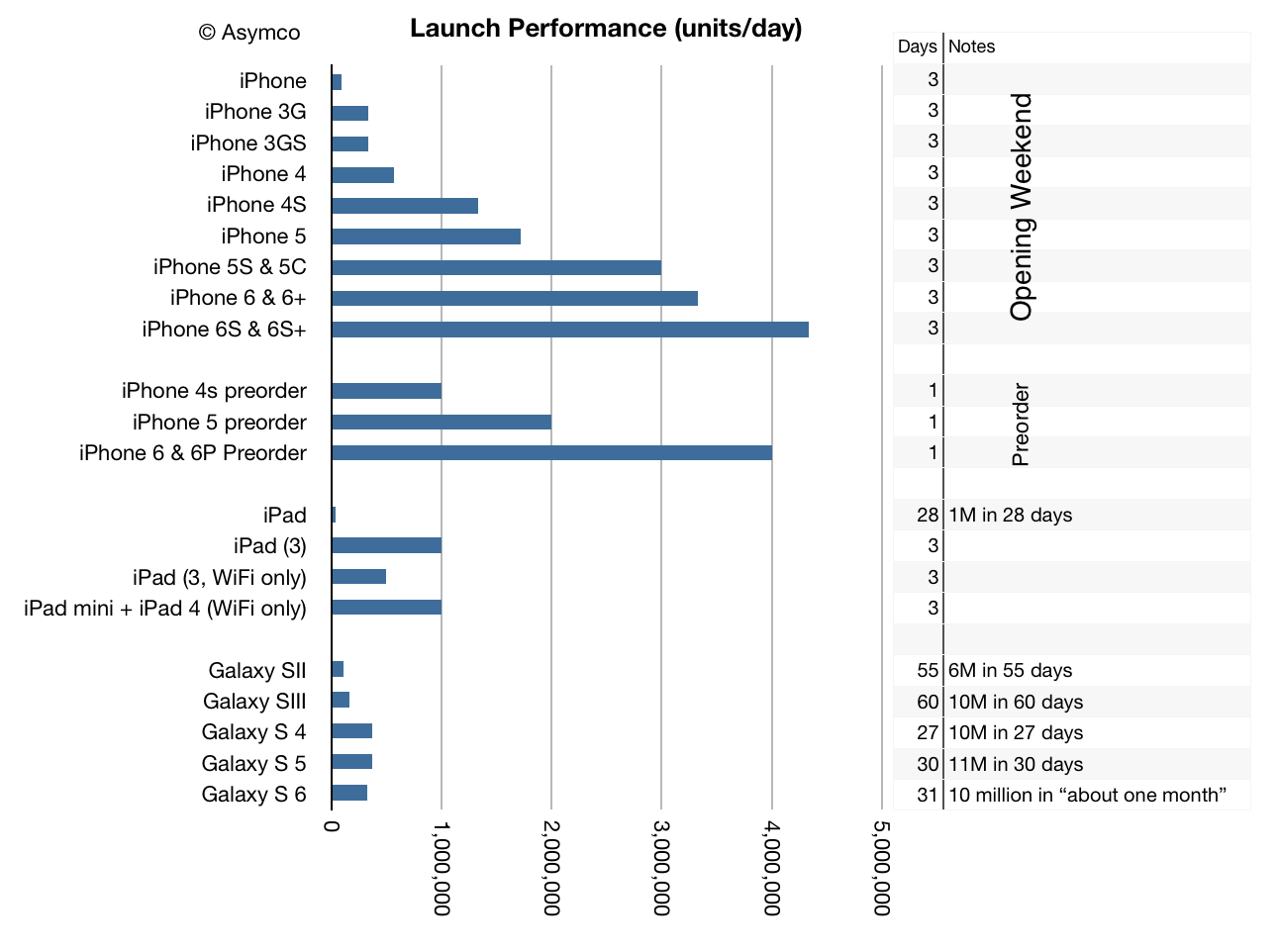
    This quandary came to mind when looking at the performance of the latest iPhone, the 6S. Observing it closely, we lose sight of it. We see only minute changes between versions; marginal changes which can't be weighed. And yet these changes have a more important attribute: they are absorbable. A change that is ignored is not only valueless, it may actually destroy perception of value. It creates clutter and confusion. A change that is absorbable is valuable. It is meaningful.

    Looking at new features like 3D Touch, Live Photos, and better cameras, one can observe how easily acceptable and desirable they are to those who first see them. As were Siri, FaceTime, Touch ID and iCloud, making something meaningfully better is a sign of sustaining innovation which does not over-serve.

    Paradoxically, the improvements are not usually things that users ask for. Surveys always show that consumers want "better battery life" or a "bigger screen" but delivering something else entirely which nevertheless leads to mass adoption shows an uncanny insight into what really matters. Indeed, those who deliver only what customers ask for end up marginalized and bereft of profit.

    To see improvements which lead to ever-increasing success in the marketplace year after year proves that this is not a transient event. This is no flash-in-the pan. This is not a stroke of genius. This is a process, a factory, a machine. The consistency and relentlessness of success is evidence of something at work that is more permanent.

    Screen Shot 2015-09-29 at 6.55.09 AM

    The definition of greatness for products then becomes easier to frame:

    Improvements which are not asked for but which change behavior suggest that the product is valued because it changes the buyer. I believe this is what causes us to pause and appreciate them. We feel we have been improved by the thing we bought though we did not ask to be made better by it. Collectively, multiplying by millions, the improvement we feel compels us to anoint the product as great.

    Apple is a company that builds greatness because they built a process to make their customers better. They do it without permission and they do it without offense. But when the buyer perceives the change they feel in debt to the object. Getting payments on that debt of gratitude is how Apple is rewarded.

  6. Meaningful Contribution

    Research · 37 comments

    What if Apple did make a car? How significant could their products be? What would it take to influence the industry's architecture?

    The global market is forecast to reach 88.6 million vehicles in 2015 and there are many ways to segment it. One could look at geography or at product configurations or the emergence of new powertrain technologies.

    One could also look at the participants.

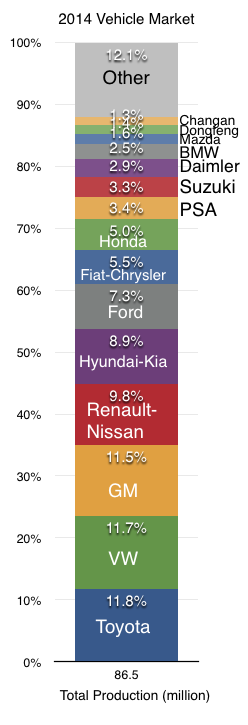
    In 2014 Toyota was the top selling automaker with a total sales volume of 10.23 million vehicles. The following graph shows the leading 15 producers and the percent of total production.

    Screen Shot 2015-09-25 at 9-25-2.19.47 PM


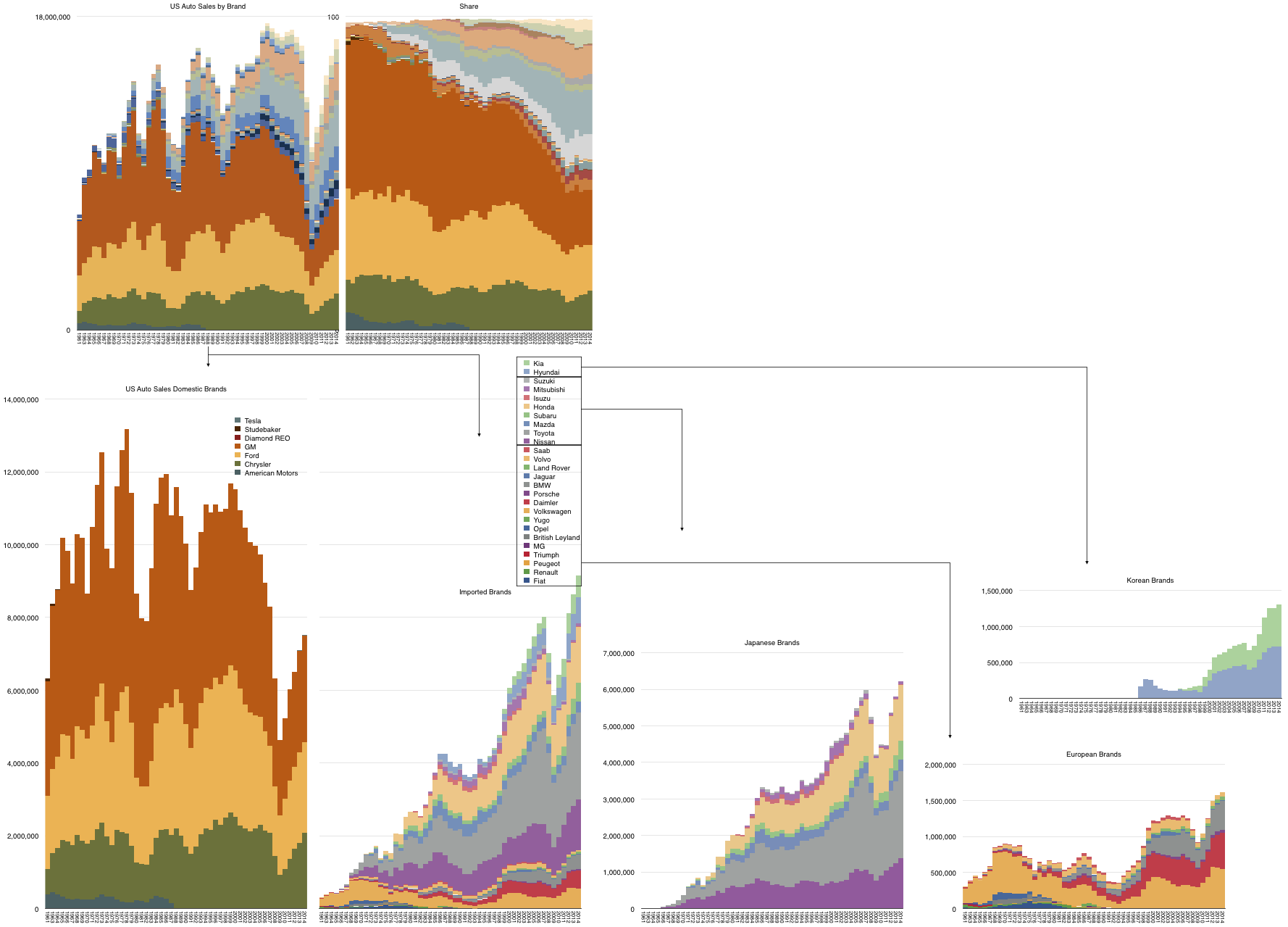
    One thing to note is the relative balance in market share. The top five vendors have volumes in a very similar range (9 to 12 million). Two vendors are at around 5%. Three are at 3%. To preserve this equilibrium the industry undergoes periodic merging and consolidation. Over the last half-century, there has been room for new entrants. Japanese brands entered between the 1960s and 1970s. Korean entries occurred in the 1990s and Chinese in the 2000s.

    Screen Shot 2015-09-25 at 9-25-3.50.46 PM


    Regardless of the entries, the industry has a high degree of centralization. Ownership is often more narrowly controlled through cross-ownership and licensing. French/Japanese, US/Italian/German, Indian/German/UK cross-over ownerships indicate a globalization of financing. Indeed, only a dozen countries account for over 80% of the production (less than 10% of nations produce significant numbers of vehicles).

    This structure is driven by the cost structure of volume production. The production system dictates financing and location and time constraints which underpin all deals. None of the entries (Japan, Korea, China) did much to redefine the core industry architecture (resources, processes or priorities).

    So how could Apple think different?

    First, the model of production could be substituted with a modular approach. This would separate the engine/body/paint/assembly plant into a deeper supplier network where components would be sourced and tooling dependence would be reduced.This speeds up ramps, reduces capital expenditure, increases flexibility, and accelerates the cadence of product evolution. Essentially, the focus would shift away from manufacturing toward design, iteration, customization and experience engineering.

    Second, Apple could change the distribution model. Controlling the relationship with the end user could allow a conversation which will reveal new jobs to be done.

    Third, Apple could affect the vehicle's lifespan and hence the financing/resale and inherent brand promise of car ownership.

    These are fairly obvious business innovations and they are easily foreseen.But are they enough? Would they even "move the needle"?

    To break into the top 10 brands would imply a production volume of at least 2.5 million units (about the same as Daimler ships today.) At 2.65 million and a price of $55k/vehicle Apple's revenues from cars would total about $145 billion. This is roughly the sales value of the iPhone business today. Not bad. Maybe that would satisfy a financial analyst. ((Yeah, right.))

    Even so, would a top 10 rank in shipments change the industry's structure?

    When I first saw the iPhone I knew that nothing would be the same after it and that Apple was poised to dominate the phone business. For the Apple car to do a similar trick in transportation the product itself has to change the perception of what a car is. Today a phone is barely something one speaks into.

    Approaching the operations side of the business with a clean sheet of paper allows a fresh and rational attack on the problem. But to really make a dent in the universe Apple also needs to change the product in ways that re-define what it's good for. And this is supposedly why Apple gets into markets. To make a meaningful contribution.