Asymco

Asymmetric Intelligence

asymco-admin

  1. Selling Watch Sales Data

    Research · 22 comments

    There is no reliable information on Apple Watch sales. None of the analysts which follow Apple or the phone, computer or watch markets have any insight into this. The only source of information is Apple itself and they have made it clear that they don’t intend to provide watch sales data for competitive reasons. I did not and do not expect any information from Apple on watch sales. They have placed the product within the “Other” category specifically to make unit data hard to discern and have explained why they do so.

    The only estimate we have heard of is from a company that has no track record in market research and relies entirely on sampling of email receipts. I urge extreme caution when dealing with this type of data. We don’t know how representative these receipts are and how they are sourced or sampled. The methodology is not only unclear but it’s one not practiced by any other analyst. You would think that receipt sampling would be a phenomenal source of information about a lot of other products and yet we hear nothing about how predictive it is for anything except this particular new product as claimed by a company which never made any such prior claims.

    It’s also a sampling of (presumably) US-only customers at a time when the product is undergoing a gradual roll-out through multiple countries and multiple channels. Consider that if sales were constrained internationally then buyers would be trying to arbitrage through the US market, meaning there would be many e.g. Chinese buyers/brokers booking sales through US online stores inflating that channel’s initial volumes. Furthermore as physical retail stores begin to receive stock, online sales (which are what is sampled) should decline as buyers opt for the instant gratification (and the option to see the product in real life.) To see US-only online purchases drop after a period of pent-up demand and as store inventory becomes available is not interesting and says almost nothing about the product’s performance.

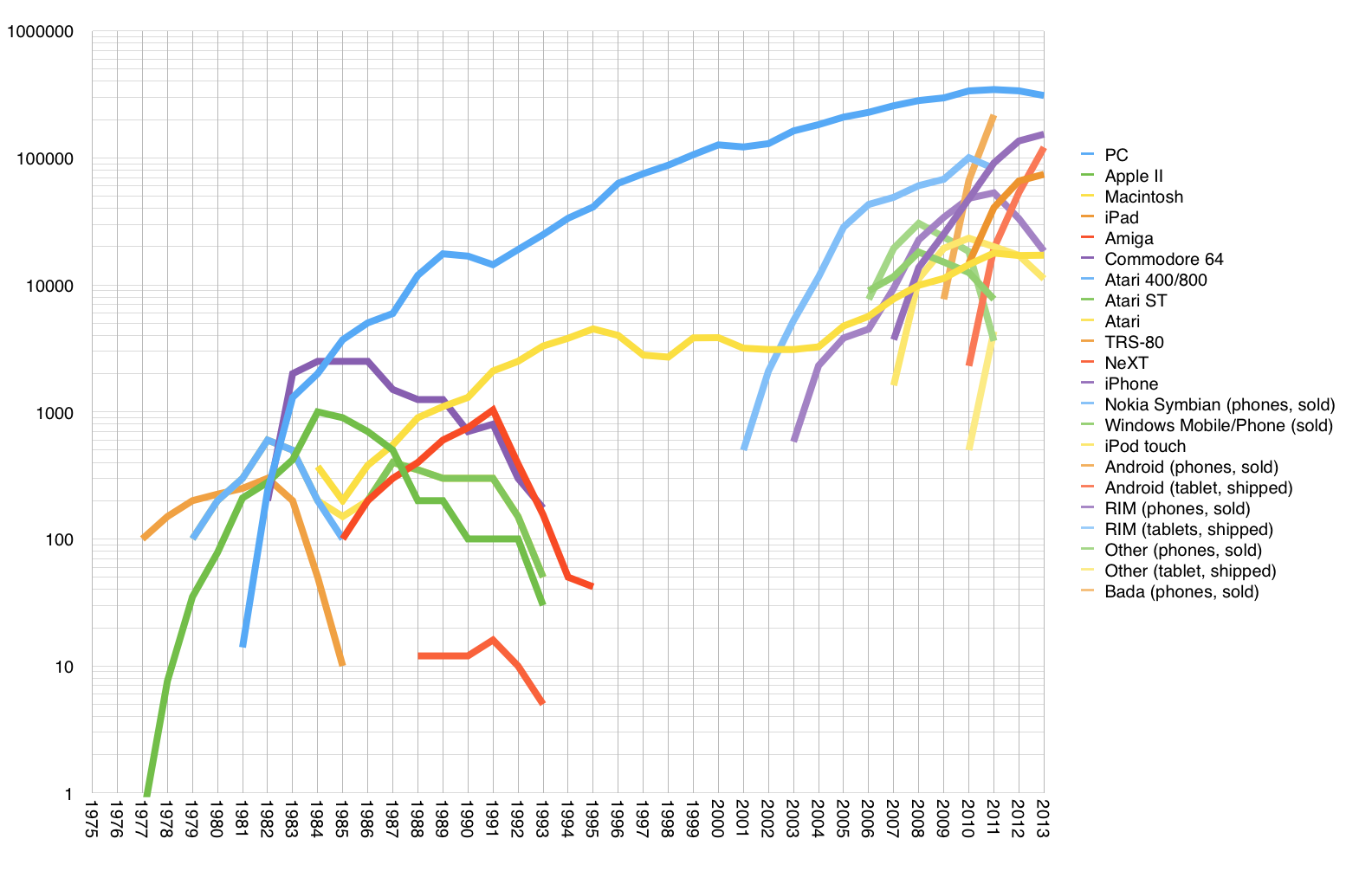
    The only way to be thoughtful about this new category is to understand the broad transitions underway in mobile computing. We are witnessing a pivot in human-computer interaction as significant as the initial iPhone launch.

    [As a rule, be very careful with the premise of data salesmanship. All data is false, some is useful. Data you have to pay for is less useful than data that has been peer reviewed.]
  2. Breaking the Law

    Research · 22 comments

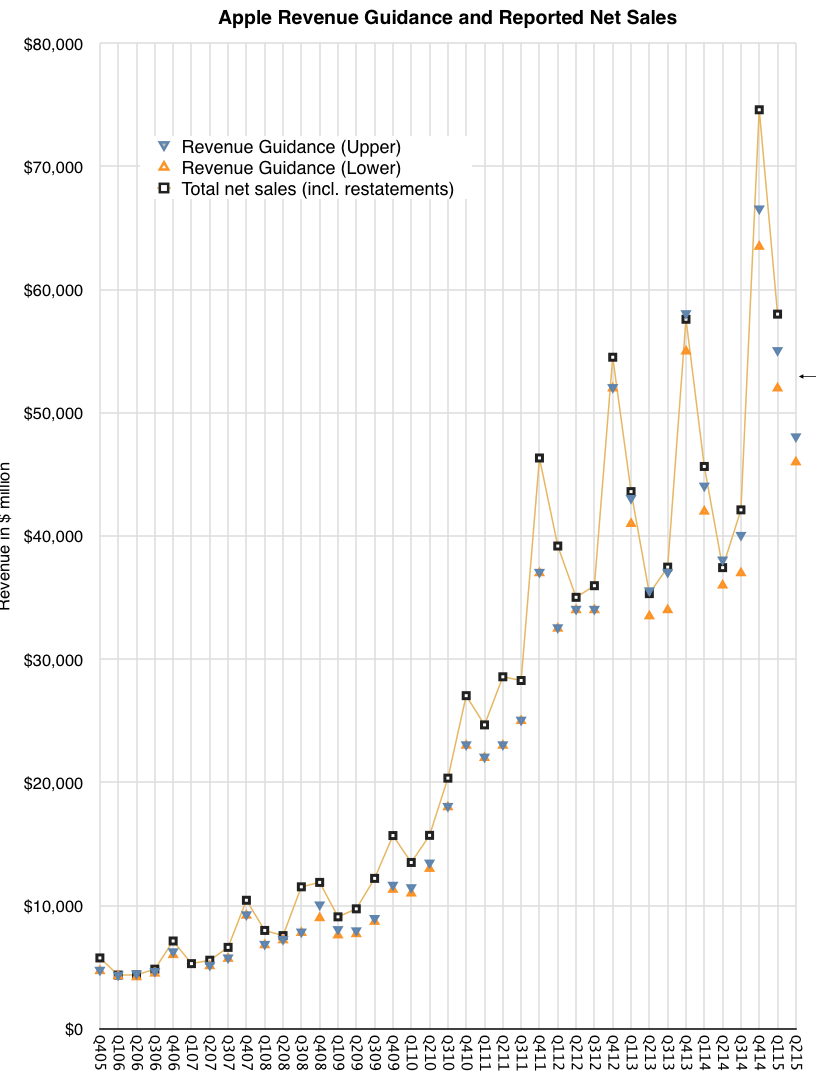
    For the first time in many years I feel that there is some potential uncertainty in the results Apple will announce. After a period of excellent accuracy (shown in graph below), the company's guidance has begun to diverge dramatically from reality and the trend might continue this quarter. The cause might be unanticipated demand for the iPhone 6/6 Plus. The growth rate for the product was 46% in Q4 and 40% in Q1. This is unanticipated because growth rates have been below 20% for five quarters and below 50% for eight.

    Screen Shot 2015-07-13 at 12.21.00 PM

    This slowing of growth was explainable given the rate of diffusion of smartphones in the global population. Within the US and some other early adopting economies the market is reaching late stages where most people have switched to smartphones. Globally we are at a more modest 30% or so but in many of the late adopting economies Apple does not have wide distribution.

    Of course this thesis is thinly supported. There are many reasons to think that late adopters would still start with iPhone and that earlier adopters of Android would upgrade to iPhone after a few purchase cycles. Thus, the iPhone could prosper in later-adoption or even in post-saturation states of the market.

    Indeed, in the post-saturation PC market, Apple is doing very well with the Mac and in the late to post-saturation MP3 player market the iPod did extremely well. This suggests that when it comes to value capture brand, experience and satisfaction trump function, price and share considerations in almost all consumer markets ((Enabled by design for jobs to be done. See non-technology markets for abundant evidence of this. ))

    With so many assumptions put asunder the iPhone business suddenly looks downright lively. I adjusted my own growth assumptions and the resulting figures are shown below.


    F3Q15Daniel TelloHorace Dediu
    iPhoneUnits51.052.8
    Price626645
    Revenues3192534059
    iPadUnits10.010.6
    Price428430
    Revenues42804567
    MacUnits4.954.94
    Price12401240
    Revenues61366129
    ServicesRevenues50065196
    OtherRevenues39023092
    TotalRevenues5124953043
    COGS3057731766
    GM40.3%40.1%
    OpEx57335789
    OpInc1493915488
    OI&E357350
    Pre-tax1529615838
    Tax40234165
    NetInc1127311673
    Shares57795780
    EPS1.952.02


    I include for comparison Daniel Tello's forecast as his work carries quite a bit of thoughtful analysis.

    The upshot of this is that the company is poised to grow earnings per share at a rate of at least 50%!

    That growth rate is astronomical, especially for what is already, by far, the world's biggest company by market capitalization.

    This was not supposed to happen because of a so-called "law of large numbers." The "law" is actually a probability theorem which states that the average of experimental results should be close to the expected value given sufficiently large number of experiments. The way it's applied in market analysis (I assume) is that "no company can perform above market average performance for a sufficiently long time".

    It implies that there can be no outliers and that all companies "revert to the mean because ..."

    Actually, I don't have any idea why they might. The premise that all companies are the same must play into this but companies can only be alike if they have the same processes, priorities and resources. As long as I've been able to observe and as much as I've ever read on the subject I have never encountered any two which had anything in common.

    And so the law of large numbers, as applied to market performance is a myth. It is easily disproved with a simple deconstruction into the causes of firm performance, but the empirical data from Apple alone shows how foolish it is to believe it.

  3. The Asymco Trilogy with Horace Dediu Part 2 - Apple in Asia & Luxury - Analyse Asia with Bernard Leong

    Research · 1 comment

    Horace Dediu, current fellow of the Clayton Christensen Institute and founder of Asymco.com joined us for an epic and insightful discussion focusing on few key interesting topics: (a) new market disruption theories, (b) Apple in China and the luxury market and (c) the Japanese automotive industry and how it shapes up against disruption from Tesla, Uber and Apple. In the second part of the trilogy, Horace discussed how Apple has managed to navigate the Asian markets with a combination of building the best product and building strategic partnerships with patience and grow the market with the right timing of the correct localised product, for example, the iPhone 6 Plus. Horace also pushed against the notion that Apple is really entering the luxury market, by applying “Jobs to be Done” perspective (used by Bob Moesta in his interviews) to the issue.

    Source: Episode 32: The Asymco Trilogy with Horace Dediu Part 2 - Apple in Asia & Luxury - Analyse Asia with Bernard Leong

  4. Biggest news of 2014

    Research · 70 comments

    As corporate romances go, IBM and Apple's must rank among the most unexpected. As I wrote on the date they changed their Facebook status, the two companies were antagonists for the better part of twenty years and their rapprochement was met with a shrug mostly because yet more decades passed since.

    Screen Shot 2014-12-26 at 11.28.03 AM

    Nostalgia aside, this new union is profoundly important. It indicates and evidences change on a vast scale. The companies' antagonism was due to being once aimed at the same business: computing. Since the early 1980s, "computing" came to be modularized into hundreds, perhaps thousands of business models. It is no longer as simple as selling beige boxes. IBM was forced out of building computers and into services and consulting while Apple moved to make devices and the software and services which make its hardware valuable.

    The convergence of interests which was consummated into a deal this year stems from the migration of computing around what has come to be called "mobile". Apple intends to accelerate the adoption of its mobile platforms among the remaining non-adopters: enterprises–a group which, by now, qualifies as laggards. ((There was a time–when Apple was young–when enterprises were the innovators, early adopters. That role ended approximately in the year 2000)) Simultaneously IBM intends to connect data warehouses at those same enterprises to their employed users.

    Both can achieve their goals better if they join forces: Apple offers assistance and expertise while obtaining access and lubrication for orifice entry. IBM offers modularized access to databases through its own APIs and obtains credible client experiences. The combination increases adoption of mobile (i.e. intuitive) solutions and an increase in productivity, benefiting the buyer.

    The recent apps release showed just how transformative this relationship could be. We were witnesses to apps which appeared to be designed for users[!] They were not designed for committees that prepare checklists of requirements.

    We must applaud IBM for having the courage to resist the featuritis which plagues enterprise software design. This resistance requires saying No to those who specify and are thus authorized to purchase software and hardware. IBM has had to essentially say no to those who buy and yes to those who are paid to use. The quality of the experience is evident at first sight. The number of user actions, the number of screens to wade through have been ruthlessly culled. These are concepts and ideas which now permeate app design best practices. Yet they are practices which still elude the spec-driven enterprise software wastelands.

    Simultaneously we must applaud Apple for accepting that there are throngs of unwashed masses laboring in cubicles which deserve to be served. They may be employed by laggards but they are people too. Apple management has made clear that they are being more inclusive and open minded. Extending that open hand to the downtrodden salaried masses must surely bring a tear to one's eye.

    Being unexpected and yet explanatory of the state of technology today, the partnership between IBM and Apple is, in my opinion, the most significant technology news of 2014.

    As a romance, it is at least as newsworthy as the divorce of Wintel was in 2012.

  5. The Critical Path #134: Chief Jobs Officer

    Podcast · 16 comments

    Turning our focus back to "Jobs to be Done" theory, we look at how producers can exceed the expectations of consumers and the role of the focus group from a "Jobs to be Done" perspective.

    We examine "Jobs to be Done" as an essential core of the product development process. Where does this kind of thinking belong in an organization?

    Should we be redefining what being "the best" means? We close with a segmentation of social media services based on the seven deadly sins.

    via 5by5 | The Critical Path #134: Chief Jobs Officer.

    This is a good one.

  6. Airshow 12 coming to Boston December 18th

    Conference

    Airshow, now in it's twelfth iteration, is coming back to Boston on the 18th.

    This time we have Fidelity Investments as a sponsor and their inspiring venue at ThinkSpace, 245 Summer Street, as our setting.

    If you are interested in how data and mobility will revolutionize the art of persuasion, please register for what will be the best Airshow ever.

    Seating is limited.

  7. What next, Samsung?

    Research · 200 comments

    I received a few questions from Shirley Siluk of NewsFactor as a follow-up to my post on the trajectory of successful companies.

    1. Do you foresee any hope for a turnaround for Samsung? If so, where do its best opportunities lie?

    Screen Shot 2014-10-13 at 1.44.54 PM

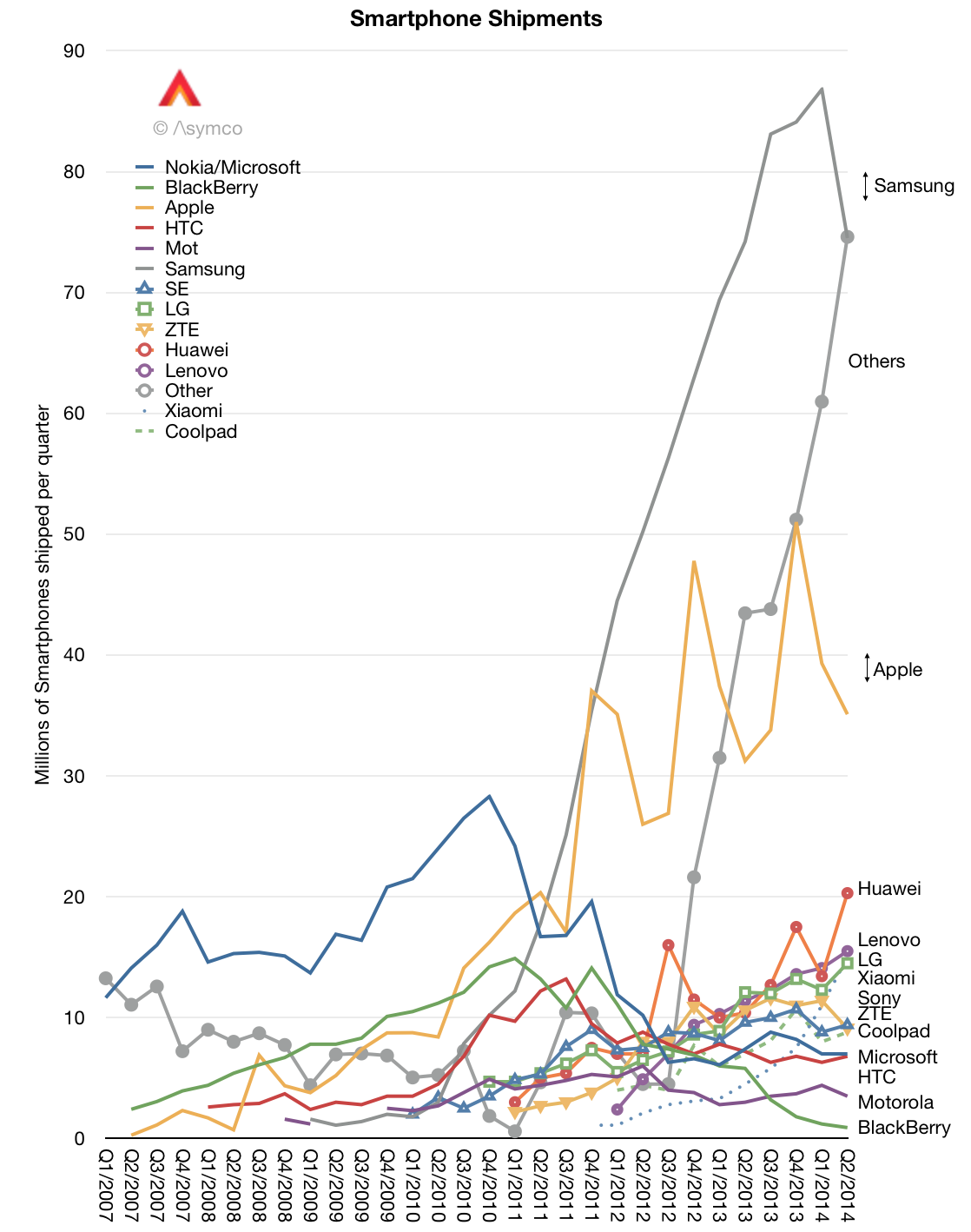
    The smartphone business was a huge opportunity for Samsung and they took full advantage of it. Unfortunately, it’s a difficult business to stay on top of. The list of victims in that industry is quite long and there have been no long-term winners. Samsung’s operating model seems to be to invest as a ‘fast follower’ filling in the market after it’s established while leveraging capital intensive components synergies. That has also worked for them in consumer electronics (at the expense of Sony and other Japanese vendors). If the modus operandi does not change then their turnaround will depend on the creation of new opportunities/categories. Wearables may be such an opportunity but it may not be as big as the phone business. ((The graph shows estimates of smartphone shipments for a select number of vendors.))

    2. What has contributed most to Samsung's decline? Which competitors are posing the greatest threat?

    The fast follower strategy belies its own limitations: it implies a transience or impermanence in strategy. In a fast follower strategy it’s only a matter of time before late followers eat into the business, similar to the way that the fast follower ate into the innovator. Chinese vendors are poised to take more share. The way I said it in 2011 was that I saw in Huawei ((I did not anticipate the Xiaomi and Lenovo entrants which are also doing very well.)) what Samsung was five years earlier. It’s easier for the low-end providers to move up-market and not at all easy (in terms of loss of margin) for the higher end to move down.

    3. You mentioned the pattern of commoditization in all of Samsung's markets -- what would be the best way around this?

    Commoditization is largely unavoidable. The way to survive as a business is to ensure you create new businesses or solve new problems. One hope that springs eternal is that through a “brand” a maker can ensure long-term margin survival. That did not help Nokia, Sony, or Microsoft. Brand is only valuable if it carries meaning and often that meaning becomes a fading product. So the short answer is that Samsung needs to create new categories or businesses. The challenge for them is that they need to control the platform and service infrastructure. These are currently out of their control and I’m not quite sure how they can regain that control.

    I was wondering if you had any followup comments you could offer about Samsung in light of the announcement today that it's developed a faster 60 GHz wifi technology -- do you think this kind of technology, if it's everything Samsung says it is, could provide the kind of corporate turnaround momentum Samsung needs?

    Certainly not. This is a sustaining improvement in a technology. What Samsung needs is a disruptive improvement. A disruptive improvement implies a new business model. Put another way, it means that Samsung needs to invent a new way of making money.

    --

    Postscript: One problem with this prescription is that it's considered impossible to execute and those who try to operate as repeatable innovation companies are punished with deep discounts and condemned as being "hits driven" rather than annuities. Woe befalls the manager who seeks this route.